2.1 — Module 2
TransitionSay this
Transition: "Module 2."
My notes
Presenter study handout
3 contact hours · 0.3 AOTA CEUs · Module 2 · 21 slides
Presenter-side material. Each block shows the slide as the audience sees it, the talk track, and space for your own notes. Model answers appear here — do not hand this version to learners.
Say this
Transition: "Module 2."
My notes
Say this
Open here. "The Visual Pathways." Ventral "what" vs. dorsal "where," and their classroom signatures.
Say why this section matters for their caseload, then advance.
My notes
Say this
Ask the poll: "Which visual performance patterns show up most in your current caseload?"
Options:
• Slow recognition of letters, words, or symbols
My notes
Say this
Talk over the visual: "Two streams, one retina."
Say the caption in your own words: Retina → optic nerve → chiasm → LGN → V1, then divergence: dorsal superiorly to parietal cortex, ventral inferiorly to temporal cortex (Visual Minds Learning clinical education).
My notes
Say this
Talk over the visual: "Parvocellular and magnocellular tracts."
Say the caption in your own words: Parvocellular cells carry fine detail and color into the ventral stream; magnocellular cells carry motion and low-contrast information into the dorsal stream.
My notes
Say this
Talk over the visual: "Vision's Two Highways."
Say the caption in your own words: The magnocellular highway (motion, contrast, spatial awareness, action) and the parvocellular highway (detail, color, form, recognition) merge at the LGN before diverging into the dorsal and ventral streams.
My notes
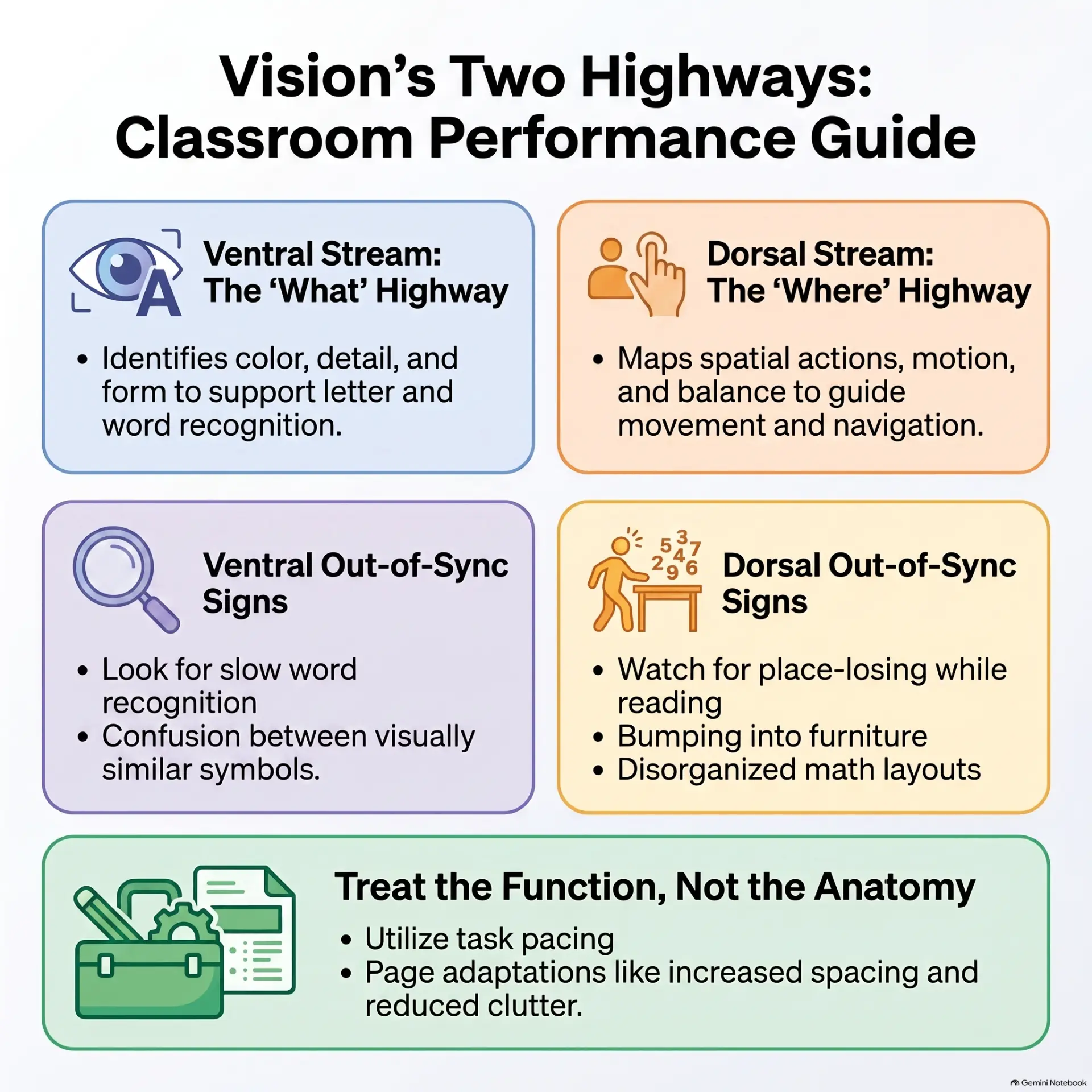
Say this
Talk over the visual: "Vision's two highways in the school day."
Say the caption in your own words: Ventral "what" signs versus dorsal "where" signs, side by side with the classroom behaviors each one produces.
My notes
Say this
Contrast the two columns: Ventral stream — "What?" versus Dorsal stream — "Where?".
Ventral stream — "What?":
• Parvocellular tract
My notes
Say this
Frame the slide: "What a ventral-stream (parvocellular) signature looks like in class."
Walk each point, one sentence each:
• Slow, effortful recognition of letters, sight words, or numerals
My notes
Say this
Frame the slide: "What a dorsal-stream (magnocellular) signature looks like in class."
Walk each point, one sentence each:
• Bumping into furniture, misjudging distances, poor spatial awareness in the room
My notes
Say this
Frame the slide: "We do not treat tracts — we treat the functional components."
Walk each point, one sentence each:
• The magnocellular and parvocellular tracts describe transmission: how visual information travels from retina to cortex. That is anatomy and physiology, and it is outside what OT assesses or changes.
My notes
Say this
Run the five levels bottom-up.
Spend your time on Level 3 — that is the point of this slide.
My notes
Say this
Set up the clip in one sentence, play it, then debrief with "what did you notice?"
My notes
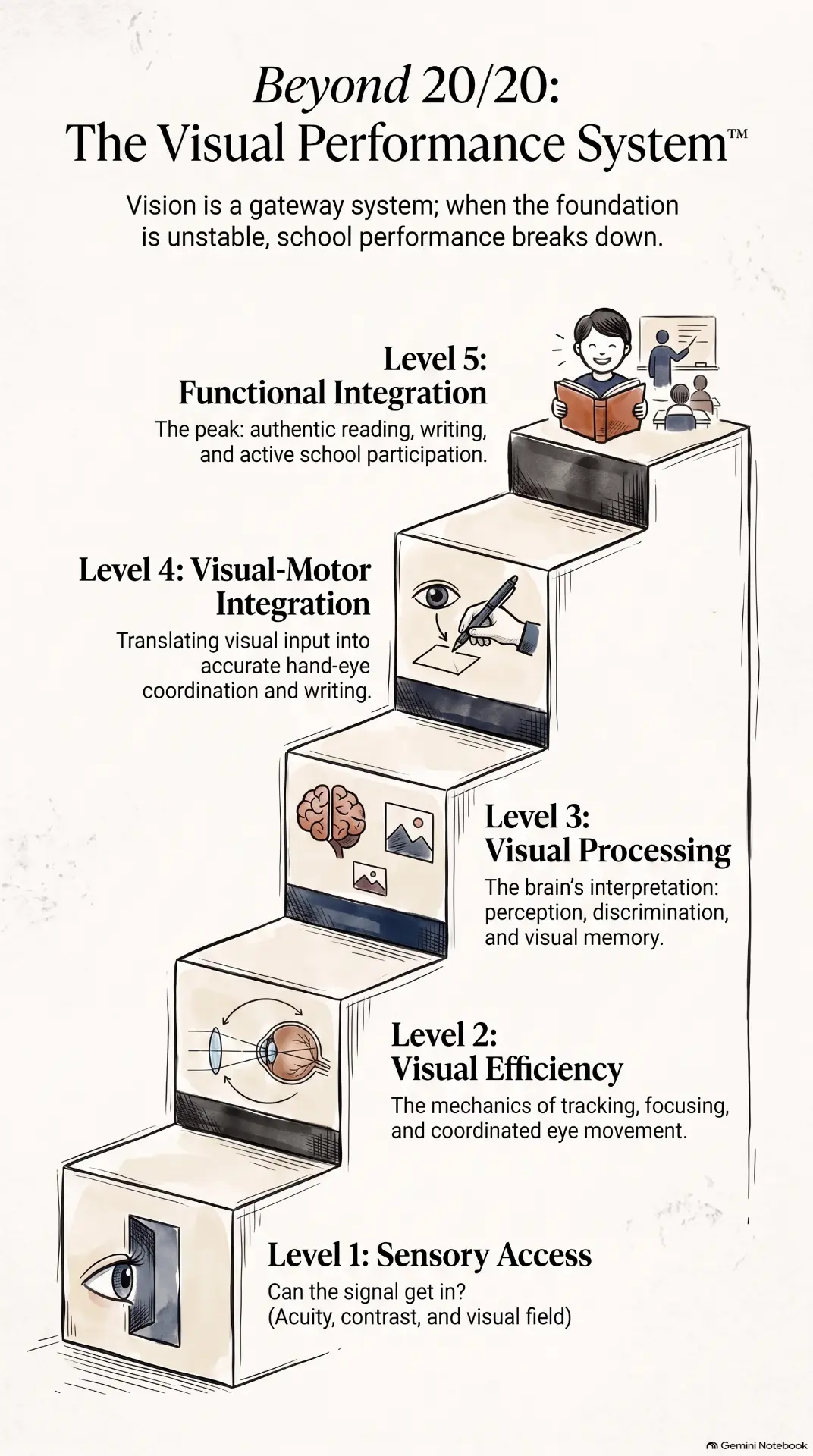
Say this
Talk over the visual: "Beyond 20/20 — the Visual Performance System™."
Say the caption in your own words: Level 1 Visual Access → Level 2 Visual Efficiency → Level 3 Visual Processing → Level 4 Visual-Motor Integration → Level 5 Functional Integration.
My notes
Say this
Read the scenario aloud, slowly:
A 3rd-grade student reads individual words accurately in isolation but cannot find her place after looking up from the page, and she frequently loses items placed directly in front of her on a busy desk.
Then put these questions to the room:
My notes
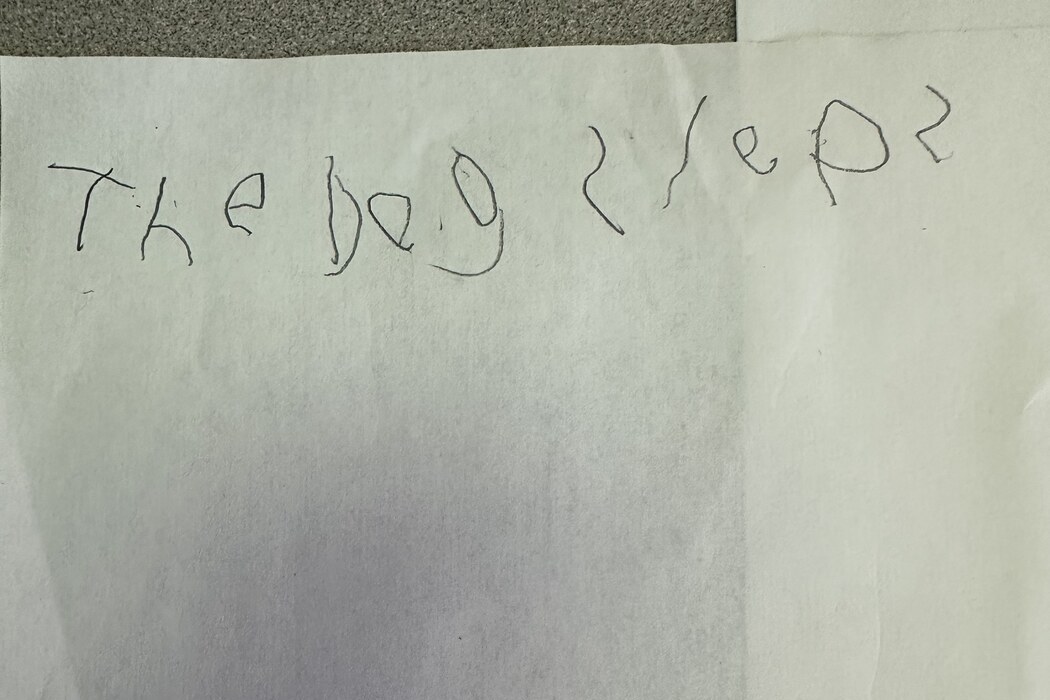
The student has to generate placement, size, and direction with no external structure.
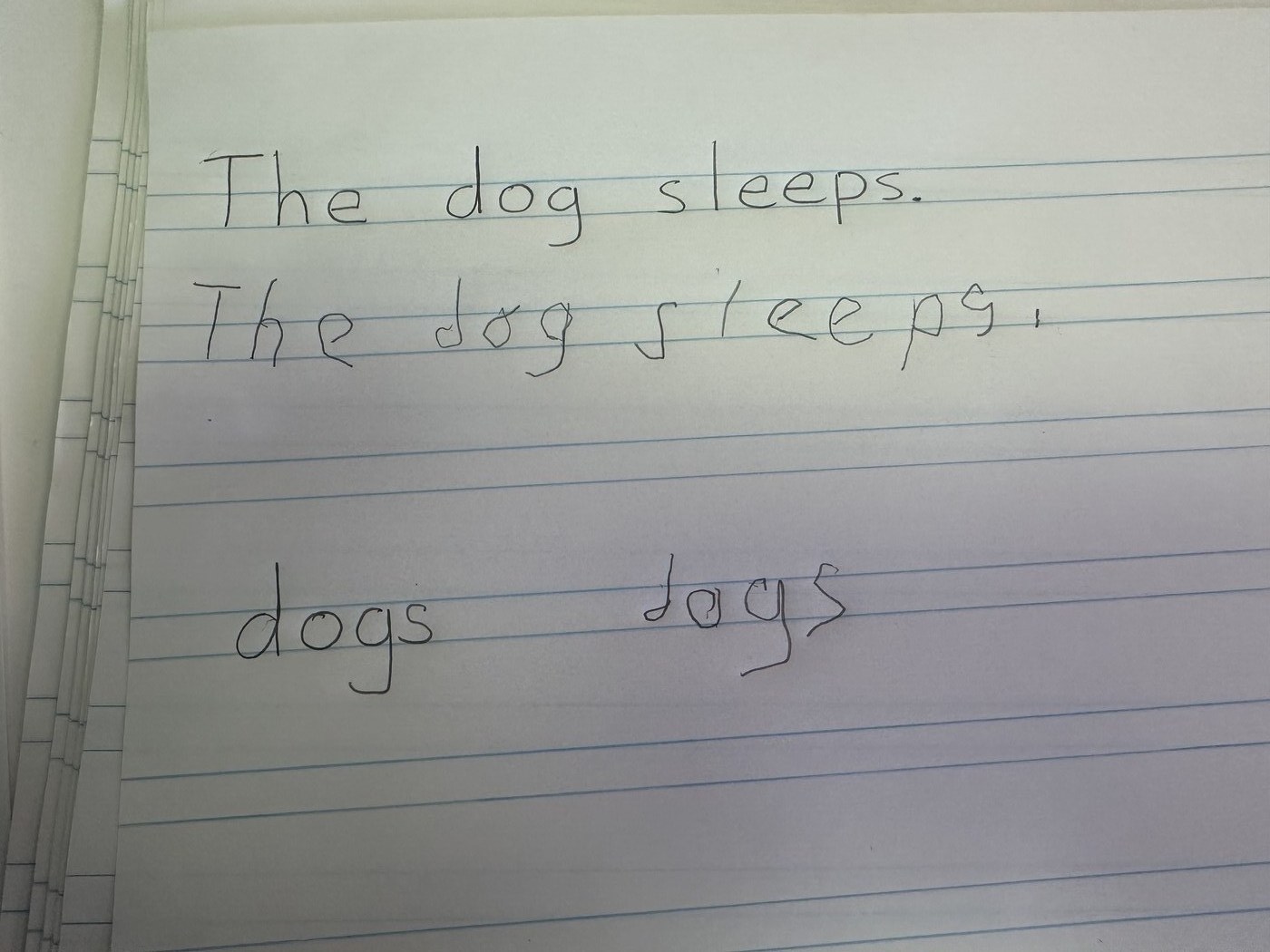
Same sentence, same student, with baseline and line-to-line reference restored.
When performance changes because the environment supplied the spatial reference, you are looking at a spatial ("where") demand, not a word-knowledge ("what") problem.
Say this
Set up the contrast: "What a spatial ("where") breakdown looks like on the page."
Point at the before panel first. The student has to generate placement, size, and direction with no external structure.
Then the after panel. Same sentence, same student, with baseline and line-to-line reference restored.
My notes
Say this
Land the "so what": You will almost never be handed a vision complaint. You will be handed avoidance, sloppiness, slowness, or "not trying."
Explain the mechanism plainly: Children rarely report a visual world they have always had. They report what it costs them, in behavior.
Then give them the moves — say each one as something they can do Monday:
My notes

Feet unsupported, trunk collapsed, page about 15 cm from the eyes.

Feet supported, hips back, page raised toward a slant, working distance near Harmon distance.
Fix posture and distance before you score anything. Otherwise you are documenting the setup, not the student.
Say this
Set up the contrast: "Postural setup changes what you are measuring."
Point at the before panel first. Feet unsupported, trunk collapsed, page about 15 cm from the eyes.
Then the after panel. Feet supported, hips back, page raised toward a slant, working distance near Harmon distance.
My notes
Say this
Two-minute case. Read it aloud:
A Grade 3 student completes math facts on a whiteboard quickly, but produces almost nothing on the same problems given as a dense worksheet.
Put the question to them: "What does that difference tell you, and what do you trial first?" Give 60 seconds, no talking.
My notes
Say this
Reflection prompt: "Choose one student. Describe one behavior that looks like a "what" problem and one that looks like a "where" problem."
Cues:
• Use only the language of classroom performance, not stream labels.
My notes
Say this
Knowledge check: "A student reads words accurately but cannot copy from a spatial diagram. Which description fits best?"
Options:
• Ventral stream problem — difficulty identifying details
My notes