Back to CEU courses

Presenter study handout

The VPA™: Assessment & Clinical Reasoning

4 contact hours · 0.4 AOTA CEUs · Module 4 · 16 slides

Presenter-side material. Each block shows the slide as the audience sees it, the talk track, and space for your own notes. Model answers appear here — do not hand this version to learners.

Module 4

4.1 — Administering the Mini VPA™: the seven probes, scripts, prompting limits, and observation cues

Transition

Module 4

Administering the Mini VPA™: the seven probes, scripts, prompting limits, and observation cues

1:20 – 1:55

The VPA™: Assessment & Clinical Reasoning
1 / 16
  • 1:20 – 1:55

Say this

Transition: "Administering the Mini VPA™: the seven probes, scripts, prompting limits, and observation cues."

My notes
4.2 — Administering the Mini VPA™

Title

Module 4

Administering the Mini VPA™

Five probes, verbatim scripts, prompting limits, and observation cues.

The VPA™: Assessment & Clinical Reasoning
2 / 16
  • Five probes, verbatim scripts, prompting limits, and observation cues.

Say this

Open here. "Administering the Mini VPA™." Five probes, verbatim scripts, prompting limits, and observation cues.

Say why this section matters for their caseload, then advance.

My notes

4.3 — Prompting habits

Poll

Poll

Prompting habits

Which prompting error are you most at risk of during administration?

The VPA™: Assessment & Clinical Reasoning
3 / 16
  • Which prompting error are you most at risk of during administration?
  • – Repeating the item after a delay
  • – Adding encouragement that cues the answer
  • – Allowing extra time past the limit
  • – Rephrasing the script

Say this

Ask the poll: "Which prompting error are you most at risk of during administration?"

Options:

• Repeating the item after a delay

My notes

4.4 — Script discipline

Teaching slide

Fidelity

Script discipline

  • Read the Say line verbatim; the Do line defines your hands and the timing.
  • One repetition of instructions is permitted; further prompting is recorded, not free.
  • Score performance, not effort — note effort separately as an observation.
  • Record the observation cues (place loss, head movement, working distance drift).
  1. 1Set conditions: lighting, distance, seating, materials
  2. 2Screen Level 0 red flags — stop and refer if present
  3. 3Establish basal at the age-entry item
  4. 4Administer to ceiling, scoring against the criterion
  5. 5Log validity observations as they happen
  6. 6Compute level profile and composite
  7. 7Name the limiter and the disposition
The fidelity sequence. Steps are not optional or reorderable — deviations are documented, not absorbed silently into the score.
The VPA™: Assessment & Clinical Reasoning
4 / 16
  • Read the Say line verbatim; the Do line defines your hands and the timing.
  • One repetition of instructions is permitted; further prompting is recorded, not free.
  • Score performance, not effort — note effort separately as an observation.
  • Record the observation cues (place loss, head movement, working distance drift).

Say this

Frame the slide: "Script discipline."

Walk each point, one sentence each:

• Read the Say line verbatim; the Do line defines your hands and the timing.

My notes

4.5 — What triggers a Full VPA™

Teaching slide

Flag logic

What triggers a Full VPA™

  • Any probe failed at or below the expected level for the band.
  • Any probe passed only with degraded rate, endurance, or strategy.
  • Teacher/caregiver report that conflicts with a passed probe.
  • Any red-flag ocular symptom — refer regardless of the screen result.
5

Efficient & durable

Performs accurately, at pace, and sustains across the school day.

4

Functional

Accurate under typical demand; fatigues only at the end of long tasks.

3

Inconsistent

Accuracy varies with load, time pressure, or visual clutter.

2

Emerging with support

Succeeds only with cueing, magnification, spacing, or reduced load.

1

Not observed

Skill not yet available under any tested condition.

The same ladder is used for every skill, so goals move a named skill up a named level. Write the level in present levels and the target level in the goal.
The VPA™: Assessment & Clinical Reasoning
5 / 16
  • Any probe failed at or below the expected level for the band.
  • Any probe passed only with degraded rate, endurance, or strategy.
  • Teacher/caregiver report that conflicts with a passed probe.
  • Any red-flag ocular symptom — refer regardless of the screen result.

Say this

Frame the slide: "What triggers a Full VPA™."

Walk each point, one sentence each:

• Any probe failed at or below the expected level for the band.

My notes

4.6 — Pursuit and saccade observation cues

Comparison

Observation

Pursuit and saccade observation cues

Pursuit: look for

  • Symmetry between the two eyes as they track
  • Head movement substituting for eye movement
  • Target drift — eyes falling behind or leading the target
  • Change in focal distance or working distance during the task

Saccade: look for

  • Accuracy of landing on the target placement
  • Undershoot or overshoot of the intended fixation point
  • Fatigue — accuracy degrading over repeated trials
  • Loss of fixation between jumps
Probe · Saccades (near, 40 cm)

Say

“Look at the star, then the circle, and keep going back and forth until I say stop. Move only your eyes.”

Do

Hold targets 20 cm apart at 40 cm, eye level. Time 30 s. Watch for head movement, undershoot, loss of place, and reported blur.

Score the level reached

L1Cannot localize both targets
L2Localizes with head movement / frequent loss
L3Accurate but effortful; slows within 30 s
L4Accurate and steady for the full trial
L5Accurate and steady while reading aloud (dual task)
Every probe is scripted: what you say, what you do, and the exact behavior that separates one level from the next. Scripting is what makes a re-probe eight weeks later comparable.
The VPA™: Assessment & Clinical Reasoning
6 / 16
  • Pursuit: look for: Symmetry between the two eyes as they track · Head movement substituting for eye movement · Target drift — eyes falling behind or leading the target · Change in focal distance or working distance during the task
  • Saccade: look for: Accuracy of landing on the target placement · Undershoot or overshoot of the intended fixation point · Fatigue — accuracy degrading over repeated trials · Loss of fixation between jumps

Say this

Contrast the two columns: Pursuit: look for versus Saccade: look for.

Pursuit: look for:

• Symmetry between the two eyes as they track

My notes

4.7 — Near point of convergence — the penlight probe

Teaching slide

Probe 2 · Efficiency

Near point of convergence — the penlight probe

  • This belongs to the Level 2 efficiency probe. You run it here in the Mini, and again inside Domain 2 of the Full.
  • Start the penlight or accommodative target at about 18 in, midline, at eye level.
  • Move it slowly toward the bridge of the nose while the student holds fixation.
  • Record the break — the distance at which the student reports doubling or you see an eye drift out.
  • Move back out and record the recovery distance. Run three trials: a break that recedes across trials is the finding.
  • Stop for any report of pain; record head movement, squinting, or an outward eye turn.
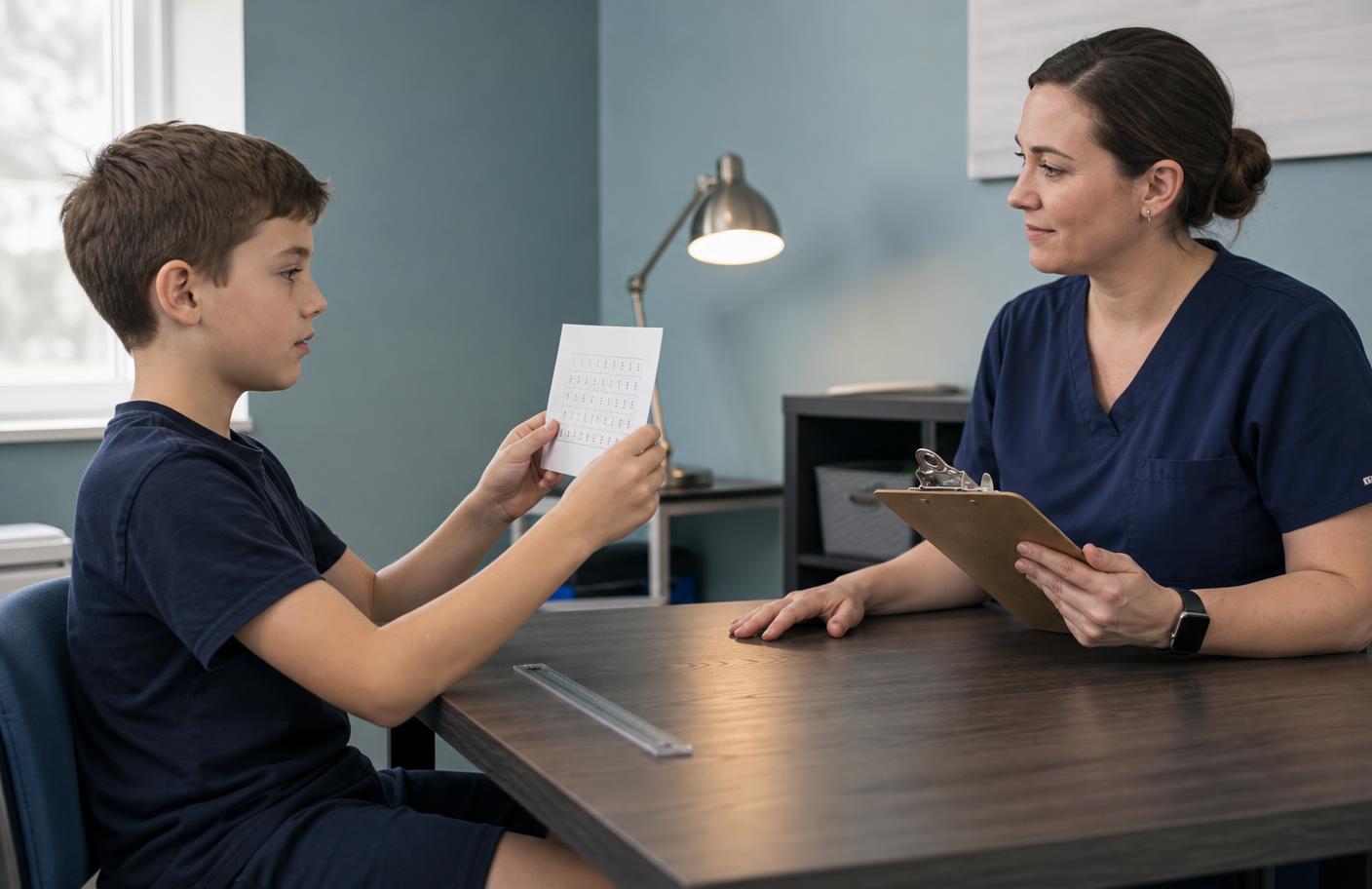
Child holding a near-point card at midline while an occupational therapist observes and records, with a ruler on the desk to verify the working distance

Near probes · 40 cm

Card at midline and at eye level; measure from the spectacle plane, not the forehead.

Table/screen · 60 cm

Use the same distance at screening and re-probe — a distance change invalidates the comparison.

Base of support

Feet supported and hips at 90° before any oculomotor scoring; postural drift reads as an efficiency deficit.

Measure, don’t estimate. Near probes are administered at 40 cm and intermediate/table probes at 60 cm, with the page at midline, feet supported, and light from behind the shoulder rather than facing the student.
The VPA™: Assessment & Clinical Reasoning
7 / 16
  • This belongs to the Level 2 efficiency probe. You run it here in the Mini, and again inside Domain 2 of the Full.
  • Start the penlight or accommodative target at about 18 in, midline, at eye level.
  • Move it slowly toward the bridge of the nose while the student holds fixation.
  • Record the break — the distance at which the student reports doubling or you see an eye drift out.
  • Move back out and record the recovery distance. Run three trials: a break that recedes across trials is the finding.
  • Stop for any report of pain; record head movement, squinting, or an outward eye turn.

Say this

Frame the slide: "Near point of convergence — the penlight probe."

Walk each point, one sentence each:

• This belongs to the Level 2 efficiency probe. You run it here in the Mini, and again inside Domain 2 of the Full.

My notes

4.8 — One probe per level

Comparison

The seven probes

One probe per level

Levels 1–3

  • L1 — acuity at the measured distance, correction worn
  • L2 — oculomotor efficiency and near endurance
  • L3 — a visual processing probe appropriate to the band
  • Score the level achieved, not the raw item count

Levels 4–5

  • L4 — visual-motor copy accuracy
  • L5 — functional reading and a writing sample
  • Record rate, prompts, and place-loss events
  • Any degraded pass is still a flag
Visual Performance Assessment™ · Select skills

Ocular foundation

  • Near acuity
  • Distance acuity
  • Contrast & glare tolerance

Field & attention to space

  • Field awareness
  • Organized scanning
  • Left/right coverage

Oculomotor efficiency

  • Fixation stability
  • Pursuits
  • Saccades & NPC

Perceptual processing

  • Discrimination & closure
  • Figure-ground
  • Visual memory & spatial

Visual-motor integration

  • Copy accuracy
  • Form reproduction
  • Timed written output
The Full VPA™ skill menu. Clinicians select the skills the referral question actually requires; the ladder and scoring rules stay identical across every skill selected.
The VPA™: Assessment & Clinical Reasoning
8 / 16
  • Levels 1–3: L1 — acuity at the measured distance, correction worn · L2 — oculomotor efficiency and near endurance · L3 — a visual processing probe appropriate to the band · Score the level achieved, not the raw item count
  • Levels 4–5: L4 — visual-motor copy accuracy · L5 — functional reading and a writing sample · Record rate, prompts, and place-loss events · Any degraded pass is still a flag

Say this

Contrast the two columns: Levels 1–3 versus Levels 4–5.

Levels 1–3:

• L1 — acuity at the measured distance, correction worn

My notes

4.9 — What to watch while they work

Teaching slide

Observation

What to watch while they work

  • Working distance drift and head movement instead of eye movement.
  • Place loss, re-reading, and finger tracking that was not there at baseline.
  • Squinting, blinking bursts, eye rubbing, or turning away from the page.
  • Strategy: does the student narrate a plan or guess and check?
1

Fatigue

Performance decays across the session, not across difficulty.

2

Attention

Errors scatter randomly instead of clustering by demand.

3

Comprehension

The student fails the instruction, not the visual task.

4

Motor confound

Hand control limits the response before vision does.

5

Environment

Glare, distance, clutter, or noise changed the demand.

Five threats that make a low score mean something other than a visual performance deficit. Name the threat in the record before you interpret the profile.
The VPA™: Assessment & Clinical Reasoning
9 / 16
  • Working distance drift and head movement instead of eye movement.
  • Place loss, re-reading, and finger tracking that was not there at baseline.
  • Squinting, blinking bursts, eye rubbing, or turning away from the page.
  • Strategy: does the student narrate a plan or guess and check?

Say this

Frame the slide: "What to watch while they work."

Walk each point, one sentence each:

• Working distance drift and head movement instead of eye movement.

My notes

4.10 — Module 4 video — administering the Mini VPA™

Video

Lecture

Module 4 video — administering the Mini VPA™

VIDEO SLOT

Full five-probe run with narration of scoring decisions.

Slides tab → set “url” to your YouTube/Vimeo/Loom embed link

The VPA™: Assessment & Clinical Reasoning
10 / 16
  • Full five-probe run with narration of scoring decisions.

Say this

Set up the clip in one sentence, play it, then debrief with "what did you notice?"

My notes

4.11 — Screenshot — Say/Do script card

Visual

Import

Screenshot — Say/Do script card

Probe · Saccades (near, 40 cm)

Say

“Look at the star, then the circle, and keep going back and forth until I say stop. Move only your eyes.”

Do

Hold targets 20 cm apart at 40 cm, eye level. Time 30 s. Watch for head movement, undershoot, loss of place, and reported blur.

Score the level reached

L1Cannot localize both targets
L2Localizes with head movement / frequent loss
L3Accurate but effortful; slows within 30 s
L4Accurate and steady for the full trial
L5Accurate and steady while reading aloud (dual task)
Every probe is scripted: what you say, what you do, and the exact behavior that separates one level from the next. Scripting is what makes a re-probe eight weeks later comparable.
The VPA™: Assessment & Clinical Reasoning
11 / 16
  • Clinician view of a probe script with the level ladder visible.

Say this

Describe what belongs here: Clinician view of a probe script with the level ladder visible..

My notes

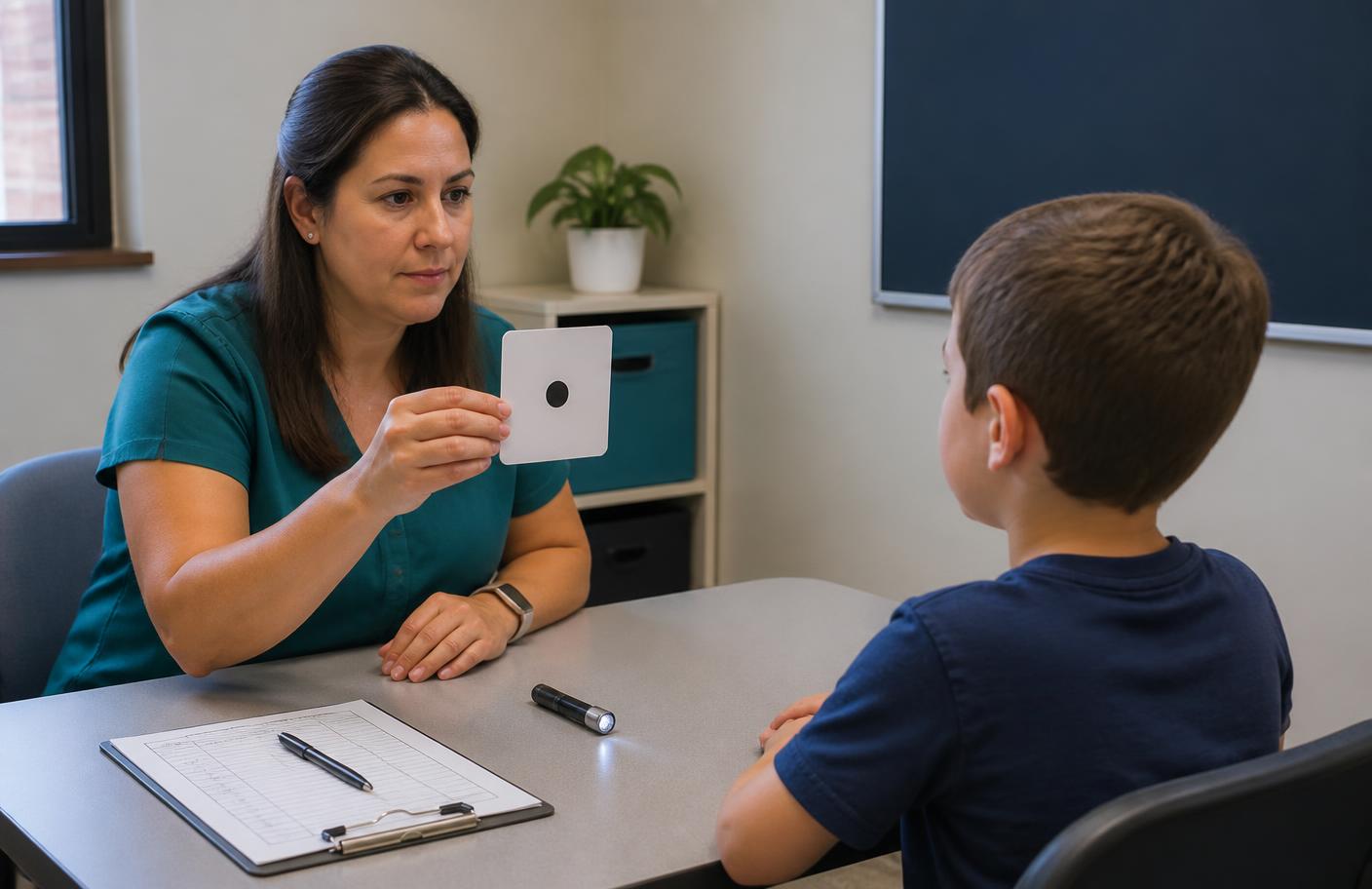
4.12 — Photo — clinician observing eye movements

Visual

Import

Photo — clinician observing eye movements

Occupational therapist seated across from a child at eye level, holding a near target while observing the child’s eyes

Eye level, off midline

Sit level with the student’s eyes and roughly 30° off midline so both eyes stay visible.

Target at eye level

Held at eye level, not above — an elevated target forces chin-up posture and false head substitution.

Score sheet within reach

Record each trial as it happens; retrospective scoring loses the qualitative signal.

You cannot score what you cannot see. Sit slightly off-midline and level with the student’s eyes so pursuits, undershoot, and head substitution are visible — not behind or above the shoulder.
The VPA™: Assessment & Clinical Reasoning
12 / 16
  • Positioning photo showing the clinician’s line of sight to the eyes.

Say this

Describe what belongs here: Positioning photo showing the clinician’s line of sight to the eyes..

My notes

4.13 — So what? Script fidelity protects the finding

So what?

So what?

So what? Script fidelity protects the finding

Every extra prompt you add turns an assessment item into a teaching trial, and the score stops meaning what the manual says it means.

The five Mini probes are standardized in wording, demonstration, and prompting limits.

What you do with it

  • Read the script; do not paraphrase into encouragement.
  • Stay inside the stated prompting limit and record any prompt given.
  • Write observation cues as you go — they carry the clinical meaning the score cannot.

Watch for

Yourself coaching. If you helped, note it; a scored item with an unrecorded prompt is unusable.

The VPA™: Assessment & Clinical Reasoning
13 / 16
  • Every extra prompt you add turns an assessment item into a teaching trial, and the score stops meaning what the manual says it means.
  • Because: The five Mini probes are standardized in wording, demonstration, and prompting limits.
  • Move: Read the script; do not paraphrase into encouragement.
  • Move: Stay inside the stated prompting limit and record any prompt given.
  • Move: Write observation cues as you go — they carry the clinical meaning the score cannot.
  • Watch for: Yourself coaching. If you helped, note it; a scored item with an unrecorded prompt is unusable.

Say this

Land the "so what": Every extra prompt you add turns an assessment item into a teaching trial, and the score stops meaning what the manual says it means.

Explain the mechanism plainly: The five Mini probes are standardized in wording, demonstration, and prompting limits.

Then give them the moves — say each one as something they can do Monday:

My notes

4.14 — Two-minute case: you gave one extra cue

Mini case

Two-minute case

Two-minute case: you gave one extra cue

Mid-probe, a student stalls and you say "remember to start at the left." He then completes the item correctly.

How do you score and document it?

The VPA™: Assessment & Clinical Reasoning
14 / 16
  • Mid-probe, a student stalls and you say "remember to start at the left." He then completes the item correctly.
  • Question: How do you score and document it?
  • Model answer: Score according to the prompting rule for that probe — the item was completed with a prompt beyond the limit, so it does not count as independent. Record the exact cue and the response; that pairing is valuable intervention information even though the item is not credited.
  • Teaching point: Never quietly upgrade a prompted response. Document the prompt and use it clinically.

Say this

Two-minute case. Read it aloud:

Mid-probe, a student stalls and you say "remember to start at the left." He then completes the item correctly.

Put the question to them: "How do you score and document it?" Give 60 seconds, no talking.

My notes

4.15 — Reflect and share

Reflection

Reflect and share

Reflect and share

After scoring yourself on the fidelity checklist, which two items will you rehearse before your first real administration?

THINKPROCESSSHARE
The VPA™: Assessment & Clinical Reasoning
15 / 16
  • After scoring yourself on the fidelity checklist, which two items will you rehearse before your first real administration?
  • Starter: I will rehearse [item 1] and [item 2] because...

Say this

Reflection prompt: "After scoring yourself on the fidelity checklist, which two items will you rehearse before your first real administration?"

Offer the sentence starter: "I will rehearse [item 1] and [item 2] because..."

Think for one minute, write, then take two shares.

My notes

4.16 — Knowledge check — fidelity

Self-check

Knowledge check

Knowledge check — fidelity

A student pauses; you say "you can do it, look again at the top." What have you done?

The VPA™: Assessment & Clinical Reasoning
16 / 16
  • A student pauses; you say "you can do it, look again at the top." What have you done?
  • – Provided allowable encouragement
  • ✓ Provided a cue that changes the task and must be recorded as a prompting deviation
  • – Nothing that affects the score
  • – Invalidated the entire administration
  • Rationale: Directional information is a cue. Record it as a deviation; the item score is no longer comparable to the standard condition.

Say this

Knowledge check: "A student pauses; you say "you can do it, look again at the top." What have you done?"

Options:

• Provided allowable encouragement

My notes