The VPA™: Assessment & Clinical Reasoning — participation guide
4 contact hours · 0.4 AOTA CEUs · All modules — follow along, take notes, and complete the reflection prompts.
Visual Minds Learning · AOTA Approved Provider #0000001618
The VPA™: Assessment & Clinical Reasoning
Participation and Reflection Guide
4 contact hours · 0.4 AOTA CEUs
Print this guide before you begin. Use it to follow the content, capture what applies to your caseload, and complete the reflection prompts.
Learning outcomes
By the end of this learning experience, you will be able to:
- Administer a criterion-referenced, performance-based visual assessment protocol following standardized procedure — setup, working distance, stimulus presentation, prompting limits, and observation recording — achieving at least 90% procedural fidelity, so that findings can be used to describe a client's occupational performance.
- Select developmentally and contextually appropriate assessment conditions (age band, stimulus set, environment) for a given client and state, in writing, the two client or contextual factors that drove the selection, so that assessment conditions match the client's actual occupational context (classroom, home, clinic, work).
- Apply basal and ceiling rules and a hierarchical progression of visual performance demands during performance-based assessment, correctly identifying the stopping point and the client's achieved performance level to produce a profile that guides occupation-based intervention planning.
- Score a completed performance-based visual assessment protocol and interpret the results in terms of the occupational performance breakdown they produce, naming the visual performance factor most likely accounting for the breakdown with a written rationale for each of three case vignettes.
- Translate visual assessment findings into a written occupational performance statement that names the occupation (e.g., copying from the board, sustained silent reading, legible written output), the visual performance factor limiting it, and the observed impact on participation, meeting all three elements of the provided rubric.
- Document visual assessment results in occupational therapy scope language suitable for an IEP present-levels statement or plan of care, including at least one occupation-based measurable statement of current performance, without using terminology reserved for medical eye care or optometric vision therapy.
- Apply scope-of-practice and referral decision rules, consistent with the AOTA scope of practice and the 2025 AOTA Occupational Therapy Code of Ethics, to determine for each of five completed protocols whether the client proceeds to further occupational therapy assessment, to occupation-based intervention, or to referral for medical eye care, and justify each disposition as the next occupation-based step.
- Identify validity threats to any performance-based visual assessment — incomplete basal or ceiling, environmental deviation, fatigue, attention, and unfamiliar stimulus content — and describe in writing how each is recorded and how it constrains interpretation, so that a client's participation in reading, written work, and other daily occupations is not misjudged and occupational therapy services are not misallocated.
Reflect: how will achieving these outcomes help you meet the needs of your students or clients?
Agenda
- Module 1 — Why performance-based visual assessment: what norm-referenced batteries miss · 20 min
- Module 2 — VPA™ architecture: 15 skills across 5 domains, Fast Screener vs. Mini vs. Full · 30 min
- Module 3 — Age bands, stimulus selection, and setup: working distance, lighting, materials, positioning · 30 min
- Module 4 — Administering the Mini VPA™: the seven probes, scripts, prompting limits, and observation cues · 35 min
- Module 5 — Administering the Full VPA™: level progression, basal and ceiling rules, validity flags · 40 min
- Module 6 — Scoring and interpretation: achieved level, domain profile, composites, and flag logic · 35 min
- Module 7 — Clinical reasoning walkthroughs: three student profiles from referral to interpretation · 30 min
- Module 8 — Documentation, disposition, referral decisions, and post-course examination · 20 min
Module 1
Why Performance-Based Visual Assessment
Follow along
What this module covers
- What a standard score misses
- What an OT measures — and what we do not
- Why performance-based measurement holds up
Key ideas
Capture these as you listen
- Norm-referenced perceptual batteries answer a psychometric question; the referral usually asks a performance question. Both are legitimate. They are not interchangeable.
- Standardized perceptual batteries systematically under-sample the oculomotor and near-point efficiency floor, which is why "visual perception WNL" so often coexists with a real Level 2 limiter.
- The VPA™ trades the normative standard score for level-and-domain specificity that maps directly to intervention. Name that trade in your report before anyone else does.
- Criterion-referenced results cannot establish an eligibility category. When a normative comparison is required, administer a norm-referenced instrument or refer.
Notes
My notes for this module
Reference figures
Keep these for practice
Screenshot — a standard score report vs. a VPA™ profile
“Within normal limits.” No statement about copying from the board, near endurance, or output rate.
Shape, not a single number: efficiency and output fall away while foundation holds.
Photo — the referral in context
Apply it
Case prompt
A school psychologist tells you, "The perceptual testing came back average, so we can rule vision out." Write a two-sentence reply that names what the battery sampled, what it did not sample, and what you propose to do about it, without disparaging the instrument or the colleague.
Practice
Mini exercise
Write, in one sentence, the difference between "this student is at the 16th percentile for visual perception" and "this student loses the line during sustained silent reading after four minutes." Which sentence writes an accommodation?
Take it to work
Action step this week
Pull the last visual-perceptual report you wrote. Highlight every sentence that describes a score and every sentence that describes performance during an occupation. If the score sentences outnumber the performance sentences, you have found your revision target.
Module 2
VPA™ Architecture
Follow along
What this module covers
- Why 15 skills across 5 domains
- When to reach for a standardized tool
Key ideas
Capture these as you listen
- 15 skills across 5 domains; the domain says what is measured, the level says how hard the item is. The output is a profile, not a global score.
- Fast Screener = triage yes/no. Mini VPA™ = which domains need full assessment. Full VPA™ = the profile that drives the plan of care.
- Age-band content variants exist to protect engagement, which protects measurement. Never hand an adolescent a primary-grade stimulus.
- Interactive and printed administration are item-equivalent, but never mix modes inside one skill, and always record the mode used.
- Observation data (head movement, refixations, latency, discomfort) is part of the finding, not optional color.
Notes
My notes for this module
Reference figures
Keep these for practice
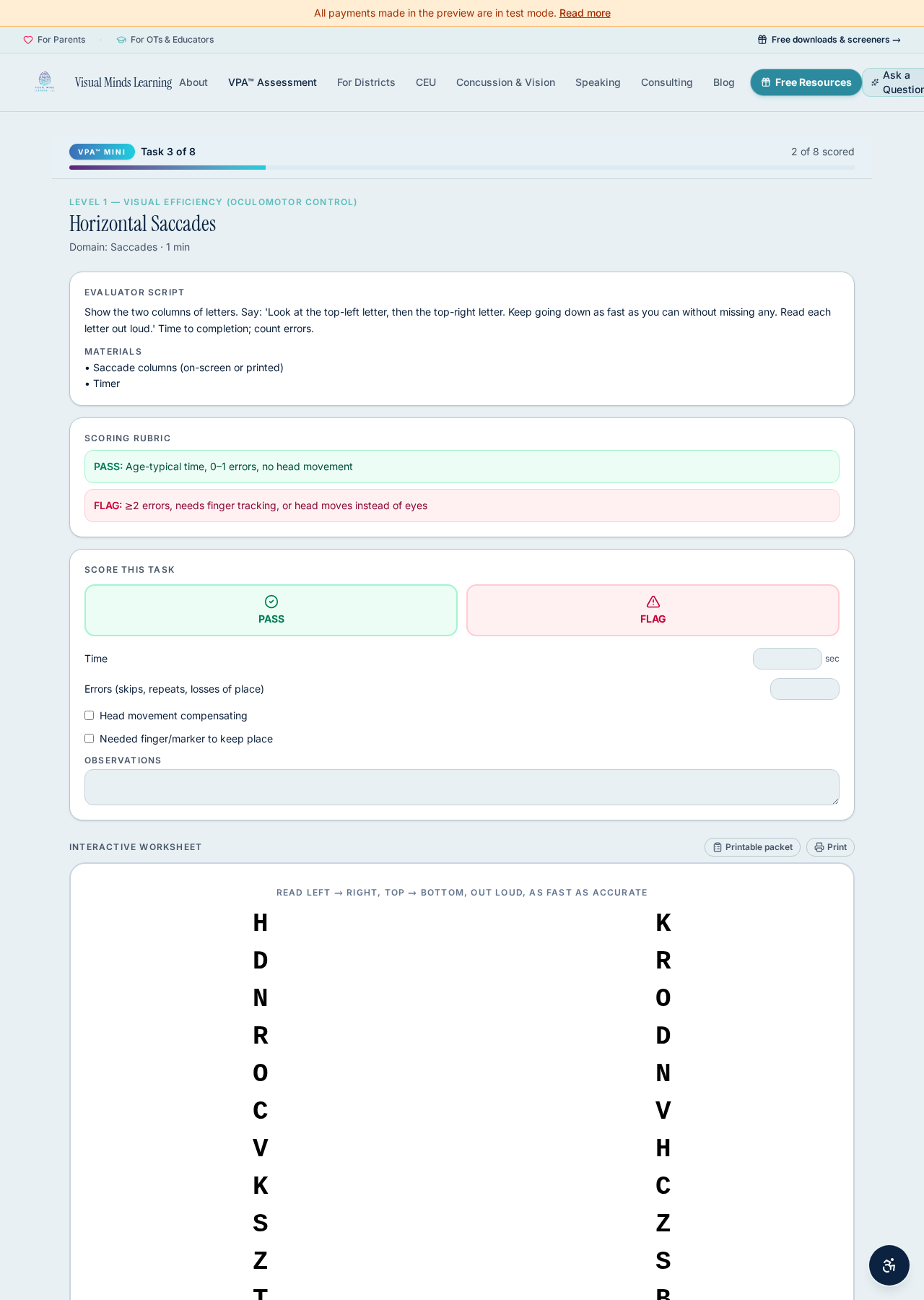
Diagram — 15 skills mapped to 5 domains
Task rubric 0–3 → reported as VPL 1–5
0
Unable
1
Emerging, max support
2
Functional but inefficient
3
Accurate & efficient
Screenshot — Full VPA™ skill menu
Ocular foundation
- Near acuity
- Distance acuity
- Contrast & glare tolerance
Field & attention to space
- Field awareness
- Organized scanning
- Left/right coverage
Oculomotor efficiency
- Fixation stability
- Pursuits
- Saccades & NPC
Perceptual processing
- Discrimination & closure
- Figure-ground
- Visual memory & spatial
Visual-motor integration
- Copy accuracy
- Form reproduction
- Timed written output
Apply it
Case prompt
A student is described by two teachers as losing stamina in the second half of any reading block. He flags on the Mini VPA™ in Domain 2 only, with all other domains at criterion. What is your next step, and what would you have done differently if Domain 1 had also flagged?
Practice
Mini exercise
In one sentence each, state the job of the Fast Screener, the Mini VPA™, and the Full VPA™. If any two sentences sound alike, you have not yet separated triage from routing from assessment.
Take it to work
Action step this week
Sketch the 5 × 15 grid, domains down, skills across, from memory, then check it against the VPA™ scope page. The gaps you find are the domains you are least likely to assess in practice.
Module 3
Age Bands, Stimuli, and Setup
Follow along
What this module covers
- Non-negotiables before the first item
- Why stimuli change with the band
- Eye dominance: Porta and Miles tests
- Below the floor of the VPA™
Key ideas
Capture these as you listen
- Setup is the measurement condition. Age band, distance, lighting, and positioning are part of the instrument, not preliminaries.
- Chronological age selects the band by default; language or reading access can justify selecting down, advanced material can justify selecting up, record the substitution and the reason either way.
- Intermediate (60 cm) and near (40 cm) are separate measurements with distance-matched card sizes. Never substitute one card set for the other distance.
- Band-adaptation is real and partial: language- and print-loaded tasks (saccade columns, reading passages, writing prompts, discrimination sets, fixation load, all Functional Integration scripts) swap by band; geometric tasks (form constancy, closure, spatial, memory, VMI figures) are held constant by design.
- Postural instability recruits head movement into oculomotor tasks and produces false efficiency deficits. Stabilize the base or flag it.
- Complete the intake before the first stimulus, lens status and date of last eye exam change Domain 1 interpretation before you measure anything.
Notes
My notes for this module
Reference figures
Keep these for practice
Photo — measured setup at 60 cm and 40 cm

Near probes · 40 cm
Card at midline and at eye level; measure from the spectacle plane, not the forehead.
Table/screen · 60 cm
Use the same distance at screening and re-probe — a distance change invalidates the comparison.
Base of support
Feet supported and hips at 90° before any oculomotor scoring; postural drift reads as an efficiency deficit.
Screenshot — age band selection screen
5–7 years
Shorter probes, picture-based stimuli, heavier modeling
8–11 years
Full ladder, standard stimuli, timed output introduced
12–16 years
Academic-load stimuli, endurance probes, self-report added
17+ years
Transition/vocational tasks, driving-adjacent scanning demands
Apply it
Case prompt
A 12-year-old with a documented reading level of mid-first grade is referred for copy difficulty. Which age band do you administer, what do you record about the choice, and which single domain is most at risk of being misinterpreted if you get this wrong?
Practice
Mini exercise
Name the two VPA™ working distances and the occupation each one represents. Then name what happens to interpretability if you present a near-sized card at the intermediate distance.
Take it to work
Action step this week
Measure your usual testing setup with a tape: chair-to-table height, the distance at which you actually hold a near card, and the illumination at the task surface. Write the numbers down and correct anything more than 5 cm off.
Module 4
Administering the Mini VPA™
Follow along
What this module covers
- Script discipline
- What triggers a Full VPA™
- Near point of convergence — the penlight probe
- What to watch while they work
Key ideas
Capture these as you listen
- Five probes, one per level, fifteen to twenty minutes. The Mini VPA™ routes; it does not describe.
- Occlude with a card, never a palm. Measure NPC with three trials and record break and recovery separately, fatigue across trials is a finding.
- Time the visual memory exposure with a timer. A drifting interval turns a memory task into a discrimination task.
- The VMI copy task leaves the model visible; record process (grasp, stabilization, model rechecks) alongside product.
- Say the script, then stop talking. One standard re-instruction maximum, and record that you gave it.
Notes
My notes for this module
Reference figures
Keep these for practice
Screenshot — Say/Do script card
Say
“Look at the star, then the circle, and keep going back and forth until I say stop. Move only your eyes.”
Do
Hold targets 20 cm apart at 40 cm, eye level. Time 30 s. Watch for head movement, undershoot, loss of place, and reported blur.
Score the level reached
Photo — clinician observing eye movements

Eye level, off midline
Sit level with the student’s eyes and roughly 30° off midline so both eyes stay visible.
Target at eye level
Held at eye level, not above — an elevated target forces chin-up posture and false head substitution.
Score sheet within reach
Record each trial as it happens; retrospective scoring loses the qualitative signal.
Apply it
Case prompt
During Probe 2, the student never reports doubling, but you observe the left eye drift outward at 12 cm and return at 18 cm. What do you record, and what do you write in the report, and what do you deliberately not write?
Practice
Mini exercise
Without looking, name the five Mini probes in order and the level each one samples. Then name the one probe where you are most likely to talk too much.
Take it to work
Action step this week
Administer the Mini VPA™ to a colleague or family member this week while running the 20-item administration-fidelity checklist on yourself. Score honestly; the items you miss are the items you will miss with a student.
Module 5
Administering the Full VPA™
Follow along
What this module covers
- Progression, basal, ceiling
- The five validity threats
- The 15 skills sit on the five levels
- Keeping a full battery clean
Key ideas
Capture these as you listen
- Full VPA™ progression is strictly sequential from Level 1. Adaptive entry inflates profiles and hides the floor.
- Basal = criterion performance at the first level administered. A Level 1 failure stops that skill; a Level 1 Domain 1 failure triggers referral immediately.
- Ceiling = the first level failed; achieved level = highest level passed. Never score an unreached ceiling as a Level 5 pass.
- Five validity threats: incomplete basal/ceiling, environmental deviation, fatigue, attention/behavioral state, unfamiliar stimulus content.
- Domain 5 is administered last and is the most endurance-loaded, suspect fatigue there first, and re-administer fresh rather than interpreting through it.
Notes
My notes for this module
Reference figures
Keep these for practice
Screenshot — Full VPA™ runner in progress
Running record
Basal established: L2
Ceiling rule: 2 consecutive fails
Observed: head substitution, 3 losses of place
Student report: “letters go blurry”
Achieved level: 3
Photo — materials laid out for a full session
Apply it
Case prompt
A student was referred because she cannot locate the problem she is working on in a dense math worksheet. She passes Levels 1–3 in figure-ground, fails Level 4 narrowly after a hallway interruption, and you stop. What is the achieved level, what do you flag, and what one additional trial would you consider?
Practice
Mini exercise
Write the basal rule and the ceiling rule in one sentence each, then write the sentence you would put in a report when the ceiling was never reached.
Take it to work
Action step this week
Review your last three evaluation reports for any statement that would have required an unreached ceiling to support it. Rewrite one of them to state what was actually administered.
Module 6
Scoring and Interpretation
Follow along
What this module covers
- Read the shape before the numbers
- What the report may and may not say
- When a standardized chart adds value
- Turning the profile into a plan of care
Key ideas
Capture these as you listen
- Interpret bottom-up: an unstable lower domain makes every higher-domain finding provisional. Say that explicitly in the report.
- Read profile shape, not single-skill depth. Flat low = suspect a global factor or invalid administration; bottom-heavy = the efficiency pattern; top-heavy = processing vs. visual-motor, and the distinction drives the plan.
- A flag earns a disposition, further assessment, intervention, or referral, not a conclusion.
- Every finding ends in an occupational performance statement: occupation + limiting visual factor + observable impact.
- Use criterion language ("below the Level 3 criterion for the 8–11 band"), never normative language ("below average"), for VPA™ results.
Notes
My notes for this module
Reference figures
Keep these for practice
Screenshot — domain profile and composite
Screenshot — scoring worksheet with achieved levels
| Skill | Rubric 0–3 | Achieved level | Observation | Student report |
|---|---|---|---|---|
| Fixation | 3 | L4 | Steady 30 s | — |
| Pursuits | 2 | L3 | Head substitution | Reported blur |
| Saccades / NPC | 1 | L2 | 3 losses of place | NPC 12 cm, receding |
| Figure-ground | 2 | L3 | Dense page slows to 2× time | — |
| Copy accuracy | 1 | L2 | Spacing collapses after 4 lines | Fatigue at 6 min |
Apply it
Case prompt
A 9-year-old is failing to complete written assignments and stops reading after roughly five minutes. His profile shows Domain 1 intact, Domain 2 achieved Level 2, Domain 3 achieved Level 4, Domain 4 achieved Level 4, Domain 5 achieved Level 2. Name the profile shape, the most likely limiter, and the one sentence you would put in the present-levels section.
Practice
Mini exercise
Rewrite this sentence so it is criterion-referenced and occupation-linked: "Student demonstrates below-average visual motor integration skills."
Take it to work
Action step this week
Take one completed protocol and write three occupational performance statements from it, each containing all three rubric elements. Then delete every sentence in your draft report that has none of them.
Module 7
Clinical Reasoning Walkthroughs
Follow along
What this module covers
- The same four questions in every case
Key ideas
Capture these as you listen
- The referral word is a hypothesis, not a finding. In all three cases it pointed away from the actual limiter.
- Time course discriminates efficiency from processing: efficiency degrades over minutes, processing is impaired from the first item.
- Intact discrimination and form constancy argue against a perceptual explanation for reversals; look lower or elsewhere.
- Repeated model-rechecking with intact Domain 3 is the behavioral signature of a Domain 4 production limiter.
- Referral and OT intervention proceed in parallel, neither waits for the other.
Notes
My notes for this module
Reference figures
Keep these for practice
Case artifact — student work sample
Screenshot — case profile chart
Apply it
Case prompt
Re-read Case B. Write the two-sentence explanation you would give the classroom teacher for why "he can do it when he tries" is consistent with the finding rather than evidence against it.
Practice
Mini exercise
For each of the three cases, name the domain that carried the finding and the domain the referral word pointed to. Note how often they differed.
Take it to work
Action step this week
Pick one student on your caseload whose referral concern you have accepted at face value. Re-read their data and ask which domain the evidence actually implicates.
Module 8
Documentation, Disposition, and Referral
Follow along
What this module covers
- A defensible VPA™ report
- Referral decision rules
- How the profile actually defines the intervention
- From achieved level to an IEP-ready goal
- Three rules that keep the activity honest
Key ideas
Capture these as you listen
- Three dispositions: refer for medical eye care, proceed to deeper assessment (Full VPA™ or a norm-referenced instrument), or proceed to occupation-based intervention. Referral and intervention routinely run in parallel.
- Refer on: Domain 1 below criterion, two-line interocular difference, pain/diplopia/headache with near work, observed strabismus or nystagmus, receding NPC, or no eye exam on record.
- Documentation needs four elements: named occupation, observable current performance, criterion-referenced visual factor, and participation impact.
- Never write "vision therapy," a lens/prism/filter recommendation, or a binocular diagnosis as your own finding. The practice does not shrink; the vocabulary changes.
- Retain the protocol, observations, validity flags, mode, band, and any deviations, a report nobody can reconstruct is a file defect.
- The entry point names the activity: L1 access/contrast changes, L2 pursuit-saccade-convergence work under the endurance ceiling, L3 perceptual work carried onto a real page, L4 graded visual-motor plus output accommodation, L5 treated inside the occupation. All named activities live in the Vision Library.
- Grading rules: treat at the lowest unstable level but measure at Level 5, change one variable at a time, and embed before you drill.
- Building the full plan of care from the profile is Course 3, Intervention Planning Using the Five-Level Framework.
Notes
My notes for this module
Reference figures
Keep these for practice
Screenshot — generated VPA™ clinical report
Screenshot — referral letter template
Re: Referral for eye care evaluation
I am the occupational therapist working with this student on written productivity and reading stamina in the school setting.
During structured performance testing, the student demonstrated reduced accuracy and endurance on sustained near tasks, with reported blur after approximately six minutes, loss of place during line-to-line tracking, and a near point of convergence receded to 12 cm.
These observations describe performance only and are not a diagnosis. I am requesting your evaluation to determine whether an underlying visual condition is contributing, and any recommendations you would like reflected in the educational plan.
Thank you — I am glad to share the full performance summary on request.
Apply it
Case prompt
Write a complete IEP present-levels statement from Case B in Module 7. Include all four documentation elements and no out-of-scope language. Then read it back and delete any word an OT licensure board would question.
Practice
Mini exercise
List the referral triggers from memory. Then check the list. Any trigger you forgot is a student you would have kept instead of referred.
Take it to work
Action step this week
Draft your standing referral letter template for eye care, the one you will reuse, with a blank slot for the specific functional observations. Having it written before you need it is the difference between referring and meaning to refer.
Video and demonstration reflections
Use this page for any video, demonstration, or case walkthrough in the course.
What did you notice about the clinician and the student?
How could you use this with a student on your caseload?
Would you do anything differently?
What questions do you still have?
Wrap-up reflections
Use this space to note:
- Strategies to try with your students next week
- Resources or materials to explore
- Information to share with your team
- Anything you want to remember