Back to CEU courses

Presenter study handout

Vision in OT Practice

3 contact hours · 0.3 AOTA CEUs · Module 6 · 21 slides

Presenter-side material. Each block shows the slide as the audience sees it, the talk track, and space for your own notes. Model answers appear here — do not hand this version to learners.

Module 6

6.1 — Evidence Base, Levels of Evidence, and Selecting Graded Intervention

Transition

Module 6

Evidence Base, Levels of Evidence, and Selecting Graded Intervention

2:14 – 2:40

Vision in OT Practice
1 / 21
  • 2:14 – 2:40

Say this

Transition: "Evidence Base, Levels of Evidence, and Selecting Graded Intervention."

My notes

6.2 — Who Does What — Supports, Roles, and Collaboration

Title

Module 6

Who Does What — Supports, Roles, and Collaboration

Turning one flagged level into a plan the whole team can carry, and saying honestly what it rests on.

Vision in OT Practice
2 / 21
  • Turning one flagged level into a plan the whole team can carry, and saying honestly what it rests on.

Say this

Open here. "Who Does What — Supports, Roles, and Collaboration." Turning one flagged level into a plan the whole team can carry, and saying honestly what it rests on.

Say why this section matters for their caseload, then advance.

My notes

6.3 — Evidence habits

Poll

Poll

Evidence habits

When you choose a vision-related strategy, what usually decides it?

Vision in OT Practice
3 / 21
  • When you choose a vision-related strategy, what usually decides it?
  • – Published evidence for that strategy
  • – What is in the supply closet
  • – What the student will tolerate
  • – What I was taught in fieldwork

Say this

Ask the poll: "When you choose a vision-related strategy, what usually decides it?"

Options:

• Published evidence for that strategy

My notes

6.4 — Vision is already inside the OT domain

Teaching slide

Where vision lives in our framework

Vision is already inside the OT domain

  • We describe vision as a client factor: acuity, field, eye-movement control, focusing, perception.
  • We measure it as a performance skill: what the eyes actually do during reading, writing, dressing, play.
  • We change it in context: light, glare, print size, contrast, seating, clutter.
  • The eye itself — health, glasses, prism, patching — is not ours. That is a referral, every time.

Occupations

What the person needs and wants to do.

  • • Reading and written work
  • • Dressing, eating, self-care
  • • Play, sport, driving, work

Client factors — body functions

The internal capacities that support doing.

  • • Visual acuity and visual field
  • • Eye-movement and focusing control
  • • Visual perception

Performance skills

Observable actions during the task.

  • • Locates, tracks, and keeps place
  • • Aligns, spaces, and copies accurately
  • • Sustains looking over time

Performance patterns

Habits and routines that carry the day.

  • • Break routines during near work
  • • Where materials live on the desk
  • • Self-checks before turning work in

Contexts and environment

Everything around the person.

  • • Lighting, glare, seating
  • • Print size, contrast, clutter
  • • Team expectations and supports

Highlighted boxes are where a visual problem shows up in our documentation: a client factor we describe, a performance skill we measure in the task, and a context we change. The diagnosis of the eye itself sits outside this picture — that belongs to eye care.

The OT practice framework, drawn as the pieces we actually observe. Vision touches three of them directly — client factors, performance skills, and context — which is why vision work is ordinary OT, not a specialty add-on.
Vision in OT Practice
4 / 21
  • We describe vision as a client factor: acuity, field, eye-movement control, focusing, perception.
  • We measure it as a performance skill: what the eyes actually do during reading, writing, dressing, play.
  • We change it in context: light, glare, print size, contrast, seating, clutter.
  • The eye itself — health, glasses, prism, patching — is not ours. That is a referral, every time.

Say this

Frame the slide: "Vision is already inside the OT domain."

Walk each point, one sentence each:

• We describe vision as a client factor: acuity, field, eye-movement control, focusing, perception.

My notes

6.5 — Four tiers, four owners

Teaching slide

Roles

Four tiers, four owners

  • Prevention is classroom design — the teacher and team own it; we suggest and model it.
  • Accommodation is written access for one student — the team writes it; we trial it and word it.
  • Intervention is skill-building inside the real task — this is the OT-only tier.
  • Eye health, lenses, prism, and patching belong to optometry or ophthalmology.

Prevention — good design for everyone

Teacher / team owns it

  • • 14–18 pt print, one task per page
  • • Board content also handed out on paper
  • • A visual rest built into long near work

OT role: suggest it, model it once, and leave a one-page reference behind.

Accommodation — access for this student

IEP / 504 team writes it, staff carry it out

  • • Enlarged or digital copy
  • • Reduced copying, extended time
  • • Audio or text-to-speech option

OT role: trial it, document which condition restored performance, write the wording for the plan.

Intervention — building the skill

OT owns it

  • • Graded eye-movement work inside the real reading task
  • • Handwriting and visual-motor practice in classwork
  • • Endurance built minute by minute

OT role: this is the only tier that requires us. Measure it in classwork, then hand off.

Eye health, glasses, prism, patching

Optometry / ophthalmology owns it

  • • Blur, pain, double vision, headaches
  • • Any change in eye appearance or alignment
  • • No exam in the last year

OT role: refer, share what we observed in the task, and keep treating occupation while we wait.

Four tiers, four owners. Most vision supports in a school are not OT-only work — naming the owner is what makes the plan survive after you leave the room.
Vision in OT Practice
5 / 21
  • Prevention is classroom design — the teacher and team own it; we suggest and model it.
  • Accommodation is written access for one student — the team writes it; we trial it and word it.
  • Intervention is skill-building inside the real task — this is the OT-only tier.
  • Eye health, lenses, prism, and patching belong to optometry or ophthalmology.

Say this

Frame the slide: "Four tiers, four owners."

Walk each point, one sentence each:

• Prevention is classroom design — the teacher and team own it; we suggest and model it.

My notes

6.6 — Design first, accommodate second, treat third

Teaching slide

UDL, in plain terms

Design first, accommodate second, treat third

  • Universal Design for Learning simply means: build the room so fewer students need a fix.
  • Three questions — how is it shown, how do they respond, how do we keep them going?
  • Our five levels name the barrier. UDL names what changes on Monday morning.
  • Adaptation is intervention. It is not waiting for the doctor.
Partner
Ask them
Give them
Teacher
When in the day does the work fall apart, and what does the paper look like then?
Two changes to try tomorrow, in writing, with nothing to buy.
Family
When was the last eye exam, and what do homework and screens look like at home?
Plain-language explanation of what we saw and what an exam would answer.
Eye care provider
Is there anything in the exam that limits what this student can do at near?
What we observed during real reading and writing — timed, described, not diagnosed.
Student
What makes your eyes tired, and what helps?
A way to signal fatigue and one self-check they can run without asking.
Team / admin
What can we build into the room for everyone?
A short in-service and a one-page checklist that outlives the therapy block.
Collaboration is a two-way exchange with each partner: one question you ask, one thing you hand back. Education is the deliverable that makes the supports last.
Vision in OT Practice
6 / 21
  • Universal Design for Learning simply means: build the room so fewer students need a fix.
  • Three questions — how is it shown, how do they respond, how do we keep them going?
  • Our five levels name the barrier. UDL names what changes on Monday morning.
  • Adaptation is intervention. It is not waiting for the doctor.

Say this

Frame the slide: "Design first, accommodate second, treat third."

Walk each point, one sentence each:

• Universal Design for Learning simply means: build the room so fewer students need a fix.

My notes

6.7 — One support idea per level

Five-Level Framework

Mapping

One support idea per level

1

Visual Acuity & Sensory Foundation

Make it visible: size, contrast, glare, clutter, or an alternate way to get the content.

2

Visual Efficiency

Protect endurance: less copying, chunked near work, scheduled visual rest.

3

Visual Processing

Label every visual, fewer items per page, let them show it without writing.

4

Visual-Motor Integration

Grade content separately from handwriting; offer keyboarding or dictation.

5

Functional Integration

Exemplars, choice, a self-check, and a written hand-off to the team.

Vision in OT Practice
7 / 21
  • Level 1 — Visual Acuity & Sensory Foundation: Make it visible: size, contrast, glare, clutter, or an alternate way to get the content.
  • Level 2 — Visual Efficiency: Protect endurance: less copying, chunked near work, scheduled visual rest.
  • Level 3 — Visual Processing: Label every visual, fewer items per page, let them show it without writing.
  • Level 4 — Visual-Motor Integration: Grade content separately from handwriting; offer keyboarding or dictation.
  • Level 5 — Functional Integration: Exemplars, choice, a self-check, and a written hand-off to the team.

Say this

Run the five levels bottom-up.

Name each level, then say which one you assess first and why.

My notes

6.8 — One question you ask, one thing you hand back

Teaching slide

Collaboration

One question you ask, one thing you hand back

  • Teacher: when does the work fall apart? Give two changes to try tomorrow, in writing.
  • Family: when was the last eye exam? Give plain-language findings and why an exam matters.
  • Eye care: does the exam limit near work? Give what you saw in real reading — described, not diagnosed.
  • Student: what makes your eyes tired? Give a signal and a self-check they control.
Partner
Ask them
Give them
Teacher
When in the day does the work fall apart, and what does the paper look like then?
Two changes to try tomorrow, in writing, with nothing to buy.
Family
When was the last eye exam, and what do homework and screens look like at home?
Plain-language explanation of what we saw and what an exam would answer.
Eye care provider
Is there anything in the exam that limits what this student can do at near?
What we observed during real reading and writing — timed, described, not diagnosed.
Student
What makes your eyes tired, and what helps?
A way to signal fatigue and one self-check they can run without asking.
Team / admin
What can we build into the room for everyone?
A short in-service and a one-page checklist that outlives the therapy block.
Collaboration is a two-way exchange with each partner: one question you ask, one thing you hand back. Education is the deliverable that makes the supports last.
Vision in OT Practice
8 / 21
  • Teacher: when does the work fall apart? Give two changes to try tomorrow, in writing.
  • Family: when was the last eye exam? Give plain-language findings and why an exam matters.
  • Eye care: does the exam limit near work? Give what you saw in real reading — described, not diagnosed.
  • Student: what makes your eyes tired? Give a signal and a self-check they control.

Say this

Frame the slide: "One question you ask, one thing you hand back."

Walk each point, one sentence each:

• Teacher: when does the work fall apart? Give two changes to try tomorrow, in writing.

My notes

6.9 — Teaching the team is part of the treatment

Teaching slide

Education

Teaching the team is part of the treatment

  • A 10-minute in-service beats a 3-page email nobody opens.
  • Leave one printable page behind — the checklist survives the meeting.
  • Show, then watch them do it once. Handoff is a skill, not a handout.
  • Re-check in two weeks: is the support still happening when you are not there?
Vision in OT Practice
9 / 21
  • A 10-minute in-service beats a 3-page email nobody opens.
  • Leave one printable page behind — the checklist survives the meeting.
  • Show, then watch them do it once. Handoff is a skill, not a handout.
  • Re-check in two weeks: is the support still happening when you are not there?

Say this

Frame the slide: "Teaching the team is part of the treatment."

Walk each point, one sentence each:

• A 10-minute in-service beats a 3-page email nobody opens.

My notes

6.10 — Maya, Grade 4 — handwriting fades and she loses her place

Case

Guided example

Maya, Grade 4 — handwriting fades and she loses her place

Maya writes legibly for about five minutes, then letter size and spacing fall apart. Copying from the board, she skips lines and asks her neighbor where they are. Eye exam last year was normal. Level 2 (efficiency) and Level 4 (visual-motor) flagged.

  • Q1.What is one change that would help every student in that room?
    Guided answer: Prevention (teacher owns): hand out a paper copy of anything written on the board, and keep worksheets to one task per page at 14–18 pt. No eligibility needed, no cost, and the whole class copies less.
  • Q2.What would you write into her plan just for her?
    Guided answer: Accommodation (team writes it, staff carry it out): reduced copying — fill-in notes instead of full board copy — plus extended time on written work. You supply the wording after trialing it and seeing her output hold.
  • Q3.What is the OT-only piece, and how will you know it worked?
    Guided answer: Intervention (OT only): graded copying and place-keeping practice inside her actual classwork, plus visual-motor work on letter size and spacing. Measure it in classwork: minutes until legibility breaks down, and number of lines skipped per copy task. Baseline first, re-probe every two weeks.
VPA™ · Scored profile
L1Acuity & sensory foundationincl. field & scanning
strong
L2Visual efficiency
limiting
L3Visual processing
emerging
L4Visual-motor integration
limiting
L5Functional integration
breaking down
Profile shape: foundation intact / output limitedIntervention enters at Level 2 (efficiency), not at Level 4 handwriting drill.
Rows are the five framework levels in order (L1 → L5) — the L number is the level, never the score. Performance is the bar and the word beside it. Read the shape before any composite: a flat-but-low profile, a single notch, and a “foundation intact / output collapsed” staircase call for three different plans.
Vision in OT Practice
10 / 21
  • Maya writes legibly for about five minutes, then letter size and spacing fall apart. Copying from the board, she skips lines and asks her neighbor where they are. Eye exam last year was normal. Level 2 (efficiency) and Level 4 (visual-motor) flagged.
  • Q1. What is one change that would help every student in that room?
  • Q2. What would you write into her plan just for her?
  • Q3. What is the OT-only piece, and how will you know it worked?
  • Answer 1: Prevention (teacher owns): hand out a paper copy of anything written on the board, and keep worksheets to one task per page at 14–18 pt. No eligibility needed, no cost, and the whole class copies less.
  • Answer 2: Accommodation (team writes it, staff carry it out): reduced copying — fill-in notes instead of full board copy — plus extended time on written work. You supply the wording after trialing it and seeing her output hold.
  • Answer 3: Intervention (OT only): graded copying and place-keeping practice inside her actual classwork, plus visual-motor work on letter size and spacing. Measure it in classwork: minutes until legibility breaks down, and number of lines skipped per copy task. Baseline first, re-probe every two weeks.

Say this

Read the scenario aloud, slowly:

Maya writes legibly for about five minutes, then letter size and spacing fall apart. Copying from the board, she skips lines and asks her neighbor where they are. Eye exam last year was normal. Level 2 (efficiency) and Level 4 (visual-motor) flagged.

Then put these questions to the room:

My notes

6.11 — Devon, Grade 7 — no answer given

Case

Your turn

Devon, Grade 7 — no answer given

Devon reads fine for a paragraph, then rubs his eyes and stops. He says the words "go blurry" late in the period. No eye exam on file for three years.

  • Q1.What do you refer, and what do you keep treating while you wait?
  • Q2.Name one prevention change, one accommodation, and one OT target.
Vision in OT Practice
11 / 21
  • Devon reads fine for a paragraph, then rubs his eyes and stops. He says the words "go blurry" late in the period. No eye exam on file for three years.
  • Q1. What do you refer, and what do you keep treating while you wait?
  • Q2. Name one prevention change, one accommodation, and one OT target.

Say this

Read the scenario aloud, slowly:

Devon reads fine for a paragraph, then rubs his eyes and stops. He says the words "go blurry" late in the period. No eye exam on file for three years.

Then put these questions to the room:

My notes

6.12 — Say plainly what your plan rests on

Teaching slide

Honesty

Say plainly what your plan rests on

  • Strongest support: practicing the actual occupation — reading, writing, the real task.
  • Good support: changing print, contrast, lighting, and workload for near-work access.
  • Weak support: isolated perceptual drills expected to raise reading scores on their own.
  • Write the strength of the evidence in the plan. Overstating it is the only real error.
Vision in OT Practice
12 / 21
  • Strongest support: practicing the actual occupation — reading, writing, the real task.
  • Good support: changing print, contrast, lighting, and workload for near-work access.
  • Weak support: isolated perceptual drills expected to raise reading scores on their own.
  • Write the strength of the evidence in the plan. Overstating it is the only real error.

Say this

Frame the slide: "Say plainly what your plan rests on."

Walk each point, one sentence each:

• Strongest support: practicing the actual occupation — reading, writing, the real task.

My notes

6.13 — Three quick checks

Teaching slide

Before you pick an activity

Three quick checks

  • Does this activity load the level that is actually unstable?
  • Does it look like the occupation she has to do in class?
  • Can I measure the change with the baseline I already ran?
StageWhat it isWhat it gives you
ObservationWhat you can do after todayDescribe visual performance, refer, modify the task
StructureWhat a level-based framework addsOrder of examination, meaning of a finding, sequencing language
MeasurementWhat standardized assessment addsFixed administration, scoring, basal/ceiling, re-measurable baseline
Plan of careWhat the combination producesDefensible goals, documentation, and progress statements
Each stage constrains the next. Observation without structure is unordered; structure without measurement cannot show change.
Vision in OT Practice
13 / 21
  • Does this activity load the level that is actually unstable?
  • Does it look like the occupation she has to do in class?
  • Can I measure the change with the baseline I already ran?

Say this

Frame the slide: "Three quick checks."

Walk each point, one sentence each:

• Does this activity load the level that is actually unstable?

My notes

6.14 — When acuity or field sets a hard ceiling

Comparison

Low-vision service model

When acuity or field sets a hard ceiling

Increase visibility / Enhance

  • Increase visibility: more light, higher contrast, bigger target, less clutter — an 18 pt high-contrast worksheet at a glare-free desk.
  • Enhance: magnify or move the target closer — a handheld magnifier for a map; a magnified medication label at home.

Augment / Substitute

  • Augment: add another channel alongside vision — text-to-speech with the print; talking labels on containers.
  • Substitute: replace vision when the signal cannot be made usable — full audio text and dictation; tactile marks on stove dials.
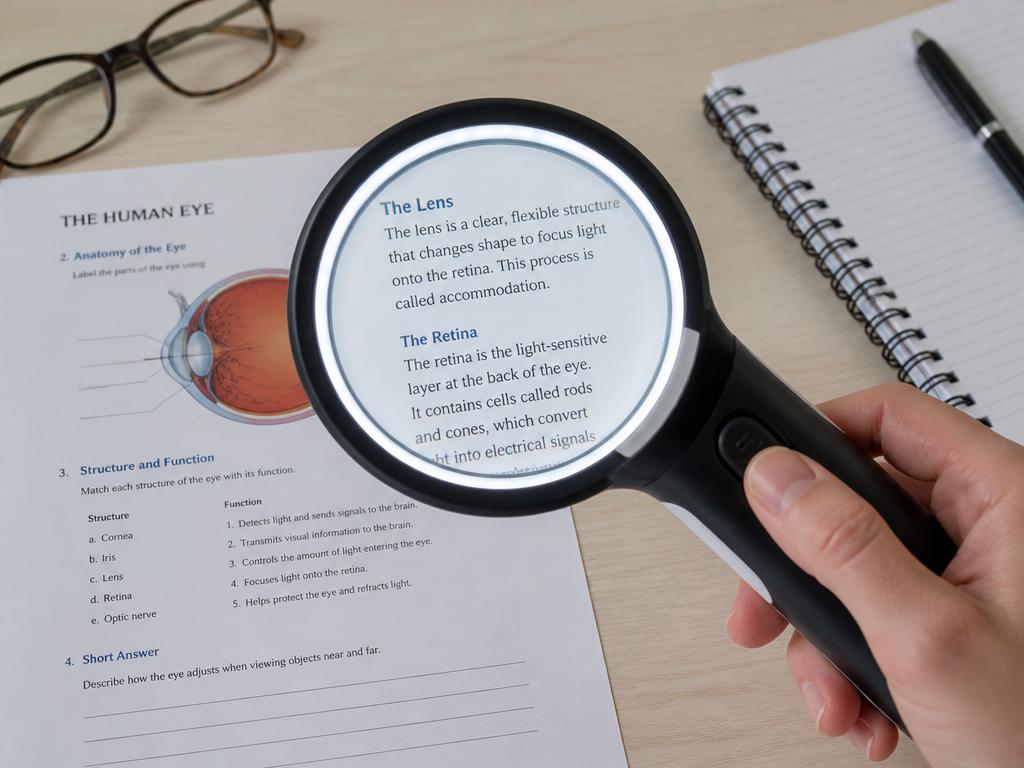
Illuminated handheld optical magnifier held above a printed worksheet, enlarging a block of text through the lens
Handheld: portable spot use; the student controls focal distance.
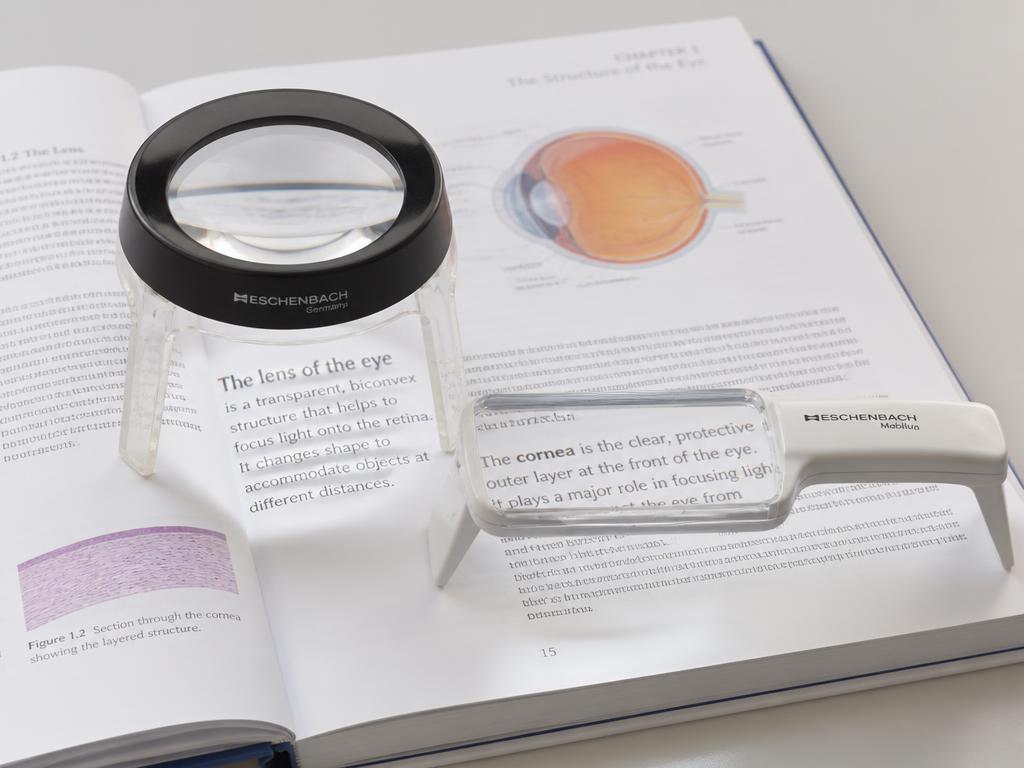
Dome stand magnifier and bar magnifier resting directly on an open book page at a fixed focal distance
Stand / bar: lens sits on the page — fixed focus, steady for sustained reading.
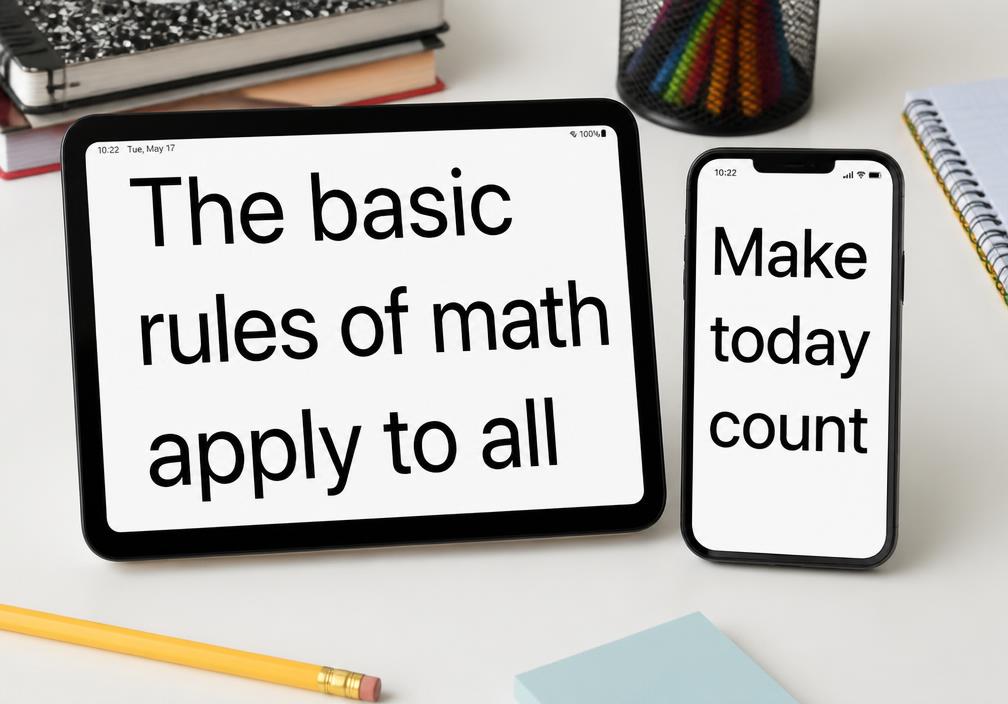
Tablet and smartphone on a desk displaying greatly enlarged high-contrast text using built-in accessibility zoom
Electronic / built-in digital: adjustable power, contrast, and speech.

Handheld magnifier

Short spot tasks: price tags, labels, a single line of text.

Portable and cheap; requires a steady hand and short focal distance.

Stand magnifier

Sustained near work for students with tremor or poor motor control.

Fixed focal distance holds the lens steady; less portable, needs desk space.

Hands-free / spectacle

Writing and bimanual tasks where both hands must stay free.

Prescribed by the eye care team; very short working distance at high power.

Telescope (mono/binocular)

Distance targets: the board, signage, a demonstration across the room.

Spot use only — narrow field, not for travel or continuous viewing.

Electronic / video magnifier (CCTV)

Long reading and writing sessions; textbooks, worksheets, science labs.

Adds adjustable magnification, reverse contrast, and speech; cost and setup.

Built-in digital magnification

Phone/tablet zoom, text enlargement, VoiceOver, screen readers.

Already in the student’s hands and free; teach it before purchasing hardware.

Match the device to the task, not to the diagnosis. Higher power means a shorter working distance and a narrower field — students usually need more than one option across the day.
Vision in OT Practice
14 / 21
  • Increase visibility / Enhance: Increase visibility: more light, higher contrast, bigger target, less clutter — an 18 pt high-contrast worksheet at a glare-free desk. · Enhance: magnify or move the target closer — a handheld magnifier for a map; a magnified medication label at home.
  • Augment / Substitute: Augment: add another channel alongside vision — text-to-speech with the print; talking labels on containers. · Substitute: replace vision when the signal cannot be made usable — full audio text and dictation; tactile marks on stove dials.

Say this

Contrast the two columns: Increase visibility / Enhance versus Augment / Substitute.

Increase visibility / Enhance:

• Increase visibility: more light, higher contrast, bigger target, less clutter — an 18 pt high-contrast worksheet at a glare-free desk.

My notes
6.15 — The classroom modification set

Teaching slide

Environment

The classroom modification set

  • Lighting: even light on the task; never backlight the student.
  • Glare: matte surfaces, blinds, seating angled away from windows.
  • Contrast and print: dark on plain, bold lines, sans-serif, larger size, one task per page.
  • Line guides or typoscopes to cut place-loss.
  • Seating with a consistent, close view of the board.
  • Tech: text-to-speech, screen magnification, tablet copy of shared material.
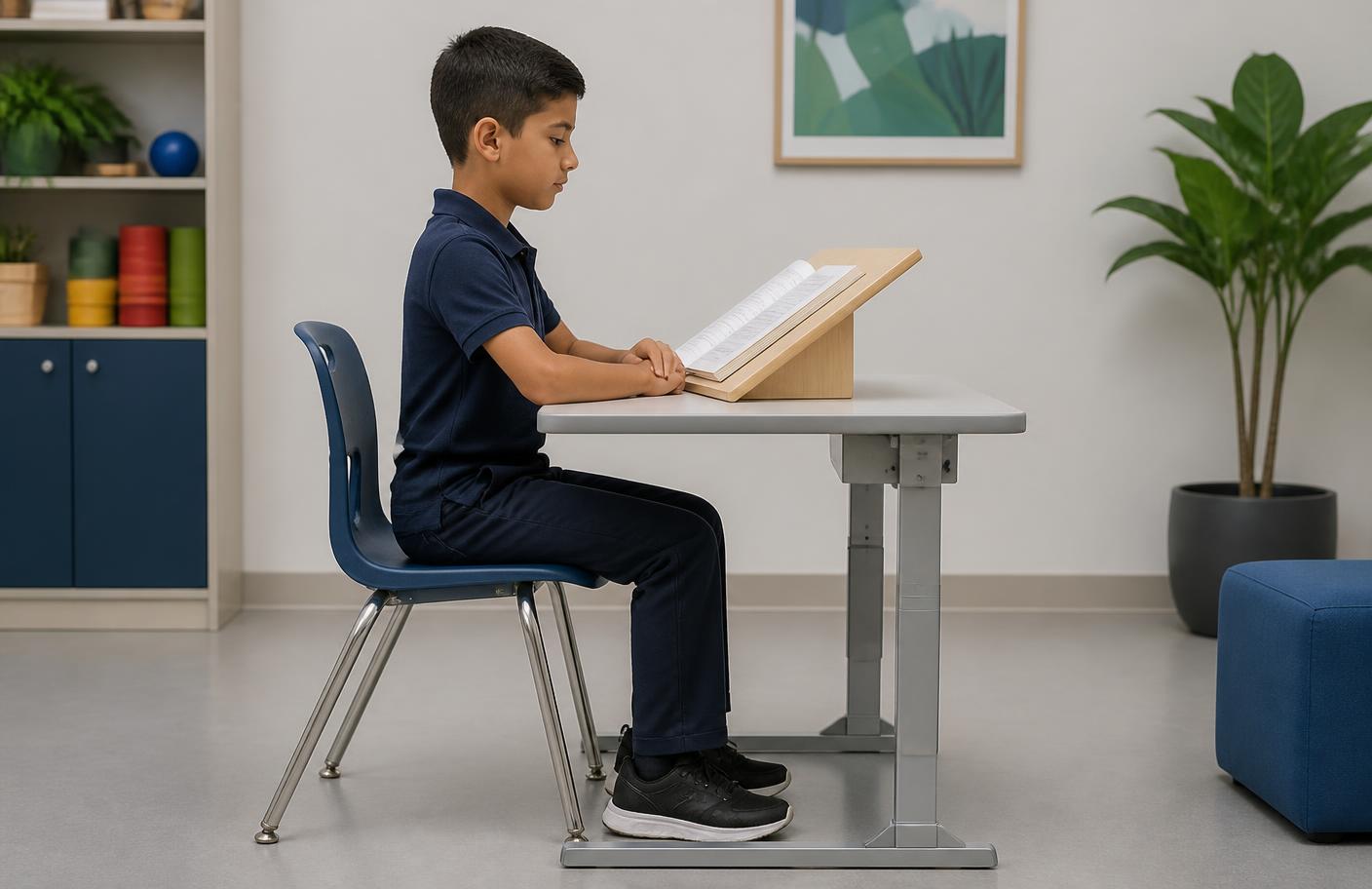
School-age student seated in neutral posture at a desk, feet flat, elbows at desk height, book on a slant board at about 40 cm

Reference posture

Feet flat, hips and knees near 90°, elbows at desk height, trunk upright and off the table.

≈40 cm at midline

A slant board holds the page at a consistent distance and angle; note any habitual 15–20 cm posture.

What to document

Head tilt, page rotation >30°, one eye closing, or distance shortening as the task lengthens.

Habitual working distance is free data. A head held at 15 cm, a persistent tilt, or a page turned 30°+ off midline all tell you something before a single probe is administered.
Vision in OT Practice
15 / 21
  • Lighting: even light on the task; never backlight the student.
  • Glare: matte surfaces, blinds, seating angled away from windows.
  • Contrast and print: dark on plain, bold lines, sans-serif, larger size, one task per page.
  • Line guides or typoscopes to cut place-loss.
  • Seating with a consistent, close view of the board.
  • Tech: text-to-speech, screen magnification, tablet copy of shared material.

Say this

Frame the slide: "The classroom modification set."

Walk each point, one sentence each:

• Lighting: even light on the task; never backlight the student.

My notes

6.16 — Module 6 video — roles, supports, and collaboration

Video

Lecture

Module 6 video — roles, supports, and collaboration

VIDEO SLOT

Who owns each tier, and how to hand a plan off so it lasts.

Slides tab → set “url” to your YouTube/Vimeo/Loom embed link

Vision in OT Practice
16 / 21
  • Who owns each tier, and how to hand a plan off so it lasts.

Say this

Set up the clip in one sentence, play it, then debrief with "what did you notice?"

My notes

6.17 — Screenshot — Treatment Template with dosage

Visual

Import

Screenshot — Treatment Template with dosage

VML Treatment Template · Level 2 entry
LTG · Complete 80% of assigned copy lines in 20 minutes with ≤2 losses of place.
STO · Sustain accurate line-to-line tracking for 3 × 60 s trials with a line guide.

Frequency

3× / week

Intensity

Line-isolated → full page

Time

15 min embedded

Type

Copy task within academics

Progression

Fade guide at 80% × 3

A treatment template forces dosage to be explicit. FITT-P (frequency, intensity, time, type, progression) turns “work on visual skills” into something a colleague could replicate and a district could fund.
Vision in OT Practice
17 / 21
  • Screenshot from the VML Treatment Templates showing LTG/STO and dosage.

Say this

Describe what belongs here: Screenshot from the VML Treatment Templates showing LTG/STO and dosage..

My notes

6.18 — So what? Evidence decides dosage, not just direction

So what?

So what?

So what? Evidence decides dosage, not just direction

Choosing the right activity and delivering it two minutes a week produces the same result as choosing the wrong one.

The evidence base for visual-performance intervention is dosage-sensitive; FITT-P gives you frequency, intensity, time, type, and progression to write into the plan.

What you do with it

  • Write dosage into the plan: how often, how long, how graded.
  • Grade by one variable — distance, size, speed, or complexity — never several at once.
  • Reassess on a 9-week increment so the data lines up with IEP reporting.

Watch for

A plateau at the same grading step for three weeks — change one variable, not the whole program.

Vision in OT Practice
18 / 21
  • Choosing the right activity and delivering it two minutes a week produces the same result as choosing the wrong one.
  • Because: The evidence base for visual-performance intervention is dosage-sensitive; FITT-P gives you frequency, intensity, time, type, and progression to write into the plan.
  • Move: Write dosage into the plan: how often, how long, how graded.
  • Move: Grade by one variable — distance, size, speed, or complexity — never several at once.
  • Move: Reassess on a 9-week increment so the data lines up with IEP reporting.
  • Watch for: A plateau at the same grading step for three weeks — change one variable, not the whole program.

Say this

Land the "so what": Choosing the right activity and delivering it two minutes a week produces the same result as choosing the wrong one.

Explain the mechanism plainly: The evidence base for visual-performance intervention is dosage-sensitive; FITT-P gives you frequency, intensity, time, type, and progression to write into the plan.

Then give them the moves — say each one as something they can do Monday:

My notes

6.19 — Two-minute case: the dosage question

Mini case

Two-minute case

Two-minute case: the dosage question

A team asks you to add a visual-efficiency activity to a student's plan. You see the student once every two weeks for 30 minutes.

How do you make this dosage-honest?

Vision in OT Practice
19 / 21
  • A team asks you to add a visual-efficiency activity to a student's plan. You see the student once every two weeks for 30 minutes.
  • Question: How do you make this dosage-honest?
  • Model answer: Do not deliver the intervention only in your session. Set a short daily classroom or home repetition with a named grading step, use your biweekly slot for grading and fidelity checks, and document the actual frequency delivered. If the classroom cannot run it daily, change the intervention rather than the expectation.
  • Teaching point: Write the dosage you can actually deliver, then measure against that.

Say this

Two-minute case. Read it aloud:

A team asks you to add a visual-efficiency activity to a student's plan. You see the student once every two weeks for 30 minutes.

Put the question to them: "How do you make this dosage-honest?" Give 60 seconds, no talking.

My notes

6.20 — Reflect and share

Reflection

Reflect and share

Reflect and share

Name one strategy you use weekly. What level of evidence supports it, and how would you justify it in a meeting?

THINKPROCESSSHARE
Vision in OT Practice
20 / 21
  • Name one strategy you use weekly. What level of evidence supports it, and how would you justify it in a meeting?
  • Starter: I use [strategy] for [level]. The evidence is... In a meeting I would say...

Say this

Reflection prompt: "Name one strategy you use weekly. What level of evidence supports it, and how would you justify it in a meeting?"

Offer the sentence starter: "I use [strategy] for [level]. The evidence is... In a meeting I would say..."

Think for one minute, write, then take two shares.

My notes

6.21 — Knowledge check — evidence

Self-check

Knowledge check

Knowledge check — evidence

What makes an environmental adaptation defensible in documentation?

Vision in OT Practice
21 / 21
  • What makes an environmental adaptation defensible in documentation?
  • – It is inexpensive and easy to implement
  • ✓ It is matched to an identified performance level and justified by the evidence supporting it
  • – The teacher requested it
  • – It was effective for a previous student
  • Rationale: Matching to the identified level plus a stated evidence rationale is what makes the selection reviewable by anyone reading the plan.

Say this

Knowledge check: "What makes an environmental adaptation defensible in documentation?"

Options:

• It is inexpensive and easy to implement

My notes