Vision in OT Practice — participation guide
3 contact hours · 0.3 AOTA CEUs · All modules — follow along, take notes, and complete the reflection prompts.
Visual Minds Learning · AOTA Approved Provider #0000001618
Vision in OT Practice
Participation and Reflection Guide
3 contact hours · 0.3 AOTA CEUs
Print this guide before you begin. Use it to follow the content, capture what applies to your caseload, and complete the reflection prompts.
Learning outcomes
By the end of this learning experience, you will be able to:
- Differentiate the levels of a structured visual performance framework and explain how each level influences occupational performance across pediatric and adult practice settings.
- Analyze the relationship between visual performance deficits and occupational challenges by applying a structured clinical reasoning framework to case scenarios.
- Integrate occupation-based assessment findings, clinical observations, and standardized measures to identify visual performance factors affecting participation in meaningful occupations.
- Develop occupation-centered intervention plans that incorporate evidence-informed strategies, environmental modifications, interdisciplinary collaboration, and client-centered goals based on the identified level of visual performance.
- Apply structured clinical reasoning to support documentation and outcome measurement that promotes occupational participation, health, and functional independence.
Reflect: how will achieving these outcomes help you meet the needs of your students or clients?
Agenda
- Module 1 — OT Scope in Vision: What We Own, What We Refer · 22 min
- Module 2 — A Structured, Level-Based Visual Performance Framework for Clinical Reasoning · 30 min
- Module 3 — Screening vs. Assessment: The OT's Two-Step Workflow · 26 min
- Module 4 — IEPs, Medicaid, and Occupation-Based Documentation · 26 min
- Module 5 — Case Walkthroughs: Three Common Occupational Performance Patterns · 30 min
- Module 6 — Evidence Base, Levels of Evidence, and Selecting Graded Intervention · 26 min
- Module 7 — Competency Wrap-Up and Post-Course Examination · 20 min
Module 1
OT Scope in Vision
Follow along
What this module covers
- Vision is a client factor, not a specialty add-on
- Say this, not that
- Prevalence and the case for OT screening
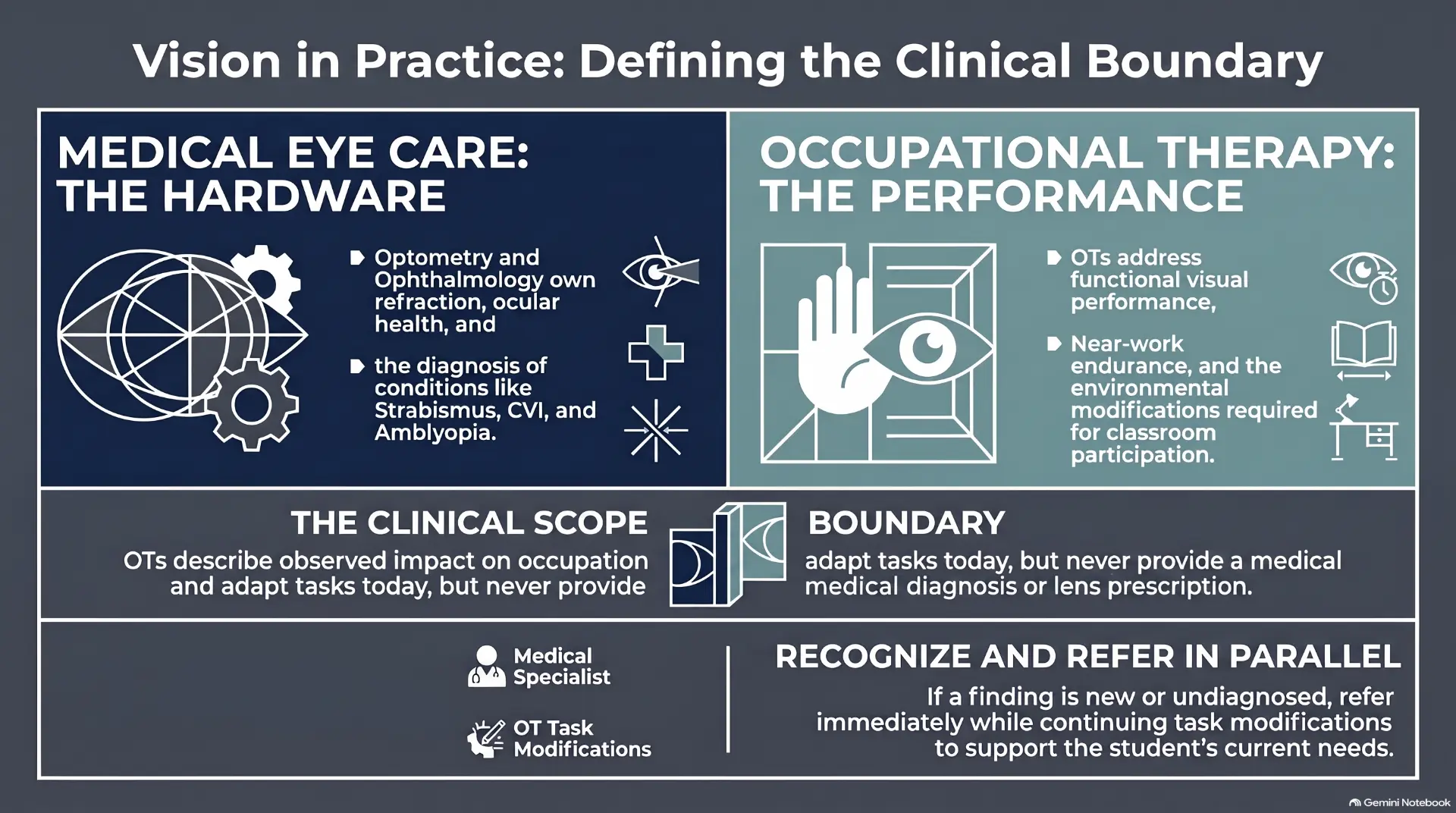
- Diagnoses OTs should recognize but never assign
- Vision work already lives in your school day
Key ideas
Capture these as you listen
- Vision is a client factor under OTPF-4. Treating how it shows up in occupation is squarely inside OT scope.
- The scope line runs along purpose: eye health = optometry, supervised optometric care = vision therapy, occupational performance = OT.
- Adaptation (Level 1 of the Framework) is OT intervention, not 'waiting for the doctor.'
Notes
My notes for this module
Reference figures
Keep these for practice
Documentation example — scope-safe present level
Out of scope
“Student has convergence insufficiency and a visual processing disorder, causing reading failure. Vision therapy is recommended.”
Scope-safe
“During 20-minute near copy tasks, the student completes 40% of assigned lines and loses place an average of 6 times, reporting blur after 6 minutes. Performance improves to 75% with an enlarged, line-isolated model. Referral to eye care has been made.”
Photo — working distance and posture at the desk
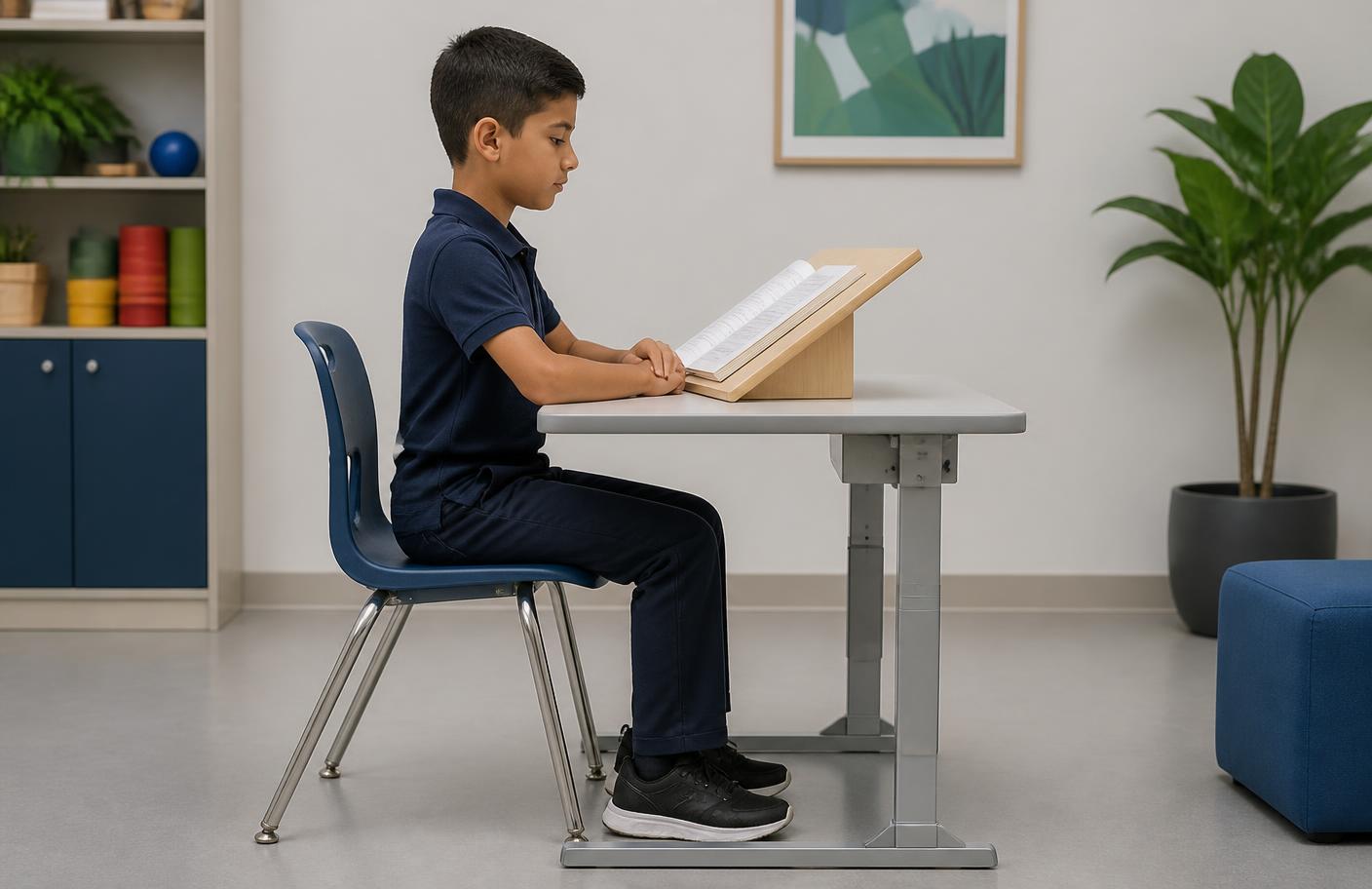
Reference posture
Feet flat, hips and knees near 90°, elbows at desk height, trunk upright and off the table.
≈40 cm at midline
A slant board holds the page at a consistent distance and angle; note any habitual 15–20 cm posture.
What to document
Head tilt, page rotation >30°, one eye closing, or distance shortening as the task lengthens.
Apply it
Case prompt
You get a teacher email: 'Kaia passed the school vision screen but still can't copy from the board. Should I even refer to you?' Draft a two-sentence reply that names your scope clearly and invites the referral.
Practice
Mini exercise
In one sentence, describe the OT scope for vision without using the words 'therapy,' 'eye doctor,' or 'refer.' Write it down before you move on. If you can defend it to a school administrator, you own the framing.
Take it to work
Action step this week
This week, audit one of your own progress notes. Circle every sentence that names a visual function tied to an occupation. If you can't circle at least one, rewrite it so you can.
Module 2
The Five-Level Visual Performance Framework
Follow along
What this module covers
- Visual development milestones OTs should know
- How the Five-Level Framework was built
- Two rules for choosing where to start
- The same four-part shape, every level
Key ideas
Capture these as you listen
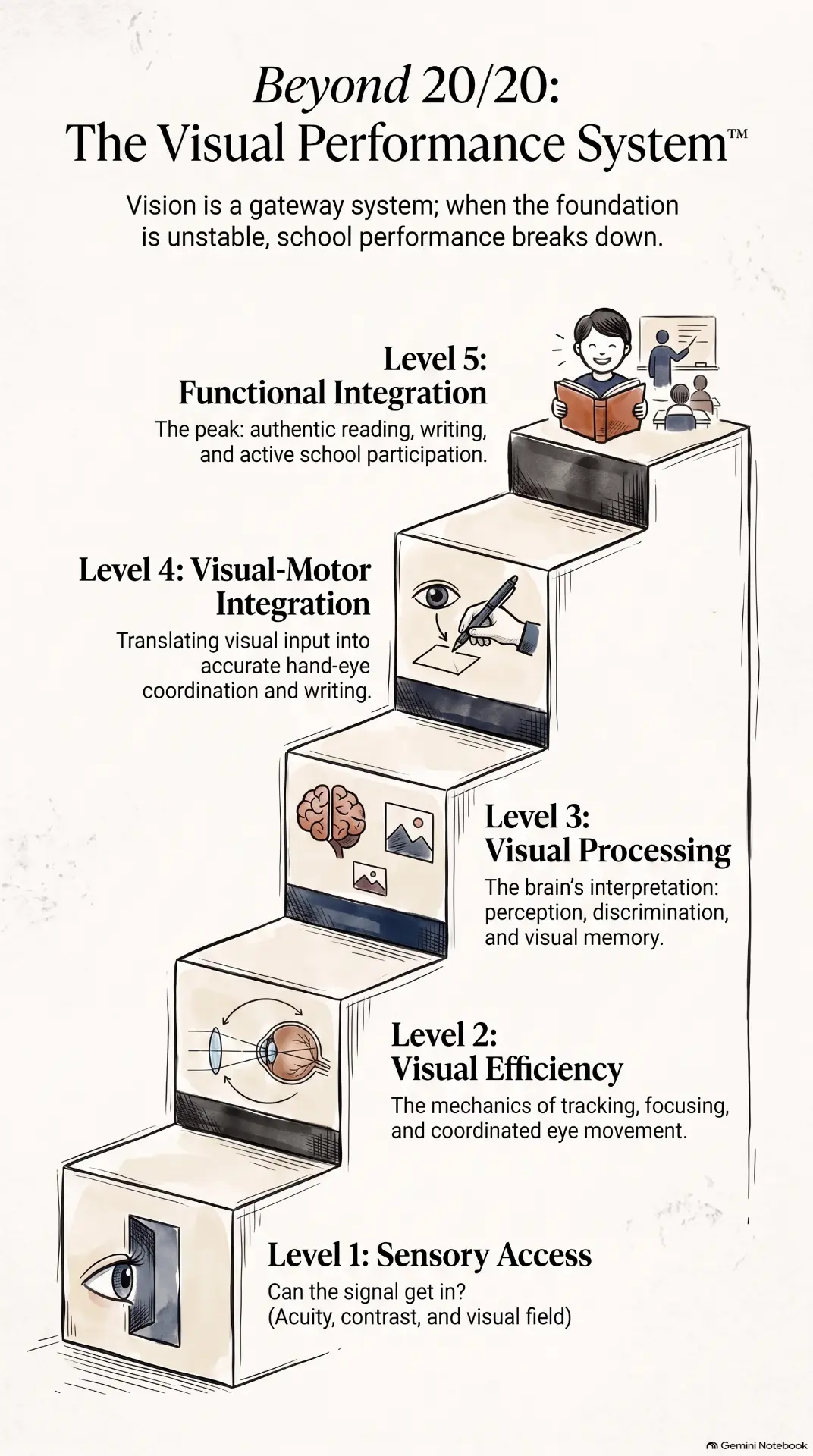
- The Framework has five levels, Access, Efficiency, Processing, Visual-Motor Integration, Functional Integration, each with its own assessment and intervention logic.
- Never intervene above an unstable level. Stabilize the floor, then build up.
- Every OT goal names Level 5 (occupation) as the outcome, even when the intervention targets a lower level.
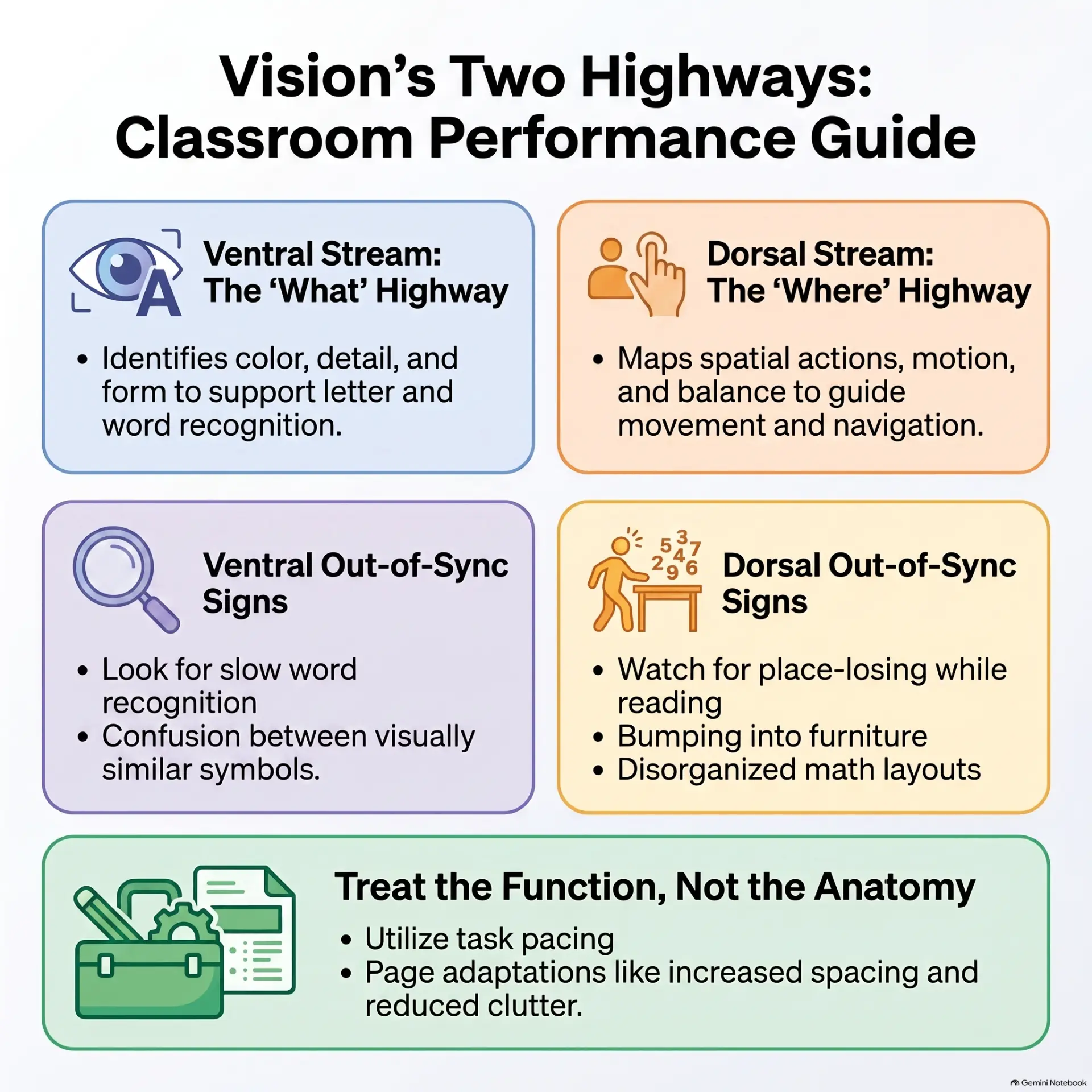
- The floors map (imperfectly but usefully) onto two neural pathways: magnocellular / dorsal stream (motion, low contrast, gaze control, Level 2 and spatial Level 3) and parvocellular / ventral stream (high-contrast form, color, memory, object Level 3 and Level 4). The tracts explain transmission only — OT does not treat or train a pathway; we address the functional components it supports and the task and environment around them.
- Each level has its own functional signature in the school day and its own OT intervention direction: Level 1 adapt-and-refer, Level 2 remediate efficiency, Level 3 reduce visual load and teach strategy, Level 4 separate visual from motor before treating, Level 5 write the goal.
- Run two threads at once, remediation on the unstable floor and compensation that keeps the occupation running while that floor is rebuilt.
- Every session follows the same four-part shape: baseline probe, graded work on the unstable floor, the same skill inside real classroom material, and a written hand-off to the teacher.
- VML resources are organized by the same five floors, screener and acuity/contrast ladders at Level 1, interactive oculomotor stimuli and anaglyph packets at Level 2, processing activities with matched worksheets at Level 3, handwriting-readiness and visual-motor packets at Level 4, and grade-banded reading/writing probes plus treatment templates at Level 5.
Notes
My notes for this module
Reference figures
Keep these for practice
One example per level
Level 1 · Access
Level 2 · Efficiency
Level 3 · Processing
Level 4 · Visual-motor
Level 5 · Functional
Apply it
Case prompt
A first grader cannot finish copying the morning message before the class moves on; the teacher reports he looks up, looks down, and has lost his place. On follow-up he has 20/20 acuity, PASSes saccades and convergence, but scores 2 of 5 on a visual-memory copy task. Which contributing level is limiting the occupation, and which is intact?
Practice
Mini exercise
Sketch the continuum from memory, left to right: five stations running from access to occupation. Label each with one word and one skill. Compare against the diagram above. Anything you missed is a note-to-self, not a failure.
Take it to work
Action step this week
Pull three current caseload students. On a sticky note for each, write which single Framework level is their primary limiter. Post them where you plan next week.
Module 3
Screening vs. Assessment
Follow along
What this module covers
- The two-step in practice
- What VML gives you at the screening step
- What turns a flag into a Full VPA™
Key ideas
Capture these as you listen
- Screening asks 'is there a concern', 15 minutes, PASS/FLAG, no plan of care. Assessment asks 'what and what next', 30–60 minutes, VPL per level, generates the plan.
- Every referral runs through the same pipeline: history → screen → decision → assessment (if warranted) → plan.
- You can screen without instrumentation. Standardized rubrics help, they do not replace clinical observation.
Notes
My notes for this module
Reference figures
Keep these for practice
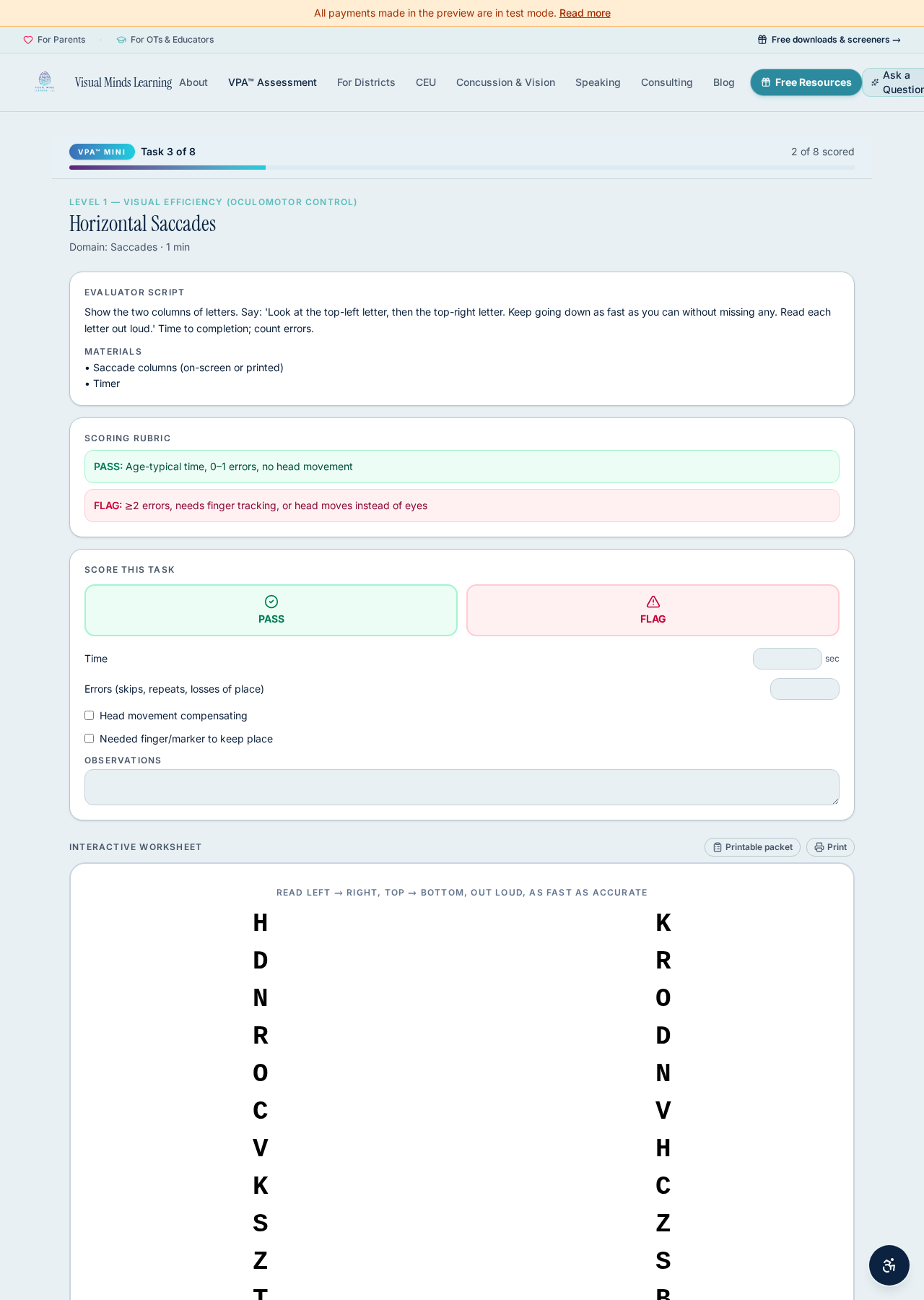
Screenshot — Mini VPA™ probe in progress
Say
“Look at the star, then the circle, and keep going back and forth until I say stop. Move only your eyes.”
Do
Hold targets 20 cm apart at 40 cm, eye level. Time 30 s. Watch for head movement, undershoot, loss of place, and reported blur.
Score the level reached
Photo — screening setup at 40 cm

Near probes · 40 cm
Card at midline and at eye level; measure from the spectacle plane, not the forehead.
Table/screen · 60 cm
Use the same distance at screening and re-probe — a distance change invalidates the comparison.
Base of support
Feet supported and hips at 90° before any oculomotor scoring; postural drift reads as an efficiency deficit.
Apply it
Case prompt
A student is rereading lines and losing place during silent reading, and independent seatwork is not getting finished. She PASSed acuity and processing on the Fast Screener but FLAGged saccades. Do you refer to optometry, schedule the Mini VPA, or both, and why?
Practice
Mini exercise
Write out your current vision workflow in five arrows. Circle every step where a decision is made. If you cannot find a clear PASS/FLAG decision node, that is your first workflow fix.
Take it to work
Action step this week
Time yourself running the Fast Screener on a colleague. If you exceeded 20 minutes, note where the drag happened. Efficiency at the screen protects your caseload capacity.
Module 4
IEPs, Medicaid, and Functional Documentation
Follow along
What this module covers
- What a reviewer needs to see
- Occupation-based goals, not skill-drill goals
- What has to be in the note
- Write accommodations from measured conditions
Key ideas
Capture these as you listen
- Goals live at Level 5 (occupation). The intervention plan describes work at whichever floor is unstable.
- Every note must connect today's intervention to a specific IEP goal, with a number.
- Avoid 'vision therapy,' 'orthoptics,' and 'eye exercises', those are supervised optometric terms and pull your work out of OT scope on the page.
Notes
My notes for this module
Reference figures
Keep these for practice
Screenshot — IEP present level and goal
Present level
Completes 40% of assigned copy lines in 20 minutes with 6 losses of place; 75% with an enlarged, line-isolated model.
Annual goal
By 05/2027, during 20-minute near copy tasks with standard classroom materials, the student will complete 80% of assigned lines with no more than 2 losses of place, across 3 consecutive data collection sessions.
How it is measured
Same 20-minute copy probe, same distance and lighting, collected every 4 weeks.
Screenshot — progress-monitoring data table
| Probe | Lines complete | Losses of place | Student report |
|---|---|---|---|
| Baseline | 40% | 6 | Blur reported at 6 min |
| Week 4 | 52% | 5 | Blur at 9 min |
| Week 8 | 66% | 3 | No blur reported |
| Week 12 | 81% | 2 | Goal criterion met (1 of 3) |
Apply it
Case prompt
Rewrite this goal as OT-defensible: 'Student will improve convergence and saccadic accuracy to grade-level norms with 80% accuracy.' Keep the visual function; move the goal to Level 5.
Practice
Mini exercise
Write one OT vision goal using the five-part anatomy, condition, learner, behavior, criterion, support, for a student you are actually seeing. Read it out loud. If it does not sound like a real occupation, rewrite the condition clause.
Take it to work
Action step this week
Open one active IEP. Check that (a) the OT vision goal is at Level 5, (b) your last session note has a number, (c) you have not used any of the three forbidden phrases. Fix whatever is broken today.
Module 5
Case Walkthroughs
Follow along
What this module covers
- How to read any profile in four steps
Key ideas
Capture these as you listen
- Every case runs through six moves: concern → screen → assess → interpret → plan → re-measure.
- The framework applies across ages and settings, school, preschool, adult home health, with the same sequence and different task samples.
- Interpretation matters more than scores. Two students with identical VPLs can have different plans if Level 5 occupations differ.
Notes
My notes for this module
Reference figures
Keep these for practice
Screenshot — domain profile graph
Work sample — student writing or copy task
Apply it
Case prompt
Pick the case above that looks most like a student on your current caseload. Where in the six-move sequence did you stop last time? What is the next move you owe them?
Practice
Mini exercise
For each of the three cases above, write the primary Framework level of intervention and the primary occupation named in the IEP-level goal. Check yourself against the walkthrough. Any mismatch is a signal about where your framework fluency needs another rep.
Take it to work
Action step this week
Book 45 minutes this week to run the six-move sequence on one referral start-to-finish. Do not skip any move. Then note where you got stuck, that is your next skill target.
Module 6
Who Does What — Supports, Roles, and Collaboration
Follow along
What this module covers
- Vision is already inside the OT domain
- Four tiers, four owners
- Design first, accommodate second, treat third
- One question you ask, one thing you hand back
- Teaching the team is part of the treatment
Key ideas
Capture these as you listen
- UDL is the delivery system for your plan: write prevention, accommodation, and intervention for every flagged level — adaptation is intervention, not a delay.
- Levels 1 through 5 are all usable. Misrepresenting the level is the error, not using lower-level evidence.
- Convergence insufficiency carries Level 1 support for vergence therapy managed by optometry; the OT contribution is occupational endurance, grading, and environmental modification.
- Perceptual drills show weak transfer to academics. Embed the visual demand inside the occupation instead.
- A level-based visual performance framework is an organizing structure (Level 5) resting on independently supported components. Never report VPA results as standard scores or percentiles.
- FITT-P plus occupation-level outcome data is what makes a Level 4/5 technique defensible in documentation.
Notes
My notes for this module
Reference figures
Keep these for practice
Screenshot — Treatment Template with dosage
Frequency
3× / week
Intensity
Line-isolated → full page
Time
15 min embedded
Type
Copy task within academics
Progression
Fade guide at 80% × 3
Apply it
Case prompt
Pick one student. Write three short lines: one prevention change the teacher owns, one accommodation the team writes, and one OT-only target with how you will measure it in classwork.
Practice
Mini exercise
Take a strategy you use weekly. Say out loud, in one sentence, how strong the evidence for it is and what you will measure. If you cannot name the measure, change the strategy or change the measure.
Take it to work
Action step this week
This week, hand one teacher a single page with two changes to try tomorrow. Two weeks later, check whether it is still happening when you are not in the room.
Module 7
Competency Wrap-Up
Follow along
What this module covers
- Self-check before the exam
- Four mistakes to stop making
Key ideas
Capture these as you listen
- Ten questions, pass at 8 of 10, unlimited retakes. First pass is what appears on the certificate.
- The certificate is verifiable, anyone can look up your code at visualmindslearning.com/ceu/verify to confirm completion.
- Lifetime access. Come back to the modules whenever a real case forces you to sharpen a specific move.
Notes
My notes for this module
Reference figures
Keep these for practice
Screenshot — completed clinical report
Image — course completion / certificate sample
Certificate of Completion
Visual Minds Learning
This certifies that
Learner name
has completed
Why Visual Performance Matters: Foundations for Occupational Therapy Practice
Apply it
Case prompt
Before you take the quiz, describe (in your head) the one concept from this course you are most likely to change in your practice on Monday.
Practice
Mini exercise
Do the three-question self-check in the module body out loud. If you get through all three cleanly, take the quiz. If any answer wobbles, revisit the source module before you start.
Take it to work
Action step this week
After you pass, share your certificate code with one colleague and walk them through the Framework in five minutes. Teaching it is how you own it.
Video and demonstration reflections
Use this page for any video, demonstration, or case walkthrough in the course.
What did you notice about the clinician and the student?
How could you use this with a student on your caseload?
Would you do anything differently?
What questions do you still have?
Wrap-up reflections
Use this space to note:
- Strategies to try with your students next week
- Resources or materials to explore
- Information to share with your team
- Anything you want to remember