6.1 — Evidence Base, Levels of Evidence, and Selecting Graded Intervention
Transition- 2:14 – 2:40
Say this
Transition: "Evidence Base, Levels of Evidence, and Selecting Graded Intervention."
My notes
Presenter study handout
3 contact hours · 0.3 AOTA CEUs · Module 6 · 21 slides
Presenter-side material. Each block shows the slide as the audience sees it, the talk track, and space for your own notes. Model answers appear here — do not hand this version to learners.
Say this
Transition: "Evidence Base, Levels of Evidence, and Selecting Graded Intervention."
My notes
Say this
Open here. "Who Does What — Supports, Roles, and Collaboration." Turning one flagged level into a plan the whole team can carry, and saying honestly what it rests on.
Say why this section matters for their caseload, then advance.
My notes
Say this
Ask the poll: "When you choose a vision-related strategy, what usually decides it?"
Options:
• Published evidence for that strategy
• What is in the supply closet
• What the student will tolerate
• What I was taught in fieldwork
Take a show of hands or the on-screen tally, then name the pattern you see before advancing.
My notes
Say this
Frame the slide: "Vision is already inside the OT domain."
Walk each point, one sentence each:
• We describe vision as a client factor: acuity, field, eye-movement control, focusing, perception.
• We measure it as a performance skill: what the eyes actually do during reading, writing, dressing, play.
• We change it in context: light, glare, print size, contrast, seating, clutter.
• The eye itself — health, glasses, prism, patching — is not ours. That is a referral, every time.
Point at the figure while you talk — name the parts before the labels.
Close with: "If you only take one of these back, take the first one."
My notes
Say this
Frame the slide: "Four tiers, four owners."
Walk each point, one sentence each:
• Prevention is classroom design — the teacher and team own it; we suggest and model it.
• Accommodation is written access for one student — the team writes it; we trial it and word it.
• Intervention is skill-building inside the real task — this is the OT-only tier.
• Eye health, lenses, prism, and patching belong to optometry or ophthalmology.
Point at the figure while you talk — name the parts before the labels.
Close with: "If you only take one of these back, take the first one."
My notes
Say this
Frame the slide: "Design first, accommodate second, treat third."
Walk each point, one sentence each:
• Universal Design for Learning simply means: build the room so fewer students need a fix.
• Three questions — how is it shown, how do they respond, how do we keep them going?
• Our five levels name the barrier. UDL names what changes on Monday morning.
• Adaptation is intervention. It is not waiting for the doctor.
Point at the figure while you talk — name the parts before the labels.
Close with: "If you only take one of these back, take the first one."
My notes
Say this
Run the five levels bottom-up.
Name each level, then say which one you assess first and why.
My notes
Say this
Frame the slide: "One question you ask, one thing you hand back."
Walk each point, one sentence each:
• Teacher: when does the work fall apart? Give two changes to try tomorrow, in writing.
• Family: when was the last eye exam? Give plain-language findings and why an exam matters.
• Eye care: does the exam limit near work? Give what you saw in real reading — described, not diagnosed.
• Student: what makes your eyes tired? Give a signal and a self-check they control.
Point at the figure while you talk — name the parts before the labels.
Close with: "If you only take one of these back, take the first one."
My notes
Say this
Frame the slide: "Teaching the team is part of the treatment."
Walk each point, one sentence each:
• A 10-minute in-service beats a 3-page email nobody opens.
• Leave one printable page behind — the checklist survives the meeting.
• Show, then watch them do it once. Handoff is a skill, not a handout.
• Re-check in two weeks: is the support still happening when you are not there?
Close with: "If you only take one of these back, take the first one."
My notes
Say this
Read the scenario aloud, slowly:
Maya writes legibly for about five minutes, then letter size and spacing fall apart. Copying from the board, she skips lines and asks her neighbor where they are. Eye exam last year was normal. Level 2 (efficiency) and Level 4 (visual-motor) flagged.
Then put these questions to the room:
• What is one change that would help every student in that room?
• What would you write into her plan just for her?
• What is the OT-only piece, and how will you know it worked?
Answer to Q1: Prevention (teacher owns): hand out a paper copy of anything written on the board, and keep worksheets to one task per page at 14–18 pt. No eligibility needed, no cost, and the whole class copies less.
Answer to Q2: Accommodation (team writes it, staff carry it out): reduced copying — fill-in notes instead of full board copy — plus extended time on written work. You supply the wording after trialing it and seeing her output hold.
Answer to Q3: Intervention (OT only): graded copying and place-keeping practice inside her actual classwork, plus visual-motor work on letter size and spacing. Measure it in classwork: minutes until legibility breaks down, and number of lines skipped per copy task. Baseline first, re-probe every two weeks.
My notes
Say this
Read the scenario aloud, slowly:
Devon reads fine for a paragraph, then rubs his eyes and stops. He says the words "go blurry" late in the period. No eye exam on file for three years.
Then put these questions to the room:
• What do you refer, and what do you keep treating while you wait?
• Name one prevention change, one accommodation, and one OT target.
Give 60 seconds of think time before you take answers. Model answers are in the panel beside this script.
My notes
Say this
Frame the slide: "Say plainly what your plan rests on."
Walk each point, one sentence each:
• Strongest support: practicing the actual occupation — reading, writing, the real task.
• Good support: changing print, contrast, lighting, and workload for near-work access.
• Weak support: isolated perceptual drills expected to raise reading scores on their own.
• Write the strength of the evidence in the plan. Overstating it is the only real error.
Close with: "If you only take one of these back, take the first one."
My notes
Say this
Frame the slide: "Three quick checks."
Walk each point, one sentence each:
• Does this activity load the level that is actually unstable?
• Does it look like the occupation she has to do in class?
• Can I measure the change with the baseline I already ran?
Point at the figure while you talk — name the parts before the labels.
Close with: "If you only take one of these back, take the first one."
My notes
Increase visibility / Enhance
Augment / Substitute
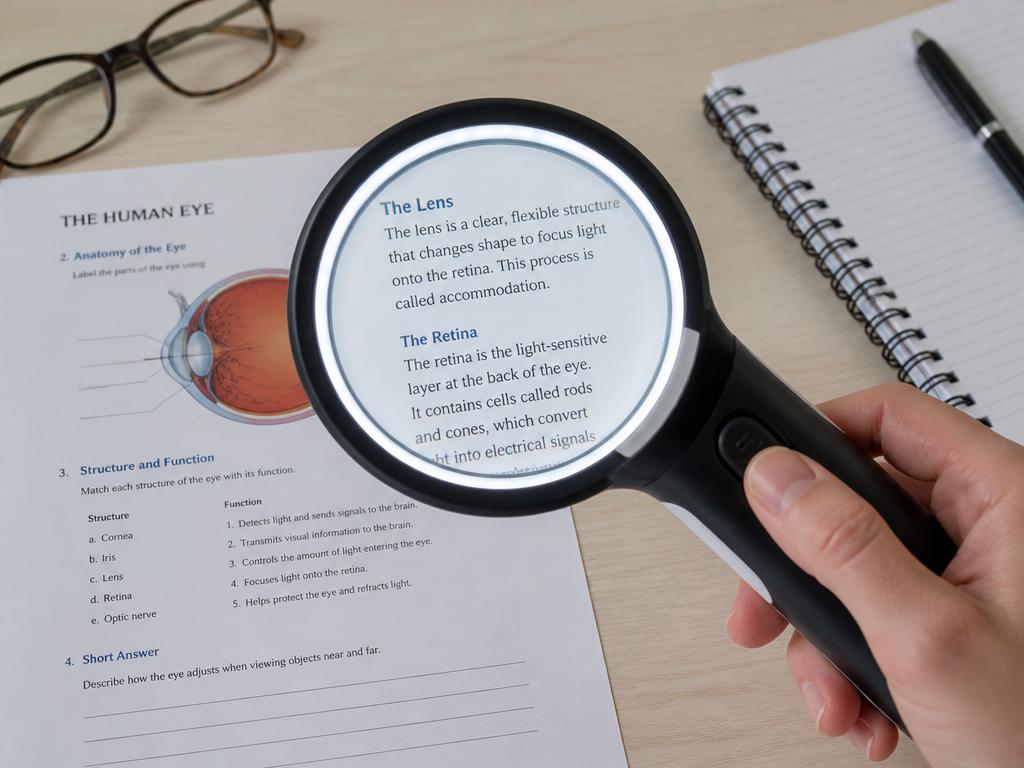
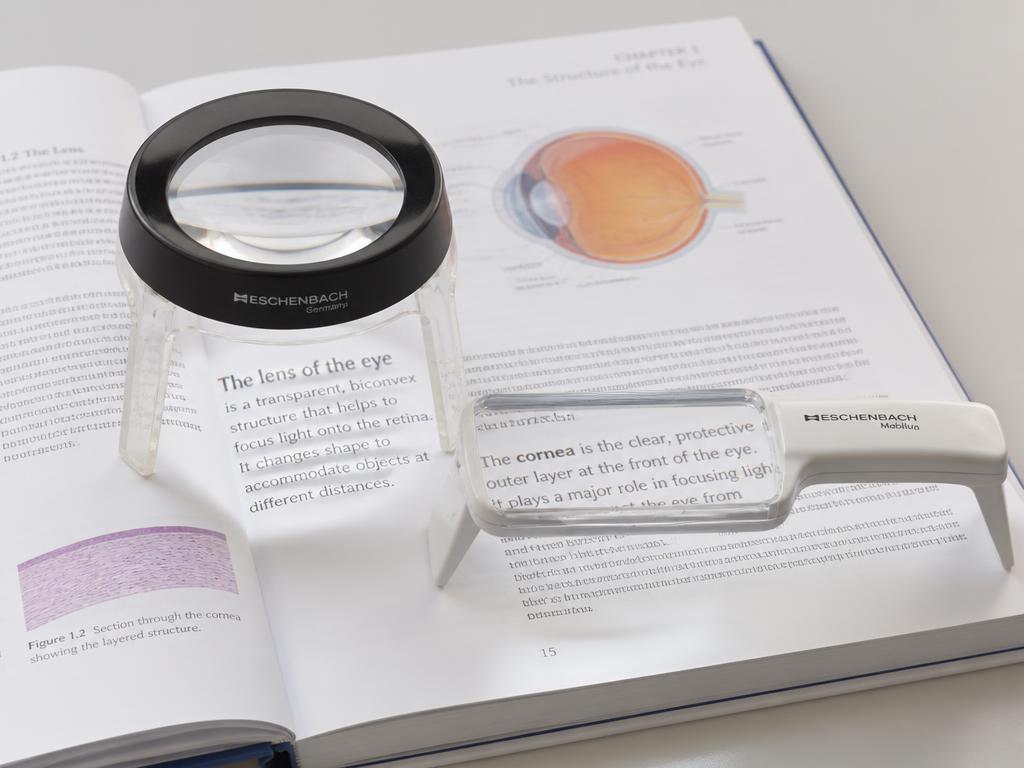
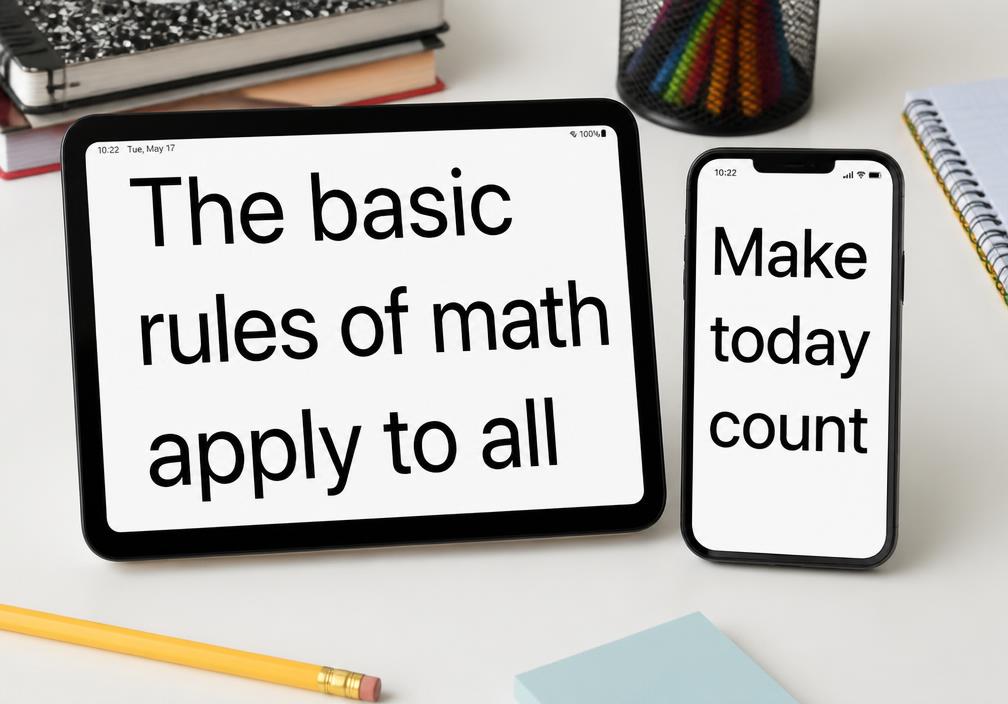
Handheld magnifier
Short spot tasks: price tags, labels, a single line of text.
Portable and cheap; requires a steady hand and short focal distance.
Stand magnifier
Sustained near work for students with tremor or poor motor control.
Fixed focal distance holds the lens steady; less portable, needs desk space.
Hands-free / spectacle
Writing and bimanual tasks where both hands must stay free.
Prescribed by the eye care team; very short working distance at high power.
Telescope (mono/binocular)
Distance targets: the board, signage, a demonstration across the room.
Spot use only — narrow field, not for travel or continuous viewing.
Electronic / video magnifier (CCTV)
Long reading and writing sessions; textbooks, worksheets, science labs.
Adds adjustable magnification, reverse contrast, and speech; cost and setup.
Built-in digital magnification
Phone/tablet zoom, text enlargement, VoiceOver, screen readers.
Already in the student’s hands and free; teach it before purchasing hardware.
Say this
Contrast the two columns: Increase visibility / Enhance versus Augment / Substitute.
Increase visibility / Enhance:
• Increase visibility: more light, higher contrast, bigger target, less clutter — an 18 pt high-contrast worksheet at a glare-free desk.
• Enhance: magnify or move the target closer — a handheld magnifier for a map; a magnified medication label at home.
Augment / Substitute:
• Augment: add another channel alongside vision — text-to-speech with the print; talking labels on containers.
• Substitute: replace vision when the signal cannot be made usable — full audio text and dictation; tactile marks on stove dials.
Ask: "Which column is your student living in right now?"
My notes
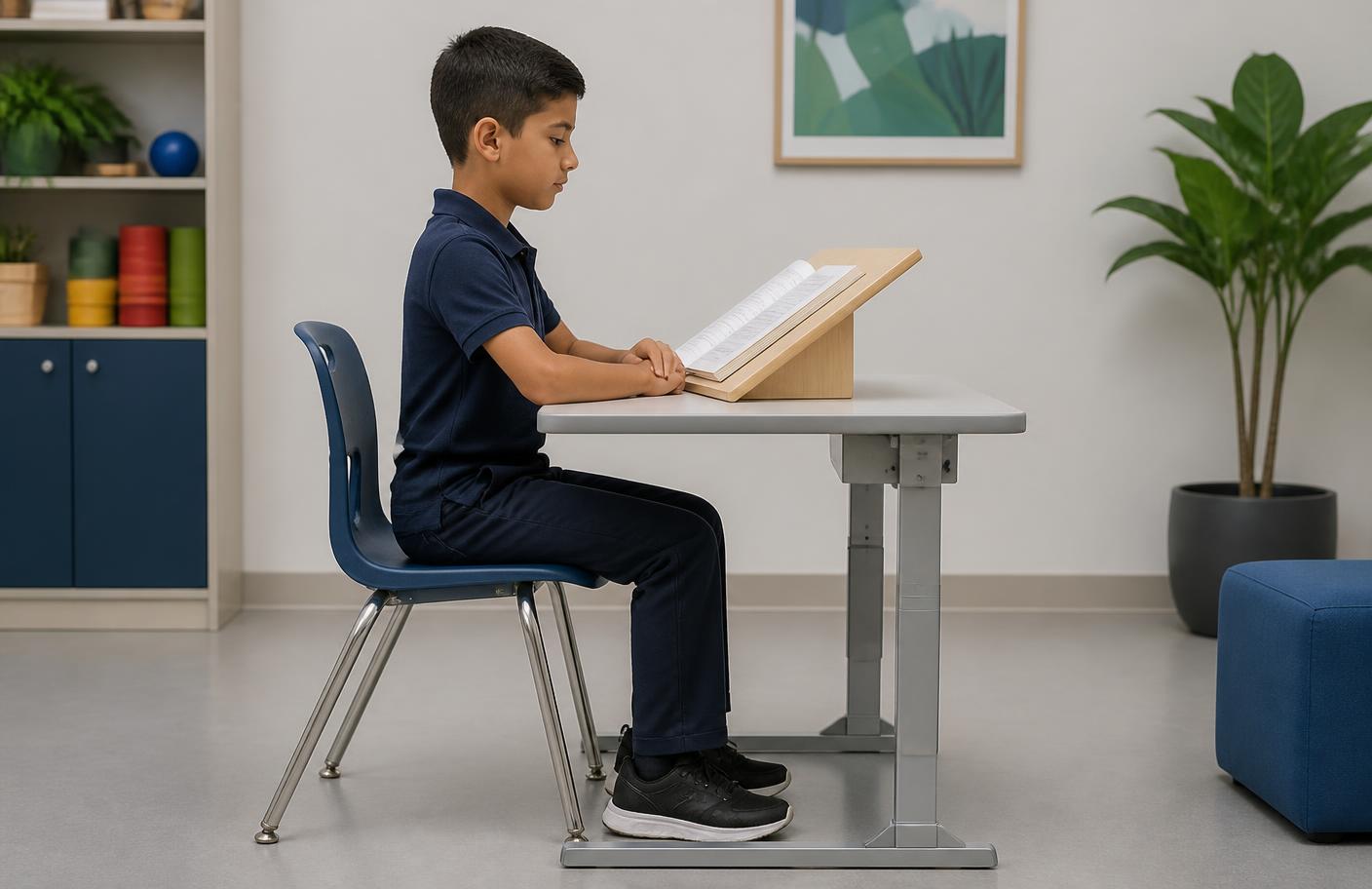
Reference posture
Feet flat, hips and knees near 90°, elbows at desk height, trunk upright and off the table.
≈40 cm at midline
A slant board holds the page at a consistent distance and angle; note any habitual 15–20 cm posture.
What to document
Head tilt, page rotation >30°, one eye closing, or distance shortening as the task lengthens.
Say this
Frame the slide: "The classroom modification set."
Walk each point, one sentence each:
• Lighting: even light on the task; never backlight the student.
• Glare: matte surfaces, blinds, seating angled away from windows.
• Contrast and print: dark on plain, bold lines, sans-serif, larger size, one task per page.
• Line guides or typoscopes to cut place-loss.
• Seating with a consistent, close view of the board.
• Tech: text-to-speech, screen magnification, tablet copy of shared material.
Point at the figure while you talk — name the parts before the labels.
Close with: "If you only take one of these back, take the first one."
My notes
Say this
Set up the clip in one sentence, play it, then debrief with "what did you notice?"
My notes
Say this
Describe what belongs here: Screenshot from the VML Treatment Templates showing LTG/STO and dosage..
My notes
Say this
Land the "so what": Choosing the right activity and delivering it two minutes a week produces the same result as choosing the wrong one.
Explain the mechanism plainly: The evidence base for visual-performance intervention is dosage-sensitive; FITT-P gives you frequency, intensity, time, type, and progression to write into the plan.
Then give them the moves — say each one as something they can do Monday:
• Write dosage into the plan: how often, how long, how graded.
• Grade by one variable — distance, size, speed, or complexity — never several at once.
• Reassess on a 9-week increment so the data lines up with IEP reporting.
Tell them what success looks like: A plateau at the same grading step for three weeks — change one variable, not the whole program.
Ask: "Who has a student this describes right now?" Take one answer, then move.
My notes
Say this
Two-minute case. Read it aloud:
A team asks you to add a visual-efficiency activity to a student's plan. You see the student once every two weeks for 30 minutes.
Put the question to them: "How do you make this dosage-honest?" Give 60 seconds, no talking.
Model answer (reveal after they commit): Do not deliver the intervention only in your session. Set a short daily classroom or home repetition with a named grading step, use your biweekly slot for grading and fidelity checks, and document the actual frequency delivered. If the classroom cannot run it daily, change the intervention rather than the expectation.
Close with the rule: Write the dosage you can actually deliver, then measure against that.
My notes
Say this
Reflection prompt: "Name one strategy you use weekly. What level of evidence supports it, and how would you justify it in a meeting?"
Offer the sentence starter: "I use [strategy] for [level]. The evidence is... In a meeting I would say..."
Think for one minute, write, then take two shares.
My notes
Say this
Knowledge check: "What makes an environmental adaptation defensible in documentation?"
Options:
• It is inexpensive and easy to implement
• It is matched to an identified performance level and justified by the evidence supporting it
• The teacher requested it
• It was effective for a previous student
Correct answer: option 2. Rationale: Matching to the identified level plus a stated evidence rationale is what makes the selection reviewable by anyone reading the plan.
My notes