3.1 — Age bands, stimulus selection, and setup: working distance, lighting, materials, positioning
Transition- 0:50 – 1:20
Say this
Transition: "Age bands, stimulus selection, and setup: working distance, lighting, materials, positioning."
My notes
Presenter study handout
4 contact hours · 0.4 AOTA CEUs · Module 3 · 20 slides
Presenter-side material. Each block shows the slide as the audience sees it, the talk track, and space for your own notes. Model answers appear here — do not hand this version to learners.
Say this
Transition: "Age bands, stimulus selection, and setup: working distance, lighting, materials, positioning."
My notes
Say this
Open here. "Age Bands, Stimuli, and Setup." Working distance, lighting, materials, and positioning — the fidelity floor.
Say why this section matters for their caseload, then advance.
My notes
Say this
Ask the poll: "How consistently is your working distance actually measured?"
Options:
• Measured every administration
My notes
Say this
Frame the slide: "Non-negotiables before the first item."
Walk each point, one sentence each:
• Intermediate tasks at 60 cm, near tasks at 40 cm — measured, not estimated.
My notes
Say this
Frame the slide: "Why stimuli change with the band."
Walk each point, one sentence each:
• Level content is developmentally scaled — shapes, then letters, then words, then sentences.
My notes
Say this
Contrast the two columns: 5–7 and 8–11 versus 12–16 and 17+.
5–7 and 8–11:
• Shapes and single letters at the lower levels
My notes
Say this
Contrast the two columns: What stays the same at L4 / L5 versus What the student actually sees.
What stays the same at L4 / L5:
• Difficulty is set by the level: 18 px print at L4, 12 px at L5; 8 then 10 saccade items per column.
My notes
Say this
Contrast the two columns: Band-adapted (the material changes) versus Level-only (deliberately band-neutral).
Band-adapted (the material changes):
• Saccade columns — symbols and CVC words at 5–7, letters and multi-syllable words at 8–11, digit/letter pairs with academic vocabulary at 12–16, alphanumeric pairs with clinical vocabulary at 17+.
My notes
Say this
Land the "so what": Working distance, lighting, and positioning change scores more than most skill differences you are trying to detect.
Explain the mechanism plainly: If setup drifts between administrations, your progress line measures your setup, not the student.
Then give them the moves — say each one as something they can do Monday:
My notes
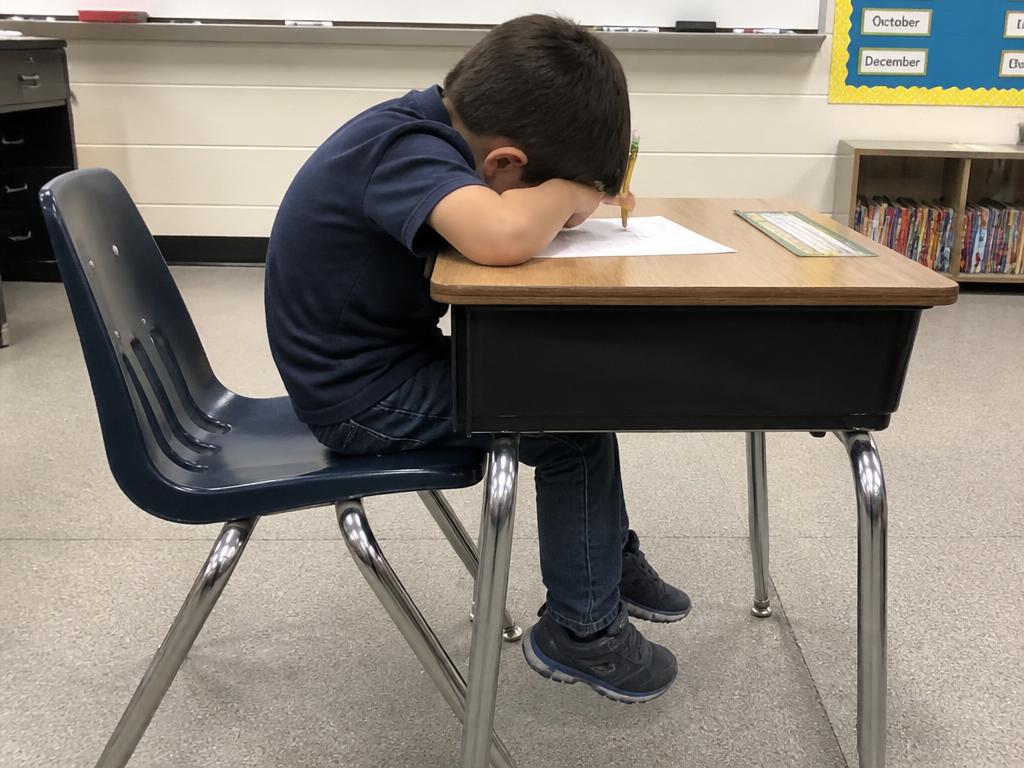
Feet unsupported, trunk collapsed, page about 15 cm from the eyes.

Feet supported, hips back, page raised toward a slant, working distance near Harmon distance.
Fix posture and distance before you score anything. Otherwise you are documenting the setup, not the student.
Say this
Set up the contrast: "Postural setup changes what you are measuring."
Point at the before panel first. Feet unsupported, trunk collapsed, page about 15 cm from the eyes.
Then the after panel. Feet supported, hips back, page raised toward a slant, working distance near Harmon distance.
My notes
Say this
Two-minute case. Read it aloud:
A student scores markedly better at the 9-week reassessment. You administered the first session at a table with the student standing and the second seated with a slant board.
Put the question to them: "What can you report?" Give 60 seconds, no talking.
My notes
Say this
Knowledge check: "A 15-year-old with an intellectual disability reads at a first-grade level and is referred for worksheet navigation. You administer the 12–16 band and she fails Level 4 figure-ground on a text-embedded array. What went wrong?"
Options:
• Nothing — the failure is a valid Level 4 figure-ground finding.
My notes
Say this
Frame the slide: "Eye dominance: Porta and Miles tests."
Walk each point, one sentence each:
• Extended-arm method: patient extends one arm, holds a thumb or wand upright, and aligns it with a distant target using both eyes open.
My notes
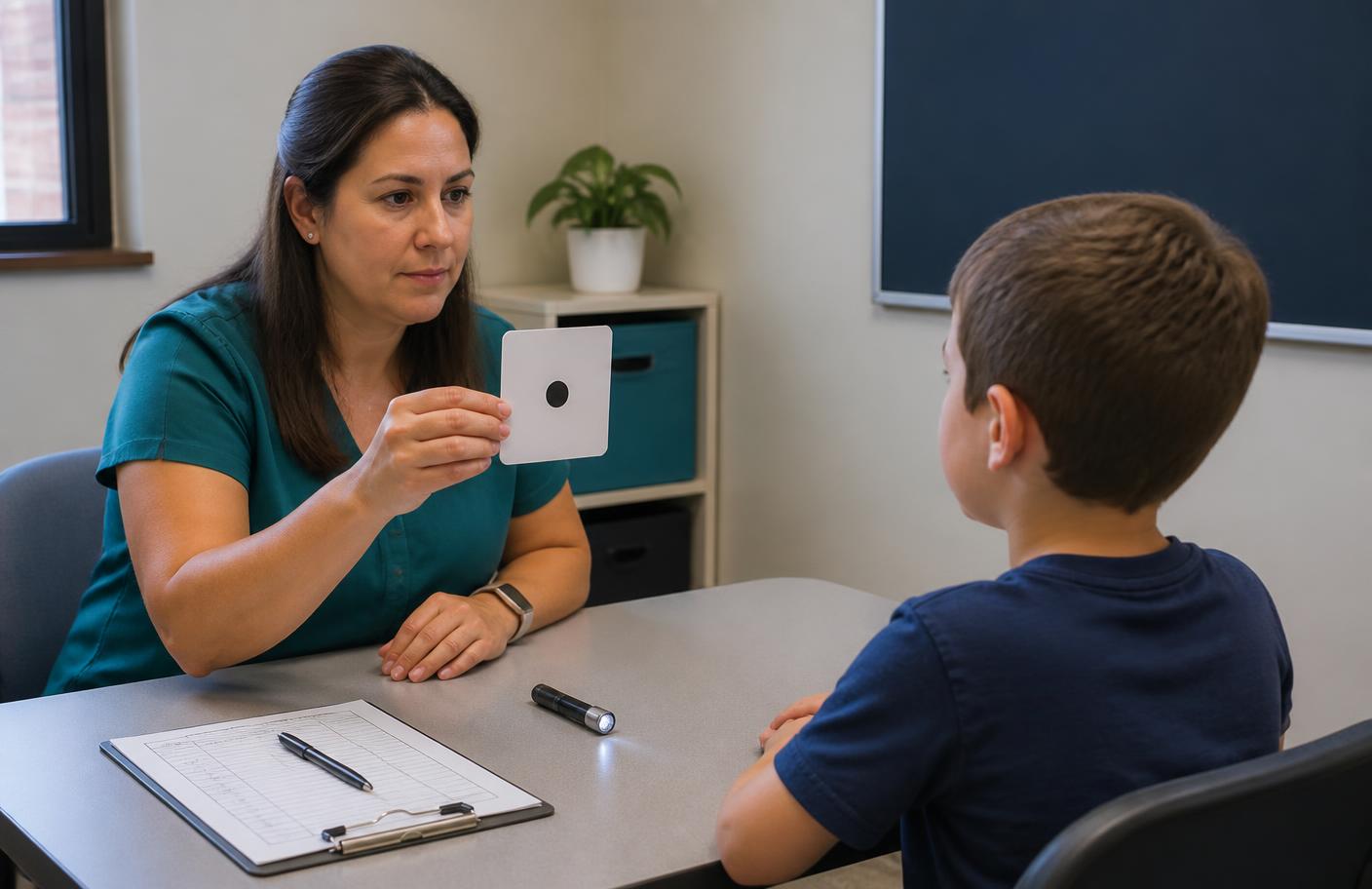
Eye level, off midline
Sit level with the student’s eyes and roughly 30° off midline so both eyes stay visible.
Target at eye level
Held at eye level, not above — an elevated target forces chin-up posture and false head substitution.
Score sheet within reach
Record each trial as it happens; retrospective scoring loses the qualitative signal.
Say this
Contrast the two columns: Cover–uncover versus Alternate cover.
Cover–uncover:
• Student fixates a target; cover one eye, then remove the cover.
My notes
Say this
Frame the slide: "Below the floor of the VPA™."
Walk each point, one sentence each:
• Ages 3–4 use the Pre-K Quick Screen — refer or offer simple activities.
My notes
Say this
Set up the clip in one sentence, play it, then debrief with "what did you notice?"
My notes
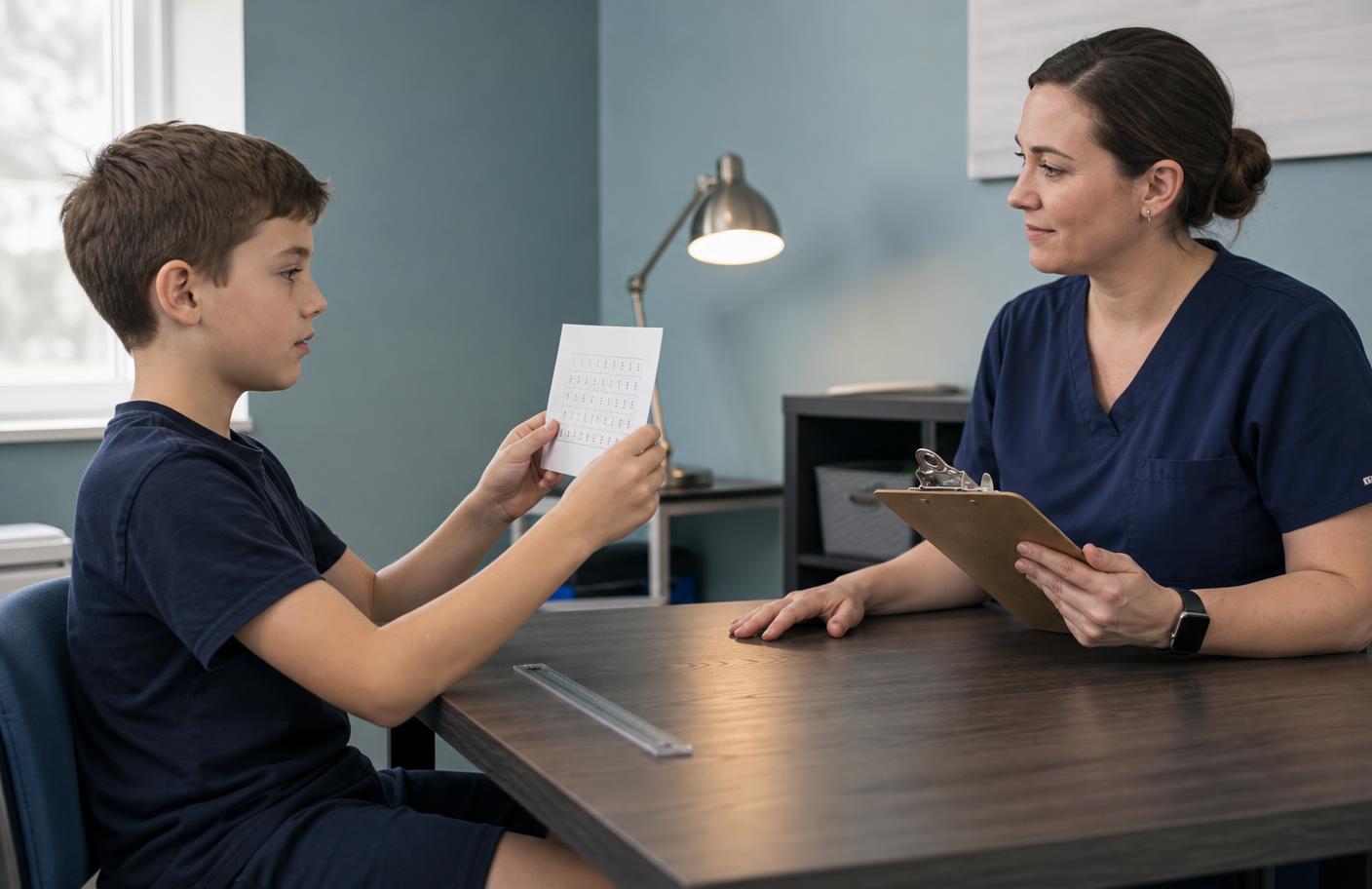
Near probes · 40 cm
Card at midline and at eye level; measure from the spectacle plane, not the forehead.
Table/screen · 60 cm
Use the same distance at screening and re-probe — a distance change invalidates the comparison.
Base of support
Feet supported and hips at 90° before any oculomotor scoring; postural drift reads as an efficiency deficit.
Say this
Describe what belongs here: Two photos or one composite showing both working distances..
My notes
Say this
Describe what belongs here: Band picker showing 5–7, 8–11, 12–16, 17+..
My notes
Say this
Reflection prompt: "Name the two client or contextual factors that will drive age band and stimulus selection for your next student."
Offer the sentence starter: "For [student], the age band is driven by... and the stimulus selection is driven by..."
Think for one minute, write, then take two shares.
My notes
Say this
Knowledge check: "Why is uncontrolled working distance a scoring problem, not just a tidiness problem?"
Options:
• It makes the session run long
My notes