3.1 — Age bands, stimulus selection, and setup: working distance, lighting, materials, positioning
Transition- 0:50 – 1:20
Say this
Transition: "Age bands, stimulus selection, and setup: working distance, lighting, materials, positioning."
My notes
Presenter study handout
4 contact hours · 0.4 AOTA CEUs · Module 3 · 20 slides
Presenter-side material. Each block shows the slide as the audience sees it, the talk track, and space for your own notes. Model answers appear here — do not hand this version to learners.
Say this
Transition: "Age bands, stimulus selection, and setup: working distance, lighting, materials, positioning."
My notes
Say this
Open here. "Age Bands, Stimuli, and Setup." Working distance, lighting, materials, and positioning — the fidelity floor.
Say why this section matters for their caseload, then advance.
My notes
Say this
Ask the poll: "How consistently is your working distance actually measured?"
Options:
• Measured every administration
• Estimated by eye
• Set once at the start of the year
• Not controlled yet
Take a show of hands or the on-screen tally, then name the pattern you see before advancing.
My notes
Say this
Frame the slide: "Non-negotiables before the first item."
Walk each point, one sentence each:
• Intermediate tasks at 60 cm, near tasks at 40 cm — measured, not estimated.
• Even, glare-free lighting; stimulus plane perpendicular to the line of sight.
• Seated with feet supported, work surface at elbow height.
• Habitual correction worn; note if the student left glasses at home.
• Age band selected by chronological age: 5–7, 8–11, 12–16, 17+.
Point at the figure while you talk — name the parts before the labels.
Close with: "If you only take one of these back, take the first one."
My notes
Say this
Frame the slide: "Why stimuli change with the band."
Walk each point, one sentence each:
• Level content is developmentally scaled — shapes, then letters, then words, then sentences.
• Reading and writing probes track grade-level print and demand.
• Distance-specific cards exist for intermediate and near; do not substitute.
Point at the figure while you talk — name the parts before the labels.
Close with: "If you only take one of these back, take the first one."
My notes
Say this
Contrast the two columns: 5–7 and 8–11 versus 12–16 and 17+.
5–7 and 8–11:
• Shapes and single letters at the lower levels
• Shorter passages, larger print, more frequent breaks
• Writing sample: copying and short generative sentences
• Heavier reliance on demonstration in the Do line
12–16 and 17+:
• Words, sentences, and dense paragraph-level print
• Longer sustained-demand probes for endurance
• Writing sample: paragraph generation under time
• Self-report of symptoms carries more diagnostic weight
Ask: "Which column is your student living in right now?"
My notes
Say this
Contrast the two columns: What stays the same at L4 / L5 versus What the student actually sees.
What stays the same at L4 / L5:
• Difficulty is set by the level: 18 px print at L4, 12 px at L5; 8 then 10 saccade items per column.
• Sustained-demand timing is set by the level and the band together — 90 s to 2 min at ages 5–7, 5 to 10 min at 12+ and adult.
• Basal and ceiling rules are identical in every band.
What the student actually sees:
• 5–7: pond and field-trip narratives; saccade columns of shapes and CVC words.
• 8–11: harbor and astronomy passages; letter columns with multi-syllable words.
• 12–16: technology and public-health passages; digit/letter columns with academic vocabulary.
• 17+: acquired brain injury and ocular-motor passages; alphanumeric pairs with clinical vocabulary.
Ask: "Which column is your student living in right now?"
My notes
Say this
Contrast the two columns: Band-adapted (the material changes) versus Level-only (deliberately band-neutral).
Band-adapted (the material changes):
• Saccade columns — symbols and CVC words at 5–7, letters and multi-syllable words at 8–11, digit/letter pairs with academic vocabulary at 12–16, alphanumeric pairs with clinical vocabulary at 17+.
• Reading passages and the read-aloud instruction — separate banked passages, and the expected oral rate anchor moves 45 → 85 → 110 → 130 wpm.
• Writing prompts — name and tracing, then functional words, then sentence stems, then a mock form or memo.
• Visual discrimination trials — shape sets for the youngest band, letter and word sets above it.
• Fixation-under-load: count to 10, count by 2s, or serial 3s backward, by band.
• Functional Integration L1–L5 scripts — reading tier and writing demand are chosen for the band before the block starts.
Level-only (deliberately band-neutral):
• Form constancy, visual closure, and spatial relations — geometric and orientation judgments; the difficulty is the geometry, not the vocabulary.
• Visual memory set size and exposure time — set by level so the same construct is measured across ages.
• Convergence target size and VMI copy figures — scaled by level, identical stimulus across bands.
• Basal, ceiling, rubric (0–3), and achieved-level rules — identical in every band.
Ask: "Which column is your student living in right now?"
My notes
Say this
Land the "so what": Working distance, lighting, and positioning change scores more than most skill differences you are trying to detect.
Explain the mechanism plainly: If setup drifts between administrations, your progress line measures your setup, not the student.
Then give them the moves — say each one as something they can do Monday:
• Measure and record working distance every administration.
• Set posture and lighting before the first item, not after item three.
• Use the same age-band stimuli and the same materials at reassessment.
Tell them what success looks like: A large change at reassessment with no intervention change — check your setup before you celebrate.
Ask: "Who has a student this describes right now?" Take one answer, then move.
My notes
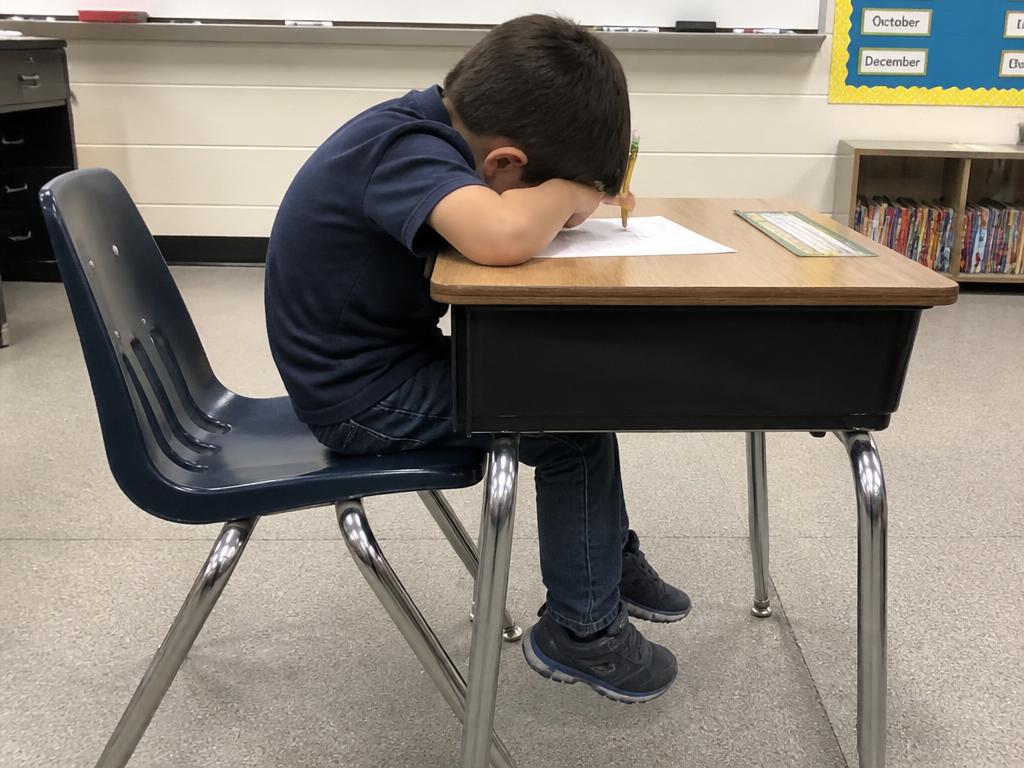
Feet unsupported, trunk collapsed, page about 15 cm from the eyes.

Feet supported, hips back, page raised toward a slant, working distance near Harmon distance.
Fix posture and distance before you score anything. Otherwise you are documenting the setup, not the student.
Say this
Set up the contrast: "Postural setup changes what you are measuring."
Point at the before panel first. Feet unsupported, trunk collapsed, page about 15 cm from the eyes.
Then the after panel. Feet supported, hips back, page raised toward a slant, working distance near Harmon distance.
Say the rule out loud: Fix posture and distance before you score anything. Otherwise you are documenting the setup, not the student.
Ask: "What did we change — the child, or the demand?"
My notes
Say this
Two-minute case. Read it aloud:
A student scores markedly better at the 9-week reassessment. You administered the first session at a table with the student standing and the second seated with a slant board.
Put the question to them: "What can you report?" Give 60 seconds, no talking.
Model answer (reveal after they commit): You cannot attribute the change to the intervention. Document the setup difference, re-administer under the original controlled setup, and report the change only when the conditions match. Note the slant-board response separately as a modification finding.
Close with the rule: Progress data is only interpretable when the setup is held constant.
My notes
Say this
Knowledge check: "A 15-year-old with an intellectual disability reads at a first-grade level and is referred for worksheet navigation. You administer the 12–16 band and she fails Level 4 figure-ground on a text-embedded array. What went wrong?"
Options:
• Nothing — the failure is a valid Level 4 figure-ground finding.
• The text-embedded stimulus measured reading access as much as figure-ground; select down a band and record the substitution and the reason.
• She should have been given the Pre-K Quick Screen instead.
• Figure-ground should be dropped from the protocol for this student.
Correct answer: option 2. Rationale: Band selection defaults to chronological age, but reading or receptive-language access can justify selecting down. Administer the accessible band, record the substitution and why, and interpret against that band. An unrecorded band substitution is the most common cause of uninterpretable VPA™ data — and the Pre-K Quick Screen is for ages 3–4, not for older students with lower reading levels.
My notes
Say this
Frame the slide: "Eye dominance: Porta and Miles tests."
Walk each point, one sentence each:
• Extended-arm method: patient extends one arm, holds a thumb or wand upright, and aligns it with a distant target using both eyes open.
• Porta test: cover one eye at a time — the dominant eye is the one that keeps the object aligned with the target when the other eye is covered.
• Miles test: patient views the target through a small triangle formed by the hands at arm’s length; closing the dominant eye makes the target appear to jump off-center.
• Record which eye is dominant and whether the result is consistent across trials.
• Note if dominance is unstable or switches between trials — this is itself an observation worth recording, not a diagnosis.
Point at the figure while you talk — name the parts before the labels.
Close with: "If you only take one of these back, take the first one."
My notes
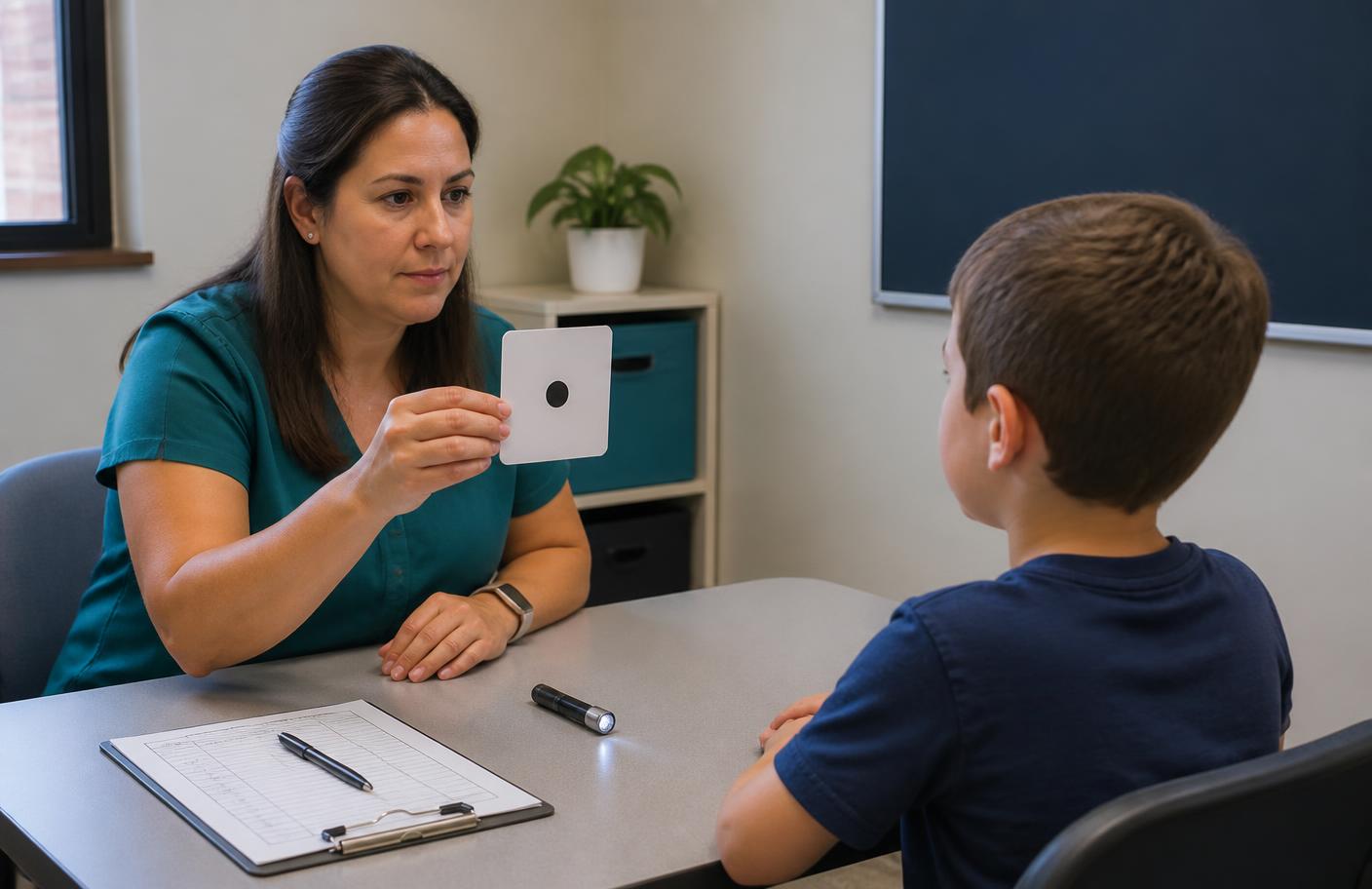
Eye level, off midline
Sit level with the student’s eyes and roughly 30° off midline so both eyes stay visible.
Target at eye level
Held at eye level, not above — an elevated target forces chin-up posture and false head substitution.
Score sheet within reach
Record each trial as it happens; retrospective scoring loses the qualitative signal.
Say this
Contrast the two columns: Cover–uncover versus Alternate cover.
Cover–uncover:
• Student fixates a target; cover one eye, then remove the cover.
• If the uncovered eye moves to re-fixate, that is a sign of a manifest eye turn.
• Note which eye moved and the direction.
Alternate cover:
• Alternate the cover briskly between the eyes.
• Movement as the cover shifts onto an eye suggests a latent deviation.
• Note the direction — in, out, up, down.
Ask: "Which column is your student living in right now?"
My notes
Say this
Frame the slide: "Below the floor of the VPA™."
Walk each point, one sentence each:
• Ages 3–4 use the Pre-K Quick Screen — refer or offer simple activities.
• Do not force a 5–7 band protocol onto a preschooler; the data will not hold.
• Document what you observed functionally and set a re-check date.
Close with: "If you only take one of these back, take the first one."
My notes
Say this
Set up the clip in one sentence, play it, then debrief with "what did you notice?"
My notes
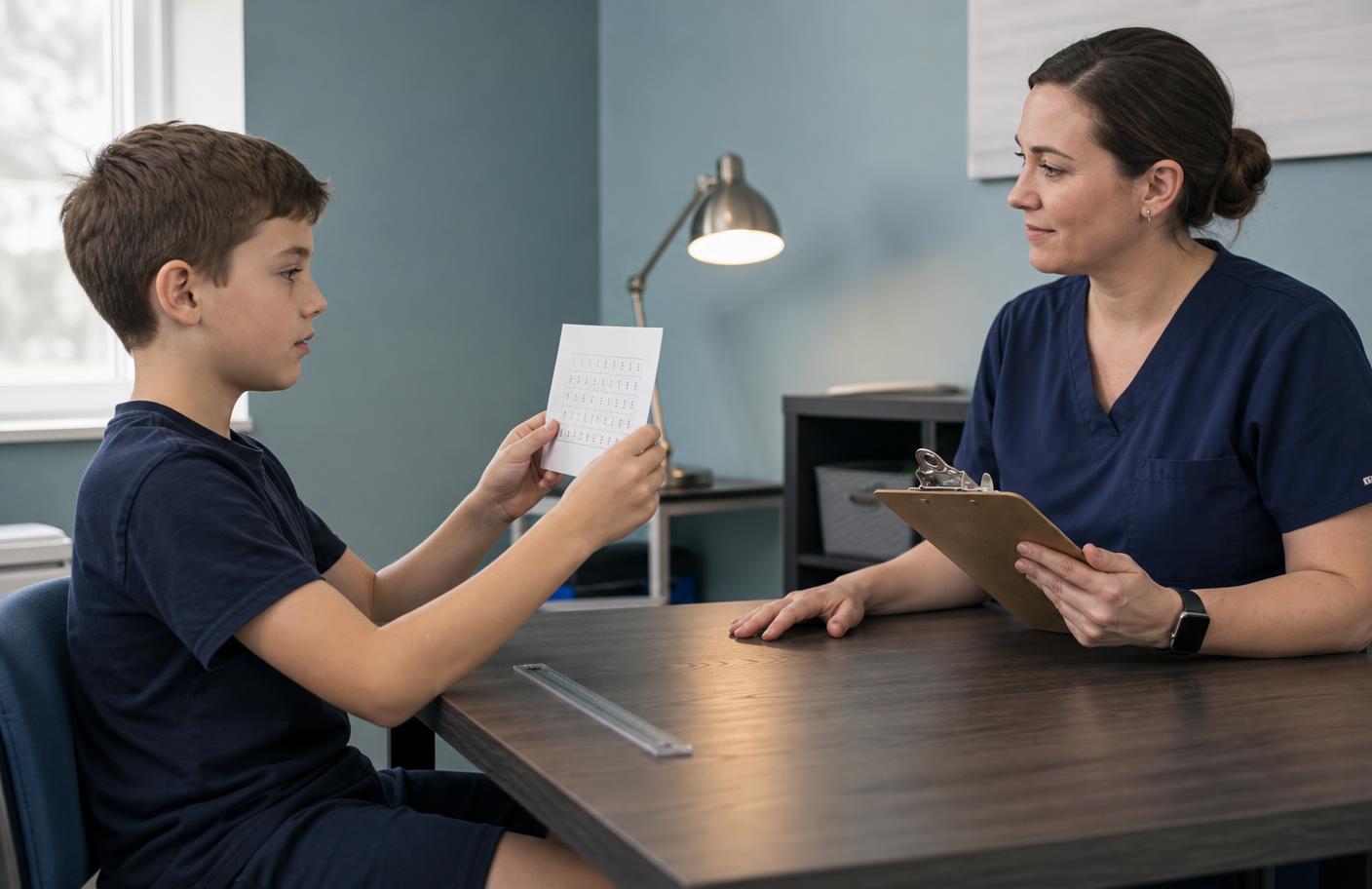
Near probes · 40 cm
Card at midline and at eye level; measure from the spectacle plane, not the forehead.
Table/screen · 60 cm
Use the same distance at screening and re-probe — a distance change invalidates the comparison.
Base of support
Feet supported and hips at 90° before any oculomotor scoring; postural drift reads as an efficiency deficit.
Say this
Describe what belongs here: Two photos or one composite showing both working distances..
My notes
Say this
Describe what belongs here: Band picker showing 5–7, 8–11, 12–16, 17+..
My notes
Say this
Reflection prompt: "Name the two client or contextual factors that will drive age band and stimulus selection for your next student."
Offer the sentence starter: "For [student], the age band is driven by... and the stimulus selection is driven by..."
Think for one minute, write, then take two shares.
My notes
Say this
Knowledge check: "Why is uncontrolled working distance a scoring problem, not just a tidiness problem?"
Options:
• It makes the session run long
• It changes the visual demand, so the score no longer means what the norms mean
• It makes the student uncomfortable
• It affects lighting only
Correct answer: option 2. Rationale: Distance changes angular size and accommodative demand. An unmeasured distance makes the result uninterpretable.
My notes