Back to CEU courses

Presenter study handout

The VPA™: Assessment & Clinical Reasoning

4 contact hours · 0.4 AOTA CEUs · All 8 modules · 144 slides

Presenter-side material. Each block shows the slide as the audience sees it, the talk track, and space for your own notes. Model answers appear here — do not hand this version to learners.

Module 1

1.1 — Welcome — set up before we start

Welcome

Welcome

Welcome — set up before we start

The VPA™: Assessment & Clinical Reasoning · 4.0 contact hours · 0.4 AOTA CEUs

Have ready

  • Participation & Reflection Guide
  • A blank VPA™ protocol and the administration-fidelity checklist
  • Tape measure or ruler for working distance
  • A student profile you plan to assess next

Before we begin

  • This course is procedural — pause the video and practice as you go.
  • Fidelity checklist scoring happens in Module 4; have it open early.
  • Polls, reflections, and self-checks do not affect your exam score.
  • Keep your testing space at the standard working distance and lighting.
The VPA™: Assessment & Clinical Reasoning
1 / 18
  • Materials: Participation & Reflection Guide
  • Materials: A blank VPA™ protocol and the administration-fidelity checklist
  • Materials: Tape measure or ruler for working distance
  • Materials: A student profile you plan to assess next
  • This course is procedural — pause the video and practice as you go.
  • Fidelity checklist scoring happens in Module 4; have it open early.
  • Polls, reflections, and self-checks do not affect your exam score.
  • Keep your testing space at the standard working distance and lighting.

Say this

Housekeeping while people arrive.

Materials to have ready:

• Participation & Reflection Guide

• A blank VPA™ protocol and the administration-fidelity checklist

• Tape measure or ruler for working distance

• A student profile you plan to assess next

Housekeeping:

• This course is procedural — pause the video and practice as you go.

• Fidelity checklist scoring happens in Module 4; have it open early.

• Polls, reflections, and self-checks do not affect your exam score.

• Keep your testing space at the standard working distance and lighting.

My notes

1.2 — What you will be able to do

Learning outcomes

Learning outcomes

What you will be able to do

So you can administer, score, and interpret the VPA™ with fidelity — and defend every disposition you reach.

  • 1Administer a criterion-referenced, performance-based visual assessment protocol following standardized procedure — setup, working distance, stimulus presentation, prompting limits, and observation recording — achieving at least 90% procedural fidelity, so that findings can be used to describe a client's occupational performance.
  • 2Select developmentally and contextually appropriate assessment conditions (age band, stimulus set, environment) for a given client and state, in writing, the two client or contextual factors that drove the selection, so that assessment conditions match the client's actual occupational context (classroom, home, clinic, work).
  • 3Apply basal and ceiling rules and a hierarchical progression of visual performance demands during performance-based assessment, correctly identifying the stopping point and the client's achieved performance level to produce a profile that guides occupation-based intervention planning.
  • 4Score a completed performance-based visual assessment protocol and interpret the results in terms of the occupational performance breakdown they produce, naming the visual performance factor most likely accounting for the breakdown with a written rationale for each of three case vignettes.
  • 5Translate visual assessment findings into a written occupational performance statement that names the occupation (e.g., copying from the board, sustained silent reading, legible written output), the visual performance factor limiting it, and the observed impact on participation, meeting all three elements of the provided rubric.
  • 6Document visual assessment results in occupational therapy scope language suitable for an IEP present-levels statement or plan of care, including at least one occupation-based measurable statement of current performance, without using terminology reserved for medical eye care or optometric vision therapy.
  • 7Apply scope-of-practice and referral decision rules, consistent with the AOTA scope of practice and the 2025 AOTA Occupational Therapy Code of Ethics, to determine for each of five completed protocols whether the client proceeds to further occupational therapy assessment, to occupation-based intervention, or to referral for medical eye care, and justify each disposition as the next occupation-based step.
  • 8Identify validity threats to any performance-based visual assessment — incomplete basal or ceiling, environmental deviation, fatigue, attention, and unfamiliar stimulus content — and describe in writing how each is recorded and how it constrains interpretation, so that a client's participation in reading, written work, and other daily occupations is not misjudged and occupational therapy services are not misallocated.
The VPA™: Assessment & Clinical Reasoning
2 / 18
  • So you can administer, score, and interpret the VPA™ with fidelity — and defend every disposition you reach.
  • Administer a criterion-referenced, performance-based visual assessment protocol following standardized procedure — setup, working distance, stimulus presentation, prompting limits, and observation recording — achieving at least 90% procedural fidelity, so that findings can be used to describe a client's occupational performance.
  • Select developmentally and contextually appropriate assessment conditions (age band, stimulus set, environment) for a given client and state, in writing, the two client or contextual factors that drove the selection, so that assessment conditions match the client's actual occupational context (classroom, home, clinic, work).
  • Apply basal and ceiling rules and a hierarchical progression of visual performance demands during performance-based assessment, correctly identifying the stopping point and the client's achieved performance level to produce a profile that guides occupation-based intervention planning.
  • Score a completed performance-based visual assessment protocol and interpret the results in terms of the occupational performance breakdown they produce, naming the visual performance factor most likely accounting for the breakdown with a written rationale for each of three case vignettes.
  • Translate visual assessment findings into a written occupational performance statement that names the occupation (e.g., copying from the board, sustained silent reading, legible written output), the visual performance factor limiting it, and the observed impact on participation, meeting all three elements of the provided rubric.
  • Document visual assessment results in occupational therapy scope language suitable for an IEP present-levels statement or plan of care, including at least one occupation-based measurable statement of current performance, without using terminology reserved for medical eye care or optometric vision therapy.
  • Apply scope-of-practice and referral decision rules, consistent with the AOTA scope of practice and the 2025 AOTA Occupational Therapy Code of Ethics, to determine for each of five completed protocols whether the client proceeds to further occupational therapy assessment, to occupation-based intervention, or to referral for medical eye care, and justify each disposition as the next occupation-based step.
  • Identify validity threats to any performance-based visual assessment — incomplete basal or ceiling, environmental deviation, fatigue, attention, and unfamiliar stimulus content — and describe in writing how each is recorded and how it constrains interpretation, so that a client's participation in reading, written work, and other daily occupations is not misjudged and occupational therapy services are not misallocated.


Say this

Read the filed learning objectives verbatim — this is the AOTA-approved wording.

Objectives:

• Administer a criterion-referenced, performance-based visual assessment protocol following standardized procedure — setup, working distance, stimulus presentation, prompting limits, and observation recording — achieving at least 90% procedural fidelity, so that findings can be used to describe a client's occupational performance.

• Select developmentally and contextually appropriate assessment conditions (age band, stimulus set, environment) for a given client and state, in writing, the two client or contextual factors that drove the selection, so that assessment conditions match the client's actual occupational context (classroom, home, clinic, work).

• Apply basal and ceiling rules and a hierarchical progression of visual performance demands during performance-based assessment, correctly identifying the stopping point and the client's achieved performance level to produce a profile that guides occupation-based intervention planning.

• Score a completed performance-based visual assessment protocol and interpret the results in terms of the occupational performance breakdown they produce, naming the visual performance factor most likely accounting for the breakdown with a written rationale for each of three case vignettes.

• Translate visual assessment findings into a written occupational performance statement that names the occupation (e.g., copying from the board, sustained silent reading, legible written output), the visual performance factor limiting it, and the observed impact on participation, meeting all three elements of the provided rubric.

• Document visual assessment results in occupational therapy scope language suitable for an IEP present-levels statement or plan of care, including at least one occupation-based measurable statement of current performance, without using terminology reserved for medical eye care or optometric vision therapy.

• Apply scope-of-practice and referral decision rules, consistent with the AOTA scope of practice and the 2025 AOTA Occupational Therapy Code of Ethics, to determine for each of five completed protocols whether the client proceeds to further occupational therapy assessment, to occupation-based intervention, or to referral for medical eye care, and justify each disposition as the next occupation-based step.

• Identify validity threats to any performance-based visual assessment — incomplete basal or ceiling, environmental deviation, fatigue, attention, and unfamiliar stimulus content — and describe in writing how each is recorded and how it constrains interpretation, so that a client's participation in reading, written work, and other daily occupations is not misjudged and occupational therapy services are not misallocated.

My notes

1.3 — How this session runs

How the session runs

Your learning experience

How this session runs

Session schedule

  • Eight modules, 4.0 contact hours total
  • Procedure → demonstration → practice → self-check
  • Scored fidelity checklist and scenario sets
  • Post-course exam, evaluation, certificate

Participation & Reflection Guide

  • Record your fidelity scores and scenario answers
  • Note every validity flag you observe
  • Entries save and print with your handout

Discussion & engagement

  • Opening poll in every module
  • Think / Process / Share after each procedure block
  • Three full clinical reasoning walkthroughs
  • One knowledge check per module
The VPA™: Assessment & Clinical Reasoning
3 / 18
  • Eight modules, 4.0 contact hours total
  • Procedure → demonstration → practice → self-check
  • Scored fidelity checklist and scenario sets
  • Post-course exam, evaluation, certificate
  • Record your fidelity scores and scenario answers
  • Note every validity flag you observe
  • Entries save and print with your handout
  • Opening poll in every module
  • Think / Process / Share after each procedure block
  • Three full clinical reasoning walkthroughs
  • One knowledge check per module

Say this

Explain how the session runs.

Schedule:

• Eight modules, 4.0 contact hours total

• Procedure → demonstration → practice → self-check

• Scored fidelity checklist and scenario sets

• Post-course exam, evaluation, certificate

How they participate:

• Opening poll in every module

• Think / Process / Share after each procedure block

• Three full clinical reasoning walkthroughs

• One knowledge check per module

My notes

1.4 — Why performance-based visual assessment: what norm-referenced batteries miss

Transition

Module 1

Why performance-based visual assessment: what norm-referenced batteries miss

0:00 – 0:20

The VPA™: Assessment & Clinical Reasoning
4 / 18
  • 0:00 – 0:20

Say this

Transition: "Why performance-based visual assessment: what norm-referenced batteries miss."

My notes

1.5 — Why Performance-Based Visual Assessment

Title

Module 1

Why Performance-Based Visual Assessment

What norm-referenced perceptual batteries do not tell you about the school day.

The VPA™: Assessment & Clinical Reasoning
5 / 18
  • What norm-referenced perceptual batteries do not tell you about the school day.
  • Visual Minds Learning · AOTA Approved Provider

Say this

Open here. "Why Performance-Based Visual Assessment." What norm-referenced perceptual batteries do not tell you about the school day.

Say why this section matters for their caseload, then advance.

My notes

1.6 — What are you using now?

Poll

Poll

What are you using now?

Which tool do you currently reach for when vision is the referral question?

The VPA™: Assessment & Clinical Reasoning
6 / 18
  • Which tool do you currently reach for when vision is the referral question?
  • – A norm-referenced visual perception battery
  • – Clinical observation only
  • – A checklist I built myself
  • – Nothing consistent yet

Say this

Ask the poll: "Which tool do you currently reach for when vision is the referral question?"

Options:

• A norm-referenced visual perception battery

• Clinical observation only

• A checklist I built myself

• Nothing consistent yet

Take a show of hands or the on-screen tally, then name the pattern you see before advancing.

My notes

1.7 — What a standard score misses

Teaching slide

The gap

What a standard score misses

  • A single accuracy score cannot show endurance decay across a work period.
  • Item-level batteries rarely sample the occupation the referral was written about.
  • Pass/fail cut scores hide the level at which performance actually breaks down.
  • Observation of strategy, prompting, and error type carries the clinical signal.
Norm-referencedCriterion-referenced
Question answeredWhere does this student rank?What can this student do, and under what conditions?
ConditionsQuiet room, fixed distance, untimedNear/far demand, time pressure, motor load
Efficiency floorRarely sampledSampled directly
OutputStandard score / percentileLevel-and-domain performance profile
Best useEligibility, medical necessityPlan of care, progress monitoring
Two legitimate instrument classes answering different questions. Eligibility needs the left column; Monday-morning planning needs the right.
The VPA™: Assessment & Clinical Reasoning
7 / 18
  • A single accuracy score cannot show endurance decay across a work period.
  • Item-level batteries rarely sample the occupation the referral was written about.
  • Pass/fail cut scores hide the level at which performance actually breaks down.
  • Observation of strategy, prompting, and error type carries the clinical signal.

Say this

Frame the slide: "What a standard score misses."

Walk each point, one sentence each:

• A single accuracy score cannot show endurance decay across a work period.

• Item-level batteries rarely sample the occupation the referral was written about.

• Pass/fail cut scores hide the level at which performance actually breaks down.

• Observation of strategy, prompting, and error type carries the clinical signal.

Point at the figure while you talk — name the parts before the labels.

Close with: "If you only take one of these back, take the first one."

My notes

1.8 — Two complementary sources of evidence

Comparison

Two complementary sources of evidence

Norm-referenced batteries

  • Population comparison
  • Eligibility support in some settings
  • Single-session snapshot
  • Limited occupational context

Performance-based VPA™

  • Level-by-level breakdown point
  • Endurance and rate under demand
  • Error-type and strategy observation
  • Direct line to goals and dosage
Standard score report
Visual perception (total)92 · 30th %ile
Visual-motor integration88 · 21st %ile
Motor-reduced perception95 · 37th %ile

“Within normal limits.” No statement about copying from the board, near endurance, or output rate.

VPA™ domain profile
L1Acuity & sensory foundationincl. field & scanning
strong
L2Visual efficiency
limiting
L3Visual processing
emerging
L4Visual-motor integration
limiting
L5Functional integration
breaking down

Shape, not a single number: efficiency and output fall away while foundation holds.

A norm-referenced score answers “how does this student compare?”. A VPA™ profile answers “where in the visual performance chain does the school day break down?” Both are evidence; only one tells you what to change on Monday.
The VPA™: Assessment & Clinical Reasoning
8 / 18
  • Norm-referenced batteries: Population comparison · Eligibility support in some settings · Single-session snapshot · Limited occupational context
  • Performance-based VPA™: Level-by-level breakdown point · Endurance and rate under demand · Error-type and strategy observation · Direct line to goals and dosage

Say this

Contrast the two columns: Norm-referenced batteries versus Performance-based VPA™.

Norm-referenced batteries:

• Population comparison

• Eligibility support in some settings

• Single-session snapshot

• Limited occupational context

Performance-based VPA™:

• Level-by-level breakdown point

• Endurance and rate under demand

• Error-type and strategy observation

• Direct line to goals and dosage

Ask: "Which column is your student living in right now?"

My notes

1.9 — What an OT measures — and what we do not

Teaching slide

Scope

What an OT measures — and what we do not

  • We measure performance, conditions, endurance, and occupational impact.
  • We do not diagnose binocular vision disorders or recommend lenses.
  • We refer in parallel whenever an ocular trigger appears.
  • Every recommendation traces to a recorded score or observation.
1Systematic reviews & meta-analysesSets the default direction of practice.
2Randomized controlled trials (e.g., CITT)Supports specific dosed interventions.
3Cohort & case-control studiesDescribes patterns and associations, not cause.
4Practice guidelines & consensus (AOTA, AOA)Defines scope and role boundaries.
5Expert opinion & single-case designsFills gaps; documented as such in the plan.
Claims in this course are labeled by tier. Where the evidence is consensus or emerging, the course says so rather than overstating it.
The VPA™: Assessment & Clinical Reasoning
9 / 18
  • We measure performance, conditions, endurance, and occupational impact.
  • We do not diagnose binocular vision disorders or recommend lenses.
  • We refer in parallel whenever an ocular trigger appears.
  • Every recommendation traces to a recorded score or observation.

Say this

Frame the slide: "What an OT measures — and what we do not."

Walk each point, one sentence each:

• We measure performance, conditions, endurance, and occupational impact.

• We do not diagnose binocular vision disorders or recommend lenses.

• We refer in parallel whenever an ocular trigger appears.

• Every recommendation traces to a recorded score or observation.

Point at the figure while you talk — name the parts before the labels.

Close with: "If you only take one of these back, take the first one."

My notes

1.10 — Address it, refer it — or both

Comparison

The standing rule

Address it, refer it — or both

Already diagnosed and medically managed → OT addresses it

  • Documented low acuity: magnification, enlarged print, working distance, seating, decluttered materials.
  • Documented contrast loss: high-contrast materials, bold-line paper, reverse polarity, glare and lighting control.
  • Documented field loss: systematic scanning, anchoring, line tracking, materials placed in the intact field.
  • The VPA™ documents the functional limitation and the conditions under which performance breaks down.

Undiagnosed, unverified, unclear, or changing → refer

  • No comprehensive eye exam on file, or correction not worn, outgrown, or unverified.
  • Assessment performance does not match the documented diagnosis.
  • Anything new: new eye turn, new double vision, new field complaint, sudden change, pain.
  • Referral is the action for these — OT addresses acuity, contrast, or field limitations only once they are diagnosed and managed.
Finding
Diagnosed & managed → OT addresses
New / undiagnosed / changing → refer
Reduced acuity
Magnify (optical, electronic, or digital), enlarge print, increase working-distance control, reduce visual clutter, seat for viewing angle.
No comprehensive eye exam on file, correction not worn or outgrown, or a new drop in near/distance performance.
Reduced contrast sensitivity
High-contrast materials, bold line paper, dark-on-light or reverse-polarity screens, glare and lighting control, edge marking on stairs and thresholds.
Contrast difficulty never evaluated, or a functional loss that is new, worsening, or does not match the documented diagnosis.
Field loss
Teach systematic scanning, anchoring, and line-tracking; position materials and seating into the intact field; organize the workspace; travel-safety routines with the O&M specialist.
Field loss suspected but never documented, or new field complaints, bumping, or missed content on one side.
Ocular alignment, oculomotor, accommodation
Grade the visual demand of the occupation, build near-point stamina, chunk and space text, schedule visual breaks.
New eye turn, new double vision, headaches or pain with near work, or no eye care follow-up in place.

OT addresses diagnosed, medically managed limitations. A new or undiagnosed finding is a referral — the diagnosis has to come first before we treat that finding as a known visual limitation.

The standing rule: OT addresses the functional limitation only when the ocular condition is already diagnosed and medically managed. If the finding is new, undiagnosed, unclear, or changing, the appropriate OT action is referral.
The VPA™: Assessment & Clinical Reasoning
10 / 18
  • Already diagnosed and medically managed → OT addresses it: Documented low acuity: magnification, enlarged print, working distance, seating, decluttered materials. · Documented contrast loss: high-contrast materials, bold-line paper, reverse polarity, glare and lighting control. · Documented field loss: systematic scanning, anchoring, line tracking, materials placed in the intact field. · The VPA™ documents the functional limitation and the conditions under which performance breaks down.
  • Undiagnosed, unverified, unclear, or changing → refer: No comprehensive eye exam on file, or correction not worn, outgrown, or unverified. · Assessment performance does not match the documented diagnosis. · Anything new: new eye turn, new double vision, new field complaint, sudden change, pain. · Referral is the action for these — OT addresses acuity, contrast, or field limitations only once they are diagnosed and managed.

Say this

Contrast the two columns: Already diagnosed and medically managed → OT addresses it versus Undiagnosed, unverified, unclear, or changing → refer.

Already diagnosed and medically managed → OT addresses it:

• Documented low acuity: magnification, enlarged print, working distance, seating, decluttered materials.

• Documented contrast loss: high-contrast materials, bold-line paper, reverse polarity, glare and lighting control.

• Documented field loss: systematic scanning, anchoring, line tracking, materials placed in the intact field.

• The VPA™ documents the functional limitation and the conditions under which performance breaks down.

Undiagnosed, unverified, unclear, or changing → refer:

• No comprehensive eye exam on file, or correction not worn, outgrown, or unverified.

• Assessment performance does not match the documented diagnosis.

• Anything new: new eye turn, new double vision, new field complaint, sudden change, pain.

• Referral is the action for these — OT addresses acuity, contrast, or field limitations only once they are diagnosed and managed.

Ask: "Which column is your student living in right now?"

My notes

1.11 — Why performance-based measurement holds up

Teaching slide

Evidence

Why performance-based measurement holds up

  • Repeated measurement of the same task documents change more defensibly than a single score.
  • Condition-dependent performance is the signal payers and teams act on.
  • Occupation-embedded probes carry the transfer argument with them.
  • Graded reference list with levels of evidence is published in the PD documentation.
1

Ocular structures

Cornea, lens, retina, extraocular muscles — image quality and eye alignment.

Looks like: Blur, fatigue, suppression, head tilt.

2

Pathways & processing

Optic nerve → chiasm → LGN → V1, then ventral "what" and dorsal "where" streams.

Looks like: Recognition errors, spatial disorganization, place-losing.

3

Visual performance

Efficiency under real demand: sustaining near work, scanning, copying, moving through space.

Looks like: Slow output, avoidance, careless-looking errors.

4

Occupation

Reading, writing, math layout, PE, cafeteria, hallway navigation, self-care.

Looks like: The referral you actually receive.

OT does not diagnose the first two columns; we measure the third and change the fourth. Eye care partners own structure and pathway health — our contribution is performance under occupational demand.
The VPA™: Assessment & Clinical Reasoning
11 / 18
  • Repeated measurement of the same task documents change more defensibly than a single score.
  • Condition-dependent performance is the signal payers and teams act on.
  • Occupation-embedded probes carry the transfer argument with them.
  • Graded reference list with levels of evidence is published in the PD documentation.

Say this

Frame the slide: "Why performance-based measurement holds up."

Walk each point, one sentence each:

• Repeated measurement of the same task documents change more defensibly than a single score.

• Condition-dependent performance is the signal payers and teams act on.

• Occupation-embedded probes carry the transfer argument with them.

• Graded reference list with levels of evidence is published in the PD documentation.

Point at the figure while you talk — name the parts before the labels.

Close with: "If you only take one of these back, take the first one."

My notes

1.12 — Module 1 video — why performance-based assessment

Video

Lecture

Module 1 video — why performance-based assessment

VIDEO SLOT

Framing lecture on the gap between scores and school-day performance.

Slides tab → set “url” to your YouTube/Vimeo/Loom embed link

The VPA™: Assessment & Clinical Reasoning
12 / 18
  • Framing lecture on the gap between scores and school-day performance.

Say this

Set up the clip in one sentence, play it, then debrief with "what did you notice?"

My notes

1.13 — Screenshot — a standard score report vs. a VPA™ profile

Visual

Import

Screenshot — a standard score report vs. a VPA™ profile

Standard score report
Visual perception (total)92 · 30th %ile
Visual-motor integration88 · 21st %ile
Motor-reduced perception95 · 37th %ile

“Within normal limits.” No statement about copying from the board, near endurance, or output rate.

VPA™ domain profile
L1Acuity & sensory foundationincl. field & scanning
strong
L2Visual efficiency
limiting
L3Visual processing
emerging
L4Visual-motor integration
limiting
L5Functional integration
breaking down

Shape, not a single number: efficiency and output fall away while foundation holds.

A norm-referenced score answers “how does this student compare?”. A VPA™ profile answers “where in the visual performance chain does the school day break down?” Both are evidence; only one tells you what to change on Monday.
The VPA™: Assessment & Clinical Reasoning
13 / 18
  • Side-by-side comparison illustrating what each source of evidence shows.

Say this

Describe what belongs here: Side-by-side comparison illustrating what each source of evidence shows..

My notes

1.14 — Photo — the referral in context

Visual

Import

Photo — the referral in context

Copy from the boardRepeated far↔near shifts, place-holding, sustained saccades
Worksheet completionNear endurance, figure-ground on a dense page, line tracking
Silent reading blockFixation stability, convergence comfort over 20+ minutes
Chromebook workContrast/glare tolerance, scrolling scan, screen-to-paper shifts
Hallway & lunch transitionsPeripheral awareness, depth on stairs, moving-crowd scanning
Referrals arrive as behavior (“loses place”, “refuses writing”). Name the occupational demand first — the demand is what you assess and what you later document as educational relevance.
The VPA™: Assessment & Clinical Reasoning
14 / 18
  • Classroom photo showing the occupational demand behind a typical referral.

Say this

Describe what belongs here: Classroom photo showing the occupational demand behind a typical referral..

My notes

1.15 — So what? A standard score does not tell you what to change

So what?

So what?

So what? A standard score does not tell you what to change

Norm-referenced batteries tell you where a student ranks. They rarely tell you which condition to change on Monday.

Performance-based assessment manipulates conditions — distance, duration, size, complexity — so the result names the demand that breaks performance.

What you do with it

  • Ask what decision the score will drive before you administer anything.
  • Record the condition under which performance changed, not only the score.
  • Pair any norm-referenced result with a performance observation in the same report.

Watch for

A percentile in the average range beside a student who cannot complete a page — that gap is the finding.

The VPA™: Assessment & Clinical Reasoning
15 / 18
  • Norm-referenced batteries tell you where a student ranks. They rarely tell you which condition to change on Monday.
  • Because: Performance-based assessment manipulates conditions — distance, duration, size, complexity — so the result names the demand that breaks performance.
  • Move: Ask what decision the score will drive before you administer anything.
  • Move: Record the condition under which performance changed, not only the score.
  • Move: Pair any norm-referenced result with a performance observation in the same report.
  • Watch for: A percentile in the average range beside a student who cannot complete a page — that gap is the finding.

Say this

Land the "so what": Norm-referenced batteries tell you where a student ranks. They rarely tell you which condition to change on Monday.

Explain the mechanism plainly: Performance-based assessment manipulates conditions — distance, duration, size, complexity — so the result names the demand that breaks performance.

Then give them the moves — say each one as something they can do Monday:

• Ask what decision the score will drive before you administer anything.

• Record the condition under which performance changed, not only the score.

• Pair any norm-referenced result with a performance observation in the same report.

Tell them what success looks like: A percentile in the average range beside a student who cannot complete a page — that gap is the finding.

Ask: "Who has a student this describes right now?" Take one answer, then move.

My notes

1.16 — Two-minute case: average score, failing student

Mini case

Two-minute case

Two-minute case: average score, failing student

A Grade 3 student scores in the average range on a norm-referenced visual perception battery, yet cannot complete grade-level written work.

What did the battery miss, and what do you do next?

The VPA™: Assessment & Clinical Reasoning
16 / 18
  • A Grade 3 student scores in the average range on a norm-referenced visual perception battery, yet cannot complete grade-level written work.
  • Question: What did the battery miss, and what do you do next?
  • Model answer: The battery sampled brief, untimed, single-item processing. It never sampled sustained near performance under classroom duration and layout. Run a performance-based sample at the real distance and duration, and document completion, place-losing, and time to degradation.
  • Teaching point: Average capacity under ideal conditions is compatible with failure under classroom conditions.

Say this

Two-minute case. Read it aloud:

A Grade 3 student scores in the average range on a norm-referenced visual perception battery, yet cannot complete grade-level written work.

Put the question to them: "What did the battery miss, and what do you do next?" Give 60 seconds, no talking.

Model answer (reveal after they commit): The battery sampled brief, untimed, single-item processing. It never sampled sustained near performance under classroom duration and layout. Run a performance-based sample at the real distance and duration, and document completion, place-losing, and time to degradation.

Close with the rule: Average capacity under ideal conditions is compatible with failure under classroom conditions.

My notes

1.17 — Reflect and share

Reflection

Reflect and share

Reflect and share

Recall a standard score that did not match what you saw in the classroom. What did the battery miss?

THINKPROCESSSHARE
The VPA™: Assessment & Clinical Reasoning
17 / 18
  • Recall a standard score that did not match what you saw in the classroom. What did the battery miss?
  • Starter: The battery score was... but in the classroom I saw... The battery missed...

Say this

Reflection prompt: "Recall a standard score that did not match what you saw in the classroom. What did the battery miss?"

Offer the sentence starter: "The battery score was... but in the classroom I saw... The battery missed..."

Think for one minute, write, then take two shares.

My notes

1.18 — Knowledge check — why performance-based

Self-check

Knowledge check

Knowledge check — why performance-based

What does a norm-referenced perceptual battery not tell you?

The VPA™: Assessment & Clinical Reasoning
18 / 18
  • What does a norm-referenced perceptual battery not tell you?
  • – How the student compares to same-age peers
  • ✓ How performance holds up under real task demand and duration
  • – Whether the score is statistically reliable
  • – Which subtest was lowest
  • Rationale: Batteries sample brief, isolated performance. Occupational breakdown usually shows up in sustained, contextual demand.

Say this

Knowledge check: "What does a norm-referenced perceptual battery not tell you?"

Options:

• How the student compares to same-age peers

• How performance holds up under real task demand and duration

• Whether the score is statistically reliable

• Which subtest was lowest

Correct answer: option 2. Rationale: Batteries sample brief, isolated performance. Occupational breakdown usually shows up in sustained, contextual demand.

My notes

Module 2

2.1 — VPA™ architecture: 15 skills across 5 domains, Fast Screener vs. Mini vs. Full

Transition

Module 2

VPA™ architecture: 15 skills across 5 domains, Fast Screener vs. Mini vs. Full

0:20 – 0:50

The VPA™: Assessment & Clinical Reasoning
1 / 16
  • 0:20 – 0:50

Say this

Transition: "VPA™ architecture: 15 skills across 5 domains, Fast Screener vs. Mini vs. Full."

My notes

2.2 — VPA™ Architecture

Title

Module 2

VPA™ Architecture

15 skills across 5 domains — Fast Screener, Mini VPA™, and Full VPA™.

The VPA™: Assessment & Clinical Reasoning
2 / 16
  • 15 skills across 5 domains — Fast Screener, Mini VPA™, and Full VPA™.

Say this

Open here. "VPA™ Architecture." 15 skills across 5 domains — Fast Screener, Mini VPA™, and Full VPA™.

Say why this section matters for their caseload, then advance.

My notes

2.3 — Choosing a depth

Poll

Poll

Choosing a depth

Given 20 minutes with a new referral, what would you run today?

The VPA™: Assessment & Clinical Reasoning
3 / 16
  • Given 20 minutes with a new referral, what would you run today?
  • – Fast Screener
  • – Mini VPA™
  • – Full VPA™
  • – I would not know which to pick

Say this

Ask the poll: "Given 20 minutes with a new referral, what would you run today?"

Options:

• Fast Screener

• Mini VPA™

• Full VPA™

• I would not know which to pick

Take a show of hands or the on-screen tally, then name the pattern you see before advancing.

My notes

2.4 — The five domains map to the five levels

Five-Level Framework

Domains

The five domains map to the five levels

1

Visual Acuity & Sensory Foundation

Can the visual signal get in clearly enough to use?

2

Visual Efficiency

Fixation, pursuits, saccades, binocular comfort, near endurance.

3

Visual Processing

Discrimination, memory, closure, figure-ground, form constancy, spatial relations.

4

Visual-Motor Integration

Translating what is seen into graded, accurate motor output.

5

Functional Integration

Reading, writing, and task performance under real classroom demand.

The VPA™: Assessment & Clinical Reasoning
4 / 16
  • Level 1 — Visual Acuity & Sensory Foundation: Can the visual signal get in clearly enough to use?
  • Level 2 — Visual Efficiency: Fixation, pursuits, saccades, binocular comfort, near endurance.
  • Level 3 — Visual Processing: Discrimination, memory, closure, figure-ground, form constancy, spatial relations.
  • Level 4 — Visual-Motor Integration: Translating what is seen into graded, accurate motor output.
  • Level 5 — Functional Integration: Reading, writing, and task performance under real classroom demand.

Say this

Run the five levels bottom-up.

Name each level, then say which one you assess first and why.

My notes

2.5 — Which instrument, when

Comparison

Which instrument, when

Mini VPA™ (screen)

  • One probe at each of Levels 1–5
  • Flags the domains needing measurement
  • Caseload-scale, brief
  • Never a stand-alone plan of care

Full VPA™ (assess)

  • 15 skills, L1–L5 progression each
  • Basal and ceiling rules per skill
  • Domain profile and composite
  • Drives goals, dosage, referral
Teacher / parentconcern raisedOT Screening (VPA Fast Screener)PASS / FLAG on 5 quick tasksPASSFLAGDocument. No further OT.Provide teacher-facingclassroom accommodationsif requested.OT Assessment (Mini or Full VPA)Score all 5 domainsPlan of careIEP goals · interventionAdapt-and-refer (Level 1)if acuity/health concern
Screening asks "Is there a concern?" Assessment asks "What exactly is the problem, and how do we intervene?" The path a referral takes depends on that answer.
The VPA™: Assessment & Clinical Reasoning
5 / 16
  • Mini VPA™ (screen): One probe at each of Levels 1–5 · Flags the domains needing measurement · Caseload-scale, brief · Never a stand-alone plan of care
  • Full VPA™ (assess): 15 skills, L1–L5 progression each · Basal and ceiling rules per skill · Domain profile and composite · Drives goals, dosage, referral

Say this

Contrast the two columns: Mini VPA™ (screen) versus Full VPA™ (assess).

Mini VPA™ (screen):

• One probe at each of Levels 1–5

• Flags the domains needing measurement

• Caseload-scale, brief

• Never a stand-alone plan of care

Full VPA™ (assess):

• 15 skills, L1–L5 progression each

• Basal and ceiling rules per skill

• Domain profile and composite

• Drives goals, dosage, referral

Ask: "Which column is your student living in right now?"

My notes

2.6 — Mini VPA™ administration view

Visual

Artifact

Mini VPA™ administration view

Say/Do script, level ladder, and the scoring worksheet in one clinician view.

Say/Do script, level ladder, and the scoring worksheet in one clinician view.

The VPA™: Assessment & Clinical Reasoning
6 / 16
  • Say/Do script, level ladder, and the scoring worksheet in one clinician view.

Say this

Talk over the visual: "Mini VPA™ administration view."

Say the caption in your own words: Say/Do script, level ladder, and the scoring worksheet in one clinician view.

My notes

2.7 — Why 15 skills across 5 domains

Teaching slide

Design logic

Why 15 skills across 5 domains

  • Each domain samples one level of the framework: Access, Efficiency, Processing, Visual-Motor Integration, Functional Integration.
  • Three skills per domain give enough spread to see a shape, not a point.
  • Every skill runs its own L1–L5 task ladder, so breakdown is located, not inferred.
  • Functional Integration includes both reading and writing — the two referral drivers.
L1 · Access
Near acuity
Intermediate / distance acuity
Contrast tolerance
L2 · Efficiency
Fixation
Pursuits
Saccades / NPC & endurance
L3 · Processing
Discrimination & closure
Figure-ground
Visual memory & spatial
L4 · Visual-motor integration
Form reproduction
Copy accuracy
Timed written output
L5 · Functional integration
Sustained reading
Generative writing
Classroom-task simulation

Task rubric 0–3 → reported as VPL 1–5

0

Unable

1

Emerging, max support

2

Functional but inefficient

3

Accurate & efficient

Five domains, fifteen skills — one domain per framework level. Every task is rubric-scored 0–3; the highest task level scored 2 or better is the skill’s achieved level, reported as VPL 1–5 against the age-band expectation.
The VPA™: Assessment & Clinical Reasoning
7 / 16
  • Each domain samples one level of the framework: Access, Efficiency, Processing, Visual-Motor Integration, Functional Integration.
  • Three skills per domain give enough spread to see a shape, not a point.
  • Every skill runs its own L1–L5 task ladder, so breakdown is located, not inferred.
  • Functional Integration includes both reading and writing — the two referral drivers.

Say this

Frame the slide: "Why 15 skills across 5 domains."

Walk each point, one sentence each:

• Each domain samples one level of the framework: Access, Efficiency, Processing, Visual-Motor Integration, Functional Integration.

• Three skills per domain give enough spread to see a shape, not a point.

• Every skill runs its own L1–L5 task ladder, so breakdown is located, not inferred.

• Functional Integration includes both reading and writing — the two referral drivers.

Point at the figure while you talk — name the parts before the labels.

Close with: "If you only take one of these back, take the first one."

My notes

2.8 — Three numbers — and they are not the same number

Comparison

Scoring

Three numbers — and they are not the same number

What you record at the table

  • Item rubric 0–3 for every task you administer: 0 unable, 1 emerging with maximum support, 2 functional with inefficiency, 3 accurate and efficient.
  • A rubric of 2 or 3 counts as passing that task; 0 or 1 does not.
  • Observation is recorded alongside every rubric score — head movement, refixations, latency, discomfort.

What the software derives

  • Achieved level L1–L5: the highest task level scored 2 or better on that skill.
  • VPL 1–5 (Visual Performance Level): achieved level adjusted for rubric quality — VPL 1 (emerging), VPL 2 (developing), VPL 3 (functional), VPL 4 (efficient), VPL 5 (advanced). Always write the number; “functional” is a descriptor of VPL 3, not the name of Domain 5.
  • Gap: VPL compared to the expected VPL range for the student’s age band.
VPA™ · Scored profile
L1Acuity & sensory foundationincl. field & scanning
strong
L2Visual efficiency
limiting
L3Visual processing
emerging
L4Visual-motor integration
limiting
L5Functional integration
breaking down
Profile shape: foundation intact / output limitedIntervention enters at Level 2 (efficiency), not at Level 4 handwriting drill.
Rows are the five framework levels in order (L1 → L5) — the L number is the level, never the score. Performance is the bar and the word beside it. Read the shape before any composite: a flat-but-low profile, a single notch, and a “foundation intact / output collapsed” staircase call for three different plans.
The VPA™: Assessment & Clinical Reasoning
8 / 16
  • What you record at the table: Item rubric 0–3 for every task you administer: 0 unable, 1 emerging with maximum support, 2 functional with inefficiency, 3 accurate and efficient. · A rubric of 2 or 3 counts as passing that task; 0 or 1 does not. · Observation is recorded alongside every rubric score — head movement, refixations, latency, discomfort.
  • What the software derives: Achieved level L1–L5: the highest task level scored 2 or better on that skill. · VPL 1–5 (Visual Performance Level): achieved level adjusted for rubric quality — VPL 1 (emerging), VPL 2 (developing), VPL 3 (functional), VPL 4 (efficient), VPL 5 (advanced). Always write the number; “functional” is a descriptor of VPL 3, not the name of Domain 5. · Gap: VPL compared to the expected VPL range for the student’s age band.

Say this

Contrast the two columns: What you record at the table versus What the software derives.

What you record at the table:

• Item rubric 0–3 for every task you administer: 0 unable, 1 emerging with maximum support, 2 functional with inefficiency, 3 accurate and efficient.

• A rubric of 2 or 3 counts as passing that task; 0 or 1 does not.

• Observation is recorded alongside every rubric score — head movement, refixations, latency, discomfort.

What the software derives:

• Achieved level L1–L5: the highest task level scored 2 or better on that skill.

• VPL 1–5 (Visual Performance Level): achieved level adjusted for rubric quality — VPL 1 (emerging), VPL 2 (developing), VPL 3 (functional), VPL 4 (efficient), VPL 5 (advanced). Always write the number; “functional” is a descriptor of VPL 3, not the name of Domain 5.

• Gap: VPL compared to the expected VPL range for the student’s age band.

Ask: "Which column is your student living in right now?"

My notes

2.9 — When to reach for a standardized tool

Teaching slide

Adjuncts

When to reach for a standardized tool

  • A single skill is flagged and you need depth for eligibility.
  • A payer or district requires a norm-referenced score.
  • Team disagreement about whether the finding is real.
  • Use adjuncts to deepen a flagged area — not to replace the level profile.
L0

Visual acuity & ocular health

Distance/near acuity check, contrast, red-flag screen

L1

Visual fields & attention to space

Confrontation fields, cancellation, scan-grid coverage

L2

Oculomotor & near-point efficiency

Fixation, pursuits, saccade columns, NPC, endurance

L3

Visual-perceptual processing

Discrimination, figure-ground, closure, memory, spatial

L4

Visual-motor integration

Copy tasks, form reproduction, timed written output

Each level is sampled by its own task family. A composite score collapses these into one number; the profile keeps them separate so the plan can target the unstable floor.
The VPA™: Assessment & Clinical Reasoning
9 / 16
  • A single skill is flagged and you need depth for eligibility.
  • A payer or district requires a norm-referenced score.
  • Team disagreement about whether the finding is real.
  • Use adjuncts to deepen a flagged area — not to replace the level profile.

Say this

Frame the slide: "When to reach for a standardized tool."

Walk each point, one sentence each:

• A single skill is flagged and you need depth for eligibility.

• A payer or district requires a norm-referenced score.

• Team disagreement about whether the finding is real.

• Use adjuncts to deepen a flagged area — not to replace the level profile.

Point at the figure while you talk — name the parts before the labels.

Close with: "If you only take one of these back, take the first one."

My notes

2.10 — Module 2 video — VPA™ architecture

Video

Lecture

Module 2 video — VPA™ architecture

VIDEO SLOT

Tour of the instrument family and how the pieces relate.

Slides tab → set “url” to your YouTube/Vimeo/Loom embed link

The VPA™: Assessment & Clinical Reasoning
10 / 16
  • Tour of the instrument family and how the pieces relate.

Say this

Set up the clip in one sentence, play it, then debrief with "what did you notice?"

My notes

2.11 — Diagram — 15 skills mapped to 5 domains

Visual

Import

Diagram — 15 skills mapped to 5 domains

L1 · Access
Near acuity
Intermediate / distance acuity
Contrast tolerance
L2 · Efficiency
Fixation
Pursuits
Saccades / NPC & endurance
L3 · Processing
Discrimination & closure
Figure-ground
Visual memory & spatial
L4 · Visual-motor integration
Form reproduction
Copy accuracy
Timed written output
L5 · Functional integration
Sustained reading
Generative writing
Classroom-task simulation

Task rubric 0–3 → reported as VPL 1–5

0

Unable

1

Emerging, max support

2

Functional but inefficient

3

Accurate & efficient

Five domains, fifteen skills — one domain per framework level. Every task is rubric-scored 0–3; the highest task level scored 2 or better is the skill’s achieved level, reported as VPL 1–5 against the age-band expectation.
The VPA™: Assessment & Clinical Reasoning
11 / 16
  • Architecture graphic showing domains, skills, and the L1–L5 ladder.

Say this

Describe what belongs here: Architecture graphic showing domains, skills, and the L1–L5 ladder..

My notes

2.12 — Screenshot — Full VPA™ skill menu

Visual

Import

Screenshot — Full VPA™ skill menu

Visual Performance Assessment™ · Select skills

Ocular foundation

  • Near acuity
  • Distance acuity
  • Contrast & glare tolerance

Field & attention to space

  • Field awareness
  • Organized scanning
  • Left/right coverage

Oculomotor efficiency

  • Fixation stability
  • Pursuits
  • Saccades & NPC

Perceptual processing

  • Discrimination & closure
  • Figure-ground
  • Visual memory & spatial

Visual-motor integration

  • Copy accuracy
  • Form reproduction
  • Timed written output
The Full VPA™ skill menu. Clinicians select the skills the referral question actually requires; the ladder and scoring rules stay identical across every skill selected.
The VPA™: Assessment & Clinical Reasoning
12 / 16
  • Skill menu view showing the 15 skills grouped by domain.

Say this

Describe what belongs here: Skill menu view showing the 15 skills grouped by domain..

My notes

2.13 — So what? Pick the tier by the decision you owe

So what?

So what?

So what? Pick the tier by the decision you owe

Fast Screener, Mini, and Full are three different commitments of time. Choosing the wrong tier costs you a session you will not get back.

Screening routes, Mini characterizes a suspected domain, Full establishes level and profile across all fifteen skills.

What you do with it

  • Fast Screener when the question is "does this need looking at?"
  • Mini when you suspect a domain and need to confirm before writing a goal.
  • Full when you need an achieved level, a domain profile, and a progress baseline.

Watch for

Repeating a Mini three times — that is a Full you have already paid for in pieces.

The VPA™: Assessment & Clinical Reasoning
13 / 16
  • Fast Screener, Mini, and Full are three different commitments of time. Choosing the wrong tier costs you a session you will not get back.
  • Because: Screening routes, Mini characterizes a suspected domain, Full establishes level and profile across all fifteen skills.
  • Move: Fast Screener when the question is "does this need looking at?"
  • Move: Mini when you suspect a domain and need to confirm before writing a goal.
  • Move: Full when you need an achieved level, a domain profile, and a progress baseline.
  • Watch for: Repeating a Mini three times — that is a Full you have already paid for in pieces.

Say this

Land the "so what": Fast Screener, Mini, and Full are three different commitments of time. Choosing the wrong tier costs you a session you will not get back.

Explain the mechanism plainly: Screening routes, Mini characterizes a suspected domain, Full establishes level and profile across all fifteen skills.

Then give them the moves — say each one as something they can do Monday:

• Fast Screener when the question is "does this need looking at?"

• Mini when you suspect a domain and need to confirm before writing a goal.

• Full when you need an achieved level, a domain profile, and a progress baseline.

Tell them what success looks like: Repeating a Mini three times — that is a Full you have already paid for in pieces.

Ask: "Who has a student this describes right now?" Take one answer, then move.

My notes

2.14 — Two-minute case: which tier?

Mini case

Two-minute case

Two-minute case: which tier?

You have 25 minutes with a newly referred Grade 2 student, an IEP meeting in three weeks, and a teacher report of place-losing and slow copying.

Which tier do you run today, and what do you schedule?

The VPA™: Assessment & Clinical Reasoning
14 / 16
  • You have 25 minutes with a newly referred Grade 2 student, an IEP meeting in three weeks, and a teacher report of place-losing and slow copying.
  • Question: Which tier do you run today, and what do you schedule?
  • Model answer: Run the Mini today, targeted at the suspected efficiency domain, so you have defensible information for the meeting. Schedule the Full before goal-writing if the Mini confirms the domain, and use the Fast Screener for the two other students on the same referral list.
  • Teaching point: Match the tier to the decision and the calendar, not to how thorough you feel.

Say this

Two-minute case. Read it aloud:

You have 25 minutes with a newly referred Grade 2 student, an IEP meeting in three weeks, and a teacher report of place-losing and slow copying.

Put the question to them: "Which tier do you run today, and what do you schedule?" Give 60 seconds, no talking.

Model answer (reveal after they commit): Run the Mini today, targeted at the suspected efficiency domain, so you have defensible information for the meeting. Schedule the Full before goal-writing if the Mini confirms the domain, and use the Fast Screener for the two other students on the same referral list.

Close with the rule: Match the tier to the decision and the calendar, not to how thorough you feel.

My notes

2.15 — Reflect and share

Reflection

Reflect and share

Reflect and share

Which of the 15 skills do you currently never assess — and what has that cost you?

THINKPROCESSSHARE
The VPA™: Assessment & Clinical Reasoning
15 / 16
  • Which of the 15 skills do you currently never assess — and what has that cost you?
  • Starter: I currently do not assess [skill]. This has cost me because...

Say this

Reflection prompt: "Which of the 15 skills do you currently never assess — and what has that cost you?"

Offer the sentence starter: "I currently do not assess [skill]. This has cost me because..."

Think for one minute, write, then take two shares.

My notes

2.16 — Knowledge check — architecture

Self-check

Knowledge check

Knowledge check — architecture

When is the Fast Screener the right instrument?

The VPA™: Assessment & Clinical Reasoning
16 / 16
  • When is the Fast Screener the right instrument?
  • – When you need a score for the IEP
  • ✓ When you need to rule a concern in or out and decide the next step
  • – When the family requests a full evaluation
  • – When the student is under 8 years old
  • Rationale: The Screener sorts. The Mini and Full measure.

Say this

Knowledge check: "When is the Fast Screener the right instrument?"

Options:

• When you need a score for the IEP

• When you need to rule a concern in or out and decide the next step

• When the family requests a full evaluation

• When the student is under 8 years old

Correct answer: option 2. Rationale: The Screener sorts. The Mini and Full measure.

My notes

Module 3

3.1 — Age bands, stimulus selection, and setup: working distance, lighting, materials, positioning

Transition

Module 3

Age bands, stimulus selection, and setup: working distance, lighting, materials, positioning

0:50 – 1:20

The VPA™: Assessment & Clinical Reasoning
1 / 20
  • 0:50 – 1:20

Say this

Transition: "Age bands, stimulus selection, and setup: working distance, lighting, materials, positioning."

My notes

3.2 — Age Bands, Stimuli, and Setup

Title

Module 3

Age Bands, Stimuli, and Setup

Working distance, lighting, materials, and positioning — the fidelity floor.

The VPA™: Assessment & Clinical Reasoning
2 / 20
  • Working distance, lighting, materials, and positioning — the fidelity floor.

Say this

Open here. "Age Bands, Stimuli, and Setup." Working distance, lighting, materials, and positioning — the fidelity floor.

Say why this section matters for their caseload, then advance.

My notes

3.3 — Setup discipline

Poll

Poll

Setup discipline

How consistently is your working distance actually measured?

The VPA™: Assessment & Clinical Reasoning
3 / 20
  • How consistently is your working distance actually measured?
  • – Measured every administration
  • – Estimated by eye
  • – Set once at the start of the year
  • – Not controlled yet

Say this

Ask the poll: "How consistently is your working distance actually measured?"

Options:

• Measured every administration

• Estimated by eye

• Set once at the start of the year

• Not controlled yet

Take a show of hands or the on-screen tally, then name the pattern you see before advancing.

My notes

3.4 — Non-negotiables before the first item

Teaching slide

Setup

Non-negotiables before the first item

  • Intermediate tasks at 60 cm, near tasks at 40 cm — measured, not estimated.
  • Even, glare-free lighting; stimulus plane perpendicular to the line of sight.
  • Seated with feet supported, work surface at elbow height.
  • Habitual correction worn; note if the student left glasses at home.
  • Age band selected by chronological age: 5–7, 8–11, 12–16, 17+.
  1. 1Set conditions: lighting, distance, seating, materials
  2. 2Screen Level 0 red flags — stop and refer if present
  3. 3Establish basal at the age-entry item
  4. 4Administer to ceiling, scoring against the criterion
  5. 5Log validity observations as they happen
  6. 6Compute level profile and composite
  7. 7Name the limiter and the disposition
The fidelity sequence. Steps are not optional or reorderable — deviations are documented, not absorbed silently into the score.
The VPA™: Assessment & Clinical Reasoning
4 / 20
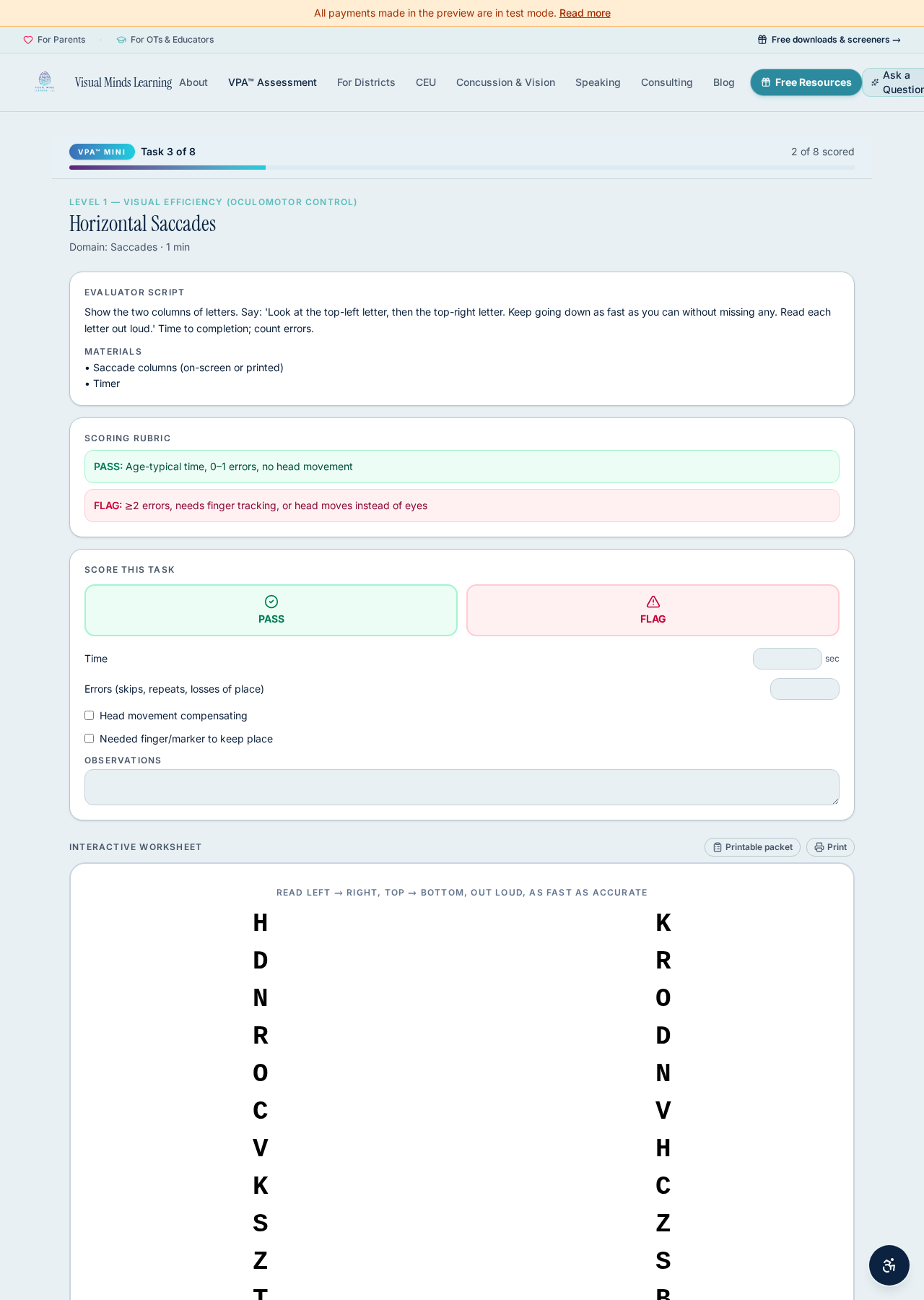
  • Intermediate tasks at 60 cm, near tasks at 40 cm — measured, not estimated.
  • Even, glare-free lighting; stimulus plane perpendicular to the line of sight.
  • Seated with feet supported, work surface at elbow height.
  • Habitual correction worn; note if the student left glasses at home.
  • Age band selected by chronological age: 5–7, 8–11, 12–16, 17+.

Say this

Frame the slide: "Non-negotiables before the first item."

Walk each point, one sentence each:

• Intermediate tasks at 60 cm, near tasks at 40 cm — measured, not estimated.

• Even, glare-free lighting; stimulus plane perpendicular to the line of sight.

• Seated with feet supported, work surface at elbow height.

• Habitual correction worn; note if the student left glasses at home.

• Age band selected by chronological age: 5–7, 8–11, 12–16, 17+.

Point at the figure while you talk — name the parts before the labels.

Close with: "If you only take one of these back, take the first one."

My notes

3.5 — Why stimuli change with the band

Teaching slide

Stimuli

Why stimuli change with the band

  • Level content is developmentally scaled — shapes, then letters, then words, then sentences.
  • Reading and writing probes track grade-level print and demand.
  • Distance-specific cards exist for intermediate and near; do not substitute.
L0

Visual acuity & ocular health

Distance/near acuity check, contrast, red-flag screen

L1

Visual fields & attention to space

Confrontation fields, cancellation, scan-grid coverage

L2

Oculomotor & near-point efficiency

Fixation, pursuits, saccade columns, NPC, endurance

L3

Visual-perceptual processing

Discrimination, figure-ground, closure, memory, spatial

L4

Visual-motor integration

Copy tasks, form reproduction, timed written output

Each level is sampled by its own task family. A composite score collapses these into one number; the profile keeps them separate so the plan can target the unstable floor.
The VPA™: Assessment & Clinical Reasoning
5 / 20
  • Level content is developmentally scaled — shapes, then letters, then words, then sentences.
  • Reading and writing probes track grade-level print and demand.
  • Distance-specific cards exist for intermediate and near; do not substitute.

Say this

Frame the slide: "Why stimuli change with the band."

Walk each point, one sentence each:

• Level content is developmentally scaled — shapes, then letters, then words, then sentences.

• Reading and writing probes track grade-level print and demand.

• Distance-specific cards exist for intermediate and near; do not substitute.

Point at the figure while you talk — name the parts before the labels.

Close with: "If you only take one of these back, take the first one."

My notes

3.6 — What changes between bands

Comparison

Age bands

What changes between bands

5–7 and 8–11

  • Shapes and single letters at the lower levels
  • Shorter passages, larger print, more frequent breaks
  • Writing sample: copying and short generative sentences
  • Heavier reliance on demonstration in the Do line

12–16 and 17+

  • Words, sentences, and dense paragraph-level print
  • Longer sustained-demand probes for endurance
  • Writing sample: paragraph generation under time
  • Self-report of symptoms carries more diagnostic weight
VPA™ · Age band

5–7 years

Shorter probes, picture-based stimuli, heavier modeling

8–11 years

Full ladder, standard stimuli, timed output introduced

12–16 years

Academic-load stimuli, endurance probes, self-report added

17+ years

Transition/vocational tasks, driving-adjacent scanning demands

Band selection sets stimulus size, pacing, and expected ceiling. Choose by chronological age unless a documented developmental profile makes a lower band the fairer test of performance — and record that decision.
The VPA™: Assessment & Clinical Reasoning
6 / 20
  • 5–7 and 8–11: Shapes and single letters at the lower levels · Shorter passages, larger print, more frequent breaks · Writing sample: copying and short generative sentences · Heavier reliance on demonstration in the Do line
  • 12–16 and 17+: Words, sentences, and dense paragraph-level print · Longer sustained-demand probes for endurance · Writing sample: paragraph generation under time · Self-report of symptoms carries more diagnostic weight

Say this

Contrast the two columns: 5–7 and 8–11 versus 12–16 and 17+.

5–7 and 8–11:

• Shapes and single letters at the lower levels

• Shorter passages, larger print, more frequent breaks

• Writing sample: copying and short generative sentences

• Heavier reliance on demonstration in the Do line

12–16 and 17+:

• Words, sentences, and dense paragraph-level print

• Longer sustained-demand probes for endurance

• Writing sample: paragraph generation under time

• Self-report of symptoms carries more diagnostic weight

Ask: "Which column is your student living in right now?"

My notes

3.7 — Levels 4 and 5 in each band — same demand, different material

Comparison

Age bands

Levels 4 and 5 in each band — same demand, different material

What stays the same at L4 / L5

  • Difficulty is set by the level: 18 px print at L4, 12 px at L5; 8 then 10 saccade items per column.
  • Sustained-demand timing is set by the level and the band together — 90 s to 2 min at ages 5–7, 5 to 10 min at 12+ and adult.
  • Basal and ceiling rules are identical in every band.

What the student actually sees

  • 5–7: pond and field-trip narratives; saccade columns of shapes and CVC words.
  • 8–11: harbor and astronomy passages; letter columns with multi-syllable words.
  • 12–16: technology and public-health passages; digit/letter columns with academic vocabulary.
  • 17+: acquired brain injury and ocular-motor passages; alphanumeric pairs with clinical vocabulary.
Line 1 → Line 5: letters grow, spacing widens, baseline drifts upward.
A rendered copy sample showing what performance breakdown looks like on the page: baseline drift, widening spacing, and letter size growth across five lines of sustained near work.
The VPA™: Assessment & Clinical Reasoning
7 / 20
  • What stays the same at L4 / L5: Difficulty is set by the level: 18 px print at L4, 12 px at L5; 8 then 10 saccade items per column. · Sustained-demand timing is set by the level and the band together — 90 s to 2 min at ages 5–7, 5 to 10 min at 12+ and adult. · Basal and ceiling rules are identical in every band.
  • What the student actually sees: 5–7: pond and field-trip narratives; saccade columns of shapes and CVC words. · 8–11: harbor and astronomy passages; letter columns with multi-syllable words. · 12–16: technology and public-health passages; digit/letter columns with academic vocabulary. · 17+: acquired brain injury and ocular-motor passages; alphanumeric pairs with clinical vocabulary.

Say this

Contrast the two columns: What stays the same at L4 / L5 versus What the student actually sees.

What stays the same at L4 / L5:

• Difficulty is set by the level: 18 px print at L4, 12 px at L5; 8 then 10 saccade items per column.

• Sustained-demand timing is set by the level and the band together — 90 s to 2 min at ages 5–7, 5 to 10 min at 12+ and adult.

• Basal and ceiling rules are identical in every band.

What the student actually sees:

• 5–7: pond and field-trip narratives; saccade columns of shapes and CVC words.

• 8–11: harbor and astronomy passages; letter columns with multi-syllable words.

• 12–16: technology and public-health passages; digit/letter columns with academic vocabulary.

• 17+: acquired brain injury and ocular-motor passages; alphanumeric pairs with clinical vocabulary.

Ask: "Which column is your student living in right now?"

My notes

3.8 — Which parts of the VPA™ actually change with the band

Comparison

Age bands

Which parts of the VPA™ actually change with the band

Band-adapted (the material changes)

  • Saccade columns — symbols and CVC words at 5–7, letters and multi-syllable words at 8–11, digit/letter pairs with academic vocabulary at 12–16, alphanumeric pairs with clinical vocabulary at 17+.
  • Reading passages and the read-aloud instruction — separate banked passages, and the expected oral rate anchor moves 45 → 85 → 110 → 130 wpm.
  • Writing prompts — name and tracing, then functional words, then sentence stems, then a mock form or memo.
  • Visual discrimination trials — shape sets for the youngest band, letter and word sets above it.
  • Fixation-under-load: count to 10, count by 2s, or serial 3s backward, by band.
  • Functional Integration L1–L5 scripts — reading tier and writing demand are chosen for the band before the block starts.

Level-only (deliberately band-neutral)

  • Form constancy, visual closure, and spatial relations — geometric and orientation judgments; the difficulty is the geometry, not the vocabulary.
  • Visual memory set size and exposure time — set by level so the same construct is measured across ages.
  • Convergence target size and VMI copy figures — scaled by level, identical stimulus across bands.
  • Basal, ceiling, rubric (0–3), and achieved-level rules — identical in every band.
The VPA™: Assessment & Clinical Reasoning
8 / 20
  • Band-adapted (the material changes): Saccade columns — symbols and CVC words at 5–7, letters and multi-syllable words at 8–11, digit/letter pairs with academic vocabulary at 12–16, alphanumeric pairs with clinical vocabulary at 17+. · Reading passages and the read-aloud instruction — separate banked passages, and the expected oral rate anchor moves 45 → 85 → 110 → 130 wpm. · Writing prompts — name and tracing, then functional words, then sentence stems, then a mock form or memo. · Visual discrimination trials — shape sets for the youngest band, letter and word sets above it. · Fixation-under-load: count to 10, count by 2s, or serial 3s backward, by band. · Functional Integration L1–L5 scripts — reading tier and writing demand are chosen for the band before the block starts.
  • Level-only (deliberately band-neutral): Form constancy, visual closure, and spatial relations — geometric and orientation judgments; the difficulty is the geometry, not the vocabulary. · Visual memory set size and exposure time — set by level so the same construct is measured across ages. · Convergence target size and VMI copy figures — scaled by level, identical stimulus across bands. · Basal, ceiling, rubric (0–3), and achieved-level rules — identical in every band.

Say this

Contrast the two columns: Band-adapted (the material changes) versus Level-only (deliberately band-neutral).

Band-adapted (the material changes):

• Saccade columns — symbols and CVC words at 5–7, letters and multi-syllable words at 8–11, digit/letter pairs with academic vocabulary at 12–16, alphanumeric pairs with clinical vocabulary at 17+.

• Reading passages and the read-aloud instruction — separate banked passages, and the expected oral rate anchor moves 45 → 85 → 110 → 130 wpm.

• Writing prompts — name and tracing, then functional words, then sentence stems, then a mock form or memo.

• Visual discrimination trials — shape sets for the youngest band, letter and word sets above it.

• Fixation-under-load: count to 10, count by 2s, or serial 3s backward, by band.

• Functional Integration L1–L5 scripts — reading tier and writing demand are chosen for the band before the block starts.

Level-only (deliberately band-neutral):

• Form constancy, visual closure, and spatial relations — geometric and orientation judgments; the difficulty is the geometry, not the vocabulary.

• Visual memory set size and exposure time — set by level so the same construct is measured across ages.

• Convergence target size and VMI copy figures — scaled by level, identical stimulus across bands.

• Basal, ceiling, rubric (0–3), and achieved-level rules — identical in every band.

Ask: "Which column is your student living in right now?"

My notes

3.9 — So what? Setup fidelity is the difference between data and noise

So what?

So what?

So what? Setup fidelity is the difference between data and noise

Working distance, lighting, and positioning change scores more than most skill differences you are trying to detect.

If setup drifts between administrations, your progress line measures your setup, not the student.

What you do with it

  • Measure and record working distance every administration.
  • Set posture and lighting before the first item, not after item three.
  • Use the same age-band stimuli and the same materials at reassessment.

Watch for

A large change at reassessment with no intervention change — check your setup before you celebrate.

The VPA™: Assessment & Clinical Reasoning
9 / 20
  • Working distance, lighting, and positioning change scores more than most skill differences you are trying to detect.
  • Because: If setup drifts between administrations, your progress line measures your setup, not the student.
  • Move: Measure and record working distance every administration.
  • Move: Set posture and lighting before the first item, not after item three.
  • Move: Use the same age-band stimuli and the same materials at reassessment.
  • Watch for: A large change at reassessment with no intervention change — check your setup before you celebrate.

Say this

Land the "so what": Working distance, lighting, and positioning change scores more than most skill differences you are trying to detect.

Explain the mechanism plainly: If setup drifts between administrations, your progress line measures your setup, not the student.

Then give them the moves — say each one as something they can do Monday:

• Measure and record working distance every administration.

• Set posture and lighting before the first item, not after item three.

• Use the same age-band stimuli and the same materials at reassessment.

Tell them what success looks like: A large change at reassessment with no intervention change — check your setup before you celebrate.

Ask: "Who has a student this describes right now?" Take one answer, then move.

My notes

3.10 — Postural setup changes what you are measuring

Before / after

Change the setup

Postural setup changes what you are measuring

Before — unsupported

Feet unsupported, trunk collapsed, page about 15 cm from the eyes.

Feet unsupported, trunk collapsed, page about 15 cm from the eyes.

  • • Near demand is far higher than the task requires
  • • Fatigue and avoidance appear within minutes

After — supported

Feet supported, hips back, page raised toward a slant, working distance near Harmon distance.

Feet supported, hips back, page raised toward a slant, working distance near Harmon distance.

  • • Working distance is now a controlled variable, not a confound
  • • Endurance findings become interpretable

Fix posture and distance before you score anything. Otherwise you are documenting the setup, not the student.

The VPA™: Assessment & Clinical Reasoning
10 / 20
  • Before — unsupported: Feet unsupported, trunk collapsed, page about 15 cm from the eyes. · Near demand is far higher than the task requires · Fatigue and avoidance appear within minutes
  • After — supported: Feet supported, hips back, page raised toward a slant, working distance near Harmon distance. · Working distance is now a controlled variable, not a confound · Endurance findings become interpretable
  • Takeaway: Fix posture and distance before you score anything. Otherwise you are documenting the setup, not the student.

Say this

Set up the contrast: "Postural setup changes what you are measuring."

Point at the before panel first. Feet unsupported, trunk collapsed, page about 15 cm from the eyes.

Then the after panel. Feet supported, hips back, page raised toward a slant, working distance near Harmon distance.

Say the rule out loud: Fix posture and distance before you score anything. Otherwise you are documenting the setup, not the student.

Ask: "What did we change — the child, or the demand?"

My notes

3.11 — Two-minute case: the score that moved for the wrong reason

Mini case

Two-minute case

Two-minute case: the score that moved for the wrong reason

A student scores markedly better at the 9-week reassessment. You administered the first session at a table with the student standing and the second seated with a slant board.

What can you report?

The VPA™: Assessment & Clinical Reasoning
11 / 20
  • A student scores markedly better at the 9-week reassessment. You administered the first session at a table with the student standing and the second seated with a slant board.
  • Question: What can you report?
  • Model answer: You cannot attribute the change to the intervention. Document the setup difference, re-administer under the original controlled setup, and report the change only when the conditions match. Note the slant-board response separately as a modification finding.
  • Teaching point: Progress data is only interpretable when the setup is held constant.

Say this

Two-minute case. Read it aloud:

A student scores markedly better at the 9-week reassessment. You administered the first session at a table with the student standing and the second seated with a slant board.

Put the question to them: "What can you report?" Give 60 seconds, no talking.

Model answer (reveal after they commit): You cannot attribute the change to the intervention. Document the setup difference, re-administer under the original controlled setup, and report the change only when the conditions match. Note the slant-board response separately as a modification finding.

Close with the rule: Progress data is only interpretable when the setup is held constant.

My notes

3.12 — Band selection under pressure

Self-check

Check

Band selection under pressure

A 15-year-old with an intellectual disability reads at a first-grade level and is referred for worksheet navigation. You administer the 12–16 band and she fails Level 4 figure-ground on a text-embedded array. What went wrong?

The VPA™: Assessment & Clinical Reasoning
12 / 20
  • A 15-year-old with an intellectual disability reads at a first-grade level and is referred for worksheet navigation. You administer the 12–16 band and she fails Level 4 figure-ground on a text-embedded array. What went wrong?
  • – Nothing — the failure is a valid Level 4 figure-ground finding.
  • ✓ The text-embedded stimulus measured reading access as much as figure-ground; select down a band and record the substitution and the reason.
  • – She should have been given the Pre-K Quick Screen instead.
  • – Figure-ground should be dropped from the protocol for this student.
  • Rationale: Band selection defaults to chronological age, but reading or receptive-language access can justify selecting down. Administer the accessible band, record the substitution and why, and interpret against that band. An unrecorded band substitution is the most common cause of uninterpretable VPA™ data — and the Pre-K Quick Screen is for ages 3–4, not for older students with lower reading levels.

Say this

Knowledge check: "A 15-year-old with an intellectual disability reads at a first-grade level and is referred for worksheet navigation. You administer the 12–16 band and she fails Level 4 figure-ground on a text-embedded array. What went wrong?"

Options:

• Nothing — the failure is a valid Level 4 figure-ground finding.

• The text-embedded stimulus measured reading access as much as figure-ground; select down a band and record the substitution and the reason.

• She should have been given the Pre-K Quick Screen instead.

• Figure-ground should be dropped from the protocol for this student.

Correct answer: option 2. Rationale: Band selection defaults to chronological age, but reading or receptive-language access can justify selecting down. Administer the accessible band, record the substitution and why, and interpret against that band. An unrecorded band substitution is the most common cause of uninterpretable VPA™ data — and the Pre-K Quick Screen is for ages 3–4, not for older students with lower reading levels.

My notes

3.13 — Eye dominance: Porta and Miles tests

Teaching slide

Setup

Eye dominance: Porta and Miles tests

  • Extended-arm method: patient extends one arm, holds a thumb or wand upright, and aligns it with a distant target using both eyes open.
  • Porta test: cover one eye at a time — the dominant eye is the one that keeps the object aligned with the target when the other eye is covered.
  • Miles test: patient views the target through a small triangle formed by the hands at arm’s length; closing the dominant eye makes the target appear to jump off-center.
  • Record which eye is dominant and whether the result is consistent across trials.
  • Note if dominance is unstable or switches between trials — this is itself an observation worth recording, not a diagnosis.
BirthLight response,brief fixation2–3 moSmooth pursuit,social fixation4–6 moBinocularity,reach-to-graspunder vision1–2 yrVisually guidedmobility, formmatching3–5 yrForm constancy,copying, sustainednear work6–9 yrReading endurance,fluent saccades
Visual function matures in an ordered sequence. Knowing the expected sequence is what lets you call a finding delayed rather than merely low.
The VPA™: Assessment & Clinical Reasoning
13 / 20
  • Extended-arm method: patient extends one arm, holds a thumb or wand upright, and aligns it with a distant target using both eyes open.
  • Porta test: cover one eye at a time — the dominant eye is the one that keeps the object aligned with the target when the other eye is covered.
  • Miles test: patient views the target through a small triangle formed by the hands at arm’s length; closing the dominant eye makes the target appear to jump off-center.
  • Record which eye is dominant and whether the result is consistent across trials.
  • Note if dominance is unstable or switches between trials — this is itself an observation worth recording, not a diagnosis.

Say this

Frame the slide: "Eye dominance: Porta and Miles tests."

Walk each point, one sentence each:

• Extended-arm method: patient extends one arm, holds a thumb or wand upright, and aligns it with a distant target using both eyes open.

• Porta test: cover one eye at a time — the dominant eye is the one that keeps the object aligned with the target when the other eye is covered.

• Miles test: patient views the target through a small triangle formed by the hands at arm’s length; closing the dominant eye makes the target appear to jump off-center.

• Record which eye is dominant and whether the result is consistent across trials.

• Note if dominance is unstable or switches between trials — this is itself an observation worth recording, not a diagnosis.

Point at the figure while you talk — name the parts before the labels.

Close with: "If you only take one of these back, take the first one."

My notes

3.14 — Cover tests: a setup observation, not a VPA™ item

Comparison

Before you score

Cover tests: a setup observation, not a VPA™ item

Cover–uncover

  • Student fixates a target; cover one eye, then remove the cover.
  • If the uncovered eye moves to re-fixate, that is a sign of a manifest eye turn.
  • Note which eye moved and the direction.

Alternate cover

  • Alternate the cover briskly between the eyes.
  • Movement as the cover shifts onto an eye suggests a latent deviation.
  • Note the direction — in, out, up, down.
Occupational therapist seated across from a child at eye level, holding a near target while observing the child’s eyes

Eye level, off midline

Sit level with the student’s eyes and roughly 30° off midline so both eyes stay visible.

Target at eye level

Held at eye level, not above — an elevated target forces chin-up posture and false head substitution.

Score sheet within reach

Record each trial as it happens; retrospective scoring loses the qualitative signal.

You cannot score what you cannot see. Sit slightly off-midline and level with the student’s eyes so pursuits, undershoot, and head substitution are visible — not behind or above the shoulder.
The VPA™: Assessment & Clinical Reasoning
14 / 20
  • Cover–uncover: Student fixates a target; cover one eye, then remove the cover. · If the uncovered eye moves to re-fixate, that is a sign of a manifest eye turn. · Note which eye moved and the direction.
  • Alternate cover: Alternate the cover briskly between the eyes. · Movement as the cover shifts onto an eye suggests a latent deviation. · Note the direction — in, out, up, down.

Say this

Contrast the two columns: Cover–uncover versus Alternate cover.

Cover–uncover:

• Student fixates a target; cover one eye, then remove the cover.

• If the uncovered eye moves to re-fixate, that is a sign of a manifest eye turn.

• Note which eye moved and the direction.

Alternate cover:

• Alternate the cover briskly between the eyes.

• Movement as the cover shifts onto an eye suggests a latent deviation.

• Note the direction — in, out, up, down.

Ask: "Which column is your student living in right now?"

My notes

3.15 — Below the floor of the VPA™

Teaching slide

Pre-K

Below the floor of the VPA™

  • Ages 3–4 use the Pre-K Quick Screen — refer or offer simple activities.
  • Do not force a 5–7 band protocol onto a preschooler; the data will not hold.
  • Document what you observed functionally and set a re-check date.
The VPA™: Assessment & Clinical Reasoning
15 / 20
  • Ages 3–4 use the Pre-K Quick Screen — refer or offer simple activities.
  • Do not force a 5–7 band protocol onto a preschooler; the data will not hold.
  • Document what you observed functionally and set a re-check date.

Say this

Frame the slide: "Below the floor of the VPA™."

Walk each point, one sentence each:

• Ages 3–4 use the Pre-K Quick Screen — refer or offer simple activities.

• Do not force a 5–7 band protocol onto a preschooler; the data will not hold.

• Document what you observed functionally and set a re-check date.

Close with: "If you only take one of these back, take the first one."

My notes

3.16 — Module 3 video — setup and age bands

Video

Lecture

Module 3 video — setup and age bands

VIDEO SLOT

Distance, lighting, positioning, and band selection demonstrated.

Slides tab → set “url” to your YouTube/Vimeo/Loom embed link

The VPA™: Assessment & Clinical Reasoning
16 / 20
  • Distance, lighting, positioning, and band selection demonstrated.

Say this

Set up the clip in one sentence, play it, then debrief with "what did you notice?"

My notes

3.17 — Photo — measured setup at 60 cm and 40 cm

Visual

Import

Photo — measured setup at 60 cm and 40 cm

Child holding a near-point card at midline while an occupational therapist observes and records, with a ruler on the desk to verify the working distance

Near probes · 40 cm

Card at midline and at eye level; measure from the spectacle plane, not the forehead.

Table/screen · 60 cm

Use the same distance at screening and re-probe — a distance change invalidates the comparison.

Base of support

Feet supported and hips at 90° before any oculomotor scoring; postural drift reads as an efficiency deficit.

Measure, don’t estimate. Near probes are administered at 40 cm and intermediate/table probes at 60 cm, with the page at midline, feet supported, and light from behind the shoulder rather than facing the student.
The VPA™: Assessment & Clinical Reasoning
17 / 20
  • Two photos or one composite showing both working distances.

Say this

Describe what belongs here: Two photos or one composite showing both working distances..

My notes

3.18 — Screenshot — age band selection screen

Visual

Import

Screenshot — age band selection screen

VPA™ · Age band

5–7 years

Shorter probes, picture-based stimuli, heavier modeling

8–11 years

Full ladder, standard stimuli, timed output introduced

12–16 years

Academic-load stimuli, endurance probes, self-report added

17+ years

Transition/vocational tasks, driving-adjacent scanning demands

Band selection sets stimulus size, pacing, and expected ceiling. Choose by chronological age unless a documented developmental profile makes a lower band the fairer test of performance — and record that decision.
The VPA™: Assessment & Clinical Reasoning
18 / 20
  • Band picker showing 5–7, 8–11, 12–16, 17+.

Say this

Describe what belongs here: Band picker showing 5–7, 8–11, 12–16, 17+..

My notes

3.19 — Reflect and share

Reflection

Reflect and share

Reflect and share

Name the two client or contextual factors that will drive age band and stimulus selection for your next student.

THINKPROCESSSHARE
The VPA™: Assessment & Clinical Reasoning
19 / 20
  • Name the two client or contextual factors that will drive age band and stimulus selection for your next student.
  • Starter: For [student], the age band is driven by... and the stimulus selection is driven by...

Say this

Reflection prompt: "Name the two client or contextual factors that will drive age band and stimulus selection for your next student."

Offer the sentence starter: "For [student], the age band is driven by... and the stimulus selection is driven by..."

Think for one minute, write, then take two shares.

My notes

3.20 — Knowledge check — setup

Self-check

Knowledge check

Knowledge check — setup

Why is uncontrolled working distance a scoring problem, not just a tidiness problem?

The VPA™: Assessment & Clinical Reasoning
20 / 20
  • Why is uncontrolled working distance a scoring problem, not just a tidiness problem?
  • – It makes the session run long
  • ✓ It changes the visual demand, so the score no longer means what the norms mean
  • – It makes the student uncomfortable
  • – It affects lighting only
  • Rationale: Distance changes angular size and accommodative demand. An unmeasured distance makes the result uninterpretable.

Say this

Knowledge check: "Why is uncontrolled working distance a scoring problem, not just a tidiness problem?"

Options:

• It makes the session run long

• It changes the visual demand, so the score no longer means what the norms mean

• It makes the student uncomfortable

• It affects lighting only

Correct answer: option 2. Rationale: Distance changes angular size and accommodative demand. An unmeasured distance makes the result uninterpretable.

My notes

Module 4

4.1 — Administering the Mini VPA™: the seven probes, scripts, prompting limits, and observation cues

Transition

Module 4

Administering the Mini VPA™: the seven probes, scripts, prompting limits, and observation cues

1:20 – 1:55

The VPA™: Assessment & Clinical Reasoning
1 / 16
  • 1:20 – 1:55

Say this

Transition: "Administering the Mini VPA™: the seven probes, scripts, prompting limits, and observation cues."

My notes

4.2 — Administering the Mini VPA™

Title

Module 4

Administering the Mini VPA™

Five probes, verbatim scripts, prompting limits, and observation cues.

The VPA™: Assessment & Clinical Reasoning
2 / 16
  • Five probes, verbatim scripts, prompting limits, and observation cues.

Say this

Open here. "Administering the Mini VPA™." Five probes, verbatim scripts, prompting limits, and observation cues.

Say why this section matters for their caseload, then advance.

My notes

4.3 — Prompting habits

Poll

Poll

Prompting habits

Which prompting error are you most at risk of during administration?

The VPA™: Assessment & Clinical Reasoning
3 / 16
  • Which prompting error are you most at risk of during administration?
  • – Repeating the item after a delay
  • – Adding encouragement that cues the answer
  • – Allowing extra time past the limit
  • – Rephrasing the script

Say this

Ask the poll: "Which prompting error are you most at risk of during administration?"

Options:

• Repeating the item after a delay

• Adding encouragement that cues the answer

• Allowing extra time past the limit

• Rephrasing the script

Take a show of hands or the on-screen tally, then name the pattern you see before advancing.

My notes

4.4 — Script discipline

Teaching slide

Fidelity

Script discipline

  • Read the Say line verbatim; the Do line defines your hands and the timing.
  • One repetition of instructions is permitted; further prompting is recorded, not free.
  • Score performance, not effort — note effort separately as an observation.
  • Record the observation cues (place loss, head movement, working distance drift).
  1. 1Set conditions: lighting, distance, seating, materials
  2. 2Screen Level 0 red flags — stop and refer if present
  3. 3Establish basal at the age-entry item
  4. 4Administer to ceiling, scoring against the criterion
  5. 5Log validity observations as they happen
  6. 6Compute level profile and composite
  7. 7Name the limiter and the disposition
The fidelity sequence. Steps are not optional or reorderable — deviations are documented, not absorbed silently into the score.
The VPA™: Assessment & Clinical Reasoning
4 / 16
  • Read the Say line verbatim; the Do line defines your hands and the timing.
  • One repetition of instructions is permitted; further prompting is recorded, not free.
  • Score performance, not effort — note effort separately as an observation.
  • Record the observation cues (place loss, head movement, working distance drift).

Say this

Frame the slide: "Script discipline."

Walk each point, one sentence each:

• Read the Say line verbatim; the Do line defines your hands and the timing.

• One repetition of instructions is permitted; further prompting is recorded, not free.

• Score performance, not effort — note effort separately as an observation.

• Record the observation cues (place loss, head movement, working distance drift).

Point at the figure while you talk — name the parts before the labels.

Close with: "If you only take one of these back, take the first one."

My notes

4.5 — What triggers a Full VPA™

Teaching slide

Flag logic

What triggers a Full VPA™

  • Any probe failed at or below the expected level for the band.
  • Any probe passed only with degraded rate, endurance, or strategy.
  • Teacher/caregiver report that conflicts with a passed probe.
  • Any red-flag ocular symptom — refer regardless of the screen result.
5

Efficient & durable

Performs accurately, at pace, and sustains across the school day.

4

Functional

Accurate under typical demand; fatigues only at the end of long tasks.

3

Inconsistent

Accuracy varies with load, time pressure, or visual clutter.

2

Emerging with support

Succeeds only with cueing, magnification, spacing, or reduced load.

1

Not observed

Skill not yet available under any tested condition.

The same ladder is used for every skill, so goals move a named skill up a named level. Write the level in present levels and the target level in the goal.
The VPA™: Assessment & Clinical Reasoning
5 / 16
  • Any probe failed at or below the expected level for the band.
  • Any probe passed only with degraded rate, endurance, or strategy.
  • Teacher/caregiver report that conflicts with a passed probe.
  • Any red-flag ocular symptom — refer regardless of the screen result.

Say this

Frame the slide: "What triggers a Full VPA™."

Walk each point, one sentence each:

• Any probe failed at or below the expected level for the band.

• Any probe passed only with degraded rate, endurance, or strategy.

• Teacher/caregiver report that conflicts with a passed probe.

• Any red-flag ocular symptom — refer regardless of the screen result.

Point at the figure while you talk — name the parts before the labels.

Close with: "If you only take one of these back, take the first one."

My notes

4.6 — Pursuit and saccade observation cues

Comparison

Observation

Pursuit and saccade observation cues

Pursuit: look for

  • Symmetry between the two eyes as they track
  • Head movement substituting for eye movement
  • Target drift — eyes falling behind or leading the target
  • Change in focal distance or working distance during the task

Saccade: look for

  • Accuracy of landing on the target placement
  • Undershoot or overshoot of the intended fixation point
  • Fatigue — accuracy degrading over repeated trials
  • Loss of fixation between jumps
Probe · Saccades (near, 40 cm)

Say

“Look at the star, then the circle, and keep going back and forth until I say stop. Move only your eyes.”

Do

Hold targets 20 cm apart at 40 cm, eye level. Time 30 s. Watch for head movement, undershoot, loss of place, and reported blur.

Score the level reached

L1Cannot localize both targets
L2Localizes with head movement / frequent loss
L3Accurate but effortful; slows within 30 s
L4Accurate and steady for the full trial
L5Accurate and steady while reading aloud (dual task)
Every probe is scripted: what you say, what you do, and the exact behavior that separates one level from the next. Scripting is what makes a re-probe eight weeks later comparable.
The VPA™: Assessment & Clinical Reasoning
6 / 16
  • Pursuit: look for: Symmetry between the two eyes as they track · Head movement substituting for eye movement · Target drift — eyes falling behind or leading the target · Change in focal distance or working distance during the task
  • Saccade: look for: Accuracy of landing on the target placement · Undershoot or overshoot of the intended fixation point · Fatigue — accuracy degrading over repeated trials · Loss of fixation between jumps

Say this

Contrast the two columns: Pursuit: look for versus Saccade: look for.

Pursuit: look for:

• Symmetry between the two eyes as they track

• Head movement substituting for eye movement

• Target drift — eyes falling behind or leading the target

• Change in focal distance or working distance during the task

Saccade: look for:

• Accuracy of landing on the target placement

• Undershoot or overshoot of the intended fixation point

• Fatigue — accuracy degrading over repeated trials

• Loss of fixation between jumps

Ask: "Which column is your student living in right now?"

My notes

4.7 — Near point of convergence — the penlight probe

Teaching slide

Probe 2 · Efficiency

Near point of convergence — the penlight probe

  • This belongs to the Level 2 efficiency probe. You run it here in the Mini, and again inside Domain 2 of the Full.
  • Start the penlight or accommodative target at about 18 in, midline, at eye level.
  • Move it slowly toward the bridge of the nose while the student holds fixation.
  • Record the break — the distance at which the student reports doubling or you see an eye drift out.
  • Move back out and record the recovery distance. Run three trials: a break that recedes across trials is the finding.
  • Stop for any report of pain; record head movement, squinting, or an outward eye turn.
Child holding a near-point card at midline while an occupational therapist observes and records, with a ruler on the desk to verify the working distance

Near probes · 40 cm

Card at midline and at eye level; measure from the spectacle plane, not the forehead.

Table/screen · 60 cm

Use the same distance at screening and re-probe — a distance change invalidates the comparison.

Base of support

Feet supported and hips at 90° before any oculomotor scoring; postural drift reads as an efficiency deficit.

Measure, don’t estimate. Near probes are administered at 40 cm and intermediate/table probes at 60 cm, with the page at midline, feet supported, and light from behind the shoulder rather than facing the student.
The VPA™: Assessment & Clinical Reasoning
7 / 16
  • This belongs to the Level 2 efficiency probe. You run it here in the Mini, and again inside Domain 2 of the Full.
  • Start the penlight or accommodative target at about 18 in, midline, at eye level.
  • Move it slowly toward the bridge of the nose while the student holds fixation.
  • Record the break — the distance at which the student reports doubling or you see an eye drift out.
  • Move back out and record the recovery distance. Run three trials: a break that recedes across trials is the finding.
  • Stop for any report of pain; record head movement, squinting, or an outward eye turn.

Say this

Frame the slide: "Near point of convergence — the penlight probe."

Walk each point, one sentence each:

• This belongs to the Level 2 efficiency probe. You run it here in the Mini, and again inside Domain 2 of the Full.

• Start the penlight or accommodative target at about 18 in, midline, at eye level.

• Move it slowly toward the bridge of the nose while the student holds fixation.

• Record the break — the distance at which the student reports doubling or you see an eye drift out.

• Move back out and record the recovery distance. Run three trials: a break that recedes across trials is the finding.

• Stop for any report of pain; record head movement, squinting, or an outward eye turn.

Point at the figure while you talk — name the parts before the labels.

Close with: "If you only take one of these back, take the first one."

My notes

4.8 — One probe per level

Comparison

The seven probes

One probe per level

Levels 1–3

  • L1 — acuity at the measured distance, correction worn
  • L2 — oculomotor efficiency and near endurance
  • L3 — a visual processing probe appropriate to the band
  • Score the level achieved, not the raw item count

Levels 4–5

  • L4 — visual-motor copy accuracy
  • L5 — functional reading and a writing sample
  • Record rate, prompts, and place-loss events
  • Any degraded pass is still a flag
Visual Performance Assessment™ · Select skills

Ocular foundation

  • Near acuity
  • Distance acuity
  • Contrast & glare tolerance

Field & attention to space

  • Field awareness
  • Organized scanning
  • Left/right coverage

Oculomotor efficiency

  • Fixation stability
  • Pursuits
  • Saccades & NPC

Perceptual processing

  • Discrimination & closure
  • Figure-ground
  • Visual memory & spatial

Visual-motor integration

  • Copy accuracy
  • Form reproduction
  • Timed written output
The Full VPA™ skill menu. Clinicians select the skills the referral question actually requires; the ladder and scoring rules stay identical across every skill selected.
The VPA™: Assessment & Clinical Reasoning
8 / 16
  • Levels 1–3: L1 — acuity at the measured distance, correction worn · L2 — oculomotor efficiency and near endurance · L3 — a visual processing probe appropriate to the band · Score the level achieved, not the raw item count
  • Levels 4–5: L4 — visual-motor copy accuracy · L5 — functional reading and a writing sample · Record rate, prompts, and place-loss events · Any degraded pass is still a flag

Say this

Contrast the two columns: Levels 1–3 versus Levels 4–5.

Levels 1–3:

• L1 — acuity at the measured distance, correction worn

• L2 — oculomotor efficiency and near endurance

• L3 — a visual processing probe appropriate to the band

• Score the level achieved, not the raw item count

Levels 4–5:

• L4 — visual-motor copy accuracy

• L5 — functional reading and a writing sample

• Record rate, prompts, and place-loss events

• Any degraded pass is still a flag

Ask: "Which column is your student living in right now?"

My notes

4.9 — What to watch while they work

Teaching slide

Observation

What to watch while they work

  • Working distance drift and head movement instead of eye movement.
  • Place loss, re-reading, and finger tracking that was not there at baseline.
  • Squinting, blinking bursts, eye rubbing, or turning away from the page.
  • Strategy: does the student narrate a plan or guess and check?
1

Fatigue

Performance decays across the session, not across difficulty.

2

Attention

Errors scatter randomly instead of clustering by demand.

3

Comprehension

The student fails the instruction, not the visual task.

4

Motor confound

Hand control limits the response before vision does.

5

Environment

Glare, distance, clutter, or noise changed the demand.

Five threats that make a low score mean something other than a visual performance deficit. Name the threat in the record before you interpret the profile.
The VPA™: Assessment & Clinical Reasoning
9 / 16
  • Working distance drift and head movement instead of eye movement.
  • Place loss, re-reading, and finger tracking that was not there at baseline.
  • Squinting, blinking bursts, eye rubbing, or turning away from the page.
  • Strategy: does the student narrate a plan or guess and check?

Say this

Frame the slide: "What to watch while they work."

Walk each point, one sentence each:

• Working distance drift and head movement instead of eye movement.

• Place loss, re-reading, and finger tracking that was not there at baseline.

• Squinting, blinking bursts, eye rubbing, or turning away from the page.

• Strategy: does the student narrate a plan or guess and check?

Point at the figure while you talk — name the parts before the labels.

Close with: "If you only take one of these back, take the first one."

My notes

4.10 — Module 4 video — administering the Mini VPA™

Video

Lecture

Module 4 video — administering the Mini VPA™

VIDEO SLOT

Full five-probe run with narration of scoring decisions.

Slides tab → set “url” to your YouTube/Vimeo/Loom embed link

The VPA™: Assessment & Clinical Reasoning
10 / 16
  • Full five-probe run with narration of scoring decisions.

Say this

Set up the clip in one sentence, play it, then debrief with "what did you notice?"

My notes

4.11 — Screenshot — Say/Do script card

Visual

Import

Screenshot — Say/Do script card

Probe · Saccades (near, 40 cm)

Say

“Look at the star, then the circle, and keep going back and forth until I say stop. Move only your eyes.”

Do

Hold targets 20 cm apart at 40 cm, eye level. Time 30 s. Watch for head movement, undershoot, loss of place, and reported blur.

Score the level reached

L1Cannot localize both targets
L2Localizes with head movement / frequent loss
L3Accurate but effortful; slows within 30 s
L4Accurate and steady for the full trial
L5Accurate and steady while reading aloud (dual task)
Every probe is scripted: what you say, what you do, and the exact behavior that separates one level from the next. Scripting is what makes a re-probe eight weeks later comparable.
The VPA™: Assessment & Clinical Reasoning
11 / 16
  • Clinician view of a probe script with the level ladder visible.

Say this

Describe what belongs here: Clinician view of a probe script with the level ladder visible..

My notes

4.12 — Photo — clinician observing eye movements

Visual

Import

Photo — clinician observing eye movements

Occupational therapist seated across from a child at eye level, holding a near target while observing the child’s eyes

Eye level, off midline

Sit level with the student’s eyes and roughly 30° off midline so both eyes stay visible.

Target at eye level

Held at eye level, not above — an elevated target forces chin-up posture and false head substitution.

Score sheet within reach

Record each trial as it happens; retrospective scoring loses the qualitative signal.

You cannot score what you cannot see. Sit slightly off-midline and level with the student’s eyes so pursuits, undershoot, and head substitution are visible — not behind or above the shoulder.
The VPA™: Assessment & Clinical Reasoning
12 / 16
  • Positioning photo showing the clinician’s line of sight to the eyes.

Say this

Describe what belongs here: Positioning photo showing the clinician’s line of sight to the eyes..

My notes

4.13 — So what? Script fidelity protects the finding

So what?

So what?

So what? Script fidelity protects the finding

Every extra prompt you add turns an assessment item into a teaching trial, and the score stops meaning what the manual says it means.

The five Mini probes are standardized in wording, demonstration, and prompting limits.

What you do with it

  • Read the script; do not paraphrase into encouragement.
  • Stay inside the stated prompting limit and record any prompt given.
  • Write observation cues as you go — they carry the clinical meaning the score cannot.

Watch for

Yourself coaching. If you helped, note it; a scored item with an unrecorded prompt is unusable.

The VPA™: Assessment & Clinical Reasoning
13 / 16
  • Every extra prompt you add turns an assessment item into a teaching trial, and the score stops meaning what the manual says it means.
  • Because: The five Mini probes are standardized in wording, demonstration, and prompting limits.
  • Move: Read the script; do not paraphrase into encouragement.
  • Move: Stay inside the stated prompting limit and record any prompt given.
  • Move: Write observation cues as you go — they carry the clinical meaning the score cannot.
  • Watch for: Yourself coaching. If you helped, note it; a scored item with an unrecorded prompt is unusable.

Say this

Land the "so what": Every extra prompt you add turns an assessment item into a teaching trial, and the score stops meaning what the manual says it means.

Explain the mechanism plainly: The five Mini probes are standardized in wording, demonstration, and prompting limits.

Then give them the moves — say each one as something they can do Monday:

• Read the script; do not paraphrase into encouragement.

• Stay inside the stated prompting limit and record any prompt given.

• Write observation cues as you go — they carry the clinical meaning the score cannot.

Tell them what success looks like: Yourself coaching. If you helped, note it; a scored item with an unrecorded prompt is unusable.

Ask: "Who has a student this describes right now?" Take one answer, then move.

My notes

4.14 — Two-minute case: you gave one extra cue

Mini case

Two-minute case

Two-minute case: you gave one extra cue

Mid-probe, a student stalls and you say "remember to start at the left." He then completes the item correctly.

How do you score and document it?

The VPA™: Assessment & Clinical Reasoning
14 / 16
  • Mid-probe, a student stalls and you say "remember to start at the left." He then completes the item correctly.
  • Question: How do you score and document it?
  • Model answer: Score according to the prompting rule for that probe — the item was completed with a prompt beyond the limit, so it does not count as independent. Record the exact cue and the response; that pairing is valuable intervention information even though the item is not credited.
  • Teaching point: Never quietly upgrade a prompted response. Document the prompt and use it clinically.

Say this

Two-minute case. Read it aloud:

Mid-probe, a student stalls and you say "remember to start at the left." He then completes the item correctly.

Put the question to them: "How do you score and document it?" Give 60 seconds, no talking.

Model answer (reveal after they commit): Score according to the prompting rule for that probe — the item was completed with a prompt beyond the limit, so it does not count as independent. Record the exact cue and the response; that pairing is valuable intervention information even though the item is not credited.

Close with the rule: Never quietly upgrade a prompted response. Document the prompt and use it clinically.

My notes

4.15 — Reflect and share

Reflection

Reflect and share

Reflect and share

After scoring yourself on the fidelity checklist, which two items will you rehearse before your first real administration?

THINKPROCESSSHARE
The VPA™: Assessment & Clinical Reasoning
15 / 16
  • After scoring yourself on the fidelity checklist, which two items will you rehearse before your first real administration?
  • Starter: I will rehearse [item 1] and [item 2] because...

Say this

Reflection prompt: "After scoring yourself on the fidelity checklist, which two items will you rehearse before your first real administration?"

Offer the sentence starter: "I will rehearse [item 1] and [item 2] because..."

Think for one minute, write, then take two shares.

My notes

4.16 — Knowledge check — fidelity

Self-check

Knowledge check

Knowledge check — fidelity

A student pauses; you say "you can do it, look again at the top." What have you done?

The VPA™: Assessment & Clinical Reasoning
16 / 16
  • A student pauses; you say "you can do it, look again at the top." What have you done?
  • – Provided allowable encouragement
  • ✓ Provided a cue that changes the task and must be recorded as a prompting deviation
  • – Nothing that affects the score
  • – Invalidated the entire administration
  • Rationale: Directional information is a cue. Record it as a deviation; the item score is no longer comparable to the standard condition.

Say this

Knowledge check: "A student pauses; you say "you can do it, look again at the top." What have you done?"

Options:

• Provided allowable encouragement

• Provided a cue that changes the task and must be recorded as a prompting deviation

• Nothing that affects the score

• Invalidated the entire administration

Correct answer: option 2. Rationale: Directional information is a cue. Record it as a deviation; the item score is no longer comparable to the standard condition.

My notes

Module 5

5.1 — Administering the Full VPA™: level progression, basal and ceiling rules, validity flags

Transition

Module 5

Administering the Full VPA™: level progression, basal and ceiling rules, validity flags

1:55 – 2:35

The VPA™: Assessment & Clinical Reasoning
1 / 15
  • 1:55 – 2:35

Say this

Transition: "Administering the Full VPA™: level progression, basal and ceiling rules, validity flags."

My notes

5.2 — Administering the Full VPA™

Title

Module 5

Administering the Full VPA™

Level progression, basal and ceiling rules, and the five validity threats.

The VPA™: Assessment & Clinical Reasoning
2 / 15
  • Level progression, basal and ceiling rules, and the five validity threats.

Say this

Open here. "Administering the Full VPA™." Level progression, basal and ceiling rules, and the five validity threats.

Say why this section matters for their caseload, then advance.

My notes

5.3 — Stopping rules

Poll

Poll

Stopping rules

What most often makes you unsure when to stop testing?

The VPA™: Assessment & Clinical Reasoning
3 / 15
  • What most often makes you unsure when to stop testing?
  • – Deciding the basal
  • – Deciding the ceiling
  • – Knowing when to drop back a level
  • – Fatigue and behavior confounds

Say this

Ask the poll: "What most often makes you unsure when to stop testing?"

Options:

• Deciding the basal

• Deciding the ceiling

• Knowing when to drop back a level

• Fatigue and behavior confounds

Take a show of hands or the on-screen tally, then name the pattern you see before advancing.

My notes

5.4 — Progression, basal, ceiling

Teaching slide

Rules

Progression, basal, ceiling

  • Every skill runs sequentially L1 → L5; no adaptive skipping.
  • Basal: the highest level performed cleanly without prompting.
  • Ceiling: the level at which performance breaks down and stays broken.
  • Record the achieved level per skill — that number, not a raw total, drives the profile.
Item 1 — difficulty 1Item 2 — difficulty 2Item 3 — difficulty 3Item 4 — difficulty 4Item 5 — difficulty 5Item 6 — difficulty 6Item 7 — difficulty 7Item 8 — difficulty 8BASALTESTCEILING
Basal establishes a floor of secure performance; ceiling stops testing once the demand exceeds capacity. Items outside the window are inferred, not administered.
The VPA™: Assessment & Clinical Reasoning
4 / 15
  • Every skill runs sequentially L1 → L5; no adaptive skipping.
  • Basal: the highest level performed cleanly without prompting.
  • Ceiling: the level at which performance breaks down and stays broken.
  • Record the achieved level per skill — that number, not a raw total, drives the profile.

Say this

Frame the slide: "Progression, basal, ceiling."

Walk each point, one sentence each:

• Every skill runs sequentially L1 → L5; no adaptive skipping.

• Basal: the highest level performed cleanly without prompting.

• Ceiling: the level at which performance breaks down and stays broken.

• Record the achieved level per skill — that number, not a raw total, drives the profile.

Point at the figure while you talk — name the parts before the labels.

Close with: "If you only take one of these back, take the first one."

My notes

5.5 — The five validity threats

Teaching slide

Validity

The five validity threats

  • Setup drift — distance, lighting, or positioning changed mid-session.
  • Fatigue or state — illness, hunger, medication timing, time of day.
  • Attention and effort inconsistency across comparable items.
  • Language or instruction comprehension confounding the visual demand.
  • Uncorrected refractive status or missing habitual correction.
1

Fatigue

Performance decays across the session, not across difficulty.

2

Attention

Errors scatter randomly instead of clustering by demand.

3

Comprehension

The student fails the instruction, not the visual task.

4

Motor confound

Hand control limits the response before vision does.

5

Environment

Glare, distance, clutter, or noise changed the demand.

Five threats that make a low score mean something other than a visual performance deficit. Name the threat in the record before you interpret the profile.
The VPA™: Assessment & Clinical Reasoning
5 / 15
  • Setup drift — distance, lighting, or positioning changed mid-session.
  • Fatigue or state — illness, hunger, medication timing, time of day.
  • Attention and effort inconsistency across comparable items.
  • Language or instruction comprehension confounding the visual demand.
  • Uncorrected refractive status or missing habitual correction.

Say this

Frame the slide: "The five validity threats."

Walk each point, one sentence each:

• Setup drift — distance, lighting, or positioning changed mid-session.

• Fatigue or state — illness, hunger, medication timing, time of day.

• Attention and effort inconsistency across comparable items.

• Language or instruction comprehension confounding the visual demand.

• Uncorrected refractive status or missing habitual correction.

Point at the figure while you talk — name the parts before the labels.

Close with: "If you only take one of these back, take the first one."

My notes

5.6 — The 15 skills sit on the five levels

Teaching slide

Structure

The 15 skills sit on the five levels

  • Level 1 · Access — near acuity, intermediate/distance acuity, contrast tolerance. Nothing above this level is interpretable if it fails.
  • Level 2 · Efficiency — fixation, pursuits, saccades with near point of convergence and endurance.
  • Level 3 · Processing — discrimination and closure, figure-ground, visual memory and spatial relations.
  • Level 4 · Visual-motor integration — form reproduction, copy accuracy, timed written output.
  • Level 5 · Functional integration — sustained reading, generative writing, classroom-task simulation.
L1 · Access
Near acuity
Intermediate / distance acuity
Contrast tolerance
L2 · Efficiency
Fixation
Pursuits
Saccades / NPC & endurance
L3 · Processing
Discrimination & closure
Figure-ground
Visual memory & spatial
L4 · Visual-motor integration
Form reproduction
Copy accuracy
Timed written output
L5 · Functional integration
Sustained reading
Generative writing
Classroom-task simulation

Task rubric 0–3 → reported as VPL 1–5

0

Unable

1

Emerging, max support

2

Functional but inefficient

3

Accurate & efficient

Five domains, fifteen skills — one domain per framework level. Every task is rubric-scored 0–3; the highest task level scored 2 or better is the skill’s achieved level, reported as VPL 1–5 against the age-band expectation.
The VPA™: Assessment & Clinical Reasoning
6 / 15
  • Level 1 · Access — near acuity, intermediate/distance acuity, contrast tolerance. Nothing above this level is interpretable if it fails.
  • Level 2 · Efficiency — fixation, pursuits, saccades with near point of convergence and endurance.
  • Level 3 · Processing — discrimination and closure, figure-ground, visual memory and spatial relations.
  • Level 4 · Visual-motor integration — form reproduction, copy accuracy, timed written output.
  • Level 5 · Functional integration — sustained reading, generative writing, classroom-task simulation.

Say this

Frame the slide: "The 15 skills sit on the five levels."

Walk each point, one sentence each:

• Level 1 · Access — near acuity, intermediate/distance acuity, contrast tolerance. Nothing above this level is interpretable if it fails.

• Level 2 · Efficiency — fixation, pursuits, saccades with near point of convergence and endurance.

• Level 3 · Processing — discrimination and closure, figure-ground, visual memory and spatial relations.

• Level 4 · Visual-motor integration — form reproduction, copy accuracy, timed written output.

• Level 5 · Functional integration — sustained reading, generative writing, classroom-task simulation.

Point at the figure while you talk — name the parts before the labels.

Close with: "If you only take one of these back, take the first one."

My notes

5.7 — What a full battery looks like, level by level

Five-Level Framework

Walkthrough

What a full battery looks like, level by level

1

Visual Acuity & Sensory Foundation

Measure both distances with habitual correction on. Fail here and you stop, refer, and re-assess after the eye examination.

2

Visual Efficiency

Three skills, each timed and observed. This is where NPC and near endurance are measured — the same probe you ran in the Mini, now with the full ladder.

3

Visual Processing

Processing tasks the student can do slowly are still passes; record the latency in the observation column.

4

Visual-Motor Integration

Copy and reproduction. Watch model-rechecking — intact processing with unreliable output is the signature of a Level 4 limiter.

5

Functional Integration

Sustained reading and generative writing. Score the time course, not just the end product.

The VPA™: Assessment & Clinical Reasoning
7 / 15
  • Level 1 — Visual Acuity & Sensory Foundation: Measure both distances with habitual correction on. Fail here and you stop, refer, and re-assess after the eye examination.
  • Level 2 — Visual Efficiency: Three skills, each timed and observed. This is where NPC and near endurance are measured — the same probe you ran in the Mini, now with the full ladder.
  • Level 3 — Visual Processing: Processing tasks the student can do slowly are still passes; record the latency in the observation column.
  • Level 4 — Visual-Motor Integration: Copy and reproduction. Watch model-rechecking — intact processing with unreliable output is the signature of a Level 4 limiter.
  • Level 5 — Functional Integration: Sustained reading and generative writing. Score the time course, not just the end product.

Say this

Run the five levels bottom-up.

Name each level, then say which one you assess first and why.

My notes

5.8 — Keeping a full battery clean

Teaching slide

Session management

Keeping a full battery clean

  • Order skills so fatigue-sensitive probes are not all at the end.
  • Break at fixed points, not when performance dips.
  • Re-state the setup after every break; re-measure distance.
  • Split across two sessions rather than pushing through fatigue.
1Near cards (40 cm set)
2Distance chart
3Pursuit / saccade targets
4Copy worksheet + pencil
5Timer or phone stopwatch
6Tape measure
7Scoring sheet or tablet
8Occluder / patch
Lay materials out before the student arrives, in administration order. Hunting for a target mid-probe changes pacing, and pacing changes the score.
The VPA™: Assessment & Clinical Reasoning
8 / 15
  • Order skills so fatigue-sensitive probes are not all at the end.
  • Break at fixed points, not when performance dips.
  • Re-state the setup after every break; re-measure distance.
  • Split across two sessions rather than pushing through fatigue.

Say this

Frame the slide: "Keeping a full battery clean."

Walk each point, one sentence each:

• Order skills so fatigue-sensitive probes are not all at the end.

• Break at fixed points, not when performance dips.

• Re-state the setup after every break; re-measure distance.

• Split across two sessions rather than pushing through fatigue.

Point at the figure while you talk — name the parts before the labels.

Close with: "If you only take one of these back, take the first one."

My notes

5.9 — Module 5 video — administering the Full VPA™

Video

Lecture

Module 5 video — administering the Full VPA™

VIDEO SLOT

Level progression, basal/ceiling rules, and pacing.

Slides tab → set “url” to your YouTube/Vimeo/Loom embed link

The VPA™: Assessment & Clinical Reasoning
9 / 15
  • Level progression, basal/ceiling rules, and pacing.

Say this

Set up the clip in one sentence, play it, then debrief with "what did you notice?"

My notes

5.10 — Screenshot — Full VPA™ runner in progress

Visual

Import

Screenshot — Full VPA™ runner in progress

Full VPA™ · in progress · Skill 6 of 9
Oculomotor efficiency → Pursuits02:14 elapsed
Level 1Pass
Level 2Pass
Level 3Pass (effortful)
Level 4Not attempted
Level 5Not attempted

Running record

Basal established: L2

Ceiling rule: 2 consecutive fails

Observed: head substitution, 3 losses of place

Student report: “letters go blurry”

Achieved level: 3

The runner keeps three things on screen at once: which probe you are in, the level ladder you are scoring against, and the running record. Basal and ceiling are computed as you go so you stop at the right place.
The VPA™: Assessment & Clinical Reasoning
10 / 15
  • Runner view showing the level ladder and scoring panel.

Say this

Describe what belongs here: Runner view showing the level ladder and scoring panel..

My notes

5.11 — Photo — materials laid out for a full session

Visual

Import

Photo — materials laid out for a full session

1Near cards (40 cm set)
2Distance chart
3Pursuit / saccade targets
4Copy worksheet + pencil
5Timer or phone stopwatch
6Tape measure
7Scoring sheet or tablet
8Occluder / patch
Lay materials out before the student arrives, in administration order. Hunting for a target mid-probe changes pacing, and pacing changes the score.
The VPA™: Assessment & Clinical Reasoning
11 / 15
  • Bench setup: cards, worksheets, timer, measured distances.

Say this

Describe what belongs here: Bench setup: cards, worksheets, timer, measured distances..

My notes

5.12 — So what? Basal and ceiling save the student from the battery

So what?

So what?

So what? Basal and ceiling save the student from the battery

Correct basal and ceiling rules keep a student out of twenty items they were always going to fail — and keep your session inside its window.

Level progression is designed to find the boundary of performance, not to sample everything.

What you do with it

  • Establish basal before you climb; a false basal invalidates everything above it.
  • Stop at the ceiling rule even when you are curious.
  • Flag validity threats in the moment — fatigue, attention, correction not worn, setup drift.

Watch for

Frustration behavior climbing before the ceiling rule triggers — stop and note the validity flag.

The VPA™: Assessment & Clinical Reasoning
12 / 15
  • Correct basal and ceiling rules keep a student out of twenty items they were always going to fail — and keep your session inside its window.
  • Because: Level progression is designed to find the boundary of performance, not to sample everything.
  • Move: Establish basal before you climb; a false basal invalidates everything above it.
  • Move: Stop at the ceiling rule even when you are curious.
  • Move: Flag validity threats in the moment — fatigue, attention, correction not worn, setup drift.
  • Watch for: Frustration behavior climbing before the ceiling rule triggers — stop and note the validity flag.

Say this

Land the "so what": Correct basal and ceiling rules keep a student out of twenty items they were always going to fail — and keep your session inside its window.

Explain the mechanism plainly: Level progression is designed to find the boundary of performance, not to sample everything.

Then give them the moves — say each one as something they can do Monday:

• Establish basal before you climb; a false basal invalidates everything above it.

• Stop at the ceiling rule even when you are curious.

• Flag validity threats in the moment — fatigue, attention, correction not worn, setup drift.

Tell them what success looks like: Frustration behavior climbing before the ceiling rule triggers — stop and note the validity flag.

Ask: "Who has a student this describes right now?" Take one answer, then move.

My notes

5.13 — Two-minute case: basal was never established

Mini case

Two-minute case

Two-minute case: basal was never established

You start at the age-band entry point, the student misses two of the first three items, and you keep going upward hoping he settles.

What went wrong and what do you do?

The VPA™: Assessment & Clinical Reasoning
13 / 15
  • You start at the age-band entry point, the student misses two of the first three items, and you keep going upward hoping he settles.
  • Question: What went wrong and what do you do?
  • Model answer: Basal was never established, so nothing above it is interpretable. Drop back to the previous level and work down until the basal rule is met, then re-climb. If time runs out, report only what is valid and schedule completion rather than reporting an unfounded level.
  • Teaching point: An achieved level without a basal is a guess with a number attached.

Say this

Two-minute case. Read it aloud:

You start at the age-band entry point, the student misses two of the first three items, and you keep going upward hoping he settles.

Put the question to them: "What went wrong and what do you do?" Give 60 seconds, no talking.

Model answer (reveal after they commit): Basal was never established, so nothing above it is interpretable. Drop back to the previous level and work down until the basal rule is met, then re-climb. If time runs out, report only what is valid and schedule completion rather than reporting an unfounded level.

Close with the rule: An achieved level without a basal is a guess with a number attached.

My notes

5.14 — Reflect and share

Reflection

Reflect and share

Reflect and share

Which of the five validity threats do you see most in your setting, and what will you change to control it?

THINKPROCESSSHARE
The VPA™: Assessment & Clinical Reasoning
14 / 15
  • Which of the five validity threats do you see most in your setting, and what will you change to control it?
  • Starter: The validity threat I see most is... I will control it by...

Say this

Reflection prompt: "Which of the five validity threats do you see most in your setting, and what will you change to control it?"

Offer the sentence starter: "The validity threat I see most is... I will control it by..."

Think for one minute, write, then take two shares.

My notes

5.15 — Knowledge check — basal and ceiling

Self-check

Knowledge check

Knowledge check — basal and ceiling

A student fails the first two items at the entry level. What do you do?

The VPA™: Assessment & Clinical Reasoning
15 / 15
  • A student fails the first two items at the entry level. What do you do?
  • – Stop and record the achieved level
  • ✓ Drop back a level to establish the basal before continuing
  • – Continue to the ceiling rule anyway
  • – Repeat the items with prompting
  • Rationale: Without an established basal, the achieved level is not defensible. Drop back, establish it, then work up.

Say this

Knowledge check: "A student fails the first two items at the entry level. What do you do?"

Options:

• Stop and record the achieved level

• Drop back a level to establish the basal before continuing

• Continue to the ceiling rule anyway

• Repeat the items with prompting

Correct answer: option 2. Rationale: Without an established basal, the achieved level is not defensible. Drop back, establish it, then work up.

My notes

Module 6

6.1 — Scoring and interpretation: achieved level, domain profile, composites, and flag logic

Transition

Module 6

Scoring and interpretation: achieved level, domain profile, composites, and flag logic

2:35 – 3:10

The VPA™: Assessment & Clinical Reasoning
1 / 23
  • 2:35 – 3:10

Say this

Transition: "Scoring and interpretation: achieved level, domain profile, composites, and flag logic."

My notes

6.2 — Scoring and Interpretation

Title

Module 6

Scoring and Interpretation

Achieved level, domain profile, composites, and flag logic.

The VPA™: Assessment & Clinical Reasoning
2 / 23
  • Achieved level, domain profile, composites, and flag logic.

Say this

Open here. "Scoring and Interpretation." Achieved level, domain profile, composites, and flag logic.

Say why this section matters for their caseload, then advance.

My notes

6.3 — Reading the profile

Poll

Poll

Reading the profile

Which profile shape do you find hardest to interpret?

The VPA™: Assessment & Clinical Reasoning
3 / 23
  • Which profile shape do you find hardest to interpret?
  • – Flat low
  • – Bottom-heavy
  • – Top-heavy
  • – Spiky and inconsistent

Say this

Ask the poll: "Which profile shape do you find hardest to interpret?"

Options:

• Flat low

• Bottom-heavy

• Top-heavy

• Spiky and inconsistent

Take a show of hands or the on-screen tally, then name the pattern you see before advancing.

My notes

6.4 — Read the shape before the numbers

Teaching slide

Profile shape

Read the shape before the numbers

  • Flat low — rule out validity threats and sensory floor before interpreting.
  • Bottom-heavy — efficiency and endurance limit everything above; treat the floor first.
  • Top-heavy — floors are clean; breakdown sits in integration and functional demand.
  • Spiky — isolated skill deficits; confirm with a second probe before goal writing.

Flat low

L0L1L2L3L4

Global limiter or validity threat — check conditions first.

Bottom-heavy

L0L1L2L3L4

Efficiency floor unstable; perception intact. Grade near-point demand.

Top-heavy

L0L1L2L3L4

Floors stable; processing and integration limit output.

Notched

L0L1L2L3L4

Single-level deficit — the cleanest intervention target.

Read shape before you read any single score. Shape names the limiter; the limiter names the plan.
The VPA™: Assessment & Clinical Reasoning
4 / 23
  • Flat low — rule out validity threats and sensory floor before interpreting.
  • Bottom-heavy — efficiency and endurance limit everything above; treat the floor first.
  • Top-heavy — floors are clean; breakdown sits in integration and functional demand.
  • Spiky — isolated skill deficits; confirm with a second probe before goal writing.

Say this

Frame the slide: "Read the shape before the numbers."

Walk each point, one sentence each:

• Flat low — rule out validity threats and sensory floor before interpreting.

• Bottom-heavy — efficiency and endurance limit everything above; treat the floor first.

• Top-heavy — floors are clean; breakdown sits in integration and functional demand.

• Spiky — isolated skill deficits; confirm with a second probe before goal writing.

Point at the figure while you talk — name the parts before the labels.

Close with: "If you only take one of these back, take the first one."

My notes

6.5 — What the report may and may not say

Teaching slide

Interpretation discipline

What the report may and may not say

  • Report observed performance, conditions, and occupational impact.
  • Do not name or imply a binocular vision diagnosis.
  • Every recommendation must trace to a recorded score or observation.
  1. 1Set conditions: lighting, distance, seating, materials
  2. 2Screen Level 0 red flags — stop and refer if present
  3. 3Establish basal at the age-entry item
  4. 4Administer to ceiling, scoring against the criterion
  5. 5Log validity observations as they happen
  6. 6Compute level profile and composite
  7. 7Name the limiter and the disposition
The fidelity sequence. Steps are not optional or reorderable — deviations are documented, not absorbed silently into the score.
The VPA™: Assessment & Clinical Reasoning
5 / 23
  • Report observed performance, conditions, and occupational impact.
  • Do not name or imply a binocular vision diagnosis.
  • Every recommendation must trace to a recorded score or observation.

Say this

Frame the slide: "What the report may and may not say."

Walk each point, one sentence each:

• Report observed performance, conditions, and occupational impact.

• Do not name or imply a binocular vision diagnosis.

• Every recommendation must trace to a recorded score or observation.

Point at the figure while you talk — name the parts before the labels.

Close with: "If you only take one of these back, take the first one."

My notes

6.6 — What do you reach for first?

Poll

Poll

What do you reach for first?

A scored VPA™ lands on your desk. What is the first thing you look at?

The VPA™: Assessment & Clinical Reasoning
6 / 23
  • A scored VPA™ lands on your desk. What is the first thing you look at?
  • – The composite / mean VPL
  • – The lowest single skill score
  • – The shape of the five-domain profile
  • – The validity flags and administration notes

Say this

Ask the poll: "A scored VPA™ lands on your desk. What is the first thing you look at?"

Options:

• The composite / mean VPL

• The lowest single skill score

• The shape of the five-domain profile

• The validity flags and administration notes

Take a show of hands or the on-screen tally, then name the pattern you see before advancing.

My notes

6.7 — Devon, age 11 — read this profile bottom-up

Five-Level Framework

Worked profile

Devon, age 11 — read this profile bottom-up

1

Visual Acuity & Sensory Foundation

L4 — acuity and contrast at criterion at 60 cm and 40 cm. Floor stable, so everything above is interpretable.

2

Visual Efficiency

L2 — saccades reach L3 with head movement and two refixations per line; NPC recedes 8 → 14 cm across trials. Below the 8–11 expectation. Lowest unstable level.

3

Visual Processing

L5 — discrimination, closure, form constancy, memory all at criterion. Perception is not the limiter.

4

Visual-Motor Integration

L4 — copy and grid reproduction at criterion. Production is not the limiter.

5

Functional Integration

L2 — reading at criterion for two minutes, then decays; line loss at ~4 minutes; writing volume falls off in the final third.

The VPA™: Assessment & Clinical Reasoning
7 / 23
  • Level 1 — Visual Acuity & Sensory Foundation: L4 — acuity and contrast at criterion at 60 cm and 40 cm. Floor stable, so everything above is interpretable.
  • Level 2 — Visual Efficiency (focus): L2 — saccades reach L3 with head movement and two refixations per line; NPC recedes 8 → 14 cm across trials. Below the 8–11 expectation. Lowest unstable level.
  • Level 3 — Visual Processing: L5 — discrimination, closure, form constancy, memory all at criterion. Perception is not the limiter.
  • Level 4 — Visual-Motor Integration: L4 — copy and grid reproduction at criterion. Production is not the limiter.
  • Level 5 — Functional Integration: L2 — reading at criterion for two minutes, then decays; line loss at ~4 minutes; writing volume falls off in the final third.

Say this

Run the five levels bottom-up.

Spend your time on Level 2 — that is the point of this slide.

My notes

6.8 — Two profiles that both average VPL 3

Comparison

Same numbers, different story

Two profiles that both average VPL 3

Profile A — L1:4 L2:2 L3:5 L4:4 L5:2

  • Mean VPL 3.4 — looks unremarkable in a composite.
  • Bottom-heavy: the floor is the limiter and the top is the symptom.
  • Entry point: Level 2, inside reading and copy tasks.
  • Prognosis: the most treatable pattern in the framework.

Profile B — L1:4 L2:4 L3:4 L4:2 L5:2

  • Mean VPL 3.2 — nearly the same composite.
  • Top-heavy: sees it, holds it, interprets it, cannot produce it.
  • Entry point: Level 4, plus output-format accommodation.
  • Prognosis: remediation plus compensation, weighted to compensation as age rises.
VPA™ · Case profile
L1Acuity & sensory foundationincl. field & scanning
strong
L2Visual efficiency
strong
L3Visual processing
limiting
L4Visual-motor integration
emerging
L5Functional integration
breaking down
The same instrument on a different student. Efficiency is intact and processing is the notch — so the plan targets discrimination and figure-ground within real page layouts, not oculomotor drills.
The VPA™: Assessment & Clinical Reasoning
8 / 23
  • Profile A — L1:4 L2:2 L3:5 L4:4 L5:2: Mean VPL 3.4 — looks unremarkable in a composite. · Bottom-heavy: the floor is the limiter and the top is the symptom. · Entry point: Level 2, inside reading and copy tasks. · Prognosis: the most treatable pattern in the framework.
  • Profile B — L1:4 L2:4 L3:4 L4:2 L5:2: Mean VPL 3.2 — nearly the same composite. · Top-heavy: sees it, holds it, interprets it, cannot produce it. · Entry point: Level 4, plus output-format accommodation. · Prognosis: remediation plus compensation, weighted to compensation as age rises.

Say this

Contrast the two columns: Profile A — L1:4 L2:2 L3:5 L4:4 L5:2 versus Profile B — L1:4 L2:4 L3:4 L4:2 L5:2.

Profile A — L1:4 L2:2 L3:5 L4:4 L5:2:

• Mean VPL 3.4 — looks unremarkable in a composite.

• Bottom-heavy: the floor is the limiter and the top is the symptom.

• Entry point: Level 2, inside reading and copy tasks.

• Prognosis: the most treatable pattern in the framework.

Profile B — L1:4 L2:4 L3:4 L4:2 L5:2:

• Mean VPL 3.2 — nearly the same composite.

• Top-heavy: sees it, holds it, interprets it, cannot produce it.

• Entry point: Level 4, plus output-format accommodation.

• Prognosis: remediation plus compensation, weighted to compensation as age rises.

Ask: "Which column is your student living in right now?"

My notes

6.9 — So what? The profile drives the plan, the composite drives the conversation

So what?

So what?

So what? The profile drives the plan, the composite drives the conversation

The domain profile is what you treat. The composite is what you say in the meeting when someone wants one number.

Two students with the same composite can need completely different intervention if their domain profiles differ.

What you do with it

  • Read the profile shape first, the composite second.
  • Convert the lowest interpretable domain into one goal, not four.
  • Report flags plainly; an unflagged invalid profile misleads the whole team.

Watch for

A flat profile with a low composite — that pattern often points back to Level 1 or setup, not to a single domain.

The VPA™: Assessment & Clinical Reasoning
9 / 23
  • The domain profile is what you treat. The composite is what you say in the meeting when someone wants one number.
  • Because: Two students with the same composite can need completely different intervention if their domain profiles differ.
  • Move: Read the profile shape first, the composite second.
  • Move: Convert the lowest interpretable domain into one goal, not four.
  • Move: Report flags plainly; an unflagged invalid profile misleads the whole team.
  • Watch for: A flat profile with a low composite — that pattern often points back to Level 1 or setup, not to a single domain.

Say this

Land the "so what": The domain profile is what you treat. The composite is what you say in the meeting when someone wants one number.

Explain the mechanism plainly: Two students with the same composite can need completely different intervention if their domain profiles differ.

Then give them the moves — say each one as something they can do Monday:

• Read the profile shape first, the composite second.

• Convert the lowest interpretable domain into one goal, not four.

• Report flags plainly; an unflagged invalid profile misleads the whole team.

Tell them what success looks like: A flat profile with a low composite — that pattern often points back to Level 1 or setup, not to a single domain.

Ask: "Who has a student this describes right now?" Take one answer, then move.

My notes

6.10 — Before / after: how the same profile gets reported

Before / after

Reporting

Before / after: how the same profile gets reported

Before — number only

Nothing here tells the team what to change.

  • • "VPA composite is below expectation for age band."
  • • "Recommend continued OT for visual skills."

After — profile to plan

The reader knows the domain, the demand, and the next measurement.

  • • "Efficiency domain is the lowest interpretable domain; processing and visual-motor are within band expectation."
  • • "Goal targets sustained near page navigation at 40 cm; reassessed on the 9-week cycle under the same setup."

One number opens the conversation. The profile is what earns the service and directs the intervention.

The VPA™: Assessment & Clinical Reasoning
10 / 23
  • Before — number only: Nothing here tells the team what to change. · "VPA composite is below expectation for age band." · "Recommend continued OT for visual skills."
  • After — profile to plan: The reader knows the domain, the demand, and the next measurement. · "Efficiency domain is the lowest interpretable domain; processing and visual-motor are within band expectation." · "Goal targets sustained near page navigation at 40 cm; reassessed on the 9-week cycle under the same setup."
  • Takeaway: One number opens the conversation. The profile is what earns the service and directs the intervention.

Say this

Set up the contrast: "Before / after: how the same profile gets reported."

Point at the before panel first. Nothing here tells the team what to change.

Then the after panel. The reader knows the domain, the demand, and the next measurement.

Say the rule out loud: One number opens the conversation. The profile is what earns the service and directs the intervention.

Ask: "What did we change — the child, or the demand?"

My notes

6.11 — Two-minute case: same composite, different plan

Mini case

Two-minute case

Two-minute case: same composite, different plan

Two Grade 4 students have nearly identical composites. One has a flat profile; the other has a sharply low efficiency domain with the rest at band expectation.

Do they get the same plan?

The VPA™: Assessment & Clinical Reasoning
11 / 23
  • Two Grade 4 students have nearly identical composites. One has a flat profile; the other has a sharply low efficiency domain with the rest at band expectation.
  • Question: Do they get the same plan?
  • Model answer: No. The sharply low efficiency profile gets a targeted near-endurance and page-navigation plan with a specific dosage. The flat profile prompts you to re-check Level 1 factors, validity flags, and setup before writing any domain-specific goal, because a uniformly depressed profile is often a global or setup finding.
  • Teaching point: Treat the shape of the profile, not the height of the composite.

Say this

Two-minute case. Read it aloud:

Two Grade 4 students have nearly identical composites. One has a flat profile; the other has a sharply low efficiency domain with the rest at band expectation.

Put the question to them: "Do they get the same plan?" Give 60 seconds, no talking.

Model answer (reveal after they commit): No. The sharply low efficiency profile gets a targeted near-endurance and page-navigation plan with a specific dosage. The flat profile prompts you to re-check Level 1 factors, validity flags, and setup before writing any domain-specific goal, because a uniformly depressed profile is often a global or setup finding.

Close with the rule: Treat the shape of the profile, not the height of the composite.

My notes

6.12 — The sentence that has to survive the meeting

Reflection

Reflect

The sentence that has to survive the meeting

Take one student you have assessed. Write the single sentence you would say when the team asks "so what does the vision testing mean?" — it must name the occupation, the limiting visual performance factor in criterion language, and the observable impact.

THINKPROCESSSHARE
  • · Would a general education teacher be able to picture it?
  • · Does any word in it imply a diagnosis you did not make?
  • · Could a parent repeat it to an eye doctor accurately?
The VPA™: Assessment & Clinical Reasoning
12 / 23
  • Take one student you have assessed. Write the single sentence you would say when the team asks "so what does the vision testing mean?" — it must name the occupation, the limiting visual performance factor in criterion language, and the observable impact.
  • Would a general education teacher be able to picture it?
  • Does any word in it imply a diagnosis you did not make?
  • Could a parent repeat it to an eye doctor accurately?
  • Starter: During ____________, ____________ limits performance; the observable result is ____________.

Say this

Reflection prompt: "Take one student you have assessed. Write the single sentence you would say when the team asks "so what does the vision testing mean?" — it must name the occupation, the limiting visual performance factor in criterion language, and the observable impact."

Cues:

• Would a general education teacher be able to picture it?

• Does any word in it imply a diagnosis you did not make?

• Could a parent repeat it to an eye doctor accurately?

Offer the sentence starter: "During ____________, ____________ limits performance; the observable result is ____________."

Think for one minute, write, then take two shares.

My notes

6.13 — Scenario 1 — Marcus, age 9: which rule applies?

Branching scenario

You decide

Scenario 1 — Marcus, age 9: which rule applies?

Marcus is in your 8–11 band. He wore his glasses for the whole session. Partway through the Level 2 saccade columns he began rubbing his eyes and asked to stop; you gave a two-minute break and finished the section. Nothing else was flagged during administration.

Results in front of you

Level 1 — Access
All tasks rubric 3 · achieved L4
Level 2 — Efficiency
L2 tasks 3, 3 · L3 tasks 1, 2 · NPC 8 → 15 cm
Level 3 — Processing
Rubric 3 through L5 tasks
Level 4 — VMI
Rubric 2–3 through L4 tasks
Level 5 — Functional
Reading decays after ~3 min; writing volume drops
Expected for 8–11 band
VPL 2–3
Decision 1Decision 2Decision 3

Decision 1. Start with the Level 2 domain. Which scoring rule sets Marcus’s achieved level for efficiency?

The VPA™: Assessment & Clinical Reasoning
13 / 23
  • Marcus is in your 8–11 band. He wore his glasses for the whole session. Partway through the Level 2 saccade columns he began rubbing his eyes and asked to stop; you gave a two-minute break and finished the section. Nothing else was flagged during administration.
  • Level 1 — Access: All tasks rubric 3 · achieved L4
  • Level 2 — Efficiency: L2 tasks 3, 3 · L3 tasks 1, 2 · NPC 8 → 15 cm
  • Level 3 — Processing: Rubric 3 through L5 tasks
  • Level 4 — VMI: Rubric 2–3 through L4 tasks
  • Level 5 — Functional: Reading decays after ~3 min; writing volume drops
  • Expected for 8–11 band: VPL 2–3
  • Step 1. Start with the Level 2 domain. Which scoring rule sets Marcus’s achieved level for efficiency? → correct: Achieved level = the highest task level scored 2 or better. The L3 tasks scored 1 and 2, so one L3 task passed.
  • Step 2. NPC receded from 8 cm to 15 cm across trials and Marcus asked to stop mid-section. Which interpretation rule governs that? → correct: Record it as a near-point endurance finding at the item where it occurred, and report the achieved level as unstable rather than clean.
  • Step 3. Level 5 also drops. Which rule tells you how to read that second low number? → correct: Read the profile bottom-up: the lowest unstable level is the most likely contributor to the Level 5 drop, so the floor is the finding and Level 5 is where it shows up.
  • Resolution: Report line: during sustained silent reading and written work, Marcus performs below the Level 3 near-point efficiency criterion for the 8–11 band; after roughly three minutes he loses the line and rereads, and written output falls off in the final third of the task.

Say this

Talk through this branch step in Module 6.

My notes

6.14 — Scenario 2 — Priya, age 15: same composite, different rule

Branching scenario

You decide

Scenario 2 — Priya, age 15: same composite, different rule

Priya is in the 14–18 band. Administration was clean: correct print size and vocabulary for the band, glasses worn, no breaks requested, no validity flags. Her mean VPL is 3.2 — the same composite you calculated for a student last week whose plan looked nothing like this.

Results in front of you

Level 1 — Access
VPL 4
Level 2 — Efficiency
VPL 4
Level 3 — Processing
VPL 4
Level 4 — VMI
VPL 2 — copy and grid reproduction below criterion
Level 5 — Functional Integration
VPL 2 — note-taking illegible, assignments incomplete
Expected for 14–18 band
VPL 4–5
Decision 1Decision 2Decision 3

Decision 1. Which rule do you apply first to this profile?

The VPA™: Assessment & Clinical Reasoning
14 / 23
  • Priya is in the 14–18 band. Administration was clean: correct print size and vocabulary for the band, glasses worn, no breaks requested, no validity flags. Her mean VPL is 3.2 — the same composite you calculated for a student last week whose plan looked nothing like this.
  • Level 1 — Access: VPL 4
  • Level 2 — Efficiency: VPL 4
  • Level 3 — Processing: VPL 4
  • Level 4 — VMI: VPL 2 — copy and grid reproduction below criterion
  • Level 5 — Functional Integration: VPL 2 — note-taking illegible, assignments incomplete
  • Expected for 14–18 band: VPL 4–5
  • Step 1. Which rule do you apply first to this profile? → correct: Read the shape first: floors are clean and the drop sits at Levels 4 and 5 — a top-heavy profile.
  • Step 2. Where is the entry point, and what does the age band change about it? → correct: Enter at Level 4, and at 15 weight the plan toward compensation and output-format access alongside remediation.
  • Step 3. The team asks whether this is the same as last week’s VPL 3.2 student. What do you tell them? → correct: No — identical composites can carry opposite profile shapes, and the shape, not the mean, sets the plan of care.
  • Resolution: Report line: during note-taking and written assignments, Priya performs below the Level 4 visual-motor integration criterion for the 14–18 band; copied work is illegible and assignments are submitted incomplete.

Say this

Talk through this branch step in Module 6.

My notes

6.15 — Which reading survives review?

Self-check

Check

Which reading survives review?

Which statement is both criterion-referenced and occupation-linked?

The VPA™: Assessment & Clinical Reasoning
15 / 23
  • Which statement is both criterion-referenced and occupation-linked?
  • – Student demonstrates below-average visual motor integration skills.
  • – Student has convergence insufficiency affecting reading.
  • ✓ During sustained silent reading, the student performs below the Level 3 near-point efficiency criterion for the 8–11 band; after about four minutes he loses the line and rereads, roughly doubling assignment completion time.
  • – Visual perceptual deficits are impacting academics.
  • Rationale: Option 1 uses normative language for a criterion-referenced instrument. Option 2 names a binocular vision diagnosis, which is outside OT scope. Option 4 names neither a criterion nor an occupation. Option 3 carries occupation + criterion-referenced factor + observable impact, and it writes its own goal.

Say this

Knowledge check: "Which statement is both criterion-referenced and occupation-linked?"

Options:

• Student demonstrates below-average visual motor integration skills.

• Student has convergence insufficiency affecting reading.

• During sustained silent reading, the student performs below the Level 3 near-point efficiency criterion for the 8–11 band; after about four minutes he loses the line and rereads, roughly doubling assignment completion time.

• Visual perceptual deficits are impacting academics.

Correct answer: option 3. Rationale: Option 1 uses normative language for a criterion-referenced instrument. Option 2 names a binocular vision diagnosis, which is outside OT scope. Option 4 names neither a criterion nor an occupation. Option 3 carries occupation + criterion-referenced factor + observable impact, and it writes its own goal.

My notes

6.16 — From item to profile

Comparison

Scoring mechanics

From item to profile

Per skill

  • Each task is rubric-scored 0–3; a 2 or 3 passes that task
  • Achieved level = the highest task level scored 2 or better
  • Reported as VPL 1–5, the achieved level adjusted for rubric quality
  • Record prompts, rate, and error type alongside the score
  • Flag any validity threat at the item where it occurred

Per domain

  • Average achieved level across the domain’s skills
  • Compare against the expected level for the age band
  • Look at spread within the domain before averaging in your head
  • Composite is a summary, never the interpretation
SkillRubric 0–3Achieved levelObservationStudent report
Fixation3L4Steady 30 s—
Pursuits2L3Head substitutionReported blur
Saccades / NPC1L23 losses of placeNPC 12 cm, receding
Figure-ground2L3Dense page slows to 2× time—
Copy accuracy1L2Spacing collapses after 4 linesFatigue at 6 min
Each task is rubric-scored 0–3; the highest task level scored 2 or better is that skill’s achieved level (L1–L5). The observation column is what makes the report defensible and the re-probe interpretable.
The VPA™: Assessment & Clinical Reasoning
16 / 23
  • Per skill: Each task is rubric-scored 0–3; a 2 or 3 passes that task · Achieved level = the highest task level scored 2 or better · Reported as VPL 1–5, the achieved level adjusted for rubric quality · Record prompts, rate, and error type alongside the score · Flag any validity threat at the item where it occurred
  • Per domain: Average achieved level across the domain’s skills · Compare against the expected level for the age band · Look at spread within the domain before averaging in your head · Composite is a summary, never the interpretation

Say this

Contrast the two columns: Per skill versus Per domain.

Per skill:

• Each task is rubric-scored 0–3; a 2 or 3 passes that task

• Achieved level = the highest task level scored 2 or better

• Reported as VPL 1–5, the achieved level adjusted for rubric quality

• Record prompts, rate, and error type alongside the score

• Flag any validity threat at the item where it occurred

Per domain:

• Average achieved level across the domain’s skills

• Compare against the expected level for the age band

• Look at spread within the domain before averaging in your head

• Composite is a summary, never the interpretation

Ask: "Which column is your student living in right now?"

My notes

6.17 — When a standardized chart adds value

Teaching slide

Adjuncts

When a standardized chart adds value

  • Acuity and contrast: Colenbrander, MNRead, Lea Low Contrast, and mixed-contrast charts add graded depth to a flagged acuity level.
  • Field screening: confrontation testing, tangent screen, and Damato campimetry can characterize a flagged visual field concern.
  • DEM (Developmental Eye Movement test) can add standardized depth to an oculomotor efficiency flag.
  • Reach for these tools when the VPA™ flags a Level 1 or Level 2 concern and eligibility or team consensus calls for a norm-referenced number.
  • These are adjuncts that deepen a flagged finding — they do not replace the VPA™ profile as the primary measure.
L0

Visual acuity & ocular health

Distance/near acuity check, contrast, red-flag screen

L1

Visual fields & attention to space

Confrontation fields, cancellation, scan-grid coverage

L2

Oculomotor & near-point efficiency

Fixation, pursuits, saccade columns, NPC, endurance

L3

Visual-perceptual processing

Discrimination, figure-ground, closure, memory, spatial

L4

Visual-motor integration

Copy tasks, form reproduction, timed written output

Each level is sampled by its own task family. A composite score collapses these into one number; the profile keeps them separate so the plan can target the unstable floor.
The VPA™: Assessment & Clinical Reasoning
17 / 23
  • Acuity and contrast: Colenbrander, MNRead, Lea Low Contrast, and mixed-contrast charts add graded depth to a flagged acuity level.
  • Field screening: confrontation testing, tangent screen, and Damato campimetry can characterize a flagged visual field concern.
  • DEM (Developmental Eye Movement test) can add standardized depth to an oculomotor efficiency flag.
  • Reach for these tools when the VPA™ flags a Level 1 or Level 2 concern and eligibility or team consensus calls for a norm-referenced number.
  • These are adjuncts that deepen a flagged finding — they do not replace the VPA™ profile as the primary measure.

Say this

Frame the slide: "When a standardized chart adds value."

Walk each point, one sentence each:

• Acuity and contrast: Colenbrander, MNRead, Lea Low Contrast, and mixed-contrast charts add graded depth to a flagged acuity level.

• Field screening: confrontation testing, tangent screen, and Damato campimetry can characterize a flagged visual field concern.

• DEM (Developmental Eye Movement test) can add standardized depth to an oculomotor efficiency flag.

• Reach for these tools when the VPA™ flags a Level 1 or Level 2 concern and eligibility or team consensus calls for a norm-referenced number.

• These are adjuncts that deepen a flagged finding — they do not replace the VPA™ profile as the primary measure.

Point at the figure while you talk — name the parts before the labels.

Close with: "If you only take one of these back, take the first one."

My notes

6.18 — Turning the profile into a plan of care

Teaching slide

From data to plan

Turning the profile into a plan of care

  • Start at the lowest unstable level; stabilize before climbing.
  • Write goals at Level 5 — the occupation — even when treating a floor.
  • Dose it with FITT-P: Frequency, Intensity, Time, Type, Progression — the same dosage frame used in rehabilitation exercise prescription, applied to visual demand. Module 8 works a full example.
  • Name the re-probe date and the criterion that advances the student before the first session.
  • Pair every remedial target with an access change the teacher can keep.
VML Treatment Template · Level 2 entry
LTG · Complete 80% of assigned copy lines in 20 minutes with ≤2 losses of place.
STO · Sustain accurate line-to-line tracking for 3 × 60 s trials with a line guide.

Frequency

3× / week

Intensity

Line-isolated → full page

Time

15 min embedded

Type

Copy task within academics

Progression

Fade guide at 80% × 3

A treatment template forces dosage to be explicit. FITT-P (frequency, intensity, time, type, progression) turns “work on visual skills” into something a colleague could replicate and a district could fund.
The VPA™: Assessment & Clinical Reasoning
18 / 23
  • Start at the lowest unstable level; stabilize before climbing.
  • Write goals at Level 5 — the occupation — even when treating a floor.
  • Dose it with FITT-P: Frequency, Intensity, Time, Type, Progression — the same dosage frame used in rehabilitation exercise prescription, applied to visual demand. Module 8 works a full example.
  • Name the re-probe date and the criterion that advances the student before the first session.
  • Pair every remedial target with an access change the teacher can keep.

Say this

Frame the slide: "Turning the profile into a plan of care."

Walk each point, one sentence each:

• Start at the lowest unstable level; stabilize before climbing.

• Write goals at Level 5 — the occupation — even when treating a floor.

• Dose it with FITT-P: Frequency, Intensity, Time, Type, Progression — the same dosage frame used in rehabilitation exercise prescription, applied to visual demand. Module 8 works a full example.

• Name the re-probe date and the criterion that advances the student before the first session.

• Pair every remedial target with an access change the teacher can keep.

Point at the figure while you talk — name the parts before the labels.

Close with: "If you only take one of these back, take the first one."

My notes

6.19 — Module 6 video — scoring and interpretation

Video

Lecture

Module 6 video — scoring and interpretation

VIDEO SLOT

Reading profile shape and writing the interpretation section.

Slides tab → set “url” to your YouTube/Vimeo/Loom embed link

The VPA™: Assessment & Clinical Reasoning
19 / 23
  • Reading profile shape and writing the interpretation section.

Say this

Set up the clip in one sentence, play it, then debrief with "what did you notice?"

My notes

6.20 — Screenshot — domain profile and composite

Visual

Import

Screenshot — domain profile and composite

VPA™ · Scored profile
L1Acuity & sensory foundationincl. field & scanning
strong
L2Visual efficiency
limiting
L3Visual processing
emerging
L4Visual-motor integration
limiting
L5Functional integration
breaking down
Profile shape: foundation intact / output limitedIntervention enters at Level 2 (efficiency), not at Level 4 handwriting drill.
Rows are the five framework levels in order (L1 → L5) — the L number is the level, never the score. Performance is the bar and the word beside it. Read the shape before any composite: a flat-but-low profile, a single notch, and a “foundation intact / output collapsed” staircase call for three different plans.
The VPA™: Assessment & Clinical Reasoning
20 / 23
  • Scored VPA™ profile chart showing the shape you are teaching.

Say this

Describe what belongs here: Scored VPA™ profile chart showing the shape you are teaching..

My notes

6.21 — Screenshot — scoring worksheet with achieved levels

Visual

Import

Screenshot — scoring worksheet with achieved levels

SkillRubric 0–3Achieved levelObservationStudent report
Fixation3L4Steady 30 s—
Pursuits2L3Head substitutionReported blur
Saccades / NPC1L23 losses of placeNPC 12 cm, receding
Figure-ground2L3Dense page slows to 2× time—
Copy accuracy1L2Spacing collapses after 4 linesFatigue at 6 min
Each task is rubric-scored 0–3; the highest task level scored 2 or better is that skill’s achieved level (L1–L5). The observation column is what makes the report defensible and the re-probe interpretable.
The VPA™: Assessment & Clinical Reasoning
21 / 23
  • Completed scoring sheet, de-identified.

Say this

Describe what belongs here: Completed scoring sheet, de-identified..

My notes

6.22 — Reflect and share

Reflection

Reflect and share

Reflect and share

Take a profile in front of you. Name the domain and level that most likely account for the breakdown, and write the rationale in one sentence.

THINKPROCESSSHARE
The VPA™: Assessment & Clinical Reasoning
22 / 23
  • Take a profile in front of you. Name the domain and level that most likely account for the breakdown, and write the rationale in one sentence.
  • Starter: The domain is... at level... The rationale is...

Say this

Reflection prompt: "Take a profile in front of you. Name the domain and level that most likely account for the breakdown, and write the rationale in one sentence."

Offer the sentence starter: "The domain is... at level... The rationale is..."

Think for one minute, write, then take two shares.

My notes

6.23 — Knowledge check — interpretation

Self-check

Knowledge check

Knowledge check — interpretation

A bottom-heavy profile with intact upper-level scores most often means what?

The VPA™: Assessment & Clinical Reasoning
23 / 23
  • A bottom-heavy profile with intact upper-level scores most often means what?
  • – The upper-level scores are invalid
  • ✓ A foundational efficiency or access problem is being compensated for at cost
  • – The student was inattentive
  • – The framework does not apply to this student
  • Rationale: Compensation is expensive. The upper-level performance is real but unlikely to hold under sustained classroom demand.

Say this

Knowledge check: "A bottom-heavy profile with intact upper-level scores most often means what?"

Options:

• The upper-level scores are invalid

• A foundational efficiency or access problem is being compensated for at cost

• The student was inattentive

• The framework does not apply to this student

Correct answer: option 2. Rationale: Compensation is expensive. The upper-level performance is real but unlikely to hold under sustained classroom demand.

My notes

Module 7

7.1 — Clinical reasoning walkthroughs: three student profiles from referral to interpretation

Transition

Module 7

Clinical reasoning walkthroughs: three student profiles from referral to interpretation

3:10 – 3:40

The VPA™: Assessment & Clinical Reasoning
1 / 16
  • 3:10 – 3:40

Say this

Transition: "Clinical reasoning walkthroughs: three student profiles from referral to interpretation."

My notes

7.2 — Clinical Reasoning Walkthroughs

Title

Module 7

Clinical Reasoning Walkthroughs

Three student profiles from referral to disposition.

The VPA™: Assessment & Clinical Reasoning
2 / 16
  • Three student profiles from referral to disposition.

Say this

Open here. "Clinical Reasoning Walkthroughs." Three student profiles from referral to disposition.

Say why this section matters for their caseload, then advance.

My notes

7.3 — Reasoning confidence

Poll

Poll

Reasoning confidence

Where does your reasoning most often stall?

The VPA™: Assessment & Clinical Reasoning
3 / 16
  • Where does your reasoning most often stall?
  • – Turning scores into a hypothesis
  • – Deciding what to treat first
  • – Deciding what to refer
  • – Explaining it to the team

Say this

Ask the poll: "Where does your reasoning most often stall?"

Options:

• Turning scores into a hypothesis

• Deciding what to treat first

• Deciding what to refer

• Explaining it to the team

Take a show of hands or the on-screen tally, then name the pattern you see before advancing.

My notes

7.4 — Referral: "reverses letters and can’t copy from the board"

Case

Case A · Maya, grade 2, age 7

Referral: "reverses letters and can’t copy from the board"

Intake: passed a kindergarten vision screening, no eye examination since, no glasses, homework is "a battle." Band 5–7. Findings — L1: near acuity at criterion both eyes; intermediate acuity at 60 cm one line below criterion with a one-line difference between the eyes; Maya leans toward the card. L2: fixation and pursuits at criterion; NPC break 9 cm, recovery 13 cm, stable across three trials. L3: at criterion through Level 4. L4: form copying reaches Level 3, orientation errors on diagonal intersections. L5: reading at criterion for grade; writing sample shows b/d reversals and an inconsistent baseline.

  • Q1.The referral says "reversals." Does the data support a processing explanation?
    Guided answer: No. Discrimination and form constancy are at criterion through Level 4 — that is exactly the skill set that would be weak if the reversals were perceptual. At age 7 with intact discrimination, b/d reversals sit inside ordinary developmental variation.
  • Q2.Which single finding carries the most clinical weight?
    Guided answer: The intermediate acuity finding: one line below criterion at 60 cm, a one-line interocular difference, and a compensatory lean. That is Level 1, in a child who has never had a comprehensive eye examination — and 60 cm is exactly the distance the board-copying complaint lives at.
  • Q3.What is the disposition?
    Guided answer: Refer for a comprehensive eye examination. Change the environment now — seating, contrast, and copy-from-desk instead of copy-from-board. Re-assess Levels 3 through 5 after the ocular question is settled, because a Level 1 finding makes everything above it provisional.
VPA™ · Case profile
L1Acuity & sensory foundationincl. field & scanning
strong
L2Visual efficiency
strong
L3Visual processing
limiting
L4Visual-motor integration
emerging
L5Functional integration
breaking down
The same instrument on a different student. Efficiency is intact and processing is the notch — so the plan targets discrimination and figure-ground within real page layouts, not oculomotor drills.
The VPA™: Assessment & Clinical Reasoning
4 / 16
  • Intake: passed a kindergarten vision screening, no eye examination since, no glasses, homework is "a battle." Band 5–7. Findings — L1: near acuity at criterion both eyes; intermediate acuity at 60 cm one line below criterion with a one-line difference between the eyes; Maya leans toward the card. L2: fixation and pursuits at criterion; NPC break 9 cm, recovery 13 cm, stable across three trials. L3: at criterion through Level 4. L4: form copying reaches Level 3, orientation errors on diagonal intersections. L5: reading at criterion for grade; writing sample shows b/d reversals and an inconsistent baseline.
  • Q1. The referral says "reversals." Does the data support a processing explanation?
  • Q2. Which single finding carries the most clinical weight?
  • Q3. What is the disposition?
  • Answer 1: No. Discrimination and form constancy are at criterion through Level 4 — that is exactly the skill set that would be weak if the reversals were perceptual. At age 7 with intact discrimination, b/d reversals sit inside ordinary developmental variation.
  • Answer 2: The intermediate acuity finding: one line below criterion at 60 cm, a one-line interocular difference, and a compensatory lean. That is Level 1, in a child who has never had a comprehensive eye examination — and 60 cm is exactly the distance the board-copying complaint lives at.
  • Answer 3: Refer for a comprehensive eye examination. Change the environment now — seating, contrast, and copy-from-desk instead of copy-from-board. Re-assess Levels 3 through 5 after the ocular question is settled, because a Level 1 finding makes everything above it provisional.

Say this

Read the scenario aloud, slowly:

Intake: passed a kindergarten vision screening, no eye examination since, no glasses, homework is "a battle." Band 5–7. Findings — L1: near acuity at criterion both eyes; intermediate acuity at 60 cm one line below criterion with a one-line difference between the eyes; Maya leans toward the card. L2: fixation and pursuits at criterion; NPC break 9 cm, recovery 13 cm, stable across three trials. L3: at criterion through Level 4. L4: form copying reaches Level 3, orientation errors on diagonal intersections. L5: reading at criterion for grade; writing sample shows b/d reversals and an inconsistent baseline.

Then put these questions to the room:

• The referral says "reversals." Does the data support a processing explanation?

• Which single finding carries the most clinical weight?

• What is the disposition?

Answer to Q1: No. Discrimination and form constancy are at criterion through Level 4 — that is exactly the skill set that would be weak if the reversals were perceptual. At age 7 with intact discrimination, b/d reversals sit inside ordinary developmental variation.

Answer to Q2: The intermediate acuity finding: one line below criterion at 60 cm, a one-line interocular difference, and a compensatory lean. That is Level 1, in a child who has never had a comprehensive eye examination — and 60 cm is exactly the distance the board-copying complaint lives at.

Answer to Q3: Refer for a comprehensive eye examination. Change the environment now — seating, contrast, and copy-from-desk instead of copy-from-board. Re-assess Levels 3 through 5 after the ocular question is settled, because a Level 1 finding makes everything above it provisional.

My notes

7.5 — Referral: "starts strong and falls apart; teacher suspects ADHD"

Case

Case B · Devon, grade 5, age 11

Referral: "starts strong and falls apart; teacher suspects ADHD"

Intake: glasses worn consistently, eye examination 8 months ago, headaches during silent reading, avoids reading homework. Band 8–11. Findings — L1: at criterion both distances. L2: fixation at criterion; saccades reach Level 3, with head movement on every horizontal shift at Levels 4 and 5 and two refixations per line; NPC break recedes across trials from 8 cm to 14 cm. L3: at criterion through Level 5. L4: at criterion through Level 4. L5: reading rate at criterion for the first two minutes then decays; line loss begins around four minutes; writing volume falls off in the final third.

  • Q1.What in this profile separates an efficiency finding from a processing finding?
    Guided answer: The time course. Everything is fine at the start and degrades over minutes — that is fatigue-sensitive machinery. A processing deficit is impaired from the very first item, not the fourth minute. Levels 3 and 4 are at criterion, which rules processing out directly.
  • Q2.Which single observation is the strongest in the protocol?
    Guided answer: The receding NPC across three trials — 8 cm to 14 cm. It corroborates both the reading decay and the headaches, and no other finding accounts for all three as plausibly.
  • Q3.What is the disposition — and what does the teacher need to hear?
    Guided answer: Both paths at once. Refer for an eye examination specifically addressing near-point function — binocular diagnosis and any lens or optometric therapy decision is not ours — and start OT intervention on near-point endurance and saccadic accuracy inside real reading. Tell the teacher: "He can do it when he tries" is exactly what this finding looks like from the back of the room. The ability is real; the endurance is not.
VPA™ · Scored profile
L1Acuity & sensory foundationincl. field & scanning
strong
L2Visual efficiency
limiting
L3Visual processing
emerging
L4Visual-motor integration
limiting
L5Functional integration
breaking down
Profile shape: foundation intact / output limitedIntervention enters at Level 2 (efficiency), not at Level 4 handwriting drill.
Rows are the five framework levels in order (L1 → L5) — the L number is the level, never the score. Performance is the bar and the word beside it. Read the shape before any composite: a flat-but-low profile, a single notch, and a “foundation intact / output collapsed” staircase call for three different plans.
The VPA™: Assessment & Clinical Reasoning
5 / 16
  • Intake: glasses worn consistently, eye examination 8 months ago, headaches during silent reading, avoids reading homework. Band 8–11. Findings — L1: at criterion both distances. L2: fixation at criterion; saccades reach Level 3, with head movement on every horizontal shift at Levels 4 and 5 and two refixations per line; NPC break recedes across trials from 8 cm to 14 cm. L3: at criterion through Level 5. L4: at criterion through Level 4. L5: reading rate at criterion for the first two minutes then decays; line loss begins around four minutes; writing volume falls off in the final third.
  • Q1. What in this profile separates an efficiency finding from a processing finding?
  • Q2. Which single observation is the strongest in the protocol?
  • Q3. What is the disposition — and what does the teacher need to hear?
  • Answer 1: The time course. Everything is fine at the start and degrades over minutes — that is fatigue-sensitive machinery. A processing deficit is impaired from the very first item, not the fourth minute. Levels 3 and 4 are at criterion, which rules processing out directly.
  • Answer 2: The receding NPC across three trials — 8 cm to 14 cm. It corroborates both the reading decay and the headaches, and no other finding accounts for all three as plausibly.
  • Answer 3: Both paths at once. Refer for an eye examination specifically addressing near-point function — binocular diagnosis and any lens or optometric therapy decision is not ours — and start OT intervention on near-point endurance and saccadic accuracy inside real reading. Tell the teacher: "He can do it when he tries" is exactly what this finding looks like from the back of the room. The ability is real; the endurance is not.

Say this

Read the scenario aloud, slowly:

Intake: glasses worn consistently, eye examination 8 months ago, headaches during silent reading, avoids reading homework. Band 8–11. Findings — L1: at criterion both distances. L2: fixation at criterion; saccades reach Level 3, with head movement on every horizontal shift at Levels 4 and 5 and two refixations per line; NPC break recedes across trials from 8 cm to 14 cm. L3: at criterion through Level 5. L4: at criterion through Level 4. L5: reading rate at criterion for the first two minutes then decays; line loss begins around four minutes; writing volume falls off in the final third.

Then put these questions to the room:

• What in this profile separates an efficiency finding from a processing finding?

• Which single observation is the strongest in the protocol?

• What is the disposition — and what does the teacher need to hear?

Answer to Q1: The time course. Everything is fine at the start and degrades over minutes — that is fatigue-sensitive machinery. A processing deficit is impaired from the very first item, not the fourth minute. Levels 3 and 4 are at criterion, which rules processing out directly.

Answer to Q2: The receding NPC across three trials — 8 cm to 14 cm. It corroborates both the reading decay and the headaches, and no other finding accounts for all three as plausibly.

Answer to Q3: Both paths at once. Refer for an eye examination specifically addressing near-point function — binocular diagnosis and any lens or optometric therapy decision is not ours — and start OT intervention on near-point endurance and saccadic accuracy inside real reading. Tell the teacher: "He can do it when he tries" is exactly what this finding looks like from the back of the room. The ability is real; the endurance is not.

My notes

7.6 — Referral: "illegible handwriting, refuses written work"

Case

Case C · Aiden, grade 9, age 15

Referral: "illegible handwriting, refuses written work"

Intake: glasses, current examination, no discomfort reported, strong verbal performance, OT in elementary school discharged in grade 4. Band 12–16. Findings — L1 and L2 at criterion throughout. L3 at criterion through Level 5. L4: grid-pattern reproduction reaches Level 2; proportion and spatial organization break down as grid complexity increases; he rechecks the model repeatedly. L5: reading at criterion; writing sample shows adequate content, poor organization on the line, slow effortful production, visible frustration.

  • Q1.Levels 1, 2, and 3 are clean. What does that rule out?
    Guided answer: Access, efficiency, and perceptual judgment. He sees it, holds it, and interprets it accurately — and still cannot produce a matching output. That isolates the limiter at Level 4.
  • Q2.What does the repeated model-rechecking tell you?
    Guided answer: It is the behavioral signature of intact perception paired with unreliable motor reproduction. He keeps going back to the model because his output does not match what he correctly perceives.
  • Q3.What does his age change about the plan?
    Guided answer: At 15, with a long-standing production problem and intact perception, remediation alone is not defensible. The plan needs an occupation-level compensation conversation — keyboarding, scribing, output-format accommodation — alongside any graded practice. And the refusal is not a separate behavior problem; it is a rational response to the finding, so it belongs in the occupational performance statement.
VPA™ · Case profile
L1Acuity & sensory foundationincl. field & scanning
strong
L2Visual efficiency
strong
L3Visual processing
limiting
L4Visual-motor integration
emerging
L5Functional integration
breaking down
The same instrument on a different student. Efficiency is intact and processing is the notch — so the plan targets discrimination and figure-ground within real page layouts, not oculomotor drills.
The VPA™: Assessment & Clinical Reasoning
6 / 16
  • Intake: glasses, current examination, no discomfort reported, strong verbal performance, OT in elementary school discharged in grade 4. Band 12–16. Findings — L1 and L2 at criterion throughout. L3 at criterion through Level 5. L4: grid-pattern reproduction reaches Level 2; proportion and spatial organization break down as grid complexity increases; he rechecks the model repeatedly. L5: reading at criterion; writing sample shows adequate content, poor organization on the line, slow effortful production, visible frustration.
  • Q1. Levels 1, 2, and 3 are clean. What does that rule out?
  • Q2. What does the repeated model-rechecking tell you?
  • Q3. What does his age change about the plan?
  • Answer 1: Access, efficiency, and perceptual judgment. He sees it, holds it, and interprets it accurately — and still cannot produce a matching output. That isolates the limiter at Level 4.
  • Answer 2: It is the behavioral signature of intact perception paired with unreliable motor reproduction. He keeps going back to the model because his output does not match what he correctly perceives.
  • Answer 3: At 15, with a long-standing production problem and intact perception, remediation alone is not defensible. The plan needs an occupation-level compensation conversation — keyboarding, scribing, output-format accommodation — alongside any graded practice. And the refusal is not a separate behavior problem; it is a rational response to the finding, so it belongs in the occupational performance statement.

Say this

Read the scenario aloud, slowly:

Intake: glasses, current examination, no discomfort reported, strong verbal performance, OT in elementary school discharged in grade 4. Band 12–16. Findings — L1 and L2 at criterion throughout. L3 at criterion through Level 5. L4: grid-pattern reproduction reaches Level 2; proportion and spatial organization break down as grid complexity increases; he rechecks the model repeatedly. L5: reading at criterion; writing sample shows adequate content, poor organization on the line, slow effortful production, visible frustration.

Then put these questions to the room:

• Levels 1, 2, and 3 are clean. What does that rule out?

• What does the repeated model-rechecking tell you?

• What does his age change about the plan?

Answer to Q1: Access, efficiency, and perceptual judgment. He sees it, holds it, and interprets it accurately — and still cannot produce a matching output. That isolates the limiter at Level 4.

Answer to Q2: It is the behavioral signature of intact perception paired with unreliable motor reproduction. He keeps going back to the model because his output does not match what he correctly perceives.

Answer to Q3: At 15, with a long-standing production problem and intact perception, remediation alone is not defensible. The plan needs an occupation-level compensation conversation — keyboarding, scribing, output-format accommodation — alongside any graded practice. And the refusal is not a separate behavior problem; it is a rational response to the finding, so it belongs in the occupational performance statement.

My notes

7.7 — Referral: "loses her place constantly and skips whole lines"

Case

Your turn · Sofia, grade 3, age 9

Referral: "loses her place constantly and skips whole lines"

Intake: no glasses, eye examination last year reported normal, no headaches, likes being read to and dislikes reading alone. Band 8–11. Findings — L1: at criterion both distances. L2: fixation at criterion; pursuits at criterion; saccades reach Level 4 with no head movement and no rate decay across the timed passage. L3: figure-ground reaches Level 2 — she cannot locate a target item on a dense page; discrimination and visual memory at criterion through Level 4. L4: at criterion through Level 4. L5: reading rate below criterion from the first minute and flat across eight minutes; she finds the line again quickly once she loses it.

  • Q1.Which level is the limiter, and what rules out the obvious answer?
  • Q2.Write the one-sentence occupational performance statement.
  • Q3.What would you change in the classroom on Monday?
VPA™ · Scored profile
L1Acuity & sensory foundationincl. field & scanning
strong
L2Visual efficiency
limiting
L3Visual processing
emerging
L4Visual-motor integration
limiting
L5Functional integration
breaking down
Profile shape: foundation intact / output limitedIntervention enters at Level 2 (efficiency), not at Level 4 handwriting drill.
Rows are the five framework levels in order (L1 → L5) — the L number is the level, never the score. Performance is the bar and the word beside it. Read the shape before any composite: a flat-but-low profile, a single notch, and a “foundation intact / output collapsed” staircase call for three different plans.
The VPA™: Assessment & Clinical Reasoning
7 / 16
  • Intake: no glasses, eye examination last year reported normal, no headaches, likes being read to and dislikes reading alone. Band 8–11. Findings — L1: at criterion both distances. L2: fixation at criterion; pursuits at criterion; saccades reach Level 4 with no head movement and no rate decay across the timed passage. L3: figure-ground reaches Level 2 — she cannot locate a target item on a dense page; discrimination and visual memory at criterion through Level 4. L4: at criterion through Level 4. L5: reading rate below criterion from the first minute and flat across eight minutes; she finds the line again quickly once she loses it.
  • Q1. Which level is the limiter, and what rules out the obvious answer?
  • Q2. Write the one-sentence occupational performance statement.
  • Q3. What would you change in the classroom on Monday?

Say this

Read the scenario aloud, slowly:

Intake: no glasses, eye examination last year reported normal, no headaches, likes being read to and dislikes reading alone. Band 8–11. Findings — L1: at criterion both distances. L2: fixation at criterion; pursuits at criterion; saccades reach Level 4 with no head movement and no rate decay across the timed passage. L3: figure-ground reaches Level 2 — she cannot locate a target item on a dense page; discrimination and visual memory at criterion through Level 4. L4: at criterion through Level 4. L5: reading rate below criterion from the first minute and flat across eight minutes; she finds the line again quickly once she loses it.

Then put these questions to the room:

• Which level is the limiter, and what rules out the obvious answer?

• Write the one-sentence occupational performance statement.

• What would you change in the classroom on Monday?

Give 60 seconds of think time before you take answers. Model answers are in the panel beside this script.

My notes

7.8 — The same four questions in every case

Teaching slide

Reasoning frame

The same four questions in every case

  • What is the occupation named in the referral?
  • Which level is the breakdown point, and what do the clean floors rule out?
  • What condition changed performance — distance, time, contrast, noise?
  • What is the disposition: treat, accommodate, refer, or monitor?

Occupation

During a 10-minute copying task from the board,

Observed performance

the student lost place 7 times and copied 12 of 30 words

Condition

at a 3 m board distance under overhead fluorescent lighting.

Level attribution

Findings are consistent with a Level 2 efficiency limiter.

Disposition

Referral to optometry for binocular vision evaluation is recommended.

Every clause earns its place: occupation, observed performance, condition, level attribution, disposition. No diagnostic language, no untested inference.
The VPA™: Assessment & Clinical Reasoning
8 / 16
  • What is the occupation named in the referral?
  • Which level is the breakdown point, and what do the clean floors rule out?
  • What condition changed performance — distance, time, contrast, noise?
  • What is the disposition: treat, accommodate, refer, or monitor?

Say this

Frame the slide: "The same four questions in every case."

Walk each point, one sentence each:

• What is the occupation named in the referral?

• Which level is the breakdown point, and what do the clean floors rule out?

• What condition changed performance — distance, time, contrast, noise?

• What is the disposition: treat, accommodate, refer, or monitor?

Point at the figure while you talk — name the parts before the labels.

Close with: "If you only take one of these back, take the first one."

My notes

7.9 — OT-reportable vs. refer-out findings

Comparison

Sorting

OT-reportable vs. refer-out findings

OT reports

  • Rate decay across a timed passage
  • Place-loss counts and prompt counts
  • Copy accuracy under speed and volume
  • Condition-dependent change in performance

Route to eye care

  • Self-reported blur, doubling, or eye pain
  • Unexplained acuity loss at either distance
  • New head tilt or eye turn
  • Symptoms persisting despite clean OT-side data
Finding
Diagnosed & managed → OT addresses
New / undiagnosed / changing → refer
Reduced acuity
Magnify (optical, electronic, or digital), enlarge print, increase working-distance control, reduce visual clutter, seat for viewing angle.
No comprehensive eye exam on file, correction not worn or outgrown, or a new drop in near/distance performance.
Reduced contrast sensitivity
High-contrast materials, bold line paper, dark-on-light or reverse-polarity screens, glare and lighting control, edge marking on stairs and thresholds.
Contrast difficulty never evaluated, or a functional loss that is new, worsening, or does not match the documented diagnosis.
Field loss
Teach systematic scanning, anchoring, and line-tracking; position materials and seating into the intact field; organize the workspace; travel-safety routines with the O&M specialist.
Field loss suspected but never documented, or new field complaints, bumping, or missed content on one side.
Ocular alignment, oculomotor, accommodation
Grade the visual demand of the occupation, build near-point stamina, chunk and space text, schedule visual breaks.
New eye turn, new double vision, headaches or pain with near work, or no eye care follow-up in place.

OT addresses diagnosed, medically managed limitations. A new or undiagnosed finding is a referral — the diagnosis has to come first before we treat that finding as a known visual limitation.

The standing rule: OT addresses the functional limitation only when the ocular condition is already diagnosed and medically managed. If the finding is new, undiagnosed, unclear, or changing, the appropriate OT action is referral.
The VPA™: Assessment & Clinical Reasoning
9 / 16
  • OT reports: Rate decay across a timed passage · Place-loss counts and prompt counts · Copy accuracy under speed and volume · Condition-dependent change in performance
  • Route to eye care: Self-reported blur, doubling, or eye pain · Unexplained acuity loss at either distance · New head tilt or eye turn · Symptoms persisting despite clean OT-side data

Say this

Contrast the two columns: OT reports versus Route to eye care.

OT reports:

• Rate decay across a timed passage

• Place-loss counts and prompt counts

• Copy accuracy under speed and volume

• Condition-dependent change in performance

Route to eye care:

• Self-reported blur, doubling, or eye pain

• Unexplained acuity loss at either distance

• New head tilt or eye turn

• Symptoms persisting despite clean OT-side data

Ask: "Which column is your student living in right now?"

My notes

7.10 — Module 7 video — clinical reasoning walkthroughs

Video

Lecture

Module 7 video — clinical reasoning walkthroughs

VIDEO SLOT

Narrated reasoning across the three student profiles.

Slides tab → set “url” to your YouTube/Vimeo/Loom embed link

The VPA™: Assessment & Clinical Reasoning
10 / 16
  • Narrated reasoning across the three student profiles.

Say this

Set up the clip in one sentence, play it, then debrief with "what did you notice?"

My notes

7.11 — Case artifact — student work sample

Visual

Import

Case artifact — student work sample

Line 1 → Line 5: letters grow, spacing widens, baseline drifts upward.
A rendered copy sample showing what performance breakdown looks like on the page: baseline drift, widening spacing, and letter size growth across five lines of sustained near work.
The VPA™: Assessment & Clinical Reasoning
11 / 16
  • De-identified writing or copy sample belonging to one of the cases.

Say this

Describe what belongs here: De-identified writing or copy sample belonging to one of the cases..

My notes

7.12 — Screenshot — case profile chart

Visual

Import

Screenshot — case profile chart

VPA™ · Case profile
L1Acuity & sensory foundationincl. field & scanning
strong
L2Visual efficiency
strong
L3Visual processing
limiting
L4Visual-motor integration
emerging
L5Functional integration
breaking down
The same instrument on a different student. Efficiency is intact and processing is the notch — so the plan targets discrimination and figure-ground within real page layouts, not oculomotor drills.
The VPA™: Assessment & Clinical Reasoning
12 / 16
  • Domain profile for the case you are walking through.

Say this

Describe what belongs here: Domain profile for the case you are walking through..

My notes

7.13 — So what? Reasoning is the deliverable, not the score sheet

So what?

So what?

So what? Reasoning is the deliverable, not the score sheet

What you are certified to do is connect a referral question to a scored profile to a defensible decision — that chain is what the team is buying.

A score with no reasoning trail cannot be defended, replicated, or built on by the next therapist.

What you do with it

  • Write the referral question at the top of your reasoning and answer it explicitly.
  • State the alternative explanations you ruled out and how.
  • End every walkthrough with a disposition: treat, refer, monitor, or reassess.

Watch for

A report that never returns to the original question — that is where teams stop reading.

The VPA™: Assessment & Clinical Reasoning
13 / 16
  • What you are certified to do is connect a referral question to a scored profile to a defensible decision — that chain is what the team is buying.
  • Because: A score with no reasoning trail cannot be defended, replicated, or built on by the next therapist.
  • Move: Write the referral question at the top of your reasoning and answer it explicitly.
  • Move: State the alternative explanations you ruled out and how.
  • Move: End every walkthrough with a disposition: treat, refer, monitor, or reassess.
  • Watch for: A report that never returns to the original question — that is where teams stop reading.

Say this

Land the "so what": What you are certified to do is connect a referral question to a scored profile to a defensible decision — that chain is what the team is buying.

Explain the mechanism plainly: A score with no reasoning trail cannot be defended, replicated, or built on by the next therapist.

Then give them the moves — say each one as something they can do Monday:

• Write the referral question at the top of your reasoning and answer it explicitly.

• State the alternative explanations you ruled out and how.

• End every walkthrough with a disposition: treat, refer, monitor, or reassess.

Tell them what success looks like: A report that never returns to the original question — that is where teams stop reading.

Ask: "Who has a student this describes right now?" Take one answer, then move.

My notes

7.14 — Two-minute case: close the loop

Mini case

Two-minute case

Two-minute case: close the loop

The referral question was "why can this student not finish written work?" Your report describes the profile in detail and recommends OT twice monthly.

What is missing?

The VPA™: Assessment & Clinical Reasoning
14 / 16
  • The referral question was "why can this student not finish written work?" Your report describes the profile in detail and recommends OT twice monthly.
  • Question: What is missing?
  • Model answer: The direct answer. Add one sentence that answers the question posed: which domain and which condition account for the incomplete work, what was ruled out, and what changes for the student in the classroom starting now.
  • Teaching point: Answer the question you were asked, in the words it was asked in.

Say this

Two-minute case. Read it aloud:

The referral question was "why can this student not finish written work?" Your report describes the profile in detail and recommends OT twice monthly.

Put the question to them: "What is missing?" Give 60 seconds, no talking.

Model answer (reveal after they commit): The direct answer. Add one sentence that answers the question posed: which domain and which condition account for the incomplete work, what was ruled out, and what changes for the student in the classroom starting now.

Close with the rule: Answer the question you were asked, in the words it was asked in.

My notes

7.15 — Reflect and share

Reflection

Reflect and share

Reflect and share

For the walkthrough we just finished, write the disposition you would document and the one thing you would tell the teacher tomorrow.

THINKPROCESSSHARE
The VPA™: Assessment & Clinical Reasoning
15 / 16
  • For the walkthrough we just finished, write the disposition you would document and the one thing you would tell the teacher tomorrow.
  • Starter: Disposition:... One thing for the teacher:...

Say this

Reflection prompt: "For the walkthrough we just finished, write the disposition you would document and the one thing you would tell the teacher tomorrow."

Offer the sentence starter: "Disposition:... One thing for the teacher:..."

Think for one minute, write, then take two shares.

My notes

7.16 — Knowledge check — disposition

Self-check

Knowledge check

Knowledge check — disposition

Interpretation is complete. What determines the disposition?

The VPA™: Assessment & Clinical Reasoning
16 / 16
  • Interpretation is complete. What determines the disposition?
  • – The lowest score on the profile
  • ✓ The level of breakdown, the validity of the data, and what the occupation requires
  • – The family preference
  • – Available service minutes
  • Rationale: Disposition is a reasoning product: what broke down, how much you trust the data, and what the occupation demands.

Say this

Knowledge check: "Interpretation is complete. What determines the disposition?"

Options:

• The lowest score on the profile

• The level of breakdown, the validity of the data, and what the occupation requires

• The family preference

• Available service minutes

Correct answer: option 2. Rationale: Disposition is a reasoning product: what broke down, how much you trust the data, and what the occupation demands.

My notes

Module 8

8.1 — Documentation, disposition, referral decisions, and post-course examination

Transition

Module 8

Documentation, disposition, referral decisions, and post-course examination

3:40 – 4:00

The VPA™: Assessment & Clinical Reasoning
1 / 20
  • 3:40 – 4:00

Say this

Transition: "Documentation, disposition, referral decisions, and post-course examination."

My notes

8.2 — Documentation, Disposition, and Referral

Title

Module 8

Documentation, Disposition, and Referral

Closing the loop before the post-course examination.

The VPA™: Assessment & Clinical Reasoning
2 / 20
  • Closing the loop before the post-course examination.

Say this

Open here. "Documentation, Disposition, and Referral." Closing the loop before the post-course examination.

Say why this section matters for their caseload, then advance.

My notes

8.3 — A defensible VPA™ report

Teaching slide

Report

A defensible VPA™ report

  • Occupational profile and referral question stated first.
  • Setup conditions and any validity threats recorded.
  • Achieved level per skill and the domain profile shape.
  • Occupation-based goals with FITT-P dosage.
  • Explicit disposition for every flagged finding.
Reduced acuity, suspected pathology, or new-onset changeRefer — optometry / ophthalmology

Meanwhile OT addresses it: magnification, enlarged print, working distance, seating.

Diplopia, receded NPC, suppression signsRefer — binocular vision evaluation

Meanwhile OT addresses it: shortened near-work bouts, task rotation, print size and spacing.

Field loss or neurological signsRefer — medical, same day if acute

Meanwhile OT addresses it: scanning and anchoring, line tracking, materials in the intact field.

Diagnosed and medically managed acuity, contrast, or field lossOT addresses it — no new referral

High-contrast materials, glare and lighting control, magnification, placement — treat the functional limitation.

Efficiency or perceptual limiter, eye health clearedOT plan of care

Goal, dosage, and condition-specific supports drawn from the recorded performance profile.

Environmental or task mismatch onlyConsultation and adaptation

Change the material, the lighting, or the task demand — no direct service required.

Disposition rules. A referral is never the whole OT output — the modification goes in the same day the referral is written.
The VPA™: Assessment & Clinical Reasoning
3 / 20
  • Occupational profile and referral question stated first.
  • Setup conditions and any validity threats recorded.
  • Achieved level per skill and the domain profile shape.
  • Occupation-based goals with FITT-P dosage.
  • Explicit disposition for every flagged finding.

Say this

Frame the slide: "A defensible VPA™ report."

Walk each point, one sentence each:

• Occupational profile and referral question stated first.

• Setup conditions and any validity threats recorded.

• Achieved level per skill and the domain profile shape.

• Occupation-based goals with FITT-P dosage.

• Explicit disposition for every flagged finding.

Point at the figure while you talk — name the parts before the labels.

Close with: "If you only take one of these back, take the first one."

My notes

8.4 — Referral decision rules

Teaching slide

Referral

Referral decision rules

  • Any ocular symptom, pain, or unexplained acuity loss — refer to eye care now.
  • Persistent near-work discomfort despite clean OT-side performance — refer.
  • Deeper skill-specific measurement warranted — consider adjunct standardized tools.
StageWhat it isWhat it gives you
ObservationWhat you can do after todayDescribe visual performance, refer, modify the task
StructureWhat a level-based framework addsOrder of examination, meaning of a finding, sequencing language
MeasurementWhat standardized assessment addsFixed administration, scoring, basal/ceiling, re-measurable baseline
Plan of careWhat the combination producesDefensible goals, documentation, and progress statements
Each stage constrains the next. Observation without structure is unordered; structure without measurement cannot show change.
The VPA™: Assessment & Clinical Reasoning
4 / 20
  • Any ocular symptom, pain, or unexplained acuity loss — refer to eye care now.
  • Persistent near-work discomfort despite clean OT-side performance — refer.
  • Deeper skill-specific measurement warranted — consider adjunct standardized tools.

Say this

Frame the slide: "Referral decision rules."

Walk each point, one sentence each:

• Any ocular symptom, pain, or unexplained acuity loss — refer to eye care now.

• Persistent near-work discomfort despite clean OT-side performance — refer.

• Deeper skill-specific measurement warranted — consider adjunct standardized tools.

Point at the figure while you talk — name the parts before the labels.

Close with: "If you only take one of these back, take the first one."

My notes

8.5 — How the profile actually defines the intervention

Teaching slide

Profile → plan

How the profile actually defines the intervention

  • Bottom-heavy (floor unstable, top low): treat at the lowest unstable level. Efficiency work inside a reading or writing task, not isolated drill — and the referral goes out the same week.
  • Notch (one level down, floors and ceiling intact): treat that level directly. A Level 3 notch means discrimination and figure-ground inside real page layouts, not oculomotor work.
  • Top-heavy (L1–L3 intact, L4–L5 down): a production problem. Split the plan between graded visual-motor practice and output-format accommodation, weighted toward accommodation as age increases.
  • Flat and low across all five: suspect a validity threat or a global factor before you write any plan. Re-probe on a different day first.
  • Flat and high with a persistent complaint: the limiter is probably not visual. Say so, and hand the question back to the team.

Flat low

L0L1L2L3L4

Global limiter or validity threat — check conditions first.

Bottom-heavy

L0L1L2L3L4

Efficiency floor unstable; perception intact. Grade near-point demand.

Top-heavy

L0L1L2L3L4

Floors stable; processing and integration limit output.

Notched

L0L1L2L3L4

Single-level deficit — the cleanest intervention target.

Read shape before you read any single score. Shape names the limiter; the limiter names the plan.
The VPA™: Assessment & Clinical Reasoning
5 / 20
  • Bottom-heavy (floor unstable, top low): treat at the lowest unstable level. Efficiency work inside a reading or writing task, not isolated drill — and the referral goes out the same week.
  • Notch (one level down, floors and ceiling intact): treat that level directly. A Level 3 notch means discrimination and figure-ground inside real page layouts, not oculomotor work.
  • Top-heavy (L1–L3 intact, L4–L5 down): a production problem. Split the plan between graded visual-motor practice and output-format accommodation, weighted toward accommodation as age increases.
  • Flat and low across all five: suspect a validity threat or a global factor before you write any plan. Re-probe on a different day first.
  • Flat and high with a persistent complaint: the limiter is probably not visual. Say so, and hand the question back to the team.

Say this

Frame the slide: "How the profile actually defines the intervention."

Walk each point, one sentence each:

• Bottom-heavy (floor unstable, top low): treat at the lowest unstable level. Efficiency work inside a reading or writing task, not isolated drill — and the referral goes out the same week.

• Notch (one level down, floors and ceiling intact): treat that level directly. A Level 3 notch means discrimination and figure-ground inside real page layouts, not oculomotor work.

• Top-heavy (L1–L3 intact, L4–L5 down): a production problem. Split the plan between graded visual-motor practice and output-format accommodation, weighted toward accommodation as age increases.

• Flat and low across all five: suspect a validity threat or a global factor before you write any plan. Re-probe on a different day first.

• Flat and high with a persistent complaint: the limiter is probably not visual. Say so, and hand the question back to the team.

Point at the figure while you talk — name the parts before the labels.

Close with: "If you only take one of these back, take the first one."

My notes

8.6 — FITT-P — turning an entry point into a dose

Comparison

Dosage

FITT-P — turning an entry point into a dose

The five decisions

  • Frequency — how many sessions per week.
  • Intensity — how hard, set by the level just above the achieved level.
  • Time — minutes per session, capped by the endurance you measured.
  • Type — the occupation the practice is embedded in (reading, copying, worksheet navigation).
  • Progression — the criterion that moves the student up a level, decided before you start.

Worked example

  • Finding: Level 2 efficiency achieved, reading decay at 4 minutes.
  • F: 2×/week direct, plus a daily 3-minute classroom routine.
  • I: L3 saccade demand — grade-level print, 8 items per column.
  • T: 6 minutes of near work per block, below the measured decay point.
  • Type: place-keeping within the student’s actual reading assignment.
  • P: re-probe at 6 weeks; advance when reading holds 6 minutes without place loss on two consecutive sessions.
VML Treatment Template · Level 2 entry
LTG · Complete 80% of assigned copy lines in 20 minutes with ≤2 losses of place.
STO · Sustain accurate line-to-line tracking for 3 × 60 s trials with a line guide.

Frequency

3× / week

Intensity

Line-isolated → full page

Time

15 min embedded

Type

Copy task within academics

Progression

Fade guide at 80% × 3

A treatment template forces dosage to be explicit. FITT-P (frequency, intensity, time, type, progression) turns “work on visual skills” into something a colleague could replicate and a district could fund.
The VPA™: Assessment & Clinical Reasoning
6 / 20
  • The five decisions: Frequency — how many sessions per week. · Intensity — how hard, set by the level just above the achieved level. · Time — minutes per session, capped by the endurance you measured. · Type — the occupation the practice is embedded in (reading, copying, worksheet navigation). · Progression — the criterion that moves the student up a level, decided before you start.
  • Worked example: Finding: Level 2 efficiency achieved, reading decay at 4 minutes. · F: 2×/week direct, plus a daily 3-minute classroom routine. · I: L3 saccade demand — grade-level print, 8 items per column. · T: 6 minutes of near work per block, below the measured decay point. · Type: place-keeping within the student’s actual reading assignment. · P: re-probe at 6 weeks; advance when reading holds 6 minutes without place loss on two consecutive sessions.

Say this

Contrast the two columns: The five decisions versus Worked example.

The five decisions:

• Frequency — how many sessions per week.

• Intensity — how hard, set by the level just above the achieved level.

• Time — minutes per session, capped by the endurance you measured.

• Type — the occupation the practice is embedded in (reading, copying, worksheet navigation).

• Progression — the criterion that moves the student up a level, decided before you start.

Worked example:

• Finding: Level 2 efficiency achieved, reading decay at 4 minutes.

• F: 2×/week direct, plus a daily 3-minute classroom routine.

• I: L3 saccade demand — grade-level print, 8 items per column.

• T: 6 minutes of near work per block, below the measured decay point.

• Type: place-keeping within the student’s actual reading assignment.

• P: re-probe at 6 weeks; advance when reading holds 6 minutes without place loss on two consecutive sessions.

Ask: "Which column is your student living in right now?"

My notes

8.7 — From achieved level to an IEP-ready goal

Teaching slide

Goal writing

From achieved level to an IEP-ready goal

  • Name the occupation first: "During independent silent reading of grade-level text…"
  • Name the measurable visual behavior: "…will maintain place without loss for 6 minutes…"
  • Name the condition you measured under: "…at a 40 cm working distance with habitual correction…"
  • Name the criterion and the schedule: "…on 3 of 4 consecutive data days by the annual review."
  • The goal sits at Level 5 (the occupation) even when the treatment sits at Level 2 (the limiter).

Present level

Completes 40% of assigned copy lines in 20 minutes with 6 losses of place; 75% with an enlarged, line-isolated model.

Annual goal

By 05/2027, during 20-minute near copy tasks with standard classroom materials, the student will complete 80% of assigned lines with no more than 2 losses of place, across 3 consecutive data collection sessions.

How it is measured

Same 20-minute copy probe, same distance and lighting, collected every 4 weeks.

The goal has to be traceable to the present level and measurable with the same probe you already administered. If you cannot state the re-probe, the goal is not measurable.
The VPA™: Assessment & Clinical Reasoning
7 / 20
  • Name the occupation first: "During independent silent reading of grade-level text…"
  • Name the measurable visual behavior: "…will maintain place without loss for 6 minutes…"
  • Name the condition you measured under: "…at a 40 cm working distance with habitual correction…"
  • Name the criterion and the schedule: "…on 3 of 4 consecutive data days by the annual review."
  • The goal sits at Level 5 (the occupation) even when the treatment sits at Level 2 (the limiter).

Say this

Frame the slide: "From achieved level to an IEP-ready goal."

Walk each point, one sentence each:

• Name the occupation first: "During independent silent reading of grade-level text…"

• Name the measurable visual behavior: "…will maintain place without loss for 6 minutes…"

• Name the condition you measured under: "…at a 40 cm working distance with habitual correction…"

• Name the criterion and the schedule: "…on 3 of 4 consecutive data days by the annual review."

• The goal sits at Level 5 (the occupation) even when the treatment sits at Level 2 (the limiter).

Point at the figure while you talk — name the parts before the labels.

Close with: "If you only take one of these back, take the first one."

My notes

8.8 — What the plan actually looks like at each level

Comparison

Entry point → activity

What the plan actually looks like at each level

Levels 1–2 — access and efficiency

  • L1 Access: contrast-graded search (Hidden Shapes in Contrast), print and lighting changes, seat and board-copy substitution. Referral runs in parallel when the finding is new.
  • L2 Pursuits: Follow the Ball and Tracking Patterns, then the same demand embedded in a line of text.
  • L2 Saccades: Saccade Sweep, Arrow / Zigzag Tracker, Z-Pattern Scan Grid, then Jumping Words in the student’s own assignment.
  • L2 Convergence: Convergence Zoom under the endurance ceiling you measured — never past the decay point.

Levels 3–5 — processing, production, occupation

  • L3 Discrimination / form constancy: Shape Shifter Safari, Form Constancy Challenge, Letter Hunt.
  • L3 Figure-ground and closure: Hidden Treasure Hunt, Complete the Object, Mystery Object Reveal — then the same demand on a real worksheet page.
  • L3 Visual memory: Visual Memory Grid, Object Sequence, graded by set size and exposure.
  • L4 Visual-motor: Visual Motor Skills and Follow the Path, graded from copy to dictation to generative writing.
  • L5 Functional: place-keeping and endurance inside the actual reading or writing assignment, timed against the measured decay point.
Activity library · filtered by level
L1Contrast-enhanced single-symbol cardCan the signal get in?
L2Line-isolated tracking strip, 30 s trialsEfficiency under time
L3Figure-ground search on a dense pageProcessing under clutter
L4Copy-from-model grid with spacing cuesPerception → motor output
L5Timed board-to-paper copy in the classroomReal occupational demand
Every activity in the library is tagged to the level it actually loads. Tagging is what keeps intervention entering at the level where performance broke down instead of defaulting to worksheets.
The VPA™: Assessment & Clinical Reasoning
8 / 20
  • Levels 1–2 — access and efficiency: L1 Access: contrast-graded search (Hidden Shapes in Contrast), print and lighting changes, seat and board-copy substitution. Referral runs in parallel when the finding is new. · L2 Pursuits: Follow the Ball and Tracking Patterns, then the same demand embedded in a line of text. · L2 Saccades: Saccade Sweep, Arrow / Zigzag Tracker, Z-Pattern Scan Grid, then Jumping Words in the student’s own assignment. · L2 Convergence: Convergence Zoom under the endurance ceiling you measured — never past the decay point.
  • Levels 3–5 — processing, production, occupation: L3 Discrimination / form constancy: Shape Shifter Safari, Form Constancy Challenge, Letter Hunt. · L3 Figure-ground and closure: Hidden Treasure Hunt, Complete the Object, Mystery Object Reveal — then the same demand on a real worksheet page. · L3 Visual memory: Visual Memory Grid, Object Sequence, graded by set size and exposure. · L4 Visual-motor: Visual Motor Skills and Follow the Path, graded from copy to dictation to generative writing. · L5 Functional: place-keeping and endurance inside the actual reading or writing assignment, timed against the measured decay point.

Say this

Contrast the two columns: Levels 1–2 — access and efficiency versus Levels 3–5 — processing, production, occupation.

Levels 1–2 — access and efficiency:

• L1 Access: contrast-graded search (Hidden Shapes in Contrast), print and lighting changes, seat and board-copy substitution. Referral runs in parallel when the finding is new.

• L2 Pursuits: Follow the Ball and Tracking Patterns, then the same demand embedded in a line of text.

• L2 Saccades: Saccade Sweep, Arrow / Zigzag Tracker, Z-Pattern Scan Grid, then Jumping Words in the student’s own assignment.

• L2 Convergence: Convergence Zoom under the endurance ceiling you measured — never past the decay point.

Levels 3–5 — processing, production, occupation:

• L3 Discrimination / form constancy: Shape Shifter Safari, Form Constancy Challenge, Letter Hunt.

• L3 Figure-ground and closure: Hidden Treasure Hunt, Complete the Object, Mystery Object Reveal — then the same demand on a real worksheet page.

• L3 Visual memory: Visual Memory Grid, Object Sequence, graded by set size and exposure.

• L4 Visual-motor: Visual Motor Skills and Follow the Path, graded from copy to dictation to generative writing.

• L5 Functional: place-keeping and endurance inside the actual reading or writing assignment, timed against the measured decay point.

Ask: "Which column is your student living in right now?"

My notes

8.9 — Three rules that keep the activity honest

Teaching slide

Grading rules

Three rules that keep the activity honest

  • Treat at the lowest unstable level, but measure progress at Level 5. If reading did not change, the activity did not matter.
  • Grade one variable at a time — duration, print size, item density, or motor demand. Change two and you cannot tell what worked.
  • Embed before you drill. Ten minutes of isolated saccade practice with no transfer step is the most common failure in school-based vision intervention.
  • Stop below the endurance ceiling you measured. Training through fatigue trains the compensation, not the skill.
  • Every remedial target gets a paired access change the teacher can keep whether or not the remediation works.
The VPA™: Assessment & Clinical Reasoning
9 / 20
  • Treat at the lowest unstable level, but measure progress at Level 5. If reading did not change, the activity did not matter.
  • Grade one variable at a time — duration, print size, item density, or motor demand. Change two and you cannot tell what worked.
  • Embed before you drill. Ten minutes of isolated saccade practice with no transfer step is the most common failure in school-based vision intervention.
  • Stop below the endurance ceiling you measured. Training through fatigue trains the compensation, not the skill.
  • Every remedial target gets a paired access change the teacher can keep whether or not the remediation works.

Say this

Frame the slide: "Three rules that keep the activity honest."

Walk each point, one sentence each:

• Treat at the lowest unstable level, but measure progress at Level 5. If reading did not change, the activity did not matter.

• Grade one variable at a time — duration, print size, item density, or motor demand. Change two and you cannot tell what worked.

• Embed before you drill. Ten minutes of isolated saccade practice with no transfer step is the most common failure in school-based vision intervention.

• Stop below the endurance ceiling you measured. Training through fatigue trains the compensation, not the skill.

• Every remedial target gets a paired access change the teacher can keep whether or not the remediation works.

Close with: "If you only take one of these back, take the first one."

My notes

8.10 — So what? Disposition is where certification becomes practice

So what?

So what?

So what? Disposition is where certification becomes practice

Every completed VPA ends in one of four decisions: treat, refer, monitor, or reassess. Naming it is what makes the assessment actionable.

Assessment without a stated disposition puts the decision back on a team that does not have your training.

What you do with it

  • State the disposition in the first paragraph of the report.
  • Name the referral separately from the OT plan so scope is visible.
  • Set the reassessment date before you close the file.

Watch for

A report the team reads and then asks "so what do we do?" — that means the disposition was buried.

The VPA™: Assessment & Clinical Reasoning
10 / 20
  • Every completed VPA ends in one of four decisions: treat, refer, monitor, or reassess. Naming it is what makes the assessment actionable.
  • Because: Assessment without a stated disposition puts the decision back on a team that does not have your training.
  • Move: State the disposition in the first paragraph of the report.
  • Move: Name the referral separately from the OT plan so scope is visible.
  • Move: Set the reassessment date before you close the file.
  • Watch for: A report the team reads and then asks "so what do we do?" — that means the disposition was buried.

Say this

Land the "so what": Every completed VPA ends in one of four decisions: treat, refer, monitor, or reassess. Naming it is what makes the assessment actionable.

Explain the mechanism plainly: Assessment without a stated disposition puts the decision back on a team that does not have your training.

Then give them the moves — say each one as something they can do Monday:

• State the disposition in the first paragraph of the report.

• Name the referral separately from the OT plan so scope is visible.

• Set the reassessment date before you close the file.

Tell them what success looks like: A report the team reads and then asks "so what do we do?" — that means the disposition was buried.

Ask: "Who has a student this describes right now?" Take one answer, then move.

My notes

8.11 — Pick the entry point

Self-check

Check

Pick the entry point

Aiden, 15: Levels 1–3 at criterion, Level 4 achieved L2, Level 5 writing slow and disorganized, refuses written work. What does the plan lead with?

The VPA™: Assessment & Clinical Reasoning
11 / 20
  • Aiden, 15: Levels 1–3 at criterion, Level 4 achieved L2, Level 5 writing slow and disorganized, refuses written work. What does the plan lead with?
  • – Oculomotor efficiency drills, since output problems usually start with tracking.
  • ✓ Graded visual-motor practice at Level 4 plus output-format accommodation now, weighted toward accommodation given his age and the course-credit cost.
  • – A processing program, since disorganized writing implies a perceptual deficit.
  • – Wait for the eye examination before writing any plan.
  • Rationale: Levels 1–3 are stable, so efficiency and perception are ruled out as limiters. The unstable level is 4, and that is the entry point. At age 15 the occupational cost of continued illegible output is measured in refused assignments and lost credit, so compensation cannot wait on remediation — and nothing in this profile triggers a hold for eye care.

Say this

Knowledge check: "Aiden, 15: Levels 1–3 at criterion, Level 4 achieved L2, Level 5 writing slow and disorganized, refuses written work. What does the plan lead with?"

Options:

• Oculomotor efficiency drills, since output problems usually start with tracking.

• Graded visual-motor practice at Level 4 plus output-format accommodation now, weighted toward accommodation given his age and the course-credit cost.

• A processing program, since disorganized writing implies a perceptual deficit.

• Wait for the eye examination before writing any plan.

Correct answer: option 2. Rationale: Levels 1–3 are stable, so efficiency and perception are ruled out as limiters. The unstable level is 4, and that is the entry point. At age 15 the occupational cost of continued illegible output is measured in refused assignments and lost credit, so compensation cannot wait on remediation — and nothing in this profile triggers a hold for eye care.

My notes

8.12 — Intervention Planning Using the Five-Level Framework

Transition

Course 3

Intervention Planning Using the Five-Level Framework

This course ends where the plan begins. Course 3 takes the profile you just learned to read and builds the full plan of care from it.

  • FITT-P protocols written out by domain and age band, not just the one worked example.
  • Long-term goals, short-term objectives, and the progress-monitoring data set that defends them.
  • Selecting and grading Vision Library activities against a specific achieved level.
  • Transfer design: how each activity gets carried into reading, copying, and written output.
The VPA™: Assessment & Clinical Reasoning
12 / 20
  • This course ends where the plan begins. Course 3 takes the profile you just learned to read and builds the full plan of care from it.
  • FITT-P protocols written out by domain and age band, not just the one worked example.
  • Long-term goals, short-term objectives, and the progress-monitoring data set that defends them.
  • Selecting and grading Vision Library activities against a specific achieved level.
  • Transfer design: how each activity gets carried into reading, copying, and written output.
  • Knowing when to advance a level, when to hold, and when to stop and re-assess.

Say this

Transition: "Intervention Planning Using the Five-Level Framework."

Preview:

• FITT-P protocols written out by domain and age band, not just the one worked example.

• Long-term goals, short-term objectives, and the progress-monitoring data set that defends them.

• Selecting and grading Vision Library activities against a specific achieved level.

• Transfer design: how each activity gets carried into reading, copying, and written output.

• Knowing when to advance a level, when to hold, and when to stop and re-assess.

My notes

8.13 — Who gets what from the report

Comparison

Hand-off

Who gets what from the report

Team and family

  • One-sentence occupational impact statement
  • The conditions that improved performance
  • The support to keep in the classroom
  • Re-probe date and what will be measured

Eye care provider

  • Observed performance and the conditions it occurred under
  • Symptom report in the student’s words
  • The specific question you are asking
  • No diagnosis, no lens or therapy recommendation
VPA™ clinical report (de-identified)
Reason for referralDifficulty copying from the board; incomplete written work.
Occupational demandSustained near copy work, 20–30 min blocks, 4× daily.
FindingsEfficiency L2, visual-motor integration L2, foundation L5.
InterpretationPerformance breaks down at efficiency under sustained near demand, not at acuity.
PlanLevel-2 entry, 3× weekly × 15 min, embedded in copy tasks; re-probe at 8 weeks.
DispositionRefer to eye care for binocular evaluation; OT services continue.
The generated report keeps one chain visible end to end: occupation → level of breakdown → dose → probe. Anything that does not serve that chain is trimmed.
The VPA™: Assessment & Clinical Reasoning
13 / 20
  • Team and family: One-sentence occupational impact statement · The conditions that improved performance · The support to keep in the classroom · Re-probe date and what will be measured
  • Eye care provider: Observed performance and the conditions it occurred under · Symptom report in the student’s words · The specific question you are asking · No diagnosis, no lens or therapy recommendation

Say this

Contrast the two columns: Team and family versus Eye care provider.

Team and family:

• One-sentence occupational impact statement

• The conditions that improved performance

• The support to keep in the classroom

• Re-probe date and what will be measured

Eye care provider:

• Observed performance and the conditions it occurred under

• Symptom report in the student’s words

• The specific question you are asking

• No diagnosis, no lens or therapy recommendation

Ask: "Which column is your student living in right now?"

My notes

8.14 — When to run the VPA™ again

Teaching slide

Re-assessment

When to run the VPA™ again

  • At the end of each intervention block, using the identical probes.
  • After any change in correction, medication, or medical status.
  • Before an annual review or eligibility decision.
  • Never mid-block on impression — it corrupts your own comparison.
Competency areaWhat you should be able to doSource
Scope & framingVision is a client factor within OT scopeModule 1
Framework fluencyName and describe the 5 levelsModule 2
Clinical reasoningRoute referrals through screening → assessmentModule 3
DocumentationWrite an OT-defensible IEP goalModule 4
Case applicationInterpret Mini VPA into a plan of careModule 5
Post-course competency map — the quiz samples across every level of the framework. Aim for 8/10 to pass.
The VPA™: Assessment & Clinical Reasoning
14 / 20
  • At the end of each intervention block, using the identical probes.
  • After any change in correction, medication, or medical status.
  • Before an annual review or eligibility decision.
  • Never mid-block on impression — it corrupts your own comparison.

Say this

Frame the slide: "When to run the VPA™ again."

Walk each point, one sentence each:

• At the end of each intervention block, using the identical probes.

• After any change in correction, medication, or medical status.

• Before an annual review or eligibility decision.

• Never mid-block on impression — it corrupts your own comparison.

Point at the figure while you talk — name the parts before the labels.

Close with: "If you only take one of these back, take the first one."

My notes

8.15 — Writing the address-vs-refer decision into the report

Teaching slide

Disposition

Writing the address-vs-refer decision into the report

  • State the functional limitation in occupational terms, then the OT plan that addresses it now.
  • For diagnosed and managed acuity, contrast, or field loss: name the modification, dosage, and where it is used — no referral needed for that item.
  • For anything undiagnosed, unverified, mismatched, or newly changing: write a scope-safe referral with the observations that triggered it.
  • For an undiagnosed or new finding, document the referral as the action; add the vision-specific modification once a diagnosis is on file.
  • Re-state the rule for the team: OT owns the occupational performance problem; the eye care provider owns the diagnosis.
Finding
Diagnosed & managed → OT addresses
New / undiagnosed / changing → refer
Reduced acuity
Magnify (optical, electronic, or digital), enlarge print, increase working-distance control, reduce visual clutter, seat for viewing angle.
No comprehensive eye exam on file, correction not worn or outgrown, or a new drop in near/distance performance.
Reduced contrast sensitivity
High-contrast materials, bold line paper, dark-on-light or reverse-polarity screens, glare and lighting control, edge marking on stairs and thresholds.
Contrast difficulty never evaluated, or a functional loss that is new, worsening, or does not match the documented diagnosis.
Field loss
Teach systematic scanning, anchoring, and line-tracking; position materials and seating into the intact field; organize the workspace; travel-safety routines with the O&M specialist.
Field loss suspected but never documented, or new field complaints, bumping, or missed content on one side.
Ocular alignment, oculomotor, accommodation
Grade the visual demand of the occupation, build near-point stamina, chunk and space text, schedule visual breaks.
New eye turn, new double vision, headaches or pain with near work, or no eye care follow-up in place.

OT addresses diagnosed, medically managed limitations. A new or undiagnosed finding is a referral — the diagnosis has to come first before we treat that finding as a known visual limitation.

The standing rule: OT addresses the functional limitation only when the ocular condition is already diagnosed and medically managed. If the finding is new, undiagnosed, unclear, or changing, the appropriate OT action is referral.
The VPA™: Assessment & Clinical Reasoning
15 / 20
  • State the functional limitation in occupational terms, then the OT plan that addresses it now.
  • For diagnosed and managed acuity, contrast, or field loss: name the modification, dosage, and where it is used — no referral needed for that item.
  • For anything undiagnosed, unverified, mismatched, or newly changing: write a scope-safe referral with the observations that triggered it.
  • For an undiagnosed or new finding, document the referral as the action; add the vision-specific modification once a diagnosis is on file.
  • Re-state the rule for the team: OT owns the occupational performance problem; the eye care provider owns the diagnosis.

Say this

Frame the slide: "Writing the address-vs-refer decision into the report."

Walk each point, one sentence each:

• State the functional limitation in occupational terms, then the OT plan that addresses it now.

• For diagnosed and managed acuity, contrast, or field loss: name the modification, dosage, and where it is used — no referral needed for that item.

• For anything undiagnosed, unverified, mismatched, or newly changing: write a scope-safe referral with the observations that triggered it.

• For an undiagnosed or new finding, document the referral as the action; add the vision-specific modification once a diagnosis is on file.

• Re-state the rule for the team: OT owns the occupational performance problem; the eye care provider owns the diagnosis.

Point at the figure while you talk — name the parts before the labels.

Close with: "If you only take one of these back, take the first one."

My notes

8.16 — Module 8 video — documentation and disposition

Video

Lecture

Module 8 video — documentation and disposition

VIDEO SLOT

Report structure, referral wording, and re-assessment timing.

Slides tab → set “url” to your YouTube/Vimeo/Loom embed link

The VPA™: Assessment & Clinical Reasoning
16 / 20
  • Report structure, referral wording, and re-assessment timing.

Say this

Set up the clip in one sentence, play it, then debrief with "what did you notice?"

My notes

8.17 — Screenshot — generated VPA™ clinical report

Visual

Import

Screenshot — generated VPA™ clinical report

VPA™ clinical report (de-identified)
Reason for referralDifficulty copying from the board; incomplete written work.
Occupational demandSustained near copy work, 20–30 min blocks, 4× daily.
FindingsEfficiency L2, visual-motor integration L2, foundation L5.
InterpretationPerformance breaks down at efficiency under sustained near demand, not at acuity.
PlanLevel-2 entry, 3× weekly × 15 min, embedded in copy tasks; re-probe at 8 weeks.
DispositionRefer to eye care for binocular evaluation; OT services continue.
The generated report keeps one chain visible end to end: occupation → level of breakdown → dose → probe. Anything that does not serve that chain is trimmed.
The VPA™: Assessment & Clinical Reasoning
17 / 20
  • De-identified report pages showing profile, goals, and disposition.

Say this

Describe what belongs here: De-identified report pages showing profile, goals, and disposition..

My notes

8.18 — Screenshot — referral letter template

Visual

Import

Screenshot — referral letter template

Re: Referral for eye care evaluation

I am the occupational therapist working with this student on written productivity and reading stamina in the school setting.

During structured performance testing, the student demonstrated reduced accuracy and endurance on sustained near tasks, with reported blur after approximately six minutes, loss of place during line-to-line tracking, and a near point of convergence receded to 12 cm.

These observations describe performance only and are not a diagnosis. I am requesting your evaluation to determine whether an underlying visual condition is contributing, and any recommendations you would like reflected in the educational plan.

Thank you — I am glad to share the full performance summary on request.

Scope-safe referral wording: describe performance and the pattern observed, state why eye care input is needed, and ask a question — never name a diagnosis or recommend a specific treatment.
The VPA™: Assessment & Clinical Reasoning
18 / 20
  • Scope-safe referral wording you use with eye care providers.

Say this

Describe what belongs here: Scope-safe referral wording you use with eye care providers..

My notes

8.19 — Before you test — plan your first administrations

Reflection

Reflect and share

Before you test — plan your first administrations

Name the two students you will assess in the next two weeks, the depth you will use, and the fidelity items you will watch.

THINKPROCESSSHARE
The VPA™: Assessment & Clinical Reasoning
19 / 20
  • Name the two students you will assess in the next two weeks, the depth you will use, and the fidelity items you will watch.
  • Starter: Student 1: [depth] with fidelity watch on... Student 2: [depth] with fidelity watch on...

Say this

Reflection prompt: "Name the two students you will assess in the next two weeks, the depth you will use, and the fidelity items you will watch."

Offer the sentence starter: "Student 1: [depth] with fidelity watch on... Student 2: [depth] with fidelity watch on..."

Think for one minute, write, then take two shares.

My notes

8.20 — Where you go from here

Close

Next steps

Where you go from here

Fidelity comes from repetition. Schedule your first two administrations this week.

Do this next

  • 1.Pass the post-course examination (80%, unlimited retakes).
  • 2.Submit the course evaluation to release your certificate.
  • 3.Run one Mini VPA™ scored against the fidelity checklist.
  • 4.Bring one profile to interpretation and write the disposition.

Resources

  • Administration-fidelity checklist (20 items)
  • Printable VPA™ protocols and worksheets
  • Interpretation rubric and referral decision rules
  • Course reference list and evidence table

Questions: jeff@visualmindslearning.com · Certificates verify at visualmindslearning.com/ceu/verify

The VPA™: Assessment & Clinical Reasoning
20 / 20
  • Fidelity comes from repetition. Schedule your first two administrations this week.
  • Pass the post-course examination (80%, unlimited retakes).
  • Submit the course evaluation to release your certificate.
  • Run one Mini VPA™ scored against the fidelity checklist.
  • Bring one profile to interpretation and write the disposition.
  • Administration-fidelity checklist (20 items)
  • Printable VPA™ protocols and worksheets
  • Interpretation rubric and referral decision rules
  • Course reference list and evidence table
  • Questions: jeff@visualmindslearning.com · Certificates verify at visualmindslearning.com/ceu/verify

Say this

Talk through this close step in Module 8.

My notes