Back to CEU courses

Presenter study handout

Why Visual Performance Matters: Foundations for Occupational Therapy Practice

3 contact hours · 0.3 AOTA CEUs · Module 2 · 21 slides

Presenter-side material. Each block shows the slide as the audience sees it, the talk track, and space for your own notes. Model answers appear here — do not hand this version to learners.

Module 2

2.1 — Module 2

Transition

Module 2

Module 2

Why Visual Performance Matters: Foundations for Occupational Therapy Practice
1 / 21

Say this

Transition: "Module 2."

My notes

2.2 — The Visual Pathways

Title

Module 2

The Visual Pathways

Ventral "what" vs. dorsal "where," and their classroom signatures.

Why Visual Performance Matters: Foundations for Occupational Therapy Practice
2 / 21

Say this

Open here. "The Visual Pathways." Ventral "what" vs. dorsal "where," and their classroom signatures.

Say why this section matters for their caseload, then advance.

My notes

2.3 — Where do your students struggle?

Poll

Poll

Where do your students struggle?

Which visual performance patterns show up most in your current caseload?

Why Visual Performance Matters: Foundations for Occupational Therapy Practice
3 / 21

Say this

Ask the poll: "Which visual performance patterns show up most in your current caseload?"

Options:

• Slow recognition of letters, words, or symbols

My notes

2.4 — Two streams, one retina

Visual

Neuroanatomy

Two streams, one retina

RetinaChiasmLGNV1striate cortex
Retina → optic nerve → chiasm → LGN → primary visual cortex (V1), then divergence: the dorsal stream travels superiorly to parietal cortex, the ventral stream inferiorly to temporal cortex.

Retina → optic nerve → chiasm → LGN → V1, then divergence: dorsal superiorly to parietal cortex, ventral inferiorly to temporal cortex (Visual Minds Learning clinical education).

Why Visual Performance Matters: Foundations for Occupational Therapy Practice
4 / 21

Say this

Talk over the visual: "Two streams, one retina."

Say the caption in your own words: Retina → optic nerve → chiasm → LGN → V1, then divergence: dorsal superiorly to parietal cortex, ventral inferiorly to temporal cortex (Visual Minds Learning clinical education).

My notes

2.5 — Parvocellular and magnocellular tracts

Visual

Tracts

Parvocellular and magnocellular tracts

ParvocellularMagnocellular
Cell body sizeSmall (parvo = “small”)Large (magno = “large”)
LGN layersLayers 3–6Layers 1–2
Best atFine spatial detail, color (red/green)Motion, low contrast, coarse form
Temporal responseSustained, slower conductionTransient, fast conduction
Contrast sensitivityNeeds higher contrastResponds to very low contrast
Feeds primarilyVentral “what” streamDorsal “where/how” stream
Functional signatureSlow letter/word ID, detail errors, color-cue reliancePlace loss, spatial/postural errors, motion-guided reach errors
Parvocellular and magnocellular tracts carry different information from retina to cortex — they explain transmission, not treatment. OT addresses the functional components in the bottom row; we never treat or train a tract.

Parvocellular cells carry fine detail and color into the ventral stream; magnocellular cells carry motion and low-contrast information into the dorsal stream.

Why Visual Performance Matters: Foundations for Occupational Therapy Practice
5 / 21

Say this

Talk over the visual: "Parvocellular and magnocellular tracts."

Say the caption in your own words: Parvocellular cells carry fine detail and color into the ventral stream; magnocellular cells carry motion and low-contrast information into the dorsal stream.

My notes

2.6 — Vision's Two Highways

Visual

Neuroanatomy

Vision's Two Highways

RetinaMagnocellularHighwayParvocellularHighwayLGNtraffic controlcenterV1striate cortexVPA link: Field & attention + Oculomotor efficiencyMagno/dorsal dominance supports scanning, tracking, and spatial action.VPA link: Visual-perceptual processingParvo/ventral dominance supports discrimination, closure, memory, and form.
The retina sends two parallel “highways” to the LGN: the magnocellular tract handles motion, contrast, and spatial-action cues; the parvocellular tract handles detail, color, and object recognition. Both pass through the LGN, then split into the dorsal (where/how) and ventral (what) streams.

The magnocellular highway (motion, contrast, spatial awareness, action) and the parvocellular highway (detail, color, form, recognition) merge at the LGN before diverging into the dorsal and ventral streams.

Why Visual Performance Matters: Foundations for Occupational Therapy Practice
6 / 21

Say this

Talk over the visual: "Vision's Two Highways."

Say the caption in your own words: The magnocellular highway (motion, contrast, spatial awareness, action) and the parvocellular highway (detail, color, form, recognition) merge at the LGN before diverging into the dorsal and ventral streams.

My notes
2.7 — Vision's two highways in the school day

Visual

Classroom translation

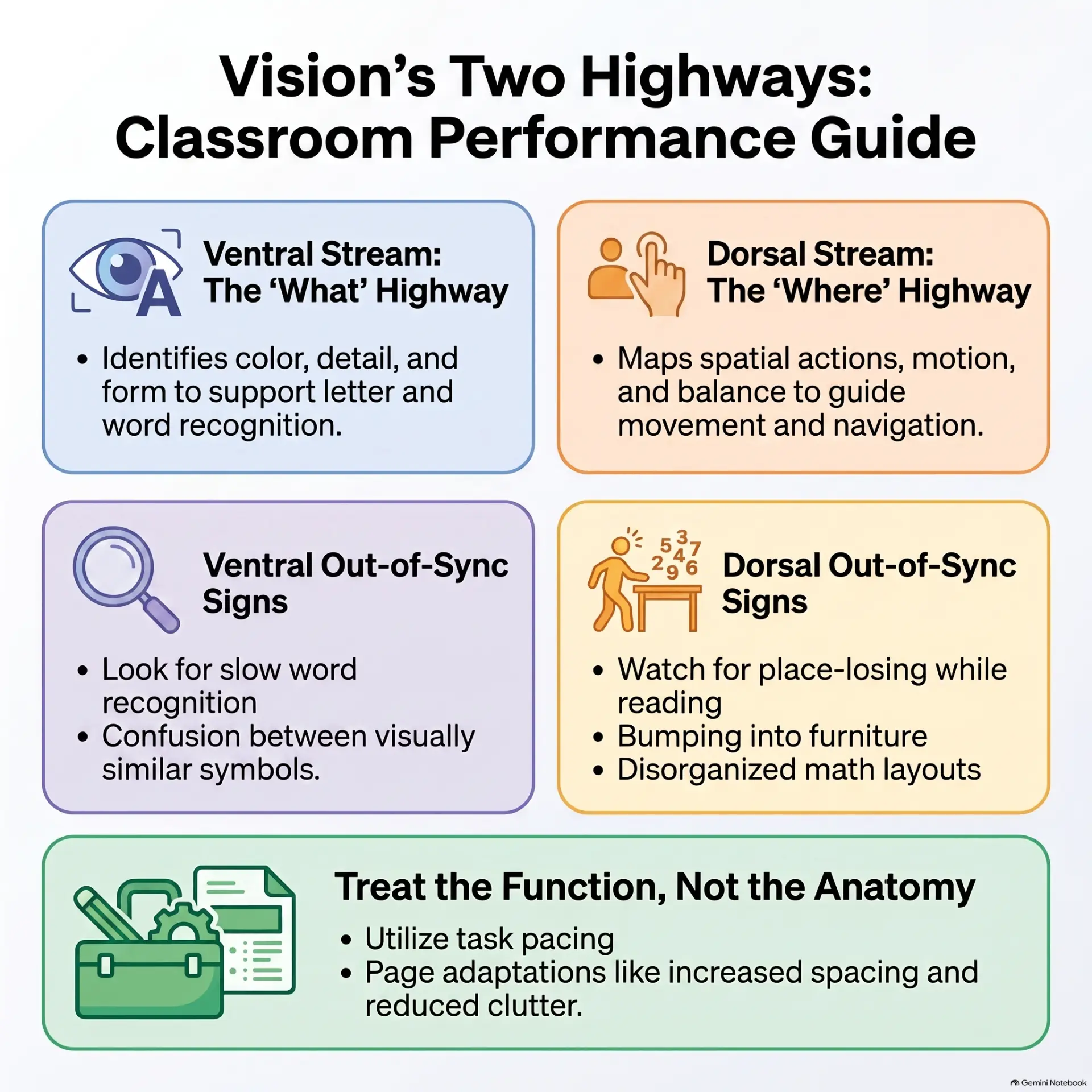
Vision's two highways in the school day

Ventral "what" signs versus dorsal "where" signs, side by side with the classroom behaviors each one produces.

Ventral "what" signs versus dorsal "where" signs, side by side with the classroom behaviors each one produces.

Why Visual Performance Matters: Foundations for Occupational Therapy Practice
7 / 21

Say this

Talk over the visual: "Vision's two highways in the school day."

Say the caption in your own words: Ventral "what" signs versus dorsal "where" signs, side by side with the classroom behaviors each one produces.

My notes

2.8 — Ventral vs. dorsal at a glance

Comparison

The two streams

Ventral vs. dorsal at a glance

Ventral stream — "What?"

  • Parvocellular tract
  • Object identity, color, size, fine detail
  • Supports letter/word recognition and object identification
  • Deficits show up as slow or inaccurate visual identification

Dorsal stream — "Where?"

  • Magnocellular tract
  • Spatial orientation, mapping, posture, balance
  • Supports locating items in space and guiding movement toward them
  • Deficits show up as spatial, postural, and navigation errors
RetinaMagnocellularHighwayParvocellularHighwayLGNtraffic controlcenterV1striate cortexVPA link: Field & attention + Oculomotor efficiencyMagno/dorsal dominance supports scanning, tracking, and spatial action.VPA link: Visual-perceptual processingParvo/ventral dominance supports discrimination, closure, memory, and form.
The retina sends two parallel “highways” to the LGN: the magnocellular tract handles motion, contrast, and spatial-action cues; the parvocellular tract handles detail, color, and object recognition. Both pass through the LGN, then split into the dorsal (where/how) and ventral (what) streams.
Why Visual Performance Matters: Foundations for Occupational Therapy Practice
8 / 21

Say this

Contrast the two columns: Ventral stream — "What?" versus Dorsal stream — "Where?".

Ventral stream — "What?":

• Parvocellular tract

My notes

2.9 — What a ventral-stream (parvocellular) signature looks like in class

Teaching slide

Classroom signatures

What a ventral-stream (parvocellular) signature looks like in class

  • Slow, effortful recognition of letters, sight words, or numerals
  • Confusing visually similar letters or symbols beyond the expected age
  • Difficulty matching an object to its picture or naming what was just seen
  • Strong performance on movement-based tasks but weak on detail/identification tasks

Dorsal — "where / how"

Occipital → parietal

  • • Bumps furniture, misjudges stairs and doorways
  • • Loses place, uneven spacing, drifting margins
  • • Struggles in visually busy rooms
  • • Reach and grasp inaccurate under time pressure

Ventral — "what"

Occipital → temporal

  • • Letter and symbol confusion beyond age expectation
  • • Difficulty recognizing familiar faces or objects
  • • Relies on color or context cues to identify items
  • • Slow to find a known item in an array
Two cortical streams, two classroom signatures. "What" failures look like recognition errors; "where" failures look like navigation, spacing, and copying errors.
Why Visual Performance Matters: Foundations for Occupational Therapy Practice
9 / 21

Say this

Frame the slide: "What a ventral-stream (parvocellular) signature looks like in class."

Walk each point, one sentence each:

• Slow, effortful recognition of letters, sight words, or numerals

My notes

2.10 — What a dorsal-stream (magnocellular) signature looks like in class

Teaching slide

Classroom signatures

What a dorsal-stream (magnocellular) signature looks like in class

  • Bumping into furniture, misjudging distances, poor spatial awareness in the room
  • Difficulty locating an item visually even when it is in plain sight
  • Trouble copying spatial layouts — maps, graphs, math columns, diagrams
  • Balance, posture, or motor-planning concerns alongside the visual complaint
What you observeMore consistent withNext OT move
Slow, effortful letter or sight-word recognitionVentralDescribe identification accuracy and rate; reduce visual detail load
Confuses visually similar letters past expected ageVentralSample discrimination directly; refer if acuity untested this year
Loses place returning from board to pageDorsalLine marker, copy-reduction; screen saccades and fixation stability
Bumps furniture, misjudges distance in transitionsDorsalEnvironmental path clearing; refer for binocular/depth evaluation
Cannot copy a graph, map, or math column layoutDorsalPre-structured paper, spatial cueing; document spatial organization
Strong on movement tasks, weak on detail tasksVentralContrast this split explicitly in the present-level statement
Sorting a “what” problem from a “where” problem in the classroom. Stream language is for your reasoning; the documentation stays in occupational terms.
Why Visual Performance Matters: Foundations for Occupational Therapy Practice
10 / 21

Say this

Frame the slide: "What a dorsal-stream (magnocellular) signature looks like in class."

Walk each point, one sentence each:

• Bumping into furniture, misjudging distances, poor spatial awareness in the room

My notes

2.11 — We do not treat tracts — we treat the functional components

Teaching slide

Scope

We do not treat tracts — we treat the functional components

  • The magnocellular and parvocellular tracts describe transmission: how visual information travels from retina to cortex. That is anatomy and physiology, and it is outside what OT assesses or changes.
  • OT works one layer up, on the functional components the tract supports — fixation stability, saccadic accuracy, place-keeping, contrast and motion tolerance, discrimination, visual memory.
  • The intervention target is always a functional component plus the task and environment: contrast and print adaptation, graded near-work load, pacing, reduced visual clutter, compensatory access.
  • Never write, say, or imply that OT intervention improves, trains, strengthens, or repairs a pathway, or that a VPA™ result identifies a magnocellular deficit.
  • The measured outcome stays in the occupation — reading the passage, copying the assignment, crossing the parking lot — not in the pathway.

Occupations

What the person needs and wants to do.

  • • Reading and written work
  • • Dressing, eating, self-care
  • • Play, sport, driving, work

Client factors — body functions

The internal capacities that support doing.

  • • Visual acuity and visual field
  • • Eye-movement and focusing control
  • • Visual perception

Performance skills

Observable actions during the task.

  • • Locates, tracks, and keeps place
  • • Aligns, spaces, and copies accurately
  • • Sustains looking over time

Performance patterns

Habits and routines that carry the day.

  • • Break routines during near work
  • • Where materials live on the desk
  • • Self-checks before turning work in

Contexts and environment

Everything around the person.

  • • Lighting, glare, seating
  • • Print size, contrast, clutter
  • • Team expectations and supports

Highlighted boxes are where a visual problem shows up in our documentation: a client factor we describe, a performance skill we measure in the task, and a context we change. The diagnosis of the eye itself sits outside this picture — that belongs to eye care.

The OT practice framework, drawn as the pieces we actually observe. Vision touches three of them directly — client factors, performance skills, and context — which is why vision work is ordinary OT, not a specialty add-on.
Why Visual Performance Matters: Foundations for Occupational Therapy Practice
11 / 21

Say this

Frame the slide: "We do not treat tracts — we treat the functional components."

Walk each point, one sentence each:

• The magnocellular and parvocellular tracts describe transmission: how visual information travels from retina to cortex. That is anatomy and physiology, and it is outside what OT assesses or changes.

My notes

2.12 — Where the two streams sit in a level-based visual performance framework

Five-Level Framework

Framework link

Where the two streams sit in a level-based visual performance framework

1

Visual Acuity & Sensory Foundation

Can the visual signal get in clearly enough to use?

2

Visual Efficiency

Magnocellular/dorsal load shows here first — fixation stability, saccadic return, place-keeping.

3

Visual Processing

Parvocellular/ventral identification lives here — discrimination, form constancy, figure-ground.

4

Visual-Motor Integration

Translating what is seen into graded, accurate motor output.

5

Functional Integration

Reading, writing, and task performance under real classroom demand.

Why Visual Performance Matters: Foundations for Occupational Therapy Practice
12 / 21

Say this

Run the five levels bottom-up.

Spend your time on Level 3 — that is the point of this slide.

My notes

2.13 — Module 2 video — how the brain splits visual processing

Video

Lecture

Module 2 video — how the brain splits visual processing

Why Visual Performance Matters: Foundations for Occupational Therapy Practice
13 / 21

Say this

Set up the clip in one sentence, play it, then debrief with "what did you notice?"

My notes
2.14 — Beyond 20/20 — the Visual Performance System™

Visual

Framework

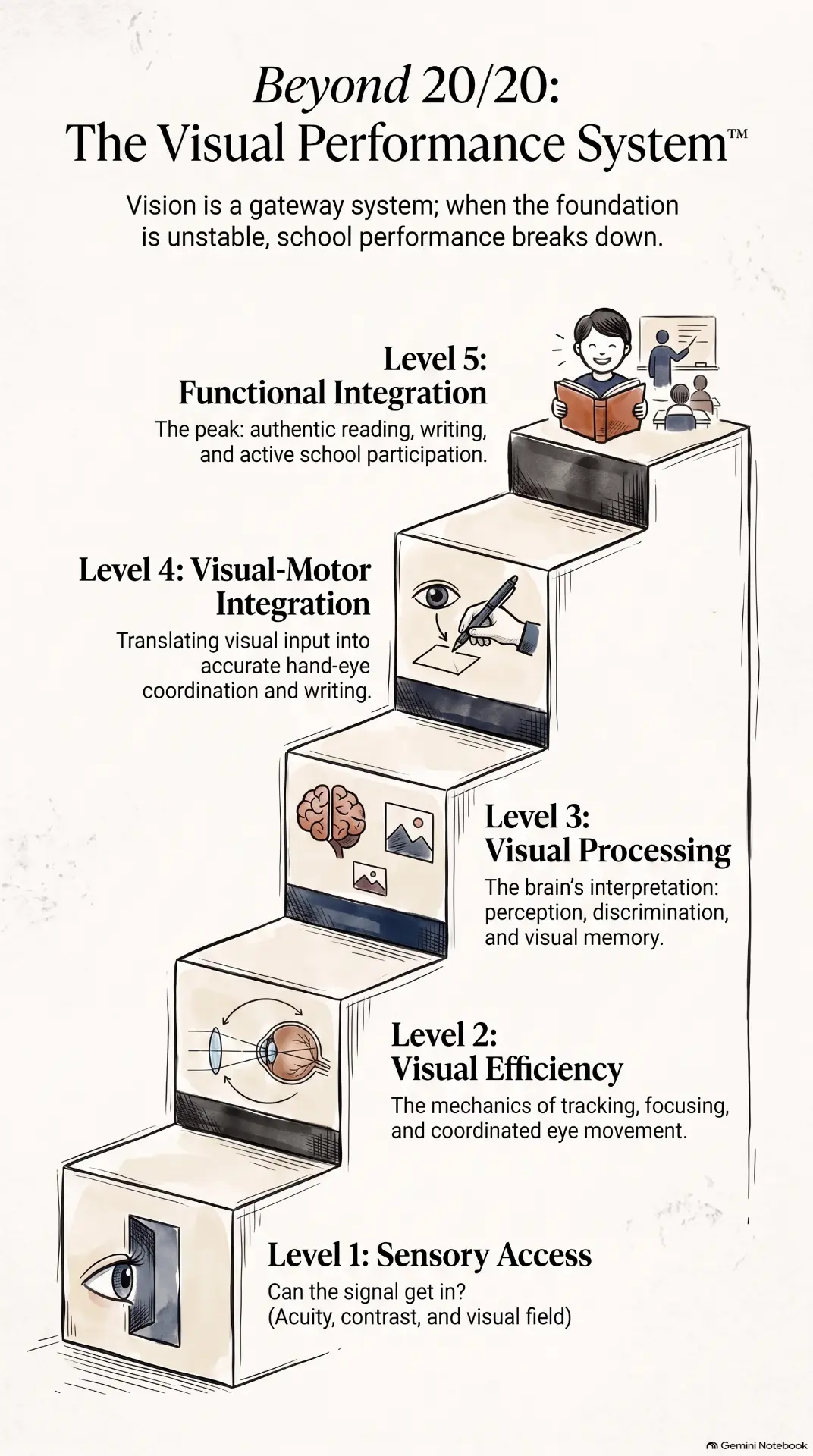
Beyond 20/20 — the Visual Performance System™

Level 1 Visual Access → Level 2 Visual Efficiency → Level 3 Visual Processing → Level 4 Visual-Motor Integration → Level 5 Functional Integration.

Level 1 Visual Access → Level 2 Visual Efficiency → Level 3 Visual Processing → Level 4 Visual-Motor Integration → Level 5 Functional Integration.

Why Visual Performance Matters: Foundations for Occupational Therapy Practice
14 / 21

Say this

Talk over the visual: "Beyond 20/20 — the Visual Performance System™."

Say the caption in your own words: Level 1 Visual Access → Level 2 Visual Efficiency → Level 3 Visual Processing → Level 4 Visual-Motor Integration → Level 5 Functional Integration.

My notes

2.15 — Sorting a "what" problem from a "where" problem

Case

Application

Sorting a "what" problem from a "where" problem

A 3rd-grade student reads individual words accurately in isolation but cannot find her place after looking up from the page, and she frequently loses items placed directly in front of her on a busy desk.

  • Q1.Which stream does this description sound more consistent with, and what would you probe next to confirm it?
  • Q2.How would you phrase this finding for a teacher without naming a "dorsal stream deficit"?
What you observeMore consistent withNext OT move
Slow, effortful letter or sight-word recognitionVentralDescribe identification accuracy and rate; reduce visual detail load
Confuses visually similar letters past expected ageVentralSample discrimination directly; refer if acuity untested this year
Loses place returning from board to pageDorsalLine marker, copy-reduction; screen saccades and fixation stability
Bumps furniture, misjudges distance in transitionsDorsalEnvironmental path clearing; refer for binocular/depth evaluation
Cannot copy a graph, map, or math column layoutDorsalPre-structured paper, spatial cueing; document spatial organization
Strong on movement tasks, weak on detail tasksVentralContrast this split explicitly in the present-level statement
Sorting a “what” problem from a “where” problem in the classroom. Stream language is for your reasoning; the documentation stays in occupational terms.
Why Visual Performance Matters: Foundations for Occupational Therapy Practice
15 / 21

Say this

Read the scenario aloud, slowly:

A 3rd-grade student reads individual words accurately in isolation but cannot find her place after looking up from the page, and she frequently loses items placed directly in front of her on a busy desk.

Then put these questions to the room:

My notes
2.16 — What a spatial ("where") breakdown looks like on the page

Before / after

Work sample

What a spatial ("where") breakdown looks like on the page

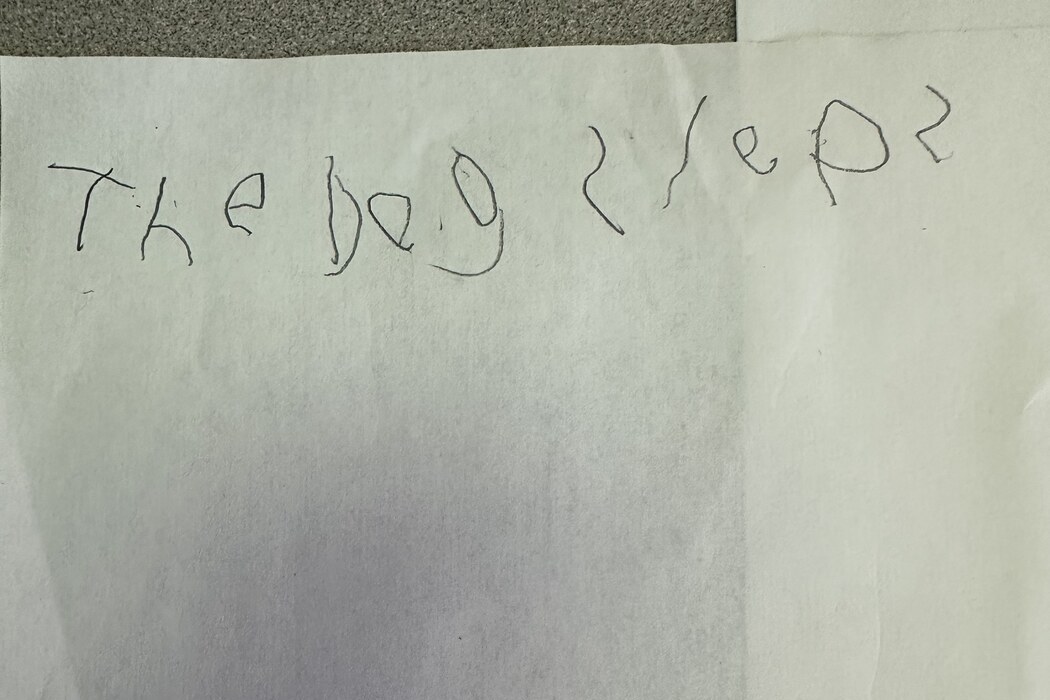
Blank paper — no spatial reference

The student has to generate placement, size, and direction with no external structure.
The student has to generate placement, size, and direction with no external structure.

  • • The line drifts upward across the page.
  • • Letter size and orientation shift mid-sentence; several letters reverse.
  • • Spacing is unpredictable — the "where" system is doing unsupported work.

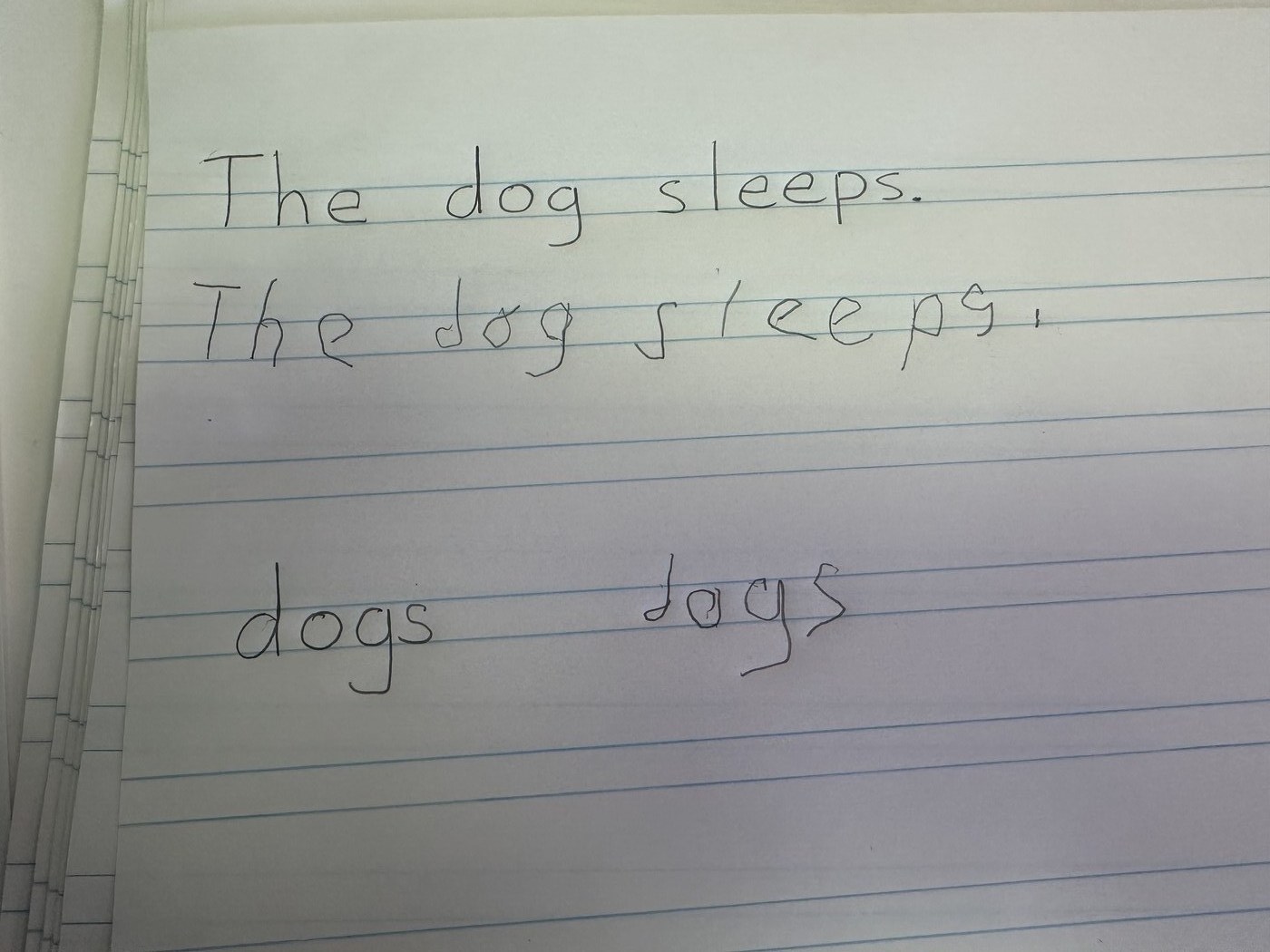
Lined paper — visual stability points supplied

Same sentence, same student, with baseline and line-to-line reference restored.

Same sentence, same student, with baseline and line-to-line reference restored.

  • • The line holds horizontal; drift disappears.
  • • Letter size normalizes against the ruling.
  • • Word spacing becomes consistent and readable.

When performance changes because the environment supplied the spatial reference, you are looking at a spatial ("where") demand, not a word-knowledge ("what") problem.

Why Visual Performance Matters: Foundations for Occupational Therapy Practice
16 / 21

Say this

Set up the contrast: "What a spatial ("where") breakdown looks like on the page."

Point at the before panel first. The student has to generate placement, size, and direction with no external structure.

Then the after panel. Same sentence, same student, with baseline and line-to-line reference restored.

My notes

2.17 — So what? Vision shows up as behavior first

So what?

So what?

So what? Vision shows up as behavior first

You will almost never be handed a vision complaint. You will be handed avoidance, sloppiness, slowness, or "not trying."

Children rarely report a visual world they have always had. They report what it costs them, in behavior.

What you do with it

  • Translate the referral complaint into an observable visual demand.
  • Compare performance across distance, duration, and layout before judging effort.
  • Give the team the behavioral signature in writing so it stops being a character description.

Watch for

Consistent avoidance of one occupation while a similar-difficulty task with lower visual load is fine.

Why Visual Performance Matters: Foundations for Occupational Therapy Practice
17 / 21

Say this

Land the "so what": You will almost never be handed a vision complaint. You will be handed avoidance, sloppiness, slowness, or "not trying."

Explain the mechanism plainly: Children rarely report a visual world they have always had. They report what it costs them, in behavior.

Then give them the moves — say each one as something they can do Monday:

My notes

2.18 — Postural setup changes what you are measuring

Before / after

Change the setup

Postural setup changes what you are measuring

Before — unsupported

Feet unsupported, trunk collapsed, page about 15 cm from the eyes.

Feet unsupported, trunk collapsed, page about 15 cm from the eyes.

  • • Near demand is far higher than the task requires
  • • Fatigue and avoidance appear within minutes

After — supported

Feet supported, hips back, page raised toward a slant, working distance near Harmon distance.

Feet supported, hips back, page raised toward a slant, working distance near Harmon distance.

  • • Working distance is now a controlled variable, not a confound
  • • Endurance findings become interpretable

Fix posture and distance before you score anything. Otherwise you are documenting the setup, not the student.

Why Visual Performance Matters: Foundations for Occupational Therapy Practice
18 / 21

Say this

Set up the contrast: "Postural setup changes what you are measuring."

Point at the before panel first. Feet unsupported, trunk collapsed, page about 15 cm from the eyes.

Then the after panel. Feet supported, hips back, page raised toward a slant, working distance near Harmon distance.

My notes

2.19 — Two-minute case: effort or demand?

Mini case

Two-minute case

Two-minute case: effort or demand?

A Grade 3 student completes math facts on a whiteboard quickly, but produces almost nothing on the same problems given as a dense worksheet.

What does that difference tell you, and what do you trial first?

Why Visual Performance Matters: Foundations for Occupational Therapy Practice
19 / 21

Say this

Two-minute case. Read it aloud:

A Grade 3 student completes math facts on a whiteboard quickly, but produces almost nothing on the same problems given as a dense worksheet.

Put the question to them: "What does that difference tell you, and what do you trial first?" Give 60 seconds, no talking.

My notes

2.20 — Reflect and share

Reflection

Reflect and share

Reflect and share

Choose one student. Describe one behavior that looks like a "what" problem and one that looks like a "where" problem.

THINKPROCESSSHARE
  • · Use only the language of classroom performance, not stream labels.
Why Visual Performance Matters: Foundations for Occupational Therapy Practice
20 / 21

Say this

Reflection prompt: "Choose one student. Describe one behavior that looks like a "what" problem and one that looks like a "where" problem."

Cues:

• Use only the language of classroom performance, not stream labels.

My notes

2.21 — Knowledge check — streams

Self-check

Knowledge check

Knowledge check — streams

A student reads words accurately but cannot copy from a spatial diagram. Which description fits best?

Why Visual Performance Matters: Foundations for Occupational Therapy Practice
21 / 21

Say this

Knowledge check: "A student reads words accurately but cannot copy from a spatial diagram. Which description fits best?"

Options:

• Ventral stream problem — difficulty identifying details

My notes