1.1 — Welcome — while you get set up
WelcomeSay this
Housekeeping while people arrive.
Materials to have ready:
• Participation & Reflection Guide (printed or on screen)
My notes
Presenter study handout
3 contact hours · 0.3 AOTA CEUs · All 7 modules · 147 slides
Presenter-side material. Each block shows the slide as the audience sees it, the talk track, and space for your own notes. Model answers appear here — do not hand this version to learners.
Say this
Housekeeping while people arrive.
Materials to have ready:
• Participation & Reflection Guide (printed or on screen)
My notes
Say this
Read the filed learning objectives verbatim — this is the AOTA-approved wording.
Objectives:
• Differentiate the levels of a structured visual performance framework and explain how each level influences occupational performance across pediatric and adult practice settings.
My notes
Say this
Explain how the session runs.
Schedule:
• Seven modules, 3.0 contact hours total
My notes
Say this
Transition: "OT Scope in Vision: What We Own, What We Refer."
My notes
Say this
Open here. "OT Scope in Vision." What we own, what we refer, and the language that keeps us inside our license.
Say why this section matters for their caseload, then advance.
My notes
Say this
Ask the poll: "When a teacher says "she can't track," what stops you from acting on it today?"
Options:
• I am not sure it is inside OT scope
My notes
Say this
Frame the slide: "Vision is a client factor, not a specialty add-on."
Walk each point, one sentence each:
• OTPF-4 lists visual functions among sensory body functions that shape occupational performance.
My notes
Say this
Contrast the two columns: OT owns (performance) versus Refer out (ocular/medical).
OT owns (performance):
• Observed gaze control during a reading task
My notes
Say this
Frame the slide: "Say this, not that."
Walk each point, one sentence each:
• "Loses place 6 times in a 2-minute passage" — not "has a tracking disorder."
My notes
Say this
Frame the slide: "Prevalence and the case for OT screening."
Walk each point, one sentence each:
• An estimated 1 in 4 school-age children has an undiagnosed vision problem (Kleinstein et al., 2003, population-based cohort).
My notes
Say this
Contrast the two columns: Term versus What it means in schoolwork.
Term:
• Convergence
My notes
Say this
Frame the slide: "Diagnoses OTs should recognize but never assign."
Walk each point, one sentence each:
• Cerebral/cortical visual impairment (CVI) — a brain-based visual processing impairment, not an eye finding.
My notes
Say this
Read the quote verbatim, then pause.
"A child can pass a 20/20 acuity screen and still be unable to read a page." — Why the acuity floor is only the first of five levels
Then say what it means for practice in one sentence.
My notes
Say this
Frame the slide: "Vision work already lives in your school day."
Walk each point, one sentence each:
• Board-to-desk copying, worksheet completion, and sustained silent reading.
My notes
Say this
Frame the slide: "Same-day referral triggers."
Walk each point, one sentence each:
• Eye pain, redness, discharge, or photophobia.
My notes
Say this
Read the scenario aloud, slowly:
A Grade 4 student squints at the board, holds worksheets at 15 cm, and reports headaches after the second reading block.
Then put these questions to the room:
My notes
Say this
Set up the clip in one sentence, play it, then debrief with "what did you notice?"
My notes
Say this
Describe what belongs here: Screenshot of a de-identified present-level statement written in performance language..
My notes
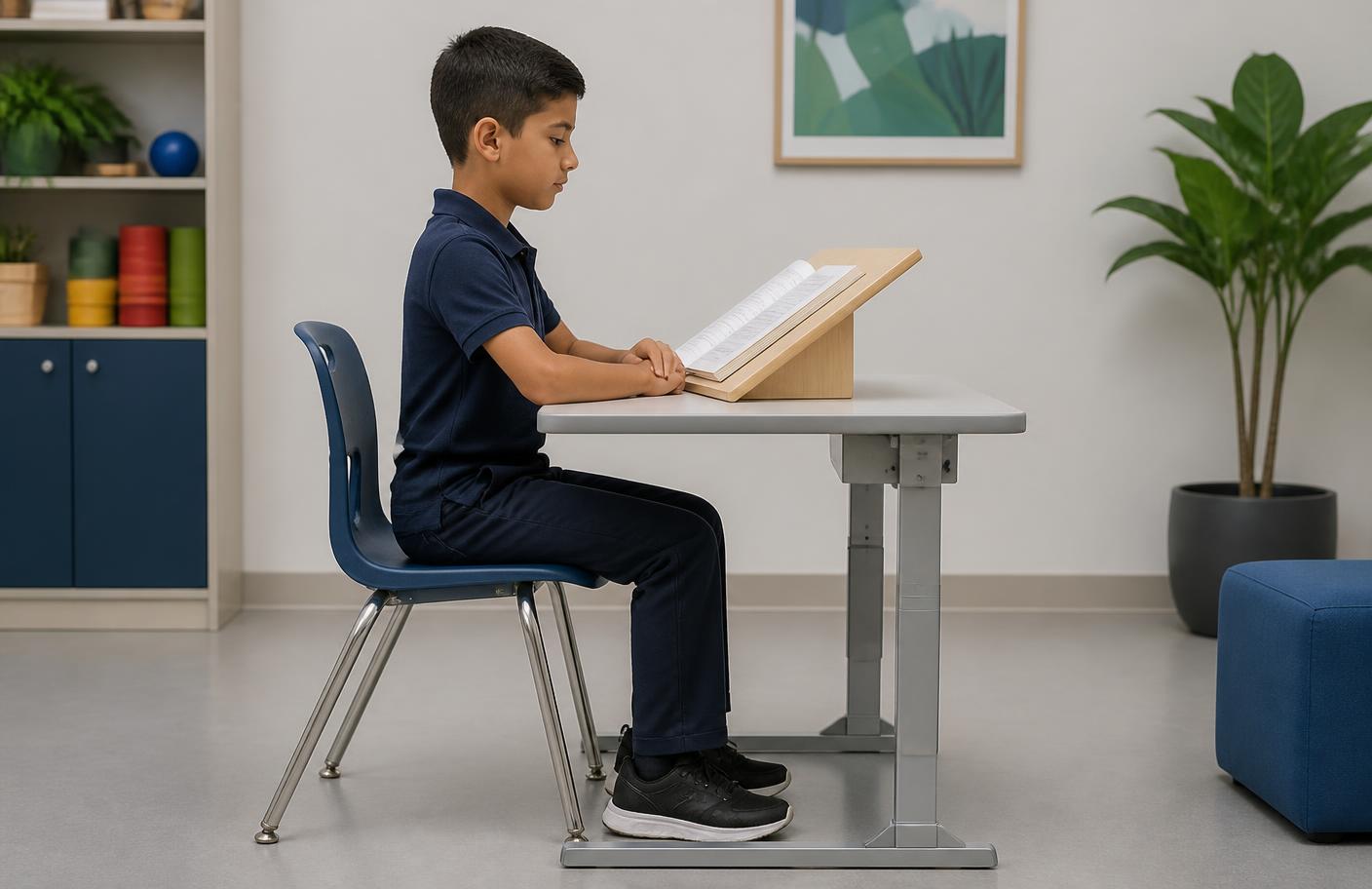
Reference posture
Feet flat, hips and knees near 90°, elbows at desk height, trunk upright and off the table.
≈40 cm at midline
A slant board holds the page at a consistent distance and angle; note any habitual 15–20 cm posture.
What to document
Head tilt, page rotation >30°, one eye closing, or distance shortening as the task lengthens.
Say this
Describe what belongs here: Photo showing habitual working distance, head tilt, or lighting conditions..
My notes
Say this
Contrast the two columns: Diagnosed and managed → OT addresses the functional limitation versus Undiagnosed, unverified, or changing → refer.
Diagnosed and managed → OT addresses the functional limitation:
• Low acuity: magnification, enlarged print, working distance, seating, decluttered materials.
My notes
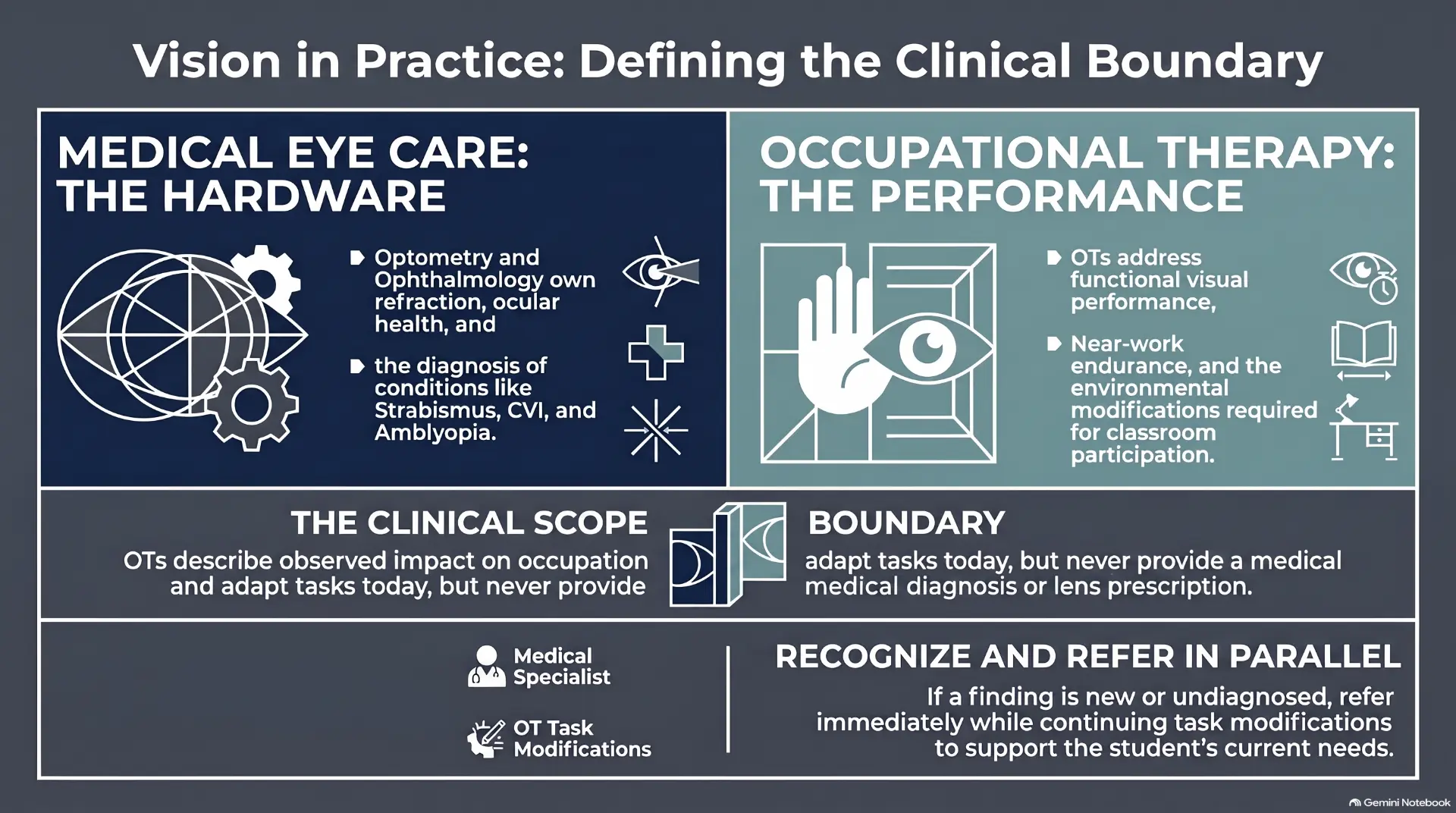
Say this
Talk over the visual: "Two lanes, one student."
Say the caption in your own words: Medical eye care owns diagnosis and the optical correction; OT owns performance inside real occupations. The referral and the task modification run in parallel, on the same day.
My notes
Say this
Set up the clip in one sentence, play it, then debrief with "what did you notice?"
My notes
Say this
Land the "so what": If you stop treating while you wait on an eye-care report, the student loses weeks of instruction for a decision you were never going to make.
Explain the mechanism plainly: Diagnosis belongs to eye care; occupational performance under a known visual condition belongs to OT. Those two lines run in parallel, not in sequence.
Then give them the moves — say each one as something they can do Monday:
My notes
Say this
Two-minute case. Read it aloud:
A Grade 2 teacher tells you a student "definitely has convergence insufficiency — she sees double when she reads." Nothing in the file supports a diagnosis and there is no eye-care report.
Put the question to them: "What do you write, and what do you do first?" Give 60 seconds, no talking.
My notes
Say this
Reflection prompt: "Recall one referral that arrived with a visual complaint. Which part of it did you own as OT, and which part needed eye care?"
Cues:
• Name the occupation that was breaking down.
My notes
Say this
Knowledge check: "A student works at 15 cm from the page, squints during board copy, and reports headaches. Which statement belongs in your OT report?"
Options:
• Student demonstrates convergence insufficiency affecting near work.
My notes
Say this
Transition: "A Structured, Level-Based Visual Performance Framework for Clinical Reasoning."
My notes
Say this
Open here. "The Five-Level Visual Performance Framework." A developmental hierarchy that organizes observation, assessment, and intervention.
Say why this section matters for their caseload, then advance.
My notes
Say this
Ask the poll: "Which framework levels do your current goals most often target?"
Options:
• Level 1 — acuity and sensory access
My notes
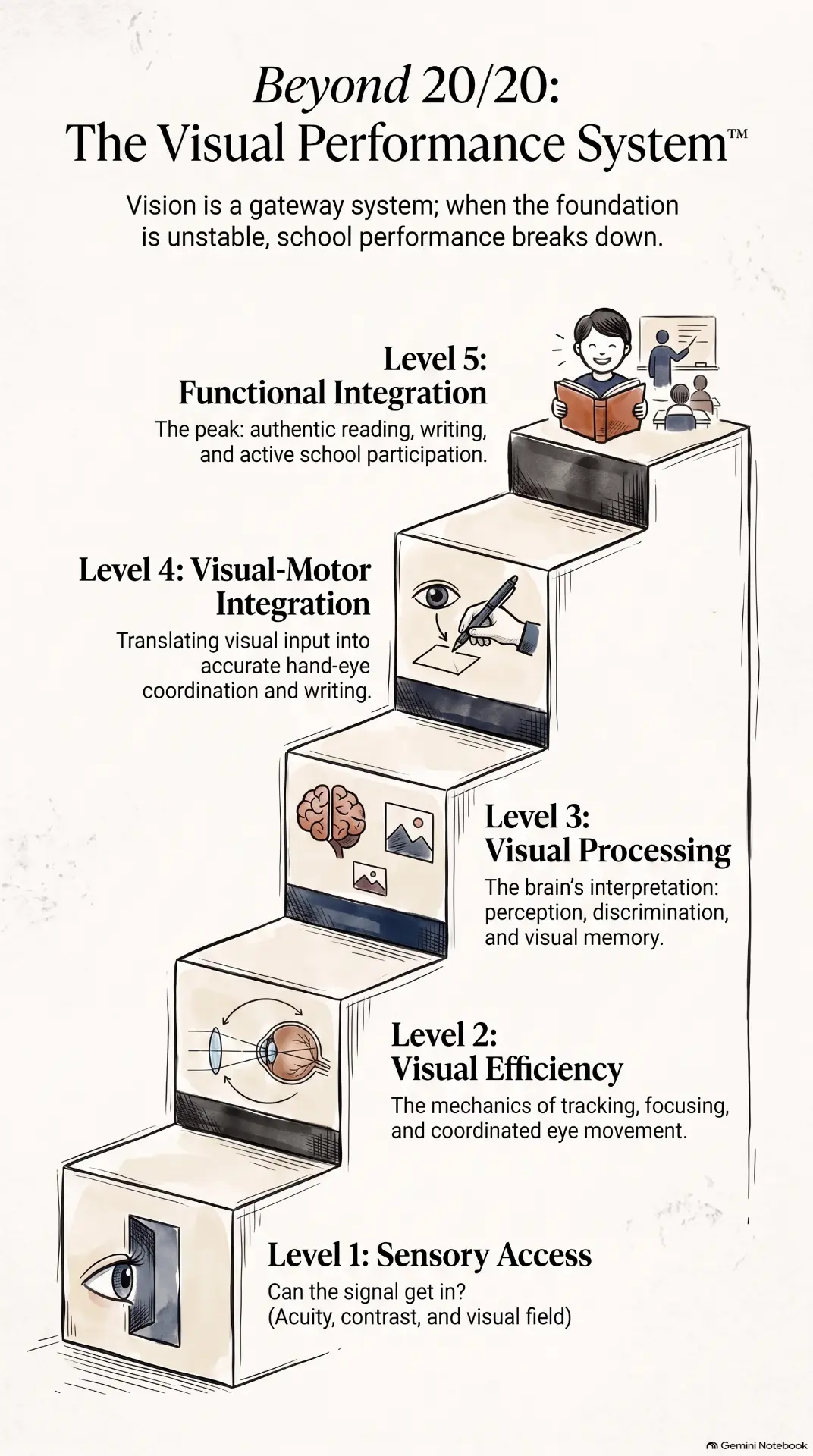
Say this
Talk over the visual: "Beyond 20/20 — the Visual Performance System™."
Say the caption in your own words: Level 1 Visual Access → Level 2 Visual Efficiency → Level 3 Visual Processing → Level 4 Visual-Motor Integration → Level 5 Functional Integration.
My notes
Say this
Frame the slide: "Visual development milestones OTs should know."
Walk each point, one sentence each:
• Basic eye movement control (fixation, following) is commonly described as established by 2–3 months of age.
My notes
Say this
Contrast the two columns: Ventral / parvocellular ("what" pathway) versus Dorsal / magnocellular ("where" pathway).
Ventral / parvocellular ("what" pathway):
• Carries fine detail, color, and form for object and letter identification
My notes
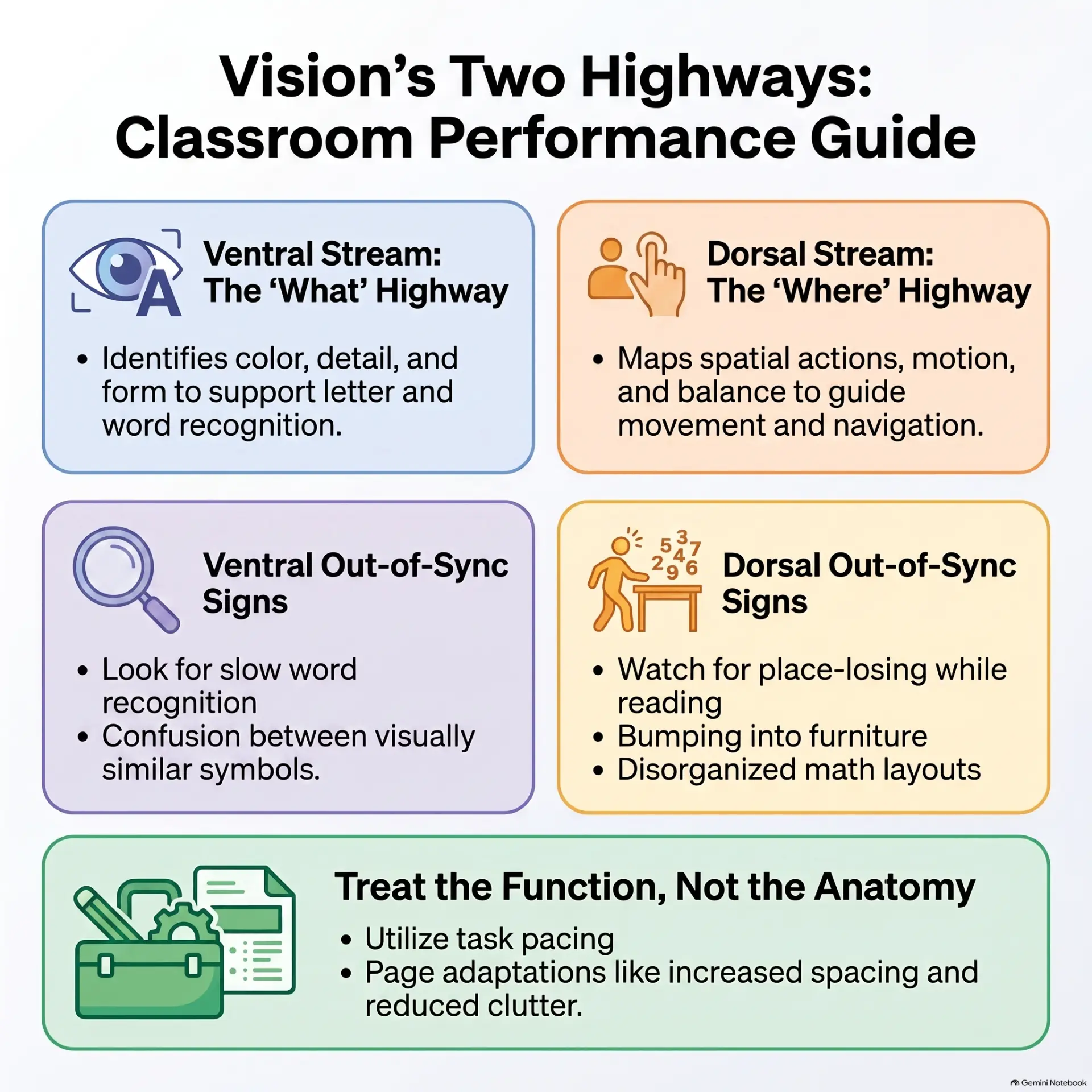
Say this
Talk over the visual: "Vision's two highways in the school day."
Say the caption in your own words: Ventral "what" signs versus dorsal "where" signs, side by side with the classroom behaviors each one produces.
My notes
Say this
Frame the slide: "How the Five-Level Framework was built."
Walk each point, one sentence each:
• OTPF-4 names visual functions as client factors — the framework simply organizes them by the order they have to be stable in.
My notes
Say this
Talk over the visual: "One example per level."
Say the caption in your own words: What you see, the probe that confirms it, and the OT move that follows — for all five levels.
My notes
Say this
Run the five levels bottom-up.
Name each level, then say which one you assess first and why.
My notes
Say this
Contrast the two columns: Functional signs versus OT direction — adapt and refer.
Functional signs:
• Print held very close or pushed away; head tilt
My notes
Say this
Talk over the visual: "Access, before and after."
Say the caption in your own words: The same worksheet at photocopy contrast and at full contrast with larger print — the gain came from the page, not the student.
My notes
Say this
Contrast the two columns: Functional signs versus OT direction — remediate + support.
Functional signs:
• Loses place, re-reads, finger-tracks past expected age
My notes
Say this
Talk over the visual: "Line loss and the stamina curve."
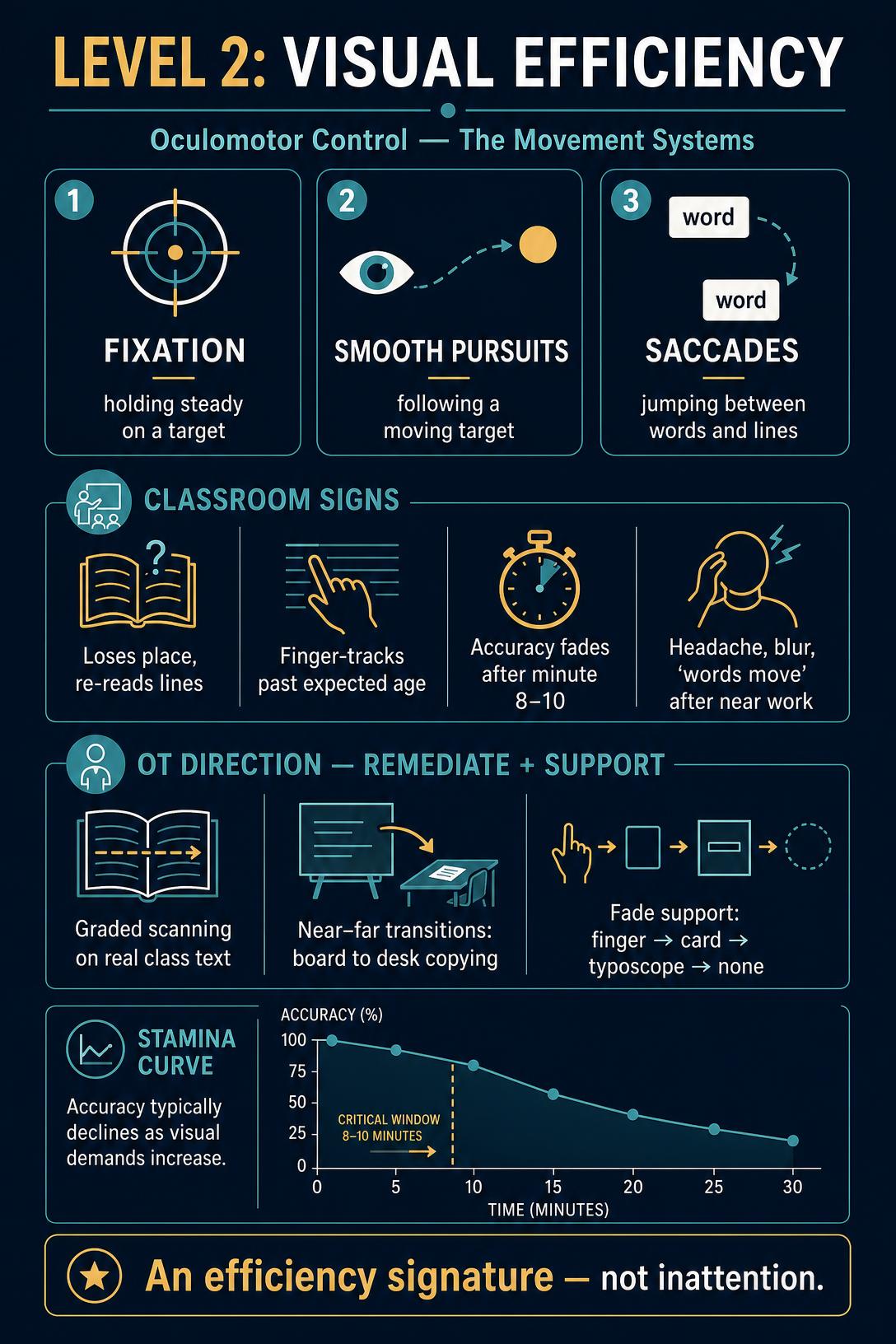
Say the caption in your own words: Place-keeping errors across a 2-minute passage, and accuracy decaying past minute 8 — an efficiency signature, not inattention.
My notes
Say this
Talk over the visual: "Oculomotor control — the movement systems."
Say the caption in your own words: Fixation, smooth pursuits, and saccades carry reading and copying. When they fatigue, accuracy decays on a predictable curve — the classroom signs and the OT directions, side by side.
My notes
Say this
Contrast the two columns: Functional signs versus OT direction — load, then strategy.
Functional signs:
• Cannot find the item on a busy page or crowded hook rack
My notes
Say this
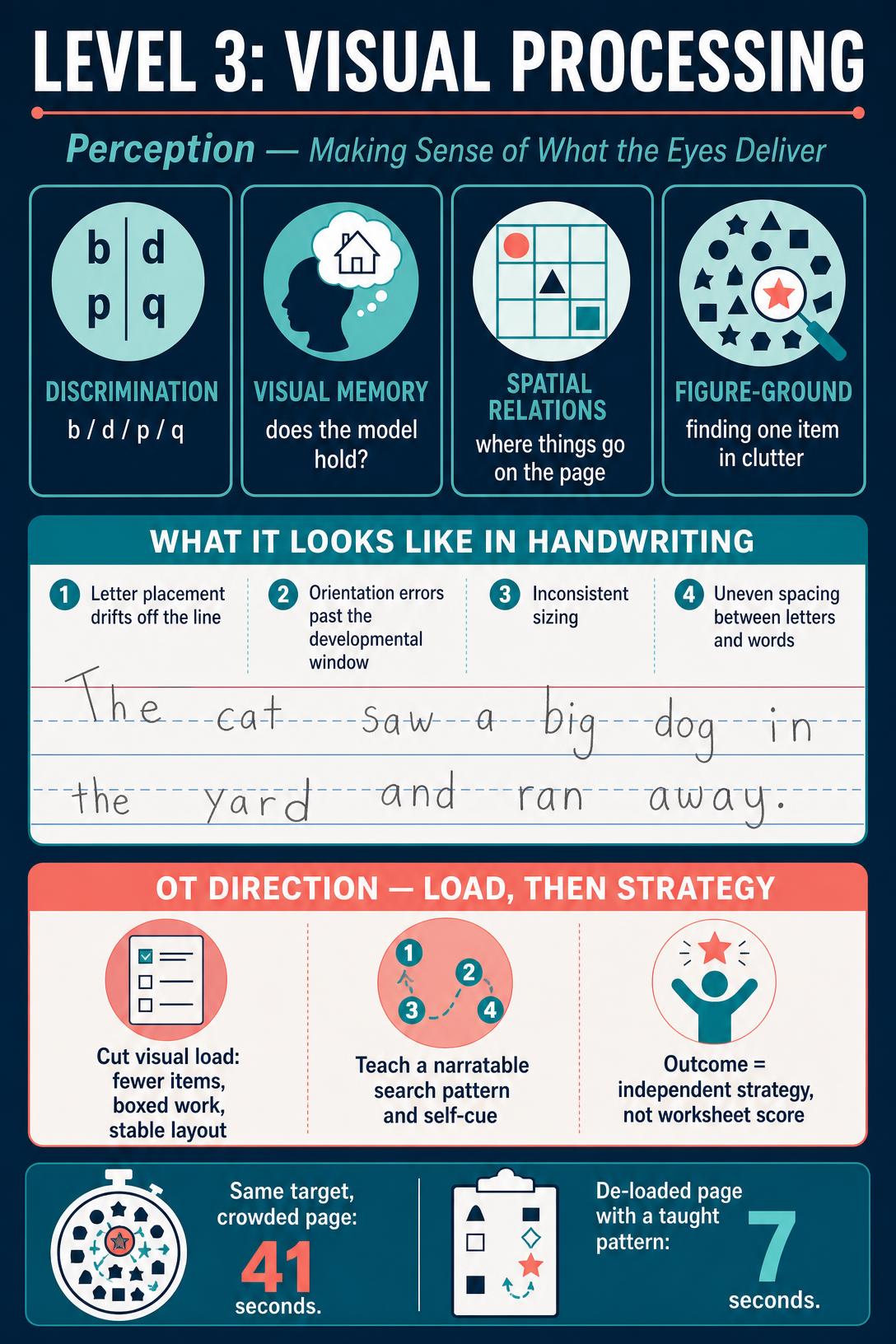
Talk over the visual: "Visual load on the page."
Say the caption in your own words: Same target item on a crowded page and a de-loaded page with a taught search pattern: 41 seconds with prompts vs. 7 seconds without.
My notes
Say this
Talk over the visual: "Perception — and what it looks like in handwriting."
Say the caption in your own words: Discrimination, visual memory, spatial relations, and figure-ground — and how each one surfaces on the page as placement, orientation, sizing, and spacing errors.
My notes
Say this
Contrast the two columns: Functional signs versus OT direction — isolate, then treat.
Functional signs:
• Legible in isolation, degrades under speed or volume
My notes
Say this
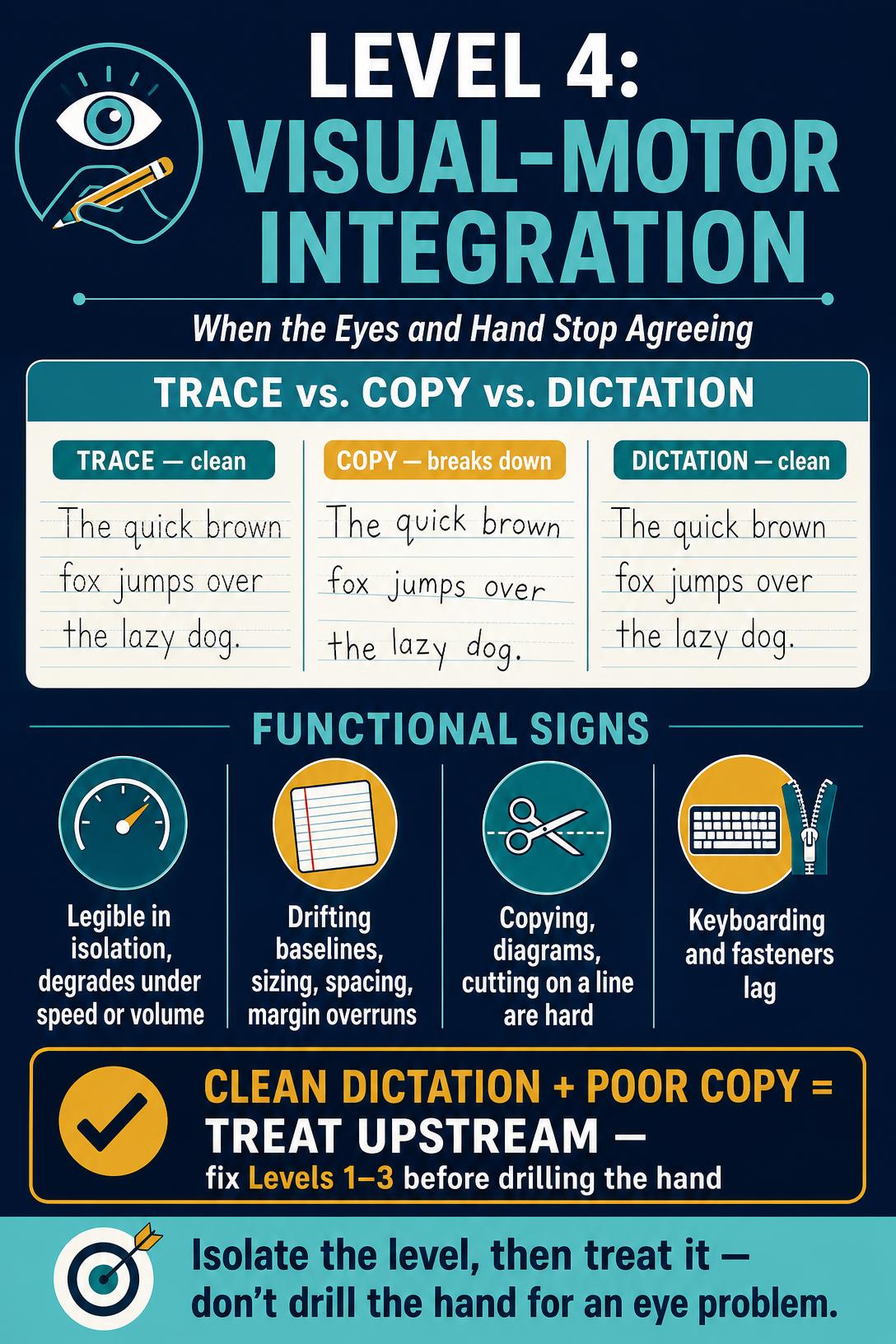
Talk over the visual: "Trace vs. copy vs. dictation."
Say the caption in your own words: Three writing samples of the same sentence. Clean dictation with a poor copy points upstream — treat Levels 1–3 before drilling the hand.
My notes
Say this
Talk over the visual: "When the eyes and hand stop agreeing."
Say the caption in your own words: The trace–copy–dictation comparison at a glance, with the functional signs and the clinical rule that keeps you from drilling the hand for an eye problem.
My notes
Say this
Contrast the two columns: Functional signs versus OT direction — measure the occupation.
Functional signs:
• Reading rate and endurance below expectation
My notes
Say this
Talk over the visual: "Where the goal line sits."
Say the caption in your own words: Baseline and 9-week re-probe on the occupations themselves: sustained reading minutes, sentences copied, written output, and work completion.
My notes
Say this
Frame the slide: "Two rules for choosing where to start."
Walk each point, one sentence each:
• Bottom-up to stabilize: adapt or fix the lowest unstable floor first.
My notes
Say this
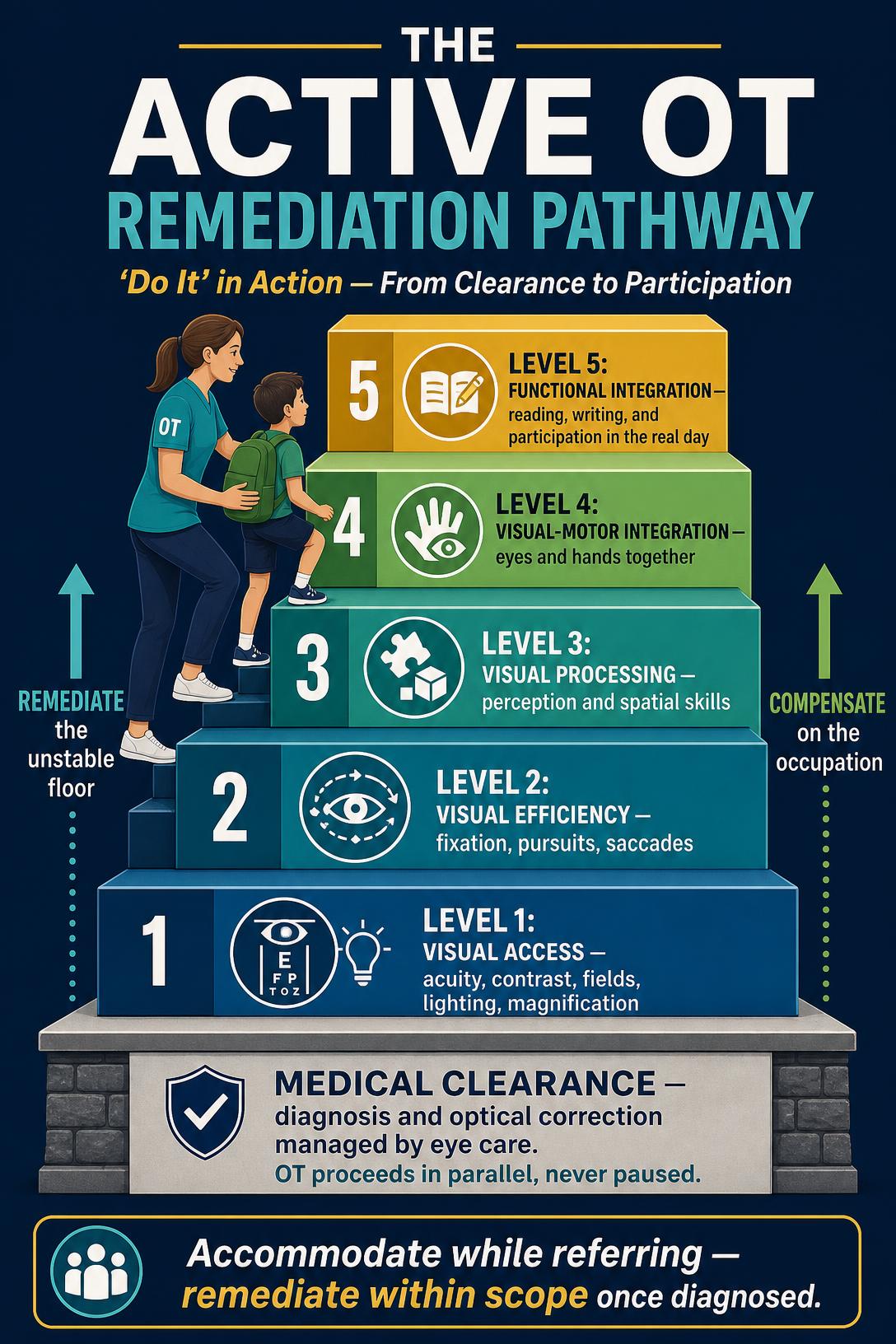
Talk over the visual: "The Active OT Remediation Pathway."
Say the caption in your own words: Medical clearance is the floor; the five levels climb from Visual Access through Functional Integration. Remediate the unstable floor on one side, compensate on the occupation on the other.
My notes
Say this
Frame the slide: "The same four-part shape, every level."
Walk each point, one sentence each:
• 1 — Baseline probe: re-measure the same task before you treat.
My notes
Say this
Contrast the two columns: Level 1 — Access versus Level 2 — Efficiency.
Level 1 — Access:
• Contrast and print-size trials, not drills
My notes
Say this
Contrast the two columns: Levels 3–4 versus Level 5.
Levels 3–4:
• Stress one processing skill inside a real page
My notes
Say this
Contrast the two columns: Levels 1–2 versus Levels 3–5.
Levels 1–2:
• L1: Fast Screener acuity/contrast; VPA ladders at 60 cm and 40 cm; printable cards in the Worksheet Print Hub
My notes
Say this
Set up the clip in one sentence, play it, then debrief with "what did you notice?"
My notes
Say this
Describe what belongs here: Your own framework graphic, if you want it in place of the built-in ladder slide..
My notes
Say this
Describe what belongs here: Interactive activity or worksheet that demonstrates work at one specific level..
My notes
Say this
Land the "so what": Most "visual processing" referrals resolve one or two levels lower — the signal was not getting in, or the eyes were not staying on the work long enough to process anything.
Explain the mechanism plainly: The five levels are ordered by dependency: acuity and sensory input, efficiency, processing, visual-motor integration, functional integration.
Then give them the moves — say each one as something they can do Monday:
My notes
Say this
Two-minute case. Read it aloud:
A Grade 3 student reverses letters, loses his place, and rubs his eyes after five minutes of reading. The teacher asks for "visual perceptual therapy."
Put the question to them: "Which level do you investigate first, and what does that change on Monday?" Give 60 seconds, no talking.
My notes
Say this
Reflection prompt: "Take one student. Which level is the lowest one showing a breakdown, and what observable behavior tells you that?"
Cues:
• Start at the bottom of the ladder, not at the complaint.
My notes
Say this
Knowledge check: "A student copies inaccurately from the board and loses his place mid-line. Where should intervention planning begin?"
Options:
• Level 4, because the written output is inaccurate
My notes
Say this
Transition: "Screening vs. Assessment: The OT's Two-Step Workflow."
My notes
Say this
Open here. "Screening vs. Assessment." The OT two-step workflow: rule in the need, then measure it.
Say why this section matters for their caseload, then advance.
My notes
Say this
Ask the poll: "What happens in your setting after a vision screen flags a concern?"
Options:
• We move straight to intervention
My notes
Say this
Contrast the two columns: Screening versus Assessment.
Screening:
• Fast, caseload-scale, pass/flag
My notes
Say this
Frame the slide: "The two-step in practice."
Walk each point, one sentence each:
• Step 1 — Screen: brief probes at each of the five levels; record flags, not diagnoses.
My notes
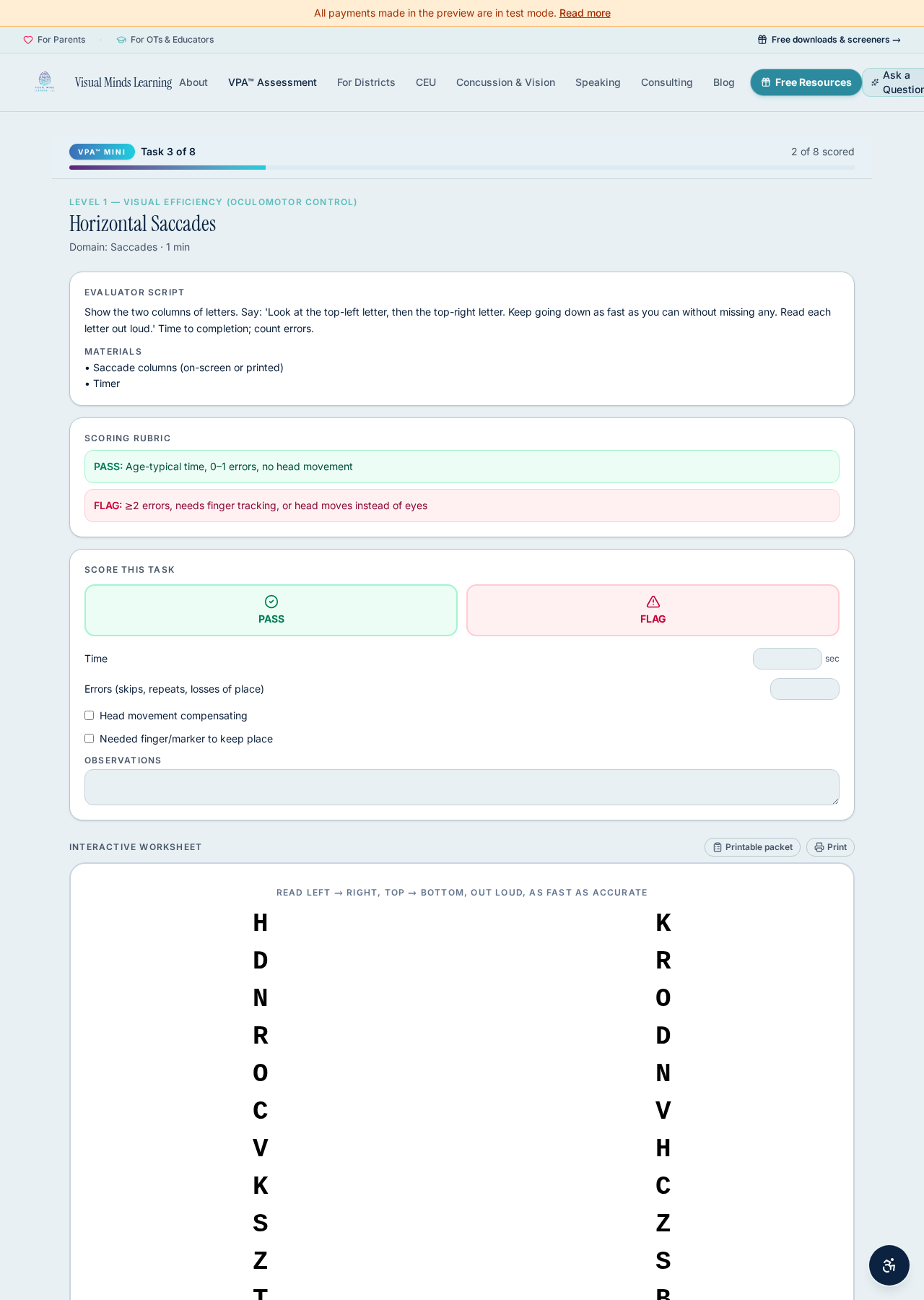
Say this
Talk over the visual: "Fast Screener mid-administration."
Say the caption in your own words: Evaluator script, PASS/FLAG rubric, referral triggers, and the on-screen worksheet in a single view.
My notes
Say this
Frame the slide: "What VML gives you at the screening step."
Walk each point, one sentence each:
• Fast Screener — brief acuity, contrast, efficiency, and a functional writing sample.
My notes
Say this
Frame the slide: "What turns a flag into a Full VPA™."
Walk each point, one sentence each:
• Any probe failed at or below the expected level for the age band.
My notes
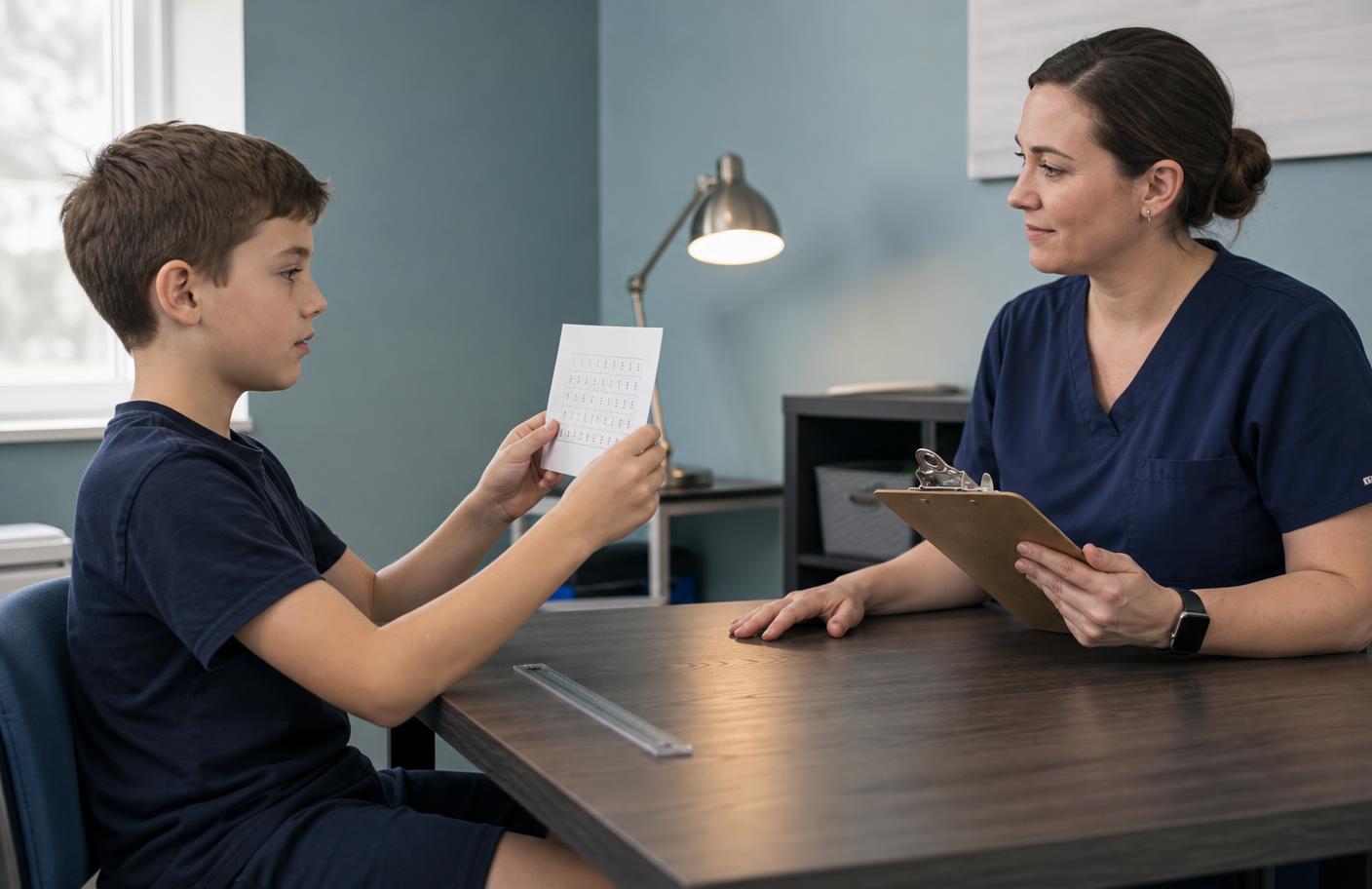
Near probes · 40 cm
Card at midline and at eye level; measure from the spectacle plane, not the forehead.
Table/screen · 60 cm
Use the same distance at screening and re-probe — a distance change invalidates the comparison.
Base of support
Feet supported and hips at 90° before any oculomotor scoring; postural drift reads as an efficiency deficit.
Say this
Contrast the two columns: Measure it versus Record it.
Measure it:
• Intermediate tasks at 60 cm, near tasks at 40 cm
My notes
Say this
Set up the clip in one sentence, play it, then debrief with "what did you notice?"
My notes
Say this
Describe what belongs here: Capture the Say/Do card, level ladder, and scoring panel together..
My notes
Near probes · 40 cm
Card at midline and at eye level; measure from the spectacle plane, not the forehead.
Table/screen · 60 cm
Use the same distance at screening and re-probe — a distance change invalidates the comparison.
Base of support
Feet supported and hips at 90° before any oculomotor scoring; postural drift reads as an efficiency deficit.
Say this
Describe what belongs here: Photo of measured working distance, lighting, and seating during a screen..
My notes
Say this
Land the "so what": A screening tells you where to send the student next. It never produces a score you can put in a present level.
Explain the mechanism plainly: Screening is sensitive by design and cannot separate a capacity limit from a demand mismatch. Assessment does that, under controlled setup.
Then give them the moves — say each one as something they can do Monday:
My notes

Feet unsupported, trunk collapsed, page about 15 cm from the eyes.

Feet supported, hips back, page raised toward a slant, working distance near Harmon distance.
Fix posture and distance before you score anything. Otherwise you are documenting the setup, not the student.
Say this
Set up the contrast: "Postural setup changes what you are measuring."
Point at the before panel first. Feet unsupported, trunk collapsed, page about 15 cm from the eyes.
Then the after panel. Feet supported, hips back, page raised toward a slant, working distance near Harmon distance.
My notes
Say this
Two-minute case. Read it aloud:
A Grade 5 student passed the school nurse vision screening in September. In November he holds his book at 12 cm, closes one eye during reading, and has fallen behind on written output.
Put the question to them: "What is your next step, and why is the passed screening not the answer?" Give 60 seconds, no talking.
My notes
Say this
Reflection prompt: "Write the decision rule you will use to move a student from screening to full assessment. Be specific enough that a colleague could apply it."
Offer the sentence starter: "I move to a full assessment when... The threshold is... The evidence I need is..."
Think for one minute, write, then take two shares.
My notes
Say this
Knowledge check: "What is the job of a screen?"
Options:
• To measure the size of the deficit
My notes
Say this
Transition: "IEPs, Medicaid, and Occupation-Based Documentation."
My notes
Say this
Open here. "IEPs, Medicaid, and Functional Documentation." Turning visual performance findings into defensible educational relevance.
Say why this section matters for their caseload, then advance.
My notes
Say this
Ask the poll: "What most often gets your vision-related goals pushed back?"
Options:
• Educational relevance is questioned
My notes
Say this
Frame the slide: "What a reviewer needs to see."
Walk each point, one sentence each:
• The occupation: what the student is expected to do in the school day.
My notes
Say this
Frame the slide: "Occupation-based goals, not skill-drill goals."
Walk each point, one sentence each:
• Target the occupation: copying, sustained reading, worksheet completion, note-taking.
My notes
Say this
Read the scenario aloud, slowly:
Grade 3 student: near copying accuracy 92% for the first 3 minutes, dropping to 58% by minute 9, with 7 place-loss events. Acuity screen passed.
Then put these questions to the room:
My notes
Say this
Contrast the two columns: Reviewer accepts versus Reviewer questions.
Reviewer accepts:
• Copy accuracy falls 34% within one class period
My notes
Say this
Frame the slide: "What has to be in the note."
Walk each point, one sentence each:
• Skilled reasoning: why an OT was required for this session.
My notes

Window beside or behind
Never seat a student facing an unshaded window — silhouetting collapses page contrast.
Task light on the working side
Directed onto the page from over the non-writing shoulder to avoid hand shadow and specular glare.
Matte surface + slant board
A non-glare mat and an angled surface raise effective contrast without changing the material.
Say this
Frame the slide: "Write accommodations from measured conditions."
Walk each point, one sentence each:
• Only list a modification you tested and recorded a change from.
My notes
Say this
Set up the clip in one sentence, play it, then debrief with "what did you notice?"
My notes
Say this
Describe what belongs here: De-identified IEP text showing the present level and matching annual goal..
My notes
Say this
Describe what belongs here: Baseline vs. re-probe data used to document progress..
My notes
Say this
Land the "so what": If the present level does not name the occupation, the condition, and the measurable demand, the service does not get funded and the goal does not get taught.
Explain the mechanism plainly: IEP teams and Medicaid reviewers cannot act on "poor visual skills." They act on observable performance under stated conditions.
Then give them the moves — say each one as something they can do Monday:
My notes
Say this
Set up the contrast: "Before / after: the same student, two present levels."
Point at the before panel first. Reads as a diagnosis, cannot be measured, names no occupation.
Then the after panel. Observation, condition, and measurable classroom demand.
My notes
Say this
Two-minute case. Read it aloud:
A draft IEP present level reads: "Student demonstrates poor visual tracking and visual perceptual weakness affecting academics."
Put the question to them: "Rewrite it in one sentence you could defend in a Medicaid audit." Give 60 seconds, no talking.
My notes
Say this
Reflection prompt: "Draft one goal now: name the occupation, the visual performance factor limiting it, the condition, and the criterion."
Cues:
• All four elements, one sentence.
My notes
Say this
Knowledge check: "Which element is missing? "Student will improve visual tracking to 80% accuracy.""
Options:
• The criterion
My notes
Say this
Transition: "Case Walkthroughs: Three Common Occupational Performance Patterns."
My notes
Say this
Open here. "Case Walkthroughs." Four real student profiles, worked through together — then one on your own.
Say why this section matters for their caseload, then advance.
My notes
Say this
Ask the poll: "Which of these three presentations shows up most on your caseload?"
Options:
• Board copying breaks down, near work is fine
My notes
Say this
Read the scenario aloud, slowly:
Maya, age 8, has glasses worn consistently and a current eye exam. She copies the first two lines from her worksheet accurately, then loses her place, skips lines, and stops after 5 minutes. Her teacher says the first problems on a math page are always her best work.
Then put these questions to the room:
My notes
Say this
Read the scenario aloud, slowly:
Elijah, age 7, tracks smoothly, keeps his place while reading, and has 20/20 corrected acuity. His letters vary in size, drift above and below the line, and spacing collapses when he copies from the board.
Then put these questions to the room:
My notes
Say this
Read the scenario aloud, slowly:
Aiden, age 10, scores low on every task you present. He was up late, has no eye exam on file, and his teacher reports he "gives up on everything," not just visual work.
Then put these questions to the room:
My notes
Say this
Read the scenario aloud, slowly:
Sofia, age 14, reads at grade rate with clean acuity and efficiency. She cannot find a labeled part on a diagram, loses items in a full locker, and misreads graphs in science.
Then put these questions to the room:
My notes
Say this
Read the scenario aloud, slowly:
Noah, age 5, holds books about 4 inches from his face, squints at the whiteboard, and has a documented diagnosis of albinism with reduced acuity managed by his ophthalmologist. He engages well and works hard for 15 minutes at a time.
Then put these questions to the room:
My notes
Say this
Frame the slide: "How to read any profile in four steps."
Walk each point, one sentence each:
• Rule out validity threats: setup, state, effort, correction.
My notes
Say this
Contrast the two columns: OT acts versus OT routes out.
OT acts:
• Direct service on the unstable floor
My notes
Say this
Set up the clip in one sentence, play it, then debrief with "what did you notice?"
My notes
Say this
Describe what belongs here: Profile chart from a completed VPA™ showing the shape you are discussing..
My notes
Say this
Describe what belongs here: De-identified handwriting or copy sample that illustrates the case..
My notes
Say this
Land the "so what": Three patterns cover most school referrals — near endurance, page navigation, and visual-motor output. Recognizing the pattern gets you to the right first probe in minutes.
Explain the mechanism plainly: Each pattern has a different latency signature: minutes to fatigue, loss across lines, or breakdown as motor precision rises.
Then give them the moves — say each one as something they can do Monday:
My notes
Say this
Two-minute case. Read it aloud:
A Grade 4 student starts written work strongly, then within six minutes his letter size grows, spacing collapses, and he asks to take a break.
Put the question to them: "Which pattern is this, and what is your first probe?" Give 60 seconds, no talking.
My notes
Say this
Reflection prompt: "For the vignette we just worked, what would you have done differently before today, and what will you do now?"
Offer the sentence starter: "Before today I would have... Now I will..."
Think for one minute, write, then take two shares.
My notes
Say this
Knowledge check: "Reading endurance collapses after four minutes but single-word accuracy is intact. What does that pattern point to first?"
Options:
• Visual processing (Level 3)
My notes
Say this
Transition: "Evidence Base, Levels of Evidence, and Selecting Graded Intervention."
My notes
Say this
Open here. "Who Does What — Supports, Roles, and Collaboration." Turning one flagged level into a plan the whole team can carry, and saying honestly what it rests on.
Say why this section matters for their caseload, then advance.
My notes
Say this
Ask the poll: "When you choose a vision-related strategy, what usually decides it?"
Options:
• Published evidence for that strategy
My notes
Say this
Frame the slide: "Vision is already inside the OT domain."
Walk each point, one sentence each:
• We describe vision as a client factor: acuity, field, eye-movement control, focusing, perception.
My notes
Say this
Frame the slide: "Four tiers, four owners."
Walk each point, one sentence each:
• Prevention is classroom design — the teacher and team own it; we suggest and model it.
My notes
Say this
Frame the slide: "Design first, accommodate second, treat third."
Walk each point, one sentence each:
• Universal Design for Learning simply means: build the room so fewer students need a fix.
My notes
Say this
Run the five levels bottom-up.
Name each level, then say which one you assess first and why.
My notes
Say this
Frame the slide: "One question you ask, one thing you hand back."
Walk each point, one sentence each:
• Teacher: when does the work fall apart? Give two changes to try tomorrow, in writing.
My notes
Say this
Frame the slide: "Teaching the team is part of the treatment."
Walk each point, one sentence each:
• A 10-minute in-service beats a 3-page email nobody opens.
My notes
Say this
Read the scenario aloud, slowly:
Maya writes legibly for about five minutes, then letter size and spacing fall apart. Copying from the board, she skips lines and asks her neighbor where they are. Eye exam last year was normal. Level 2 (efficiency) and Level 4 (visual-motor) flagged.
Then put these questions to the room:
My notes
Say this
Read the scenario aloud, slowly:
Devon reads fine for a paragraph, then rubs his eyes and stops. He says the words "go blurry" late in the period. No eye exam on file for three years.
Then put these questions to the room:
My notes
Say this
Frame the slide: "Say plainly what your plan rests on."
Walk each point, one sentence each:
• Strongest support: practicing the actual occupation — reading, writing, the real task.
My notes
Say this
Frame the slide: "Three quick checks."
Walk each point, one sentence each:
• Does this activity load the level that is actually unstable?
My notes
Increase visibility / Enhance
Augment / Substitute
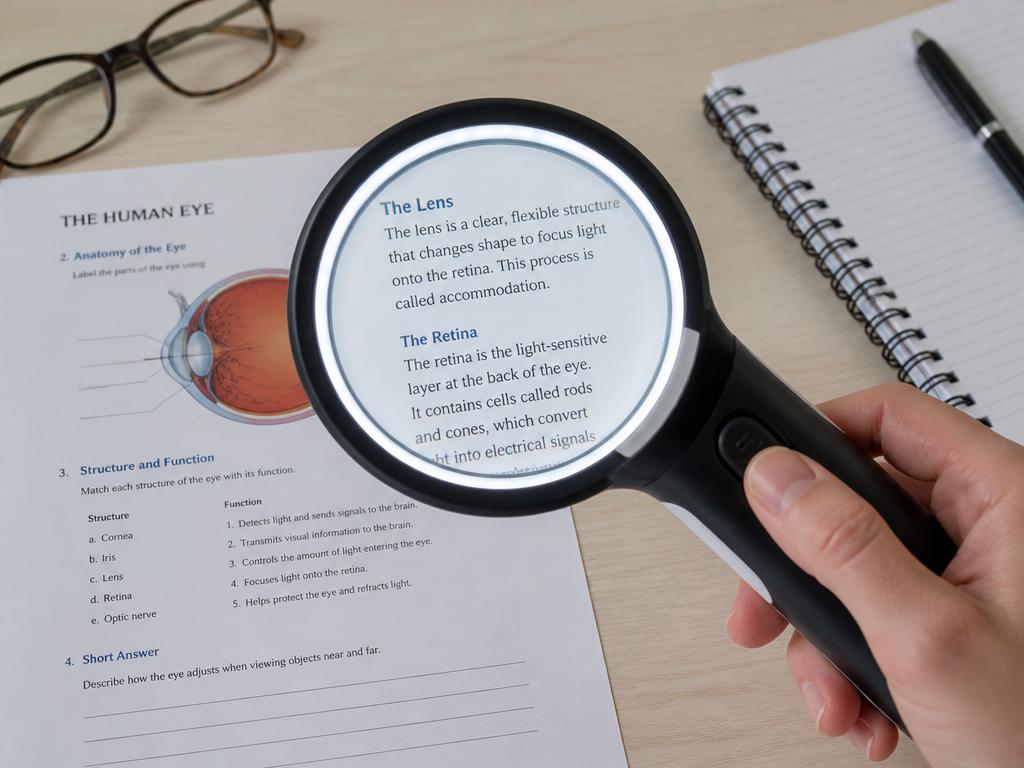
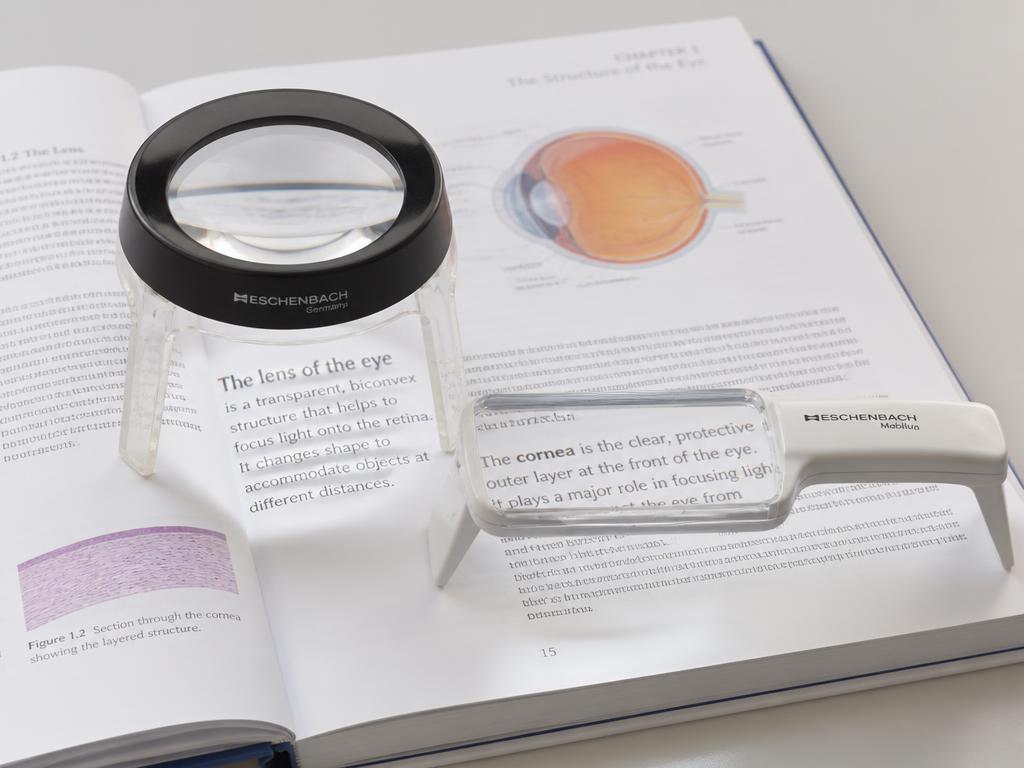

Handheld magnifier
Short spot tasks: price tags, labels, a single line of text.
Portable and cheap; requires a steady hand and short focal distance.
Stand magnifier
Sustained near work for students with tremor or poor motor control.
Fixed focal distance holds the lens steady; less portable, needs desk space.
Hands-free / spectacle
Writing and bimanual tasks where both hands must stay free.
Prescribed by the eye care team; very short working distance at high power.
Telescope (mono/binocular)
Distance targets: the board, signage, a demonstration across the room.
Spot use only — narrow field, not for travel or continuous viewing.
Electronic / video magnifier (CCTV)
Long reading and writing sessions; textbooks, worksheets, science labs.
Adds adjustable magnification, reverse contrast, and speech; cost and setup.
Built-in digital magnification
Phone/tablet zoom, text enlargement, VoiceOver, screen readers.
Already in the student’s hands and free; teach it before purchasing hardware.
Say this
Contrast the two columns: Increase visibility / Enhance versus Augment / Substitute.
Increase visibility / Enhance:
• Increase visibility: more light, higher contrast, bigger target, less clutter — an 18 pt high-contrast worksheet at a glare-free desk.
My notes
Reference posture
Feet flat, hips and knees near 90°, elbows at desk height, trunk upright and off the table.
≈40 cm at midline
A slant board holds the page at a consistent distance and angle; note any habitual 15–20 cm posture.
What to document
Head tilt, page rotation >30°, one eye closing, or distance shortening as the task lengthens.
Say this
Frame the slide: "The classroom modification set."
Walk each point, one sentence each:
• Lighting: even light on the task; never backlight the student.
My notes
Say this
Set up the clip in one sentence, play it, then debrief with "what did you notice?"
My notes
Say this
Describe what belongs here: Screenshot from the VML Treatment Templates showing LTG/STO and dosage..
My notes
Say this
Land the "so what": Choosing the right activity and delivering it two minutes a week produces the same result as choosing the wrong one.
Explain the mechanism plainly: The evidence base for visual-performance intervention is dosage-sensitive; FITT-P gives you frequency, intensity, time, type, and progression to write into the plan.
Then give them the moves — say each one as something they can do Monday:
My notes
Say this
Two-minute case. Read it aloud:
A team asks you to add a visual-efficiency activity to a student's plan. You see the student once every two weeks for 30 minutes.
Put the question to them: "How do you make this dosage-honest?" Give 60 seconds, no talking.
My notes
Say this
Reflection prompt: "Name one strategy you use weekly. What level of evidence supports it, and how would you justify it in a meeting?"
Offer the sentence starter: "I use [strategy] for [level]. The evidence is... In a meeting I would say..."
Think for one minute, write, then take two shares.
My notes
Say this
Knowledge check: "What makes an environmental adaptation defensible in documentation?"
Options:
• It is inexpensive and easy to implement
My notes
Say this
Transition: "Competency Wrap-Up and Post-Course Examination."
My notes
Say this
Open here. "Competency Wrap-Up." What you should be able to do before the post-course examination.
Say why this section matters for their caseload, then advance.
My notes
Say this
Frame the slide: "Self-check before the exam."
Walk each point, one sentence each:
• State the OT scope line for vision in one sentence, without hedging.
My notes
Say this
Contrast the two columns: On Monday versus Within the quarter.
On Monday:
• Pick one flagged student and name the unstable floor
My notes
Say this
Frame the slide: "Four mistakes to stop making."
Walk each point, one sentence each:
• Naming a binocular vision diagnosis in an OT report.
My notes
Say this
Read the scenario aloud, slowly:
Grade 5 student: passes acuity, copies accurately for 4 minutes then drops to 60% with 8 place-loss events, and writes half the expected volume in a timed paragraph.
Then put these questions to the room:
My notes
Say this
Land the "so what": The value of this material shows up in one place: whether next week's documentation, referrals, and task setups look different.
Explain the mechanism plainly: Scope, levels, screening logic, and dosage only matter when they change a decision on a real caseload.
Then give them the moves — say each one as something they can do Monday:
My notes
Say this
Reflection prompt: "Write the three things you will change in the next two weeks: one sentence, one student, one measurement."
Offer the sentence starter: "The sentence I will use is... The student is... The measurement is..."
Think for one minute, write, then take two shares.
My notes
Say this
Talk through this close step in Module 7.
My notes
Say this
Point out that the full reference list travels with the handout; do not read it aloud.
My notes
Say this
Set up the clip in one sentence, play it, then debrief with "what did you notice?"
My notes
Say this
Describe what belongs here: De-identified generated report showing the occupation → level → dose → probe chain..
My notes
Say this
Describe what belongs here: Certificate or AOTA provider badge image for the closing slide..
My notes