1.1 — Welcome — set up before we start
WelcomeSay this
Housekeeping while people arrive.
Materials to have ready:
• Participation & Reflection Guide
My notes
Presenter study handout
4 contact hours · 0.4 AOTA CEUs · All 8 modules · 144 slides
Presenter-side material. Each block shows the slide as the audience sees it, the talk track, and space for your own notes. Model answers appear here — do not hand this version to learners.
Say this
Housekeeping while people arrive.
Materials to have ready:
• Participation & Reflection Guide
My notes
Say this
Read the filed learning objectives verbatim — this is the AOTA-approved wording.
Objectives:
• Administer a criterion-referenced, performance-based visual assessment protocol following standardized procedure — setup, working distance, stimulus presentation, prompting limits, and observation recording — achieving at least 90% procedural fidelity, so that findings can be used to describe a client's occupational performance.
My notes
Say this
Explain how the session runs.
Schedule:
• Eight modules, 4.0 contact hours total
My notes
Say this
Transition: "Why performance-based visual assessment: what norm-referenced batteries miss."
My notes
Say this
Open here. "Why Performance-Based Visual Assessment." What norm-referenced perceptual batteries do not tell you about the school day.
Say why this section matters for their caseload, then advance.
My notes
Say this
Ask the poll: "Which tool do you currently reach for when vision is the referral question?"
Options:
• A norm-referenced visual perception battery
My notes
Say this
Frame the slide: "What a standard score misses."
Walk each point, one sentence each:
• A single accuracy score cannot show endurance decay across a work period.
My notes
Say this
Contrast the two columns: Norm-referenced batteries versus Performance-based VPA™.
Norm-referenced batteries:
• Population comparison
My notes
Say this
Frame the slide: "What an OT measures — and what we do not."
Walk each point, one sentence each:
• We measure performance, conditions, endurance, and occupational impact.
My notes
Say this
Contrast the two columns: Already diagnosed and medically managed → OT addresses it versus Undiagnosed, unverified, unclear, or changing → refer.
Already diagnosed and medically managed → OT addresses it:
• Documented low acuity: magnification, enlarged print, working distance, seating, decluttered materials.
My notes
Say this
Frame the slide: "Why performance-based measurement holds up."
Walk each point, one sentence each:
• Repeated measurement of the same task documents change more defensibly than a single score.
My notes
Say this
Set up the clip in one sentence, play it, then debrief with "what did you notice?"
My notes
Say this
Describe what belongs here: Side-by-side comparison illustrating what each source of evidence shows..
My notes
Say this
Describe what belongs here: Classroom photo showing the occupational demand behind a typical referral..
My notes
Say this
Land the "so what": Norm-referenced batteries tell you where a student ranks. They rarely tell you which condition to change on Monday.
Explain the mechanism plainly: Performance-based assessment manipulates conditions — distance, duration, size, complexity — so the result names the demand that breaks performance.
Then give them the moves — say each one as something they can do Monday:
My notes
Say this
Two-minute case. Read it aloud:
A Grade 3 student scores in the average range on a norm-referenced visual perception battery, yet cannot complete grade-level written work.
Put the question to them: "What did the battery miss, and what do you do next?" Give 60 seconds, no talking.
My notes
Say this
Reflection prompt: "Recall a standard score that did not match what you saw in the classroom. What did the battery miss?"
Offer the sentence starter: "The battery score was... but in the classroom I saw... The battery missed..."
Think for one minute, write, then take two shares.
My notes
Say this
Knowledge check: "What does a norm-referenced perceptual battery not tell you?"
Options:
• How the student compares to same-age peers
My notes
Say this
Transition: "VPA™ architecture: 15 skills across 5 domains, Fast Screener vs. Mini vs. Full."
My notes
Say this
Open here. "VPA™ Architecture." 15 skills across 5 domains — Fast Screener, Mini VPA™, and Full VPA™.
Say why this section matters for their caseload, then advance.
My notes
Say this
Ask the poll: "Given 20 minutes with a new referral, what would you run today?"
Options:
• Fast Screener
My notes
Say this
Run the five levels bottom-up.
Name each level, then say which one you assess first and why.
My notes
Say this
Contrast the two columns: Mini VPA™ (screen) versus Full VPA™ (assess).
Mini VPA™ (screen):
• One probe at each of Levels 1–5
My notes
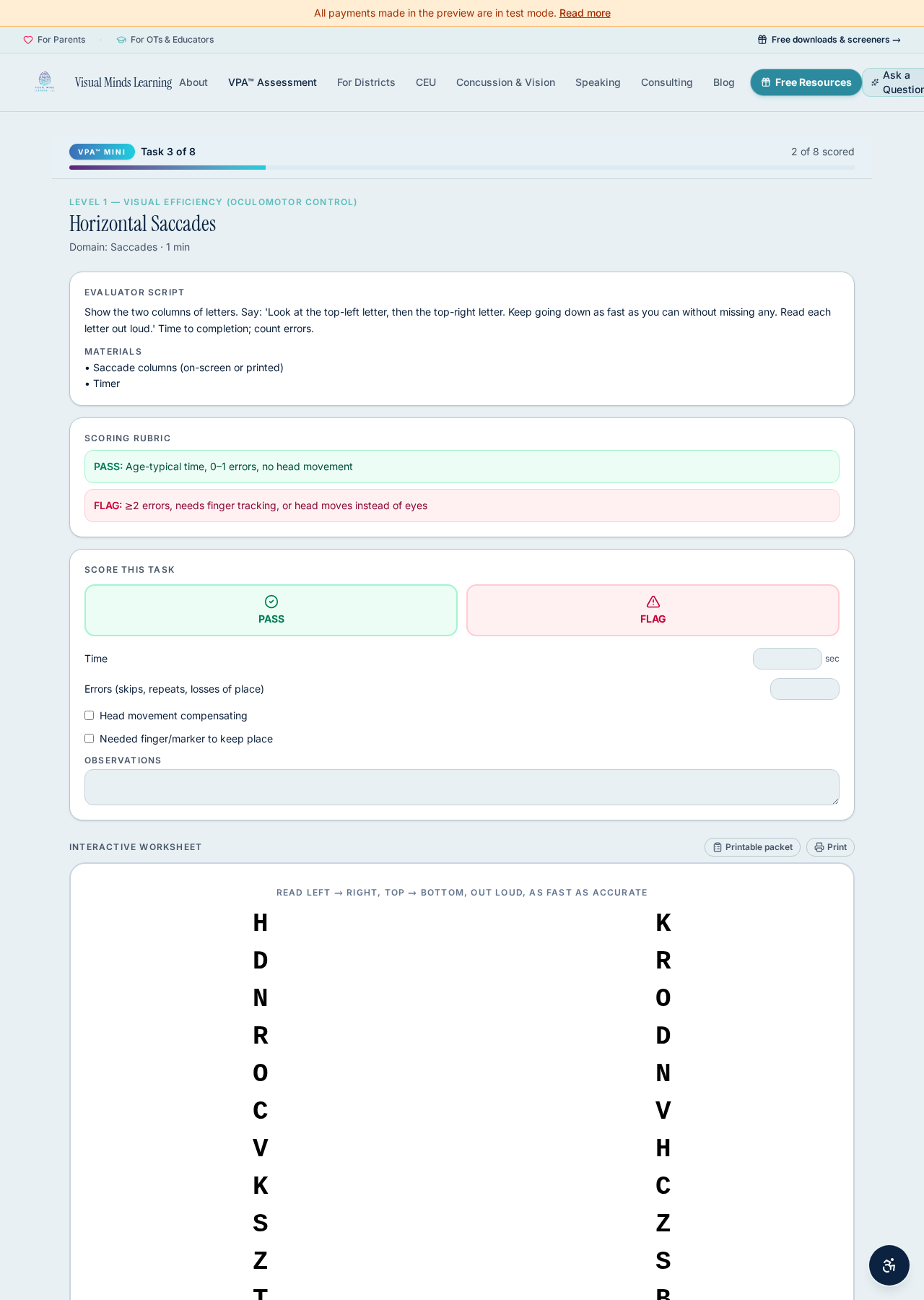
Say this
Talk over the visual: "Mini VPA™ administration view."
Say the caption in your own words: Say/Do script, level ladder, and the scoring worksheet in one clinician view.
My notes
Say this
Frame the slide: "Why 15 skills across 5 domains."
Walk each point, one sentence each:
• Each domain samples one level of the framework: Access, Efficiency, Processing, Visual-Motor Integration, Functional Integration.
My notes
Say this
Contrast the two columns: What you record at the table versus What the software derives.
What you record at the table:
• Item rubric 0–3 for every task you administer: 0 unable, 1 emerging with maximum support, 2 functional with inefficiency, 3 accurate and efficient.
My notes
Say this
Frame the slide: "When to reach for a standardized tool."
Walk each point, one sentence each:
• A single skill is flagged and you need depth for eligibility.
My notes
Say this
Set up the clip in one sentence, play it, then debrief with "what did you notice?"
My notes
Say this
Describe what belongs here: Architecture graphic showing domains, skills, and the L1–L5 ladder..
My notes
Say this
Describe what belongs here: Skill menu view showing the 15 skills grouped by domain..
My notes
Say this
Land the "so what": Fast Screener, Mini, and Full are three different commitments of time. Choosing the wrong tier costs you a session you will not get back.
Explain the mechanism plainly: Screening routes, Mini characterizes a suspected domain, Full establishes level and profile across all fifteen skills.
Then give them the moves — say each one as something they can do Monday:
My notes
Say this
Two-minute case. Read it aloud:
You have 25 minutes with a newly referred Grade 2 student, an IEP meeting in three weeks, and a teacher report of place-losing and slow copying.
Put the question to them: "Which tier do you run today, and what do you schedule?" Give 60 seconds, no talking.
My notes
Say this
Reflection prompt: "Which of the 15 skills do you currently never assess — and what has that cost you?"
Offer the sentence starter: "I currently do not assess [skill]. This has cost me because..."
Think for one minute, write, then take two shares.
My notes
Say this
Knowledge check: "When is the Fast Screener the right instrument?"
Options:
• When you need a score for the IEP
My notes
Say this
Transition: "Age bands, stimulus selection, and setup: working distance, lighting, materials, positioning."
My notes
Say this
Open here. "Age Bands, Stimuli, and Setup." Working distance, lighting, materials, and positioning — the fidelity floor.
Say why this section matters for their caseload, then advance.
My notes
Say this
Ask the poll: "How consistently is your working distance actually measured?"
Options:
• Measured every administration
My notes
Say this
Frame the slide: "Non-negotiables before the first item."
Walk each point, one sentence each:
• Intermediate tasks at 60 cm, near tasks at 40 cm — measured, not estimated.
My notes
Say this
Frame the slide: "Why stimuli change with the band."
Walk each point, one sentence each:
• Level content is developmentally scaled — shapes, then letters, then words, then sentences.
My notes
Say this
Contrast the two columns: 5–7 and 8–11 versus 12–16 and 17+.
5–7 and 8–11:
• Shapes and single letters at the lower levels
My notes
Say this
Contrast the two columns: What stays the same at L4 / L5 versus What the student actually sees.
What stays the same at L4 / L5:
• Difficulty is set by the level: 18 px print at L4, 12 px at L5; 8 then 10 saccade items per column.
My notes
Say this
Contrast the two columns: Band-adapted (the material changes) versus Level-only (deliberately band-neutral).
Band-adapted (the material changes):
• Saccade columns — symbols and CVC words at 5–7, letters and multi-syllable words at 8–11, digit/letter pairs with academic vocabulary at 12–16, alphanumeric pairs with clinical vocabulary at 17+.
My notes
Say this
Land the "so what": Working distance, lighting, and positioning change scores more than most skill differences you are trying to detect.
Explain the mechanism plainly: If setup drifts between administrations, your progress line measures your setup, not the student.
Then give them the moves — say each one as something they can do Monday:
My notes

Feet unsupported, trunk collapsed, page about 15 cm from the eyes.

Feet supported, hips back, page raised toward a slant, working distance near Harmon distance.
Fix posture and distance before you score anything. Otherwise you are documenting the setup, not the student.
Say this
Set up the contrast: "Postural setup changes what you are measuring."
Point at the before panel first. Feet unsupported, trunk collapsed, page about 15 cm from the eyes.
Then the after panel. Feet supported, hips back, page raised toward a slant, working distance near Harmon distance.
My notes
Say this
Two-minute case. Read it aloud:
A student scores markedly better at the 9-week reassessment. You administered the first session at a table with the student standing and the second seated with a slant board.
Put the question to them: "What can you report?" Give 60 seconds, no talking.
My notes
Say this
Knowledge check: "A 15-year-old with an intellectual disability reads at a first-grade level and is referred for worksheet navigation. You administer the 12–16 band and she fails Level 4 figure-ground on a text-embedded array. What went wrong?"
Options:
• Nothing — the failure is a valid Level 4 figure-ground finding.
My notes
Say this
Frame the slide: "Eye dominance: Porta and Miles tests."
Walk each point, one sentence each:
• Extended-arm method: patient extends one arm, holds a thumb or wand upright, and aligns it with a distant target using both eyes open.
My notes

Eye level, off midline
Sit level with the student’s eyes and roughly 30° off midline so both eyes stay visible.
Target at eye level
Held at eye level, not above — an elevated target forces chin-up posture and false head substitution.
Score sheet within reach
Record each trial as it happens; retrospective scoring loses the qualitative signal.
Say this
Contrast the two columns: Cover–uncover versus Alternate cover.
Cover–uncover:
• Student fixates a target; cover one eye, then remove the cover.
My notes
Say this
Frame the slide: "Below the floor of the VPA™."
Walk each point, one sentence each:
• Ages 3–4 use the Pre-K Quick Screen — refer or offer simple activities.
My notes
Say this
Set up the clip in one sentence, play it, then debrief with "what did you notice?"
My notes

Near probes · 40 cm
Card at midline and at eye level; measure from the spectacle plane, not the forehead.
Table/screen · 60 cm
Use the same distance at screening and re-probe — a distance change invalidates the comparison.
Base of support
Feet supported and hips at 90° before any oculomotor scoring; postural drift reads as an efficiency deficit.
Say this
Describe what belongs here: Two photos or one composite showing both working distances..
My notes
Say this
Describe what belongs here: Band picker showing 5–7, 8–11, 12–16, 17+..
My notes
Say this
Reflection prompt: "Name the two client or contextual factors that will drive age band and stimulus selection for your next student."
Offer the sentence starter: "For [student], the age band is driven by... and the stimulus selection is driven by..."
Think for one minute, write, then take two shares.
My notes
Say this
Knowledge check: "Why is uncontrolled working distance a scoring problem, not just a tidiness problem?"
Options:
• It makes the session run long
My notes
Say this
Transition: "Administering the Mini VPA™: the seven probes, scripts, prompting limits, and observation cues."
My notes
Say this
Open here. "Administering the Mini VPA™." Five probes, verbatim scripts, prompting limits, and observation cues.
Say why this section matters for their caseload, then advance.
My notes
Say this
Ask the poll: "Which prompting error are you most at risk of during administration?"
Options:
• Repeating the item after a delay
My notes
Say this
Frame the slide: "Script discipline."
Walk each point, one sentence each:
• Read the Say line verbatim; the Do line defines your hands and the timing.
My notes
Say this
Frame the slide: "What triggers a Full VPA™."
Walk each point, one sentence each:
• Any probe failed at or below the expected level for the band.
My notes
Say this
Contrast the two columns: Pursuit: look for versus Saccade: look for.
Pursuit: look for:
• Symmetry between the two eyes as they track
My notes
Near probes · 40 cm
Card at midline and at eye level; measure from the spectacle plane, not the forehead.
Table/screen · 60 cm
Use the same distance at screening and re-probe — a distance change invalidates the comparison.
Base of support
Feet supported and hips at 90° before any oculomotor scoring; postural drift reads as an efficiency deficit.
Say this
Frame the slide: "Near point of convergence — the penlight probe."
Walk each point, one sentence each:
• This belongs to the Level 2 efficiency probe. You run it here in the Mini, and again inside Domain 2 of the Full.
My notes
Say this
Contrast the two columns: Levels 1–3 versus Levels 4–5.
Levels 1–3:
• L1 — acuity at the measured distance, correction worn
My notes
Say this
Frame the slide: "What to watch while they work."
Walk each point, one sentence each:
• Working distance drift and head movement instead of eye movement.
My notes
Say this
Set up the clip in one sentence, play it, then debrief with "what did you notice?"
My notes
Say this
Describe what belongs here: Clinician view of a probe script with the level ladder visible..
My notes
Eye level, off midline
Sit level with the student’s eyes and roughly 30° off midline so both eyes stay visible.
Target at eye level
Held at eye level, not above — an elevated target forces chin-up posture and false head substitution.
Score sheet within reach
Record each trial as it happens; retrospective scoring loses the qualitative signal.
Say this
Describe what belongs here: Positioning photo showing the clinician’s line of sight to the eyes..
My notes
Say this
Land the "so what": Every extra prompt you add turns an assessment item into a teaching trial, and the score stops meaning what the manual says it means.
Explain the mechanism plainly: The five Mini probes are standardized in wording, demonstration, and prompting limits.
Then give them the moves — say each one as something they can do Monday:
My notes
Say this
Two-minute case. Read it aloud:
Mid-probe, a student stalls and you say "remember to start at the left." He then completes the item correctly.
Put the question to them: "How do you score and document it?" Give 60 seconds, no talking.
My notes
Say this
Reflection prompt: "After scoring yourself on the fidelity checklist, which two items will you rehearse before your first real administration?"
Offer the sentence starter: "I will rehearse [item 1] and [item 2] because..."
Think for one minute, write, then take two shares.
My notes
Say this
Knowledge check: "A student pauses; you say "you can do it, look again at the top." What have you done?"
Options:
• Provided allowable encouragement
My notes
Say this
Transition: "Administering the Full VPA™: level progression, basal and ceiling rules, validity flags."
My notes
Say this
Open here. "Administering the Full VPA™." Level progression, basal and ceiling rules, and the five validity threats.
Say why this section matters for their caseload, then advance.
My notes
Say this
Ask the poll: "What most often makes you unsure when to stop testing?"
Options:
• Deciding the basal
My notes
Say this
Frame the slide: "Progression, basal, ceiling."
Walk each point, one sentence each:
• Every skill runs sequentially L1 → L5; no adaptive skipping.
My notes
Say this
Frame the slide: "The five validity threats."
Walk each point, one sentence each:
• Setup drift — distance, lighting, or positioning changed mid-session.
My notes
Say this
Frame the slide: "The 15 skills sit on the five levels."
Walk each point, one sentence each:
• Level 1 · Access — near acuity, intermediate/distance acuity, contrast tolerance. Nothing above this level is interpretable if it fails.
My notes
Say this
Run the five levels bottom-up.
Name each level, then say which one you assess first and why.
My notes
Say this
Frame the slide: "Keeping a full battery clean."
Walk each point, one sentence each:
• Order skills so fatigue-sensitive probes are not all at the end.
My notes
Say this
Set up the clip in one sentence, play it, then debrief with "what did you notice?"
My notes
Say this
Describe what belongs here: Runner view showing the level ladder and scoring panel..
My notes
Say this
Describe what belongs here: Bench setup: cards, worksheets, timer, measured distances..
My notes
Say this
Land the "so what": Correct basal and ceiling rules keep a student out of twenty items they were always going to fail — and keep your session inside its window.
Explain the mechanism plainly: Level progression is designed to find the boundary of performance, not to sample everything.
Then give them the moves — say each one as something they can do Monday:
My notes
Say this
Two-minute case. Read it aloud:
You start at the age-band entry point, the student misses two of the first three items, and you keep going upward hoping he settles.
Put the question to them: "What went wrong and what do you do?" Give 60 seconds, no talking.
My notes
Say this
Reflection prompt: "Which of the five validity threats do you see most in your setting, and what will you change to control it?"
Offer the sentence starter: "The validity threat I see most is... I will control it by..."
Think for one minute, write, then take two shares.
My notes
Say this
Knowledge check: "A student fails the first two items at the entry level. What do you do?"
Options:
• Stop and record the achieved level
My notes
Say this
Transition: "Scoring and interpretation: achieved level, domain profile, composites, and flag logic."
My notes
Say this
Open here. "Scoring and Interpretation." Achieved level, domain profile, composites, and flag logic.
Say why this section matters for their caseload, then advance.
My notes
Say this
Ask the poll: "Which profile shape do you find hardest to interpret?"
Options:
• Flat low
My notes
Say this
Frame the slide: "Read the shape before the numbers."
Walk each point, one sentence each:
• Flat low — rule out validity threats and sensory floor before interpreting.
My notes
Say this
Frame the slide: "What the report may and may not say."
Walk each point, one sentence each:
• Report observed performance, conditions, and occupational impact.
My notes
Say this
Ask the poll: "A scored VPA™ lands on your desk. What is the first thing you look at?"
Options:
• The composite / mean VPL
My notes
Say this
Run the five levels bottom-up.
Spend your time on Level 2 — that is the point of this slide.
My notes
Say this
Contrast the two columns: Profile A — L1:4 L2:2 L3:5 L4:4 L5:2 versus Profile B — L1:4 L2:4 L3:4 L4:2 L5:2.
Profile A — L1:4 L2:2 L3:5 L4:4 L5:2:
• Mean VPL 3.4 — looks unremarkable in a composite.
My notes
Say this
Land the "so what": The domain profile is what you treat. The composite is what you say in the meeting when someone wants one number.
Explain the mechanism plainly: Two students with the same composite can need completely different intervention if their domain profiles differ.
Then give them the moves — say each one as something they can do Monday:
My notes
Say this
Set up the contrast: "Before / after: how the same profile gets reported."
Point at the before panel first. Nothing here tells the team what to change.
Then the after panel. The reader knows the domain, the demand, and the next measurement.
My notes
Say this
Two-minute case. Read it aloud:
Two Grade 4 students have nearly identical composites. One has a flat profile; the other has a sharply low efficiency domain with the rest at band expectation.
Put the question to them: "Do they get the same plan?" Give 60 seconds, no talking.
My notes
Say this
Reflection prompt: "Take one student you have assessed. Write the single sentence you would say when the team asks "so what does the vision testing mean?" — it must name the occupation, the limiting visual performance factor in criterion language, and the observable impact."
Cues:
• Would a general education teacher be able to picture it?
My notes
Say this
Talk through this branch step in Module 6.
My notes
Say this
Talk through this branch step in Module 6.
My notes
Say this
Knowledge check: "Which statement is both criterion-referenced and occupation-linked?"
Options:
• Student demonstrates below-average visual motor integration skills.
My notes
Say this
Contrast the two columns: Per skill versus Per domain.
Per skill:
• Each task is rubric-scored 0–3; a 2 or 3 passes that task
My notes
Say this
Frame the slide: "When a standardized chart adds value."
Walk each point, one sentence each:
• Acuity and contrast: Colenbrander, MNRead, Lea Low Contrast, and mixed-contrast charts add graded depth to a flagged acuity level.
My notes
Say this
Frame the slide: "Turning the profile into a plan of care."
Walk each point, one sentence each:
• Start at the lowest unstable level; stabilize before climbing.
My notes
Say this
Set up the clip in one sentence, play it, then debrief with "what did you notice?"
My notes
Say this
Describe what belongs here: Scored VPA™ profile chart showing the shape you are teaching..
My notes
Say this
Describe what belongs here: Completed scoring sheet, de-identified..
My notes
Say this
Reflection prompt: "Take a profile in front of you. Name the domain and level that most likely account for the breakdown, and write the rationale in one sentence."
Offer the sentence starter: "The domain is... at level... The rationale is..."
Think for one minute, write, then take two shares.
My notes
Say this
Knowledge check: "A bottom-heavy profile with intact upper-level scores most often means what?"
Options:
• The upper-level scores are invalid
My notes
Say this
Transition: "Clinical reasoning walkthroughs: three student profiles from referral to interpretation."
My notes
Say this
Open here. "Clinical Reasoning Walkthroughs." Three student profiles from referral to disposition.
Say why this section matters for their caseload, then advance.
My notes
Say this
Ask the poll: "Where does your reasoning most often stall?"
Options:
• Turning scores into a hypothesis
My notes
Say this
Read the scenario aloud, slowly:
Intake: passed a kindergarten vision screening, no eye examination since, no glasses, homework is "a battle." Band 5–7. Findings — L1: near acuity at criterion both eyes; intermediate acuity at 60 cm one line below criterion with a one-line difference between the eyes; Maya leans toward the card. L2: fixation and pursuits at criterion; NPC break 9 cm, recovery 13 cm, stable across three trials. L3: at criterion through Level 4. L4: form copying reaches Level 3, orientation errors on diagonal intersections. L5: reading at criterion for grade; writing sample shows b/d reversals and an inconsistent baseline.
Then put these questions to the room:
My notes
Say this
Read the scenario aloud, slowly:
Intake: glasses worn consistently, eye examination 8 months ago, headaches during silent reading, avoids reading homework. Band 8–11. Findings — L1: at criterion both distances. L2: fixation at criterion; saccades reach Level 3, with head movement on every horizontal shift at Levels 4 and 5 and two refixations per line; NPC break recedes across trials from 8 cm to 14 cm. L3: at criterion through Level 5. L4: at criterion through Level 4. L5: reading rate at criterion for the first two minutes then decays; line loss begins around four minutes; writing volume falls off in the final third.
Then put these questions to the room:
My notes
Say this
Read the scenario aloud, slowly:
Intake: glasses, current examination, no discomfort reported, strong verbal performance, OT in elementary school discharged in grade 4. Band 12–16. Findings — L1 and L2 at criterion throughout. L3 at criterion through Level 5. L4: grid-pattern reproduction reaches Level 2; proportion and spatial organization break down as grid complexity increases; he rechecks the model repeatedly. L5: reading at criterion; writing sample shows adequate content, poor organization on the line, slow effortful production, visible frustration.
Then put these questions to the room:
My notes
Say this
Read the scenario aloud, slowly:
Intake: no glasses, eye examination last year reported normal, no headaches, likes being read to and dislikes reading alone. Band 8–11. Findings — L1: at criterion both distances. L2: fixation at criterion; pursuits at criterion; saccades reach Level 4 with no head movement and no rate decay across the timed passage. L3: figure-ground reaches Level 2 — she cannot locate a target item on a dense page; discrimination and visual memory at criterion through Level 4. L4: at criterion through Level 4. L5: reading rate below criterion from the first minute and flat across eight minutes; she finds the line again quickly once she loses it.
Then put these questions to the room:
My notes
Say this
Frame the slide: "The same four questions in every case."
Walk each point, one sentence each:
• What is the occupation named in the referral?
My notes
Say this
Contrast the two columns: OT reports versus Route to eye care.
OT reports:
• Rate decay across a timed passage
My notes
Say this
Set up the clip in one sentence, play it, then debrief with "what did you notice?"
My notes
Say this
Describe what belongs here: De-identified writing or copy sample belonging to one of the cases..
My notes
Say this
Describe what belongs here: Domain profile for the case you are walking through..
My notes
Say this
Land the "so what": What you are certified to do is connect a referral question to a scored profile to a defensible decision — that chain is what the team is buying.
Explain the mechanism plainly: A score with no reasoning trail cannot be defended, replicated, or built on by the next therapist.
Then give them the moves — say each one as something they can do Monday:
My notes
Say this
Two-minute case. Read it aloud:
The referral question was "why can this student not finish written work?" Your report describes the profile in detail and recommends OT twice monthly.
Put the question to them: "What is missing?" Give 60 seconds, no talking.
My notes
Say this
Reflection prompt: "For the walkthrough we just finished, write the disposition you would document and the one thing you would tell the teacher tomorrow."
Offer the sentence starter: "Disposition:... One thing for the teacher:..."
Think for one minute, write, then take two shares.
My notes
Say this
Knowledge check: "Interpretation is complete. What determines the disposition?"
Options:
• The lowest score on the profile
My notes
Say this
Transition: "Documentation, disposition, referral decisions, and post-course examination."
My notes
Say this
Open here. "Documentation, Disposition, and Referral." Closing the loop before the post-course examination.
Say why this section matters for their caseload, then advance.
My notes
Say this
Frame the slide: "A defensible VPA™ report."
Walk each point, one sentence each:
• Occupational profile and referral question stated first.
My notes
Say this
Frame the slide: "Referral decision rules."
Walk each point, one sentence each:
• Any ocular symptom, pain, or unexplained acuity loss — refer to eye care now.
My notes
Say this
Frame the slide: "How the profile actually defines the intervention."
Walk each point, one sentence each:
• Bottom-heavy (floor unstable, top low): treat at the lowest unstable level. Efficiency work inside a reading or writing task, not isolated drill — and the referral goes out the same week.
My notes
Say this
Contrast the two columns: The five decisions versus Worked example.
The five decisions:
• Frequency — how many sessions per week.
My notes
Say this
Frame the slide: "From achieved level to an IEP-ready goal."
Walk each point, one sentence each:
• Name the occupation first: "During independent silent reading of grade-level text…"
My notes
Say this
Contrast the two columns: Levels 1–2 — access and efficiency versus Levels 3–5 — processing, production, occupation.
Levels 1–2 — access and efficiency:
• L1 Access: contrast-graded search (Hidden Shapes in Contrast), print and lighting changes, seat and board-copy substitution. Referral runs in parallel when the finding is new.
My notes
Say this
Frame the slide: "Three rules that keep the activity honest."
Walk each point, one sentence each:
• Treat at the lowest unstable level, but measure progress at Level 5. If reading did not change, the activity did not matter.
My notes
Say this
Land the "so what": Every completed VPA ends in one of four decisions: treat, refer, monitor, or reassess. Naming it is what makes the assessment actionable.
Explain the mechanism plainly: Assessment without a stated disposition puts the decision back on a team that does not have your training.
Then give them the moves — say each one as something they can do Monday:
My notes
Say this
Knowledge check: "Aiden, 15: Levels 1–3 at criterion, Level 4 achieved L2, Level 5 writing slow and disorganized, refuses written work. What does the plan lead with?"
Options:
• Oculomotor efficiency drills, since output problems usually start with tracking.
My notes
Say this
Transition: "Intervention Planning Using the Five-Level Framework."
Preview:
• FITT-P protocols written out by domain and age band, not just the one worked example.
My notes
Say this
Contrast the two columns: Team and family versus Eye care provider.
Team and family:
• One-sentence occupational impact statement
My notes
Say this
Frame the slide: "When to run the VPA™ again."
Walk each point, one sentence each:
• At the end of each intervention block, using the identical probes.
My notes
Say this
Frame the slide: "Writing the address-vs-refer decision into the report."
Walk each point, one sentence each:
• State the functional limitation in occupational terms, then the OT plan that addresses it now.
My notes
Say this
Set up the clip in one sentence, play it, then debrief with "what did you notice?"
My notes
Say this
Describe what belongs here: De-identified report pages showing profile, goals, and disposition..
My notes
Say this
Describe what belongs here: Scope-safe referral wording you use with eye care providers..
My notes
Say this
Reflection prompt: "Name the two students you will assess in the next two weeks, the depth you will use, and the fidelity items you will watch."
Offer the sentence starter: "Student 1: [depth] with fidelity watch on... Student 2: [depth] with fidelity watch on..."
Think for one minute, write, then take two shares.
My notes
Say this
Talk through this close step in Module 8.
My notes