Vision in OT Practice — participation guide
3 contact hours · 0.3 AOTA CEUs · Module 1 — follow along, take notes, and complete the reflection prompts.
Module 1
OT Scope in Vision
Follow along
What this module covers
- Vision is a client factor, not a specialty add-on
- Say this, not that
- Prevalence and the case for OT screening
- Diagnoses OTs should recognize but never assign
- Vision work already lives in your school day
Key ideas
Capture these as you listen
- Vision is a client factor under OTPF-4. Treating how it shows up in occupation is squarely inside OT scope.
- The scope line runs along purpose: eye health = optometry, supervised optometric care = vision therapy, occupational performance = OT.
- Adaptation (Level 1 of the Framework) is OT intervention, not 'waiting for the doctor.'
Notes
My notes for this module
Reference figures
Keep these for practice
Documentation example — scope-safe present level
Out of scope
“Student has convergence insufficiency and a visual processing disorder, causing reading failure. Vision therapy is recommended.”
Scope-safe
“During 20-minute near copy tasks, the student completes 40% of assigned lines and loses place an average of 6 times, reporting blur after 6 minutes. Performance improves to 75% with an enlarged, line-isolated model. Referral to eye care has been made.”
Photo — working distance and posture at the desk
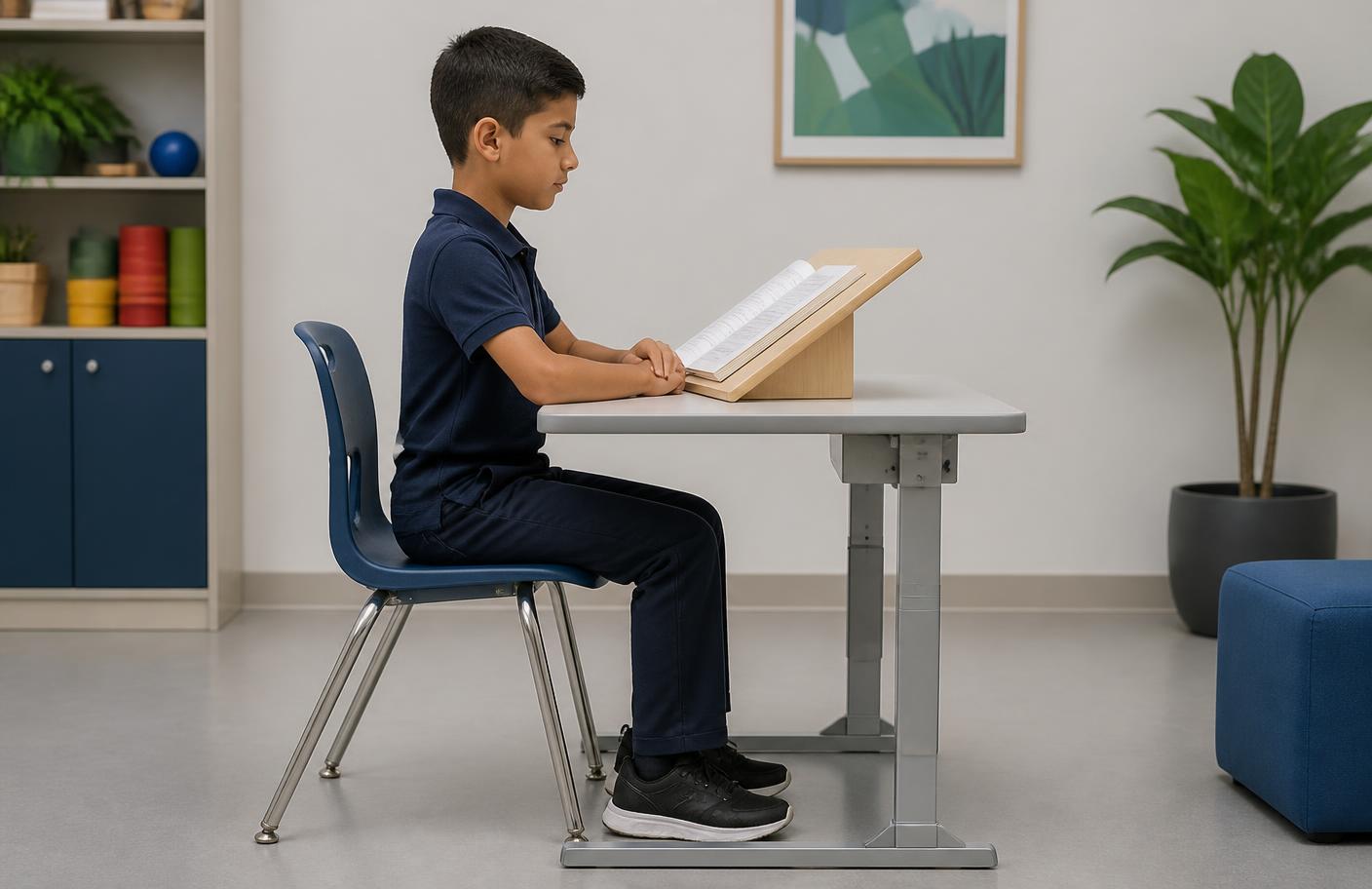
Reference posture
Feet flat, hips and knees near 90°, elbows at desk height, trunk upright and off the table.
≈40 cm at midline
A slant board holds the page at a consistent distance and angle; note any habitual 15–20 cm posture.
What to document
Head tilt, page rotation >30°, one eye closing, or distance shortening as the task lengthens.
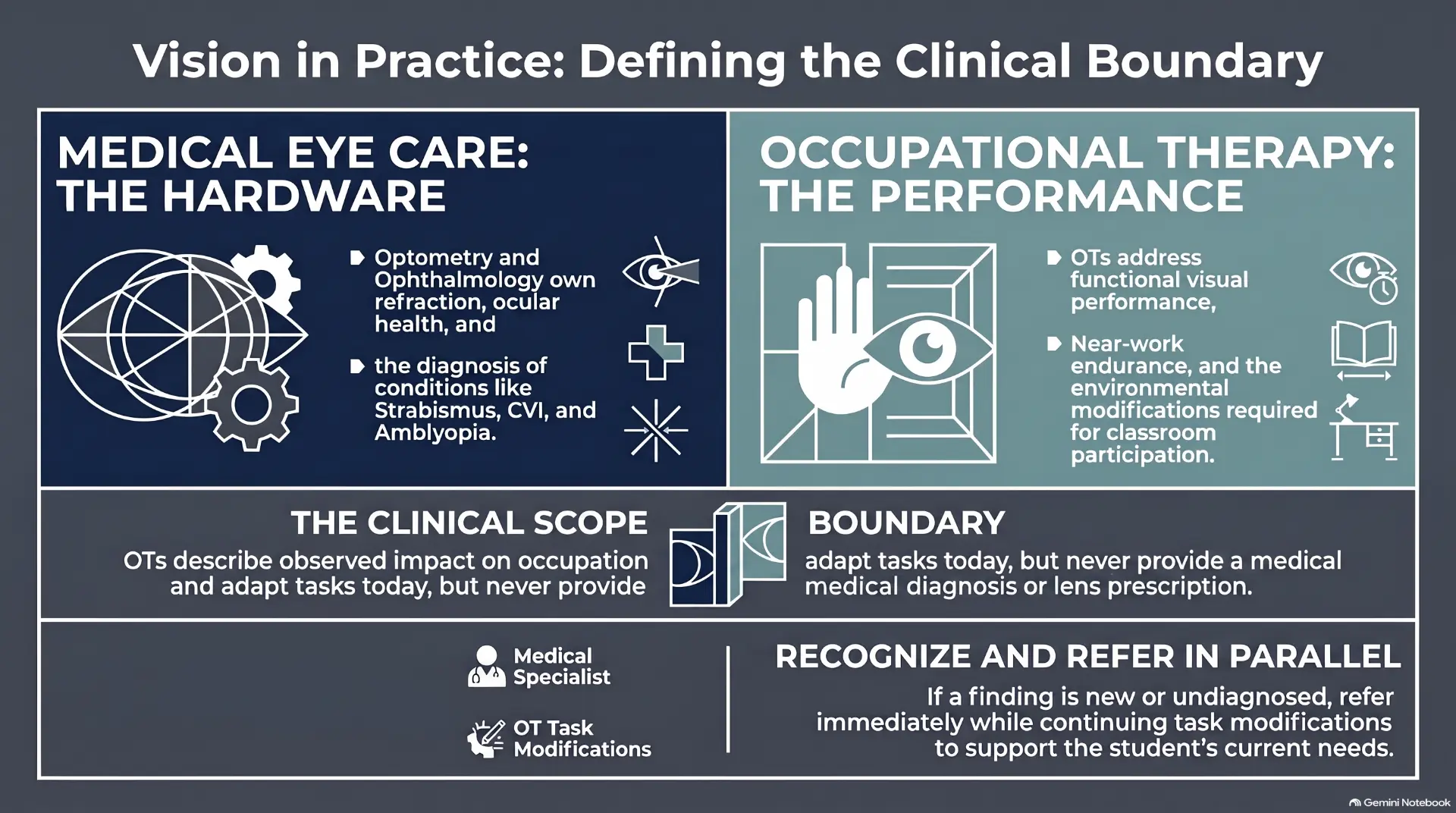
Apply it
Case prompt
You get a teacher email: 'Kaia passed the school vision screen but still can't copy from the board. Should I even refer to you?' Draft a two-sentence reply that names your scope clearly and invites the referral.
Practice
Mini exercise
In one sentence, describe the OT scope for vision without using the words 'therapy,' 'eye doctor,' or 'refer.' Write it down before you move on. If you can defend it to a school administrator, you own the framing.
Take it to work
Action step this week
This week, audit one of your own progress notes. Circle every sentence that names a visual function tied to an occupation. If you can't circle at least one, rewrite it so you can.