Vision in OT Practice — participation guide
3 contact hours · 0.3 AOTA CEUs · Module 3 — follow along, take notes, and complete the reflection prompts.
Module 3
Screening vs. Assessment
Follow along
What this module covers
- The two-step in practice
- What VML gives you at the screening step
- What turns a flag into a Full VPA™
Key ideas
Capture these as you listen
- Screening asks 'is there a concern', 15 minutes, PASS/FLAG, no plan of care. Assessment asks 'what and what next', 30–60 minutes, VPL per level, generates the plan.
- Every referral runs through the same pipeline: history → screen → decision → assessment (if warranted) → plan.
- You can screen without instrumentation. Standardized rubrics help, they do not replace clinical observation.
Notes
My notes for this module
Reference figures
Keep these for practice
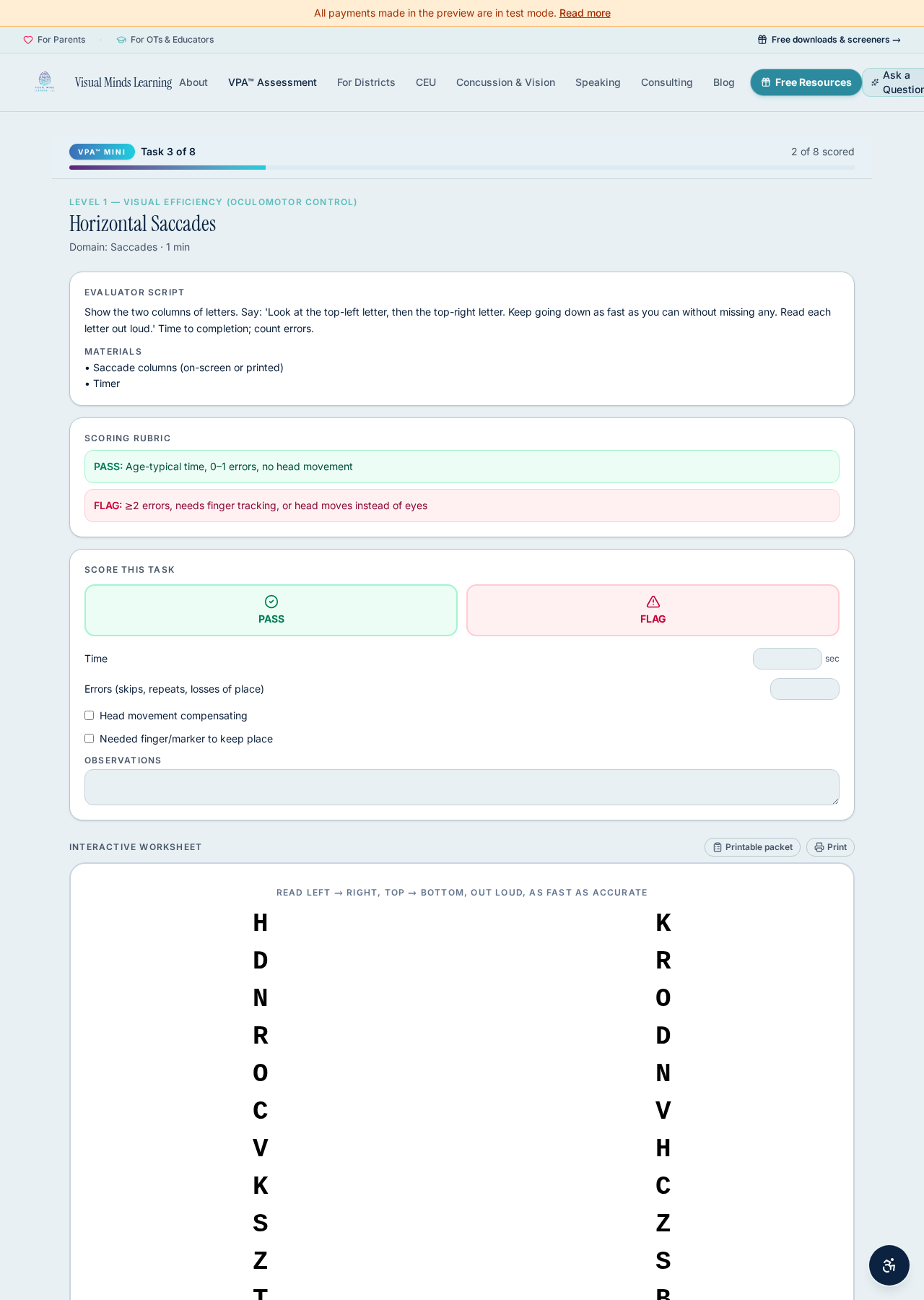
Screenshot — Mini VPA™ probe in progress
Say
“Look at the star, then the circle, and keep going back and forth until I say stop. Move only your eyes.”
Do
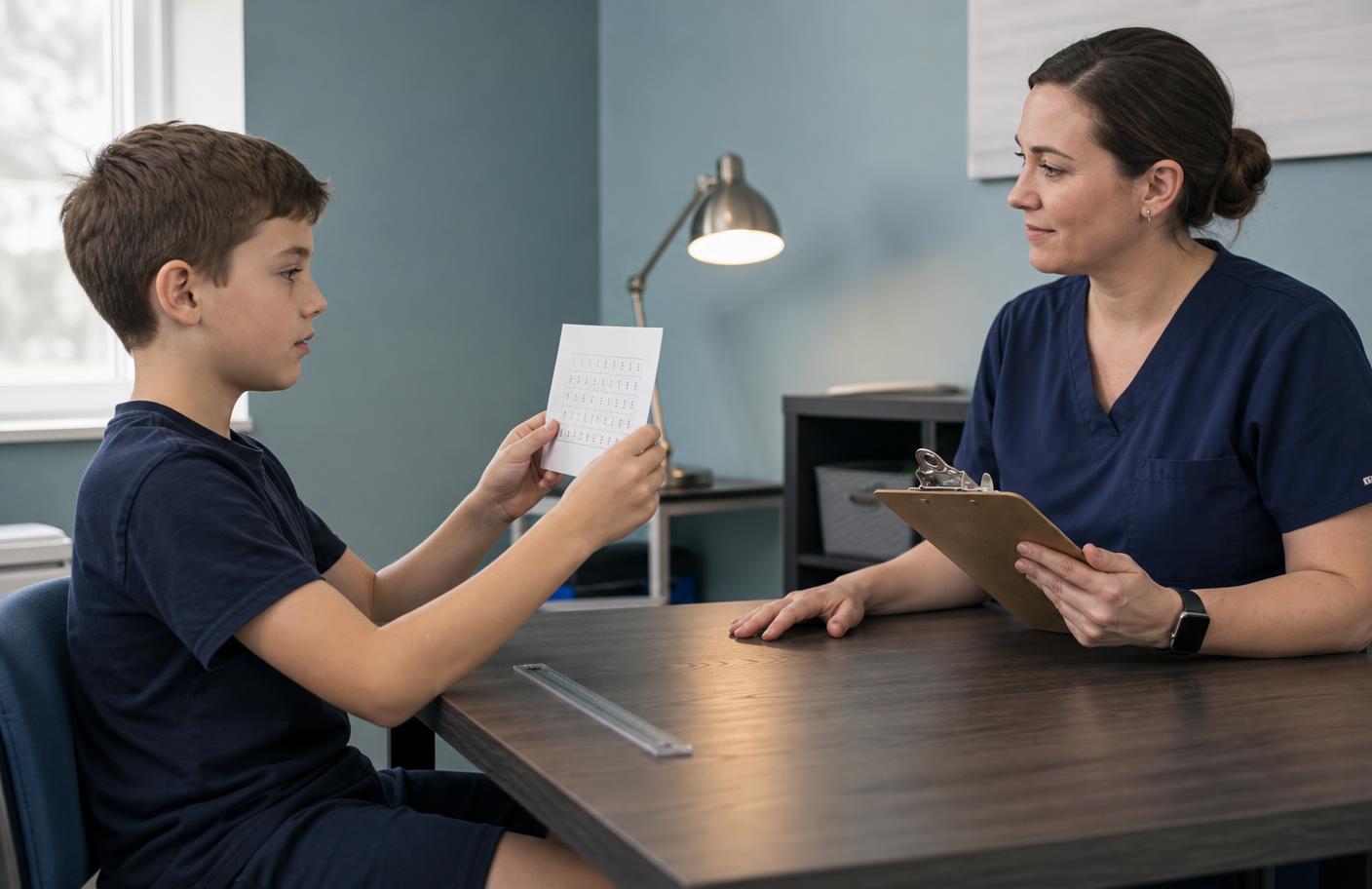
Hold targets 20 cm apart at 40 cm, eye level. Time 30 s. Watch for head movement, undershoot, loss of place, and reported blur.
Score the level reached
Photo — screening setup at 40 cm
Near probes · 40 cm
Card at midline and at eye level; measure from the spectacle plane, not the forehead.
Table/screen · 60 cm
Use the same distance at screening and re-probe — a distance change invalidates the comparison.
Base of support
Feet supported and hips at 90° before any oculomotor scoring; postural drift reads as an efficiency deficit.
Apply it
Case prompt
A student is rereading lines and losing place during silent reading, and independent seatwork is not getting finished. She PASSed acuity and processing on the Fast Screener but FLAGged saccades. Do you refer to optometry, schedule the Mini VPA, or both, and why?
Practice
Mini exercise
Write out your current vision workflow in five arrows. Circle every step where a decision is made. If you cannot find a clear PASS/FLAG decision node, that is your first workflow fix.
Take it to work
Action step this week
Time yourself running the Fast Screener on a colleague. If you exceeded 20 minutes, note where the drag happened. Efficiency at the screen protects your caseload capacity.