Vision in OT Practice — participation guide
3 contact hours · 0.3 AOTA CEUs · Module 2 — follow along, take notes, and complete the reflection prompts.
Module 2
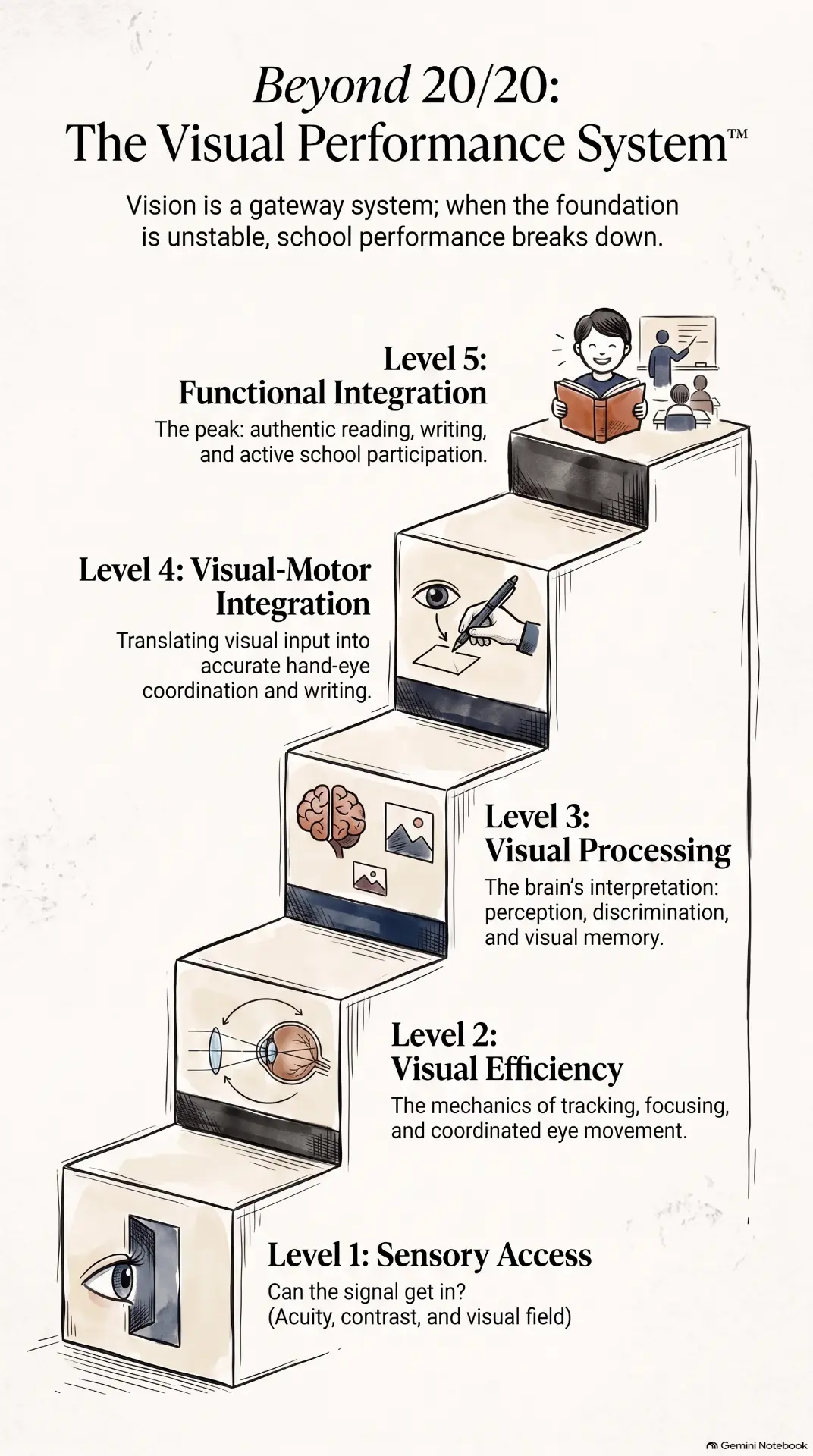
The Five-Level Visual Performance Framework
Follow along
What this module covers
- Visual development milestones OTs should know
- How the Five-Level Framework was built
- Two rules for choosing where to start
- The same four-part shape, every level
Key ideas
Capture these as you listen
- The Framework has five levels, Access, Efficiency, Processing, Visual-Motor Integration, Functional Integration, each with its own assessment and intervention logic.
- Never intervene above an unstable level. Stabilize the floor, then build up.
- Every OT goal names Level 5 (occupation) as the outcome, even when the intervention targets a lower level.
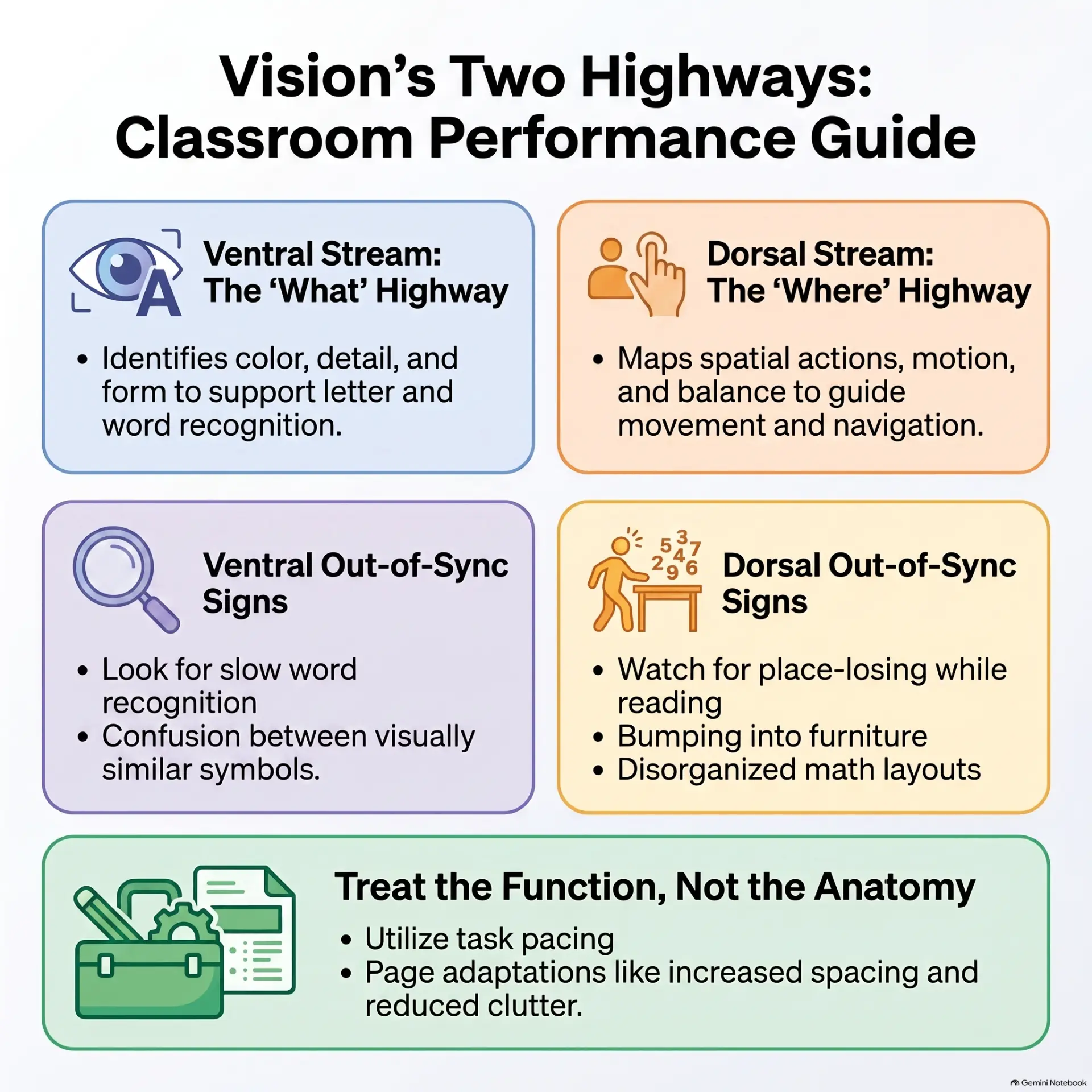
- The floors map (imperfectly but usefully) onto two neural pathways: magnocellular / dorsal stream (motion, low contrast, gaze control, Level 2 and spatial Level 3) and parvocellular / ventral stream (high-contrast form, color, memory, object Level 3 and Level 4). The tracts explain transmission only — OT does not treat or train a pathway; we address the functional components it supports and the task and environment around them.
- Each level has its own functional signature in the school day and its own OT intervention direction: Level 1 adapt-and-refer, Level 2 remediate efficiency, Level 3 reduce visual load and teach strategy, Level 4 separate visual from motor before treating, Level 5 write the goal.
- Run two threads at once, remediation on the unstable floor and compensation that keeps the occupation running while that floor is rebuilt.
- Every session follows the same four-part shape: baseline probe, graded work on the unstable floor, the same skill inside real classroom material, and a written hand-off to the teacher.
- VML resources are organized by the same five floors, screener and acuity/contrast ladders at Level 1, interactive oculomotor stimuli and anaglyph packets at Level 2, processing activities with matched worksheets at Level 3, handwriting-readiness and visual-motor packets at Level 4, and grade-banded reading/writing probes plus treatment templates at Level 5.
Notes
My notes for this module
Reference figures
Keep these for practice
One example per level
Level 1 · Access
Level 2 · Efficiency
Level 3 · Processing
Level 4 · Visual-motor
Level 5 · Functional
Apply it
Case prompt
A first grader cannot finish copying the morning message before the class moves on; the teacher reports he looks up, looks down, and has lost his place. On follow-up he has 20/20 acuity, PASSes saccades and convergence, but scores 2 of 5 on a visual-memory copy task. Which contributing level is limiting the occupation, and which is intact?
Practice
Mini exercise
Sketch the continuum from memory, left to right: five stations running from access to occupation. Label each with one word and one skill. Compare against the diagram above. Anything you missed is a note-to-self, not a failure.
Take it to work
Action step this week
Pull three current caseload students. On a sticky note for each, write which single Framework level is their primary limiter. Post them where you plan next week.