Back to CEU courses

Presenter study handout

Vision in OT Practice

3 contact hours · 0.3 AOTA CEUs · Module 1 · 26 slides

Presenter-side material. Each block shows the slide as the audience sees it, the talk track, and space for your own notes. Model answers appear here — do not hand this version to learners.

Module 1

1.1 — Welcome — while you get set up

Welcome

Welcome

Welcome — while you get set up

Vision in OT Practice · 3.0 contact hours · 0.3 AOTA CEUs

Have ready

  • Participation & Reflection Guide (printed or on screen)
  • A current student on your caseload to think with
  • Pen and paper, or the reflection boxes in this player
  • One recent evaluation report you wrote

Before we begin

  • Modules are self-paced; your place is saved as you go.
  • Polls, reflections, and self-checks are participation supports — they do not affect your quiz score.
  • Take a stretch break between modules; sustained near work is the topic, not the goal.
  • The post-course exam and evaluation unlock after the last module.
Vision in OT Practice
1 / 26

Say this

Housekeeping while people arrive.

Materials to have ready:

• Participation & Reflection Guide (printed or on screen)

My notes

1.2 — What you will be able to do

Learning outcomes

Learning outcomes

What you will be able to do

So you can describe, document, and act on visual performance in occupation — without stepping outside OT scope.

  • 1Differentiate the levels of a structured visual performance framework and explain how each level influences occupational performance across pediatric and adult practice settings.
  • 2Analyze the relationship between visual performance deficits and occupational challenges by applying a structured clinical reasoning framework to case scenarios.
  • 3Integrate occupation-based assessment findings, clinical observations, and standardized measures to identify visual performance factors affecting participation in meaningful occupations.
  • 4Develop occupation-centered intervention plans that incorporate evidence-informed strategies, environmental modifications, interdisciplinary collaboration, and client-centered goals based on the identified level of visual performance.
  • 5Apply structured clinical reasoning to support documentation and outcome measurement that promotes occupational participation, health, and functional independence.
Vision in OT Practice
2 / 26

Say this

Read the filed learning objectives verbatim — this is the AOTA-approved wording.

Objectives:

• Differentiate the levels of a structured visual performance framework and explain how each level influences occupational performance across pediatric and adult practice settings.

My notes

1.3 — How this session runs

How the session runs

Your learning experience

How this session runs

Session schedule

  • Seven modules, 3.0 contact hours total
  • Each module: teach → show → reflect → self-check
  • Post-course exam (80% to pass, unlimited retakes)
  • Course evaluation, then certificate

Participation & Reflection Guide

  • Write your reflections as you go
  • Entries save to your guide and print with the handout
  • Use it as your Monday-morning action plan

Discussion & engagement

  • Opening poll in every module
  • Think / Process / Share reflection prompts
  • Case vignettes with clinical reasoning prompts
  • One knowledge check per module
Vision in OT Practice
3 / 26

Say this

Explain how the session runs.

Schedule:

• Seven modules, 3.0 contact hours total

My notes

1.4 — OT Scope in Vision: What We Own, What We Refer

Transition

Module 1

OT Scope in Vision: What We Own, What We Refer

0:00 – 0:22

Vision in OT Practice
4 / 26

Say this

Transition: "OT Scope in Vision: What We Own, What We Refer."

My notes

1.5 — OT Scope in Vision

Title

Module 1

OT Scope in Vision

What we own, what we refer, and the language that keeps us inside our license.

Vision in OT Practice
5 / 26

Say this

Open here. "OT Scope in Vision." What we own, what we refer, and the language that keeps us inside our license.

Say why this section matters for their caseload, then advance.

My notes

1.6 — Where does your discomfort sit?

Poll

Poll

Where does your discomfort sit?

When a teacher says "she can't track," what stops you from acting on it today?

Vision in OT Practice
6 / 26

Say this

Ask the poll: "When a teacher says "she can't track," what stops you from acting on it today?"

Options:

• I am not sure it is inside OT scope

My notes

1.7 — Vision is a client factor, not a specialty add-on

Teaching slide

Framing

Vision is a client factor, not a specialty add-on

  • OTPF-4 lists visual functions among sensory body functions that shape occupational performance.
  • Our lens is performance: how vision enables or limits reading, writing, dressing, play, work, and driving.
  • Describing visual performance during occupation requires no referral or supervision.
  • Ocular health, refraction, and disease diagnosis stay with optometry and ophthalmology.
Optometry (OD)Acuity · refraction · pathologyVision therapy (COVT)Under OD supervisionOTPF-4 · IEP · ADL/IADLIndependent scopeOccupational TherapyVision as a client factor in occupation
OT scope for vision sits inside occupational performance — distinct from optometry (eye health) and vision therapy (visual-perceptual efficiency under an OD).
Vision in OT Practice
7 / 26

Say this

Frame the slide: "Vision is a client factor, not a specialty add-on."

Walk each point, one sentence each:

• OTPF-4 lists visual functions among sensory body functions that shape occupational performance.

My notes

1.8 — Two columns that keep documentation defensible

Comparison

Scope line

Two columns that keep documentation defensible

OT owns (performance)

  • Observed gaze control during a reading task
  • Near-work endurance and fatigue time course
  • Copying accuracy, line loss, place-keeping
  • Task grading, environment, and compensatory strategy

Refer out (ocular/medical)

  • Pain, redness, sudden vision change
  • Suspected pathology or unexplained acuity loss
  • Refraction and lens prescription
  • Diagnosis of a binocular vision disorder

Prevention — good design for everyone

Teacher / team owns it

  • • 14–18 pt print, one task per page
  • • Board content also handed out on paper
  • • A visual rest built into long near work

OT role: suggest it, model it once, and leave a one-page reference behind.

Accommodation — access for this student

IEP / 504 team writes it, staff carry it out

  • • Enlarged or digital copy
  • • Reduced copying, extended time
  • • Audio or text-to-speech option

OT role: trial it, document which condition restored performance, write the wording for the plan.

Intervention — building the skill

OT owns it

  • • Graded eye-movement work inside the real reading task
  • • Handwriting and visual-motor practice in classwork
  • • Endurance built minute by minute

OT role: this is the only tier that requires us. Measure it in classwork, then hand off.

Eye health, glasses, prism, patching

Optometry / ophthalmology owns it

  • • Blur, pain, double vision, headaches
  • • Any change in eye appearance or alignment
  • • No exam in the last year

OT role: refer, share what we observed in the task, and keep treating occupation while we wait.

Four tiers, four owners. Most vision supports in a school are not OT-only work — naming the owner is what makes the plan survive after you leave the room.
Vision in OT Practice
8 / 26

Say this

Contrast the two columns: OT owns (performance) versus Refer out (ocular/medical).

OT owns (performance):

• Observed gaze control during a reading task

My notes

1.9 — Say this, not that

Teaching slide

Language

Say this, not that

  • "Loses place 6 times in a 2-minute passage" — not "has a tracking disorder."
  • "Copying accuracy drops from 90% to 55% after 8 minutes" — not "convergence insufficiency."
  • "Reports blur at 40 cm after sustained near work; referred for eye exam" — findings plus disposition.
  • Every statement ties an observation to an occupation and a next action.
1

Ocular structures

Cornea, lens, retina, extraocular muscles — image quality and eye alignment.

Looks like: Blur, fatigue, suppression, head tilt.

2

Pathways & processing

Optic nerve → chiasm → LGN → V1, then ventral "what" and dorsal "where" streams.

Looks like: Recognition errors, spatial disorganization, place-losing.

3

Visual performance

Efficiency under real demand: sustaining near work, scanning, copying, moving through space.

Looks like: Slow output, avoidance, careless-looking errors.

4

Occupation

Reading, writing, math layout, PE, cafeteria, hallway navigation, self-care.

Looks like: The referral you actually receive.

OT does not diagnose the first two columns; we measure the third and change the fourth. Eye care partners own structure and pathway health — our contribution is performance under occupational demand.
Vision in OT Practice
9 / 26

Say this

Frame the slide: "Say this, not that."

Walk each point, one sentence each:

• "Loses place 6 times in a 2-minute passage" — not "has a tracking disorder."

My notes

1.10 — Prevalence and the case for OT screening

Teaching slide

Why this matters

Prevalence and the case for OT screening

  • An estimated 1 in 4 school-age children has an undiagnosed vision problem (Kleinstein et al., 2003, population-based cohort).
  • CDC surveillance data show 6.8% of children carry a diagnosed eye/vision condition; roughly 3% meet criteria for blind or visually impaired (BVI).
  • Classroom occupations are visually loaded — reading, copying, and board work all route through vision, so a visual client factor touches nearly every academic occupation (framing statement, not a prevalence figure).
  • ADHD populations show visual/binocular dysfunction at roughly 16% co-occurrence (Bellato et al., 2023, systematic review) — co-occurrence only, not causation, and a common confound for "inattention."
  • Dyslexia is associated with unstable eye dominance in a majority of observational samples (73% / 63%) — a correlate, not a cause. AAP/AAO/AAPOS hold that dyslexia is language-based and vision treatment does not treat it.
  • Strabismus occurs in an estimated 1.8–8.3% of children with autism spectrum disorder (Holhoș et al., 2022, systematic review) — an association, above general-population rates, not a causal link.
  • These numbers are the argument for universal, low-burden OT vision screening — not a license to diagnose.
Reduced acuity, suspected pathology, or new-onset changeRefer — optometry / ophthalmology

Meanwhile OT addresses it: magnification, enlarged print, working distance, seating.

Diplopia, receded NPC, suppression signsRefer — binocular vision evaluation

Meanwhile OT addresses it: shortened near-work bouts, task rotation, print size and spacing.

Field loss or neurological signsRefer — medical, same day if acute

Meanwhile OT addresses it: scanning and anchoring, line tracking, materials in the intact field.

Diagnosed and medically managed acuity, contrast, or field lossOT addresses it — no new referral

High-contrast materials, glare and lighting control, magnification, placement — treat the functional limitation.

Efficiency or perceptual limiter, eye health clearedOT plan of care

Goal, dosage, and condition-specific supports drawn from the recorded performance profile.

Environmental or task mismatch onlyConsultation and adaptation

Change the material, the lighting, or the task demand — no direct service required.

Disposition rules. A referral is never the whole OT output — the modification goes in the same day the referral is written.
Vision in OT Practice
10 / 26

Say this

Frame the slide: "Prevalence and the case for OT screening."

Walk each point, one sentence each:

• An estimated 1 in 4 school-age children has an undiagnosed vision problem (Kleinstein et al., 2003, population-based cohort).

My notes

1.11 — Visual terminology glossary

Comparison

Shared language

Visual terminology glossary

Term

  • Convergence
  • Accommodation
  • Stereopsis
  • Fixation
  • Saccades
  • Pursuits

What it means in schoolwork

  • Both eyes turning inward together to hold near print in single focus — unstable convergence shows up as double vision or fatigue on close work.
  • The eye's lens changing shape to keep near print sharp — poor accommodation looks like blur that worsens the longer the task runs.
  • Depth perception from combining two eyes' images — weak stereopsis affects catching, stairs, and judging space on a busy page.
  • Holding gaze steady on a target — an unstable fixation shows up as losing the word or the math problem being copied.
  • Quick jumps between points, as in reading line to line — inefficient saccades look like skipped words or re-reading.
  • Smooth following of a moving target, as in tracking a ball or a moving finger — poor pursuits show up as losing a thrown object or a moving demonstration.
Vision in OT Practice
11 / 26

Say this

Contrast the two columns: Term versus What it means in schoolwork.

Term:

• Convergence

My notes

1.12 — Diagnoses OTs should recognize but never assign

Teaching slide

Recognize, refer, adapt

Diagnoses OTs should recognize but never assign

  • Cerebral/cortical visual impairment (CVI) — a brain-based visual processing impairment, not an eye finding.
  • Optic nerve hypoplasia (ONH) — underdeveloped optic nerve affecting acuity and visual field.
  • Strabismus and amblyopia — eye misalignment and reduced acuity from disuse.
  • Albinism — reduced pigment associated with nystagmus, photophobia, and reduced acuity.
  • Nystagmus — involuntary, rhythmic eye movement affecting fixation stability.
  • Retinopathy of prematurity (ROP) — retinal vascular condition in infants born preterm.
  • Retinitis pigmentosa (RP) — progressive peripheral vision and night-vision loss.
  • Congenital cataract — clouding of the lens present from birth or early infancy.
  • Our job: recognize the signs, make the referral to medical eye care, and adapt the occupation while the family waits for that appointment.

Same-day / urgent

Ophthalmology or ED via family and school nurse

  • • Sudden vision loss or new double vision
  • • New eye turn, new head tilt, or new nystagmus
  • • Eye pain, trauma, or acute photophobia

Routine eye care referral

Optometry / developmental optometry

  • • Blur, squinting, or headaches with near work
  • • Suspected phoria: fatigue, place loss, avoidance
  • • No comprehensive exam within the past year

Educational vision team

TVI · O&M specialist

  • • Documented low vision or field loss
  • • Navigation or travel safety concerns
  • • Braille, large print, or AT decisions

OT continues in parallel

You

  • • Environmental and task modification today
  • • Functional description for the IEP team
  • • Re-check performance after the modification
Referral routing. A referral never pauses OT — modification, documentation, and re-measurement continue while the eye care team works.
Vision in OT Practice
12 / 26

Say this

Frame the slide: "Diagnoses OTs should recognize but never assign."

Walk each point, one sentence each:

• Cerebral/cortical visual impairment (CVI) — a brain-based visual processing impairment, not an eye finding.

My notes

1.13 — Quote

Quote

“A child can pass a 20/20 acuity screen and still be unable to read a page.”

— Why the acuity floor is only the first of five levels

Vision in OT Practice
13 / 26

Say this

Read the quote verbatim, then pause.

"A child can pass a 20/20 acuity screen and still be unable to read a page." — Why the acuity floor is only the first of five levels

Then say what it means for practice in one sentence.

My notes

1.14 — Vision work already lives in your school day

Teaching slide

Where it shows up

Vision work already lives in your school day

  • Board-to-desk copying, worksheet completion, and sustained silent reading.
  • Handwriting legibility under speed, volume, and page-layout demand.
  • Cafeteria, hallway, stairs, and PE — mobility and clutter tolerance.
  • Dressing, fasteners, and tool use in life-skills and transition programming.
Vision in OT Practice
14 / 26

Say this

Frame the slide: "Vision work already lives in your school day."

Walk each point, one sentence each:

• Board-to-desk copying, worksheet completion, and sustained silent reading.

My notes

1.15 — Same-day referral triggers

Teaching slide

Safety

Same-day referral triggers

  • Eye pain, redness, discharge, or photophobia.
  • Sudden or unexplained change in vision, including new double vision.
  • Head tilt or eye turn not previously documented.
  • Acuity loss that does not resolve with habitual correction worn.
Copy from the boardRepeated far↔near shifts, place-holding, sustained saccades
Worksheet completionNear endurance, figure-ground on a dense page, line tracking
Silent reading blockFixation stability, convergence comfort over 20+ minutes
Chromebook workContrast/glare tolerance, scrolling scan, screen-to-paper shifts
Hallway & lunch transitionsPeripheral awareness, depth on stairs, moving-crowd scanning
Referrals arrive as behavior (“loses place”, “refuses writing”). Name the occupational demand first — the demand is what you assess and what you later document as educational relevance.
Vision in OT Practice
15 / 26

Say this

Frame the slide: "Same-day referral triggers."

Walk each point, one sentence each:

• Eye pain, redness, discharge, or photophobia.

My notes

1.16 — Which sentence belongs in your report?

Case

Scope check

Which sentence belongs in your report?

A Grade 4 student squints at the board, holds worksheets at 15 cm, and reports headaches after the second reading block.

  • Q1.Which of those three observations is OT-reportable as written?
  • Q2.What is the one sentence you send to the family, and what do you not name?

Out of scope

“Student has convergence insufficiency and a visual processing disorder, causing reading failure. Vision therapy is recommended.”

Scope-safe

“During 20-minute near copy tasks, the student completes 40% of assigned lines and loses place an average of 6 times, reporting blur after 6 minutes. Performance improves to 75% with an enlarged, line-isolated model. Referral to eye care has been made.”

Write the present level in performance language. Every clause names an observable task, a condition, and a measured result — none names a visual diagnosis.
Vision in OT Practice
16 / 26

Say this

Read the scenario aloud, slowly:

A Grade 4 student squints at the board, holds worksheets at 15 cm, and reports headaches after the second reading block.

Then put these questions to the room:

My notes

1.17 — Module 1 video — OT scope in vision

Video

Lecture

Module 1 video — OT scope in vision

VIDEO SLOT

Recorded walkthrough of the scope line and documentation language.

Slides tab → set “url” to your YouTube/Vimeo/Loom embed link

Vision in OT Practice
17 / 26

Say this

Set up the clip in one sentence, play it, then debrief with "what did you notice?"

My notes

1.18 — Documentation example — scope-safe present level

Visual

Import

Documentation example — scope-safe present level

Out of scope

“Student has convergence insufficiency and a visual processing disorder, causing reading failure. Vision therapy is recommended.”

Scope-safe

“During 20-minute near copy tasks, the student completes 40% of assigned lines and loses place an average of 6 times, reporting blur after 6 minutes. Performance improves to 75% with an enlarged, line-isolated model. Referral to eye care has been made.”

Write the present level in performance language. Every clause names an observable task, a condition, and a measured result — none names a visual diagnosis.
Vision in OT Practice
18 / 26

Say this

Describe what belongs here: Screenshot of a de-identified present-level statement written in performance language..

My notes
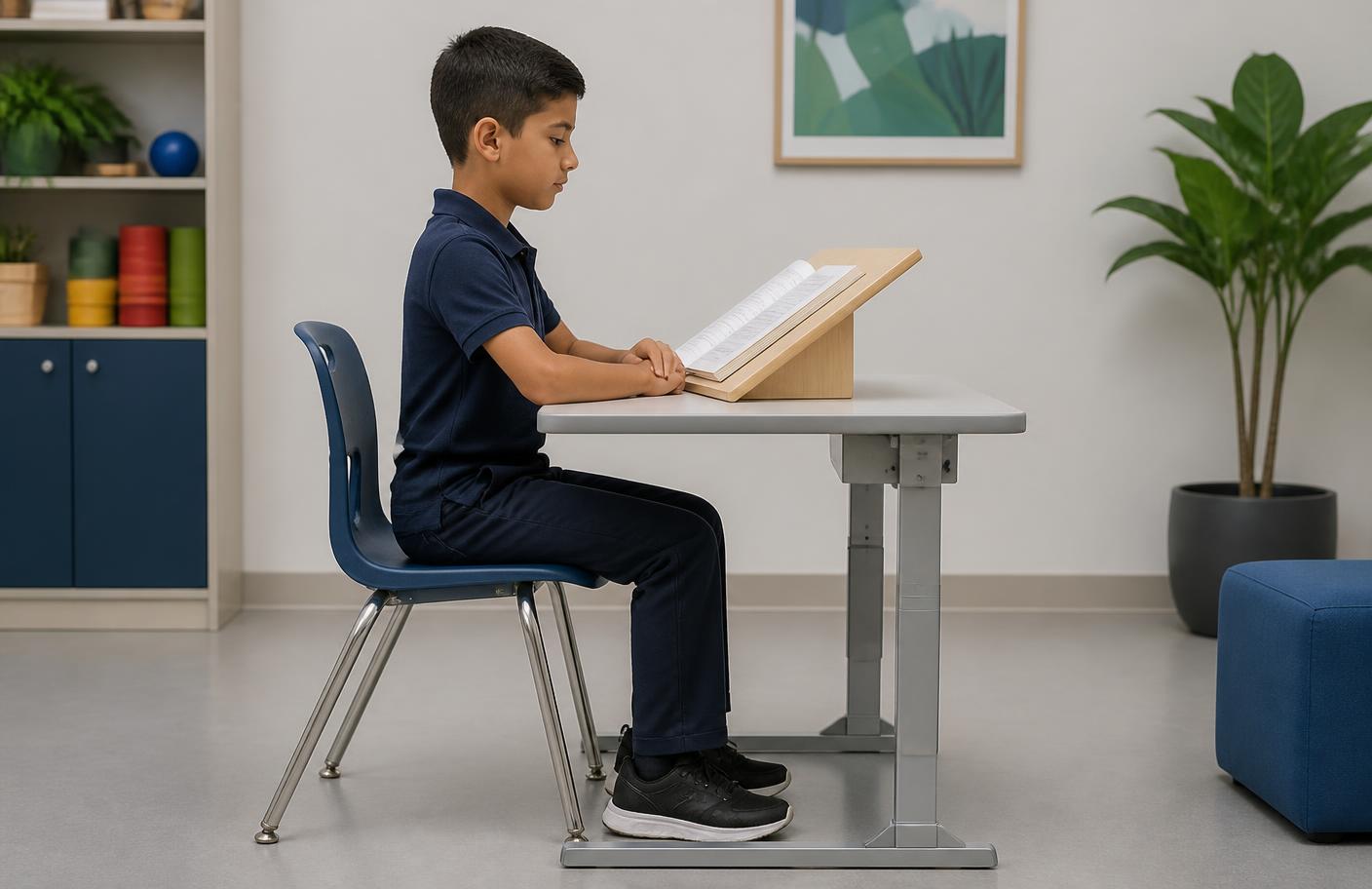
1.19 — Photo — working distance and posture at the desk

Visual

Import

Photo — working distance and posture at the desk

School-age student seated in neutral posture at a desk, feet flat, elbows at desk height, book on a slant board at about 40 cm

Reference posture

Feet flat, hips and knees near 90°, elbows at desk height, trunk upright and off the table.

≈40 cm at midline

A slant board holds the page at a consistent distance and angle; note any habitual 15–20 cm posture.

What to document

Head tilt, page rotation >30°, one eye closing, or distance shortening as the task lengthens.

Habitual working distance is free data. A head held at 15 cm, a persistent tilt, or a page turned 30°+ off midline all tell you something before a single probe is administered.
Vision in OT Practice
19 / 26

Say this

Describe what belongs here: Photo showing habitual working distance, head tilt, or lighting conditions..

My notes

1.20 — "Refer" does not mean "hands off"

Comparison

Scope rule

"Refer" does not mean "hands off"

Diagnosed and managed → OT addresses the functional limitation

  • Low acuity: magnification, enlarged print, working distance, seating, decluttered materials.
  • Reduced contrast: high-contrast materials, bold-line paper, reverse polarity, glare and lighting control.
  • Field loss: systematic scanning, anchoring, line tracking, intact-field placement, O&M collaboration.
  • These are Level 1 OT interventions — adaptation is intervention, not a holding pattern.

Undiagnosed, unverified, or changing → refer

  • No comprehensive exam on file, or correction not worn, outgrown, or unconfirmed.
  • A functional loss nobody has evaluated, or one that does not match the documented diagnosis.
  • Any red flag: new eye turn, new double vision, new field complaint, pain, sudden change.
  • Write the referral and put the modification in place the same day.
Finding
Diagnosed & managed → OT addresses
New / undiagnosed / changing → refer
Reduced acuity
Magnify (optical, electronic, or digital), enlarge print, increase working-distance control, reduce visual clutter, seat for viewing angle.
No comprehensive eye exam on file, correction not worn or outgrown, or a new drop in near/distance performance.
Reduced contrast sensitivity
High-contrast materials, bold line paper, dark-on-light or reverse-polarity screens, glare and lighting control, edge marking on stairs and thresholds.
Contrast difficulty never evaluated, or a functional loss that is new, worsening, or does not match the documented diagnosis.
Field loss
Teach systematic scanning, anchoring, and line-tracking; position materials and seating into the intact field; organize the workspace; travel-safety routines with the O&M specialist.
Field loss suspected but never documented, or new field complaints, bumping, or missed content on one side.
Ocular alignment, oculomotor, accommodation
Grade the visual demand of the occupation, build near-point stamina, chunk and space text, schedule visual breaks.
New eye turn, new double vision, headaches or pain with near work, or no eye care follow-up in place.

OT addresses diagnosed, medically managed limitations. A new or undiagnosed finding is a referral — the diagnosis has to come first before we treat that finding as a known visual limitation.

The standing rule: OT addresses the functional limitation only when the ocular condition is already diagnosed and medically managed. If the finding is new, undiagnosed, unclear, or changing, the appropriate OT action is referral.
Vision in OT Practice
20 / 26

Say this

Contrast the two columns: Diagnosed and managed → OT addresses the functional limitation versus Undiagnosed, unverified, or changing → refer.

Diagnosed and managed → OT addresses the functional limitation:

• Low acuity: magnification, enlarged print, working distance, seating, decluttered materials.

My notes
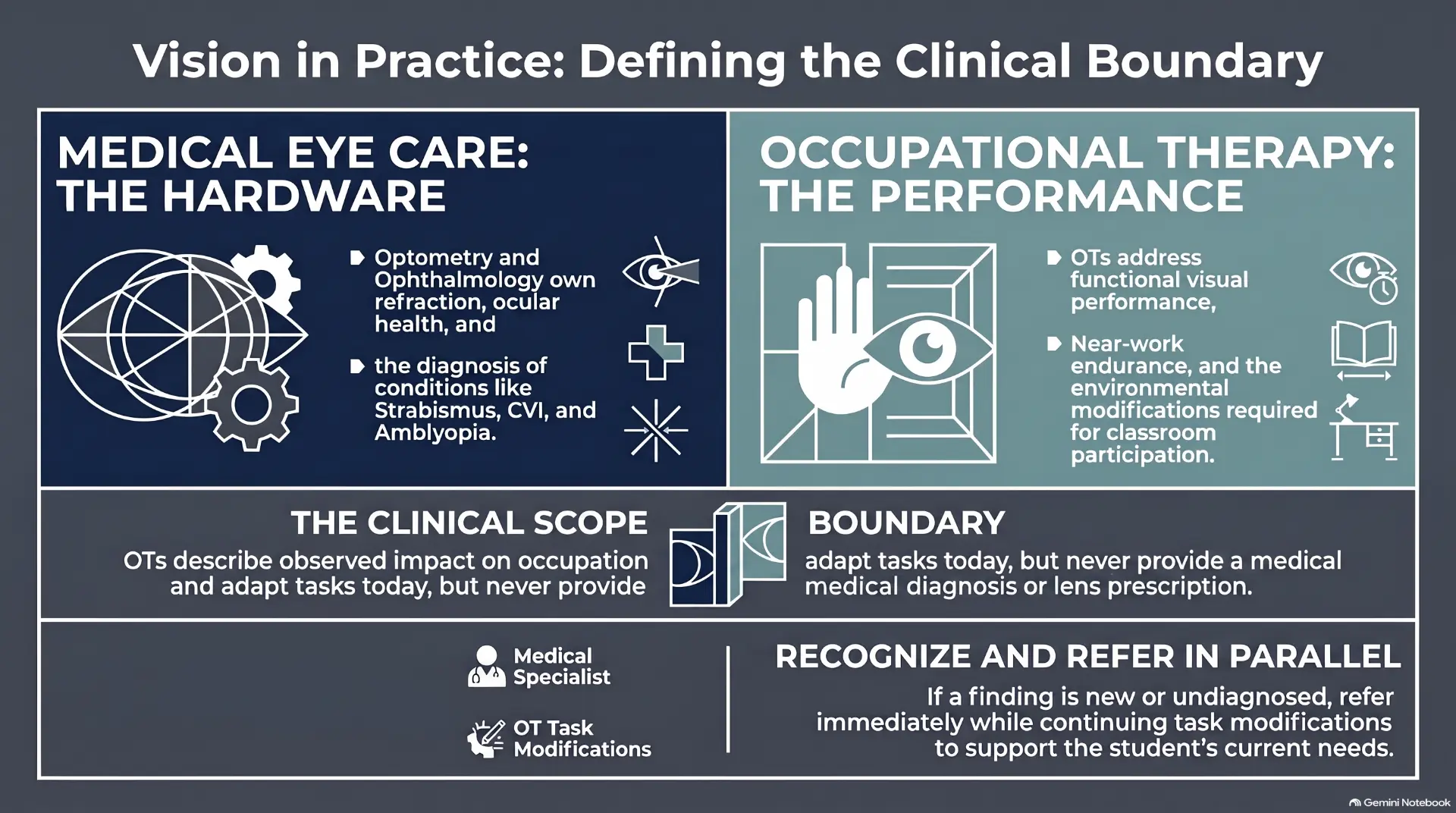
1.21 — Two lanes, one student

Visual

Scope

Two lanes, one student

Medical eye care owns diagnosis and the optical correction; OT owns performance inside real occupations. The referral and the task modification run in parallel, on the same day.

Medical eye care owns diagnosis and the optical correction; OT owns performance inside real occupations. The referral and the task modification run in parallel, on the same day.

Vision in OT Practice
21 / 26

Say this

Talk over the visual: "Two lanes, one student."

Say the caption in your own words: Medical eye care owns diagnosis and the optical correction; OT owns performance inside real occupations. The referral and the task modification run in parallel, on the same day.

My notes

1.22 — The brain's two visual highways

Video

Lecture

The brain's two visual highways

Vision in OT Practice
22 / 26

Say this

Set up the clip in one sentence, play it, then debrief with "what did you notice?"

My notes

1.23 — So what? Scope is what keeps the student moving

So what?

So what?

So what? Scope is what keeps the student moving

If you stop treating while you wait on an eye-care report, the student loses weeks of instruction for a decision you were never going to make.

Diagnosis belongs to eye care; occupational performance under a known visual condition belongs to OT. Those two lines run in parallel, not in sequence.

What you do with it

  • Write performance language: what the student did, at what distance, for how long.
  • Send the referral the same week you observe the sign — do not wait for the next IEP date.
  • Keep the intervention plan running while the referral is out.

Watch for

A report that names a diagnosis you did not make — that is the sentence to rewrite before it goes in the file.

Vision in OT Practice
23 / 26

Say this

Land the "so what": If you stop treating while you wait on an eye-care report, the student loses weeks of instruction for a decision you were never going to make.

Explain the mechanism plainly: Diagnosis belongs to eye care; occupational performance under a known visual condition belongs to OT. Those two lines run in parallel, not in sequence.

Then give them the moves — say each one as something they can do Monday:

My notes

1.24 — Two-minute case: the sentence you can defend

Mini case

Two-minute case

Two-minute case: the sentence you can defend

A Grade 2 teacher tells you a student "definitely has convergence insufficiency — she sees double when she reads." Nothing in the file supports a diagnosis and there is no eye-care report.

What do you write, and what do you do first?

Vision in OT Practice
24 / 26

Say this

Two-minute case. Read it aloud:

A Grade 2 teacher tells you a student "definitely has convergence insufficiency — she sees double when she reads." Nothing in the file supports a diagnosis and there is no eye-care report.

Put the question to them: "What do you write, and what do you do first?" Give 60 seconds, no talking.

My notes

1.25 — Reflect and share

Reflection

Reflect and share

Reflect and share

Recall one referral that arrived with a visual complaint. Which part of it did you own as OT, and which part needed eye care?

THINKPROCESSSHARE
  • · Name the occupation that was breaking down.
  • · Name the one sentence you would send to the family today.
Vision in OT Practice
25 / 26

Say this

Reflection prompt: "Recall one referral that arrived with a visual complaint. Which part of it did you own as OT, and which part needed eye care?"

Cues:

• Name the occupation that was breaking down.

My notes

1.26 — Knowledge check — scope

Self-check

Knowledge check

Knowledge check — scope

A student works at 15 cm from the page, squints during board copy, and reports headaches. Which statement belongs in your OT report?

Vision in OT Practice
26 / 26

Say this

Knowledge check: "A student works at 15 cm from the page, squints during board copy, and reports headaches. Which statement belongs in your OT report?"

Options:

• Student demonstrates convergence insufficiency affecting near work.

My notes