Presenter-side material. Each block shows the slide as the audience sees it, the talk track, and space for your own notes. Model answers appear here — do not hand this version to learners.
Module 2
2.1 — A Structured, Level-Based Visual Performance Framework for Clinical Reasoning
Transition
Module 2
A Structured, Level-Based Visual Performance Framework for Clinical Reasoning
0:22 – 0:52
Vision in OT Practice
1 / 36
Say this
Transition: "A Structured, Level-Based Visual Performance Framework for Clinical Reasoning."
My notes
2.2 — The Five-Level Visual Performance Framework
Title
Module 2
The Five-Level Visual Performance Framework
A developmental hierarchy that organizes observation, assessment, and intervention.
Vision in OT Practice
2 / 36
Say this
Open here. "The Five-Level Visual Performance Framework." A developmental hierarchy that organizes observation, assessment, and intervention.
Say why this section matters for their caseload, then advance.
My notes
2.3 — Where does your caseload live?
Poll
Poll
Where does your caseload live?
Which framework levels do your current goals most often target?
Select all that apply.
Vision in OT Practice
3 / 36
Say this
Ask the poll: "Which framework levels do your current goals most often target?"
Options:
• Level 1 — acuity and sensory access
My notes
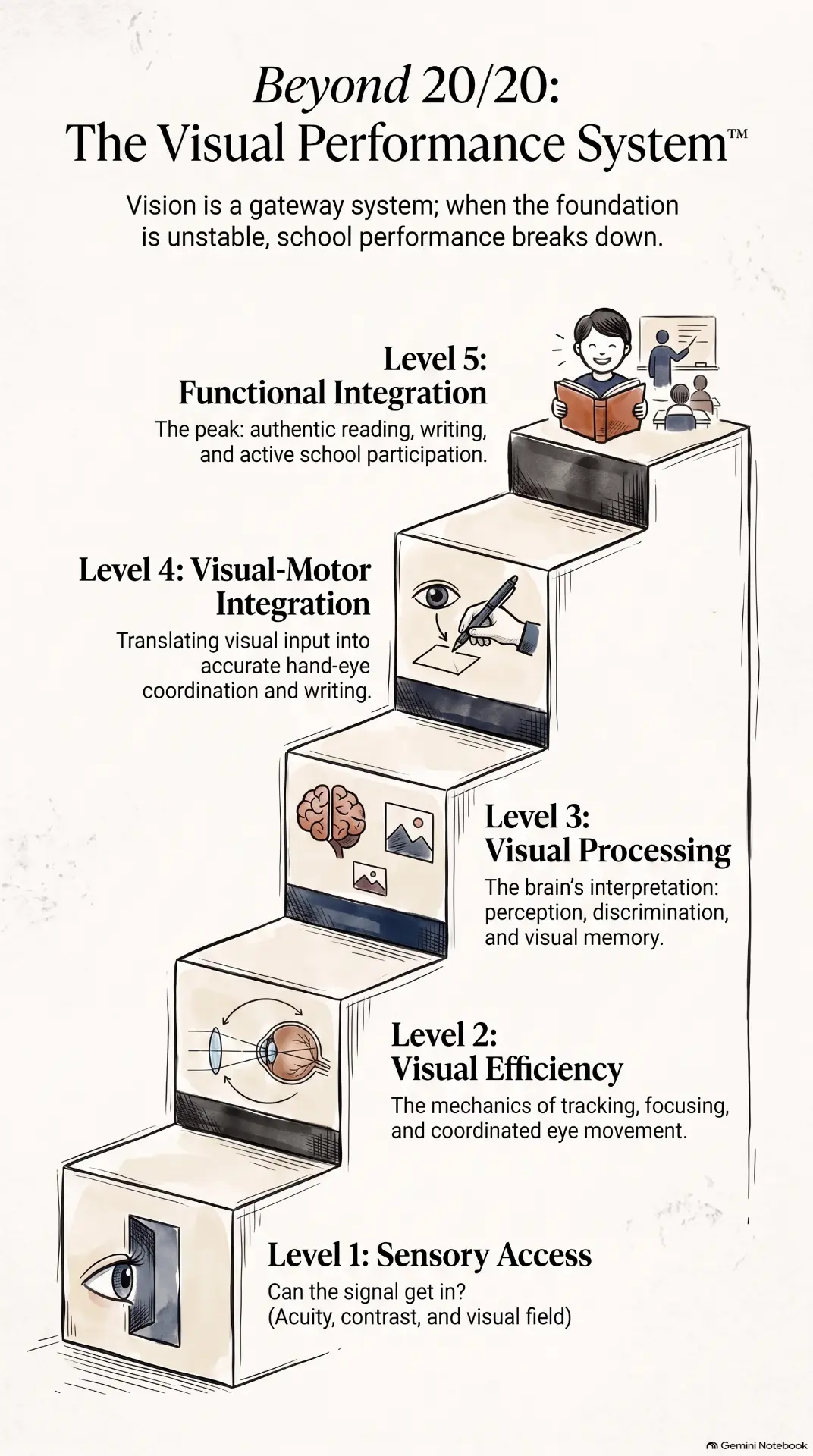
2.4 — Beyond 20/20 — the Visual Performance System™
Each level rests on the one below it. Level 1 is Visual Access — acuity, contrast, fields, lighting, magnification.
Vision in OT Practice
4 / 36
Say this
Talk over the visual: "Beyond 20/20 — the Visual Performance System™."
Say the caption in your own words: Level 1 Visual Access → Level 2 Visual Efficiency → Level 3 Visual Processing → Level 4 Visual-Motor Integration → Level 5 Functional Integration.
My notes
2.5 — Visual development milestones OTs should know
Teaching slide
Development
Visual development milestones OTs should know
Basic eye movement control (fixation, following) is commonly described as established by 2–3 months of age.
Coordinated eye movement control is commonly described as expected by about 2 years.
Complex visual-motor and visual-perceptual control is commonly described as continuing to mature until roughly 9 years — the age by which most school-readiness visual skills are expected to be reliable.
Visual acuity is commonly described as progressing rapidly in infancy and approaching adult levels well before school entry, while efficiency and processing skills mature much later.
Eye dominance (sighting preference) is commonly described as emerging and stabilizing in stages — around ages 4, 7, and 12 — with instability past those windows worth noting, not diagnosing.
Visual function matures in an ordered sequence. Knowing the expected sequence is what lets you call a finding delayed rather than merely low.
Ages above are commonly described developmental ranges from the pediatric vision and OT practice literature, not diagnostic cutoffs. A young child performing "at level" for age is not the same as an older student performing at that same level — always compare to developmental expectation.
Vision in OT Practice
5 / 36
Say this
Frame the slide: "Visual development milestones OTs should know."
Walk each point, one sentence each:
• Basic eye movement control (fixation, following) is commonly described as established by 2–3 months of age.
My notes
2.6 — Two visual pathways, two kinds of classroom breakdown
Comparison
Neuroanatomy
Two visual pathways, two kinds of classroom breakdown
Ventral / parvocellular ("what" pathway)
Carries fine detail, color, and form for object and letter identification
Classroom sign: confuses similar letters/numbers (b/d, 6/9)
Classroom sign: struggles to identify an object embedded in a busy picture
Carries motion, spatial location, and visual guidance of movement
Classroom sign: misjudges distance when reaching, stepping, or catching
Classroom sign: loses place moving between lines or from board to desk
Classroom sign: difficulty with maps, block designs, or spatial math layout
The retina sends two parallel “highways” to the LGN: the magnocellular tract handles motion, contrast, and spatial-action cues; the parvocellular tract handles detail, color, and object recognition. Both pass through the LGN, then split into the dorsal (where/how) and ventral (what) streams.
Two children can both "fail" the same task for opposite pathway reasons — this is why we probe function, not just score pass/fail.
Vision in OT Practice
6 / 36
Say this
Contrast the two columns: Ventral / parvocellular ("what" pathway) versus Dorsal / magnocellular ("where" pathway).
Ventral / parvocellular ("what" pathway):
• Carries fine detail, color, and form for object and letter identification
My notes
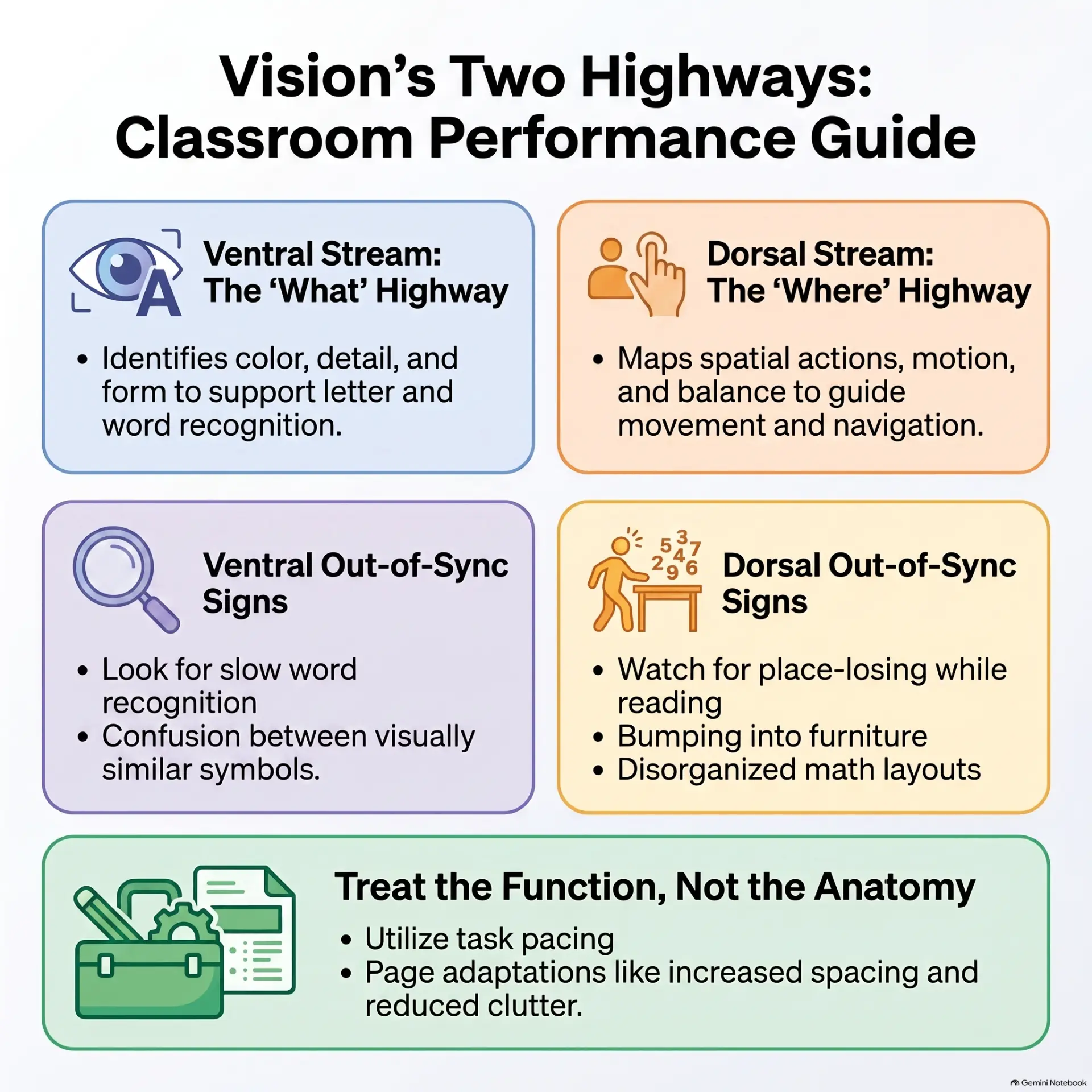
2.7 — Vision's two highways in the school day
Visual
Classroom translation
Vision's two highways in the school day
Ventral "what" signs versus dorsal "where" signs, side by side with the classroom behaviors each one produces.
Treat the function, not the anatomy — the stream explains the behavior; the intervention targets the task.
Vision in OT Practice
7 / 36
Say this
Talk over the visual: "Vision's two highways in the school day."
Say the caption in your own words: Ventral "what" signs versus dorsal "where" signs, side by side with the classroom behaviors each one produces.
My notes
2.8 — How the Five-Level Framework was built
Teaching slide
Where the framework comes from
How the Five-Level Framework was built
OTPF-4 names visual functions as client factors — the framework simply organizes them by the order they have to be stable in.
The developmental sequence of visual skill sets the floor order: sensory access, then efficiency, then processing, then visual-motor control, then occupation.
Dual-stream neuroscience explains why two students fail the same worksheet for opposite reasons, so each level carries its own probe.
School caseload data shaped the level definitions around what can actually be measured in a 30-minute session and written into an IEP.
The clinical rule holds at every floor: an unstable higher level is never trusted until the levels beneath it are confirmed stable.
OTPF-4 client factors
Visual functions named as body functions that shape occupational performance.
Visual development sequence
Fixation and following, then efficiency, then perception, then visual-motor control.
Dual-stream neuroscience
Ventral "what" and dorsal "where" pathways predict two different classroom breakdowns.
School-based caseload data
Referral patterns, work samples, and re-probe data from school OT practice.
The five levels exist to make one decision repeatable: identify the lowest unstable floor, stabilize it, and keep the outcome measured in the occupation.
The Five-Level Visual Performance Framework is organized from OTPF-4 client-factor language, the developmental sequence of visual skill, dual-stream visual neuroscience, and school-based caseload data.
Five named floors, each with its own assessment logic, intervention style, and documentation language.
Vision in OT Practice
8 / 36
Say this
Frame the slide: "How the Five-Level Framework was built."
Walk each point, one sentence each:
• OTPF-4 names visual functions as client factors — the framework simply organizes them by the order they have to be stable in.
My notes
2.9 — One example per level
Visual
Worked examples
One example per level
Level 1 · Access
You seeHolds the packet 10 cm from the face; misses every item on the faded copy.You probeNear acuity and contrast trial at the desk.You doHigh-contrast original, 16 pt, glare control; eye-exam referral if undiagnosed.
Level 2 · Efficiency
You seeLoses place three times per paragraph; accurate until minute 8, then falls apart.You probeTimed passage with line-loss count, near–far transitions.You doGraded scanning in real class text; fade finger → card → typoscope.
Level 3 · Processing
You seeCannot find the item on a crowded page; b/d confusion past the developmental window.You probeSame target on a loaded vs. de-loaded page, timed.You doCut visual load, teach a narratable search pattern, preview the page.
Level 4 · Visual-motor
You seeLegible when traced, drifting and uneven when copied from the board.You probeTrace vs. copy vs. dictation on the same sentence.You doShrinking model, part-to-whole, spatial scaffolds; reduce copy volume.
Level 5 · Functional
You seeReads 4 minutes before quitting; writes far below what he can say aloud.You probeThe classroom occupation itself, timed and scored.You doGoal in minutes, accuracy, and output; intervene on the unstable floor beneath it.
One worked example per level — what you see, the probe that confirms it, and the OT move that follows.
What you see, the probe that confirms it, and the OT move that follows — for all five levels.
Vision in OT Practice
9 / 36
Say this
Talk over the visual: "One example per level."
Say the caption in your own words: What you see, the probe that confirms it, and the OT move that follows — for all five levels.
My notes
2.10 — Five levels, bottom to top
Five-Level Framework
The ladder
Five levels, bottom to top
1
Visual Acuity & Sensory Foundation
Can the visual signal get in clearly enough to use?
2
Visual Efficiency
Fixation, pursuits, saccades, binocular comfort, near endurance.
3
Visual Processing
Discrimination, memory, closure, figure-ground, form constancy, spatial relations.
4
Visual-Motor Integration
Translating what is seen into graded, accurate motor output.
5
Functional Integration
Reading, writing, and task performance under real classroom demand.
Vision in OT Practice
10 / 36
Say this
Run the five levels bottom-up.
Name each level, then say which one you assess first and why.
My notes
2.11 — What it looks like — and what OT does
Comparison
Level 1 · Visual Access
What it looks like — and what OT does
Functional signs
Print held very close or pushed away; head tilt
Fails photocopied/low-contrast packets, fine on crisp ones
Performance drops in window glare or late in the day
Misses curb edges, thresholds, food on the plate
OT direction — adapt and refer
Raise contrast; enlarge by task, not globally
Kill glare; control clutter and spacing
Set working distance where performance is best
Write the eye-exam referral in parallel, not after
Never build skill-training goals on an unstable Level 1.
Vision in OT Practice
11 / 36
Say this
Contrast the two columns: Functional signs versus OT direction — adapt and refer.
Functional signs:
• Print held very close or pushed away; head tilt
My notes
2.12 — Access, before and after
Visual
Level 1 in the real work
Access, before and after
What the student was handed
3rd-generation photocopy, 11 pt, glossy paper near a window. Reads 4 of 12 items in 5 minutes.
Same content, access fixed
Clean black-on-cream original, 16 pt, matte paper, glare controlled. Reads 11 of 12 items in the same 5 minutes.
Nothing about the student changed between these two panels. If a level-1 change produces the gain, the finding is access — not processing, and not motivation.
Level 1 · Access — the same worksheet at faded photocopy contrast and at full contrast with larger print. Trial the condition, record the one that works, and write it into accommodations.
The same worksheet at photocopy contrast and at full contrast with larger print — the gain came from the page, not the student.
Vision in OT Practice
12 / 36
Say this
Talk over the visual: "Access, before and after."
Say the caption in your own words: The same worksheet at photocopy contrast and at full contrast with larger print — the gain came from the page, not the student.
My notes
2.13 — What it looks like — and what OT does
Comparison
Level 2 · Visual efficiency
What it looks like — and what OT does
Functional signs
Loses place, re-reads, finger-tracks past expected age
Accurate early, degrades by minute 8–10
Blur, doubling, headache, "words move" after near work
Reads as inattention in the last block of the day
OT direction — remediate + support
Graded scanning and cancellation on real class text
Near–far transitions tied to board-to-desk copying
Fade support: finger → card → typoscope → none
Keep a compensatory tool while stamina is built
Grade by dosage — same task, longer, less support, more clutter.
Vision in OT Practice
13 / 36
Say this
Contrast the two columns: Functional signs versus OT direction — remediate + support.
Functional signs:
• Loses place, re-reads, finger-tracks past expected age
My notes
2.14 — Line loss and the stamina curve
Visual
Level 2 in the real work
Line loss and the stamina curve
Observed scan path
Red points mark a re-read, a skipped line, and a lost return sweep in a 2-minute passage.
Accuracy over time on task
Accurate at the start, degrading past minute 8 — a stamina signature, not a skill the student never had.
Level 2 · Visual efficiency — line loss on a timed passage and the accuracy decay curve that separates an efficiency problem from an attention problem.
Place-keeping errors across a 2-minute passage, and accuracy decaying past minute 8 — an efficiency signature, not inattention.
Vision in OT Practice
14 / 36
Say this
Talk over the visual: "Line loss and the stamina curve."
Say the caption in your own words: Place-keeping errors across a 2-minute passage, and accuracy decaying past minute 8 — an efficiency signature, not inattention.
My notes
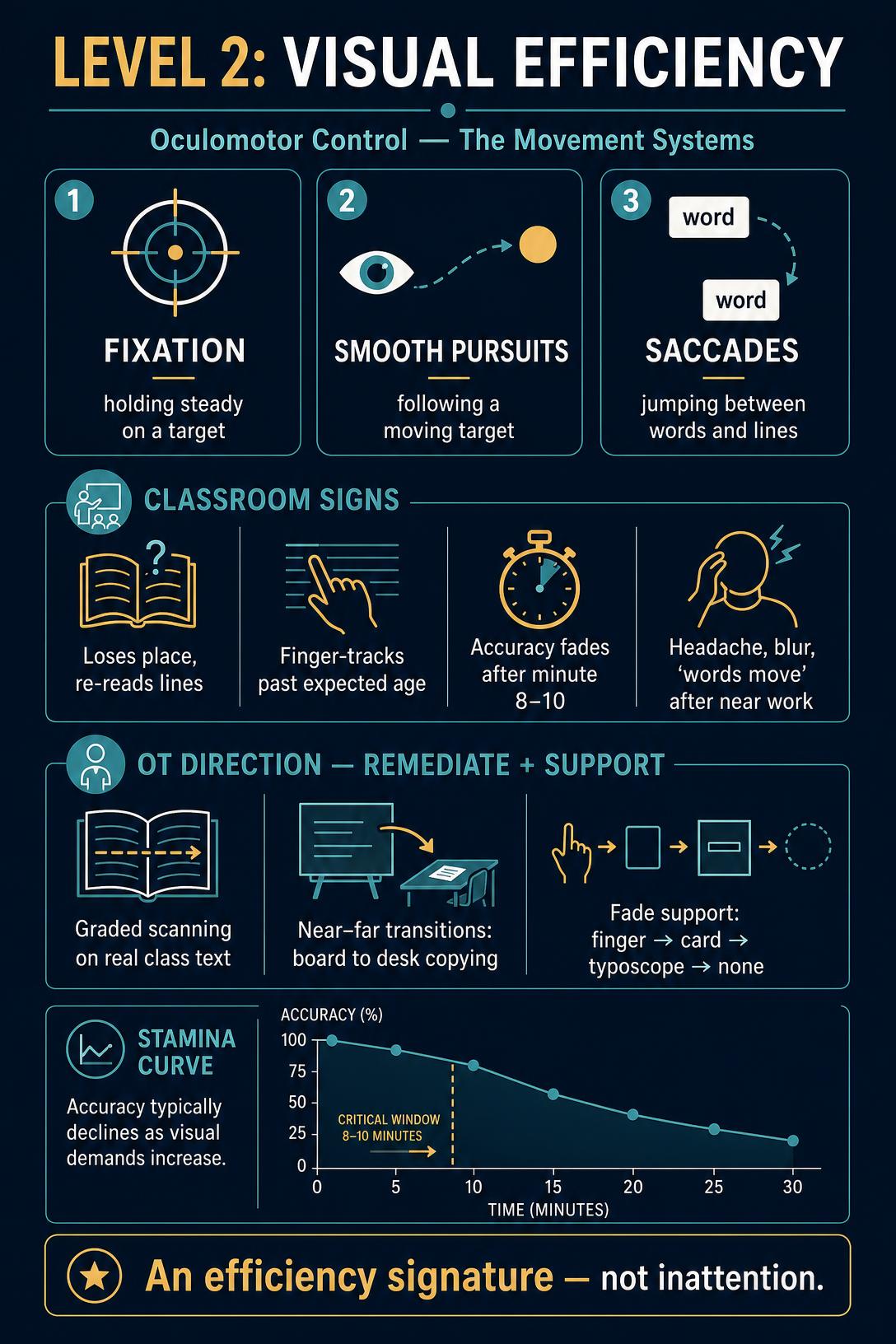
2.15 — Oculomotor control — the movement systems
Visual
Level 2 · Visual efficiency
Oculomotor control — the movement systems
Fixation, smooth pursuits, and saccades carry reading and copying. When they fatigue, accuracy decays on a predictable curve — the classroom signs and the OT directions, side by side.
An efficiency signature — not inattention.
Vision in OT Practice
15 / 36
Say this
Talk over the visual: "Oculomotor control — the movement systems."
Say the caption in your own words: Fixation, smooth pursuits, and saccades carry reading and copying. When they fatigue, accuracy decays on a predictable curve — the classroom signs and the OT directions, side by side.
My notes
2.16 — What it looks like — and what OT does
Comparison
Level 3 · Visual processing
What it looks like — and what OT does
Functional signs
Cannot find the item on a busy page or crowded hook rack
b/d/p/q confusion past the developmental window
Many glances per copied word; model does not hold
Reverses place value; struggles with maps and diagrams
Outcome = independent strategy, not worksheet score
Vision in OT Practice
16 / 36
Say this
Contrast the two columns: Functional signs versus OT direction — load, then strategy.
Functional signs:
• Cannot find the item on a busy page or crowded hook rack
My notes
2.17 — Visual load on the page
Visual
Level 3 in the real work
Visual load on the page
High visual load
Target square is present. Median search time 41 s, two prompts required.
Load reduced, strategy taught
Boxed layout plus a narrated left-to-right sweep: 7 s, no prompts, strategy stated aloud.
Level 3 · Visual processing — the same target item on a crowded page and on a de-loaded page. Level 3 work is about search strategy and visual load, not worksheet score.
Same target item on a crowded page and a de-loaded page with a taught search pattern: 41 seconds with prompts vs. 7 seconds without.
Vision in OT Practice
17 / 36
Say this
Talk over the visual: "Visual load on the page."
Say the caption in your own words: Same target item on a crowded page and a de-loaded page with a taught search pattern: 41 seconds with prompts vs. 7 seconds without.
My notes
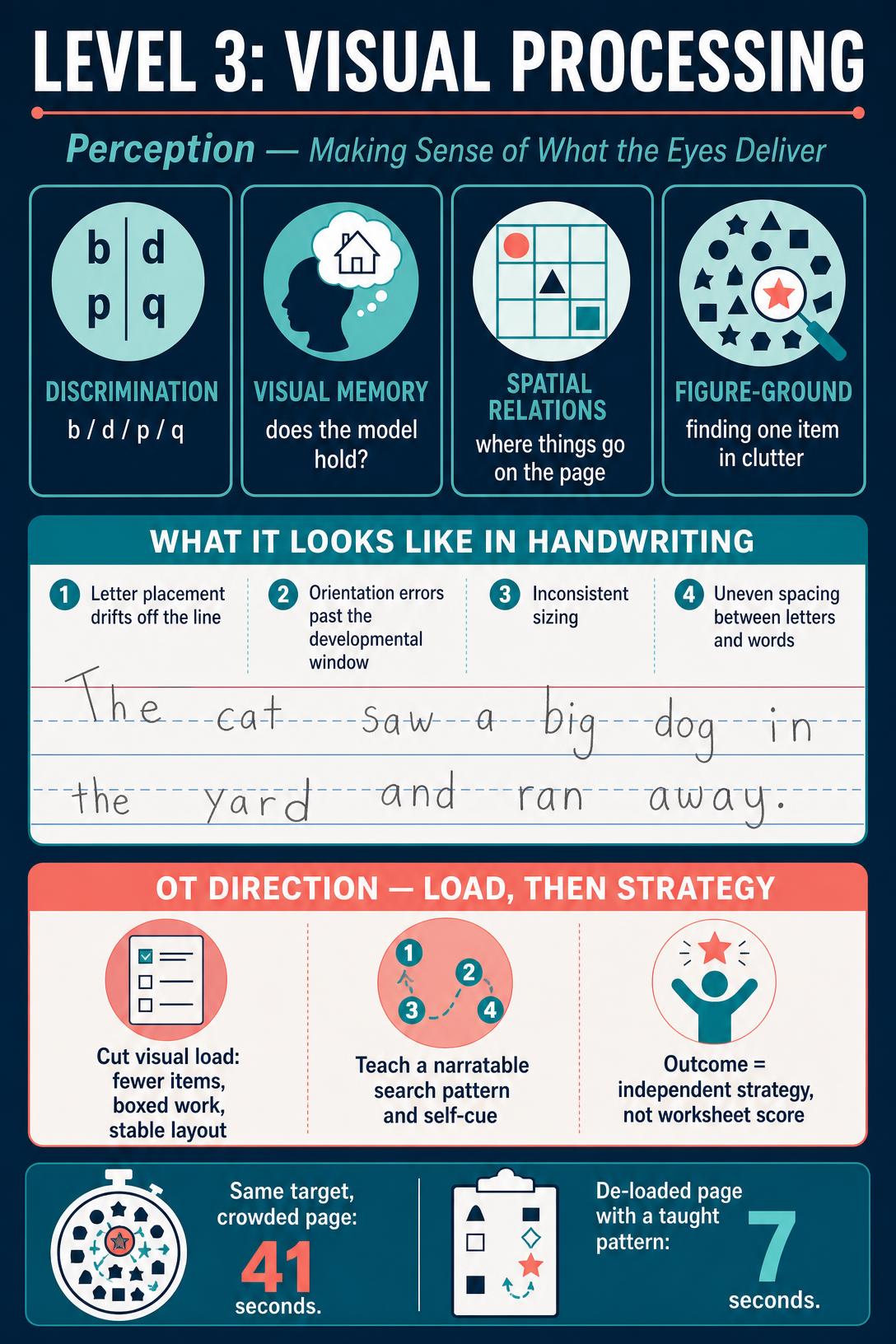
2.18 — Perception — and what it looks like in handwriting
Visual
Level 3 · Visual processing
Perception — and what it looks like in handwriting
Discrimination, visual memory, spatial relations, and figure-ground — and how each one surfaces on the page as placement, orientation, sizing, and spacing errors.
Load, then strategy: the outcome is an independent strategy, not a worksheet score.
Vision in OT Practice
18 / 36
Say this
Talk over the visual: "Perception — and what it looks like in handwriting."
Say the caption in your own words: Discrimination, visual memory, spatial relations, and figure-ground — and how each one surfaces on the page as placement, orientation, sizing, and spacing errors.
My notes
2.19 — What it looks like — and what OT does
Comparison
Level 4 · Visual-motor integration
What it looks like — and what OT does
Functional signs
Legible in isolation, degrades under speed or volume
Pair with access: reduced copy volume, notes, tech
Vision in OT Practice
19 / 36
Say this
Contrast the two columns: Functional signs versus OT direction — isolate, then treat.
Functional signs:
• Legible in isolation, degrades under speed or volume
My notes
2.20 — Trace vs. copy vs. dictation
Visual
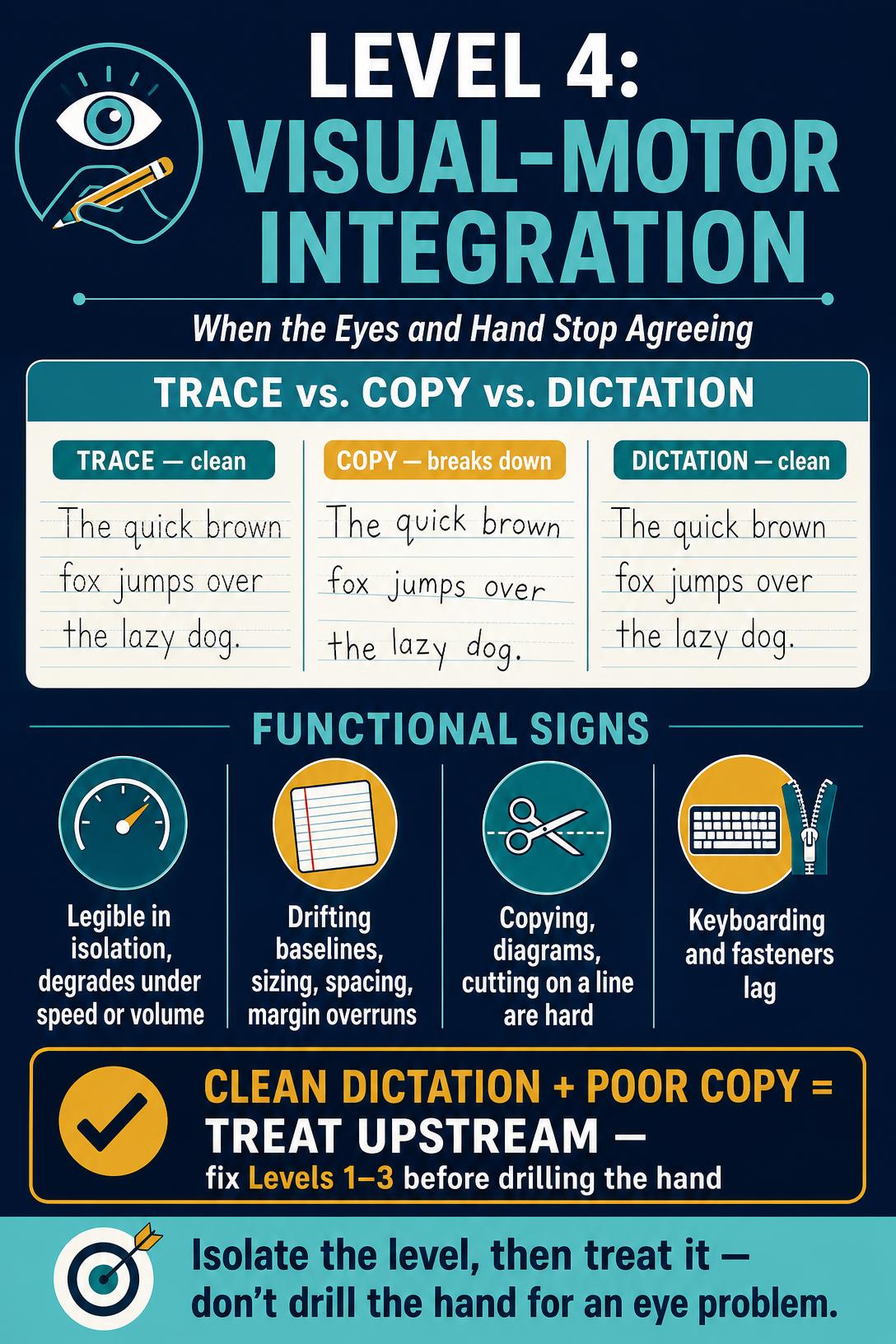
Level 4 in the real work
Trace vs. copy vs. dictation
Traced
Legible, even sizing, on the line.
Copied from a model
Baseline drifts, spacing collapses, letters resize — the copy demand is what broke it.
From dictation
Clean dictation with a poor copy points upstream — treat Levels 1–3 before drilling the hand.
Level 4 · Visual-motor integration — the same sentence traced, copied from a model, and written from dictation. Comparing the three tells you whether the breakdown is motor output or an upstream level.
Three writing samples of the same sentence. Clean dictation with a poor copy points upstream — treat Levels 1–3 before drilling the hand.
Vision in OT Practice
20 / 36
Say this
Talk over the visual: "Trace vs. copy vs. dictation."
Say the caption in your own words: Three writing samples of the same sentence. Clean dictation with a poor copy points upstream — treat Levels 1–3 before drilling the hand.
My notes
2.21 — When the eyes and hand stop agreeing
Visual
Level 4 · Visual-motor integration
When the eyes and hand stop agreeing
The trace–copy–dictation comparison at a glance, with the functional signs and the clinical rule that keeps you from drilling the hand for an eye problem.
Talk over the visual: "When the eyes and hand stop agreeing."
Say the caption in your own words: The trace–copy–dictation comparison at a glance, with the functional signs and the clinical rule that keeps you from drilling the hand for an eye problem.
My notes
2.22 — Where the goal lives
Comparison
Level 5 · Functional integration
Where the goal lives
Functional signs
Reading rate and endurance below expectation
Written output far below spoken capability
Incomplete work, avoidance, late-period fatigue
Multi-step visual tasks fail in class and community
Document the chain: occupation → level → dose → probe
Re-probe with the identical baseline task
Condition
During grade-level copy tasks from the board
→ Occupation-based context
Learner
the student will
Behavior
accurately copy 5 sentences with correct spacing and letter placement
→ Level 4 — Visual-Motor Integration
Criterion
in 4 of 5 opportunities across 3 consecutive sessions
→ Measurable, defensible
Support
with slant board and visually-simplified target as needed
→ Adapt & Refer language (Level 1)
Anatomy of an OT-authored IEP goal that survives Medicaid audit and speaks to the Five-Level Framework.
Vision in OT Practice
22 / 36
Say this
Contrast the two columns: Functional signs versus OT direction — measure the occupation.
Functional signs:
• Reading rate and endurance below expectation
My notes
2.23 — Where the goal line sits
Visual
Level 5 in the real work
Where the goal line sits
Sustained silent reading
baseline 4 min
9 wks 14 min
Sentences copied from board
baseline 2 of 5
9 wks 5 of 5
Written words in 10 min
baseline 21 words
9 wks 58 words
Worksheets finished in class
baseline 30 %
9 wks 85 %
Re-probe with the identical baseline task. Change the task and the gain is no longer measurable.
Level 5 · Functional integration — the goal line always sits in the occupation. Intervention may target Level 2 or 4, but the probe that decides progress is the classroom task itself.
Baseline and 9-week re-probe on the occupations themselves: sustained reading minutes, sentences copied, written output, and work completion.
Vision in OT Practice
23 / 36
Say this
Talk over the visual: "Where the goal line sits."
Say the caption in your own words: Baseline and 9-week re-probe on the occupations themselves: sustained reading minutes, sentences copied, written output, and work completion.
My notes
2.24 — Two rules for choosing where to start
Teaching slide
Direction of travel
Two rules for choosing where to start
Bottom-up to stabilize: adapt or fix the lowest unstable floor first.
Top-down for meaning: pick the occupation, then find the floor holding it up.
Run both threads at once — remediation on the floor, compensation on the occupation.
If you cannot tie the session to the student's day, you picked the wrong level.
5
Efficient & durable
Performs accurately, at pace, and sustains across the school day.
4
Functional
Accurate under typical demand; fatigues only at the end of long tasks.
3
Inconsistent
Accuracy varies with load, time pressure, or visual clutter.
2
Emerging with support
Succeeds only with cueing, magnification, spacing, or reduced load.
1
Not observed
Skill not yet available under any tested condition.
The same ladder is used for every skill, so goals move a named skill up a named level. Write the level in present levels and the target level in the goal.
Vision in OT Practice
24 / 36
Say this
Frame the slide: "Two rules for choosing where to start."
Walk each point, one sentence each:
• Bottom-up to stabilize: adapt or fix the lowest unstable floor first.
My notes
2.25 — The Active OT Remediation Pathway
Visual
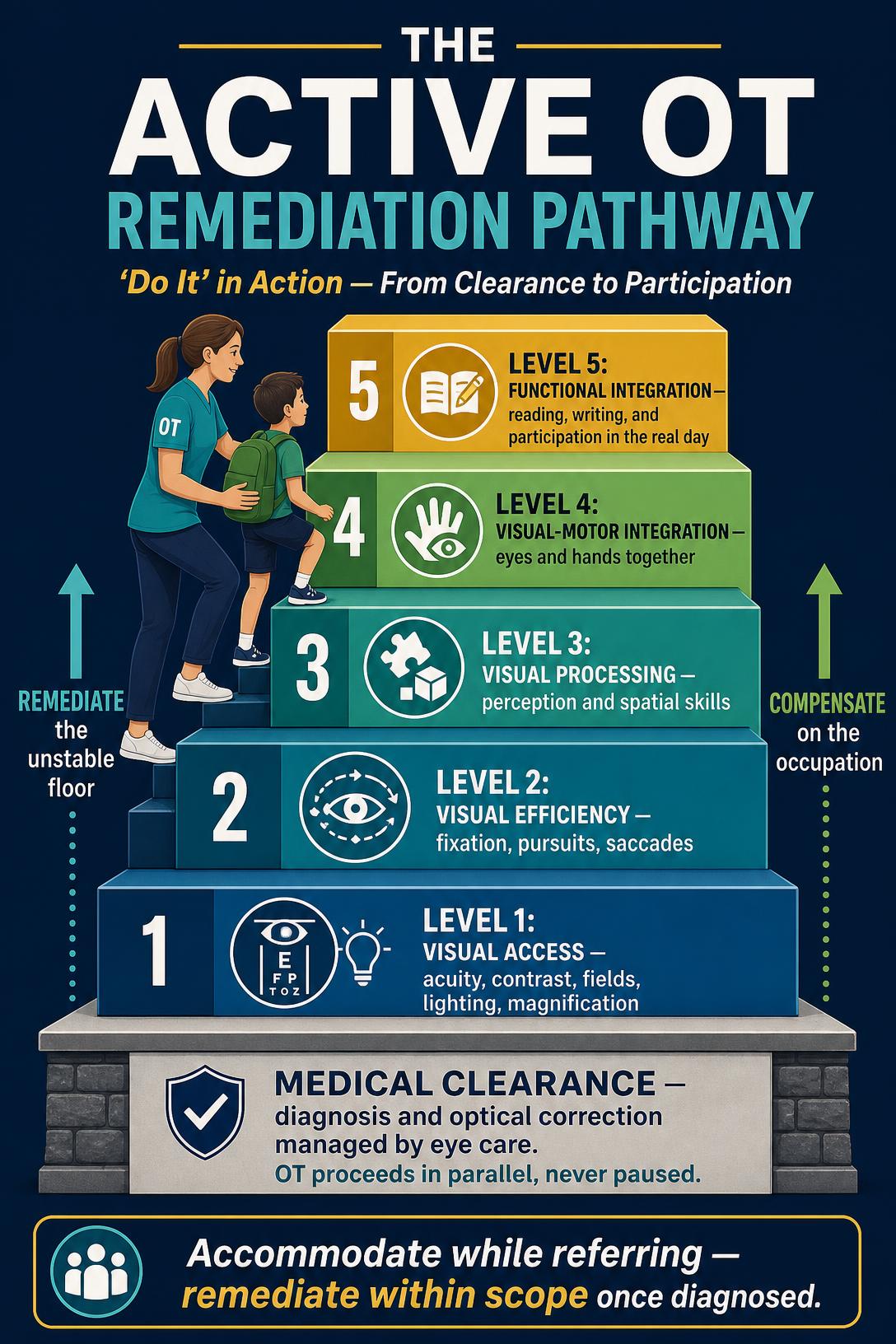
The pathway
The Active OT Remediation Pathway
Medical clearance is the floor; the five levels climb from Visual Access through Functional Integration. Remediate the unstable floor on one side, compensate on the occupation on the other.
Accommodate while referring — remediate within scope once diagnosed.
Vision in OT Practice
25 / 36
Say this
Talk over the visual: "The Active OT Remediation Pathway."
Say the caption in your own words: Medical clearance is the floor; the five levels climb from Visual Access through Functional Integration. Remediate the unstable floor on one side, compensate on the occupation on the other.
My notes
2.26 — The same four-part shape, every level
Teaching slide
Session design
The same four-part shape, every level
1 — Baseline probe: re-measure the same task before you treat.
2 — 6–10 min graded work on the unstable floor.
3 — 3–5 min of that skill inside the student's real classroom material.
4 — One-sentence hand-off to the teacher naming the support to keep.
Grade by dosage, not novelty. Change the activity and you lose your data.
Vision in OT Practice
26 / 36
Say this
Frame the slide: "The same four-part shape, every level."
Walk each point, one sentence each:
• 1 — Baseline probe: re-measure the same task before you treat.
My notes
2.27 — Levels 1–2 on Monday morning
Comparison
Intervention direction
Levels 1–2 on Monday morning
Level 1 — Access
Contrast and print-size trials, not drills
Record the best condition; paste it into accommodations
Glare control and setup taught as self-advocacy
Eye-exam referral sent the same day
Level 2 — Efficiency
Fixation hold → saccadic accuracy → pursuit path
Near–far transitions tied to board-to-desk copying
Timed re-probe of the passage you opened with
Fade support in writing: finger → card → typoscope → none
Vision in OT Practice
27 / 36
Say this
Contrast the two columns: Level 1 — Access versus Level 2 — Efficiency.
Level 1 — Access:
• Contrast and print-size trials, not drills
My notes
2.28 — Levels 3–5 on Monday morning
Comparison
Intervention direction
Levels 3–5 on Monday morning
Levels 3–4
Stress one processing skill inside a real page
Outcome = the strategy the student narrates unprompted
L4: trace vs. copy vs. dictate before you plan
Pair every remedial block with an access change
Level 5
End every session inside the occupation itself
Sustained reading minutes, full copy task, timed writing
This probe is the goal line — nothing else belongs there
Document occupation → level → dose → probe
Vision in OT Practice
28 / 36
Say this
Contrast the two columns: Levels 3–4 versus Level 5.
Levels 3–4:
• Stress one processing skill inside a real page
My notes
2.29 — What you already have, by level
Comparison
VML resources
What you already have, by level
Levels 1–2
L1: Fast Screener acuity/contrast; VPA ladders at 60 cm and 40 cm; printable cards in the Worksheet Print Hub
L1Contrast-enhanced single-symbol cardCan the signal get in?
L2Line-isolated tracking strip, 30 s trialsEfficiency under time
L3Figure-ground search on a dense pageProcessing under clutter
L4Copy-from-model grid with spacing cuesPerception → motor output
L5Timed board-to-paper copy in the classroomReal occupational demand
Every activity in the library is tagged to the level it actually loads. Tagging is what keeps intervention entering at the level where performance broke down instead of defaulting to worksheets.
Plus: free Vision Concern Quiz, Pre-K Quick Screen, teen/adult track, and concussion, CVI, and low-vision branches.
Vision in OT Practice
29 / 36
Say this
Contrast the two columns: Levels 1–2 versus Levels 3–5.
Levels 1–2:
• L1: Fast Screener acuity/contrast; VPA ladders at 60 cm and 40 cm; printable cards in the Worksheet Print Hub
My notes
2.30 — Module 2 video — the five-level visual performance structure
Video
Lecture
Module 2 video — the five-level visual performance structure
VIDEO SLOT
Level-by-level narration with functional examples.
Slides tab → set “url” to your YouTube/Vimeo/Loom embed link
Vision in OT Practice
30 / 36
Say this
Set up the clip in one sentence, play it, then debrief with "what did you notice?"
My notes
2.31 — Diagram — the five-level ladder
Visual
Import
Diagram — the five-level ladder
5
Efficient & durable
Performs accurately, at pace, and sustains across the school day.
4
Functional
Accurate under typical demand; fatigues only at the end of long tasks.
3
Inconsistent
Accuracy varies with load, time pressure, or visual clutter.
2
Emerging with support
Succeeds only with cueing, magnification, spacing, or reduced load.
1
Not observed
Skill not yet available under any tested condition.
The same ladder is used for every skill, so goals move a named skill up a named level. Write the level in present levels and the target level in the goal.
Vision in OT Practice
31 / 36
Say this
Describe what belongs here: Your own framework graphic, if you want it in place of the built-in ladder slide..
My notes
2.32 — Screenshot — level-tagged activity from the library
Visual
Import
Screenshot — level-tagged activity from the library
Activity library · filtered by level
L1Contrast-enhanced single-symbol cardCan the signal get in?
L2Line-isolated tracking strip, 30 s trialsEfficiency under time
L3Figure-ground search on a dense pageProcessing under clutter
L4Copy-from-model grid with spacing cuesPerception → motor output
L5Timed board-to-paper copy in the classroomReal occupational demand
Every activity in the library is tagged to the level it actually loads. Tagging is what keeps intervention entering at the level where performance broke down instead of defaulting to worksheets.
Vision in OT Practice
32 / 36
Say this
Describe what belongs here: Interactive activity or worksheet that demonstrates work at one specific level..
My notes
2.33 — So what? Levels stop you from treating the wrong thing
So what?
So what?
So what? Levels stop you from treating the wrong thing
Most "visual processing" referrals resolve one or two levels lower — the signal was not getting in, or the eyes were not staying on the work long enough to process anything.
The five levels are ordered by dependency: acuity and sensory input, efficiency, processing, visual-motor integration, functional integration.
What you do with it
Before you buy a processing program, confirm Level 1 and Level 2 are accounted for.
State the level you are targeting in the goal so the team can see the reasoning.
Re-check the lower level when progress stalls instead of adding more of the same activity.
Watch for
Fast gains once the lower level is addressed — that is confirmation you had the level wrong, not luck.
Vision in OT Practice
33 / 36
Say this
Land the "so what": Most "visual processing" referrals resolve one or two levels lower — the signal was not getting in, or the eyes were not staying on the work long enough to process anything.
Explain the mechanism plainly: The five levels are ordered by dependency: acuity and sensory input, efficiency, processing, visual-motor integration, functional integration.
Then give them the moves — say each one as something they can do Monday:
My notes
2.34 — Two-minute case: which level are you actually looking at?
Mini case
Two-minute case
Two-minute case: which level are you actually looking at?
A Grade 3 student reverses letters, loses his place, and rubs his eyes after five minutes of reading. The teacher asks for "visual perceptual therapy."
Which level do you investigate first, and what does that change on Monday?
Vision in OT Practice
34 / 36
Say this
Two-minute case. Read it aloud:
A Grade 3 student reverses letters, loses his place, and rubs his eyes after five minutes of reading. The teacher asks for "visual perceptual therapy."
Put the question to them: "Which level do you investigate first, and what does that change on Monday?" Give 60 seconds, no talking.
My notes
2.35 — Reflect and share
Reflection
Reflect and share
Reflect and share
Take one student. Which level is the lowest one showing a breakdown, and what observable behavior tells you that?
THINKPROCESSSHARE
· Start at the bottom of the ladder, not at the complaint.
Vision in OT Practice
35 / 36
Say this
Reflection prompt: "Take one student. Which level is the lowest one showing a breakdown, and what observable behavior tells you that?"
Cues:
• Start at the bottom of the ladder, not at the complaint.
My notes
2.36 — Knowledge check — the ladder
Self-check
Knowledge check
Knowledge check — the ladder
A student copies inaccurately from the board and loses his place mid-line. Where should intervention planning begin?
Self-check only — it does not affect your post-course quiz score.
Vision in OT Practice
36 / 36
Say this
Knowledge check: "A student copies inaccurately from the board and loses his place mid-line. Where should intervention planning begin?"
Options:
• Level 4, because the written output is inaccurate