1.1 — Welcome — while you get set up
WelcomeSay this
Housekeeping while people arrive.
Materials to have ready:
• Participation & Reflection Guide (printed or on screen)
My notes
Presenter study handout
3 contact hours · 0.3 AOTA CEUs · Module 1 · 22 slides
Presenter-side material. Each block shows the slide as the audience sees it, the talk track, and space for your own notes. Model answers appear here — do not hand this version to learners.
Say this
Housekeeping while people arrive.
Materials to have ready:
• Participation & Reflection Guide (printed or on screen)
My notes
Say this
Read the filed learning objectives verbatim — this is the AOTA-approved wording.
Objectives:
• Explain the developmental and anatomical basis of the visual system and articulate the occupational therapy practitioner's role in supporting visual function within the OT scope of practice.
My notes
Say this
Explain how the session runs.
Schedule:
• Six modules, 3.0 contact hours total
My notes
Say this
Transition: "Module 1."
My notes
Say this
Open here. "Why Visual Performance Matters." Vision is already on your caseload. The only question is whether it is named, measured, and treated.
Say why this section matters for their caseload, then advance.
My notes
Say this
Ask the poll: "When you see a visual concern in a student, how do you usually respond first?"
Options:
• I refer to the eye doctor and wait for results
My notes
Say this
Frame the slide: "You are already treating vision."
Walk each point, one sentence each:
• Handwriting, reading endurance, board copying, dressing, feeding, mobility, play, driving, work simulation — every one routes through vision.
My notes
Say this
Frame the slide: "Understand → assess → intervene."
Walk each point, one sentence each:
• Understanding is not optional: vision is a client factor and a performance skill inside every occupational performance evaluation you already do.
My notes
Say this
Contrast the two columns: Schools and clinics versus Universities and programs.
Schools and clinics:
• Schools: visual performance sits under reading, writing, accommodations, and state testing.
My notes
Say this
Frame the slide: "Vision is the dominant channel for learning."
Walk each point, one sentence each:
• Classroom occupations are visually loaded: reading, copying, board work, worksheets, and navigation all route through vision (framing statement, Visual Minds Learning — not a prevalence figure).
My notes
Say this
Frame the slide: "Why schools are required to respond."
Walk each point, one sentence each:
• IDEA covers school-age children whose qualifying condition adversely affects educational performance.
My notes
Say this
Contrast the two columns: Oculomotor and acuity versus Related development.
Oculomotor and acuity:
• Fixation and basic eye movements emerge by 2–3 months
My notes
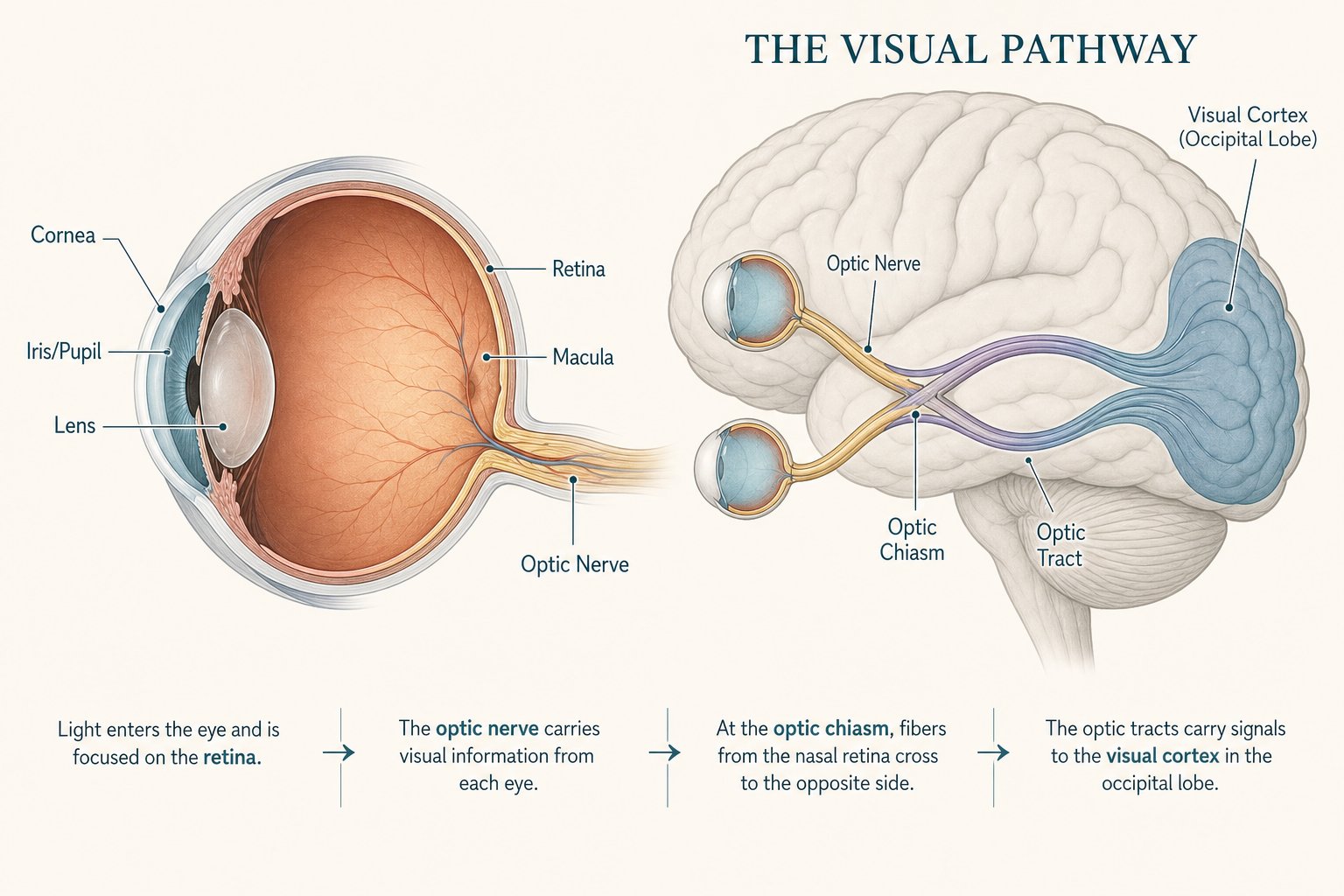
Say this
Talk over the visual: "Visual anatomy — the structures behind the function."
Say the caption in your own words: Cornea, lens, retina, optic nerve, chiasm, tracts, and visual cortex — the hardware that visual performance depends on.
My notes
Say this
Frame the slide: "Where OT sits relative to the eye care team."
Walk each point, one sentence each:
• Optometry and ophthalmology own refraction, ocular health, and diagnosis.
My notes
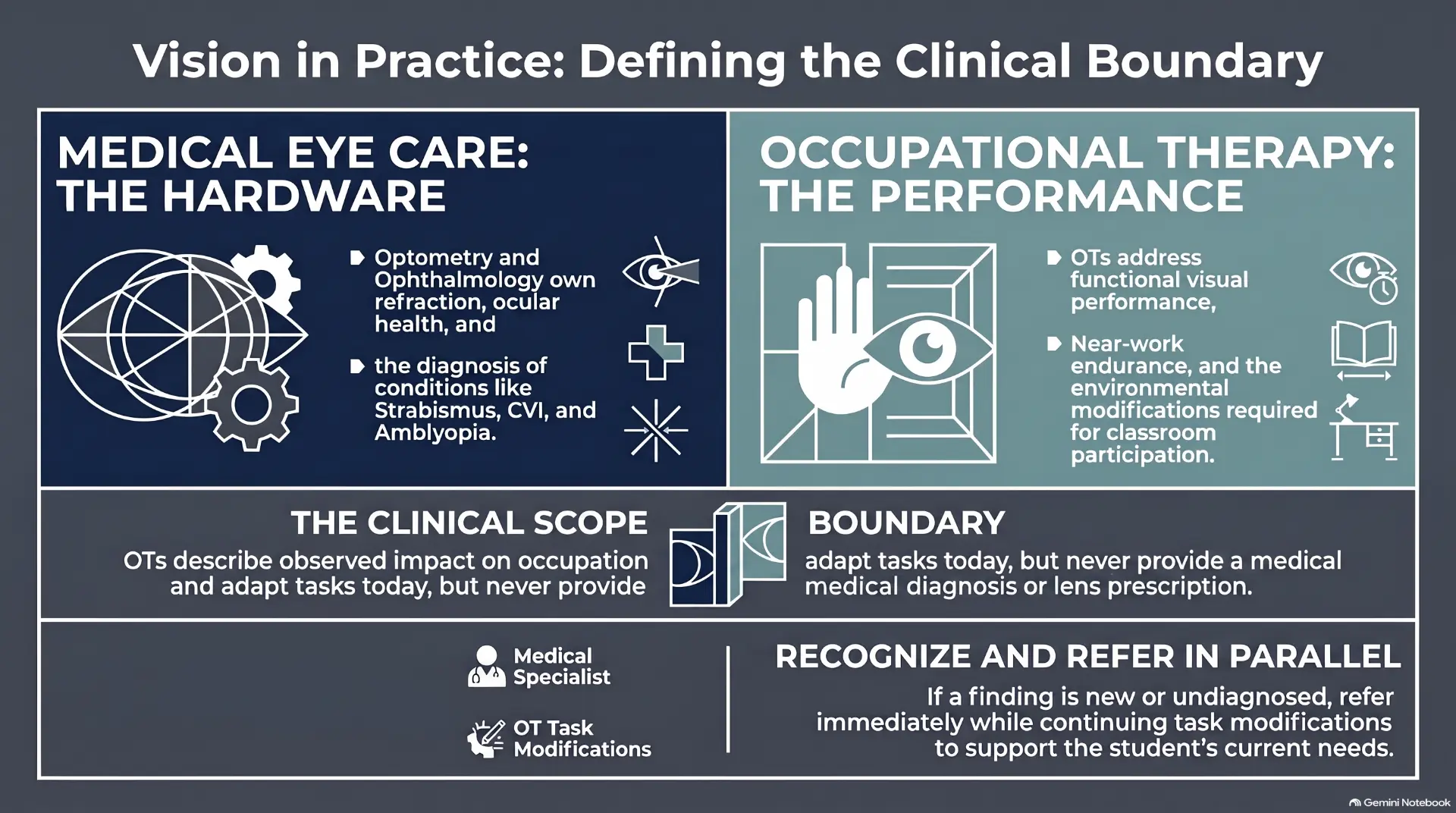
Say this
Talk over the visual: "Two lanes, one student."
Say the caption in your own words: Medical eye care owns diagnosis and the optical correction; OT owns performance inside real occupations. The referral and the task modification run in parallel, on the same day.
My notes
Say this
Set up the clip in one sentence, play it, then debrief with "what did you notice?"
My notes
Say this
Read the scenario aloud, slowly:
A kindergarten teacher reports that a student "just isn't paying attention" during calendar time and often bumps into classmates during transitions. The student passed a school vision screening six months ago.
Then put these questions to the room:
My notes
Say this
Describe what belongs here: The referral question, the occupation it interrupts, and who else is already involved..
My notes
Say this
Land the "so what": A distance acuity screening answers one question at one distance. Nearly every school task the student is failing happens at 40 cm, under time pressure, with both eyes working together.
Explain the mechanism plainly: Screenings are built to catch reduced acuity, not efficiency, endurance, or integration.
Then give them the moves — say each one as something they can do Monday:
My notes
Say this
Two-minute case. Read it aloud:
A teacher forwards a screening result of 20/20 in each eye and says "so it is not her vision."
Put the question to them: "What is your one-sentence reply, and what do you do next?" Give 60 seconds, no talking.
My notes
Say this
Reflection prompt: "Think about a referral you received that mentioned a visual concern. What did you own as OT, and what did you defer to eye care?"
Cues:
• Name one observation you could write in occupational terms.
My notes
Say this
Knowledge check: "A first-grade student holds books at 10 cm and squints. The school vision screen was passed. Which statement is most appropriate for your OT note?"
Options:
• Student has convergence insufficiency and needs vision therapy.
My notes