Back to CEU courses

Presenter study handout

Why Visual Performance Matters: Foundations for Occupational Therapy Practice

3 contact hours · 0.3 AOTA CEUs · Module 1 · 22 slides

Presenter-side material. Each block shows the slide as the audience sees it, the talk track, and space for your own notes. Model answers appear here — do not hand this version to learners.

Module 1

1.1 — Welcome — while you get set up

Welcome

Welcome

Welcome — while you get set up

Why Visual Performance Matters: Foundations for Occupational Therapy Practice · Free · 3.0 contact hours · 0.3 AOTA CEUs

Have ready

  • Participation & Reflection Guide (printed or on screen)
  • One client or student to think with for the whole session
  • Pen and paper, or the reflection boxes in this player
  • One referral or eye care report you have received

Before we begin

  • Modules are self-paced; your place is saved as you go.
  • Polls, reflections, and self-checks are participation supports — they do not affect your quiz score.
  • Take a stretch break between modules; sustained near work is the topic, not the goal.
  • The post-course exam and evaluation unlock after the last module.
Why Visual Performance Matters: Foundations for Occupational Therapy Practice
1 / 22
  • Materials: Participation & Reflection Guide (printed or on screen)
  • Materials: One client or student to think with for the whole session
  • Materials: Pen and paper, or the reflection boxes in this player
  • Materials: One referral or eye care report you have received
  • Modules are self-paced; your place is saved as you go.
  • Polls, reflections, and self-checks are participation supports — they do not affect your quiz score.
  • Take a stretch break between modules; sustained near work is the topic, not the goal.
  • The post-course exam and evaluation unlock after the last module.

Say this

Housekeeping while people arrive.

Materials to have ready:

• Participation & Reflection Guide (printed or on screen)

• One client or student to think with for the whole session

• Pen and paper, or the reflection boxes in this player

• One referral or eye care report you have received

Housekeeping:

• Modules are self-paced; your place is saved as you go.

• Polls, reflections, and self-checks are participation supports — they do not affect your quiz score.

• Take a stretch break between modules; sustained near work is the topic, not the goal.

• The post-course exam and evaluation unlock after the last module.

My notes
1.2 — What you will be able to do

Learning outcomes

Learning outcomes

What you will be able to do

So you can recognize visual performance patterns, describe them in occupational terms, decide when to refer, and change the task on Monday.

  • 1Explain the developmental and anatomical basis of the visual system and articulate the occupational therapy practitioner's role in supporting visual function within the OT scope of practice.
  • 2Differentiate ventral ("what") and dorsal ("where") visual pathway functions and identify classroom-based behavioral signatures associated with dysfunction in each pathway.
  • 3Recognize clinical signs of visual conditions warranting referral to optometry, ophthalmology, or developmental vision specialists and distinguish them from findings addressable through OT intervention.
  • 4Analyze comorbidity patterns between visual function deficits and autism, ADHD, dyslexia, and dysgraphia to inform integrated, occupation-based intervention planning.
  • 5Apply a low-vision service delivery model, including environmental modification strategies, to support occupational performance for clients with reduced visual function.
  • 6Construct an immediate next-step plan for a client with suspected visual performance limitations, sequencing clinical observation, occupation-based documentation, referral, and structured follow-up assessment within the OT scope of practice.
Why Visual Performance Matters: Foundations for Occupational Therapy Practice
2 / 22
  • So you can recognize visual performance patterns, describe them in occupational terms, decide when to refer, and change the task on Monday.
  • Explain the developmental and anatomical basis of the visual system and articulate the occupational therapy practitioner's role in supporting visual function within the OT scope of practice.
  • Differentiate ventral ("what") and dorsal ("where") visual pathway functions and identify classroom-based behavioral signatures associated with dysfunction in each pathway.
  • Recognize clinical signs of visual conditions warranting referral to optometry, ophthalmology, or developmental vision specialists and distinguish them from findings addressable through OT intervention.
  • Analyze comorbidity patterns between visual function deficits and autism, ADHD, dyslexia, and dysgraphia to inform integrated, occupation-based intervention planning.
  • Apply a low-vision service delivery model, including environmental modification strategies, to support occupational performance for clients with reduced visual function.
  • Construct an immediate next-step plan for a client with suspected visual performance limitations, sequencing clinical observation, occupation-based documentation, referral, and structured follow-up assessment within the OT scope of practice.

Say this

Read the filed learning objectives verbatim — this is the AOTA-approved wording.

Objectives:

• Explain the developmental and anatomical basis of the visual system and articulate the occupational therapy practitioner's role in supporting visual function within the OT scope of practice.

• Differentiate ventral ("what") and dorsal ("where") visual pathway functions and identify classroom-based behavioral signatures associated with dysfunction in each pathway.

• Recognize clinical signs of visual conditions warranting referral to optometry, ophthalmology, or developmental vision specialists and distinguish them from findings addressable through OT intervention.

• Analyze comorbidity patterns between visual function deficits and autism, ADHD, dyslexia, and dysgraphia to inform integrated, occupation-based intervention planning.

• Apply a low-vision service delivery model, including environmental modification strategies, to support occupational performance for clients with reduced visual function.

• Construct an immediate next-step plan for a client with suspected visual performance limitations, sequencing clinical observation, occupation-based documentation, referral, and structured follow-up assessment within the OT scope of practice.

My notes

1.3 — How this session runs

How the session runs

Your learning experience

How this session runs

Session schedule

  • Six modules, 3.0 contact hours total
  • Each module: teach → show → reflect → self-check
  • Post-course exam (80% to pass, unlimited retakes)
  • Course evaluation, then certificate

Participation & Reflection Guide

  • Write your reflections as you go
  • Entries save to your guide and print with the handout
  • Use it as your Monday-morning action plan

Discussion & engagement

  • Opening poll in every module
  • Think / Process / Share reflection prompts
  • Case vignettes with referral and modification prompts
  • One knowledge check per module
Why Visual Performance Matters: Foundations for Occupational Therapy Practice
3 / 22
  • Six modules, 3.0 contact hours total
  • Each module: teach → show → reflect → self-check
  • Post-course exam (80% to pass, unlimited retakes)
  • Course evaluation, then certificate
  • Write your reflections as you go
  • Entries save to your guide and print with the handout
  • Use it as your Monday-morning action plan
  • Opening poll in every module
  • Think / Process / Share reflection prompts
  • Case vignettes with referral and modification prompts
  • One knowledge check per module

Say this

Explain how the session runs.

Schedule:

• Six modules, 3.0 contact hours total

• Each module: teach → show → reflect → self-check

• Post-course exam (80% to pass, unlimited retakes)

• Course evaluation, then certificate

How they participate:

• Opening poll in every module

• Think / Process / Share reflection prompts

• Case vignettes with referral and modification prompts

• One knowledge check per module

My notes

1.4 — Module 1

Transition

Module 1

Module 1

Why Visual Performance Matters: Foundations for Occupational Therapy Practice
4 / 22

Say this

Transition: "Module 1."

My notes

1.5 — Why Visual Performance Matters

Title

Module 1

Why Visual Performance Matters

Vision is already on your caseload. The only question is whether it is named, measured, and treated.

Why Visual Performance Matters: Foundations for Occupational Therapy Practice
5 / 22
  • Vision is already on your caseload. The only question is whether it is named, measured, and treated.
  • Visual Minds Learning · AOTA Approved Provider

Say this

Open here. "Why Visual Performance Matters." Vision is already on your caseload. The only question is whether it is named, measured, and treated.

Say why this section matters for their caseload, then advance.

My notes

1.6 — Your current confidence

Poll

Poll

Your current confidence

When you see a visual concern in a student, how do you usually respond first?

Why Visual Performance Matters: Foundations for Occupational Therapy Practice
6 / 22
  • When you see a visual concern in a student, how do you usually respond first?
  • – I refer to the eye doctor and wait for results
  • – I observe in class and document what I see
  • – I start adaptation or intervention while also referring
  • – I assume the issue is already covered by the school vision screen

Say this

Ask the poll: "When you see a visual concern in a student, how do you usually respond first?"

Options:

• I refer to the eye doctor and wait for results

• I observe in class and document what I see

• I start adaptation or intervention while also referring

• I assume the issue is already covered by the school vision screen

Take a show of hands or the on-screen tally, then name the pattern you see before advancing.

My notes

1.7 — You are already treating vision

Teaching slide

The hook

You are already treating vision

  • Handwriting, reading endurance, board copying, dressing, feeding, mobility, play, driving, work simulation — every one routes through vision.
  • When a practitioner says "vision is not my area," the visual contribution does not disappear. It gets renamed as attention, behavior, motivation, or motor planning.
  • The plan of care is then built on the wrong variable — the most common reason a well-written visual-motor goal never moves.
  • This is not a specialty. It is a competency inside occupational therapy.

Occupations

What the person needs and wants to do.

  • • Reading and written work
  • • Dressing, eating, self-care
  • • Play, sport, driving, work

Client factors — body functions

The internal capacities that support doing.

  • • Visual acuity and visual field
  • • Eye-movement and focusing control
  • • Visual perception

Performance skills

Observable actions during the task.

  • • Locates, tracks, and keeps place
  • • Aligns, spaces, and copies accurately
  • • Sustains looking over time

Performance patterns

Habits and routines that carry the day.

  • • Break routines during near work
  • • Where materials live on the desk
  • • Self-checks before turning work in

Contexts and environment

Everything around the person.

  • • Lighting, glare, seating
  • • Print size, contrast, clutter
  • • Team expectations and supports

Highlighted boxes are where a visual problem shows up in our documentation: a client factor we describe, a performance skill we measure in the task, and a context we change. The diagnosis of the eye itself sits outside this picture — that belongs to eye care.

The OT practice framework, drawn as the pieces we actually observe. Vision touches three of them directly — client factors, performance skills, and context — which is why vision work is ordinary OT, not a specialty add-on.
Why Visual Performance Matters: Foundations for Occupational Therapy Practice
7 / 22
  • Handwriting, reading endurance, board copying, dressing, feeding, mobility, play, driving, work simulation — every one routes through vision.
  • When a practitioner says "vision is not my area," the visual contribution does not disappear. It gets renamed as attention, behavior, motivation, or motor planning.
  • The plan of care is then built on the wrong variable — the most common reason a well-written visual-motor goal never moves.
  • This is not a specialty. It is a competency inside occupational therapy.

Say this

Frame the slide: "You are already treating vision."

Walk each point, one sentence each:

• Handwriting, reading endurance, board copying, dressing, feeding, mobility, play, driving, work simulation — every one routes through vision.

• When a practitioner says "vision is not my area," the visual contribution does not disappear. It gets renamed as attention, behavior, motivation, or motor planning.

• The plan of care is then built on the wrong variable — the most common reason a well-written visual-motor goal never moves.

• This is not a specialty. It is a competency inside occupational therapy.

Point at the figure while you talk — name the parts before the labels.

Close with: "If you only take one of these back, take the first one."

My notes

1.8 — Understand → assess → intervene

Teaching slide

Three claims

Understand → assess → intervene

  • Understanding is not optional: vision is a client factor and a performance skill inside every occupational performance evaluation you already do.
  • Understanding without assessment is a guess: "visual issues" in a report gives the team nothing to act on and nothing to re-measure.
  • Assessment without intervention is abandonment: a profile that does not change Monday is documentation, not care.
  • The Five-Level Framework and the VPA™ exist to close that loop — structured findings that point directly at an entry point for treatment.

Module 1 — Vision as a gateway system

12345

Frames the whole system; every level is introduced.

Module 2 — Visual pathways (ventral / dorsal)

12345

Magnocellular/dorsal work shows at Level 2 efficiency; parvocellular/ventral identification is Level 3 processing.

Module 3 — Underlying Conditions vs. Functional Limitations

12345

Ocular and neurological conditions act on the sensory foundation and on binocular efficiency; OT treats the functional limitation, not the diagnosis.

Module 4 — Comorbidity patterns

12345

Autism, ADHD, dyslexia, dysgraphia signatures appear as processing and visual-motor integration performance.

Module 5 — Low-vision service model

12345

Low vision is a Level 1 sensory-foundation problem. Contrast, lighting, and magnification restore access at the floor; the Level 5 change is the downstream result, not the target.

Module 6 — Where this goes next

12345

Functional integration is where all findings resolve into a plan of care.

L1 · Acuity & sensory foundationL2 · Visual efficiencyL3 · Visual processingL4 · Visual-motor integrationL5 · Functional integration
Which level of the framework each module is actually operating on. Use this to keep the module content, the slide framework references, and your documentation language aligned.
Why Visual Performance Matters: Foundations for Occupational Therapy Practice
8 / 22
  • Understanding is not optional: vision is a client factor and a performance skill inside every occupational performance evaluation you already do.
  • Understanding without assessment is a guess: "visual issues" in a report gives the team nothing to act on and nothing to re-measure.
  • Assessment without intervention is abandonment: a profile that does not change Monday is documentation, not care.
  • The Five-Level Framework and the VPA™ exist to close that loop — structured findings that point directly at an entry point for treatment.

Say this

Frame the slide: "Understand → assess → intervene."

Walk each point, one sentence each:

• Understanding is not optional: vision is a client factor and a performance skill inside every occupational performance evaluation you already do.

• Understanding without assessment is a guess: "visual issues" in a report gives the team nothing to act on and nothing to re-measure.

• Assessment without intervention is abandonment: a profile that does not change Monday is documentation, not care.

• The Five-Level Framework and the VPA™ exist to close that loop — structured findings that point directly at an entry point for treatment.

Point at the figure while you talk — name the parts before the labels.

Close with: "If you only take one of these back, take the first one."

My notes

1.9 — Same competency, three settings

Comparison

Who this is for

Same competency, three settings

Schools and clinics

  • Schools: visual performance sits under reading, writing, accommodations, and state testing.
  • Clinics: visual demands drive ADL independence, concussion recovery, and return to work or sport.
  • Both need language a team can fund, act on, and re-test.

Universities and programs

  • Entry-level curricula still teach vision as anatomy and acuity.
  • Graduates arrive able to name structures but not to describe visual performance in occupational terms.
  • A shared framework gives faculty, fieldwork educators, and new grads one vocabulary.
Why Visual Performance Matters: Foundations for Occupational Therapy Practice
9 / 22
  • Schools and clinics: Schools: visual performance sits under reading, writing, accommodations, and state testing. · Clinics: visual demands drive ADL independence, concussion recovery, and return to work or sport. · Both need language a team can fund, act on, and re-test.
  • Universities and programs: Entry-level curricula still teach vision as anatomy and acuity. · Graduates arrive able to name structures but not to describe visual performance in occupational terms. · A shared framework gives faculty, fieldwork educators, and new grads one vocabulary.

Say this

Contrast the two columns: Schools and clinics versus Universities and programs.

Schools and clinics:

• Schools: visual performance sits under reading, writing, accommodations, and state testing.

• Clinics: visual demands drive ADL independence, concussion recovery, and return to work or sport.

• Both need language a team can fund, act on, and re-test.

Universities and programs:

• Entry-level curricula still teach vision as anatomy and acuity.

• Graduates arrive able to name structures but not to describe visual performance in occupational terms.

• A shared framework gives faculty, fieldwork educators, and new grads one vocabulary.

Ask: "Which column is your student living in right now?"

My notes

1.10 — Vision is the dominant channel for learning

Teaching slide

Why it matters

Vision is the dominant channel for learning

  • Classroom occupations are visually loaded: reading, copying, board work, worksheets, and navigation all route through vision (framing statement, Visual Minds Learning — not a prevalence figure).
  • Visual demand dominates the school day, which is why an unstable visual system shows up as an academic problem first.
  • Vision is not one skill — it is a gateway system that every other occupation is routed through.
  • When the gateway is unstable, the deficit shows up everywhere: reading, writing, mobility, social participation.
BirthLight response,brief fixation2–3 moSmooth pursuit,social fixation4–6 moBinocularity,reach-to-graspunder vision1–2 yrVisually guidedmobility, formmatching3–5 yrForm constancy,copying, sustainednear work6–9 yrReading endurance,fluent saccades
Visual function matures in an ordered sequence. Knowing the expected sequence is what lets you call a finding delayed rather than merely low.
Why Visual Performance Matters: Foundations for Occupational Therapy Practice
10 / 22
  • Classroom occupations are visually loaded: reading, copying, board work, worksheets, and navigation all route through vision (framing statement, Visual Minds Learning — not a prevalence figure).
  • Visual demand dominates the school day, which is why an unstable visual system shows up as an academic problem first.
  • Vision is not one skill — it is a gateway system that every other occupation is routed through.
  • When the gateway is unstable, the deficit shows up everywhere: reading, writing, mobility, social participation.

Say this

Frame the slide: "Vision is the dominant channel for learning."

Walk each point, one sentence each:

• Classroom occupations are visually loaded: reading, copying, board work, worksheets, and navigation all route through vision (framing statement, Visual Minds Learning — not a prevalence figure).

• Visual demand dominates the school day, which is why an unstable visual system shows up as an academic problem first.

• Vision is not one skill — it is a gateway system that every other occupation is routed through.

• When the gateway is unstable, the deficit shows up everywhere: reading, writing, mobility, social participation.

Point at the figure while you talk — name the parts before the labels.

Close with: "If you only take one of these back, take the first one."

My notes

1.11 — Why schools are required to respond

Teaching slide

Legal context

Why schools are required to respond

  • IDEA covers school-age children whose qualifying condition adversely affects educational performance.
  • Section 504 covers a broader group of "qualified handicapped" students, without requiring special education eligibility.
  • OTs contribute functional, performance-based evidence that supports both pathways.
  • Our documentation describes impact on occupation — it does not establish medical or ocular diagnosis.
1

Ocular structures

Cornea, lens, retina, extraocular muscles — image quality and eye alignment.

Looks like: Blur, fatigue, suppression, head tilt.

2

Pathways & processing

Optic nerve → chiasm → LGN → V1, then ventral "what" and dorsal "where" streams.

Looks like: Recognition errors, spatial disorganization, place-losing.

3

Visual performance

Efficiency under real demand: sustaining near work, scanning, copying, moving through space.

Looks like: Slow output, avoidance, careless-looking errors.

4

Occupation

Reading, writing, math layout, PE, cafeteria, hallway navigation, self-care.

Looks like: The referral you actually receive.

OT does not diagnose the first two columns; we measure the third and change the fourth. Eye care partners own structure and pathway health — our contribution is performance under occupational demand.
Why Visual Performance Matters: Foundations for Occupational Therapy Practice
11 / 22
  • IDEA covers school-age children whose qualifying condition adversely affects educational performance.
  • Section 504 covers a broader group of "qualified handicapped" students, without requiring special education eligibility.
  • OTs contribute functional, performance-based evidence that supports both pathways.
  • Our documentation describes impact on occupation — it does not establish medical or ocular diagnosis.

Say this

Frame the slide: "Why schools are required to respond."

Walk each point, one sentence each:

• IDEA covers school-age children whose qualifying condition adversely affects educational performance.

• Section 504 covers a broader group of "qualified handicapped" students, without requiring special education eligibility.

• OTs contribute functional, performance-based evidence that supports both pathways.

• Our documentation describes impact on occupation — it does not establish medical or ocular diagnosis.

Point at the figure while you talk — name the parts before the labels.

Close with: "If you only take one of these back, take the first one."

My notes

1.12 — Typical visual development, birth to 4 years

Comparison

Milestones

Typical visual development, birth to 4 years

Oculomotor and acuity

  • Fixation and basic eye movements emerge by 2–3 months
  • Good oculomotor control by ~2 years; complex control to age 9
  • Acuity ~20/200–20/400 at 1–4 months, ~20/50 by 12–24 months, ~20/20 by 24–36 months
  • Fine motor coordination and refined eye movement by 36–48 months

Related development

  • Color vision develops through 5–8 months, maturing gradually
  • Depth perception and eye-hand coordination build 12–24 months
  • Eye dominance emerges by age 4, more consistent by 7, mature by 12
  • Dominance directs fixation and is as resistant to change as hand dominance
Why Visual Performance Matters: Foundations for Occupational Therapy Practice
12 / 22
  • Oculomotor and acuity: Fixation and basic eye movements emerge by 2–3 months · Good oculomotor control by ~2 years; complex control to age 9 · Acuity ~20/200–20/400 at 1–4 months, ~20/50 by 12–24 months, ~20/20 by 24–36 months · Fine motor coordination and refined eye movement by 36–48 months
  • Related development: Color vision develops through 5–8 months, maturing gradually · Depth perception and eye-hand coordination build 12–24 months · Eye dominance emerges by age 4, more consistent by 7, mature by 12 · Dominance directs fixation and is as resistant to change as hand dominance

Say this

Contrast the two columns: Oculomotor and acuity versus Related development.

Oculomotor and acuity:

• Fixation and basic eye movements emerge by 2–3 months

• Good oculomotor control by ~2 years; complex control to age 9

• Acuity ~20/200–20/400 at 1–4 months, ~20/50 by 12–24 months, ~20/20 by 24–36 months

• Fine motor coordination and refined eye movement by 36–48 months

Related development:

• Color vision develops through 5–8 months, maturing gradually

• Depth perception and eye-hand coordination build 12–24 months

• Eye dominance emerges by age 4, more consistent by 7, mature by 12

• Dominance directs fixation and is as resistant to change as hand dominance

Ask: "Which column is your student living in right now?"

My notes

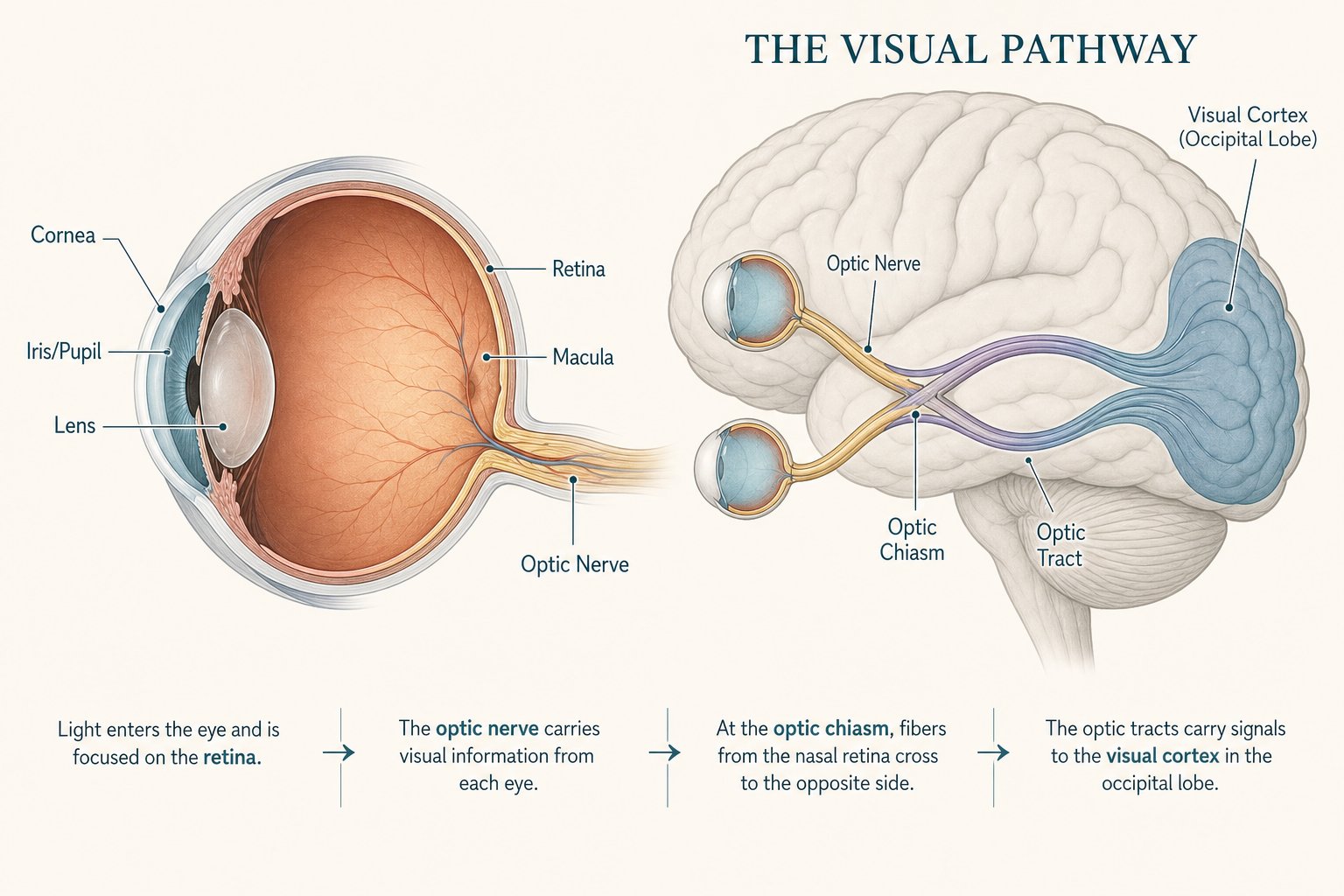
1.13 — Visual anatomy — the structures behind the function

Visual

Anatomy

Visual anatomy — the structures behind the function

Cornea, lens, retina, optic nerve, chiasm, tracts, and visual cortex — the hardware that visual performance depends on.

Cornea, lens, retina, optic nerve, chiasm, tracts, and visual cortex — the hardware that visual performance depends on.

Why Visual Performance Matters: Foundations for Occupational Therapy Practice
13 / 22
  • Cornea, lens, retina, optic nerve, chiasm, tracts, and visual cortex — the hardware that visual performance depends on.

Say this

Talk over the visual: "Visual anatomy — the structures behind the function."

Say the caption in your own words: Cornea, lens, retina, optic nerve, chiasm, tracts, and visual cortex — the hardware that visual performance depends on.

My notes

1.14 — Where OT sits relative to the eye care team

Teaching slide

OT scope

Where OT sits relative to the eye care team

  • Optometry and ophthalmology own refraction, ocular health, and diagnosis.
  • OT owns the functional question: how does this student's visual system perform inside real occupations?
  • We describe observed performance, conditions, and occupational impact — never a diagnosis or a lens prescription.
  • Every visual finding in this course is framed as "recognize and refer," not "diagnose and treat."
1Systematic reviews & meta-analysesSets the default direction of practice.
2Randomized controlled trials (e.g., CITT)Supports specific dosed interventions.
3Cohort & case-control studiesDescribes patterns and associations, not cause.
4Practice guidelines & consensus (AOTA, AOA)Defines scope and role boundaries.
5Expert opinion & single-case designsFills gaps; documented as such in the plan.
Claims in this course are labeled by tier. Where the evidence is consensus or emerging, the course says so rather than overstating it.
Why Visual Performance Matters: Foundations for Occupational Therapy Practice
14 / 22
  • Optometry and ophthalmology own refraction, ocular health, and diagnosis.
  • OT owns the functional question: how does this student's visual system perform inside real occupations?
  • We describe observed performance, conditions, and occupational impact — never a diagnosis or a lens prescription.
  • Every visual finding in this course is framed as "recognize and refer," not "diagnose and treat."

Say this

Frame the slide: "Where OT sits relative to the eye care team."

Walk each point, one sentence each:

• Optometry and ophthalmology own refraction, ocular health, and diagnosis.

• OT owns the functional question: how does this student's visual system perform inside real occupations?

• We describe observed performance, conditions, and occupational impact — never a diagnosis or a lens prescription.

• Every visual finding in this course is framed as "recognize and refer," not "diagnose and treat."

Point at the figure while you talk — name the parts before the labels.

Close with: "If you only take one of these back, take the first one."

My notes

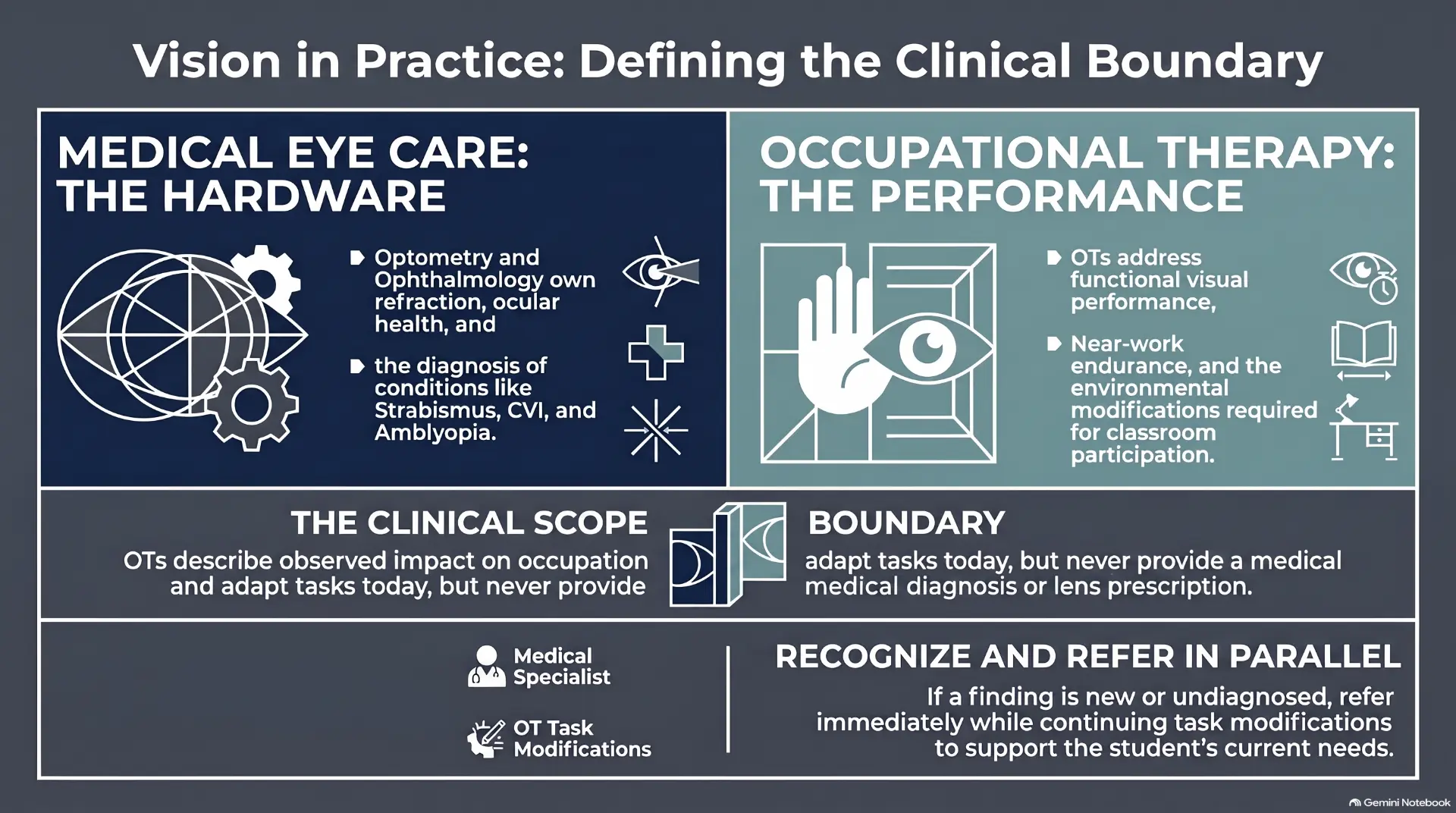
1.15 — Two lanes, one student

Visual

Scope

Two lanes, one student

Medical eye care owns diagnosis and the optical correction; OT owns performance inside real occupations. The referral and the task modification run in parallel, on the same day.

Medical eye care owns diagnosis and the optical correction; OT owns performance inside real occupations. The referral and the task modification run in parallel, on the same day.

Why Visual Performance Matters: Foundations for Occupational Therapy Practice
15 / 22
  • Medical eye care owns diagnosis and the optical correction; OT owns performance inside real occupations. The referral and the task modification run in parallel, on the same day.

Say this

Talk over the visual: "Two lanes, one student."

Say the caption in your own words: Medical eye care owns diagnosis and the optical correction; OT owns performance inside real occupations. The referral and the task modification run in parallel, on the same day.

My notes

1.16 — The brain's two visual highways

Video

Lecture

The brain's two visual highways

Why Visual Performance Matters: Foundations for Occupational Therapy Practice
16 / 22
  • Ventral "what" and dorsal "where" streams, and how each one shows up in the school day.

Say this

Set up the clip in one sentence, play it, then debrief with "what did you notice?"

My notes

1.17 — A gateway problem hiding in plain sight

Case

Application

A gateway problem hiding in plain sight

A kindergarten teacher reports that a student "just isn't paying attention" during calendar time and often bumps into classmates during transitions. The student passed a school vision screening six months ago.

  • Q1.What visual-performance questions would you want answered before assuming this is an attention or behavior issue?
  • Q2.What is the one sentence you would write in a consult note, and what referral would run in parallel?
RetinaChiasmLGNV1striate cortex
Retina → optic nerve → chiasm → LGN → primary visual cortex (V1), then divergence: the dorsal stream travels superiorly to parietal cortex, the ventral stream inferiorly to temporal cortex.
Why Visual Performance Matters: Foundations for Occupational Therapy Practice
17 / 22
  • A kindergarten teacher reports that a student "just isn't paying attention" during calendar time and often bumps into classmates during transitions. The student passed a school vision screening six months ago.
  • Q1. What visual-performance questions would you want answered before assuming this is an attention or behavior issue?
  • Q2. What is the one sentence you would write in a consult note, and what referral would run in parallel?

Say this

Read the scenario aloud, slowly:

A kindergarten teacher reports that a student "just isn't paying attention" during calendar time and often bumps into classmates during transitions. The student passed a school vision screening six months ago.

Then put these questions to the room:

• What visual-performance questions would you want answered before assuming this is an attention or behavior issue?

• What is the one sentence you would write in a consult note, and what referral would run in parallel?

Give 60 seconds of think time before you take answers. Model answers are in the panel beside this script.

My notes

1.18 — Where the referral sits in the student’s day

Visual

Import

Where the referral sits in the student’s day

Copy from the boardRepeated far↔near shifts, place-holding, sustained saccades
Worksheet completionNear endurance, figure-ground on a dense page, line tracking
Silent reading blockFixation stability, convergence comfort over 20+ minutes
Chromebook workContrast/glare tolerance, scrolling scan, screen-to-paper shifts
Hallway & lunch transitionsPeripheral awareness, depth on stairs, moving-crowd scanning
Referrals arrive as behavior (“loses place”, “refuses writing”). Name the occupational demand first — the demand is what you assess and what you later document as educational relevance.
Why Visual Performance Matters: Foundations for Occupational Therapy Practice
18 / 22
  • The referral question, the occupation it interrupts, and who else is already involved.

Say this

Describe what belongs here: The referral question, the occupation it interrupts, and who else is already involved..

My notes

1.19 — So what? "Passed the screening" is not a clearance

So what?

So what?

So what? "Passed the screening" is not a clearance

A distance acuity screening answers one question at one distance. Nearly every school task the student is failing happens at 40 cm, under time pressure, with both eyes working together.

Screenings are built to catch reduced acuity, not efficiency, endurance, or integration.

What you do with it

  • Ask what the screening actually measured before accepting it as a clearance.
  • Observe the student in the failing occupation, at the real distance and duration.
  • Refer when a sign is undiagnosed, even if the screening was passed.

Watch for

Performance that falls apart only under sustained near demand — a screening will never show you that.

Why Visual Performance Matters: Foundations for Occupational Therapy Practice
19 / 22
  • A distance acuity screening answers one question at one distance. Nearly every school task the student is failing happens at 40 cm, under time pressure, with both eyes working together.
  • Because: Screenings are built to catch reduced acuity, not efficiency, endurance, or integration.
  • Move: Ask what the screening actually measured before accepting it as a clearance.
  • Move: Observe the student in the failing occupation, at the real distance and duration.
  • Move: Refer when a sign is undiagnosed, even if the screening was passed.
  • Watch for: Performance that falls apart only under sustained near demand — a screening will never show you that.

Say this

Land the "so what": A distance acuity screening answers one question at one distance. Nearly every school task the student is failing happens at 40 cm, under time pressure, with both eyes working together.

Explain the mechanism plainly: Screenings are built to catch reduced acuity, not efficiency, endurance, or integration.

Then give them the moves — say each one as something they can do Monday:

• Ask what the screening actually measured before accepting it as a clearance.

• Observe the student in the failing occupation, at the real distance and duration.

• Refer when a sign is undiagnosed, even if the screening was passed.

Tell them what success looks like: Performance that falls apart only under sustained near demand — a screening will never show you that.

Ask: "Who has a student this describes right now?" Take one answer, then move.

My notes

1.20 — Two-minute case: what did the screening tell you?

Mini case

Two-minute case

Two-minute case: what did the screening tell you?

A teacher forwards a screening result of 20/20 in each eye and says "so it is not her vision."

What is your one-sentence reply, and what do you do next?

Why Visual Performance Matters: Foundations for Occupational Therapy Practice
20 / 22
  • A teacher forwards a screening result of 20/20 in each eye and says "so it is not her vision."
  • Question: What is your one-sentence reply, and what do you do next?
  • Model answer: "That tells us she can resolve detail at distance; it does not tell us how her eyes hold up at 40 cm for twenty minutes." Then observe a real near task at real duration and document what changes with time on task.
  • Teaching point: Distance acuity is a floor, not a clearance.

Say this

Two-minute case. Read it aloud:

A teacher forwards a screening result of 20/20 in each eye and says "so it is not her vision."

Put the question to them: "What is your one-sentence reply, and what do you do next?" Give 60 seconds, no talking.

Model answer (reveal after they commit): "That tells us she can resolve detail at distance; it does not tell us how her eyes hold up at 40 cm for twenty minutes." Then observe a real near task at real duration and document what changes with time on task.

Close with the rule: Distance acuity is a floor, not a clearance.

My notes

1.21 — Reflect and share

Reflection

Reflect and share

Reflect and share

Think about a referral you received that mentioned a visual concern. What did you own as OT, and what did you defer to eye care?

THINKPROCESSSHARE
  • · Name one observation you could write in occupational terms.
  • · Name one thing you would not write because it is outside OT scope.
Why Visual Performance Matters: Foundations for Occupational Therapy Practice
21 / 22
  • Think about a referral you received that mentioned a visual concern. What did you own as OT, and what did you defer to eye care?
  • Name one observation you could write in occupational terms.
  • Name one thing you would not write because it is outside OT scope.
  • Starter: I own the occupational observation that... I defer to eye care the question of whether...

Say this

Reflection prompt: "Think about a referral you received that mentioned a visual concern. What did you own as OT, and what did you defer to eye care?"

Cues:

• Name one observation you could write in occupational terms.

• Name one thing you would not write because it is outside OT scope.

Offer the sentence starter: "I own the occupational observation that... I defer to eye care the question of whether..."

Think for one minute, write, then take two shares.

My notes

1.22 — Knowledge check — scope and development

Self-check

Knowledge check

Knowledge check — scope and development

A first-grade student holds books at 10 cm and squints. The school vision screen was passed. Which statement is most appropriate for your OT note?

Why Visual Performance Matters: Foundations for Occupational Therapy Practice
22 / 22
  • A first-grade student holds books at 10 cm and squints. The school vision screen was passed. Which statement is most appropriate for your OT note?
  • – Student has convergence insufficiency and needs vision therapy.
  • – Student passes vision screen; no visual concerns noted.
  • ✓ Student reads at 10 cm working distance with squinting; refer for comprehensive eye exam and adapt materials in the meantime.
  • – Student requires reading glasses before starting OT intervention.
  • Rationale: The OT describes observable performance and working distance, recommends referral, and continues adaptation. Diagnosis, therapy prescriptions, and optical recommendations belong to eye care.

Say this

Knowledge check: "A first-grade student holds books at 10 cm and squints. The school vision screen was passed. Which statement is most appropriate for your OT note?"

Options:

• Student has convergence insufficiency and needs vision therapy.

• Student passes vision screen; no visual concerns noted.

• Student reads at 10 cm working distance with squinting; refer for comprehensive eye exam and adapt materials in the meantime.

• Student requires reading glasses before starting OT intervention.

Correct answer: option 3. Rationale: The OT describes observable performance and working distance, recommends referral, and continues adaptation. Diagnosis, therapy prescriptions, and optical recommendations belong to eye care.

My notes