4.1 — Administering the Mini VPA™: the seven probes, scripts, prompting limits, and observation cues
TransitionSay this
Transition: "Administering the Mini VPA™: the seven probes, scripts, prompting limits, and observation cues."
My notes
Presenter study handout
4 contact hours · 0.4 AOTA CEUs · Module 4 · 16 slides
Presenter-side material. Each block shows the slide as the audience sees it, the talk track, and space for your own notes. Model answers appear here — do not hand this version to learners.
Say this
Transition: "Administering the Mini VPA™: the seven probes, scripts, prompting limits, and observation cues."
My notes
Say this
Open here. "Administering the Mini VPA™." Five probes, verbatim scripts, prompting limits, and observation cues.
Say why this section matters for their caseload, then advance.
My notes
Say this
Ask the poll: "Which prompting error are you most at risk of during administration?"
Options:
• Repeating the item after a delay
My notes
Say this
Frame the slide: "Script discipline."
Walk each point, one sentence each:
• Read the Say line verbatim; the Do line defines your hands and the timing.
My notes
Say this
Frame the slide: "What triggers a Full VPA™."
Walk each point, one sentence each:
• Any probe failed at or below the expected level for the band.
My notes
Say this
Contrast the two columns: Pursuit: look for versus Saccade: look for.
Pursuit: look for:
• Symmetry between the two eyes as they track
My notes
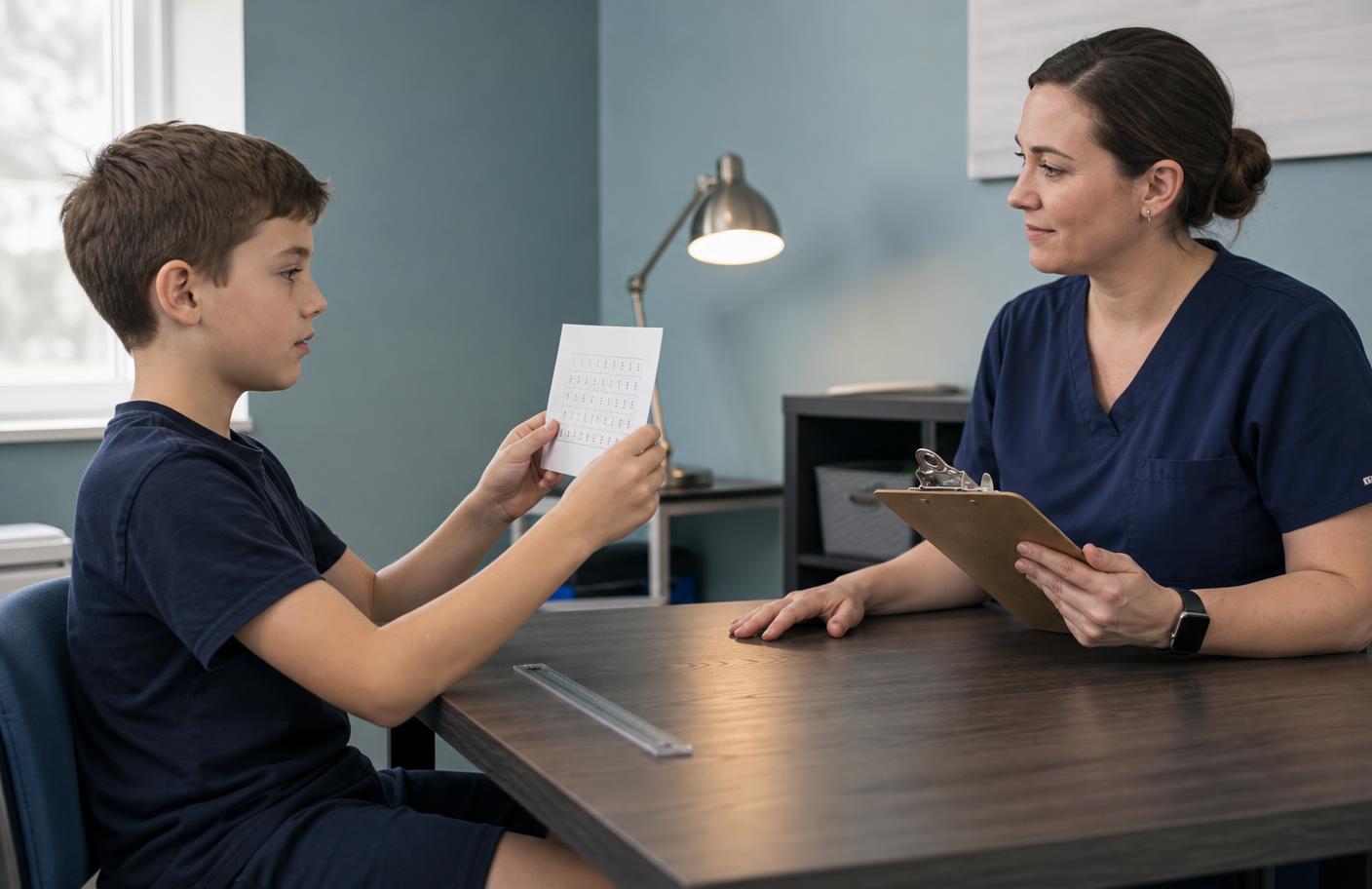
Near probes · 40 cm
Card at midline and at eye level; measure from the spectacle plane, not the forehead.
Table/screen · 60 cm
Use the same distance at screening and re-probe — a distance change invalidates the comparison.
Base of support
Feet supported and hips at 90° before any oculomotor scoring; postural drift reads as an efficiency deficit.
Say this
Frame the slide: "Near point of convergence — the penlight probe."
Walk each point, one sentence each:
• This belongs to the Level 2 efficiency probe. You run it here in the Mini, and again inside Domain 2 of the Full.
My notes
Say this
Contrast the two columns: Levels 1–3 versus Levels 4–5.
Levels 1–3:
• L1 — acuity at the measured distance, correction worn
My notes
Say this
Frame the slide: "What to watch while they work."
Walk each point, one sentence each:
• Working distance drift and head movement instead of eye movement.
My notes
Say this
Set up the clip in one sentence, play it, then debrief with "what did you notice?"
My notes
Say this
Describe what belongs here: Clinician view of a probe script with the level ladder visible..
My notes
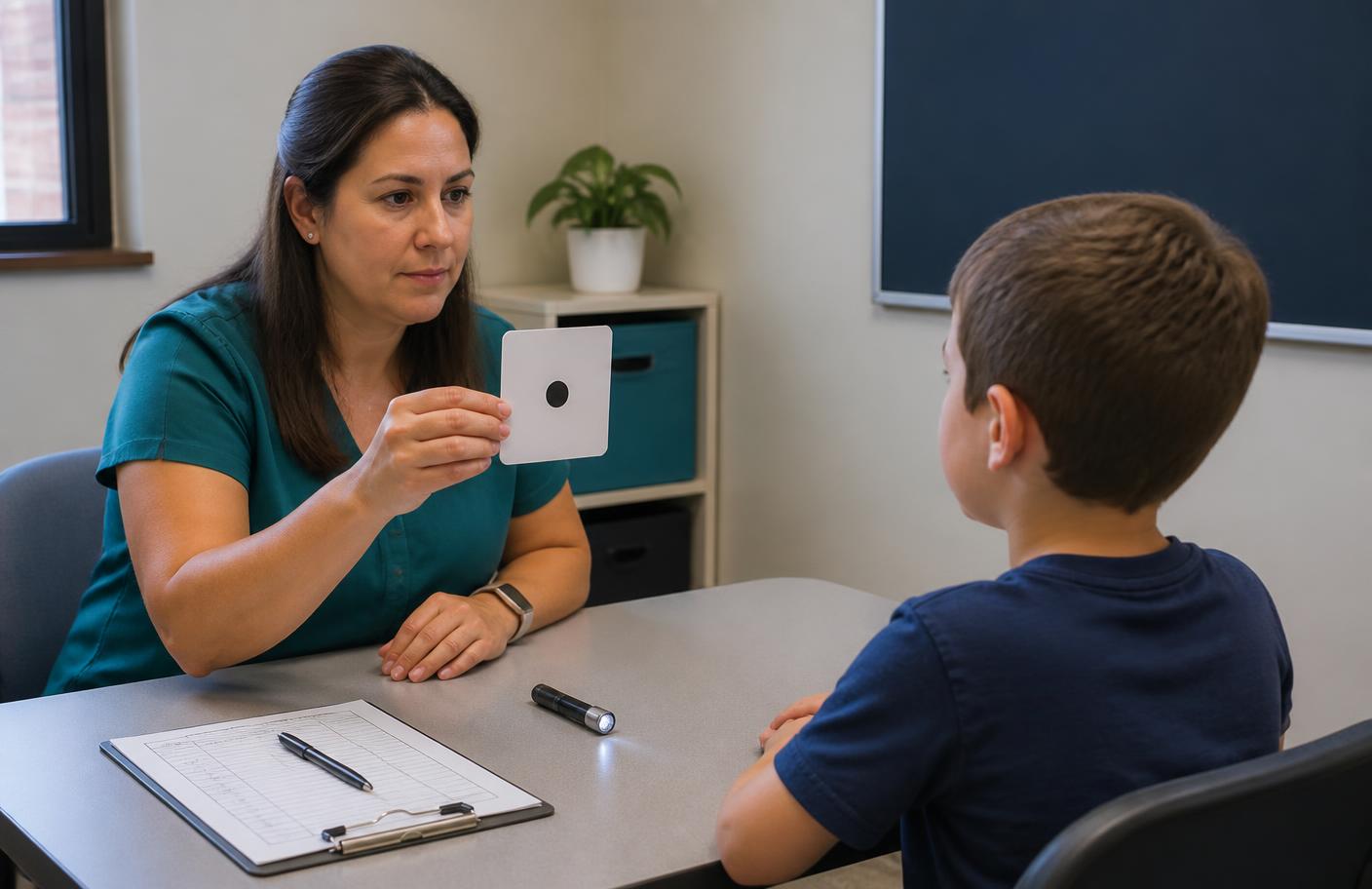
Eye level, off midline
Sit level with the student’s eyes and roughly 30° off midline so both eyes stay visible.
Target at eye level
Held at eye level, not above — an elevated target forces chin-up posture and false head substitution.
Score sheet within reach
Record each trial as it happens; retrospective scoring loses the qualitative signal.
Say this
Describe what belongs here: Positioning photo showing the clinician’s line of sight to the eyes..
My notes
Say this
Land the "so what": Every extra prompt you add turns an assessment item into a teaching trial, and the score stops meaning what the manual says it means.
Explain the mechanism plainly: The five Mini probes are standardized in wording, demonstration, and prompting limits.
Then give them the moves — say each one as something they can do Monday:
My notes
Say this
Two-minute case. Read it aloud:
Mid-probe, a student stalls and you say "remember to start at the left." He then completes the item correctly.
Put the question to them: "How do you score and document it?" Give 60 seconds, no talking.
My notes
Say this
Reflection prompt: "After scoring yourself on the fidelity checklist, which two items will you rehearse before your first real administration?"
Offer the sentence starter: "I will rehearse [item 1] and [item 2] because..."
Think for one minute, write, then take two shares.
My notes
Say this
Knowledge check: "A student pauses; you say "you can do it, look again at the top." What have you done?"
Options:
• Provided allowable encouragement
My notes