Back to CEU courses

Presenter study handout

Vision in OT Practice

3 contact hours · 0.3 AOTA CEUs · All 7 modules · 147 slides

Presenter-side material. Each block shows the slide as the audience sees it, the talk track, and space for your own notes. Model answers appear here — do not hand this version to learners.

Module 1

1.1 — Welcome — while you get set up

Welcome

Welcome

Welcome — while you get set up

Vision in OT Practice · 3.0 contact hours · 0.3 AOTA CEUs

Have ready

  • Participation & Reflection Guide (printed or on screen)
  • A current student on your caseload to think with
  • Pen and paper, or the reflection boxes in this player
  • One recent evaluation report you wrote

Before we begin

  • Modules are self-paced; your place is saved as you go.
  • Polls, reflections, and self-checks are participation supports — they do not affect your quiz score.
  • Take a stretch break between modules; sustained near work is the topic, not the goal.
  • The post-course exam and evaluation unlock after the last module.
Vision in OT Practice
1 / 26
  • Materials: Participation & Reflection Guide (printed or on screen)
  • Materials: A current student on your caseload to think with
  • Materials: Pen and paper, or the reflection boxes in this player
  • Materials: One recent evaluation report you wrote
  • Modules are self-paced; your place is saved as you go.
  • Polls, reflections, and self-checks are participation supports — they do not affect your quiz score.
  • Take a stretch break between modules; sustained near work is the topic, not the goal.
  • The post-course exam and evaluation unlock after the last module.

Say this

Housekeeping while people arrive.

Materials to have ready:

• Participation & Reflection Guide (printed or on screen)

• A current student on your caseload to think with

• Pen and paper, or the reflection boxes in this player

• One recent evaluation report you wrote

Housekeeping:

• Modules are self-paced; your place is saved as you go.

• Polls, reflections, and self-checks are participation supports — they do not affect your quiz score.

• Take a stretch break between modules; sustained near work is the topic, not the goal.

• The post-course exam and evaluation unlock after the last module.

My notes
1.2 — What you will be able to do

Learning outcomes

Learning outcomes

What you will be able to do

So you can describe, document, and act on visual performance in occupation — without stepping outside OT scope.

  • 1Differentiate the levels of a structured visual performance framework and explain how each level influences occupational performance across pediatric and adult practice settings.
  • 2Analyze the relationship between visual performance deficits and occupational challenges by applying a structured clinical reasoning framework to case scenarios.
  • 3Integrate occupation-based assessment findings, clinical observations, and standardized measures to identify visual performance factors affecting participation in meaningful occupations.
  • 4Develop occupation-centered intervention plans that incorporate evidence-informed strategies, environmental modifications, interdisciplinary collaboration, and client-centered goals based on the identified level of visual performance.
  • 5Apply structured clinical reasoning to support documentation and outcome measurement that promotes occupational participation, health, and functional independence.
Vision in OT Practice
2 / 26
  • So you can describe, document, and act on visual performance in occupation — without stepping outside OT scope.
  • Differentiate the levels of a structured visual performance framework and explain how each level influences occupational performance across pediatric and adult practice settings.
  • Analyze the relationship between visual performance deficits and occupational challenges by applying a structured clinical reasoning framework to case scenarios.
  • Integrate occupation-based assessment findings, clinical observations, and standardized measures to identify visual performance factors affecting participation in meaningful occupations.
  • Develop occupation-centered intervention plans that incorporate evidence-informed strategies, environmental modifications, interdisciplinary collaboration, and client-centered goals based on the identified level of visual performance.
  • Apply structured clinical reasoning to support documentation and outcome measurement that promotes occupational participation, health, and functional independence.

Say this

Read the filed learning objectives verbatim — this is the AOTA-approved wording.

Objectives:

• Differentiate the levels of a structured visual performance framework and explain how each level influences occupational performance across pediatric and adult practice settings.

• Analyze the relationship between visual performance deficits and occupational challenges by applying a structured clinical reasoning framework to case scenarios.

• Integrate occupation-based assessment findings, clinical observations, and standardized measures to identify visual performance factors affecting participation in meaningful occupations.

• Develop occupation-centered intervention plans that incorporate evidence-informed strategies, environmental modifications, interdisciplinary collaboration, and client-centered goals based on the identified level of visual performance.

• Apply structured clinical reasoning to support documentation and outcome measurement that promotes occupational participation, health, and functional independence.

My notes

1.3 — How this session runs

How the session runs

Your learning experience

How this session runs

Session schedule

  • Seven modules, 3.0 contact hours total
  • Each module: teach → show → reflect → self-check
  • Post-course exam (80% to pass, unlimited retakes)
  • Course evaluation, then certificate

Participation & Reflection Guide

  • Write your reflections as you go
  • Entries save to your guide and print with the handout
  • Use it as your Monday-morning action plan

Discussion & engagement

  • Opening poll in every module
  • Think / Process / Share reflection prompts
  • Case vignettes with clinical reasoning prompts
  • One knowledge check per module
Vision in OT Practice
3 / 26
  • Seven modules, 3.0 contact hours total
  • Each module: teach → show → reflect → self-check
  • Post-course exam (80% to pass, unlimited retakes)
  • Course evaluation, then certificate
  • Write your reflections as you go
  • Entries save to your guide and print with the handout
  • Use it as your Monday-morning action plan
  • Opening poll in every module
  • Think / Process / Share reflection prompts
  • Case vignettes with clinical reasoning prompts
  • One knowledge check per module

Say this

Explain how the session runs.

Schedule:

• Seven modules, 3.0 contact hours total

• Each module: teach → show → reflect → self-check

• Post-course exam (80% to pass, unlimited retakes)

• Course evaluation, then certificate

How they participate:

• Opening poll in every module

• Think / Process / Share reflection prompts

• Case vignettes with clinical reasoning prompts

• One knowledge check per module

My notes

1.4 — OT Scope in Vision: What We Own, What We Refer

Transition

Module 1

OT Scope in Vision: What We Own, What We Refer

0:00 – 0:22

Vision in OT Practice
4 / 26
  • 0:00 – 0:22

Say this

Transition: "OT Scope in Vision: What We Own, What We Refer."

My notes

1.5 — OT Scope in Vision

Title

Module 1

OT Scope in Vision

What we own, what we refer, and the language that keeps us inside our license.

Vision in OT Practice
5 / 26
  • What we own, what we refer, and the language that keeps us inside our license.
  • Visual Minds Learning · AOTA Approved Provider

Say this

Open here. "OT Scope in Vision." What we own, what we refer, and the language that keeps us inside our license.

Say why this section matters for their caseload, then advance.

My notes

1.6 — Where does your discomfort sit?

Poll

Poll

Where does your discomfort sit?

When a teacher says "she can't track," what stops you from acting on it today?

Vision in OT Practice
6 / 26
  • When a teacher says "she can't track," what stops you from acting on it today?
  • – I am not sure it is inside OT scope
  • – I do not have the language for the report
  • – I do not know what to measure
  • – I act on it already and want cleaner documentation

Say this

Ask the poll: "When a teacher says "she can't track," what stops you from acting on it today?"

Options:

• I am not sure it is inside OT scope

• I do not have the language for the report

• I do not know what to measure

• I act on it already and want cleaner documentation

Take a show of hands or the on-screen tally, then name the pattern you see before advancing.

My notes

1.7 — Vision is a client factor, not a specialty add-on

Teaching slide

Framing

Vision is a client factor, not a specialty add-on

  • OTPF-4 lists visual functions among sensory body functions that shape occupational performance.
  • Our lens is performance: how vision enables or limits reading, writing, dressing, play, work, and driving.
  • Describing visual performance during occupation requires no referral or supervision.
  • Ocular health, refraction, and disease diagnosis stay with optometry and ophthalmology.
Optometry (OD)Acuity · refraction · pathologyVision therapy (COVT)Under OD supervisionOTPF-4 · IEP · ADL/IADLIndependent scopeOccupational TherapyVision as a client factor in occupation
OT scope for vision sits inside occupational performance — distinct from optometry (eye health) and vision therapy (visual-perceptual efficiency under an OD).
Vision in OT Practice
7 / 26
  • OTPF-4 lists visual functions among sensory body functions that shape occupational performance.
  • Our lens is performance: how vision enables or limits reading, writing, dressing, play, work, and driving.
  • Describing visual performance during occupation requires no referral or supervision.
  • Ocular health, refraction, and disease diagnosis stay with optometry and ophthalmology.

Say this

Frame the slide: "Vision is a client factor, not a specialty add-on."

Walk each point, one sentence each:

• OTPF-4 lists visual functions among sensory body functions that shape occupational performance.

• Our lens is performance: how vision enables or limits reading, writing, dressing, play, work, and driving.

• Describing visual performance during occupation requires no referral or supervision.

• Ocular health, refraction, and disease diagnosis stay with optometry and ophthalmology.

Point at the figure while you talk — name the parts before the labels.

Close with: "If you only take one of these back, take the first one."

My notes

1.8 — Two columns that keep documentation defensible

Comparison

Scope line

Two columns that keep documentation defensible

OT owns (performance)

  • Observed gaze control during a reading task
  • Near-work endurance and fatigue time course
  • Copying accuracy, line loss, place-keeping
  • Task grading, environment, and compensatory strategy

Refer out (ocular/medical)

  • Pain, redness, sudden vision change
  • Suspected pathology or unexplained acuity loss
  • Refraction and lens prescription
  • Diagnosis of a binocular vision disorder

Prevention — good design for everyone

Teacher / team owns it

  • • 14–18 pt print, one task per page
  • • Board content also handed out on paper
  • • A visual rest built into long near work

OT role: suggest it, model it once, and leave a one-page reference behind.

Accommodation — access for this student

IEP / 504 team writes it, staff carry it out

  • • Enlarged or digital copy
  • • Reduced copying, extended time
  • • Audio or text-to-speech option

OT role: trial it, document which condition restored performance, write the wording for the plan.

Intervention — building the skill

OT owns it

  • • Graded eye-movement work inside the real reading task
  • • Handwriting and visual-motor practice in classwork
  • • Endurance built minute by minute

OT role: this is the only tier that requires us. Measure it in classwork, then hand off.

Eye health, glasses, prism, patching

Optometry / ophthalmology owns it

  • • Blur, pain, double vision, headaches
  • • Any change in eye appearance or alignment
  • • No exam in the last year

OT role: refer, share what we observed in the task, and keep treating occupation while we wait.

Four tiers, four owners. Most vision supports in a school are not OT-only work — naming the owner is what makes the plan survive after you leave the room.
Vision in OT Practice
8 / 26
  • OT owns (performance): Observed gaze control during a reading task · Near-work endurance and fatigue time course · Copying accuracy, line loss, place-keeping · Task grading, environment, and compensatory strategy
  • Refer out (ocular/medical): Pain, redness, sudden vision change · Suspected pathology or unexplained acuity loss · Refraction and lens prescription · Diagnosis of a binocular vision disorder

Say this

Contrast the two columns: OT owns (performance) versus Refer out (ocular/medical).

OT owns (performance):

• Observed gaze control during a reading task

• Near-work endurance and fatigue time course

• Copying accuracy, line loss, place-keeping

• Task grading, environment, and compensatory strategy

Refer out (ocular/medical):

• Pain, redness, sudden vision change

• Suspected pathology or unexplained acuity loss

• Refraction and lens prescription

• Diagnosis of a binocular vision disorder

Ask: "Which column is your student living in right now?"

My notes

1.9 — Say this, not that

Teaching slide

Language

Say this, not that

  • "Loses place 6 times in a 2-minute passage" — not "has a tracking disorder."
  • "Copying accuracy drops from 90% to 55% after 8 minutes" — not "convergence insufficiency."
  • "Reports blur at 40 cm after sustained near work; referred for eye exam" — findings plus disposition.
  • Every statement ties an observation to an occupation and a next action.
1

Ocular structures

Cornea, lens, retina, extraocular muscles — image quality and eye alignment.

Looks like: Blur, fatigue, suppression, head tilt.

2

Pathways & processing

Optic nerve → chiasm → LGN → V1, then ventral "what" and dorsal "where" streams.

Looks like: Recognition errors, spatial disorganization, place-losing.

3

Visual performance

Efficiency under real demand: sustaining near work, scanning, copying, moving through space.

Looks like: Slow output, avoidance, careless-looking errors.

4

Occupation

Reading, writing, math layout, PE, cafeteria, hallway navigation, self-care.

Looks like: The referral you actually receive.

OT does not diagnose the first two columns; we measure the third and change the fourth. Eye care partners own structure and pathway health — our contribution is performance under occupational demand.
Vision in OT Practice
9 / 26
  • "Loses place 6 times in a 2-minute passage" — not "has a tracking disorder."
  • "Copying accuracy drops from 90% to 55% after 8 minutes" — not "convergence insufficiency."
  • "Reports blur at 40 cm after sustained near work; referred for eye exam" — findings plus disposition.
  • Every statement ties an observation to an occupation and a next action.

Say this

Frame the slide: "Say this, not that."

Walk each point, one sentence each:

• "Loses place 6 times in a 2-minute passage" — not "has a tracking disorder."

• "Copying accuracy drops from 90% to 55% after 8 minutes" — not "convergence insufficiency."

• "Reports blur at 40 cm after sustained near work; referred for eye exam" — findings plus disposition.

• Every statement ties an observation to an occupation and a next action.

Point at the figure while you talk — name the parts before the labels.

Close with: "If you only take one of these back, take the first one."

My notes

1.10 — Prevalence and the case for OT screening

Teaching slide

Why this matters

Prevalence and the case for OT screening

  • An estimated 1 in 4 school-age children has an undiagnosed vision problem (Kleinstein et al., 2003, population-based cohort).
  • CDC surveillance data show 6.8% of children carry a diagnosed eye/vision condition; roughly 3% meet criteria for blind or visually impaired (BVI).
  • Classroom occupations are visually loaded — reading, copying, and board work all route through vision, so a visual client factor touches nearly every academic occupation (framing statement, not a prevalence figure).
  • ADHD populations show visual/binocular dysfunction at roughly 16% co-occurrence (Bellato et al., 2023, systematic review) — co-occurrence only, not causation, and a common confound for "inattention."
  • Dyslexia is associated with unstable eye dominance in a majority of observational samples (73% / 63%) — a correlate, not a cause. AAP/AAO/AAPOS hold that dyslexia is language-based and vision treatment does not treat it.
  • Strabismus occurs in an estimated 1.8–8.3% of children with autism spectrum disorder (Holhoș et al., 2022, systematic review) — an association, above general-population rates, not a causal link.
  • These numbers are the argument for universal, low-burden OT vision screening — not a license to diagnose.
Reduced acuity, suspected pathology, or new-onset changeRefer — optometry / ophthalmology

Meanwhile OT addresses it: magnification, enlarged print, working distance, seating.

Diplopia, receded NPC, suppression signsRefer — binocular vision evaluation

Meanwhile OT addresses it: shortened near-work bouts, task rotation, print size and spacing.

Field loss or neurological signsRefer — medical, same day if acute

Meanwhile OT addresses it: scanning and anchoring, line tracking, materials in the intact field.

Diagnosed and medically managed acuity, contrast, or field lossOT addresses it — no new referral

High-contrast materials, glare and lighting control, magnification, placement — treat the functional limitation.

Efficiency or perceptual limiter, eye health clearedOT plan of care

Goal, dosage, and condition-specific supports drawn from the recorded performance profile.

Environmental or task mismatch onlyConsultation and adaptation

Change the material, the lighting, or the task demand — no direct service required.

Disposition rules. A referral is never the whole OT output — the modification goes in the same day the referral is written.
Vision in OT Practice
10 / 26
  • An estimated 1 in 4 school-age children has an undiagnosed vision problem (Kleinstein et al., 2003, population-based cohort).
  • CDC surveillance data show 6.8% of children carry a diagnosed eye/vision condition; roughly 3% meet criteria for blind or visually impaired (BVI).
  • Classroom occupations are visually loaded — reading, copying, and board work all route through vision, so a visual client factor touches nearly every academic occupation (framing statement, not a prevalence figure).
  • ADHD populations show visual/binocular dysfunction at roughly 16% co-occurrence (Bellato et al., 2023, systematic review) — co-occurrence only, not causation, and a common confound for "inattention."
  • Dyslexia is associated with unstable eye dominance in a majority of observational samples (73% / 63%) — a correlate, not a cause. AAP/AAO/AAPOS hold that dyslexia is language-based and vision treatment does not treat it.
  • Strabismus occurs in an estimated 1.8–8.3% of children with autism spectrum disorder (Holhoș et al., 2022, systematic review) — an association, above general-population rates, not a causal link.
  • These numbers are the argument for universal, low-burden OT vision screening — not a license to diagnose.

Say this

Frame the slide: "Prevalence and the case for OT screening."

Walk each point, one sentence each:

• An estimated 1 in 4 school-age children has an undiagnosed vision problem (Kleinstein et al., 2003, population-based cohort).

• CDC surveillance data show 6.8% of children carry a diagnosed eye/vision condition; roughly 3% meet criteria for blind or visually impaired (BVI).

• Classroom occupations are visually loaded — reading, copying, and board work all route through vision, so a visual client factor touches nearly every academic occupation (framing statement, not a prevalence figure).

• ADHD populations show visual/binocular dysfunction at roughly 16% co-occurrence (Bellato et al., 2023, systematic review) — co-occurrence only, not causation, and a common confound for "inattention."

• Dyslexia is associated with unstable eye dominance in a majority of observational samples (73% / 63%) — a correlate, not a cause. AAP/AAO/AAPOS hold that dyslexia is language-based and vision treatment does not treat it.

• Strabismus occurs in an estimated 1.8–8.3% of children with autism spectrum disorder (Holhoș et al., 2022, systematic review) — an association, above general-population rates, not a causal link.

• These numbers are the argument for universal, low-burden OT vision screening — not a license to diagnose.

Point at the figure while you talk — name the parts before the labels.

Close with: "If you only take one of these back, take the first one."

My notes

1.11 — Visual terminology glossary

Comparison

Shared language

Visual terminology glossary

Term

  • Convergence
  • Accommodation
  • Stereopsis
  • Fixation
  • Saccades
  • Pursuits

What it means in schoolwork

  • Both eyes turning inward together to hold near print in single focus — unstable convergence shows up as double vision or fatigue on close work.
  • The eye's lens changing shape to keep near print sharp — poor accommodation looks like blur that worsens the longer the task runs.
  • Depth perception from combining two eyes' images — weak stereopsis affects catching, stairs, and judging space on a busy page.
  • Holding gaze steady on a target — an unstable fixation shows up as losing the word or the math problem being copied.
  • Quick jumps between points, as in reading line to line — inefficient saccades look like skipped words or re-reading.
  • Smooth following of a moving target, as in tracking a ball or a moving finger — poor pursuits show up as losing a thrown object or a moving demonstration.
Vision in OT Practice
11 / 26
  • Term: Convergence · Accommodation · Stereopsis · Fixation · Saccades · Pursuits
  • What it means in schoolwork: Both eyes turning inward together to hold near print in single focus — unstable convergence shows up as double vision or fatigue on close work. · The eye's lens changing shape to keep near print sharp — poor accommodation looks like blur that worsens the longer the task runs. · Depth perception from combining two eyes' images — weak stereopsis affects catching, stairs, and judging space on a busy page. · Holding gaze steady on a target — an unstable fixation shows up as losing the word or the math problem being copied. · Quick jumps between points, as in reading line to line — inefficient saccades look like skipped words or re-reading. · Smooth following of a moving target, as in tracking a ball or a moving finger — poor pursuits show up as losing a thrown object or a moving demonstration.

Say this

Contrast the two columns: Term versus What it means in schoolwork.

Term:

• Convergence

• Accommodation

• Stereopsis

• Fixation

• Saccades

• Pursuits

What it means in schoolwork:

• Both eyes turning inward together to hold near print in single focus — unstable convergence shows up as double vision or fatigue on close work.

• The eye's lens changing shape to keep near print sharp — poor accommodation looks like blur that worsens the longer the task runs.

• Depth perception from combining two eyes' images — weak stereopsis affects catching, stairs, and judging space on a busy page.

• Holding gaze steady on a target — an unstable fixation shows up as losing the word or the math problem being copied.

• Quick jumps between points, as in reading line to line — inefficient saccades look like skipped words or re-reading.

• Smooth following of a moving target, as in tracking a ball or a moving finger — poor pursuits show up as losing a thrown object or a moving demonstration.

Ask: "Which column is your student living in right now?"

My notes

1.12 — Diagnoses OTs should recognize but never assign

Teaching slide

Recognize, refer, adapt

Diagnoses OTs should recognize but never assign

  • Cerebral/cortical visual impairment (CVI) — a brain-based visual processing impairment, not an eye finding.
  • Optic nerve hypoplasia (ONH) — underdeveloped optic nerve affecting acuity and visual field.
  • Strabismus and amblyopia — eye misalignment and reduced acuity from disuse.
  • Albinism — reduced pigment associated with nystagmus, photophobia, and reduced acuity.
  • Nystagmus — involuntary, rhythmic eye movement affecting fixation stability.
  • Retinopathy of prematurity (ROP) — retinal vascular condition in infants born preterm.
  • Retinitis pigmentosa (RP) — progressive peripheral vision and night-vision loss.
  • Congenital cataract — clouding of the lens present from birth or early infancy.
  • Our job: recognize the signs, make the referral to medical eye care, and adapt the occupation while the family waits for that appointment.

Same-day / urgent

Ophthalmology or ED via family and school nurse

  • • Sudden vision loss or new double vision
  • • New eye turn, new head tilt, or new nystagmus
  • • Eye pain, trauma, or acute photophobia

Routine eye care referral

Optometry / developmental optometry

  • • Blur, squinting, or headaches with near work
  • • Suspected phoria: fatigue, place loss, avoidance
  • • No comprehensive exam within the past year

Educational vision team

TVI · O&M specialist

  • • Documented low vision or field loss
  • • Navigation or travel safety concerns
  • • Braille, large print, or AT decisions

OT continues in parallel

You

  • • Environmental and task modification today
  • • Functional description for the IEP team
  • • Re-check performance after the modification
Referral routing. A referral never pauses OT — modification, documentation, and re-measurement continue while the eye care team works.
Vision in OT Practice
12 / 26
  • Cerebral/cortical visual impairment (CVI) — a brain-based visual processing impairment, not an eye finding.
  • Optic nerve hypoplasia (ONH) — underdeveloped optic nerve affecting acuity and visual field.
  • Strabismus and amblyopia — eye misalignment and reduced acuity from disuse.
  • Albinism — reduced pigment associated with nystagmus, photophobia, and reduced acuity.
  • Nystagmus — involuntary, rhythmic eye movement affecting fixation stability.
  • Retinopathy of prematurity (ROP) — retinal vascular condition in infants born preterm.
  • Retinitis pigmentosa (RP) — progressive peripheral vision and night-vision loss.
  • Congenital cataract — clouding of the lens present from birth or early infancy.
  • Our job: recognize the signs, make the referral to medical eye care, and adapt the occupation while the family waits for that appointment.

Say this

Frame the slide: "Diagnoses OTs should recognize but never assign."

Walk each point, one sentence each:

• Cerebral/cortical visual impairment (CVI) — a brain-based visual processing impairment, not an eye finding.

• Optic nerve hypoplasia (ONH) — underdeveloped optic nerve affecting acuity and visual field.

• Strabismus and amblyopia — eye misalignment and reduced acuity from disuse.

• Albinism — reduced pigment associated with nystagmus, photophobia, and reduced acuity.

• Nystagmus — involuntary, rhythmic eye movement affecting fixation stability.

• Retinopathy of prematurity (ROP) — retinal vascular condition in infants born preterm.

• Retinitis pigmentosa (RP) — progressive peripheral vision and night-vision loss.

• Congenital cataract — clouding of the lens present from birth or early infancy.

• Our job: recognize the signs, make the referral to medical eye care, and adapt the occupation while the family waits for that appointment.

Point at the figure while you talk — name the parts before the labels.

Close with: "If you only take one of these back, take the first one."

My notes

1.13 — Quote

Quote

“A child can pass a 20/20 acuity screen and still be unable to read a page.”

— Why the acuity floor is only the first of five levels

Vision in OT Practice
13 / 26
  • "A child can pass a 20/20 acuity screen and still be unable to read a page."
  • Why the acuity floor is only the first of five levels

Say this

Read the quote verbatim, then pause.

"A child can pass a 20/20 acuity screen and still be unable to read a page." — Why the acuity floor is only the first of five levels

Then say what it means for practice in one sentence.

My notes

1.14 — Vision work already lives in your school day

Teaching slide

Where it shows up

Vision work already lives in your school day

  • Board-to-desk copying, worksheet completion, and sustained silent reading.
  • Handwriting legibility under speed, volume, and page-layout demand.
  • Cafeteria, hallway, stairs, and PE — mobility and clutter tolerance.
  • Dressing, fasteners, and tool use in life-skills and transition programming.
Vision in OT Practice
14 / 26
  • Board-to-desk copying, worksheet completion, and sustained silent reading.
  • Handwriting legibility under speed, volume, and page-layout demand.
  • Cafeteria, hallway, stairs, and PE — mobility and clutter tolerance.
  • Dressing, fasteners, and tool use in life-skills and transition programming.

Say this

Frame the slide: "Vision work already lives in your school day."

Walk each point, one sentence each:

• Board-to-desk copying, worksheet completion, and sustained silent reading.

• Handwriting legibility under speed, volume, and page-layout demand.

• Cafeteria, hallway, stairs, and PE — mobility and clutter tolerance.

• Dressing, fasteners, and tool use in life-skills and transition programming.

Close with: "If you only take one of these back, take the first one."

My notes

1.15 — Same-day referral triggers

Teaching slide

Safety

Same-day referral triggers

  • Eye pain, redness, discharge, or photophobia.
  • Sudden or unexplained change in vision, including new double vision.
  • Head tilt or eye turn not previously documented.
  • Acuity loss that does not resolve with habitual correction worn.
Copy from the boardRepeated far↔near shifts, place-holding, sustained saccades
Worksheet completionNear endurance, figure-ground on a dense page, line tracking
Silent reading blockFixation stability, convergence comfort over 20+ minutes
Chromebook workContrast/glare tolerance, scrolling scan, screen-to-paper shifts
Hallway & lunch transitionsPeripheral awareness, depth on stairs, moving-crowd scanning
Referrals arrive as behavior (“loses place”, “refuses writing”). Name the occupational demand first — the demand is what you assess and what you later document as educational relevance.
Vision in OT Practice
15 / 26
  • Eye pain, redness, discharge, or photophobia.
  • Sudden or unexplained change in vision, including new double vision.
  • Head tilt or eye turn not previously documented.
  • Acuity loss that does not resolve with habitual correction worn.

Say this

Frame the slide: "Same-day referral triggers."

Walk each point, one sentence each:

• Eye pain, redness, discharge, or photophobia.

• Sudden or unexplained change in vision, including new double vision.

• Head tilt or eye turn not previously documented.

• Acuity loss that does not resolve with habitual correction worn.

Point at the figure while you talk — name the parts before the labels.

Close with: "If you only take one of these back, take the first one."

My notes

1.16 — Which sentence belongs in your report?

Case

Scope check

Which sentence belongs in your report?

A Grade 4 student squints at the board, holds worksheets at 15 cm, and reports headaches after the second reading block.

  • Q1.Which of those three observations is OT-reportable as written?
  • Q2.What is the one sentence you send to the family, and what do you not name?

Out of scope

“Student has convergence insufficiency and a visual processing disorder, causing reading failure. Vision therapy is recommended.”

Scope-safe

“During 20-minute near copy tasks, the student completes 40% of assigned lines and loses place an average of 6 times, reporting blur after 6 minutes. Performance improves to 75% with an enlarged, line-isolated model. Referral to eye care has been made.”

Write the present level in performance language. Every clause names an observable task, a condition, and a measured result — none names a visual diagnosis.
Vision in OT Practice
16 / 26
  • A Grade 4 student squints at the board, holds worksheets at 15 cm, and reports headaches after the second reading block.
  • Q1. Which of those three observations is OT-reportable as written?
  • Q2. What is the one sentence you send to the family, and what do you not name?

Say this

Read the scenario aloud, slowly:

A Grade 4 student squints at the board, holds worksheets at 15 cm, and reports headaches after the second reading block.

Then put these questions to the room:

• Which of those three observations is OT-reportable as written?

• What is the one sentence you send to the family, and what do you not name?

Give 60 seconds of think time before you take answers. Model answers are in the panel beside this script.

My notes

1.17 — Module 1 video — OT scope in vision

Video

Lecture

Module 1 video — OT scope in vision

VIDEO SLOT

Recorded walkthrough of the scope line and documentation language.

Slides tab → set “url” to your YouTube/Vimeo/Loom embed link

Vision in OT Practice
17 / 26
  • Recorded walkthrough of the scope line and documentation language.

Say this

Set up the clip in one sentence, play it, then debrief with "what did you notice?"

My notes

1.18 — Documentation example — scope-safe present level

Visual

Import

Documentation example — scope-safe present level

Out of scope

“Student has convergence insufficiency and a visual processing disorder, causing reading failure. Vision therapy is recommended.”

Scope-safe

“During 20-minute near copy tasks, the student completes 40% of assigned lines and loses place an average of 6 times, reporting blur after 6 minutes. Performance improves to 75% with an enlarged, line-isolated model. Referral to eye care has been made.”

Write the present level in performance language. Every clause names an observable task, a condition, and a measured result — none names a visual diagnosis.
Vision in OT Practice
18 / 26
  • Screenshot of a de-identified present-level statement written in performance language.

Say this

Describe what belongs here: Screenshot of a de-identified present-level statement written in performance language..

My notes

1.19 — Photo — working distance and posture at the desk

Visual

Import

Photo — working distance and posture at the desk

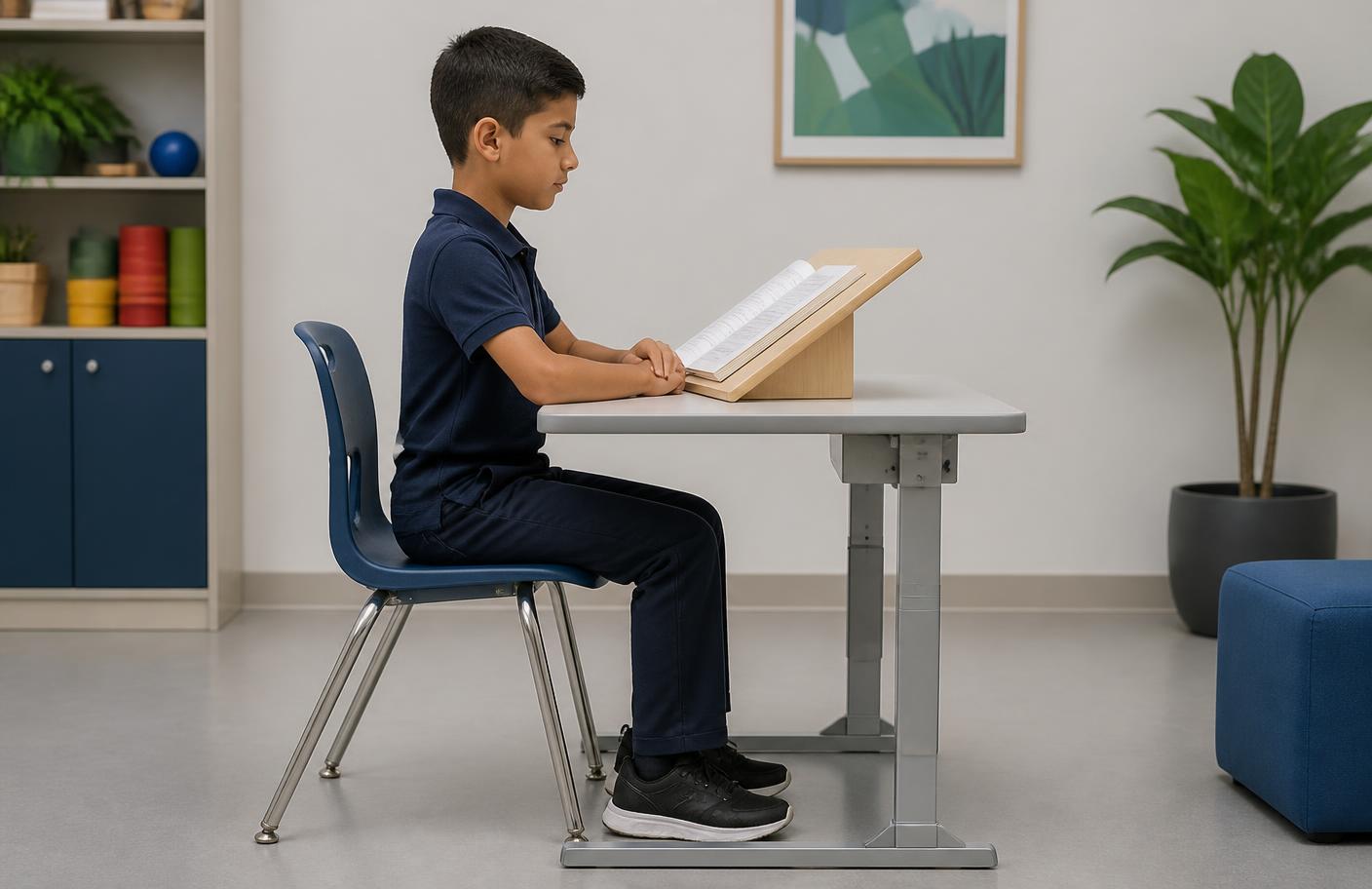
School-age student seated in neutral posture at a desk, feet flat, elbows at desk height, book on a slant board at about 40 cm

Reference posture

Feet flat, hips and knees near 90°, elbows at desk height, trunk upright and off the table.

≈40 cm at midline

A slant board holds the page at a consistent distance and angle; note any habitual 15–20 cm posture.

What to document

Head tilt, page rotation >30°, one eye closing, or distance shortening as the task lengthens.

Habitual working distance is free data. A head held at 15 cm, a persistent tilt, or a page turned 30°+ off midline all tell you something before a single probe is administered.
Vision in OT Practice
19 / 26
  • Photo showing habitual working distance, head tilt, or lighting conditions.

Say this

Describe what belongs here: Photo showing habitual working distance, head tilt, or lighting conditions..

My notes

1.20 — "Refer" does not mean "hands off"

Comparison

Scope rule

"Refer" does not mean "hands off"

Diagnosed and managed → OT addresses the functional limitation

  • Low acuity: magnification, enlarged print, working distance, seating, decluttered materials.
  • Reduced contrast: high-contrast materials, bold-line paper, reverse polarity, glare and lighting control.
  • Field loss: systematic scanning, anchoring, line tracking, intact-field placement, O&M collaboration.
  • These are Level 1 OT interventions — adaptation is intervention, not a holding pattern.

Undiagnosed, unverified, or changing → refer

  • No comprehensive exam on file, or correction not worn, outgrown, or unconfirmed.
  • A functional loss nobody has evaluated, or one that does not match the documented diagnosis.
  • Any red flag: new eye turn, new double vision, new field complaint, pain, sudden change.
  • Write the referral and put the modification in place the same day.
Finding
Diagnosed & managed → OT addresses
New / undiagnosed / changing → refer
Reduced acuity
Magnify (optical, electronic, or digital), enlarge print, increase working-distance control, reduce visual clutter, seat for viewing angle.
No comprehensive eye exam on file, correction not worn or outgrown, or a new drop in near/distance performance.
Reduced contrast sensitivity
High-contrast materials, bold line paper, dark-on-light or reverse-polarity screens, glare and lighting control, edge marking on stairs and thresholds.
Contrast difficulty never evaluated, or a functional loss that is new, worsening, or does not match the documented diagnosis.
Field loss
Teach systematic scanning, anchoring, and line-tracking; position materials and seating into the intact field; organize the workspace; travel-safety routines with the O&M specialist.
Field loss suspected but never documented, or new field complaints, bumping, or missed content on one side.
Ocular alignment, oculomotor, accommodation
Grade the visual demand of the occupation, build near-point stamina, chunk and space text, schedule visual breaks.
New eye turn, new double vision, headaches or pain with near work, or no eye care follow-up in place.

OT addresses diagnosed, medically managed limitations. A new or undiagnosed finding is a referral — the diagnosis has to come first before we treat that finding as a known visual limitation.

The standing rule: OT addresses the functional limitation only when the ocular condition is already diagnosed and medically managed. If the finding is new, undiagnosed, unclear, or changing, the appropriate OT action is referral.
Vision in OT Practice
20 / 26
  • Diagnosed and managed → OT addresses the functional limitation: Low acuity: magnification, enlarged print, working distance, seating, decluttered materials. · Reduced contrast: high-contrast materials, bold-line paper, reverse polarity, glare and lighting control. · Field loss: systematic scanning, anchoring, line tracking, intact-field placement, O&M collaboration. · These are Level 1 OT interventions — adaptation is intervention, not a holding pattern.
  • Undiagnosed, unverified, or changing → refer: No comprehensive exam on file, or correction not worn, outgrown, or unconfirmed. · A functional loss nobody has evaluated, or one that does not match the documented diagnosis. · Any red flag: new eye turn, new double vision, new field complaint, pain, sudden change. · Write the referral and put the modification in place the same day.

Say this

Contrast the two columns: Diagnosed and managed → OT addresses the functional limitation versus Undiagnosed, unverified, or changing → refer.

Diagnosed and managed → OT addresses the functional limitation:

• Low acuity: magnification, enlarged print, working distance, seating, decluttered materials.

• Reduced contrast: high-contrast materials, bold-line paper, reverse polarity, glare and lighting control.

• Field loss: systematic scanning, anchoring, line tracking, intact-field placement, O&M collaboration.

• These are Level 1 OT interventions — adaptation is intervention, not a holding pattern.

Undiagnosed, unverified, or changing → refer:

• No comprehensive exam on file, or correction not worn, outgrown, or unconfirmed.

• A functional loss nobody has evaluated, or one that does not match the documented diagnosis.

• Any red flag: new eye turn, new double vision, new field complaint, pain, sudden change.

• Write the referral and put the modification in place the same day.

Ask: "Which column is your student living in right now?"

My notes

1.21 — Two lanes, one student

Visual

Scope

Two lanes, one student

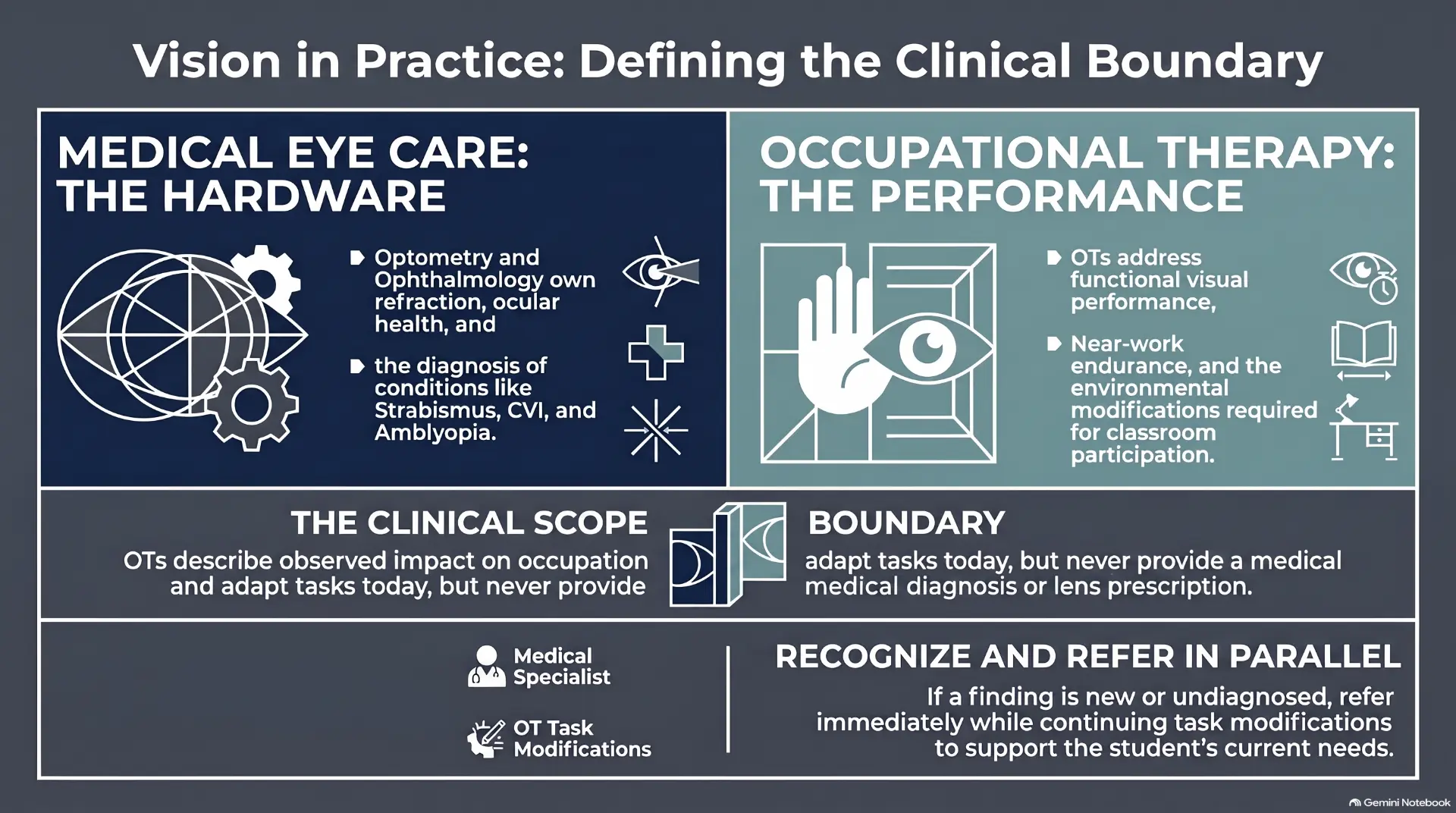
Medical eye care owns diagnosis and the optical correction; OT owns performance inside real occupations. The referral and the task modification run in parallel, on the same day.

Medical eye care owns diagnosis and the optical correction; OT owns performance inside real occupations. The referral and the task modification run in parallel, on the same day.

Vision in OT Practice
21 / 26
  • Medical eye care owns diagnosis and the optical correction; OT owns performance inside real occupations. The referral and the task modification run in parallel, on the same day.

Say this

Talk over the visual: "Two lanes, one student."

Say the caption in your own words: Medical eye care owns diagnosis and the optical correction; OT owns performance inside real occupations. The referral and the task modification run in parallel, on the same day.

My notes

1.22 — The brain's two visual highways

Video

Lecture

The brain's two visual highways

Vision in OT Practice
22 / 26
  • Ventral "what" and dorsal "where" streams, and how each one shows up in the school day.

Say this

Set up the clip in one sentence, play it, then debrief with "what did you notice?"

My notes

1.23 — So what? Scope is what keeps the student moving

So what?

So what?

So what? Scope is what keeps the student moving

If you stop treating while you wait on an eye-care report, the student loses weeks of instruction for a decision you were never going to make.

Diagnosis belongs to eye care; occupational performance under a known visual condition belongs to OT. Those two lines run in parallel, not in sequence.

What you do with it

  • Write performance language: what the student did, at what distance, for how long.
  • Send the referral the same week you observe the sign — do not wait for the next IEP date.
  • Keep the intervention plan running while the referral is out.

Watch for

A report that names a diagnosis you did not make — that is the sentence to rewrite before it goes in the file.

Vision in OT Practice
23 / 26
  • If you stop treating while you wait on an eye-care report, the student loses weeks of instruction for a decision you were never going to make.
  • Because: Diagnosis belongs to eye care; occupational performance under a known visual condition belongs to OT. Those two lines run in parallel, not in sequence.
  • Move: Write performance language: what the student did, at what distance, for how long.
  • Move: Send the referral the same week you observe the sign — do not wait for the next IEP date.
  • Move: Keep the intervention plan running while the referral is out.
  • Watch for: A report that names a diagnosis you did not make — that is the sentence to rewrite before it goes in the file.

Say this

Land the "so what": If you stop treating while you wait on an eye-care report, the student loses weeks of instruction for a decision you were never going to make.

Explain the mechanism plainly: Diagnosis belongs to eye care; occupational performance under a known visual condition belongs to OT. Those two lines run in parallel, not in sequence.

Then give them the moves — say each one as something they can do Monday:

• Write performance language: what the student did, at what distance, for how long.

• Send the referral the same week you observe the sign — do not wait for the next IEP date.

• Keep the intervention plan running while the referral is out.

Tell them what success looks like: A report that names a diagnosis you did not make — that is the sentence to rewrite before it goes in the file.

Ask: "Who has a student this describes right now?" Take one answer, then move.

My notes

1.24 — Two-minute case: the sentence you can defend

Mini case

Two-minute case

Two-minute case: the sentence you can defend

A Grade 2 teacher tells you a student "definitely has convergence insufficiency — she sees double when she reads." Nothing in the file supports a diagnosis and there is no eye-care report.

What do you write, and what do you do first?

Vision in OT Practice
24 / 26
  • A Grade 2 teacher tells you a student "definitely has convergence insufficiency — she sees double when she reads." Nothing in the file supports a diagnosis and there is no eye-care report.
  • Question: What do you write, and what do you do first?
  • Model answer: Document the observation, not the label: "During 10 minutes of near reading, the student reported intermittent doubling and stopped reading twice." Refer to eye care that week for the undiagnosed report of diplopia, notify the family, and continue OT for the near-work endurance demand while the referral is out.
  • Teaching point: Address the diagnosed, refer the undiagnosed, and never pause treatment while you wait.

Say this

Two-minute case. Read it aloud:

A Grade 2 teacher tells you a student "definitely has convergence insufficiency — she sees double when she reads." Nothing in the file supports a diagnosis and there is no eye-care report.

Put the question to them: "What do you write, and what do you do first?" Give 60 seconds, no talking.

Model answer (reveal after they commit): Document the observation, not the label: "During 10 minutes of near reading, the student reported intermittent doubling and stopped reading twice." Refer to eye care that week for the undiagnosed report of diplopia, notify the family, and continue OT for the near-work endurance demand while the referral is out.

Close with the rule: Address the diagnosed, refer the undiagnosed, and never pause treatment while you wait.

My notes

1.25 — Reflect and share

Reflection

Reflect and share

Reflect and share

Recall one referral that arrived with a visual complaint. Which part of it did you own as OT, and which part needed eye care?

THINKPROCESSSHARE
  • · Name the occupation that was breaking down.
  • · Name the one sentence you would send to the family today.
Vision in OT Practice
25 / 26
  • Recall one referral that arrived with a visual complaint. Which part of it did you own as OT, and which part needed eye care?
  • Name the occupation that was breaking down.
  • Name the one sentence you would send to the family today.
  • Starter: I own the occupational observation that... I defer to eye care the question of whether...

Say this

Reflection prompt: "Recall one referral that arrived with a visual complaint. Which part of it did you own as OT, and which part needed eye care?"

Cues:

• Name the occupation that was breaking down.

• Name the one sentence you would send to the family today.

Offer the sentence starter: "I own the occupational observation that... I defer to eye care the question of whether..."

Think for one minute, write, then take two shares.

My notes

1.26 — Knowledge check — scope

Self-check

Knowledge check

Knowledge check — scope

A student works at 15 cm from the page, squints during board copy, and reports headaches. Which statement belongs in your OT report?

Vision in OT Practice
26 / 26
  • A student works at 15 cm from the page, squints during board copy, and reports headaches. Which statement belongs in your OT report?
  • – Student demonstrates convergence insufficiency affecting near work.
  • ✓ Student sustained near work at a 15 cm working distance and reported headache after 10 minutes of reading; eye examination recommended.
  • – Student requires vision therapy to normalize binocular function.
  • – Student needs reading glasses for classroom tasks.
  • Rationale: Objective performance under a stated condition, plus a referral. Diagnosis, optical recommendations, and therapy prescriptions belong to the eye care provider.

Say this

Knowledge check: "A student works at 15 cm from the page, squints during board copy, and reports headaches. Which statement belongs in your OT report?"

Options:

• Student demonstrates convergence insufficiency affecting near work.

• Student sustained near work at a 15 cm working distance and reported headache after 10 minutes of reading; eye examination recommended.

• Student requires vision therapy to normalize binocular function.

• Student needs reading glasses for classroom tasks.

Correct answer: option 2. Rationale: Objective performance under a stated condition, plus a referral. Diagnosis, optical recommendations, and therapy prescriptions belong to the eye care provider.

My notes

Module 2

2.1 — A Structured, Level-Based Visual Performance Framework for Clinical Reasoning

Transition

Module 2

A Structured, Level-Based Visual Performance Framework for Clinical Reasoning

0:22 – 0:52

Vision in OT Practice
1 / 36
  • 0:22 – 0:52

Say this

Transition: "A Structured, Level-Based Visual Performance Framework for Clinical Reasoning."

My notes

2.2 — The Five-Level Visual Performance Framework

Title

Module 2

The Five-Level Visual Performance Framework

A developmental hierarchy that organizes observation, assessment, and intervention.

Vision in OT Practice
2 / 36
  • A developmental hierarchy that organizes observation, assessment, and intervention.

Say this

Open here. "The Five-Level Visual Performance Framework." A developmental hierarchy that organizes observation, assessment, and intervention.

Say why this section matters for their caseload, then advance.

My notes

2.3 — Where does your caseload live?

Poll

Poll

Where does your caseload live?

Which framework levels do your current goals most often target?

Vision in OT Practice
3 / 36
  • Which framework levels do your current goals most often target?
  • – Level 1 — acuity and sensory access
  • – Level 2 — visual efficiency
  • – Level 3 — visual processing
  • – Level 4 — visual-motor integration
  • – Level 5 — functional integration

Say this

Ask the poll: "Which framework levels do your current goals most often target?"

Options:

• Level 1 — acuity and sensory access

• Level 2 — visual efficiency

• Level 3 — visual processing

• Level 4 — visual-motor integration

• Level 5 — functional integration

Take a show of hands or the on-screen tally, then name the pattern you see before advancing.

My notes

2.4 — Beyond 20/20 — the Visual Performance System™

Visual

Framework

Beyond 20/20 — the Visual Performance System™

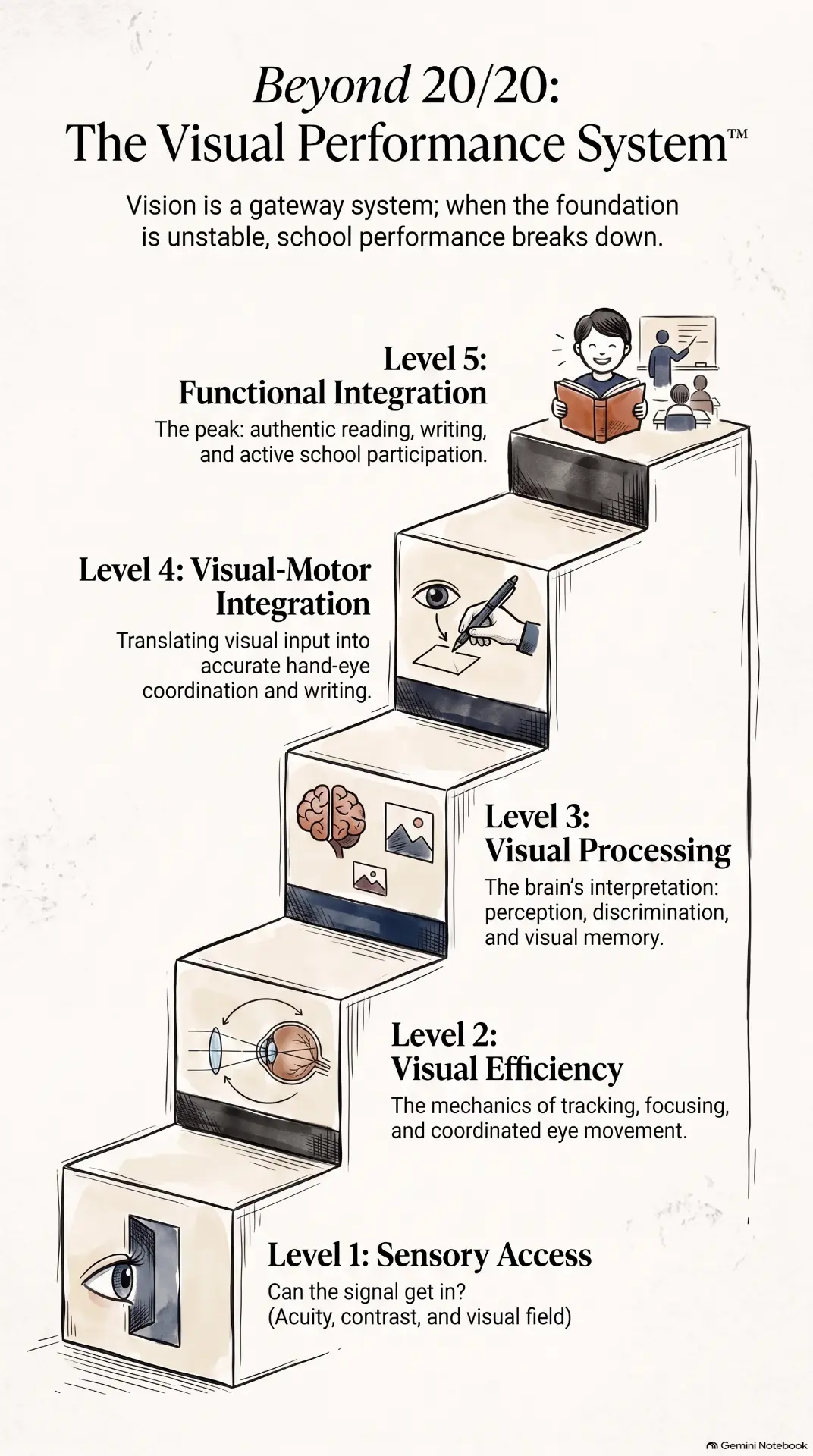
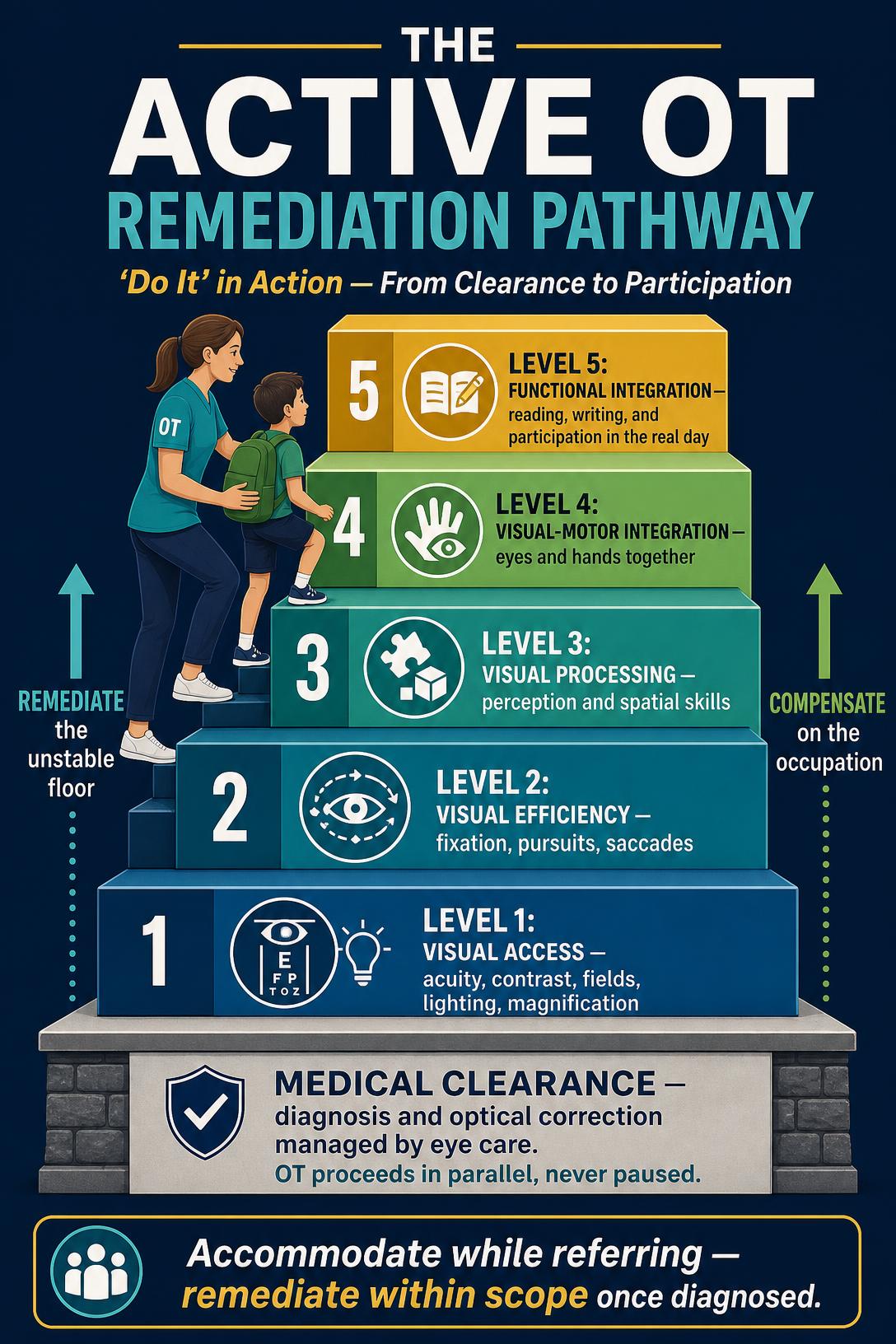
Level 1 Visual Access → Level 2 Visual Efficiency → Level 3 Visual Processing → Level 4 Visual-Motor Integration → Level 5 Functional Integration.

Level 1 Visual Access → Level 2 Visual Efficiency → Level 3 Visual Processing → Level 4 Visual-Motor Integration → Level 5 Functional Integration.

Vision in OT Practice
4 / 36
  • Level 1 Visual Access → Level 2 Visual Efficiency → Level 3 Visual Processing → Level 4 Visual-Motor Integration → Level 5 Functional Integration.

Say this

Talk over the visual: "Beyond 20/20 — the Visual Performance System™."

Say the caption in your own words: Level 1 Visual Access → Level 2 Visual Efficiency → Level 3 Visual Processing → Level 4 Visual-Motor Integration → Level 5 Functional Integration.

My notes

2.5 — Visual development milestones OTs should know

Teaching slide

Development

Visual development milestones OTs should know

  • Basic eye movement control (fixation, following) is commonly described as established by 2–3 months of age.
  • Coordinated eye movement control is commonly described as expected by about 2 years.
  • Complex visual-motor and visual-perceptual control is commonly described as continuing to mature until roughly 9 years — the age by which most school-readiness visual skills are expected to be reliable.
  • Visual acuity is commonly described as progressing rapidly in infancy and approaching adult levels well before school entry, while efficiency and processing skills mature much later.
  • Eye dominance (sighting preference) is commonly described as emerging and stabilizing in stages — around ages 4, 7, and 12 — with instability past those windows worth noting, not diagnosing.
BirthLight response,brief fixation2–3 moSmooth pursuit,social fixation4–6 moBinocularity,reach-to-graspunder vision1–2 yrVisually guidedmobility, formmatching3–5 yrForm constancy,copying, sustainednear work6–9 yrReading endurance,fluent saccades
Visual function matures in an ordered sequence. Knowing the expected sequence is what lets you call a finding delayed rather than merely low.
Vision in OT Practice
5 / 36
  • Basic eye movement control (fixation, following) is commonly described as established by 2–3 months of age.
  • Coordinated eye movement control is commonly described as expected by about 2 years.
  • Complex visual-motor and visual-perceptual control is commonly described as continuing to mature until roughly 9 years — the age by which most school-readiness visual skills are expected to be reliable.
  • Visual acuity is commonly described as progressing rapidly in infancy and approaching adult levels well before school entry, while efficiency and processing skills mature much later.
  • Eye dominance (sighting preference) is commonly described as emerging and stabilizing in stages — around ages 4, 7, and 12 — with instability past those windows worth noting, not diagnosing.

Say this

Frame the slide: "Visual development milestones OTs should know."

Walk each point, one sentence each:

• Basic eye movement control (fixation, following) is commonly described as established by 2–3 months of age.

• Coordinated eye movement control is commonly described as expected by about 2 years.

• Complex visual-motor and visual-perceptual control is commonly described as continuing to mature until roughly 9 years — the age by which most school-readiness visual skills are expected to be reliable.

• Visual acuity is commonly described as progressing rapidly in infancy and approaching adult levels well before school entry, while efficiency and processing skills mature much later.

• Eye dominance (sighting preference) is commonly described as emerging and stabilizing in stages — around ages 4, 7, and 12 — with instability past those windows worth noting, not diagnosing.

Point at the figure while you talk — name the parts before the labels.

Close with: "If you only take one of these back, take the first one."

My notes

2.6 — Two visual pathways, two kinds of classroom breakdown

Comparison

Neuroanatomy

Two visual pathways, two kinds of classroom breakdown

Ventral / parvocellular ("what" pathway)

  • Carries fine detail, color, and form for object and letter identification
  • Classroom sign: confuses similar letters/numbers (b/d, 6/9)
  • Classroom sign: struggles to identify an object embedded in a busy picture
  • Classroom sign: slow, effortful sight-word recognition despite adequate acuity

Dorsal / magnocellular ("where" pathway)

  • Carries motion, spatial location, and visual guidance of movement
  • Classroom sign: misjudges distance when reaching, stepping, or catching
  • Classroom sign: loses place moving between lines or from board to desk
  • Classroom sign: difficulty with maps, block designs, or spatial math layout
RetinaMagnocellularHighwayParvocellularHighwayLGNtraffic controlcenterV1striate cortexVPA link: Field & attention + Oculomotor efficiencyMagno/dorsal dominance supports scanning, tracking, and spatial action.VPA link: Visual-perceptual processingParvo/ventral dominance supports discrimination, closure, memory, and form.
The retina sends two parallel “highways” to the LGN: the magnocellular tract handles motion, contrast, and spatial-action cues; the parvocellular tract handles detail, color, and object recognition. Both pass through the LGN, then split into the dorsal (where/how) and ventral (what) streams.
Vision in OT Practice
6 / 36
  • Ventral / parvocellular ("what" pathway): Carries fine detail, color, and form for object and letter identification · Classroom sign: confuses similar letters/numbers (b/d, 6/9) · Classroom sign: struggles to identify an object embedded in a busy picture · Classroom sign: slow, effortful sight-word recognition despite adequate acuity
  • Dorsal / magnocellular ("where" pathway): Carries motion, spatial location, and visual guidance of movement · Classroom sign: misjudges distance when reaching, stepping, or catching · Classroom sign: loses place moving between lines or from board to desk · Classroom sign: difficulty with maps, block designs, or spatial math layout

Say this

Contrast the two columns: Ventral / parvocellular ("what" pathway) versus Dorsal / magnocellular ("where" pathway).

Ventral / parvocellular ("what" pathway):

• Carries fine detail, color, and form for object and letter identification

• Classroom sign: confuses similar letters/numbers (b/d, 6/9)

• Classroom sign: struggles to identify an object embedded in a busy picture

• Classroom sign: slow, effortful sight-word recognition despite adequate acuity

Dorsal / magnocellular ("where" pathway):

• Carries motion, spatial location, and visual guidance of movement

• Classroom sign: misjudges distance when reaching, stepping, or catching

• Classroom sign: loses place moving between lines or from board to desk

• Classroom sign: difficulty with maps, block designs, or spatial math layout

Ask: "Which column is your student living in right now?"

My notes

2.7 — Vision's two highways in the school day

Visual

Classroom translation

Vision's two highways in the school day

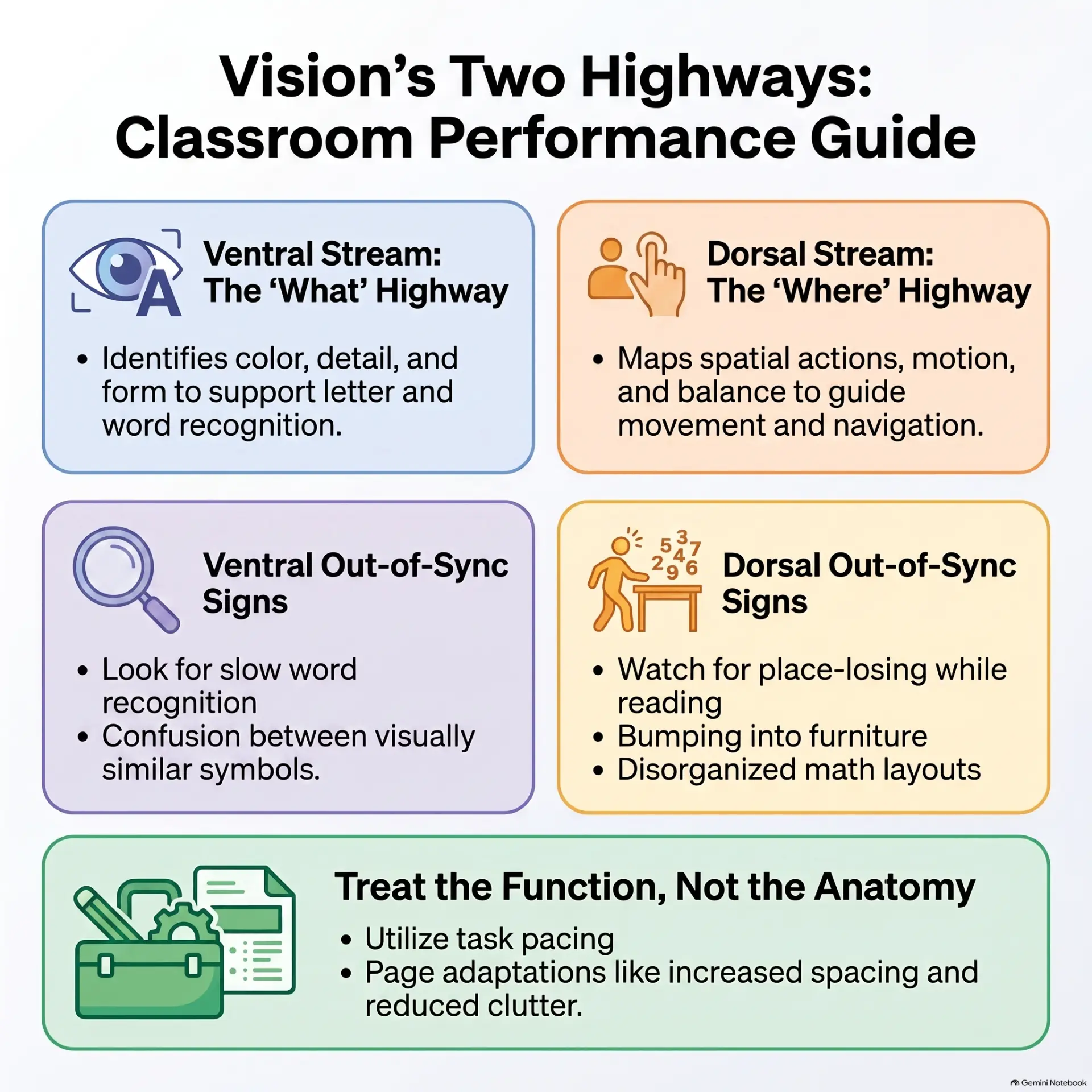
Ventral "what" signs versus dorsal "where" signs, side by side with the classroom behaviors each one produces.

Ventral "what" signs versus dorsal "where" signs, side by side with the classroom behaviors each one produces.

Vision in OT Practice
7 / 36
  • Ventral "what" signs versus dorsal "where" signs, side by side with the classroom behaviors each one produces.

Say this

Talk over the visual: "Vision's two highways in the school day."

Say the caption in your own words: Ventral "what" signs versus dorsal "where" signs, side by side with the classroom behaviors each one produces.

My notes

2.8 — How the Five-Level Framework was built

Teaching slide

Where the framework comes from

How the Five-Level Framework was built

  • OTPF-4 names visual functions as client factors — the framework simply organizes them by the order they have to be stable in.
  • The developmental sequence of visual skill sets the floor order: sensory access, then efficiency, then processing, then visual-motor control, then occupation.
  • Dual-stream neuroscience explains why two students fail the same worksheet for opposite reasons, so each level carries its own probe.
  • School caseload data shaped the level definitions around what can actually be measured in a 30-minute session and written into an IEP.
  • The clinical rule holds at every floor: an unstable higher level is never trusted until the levels beneath it are confirmed stable.

OTPF-4 client factors

Visual functions named as body functions that shape occupational performance.

Visual development sequence

Fixation and following, then efficiency, then perception, then visual-motor control.

Dual-stream neuroscience

Ventral "what" and dorsal "where" pathways predict two different classroom breakdowns.

School-based caseload data

Referral patterns, work samples, and re-probe data from school OT practice.

The five levels exist to make one decision repeatable: identify the lowest unstable floor, stabilize it, and keep the outcome measured in the occupation.

The Five-Level Visual Performance Framework is organized from OTPF-4 client-factor language, the developmental sequence of visual skill, dual-stream visual neuroscience, and school-based caseload data.
Vision in OT Practice
8 / 36
  • OTPF-4 names visual functions as client factors — the framework simply organizes them by the order they have to be stable in.
  • The developmental sequence of visual skill sets the floor order: sensory access, then efficiency, then processing, then visual-motor control, then occupation.
  • Dual-stream neuroscience explains why two students fail the same worksheet for opposite reasons, so each level carries its own probe.
  • School caseload data shaped the level definitions around what can actually be measured in a 30-minute session and written into an IEP.
  • The clinical rule holds at every floor: an unstable higher level is never trusted until the levels beneath it are confirmed stable.

Say this

Frame the slide: "How the Five-Level Framework was built."

Walk each point, one sentence each:

• OTPF-4 names visual functions as client factors — the framework simply organizes them by the order they have to be stable in.

• The developmental sequence of visual skill sets the floor order: sensory access, then efficiency, then processing, then visual-motor control, then occupation.

• Dual-stream neuroscience explains why two students fail the same worksheet for opposite reasons, so each level carries its own probe.

• School caseload data shaped the level definitions around what can actually be measured in a 30-minute session and written into an IEP.

• The clinical rule holds at every floor: an unstable higher level is never trusted until the levels beneath it are confirmed stable.

Point at the figure while you talk — name the parts before the labels.

Close with: "If you only take one of these back, take the first one."

My notes

2.9 — One example per level

Visual

Worked examples

One example per level

Level 1 · Access

You seeHolds the packet 10 cm from the face; misses every item on the faded copy.You probeNear acuity and contrast trial at the desk.You doHigh-contrast original, 16 pt, glare control; eye-exam referral if undiagnosed.

Level 2 · Efficiency

You seeLoses place three times per paragraph; accurate until minute 8, then falls apart.You probeTimed passage with line-loss count, near–far transitions.You doGraded scanning in real class text; fade finger → card → typoscope.

Level 3 · Processing

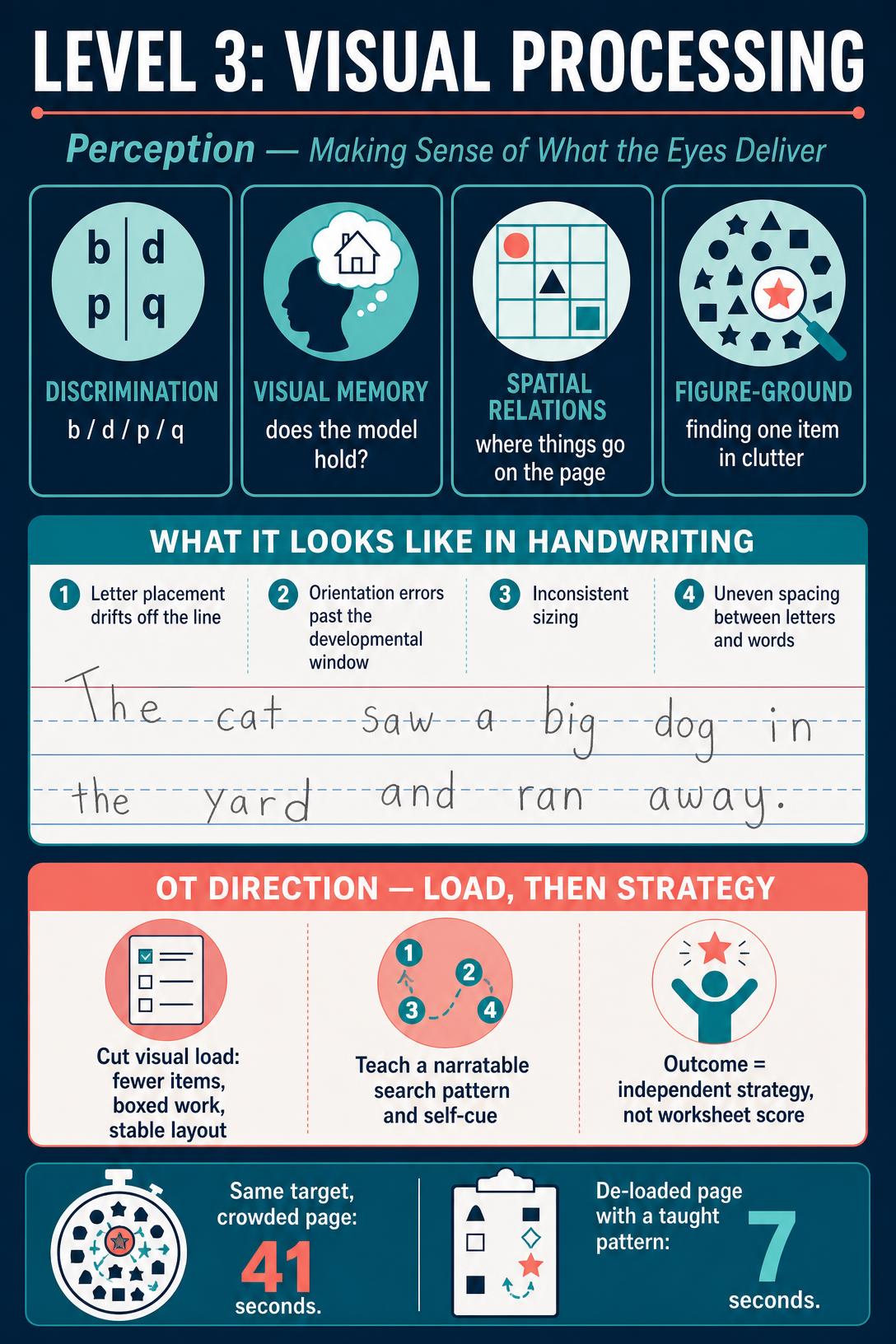
You seeCannot find the item on a crowded page; b/d confusion past the developmental window.You probeSame target on a loaded vs. de-loaded page, timed.You doCut visual load, teach a narratable search pattern, preview the page.

Level 4 · Visual-motor

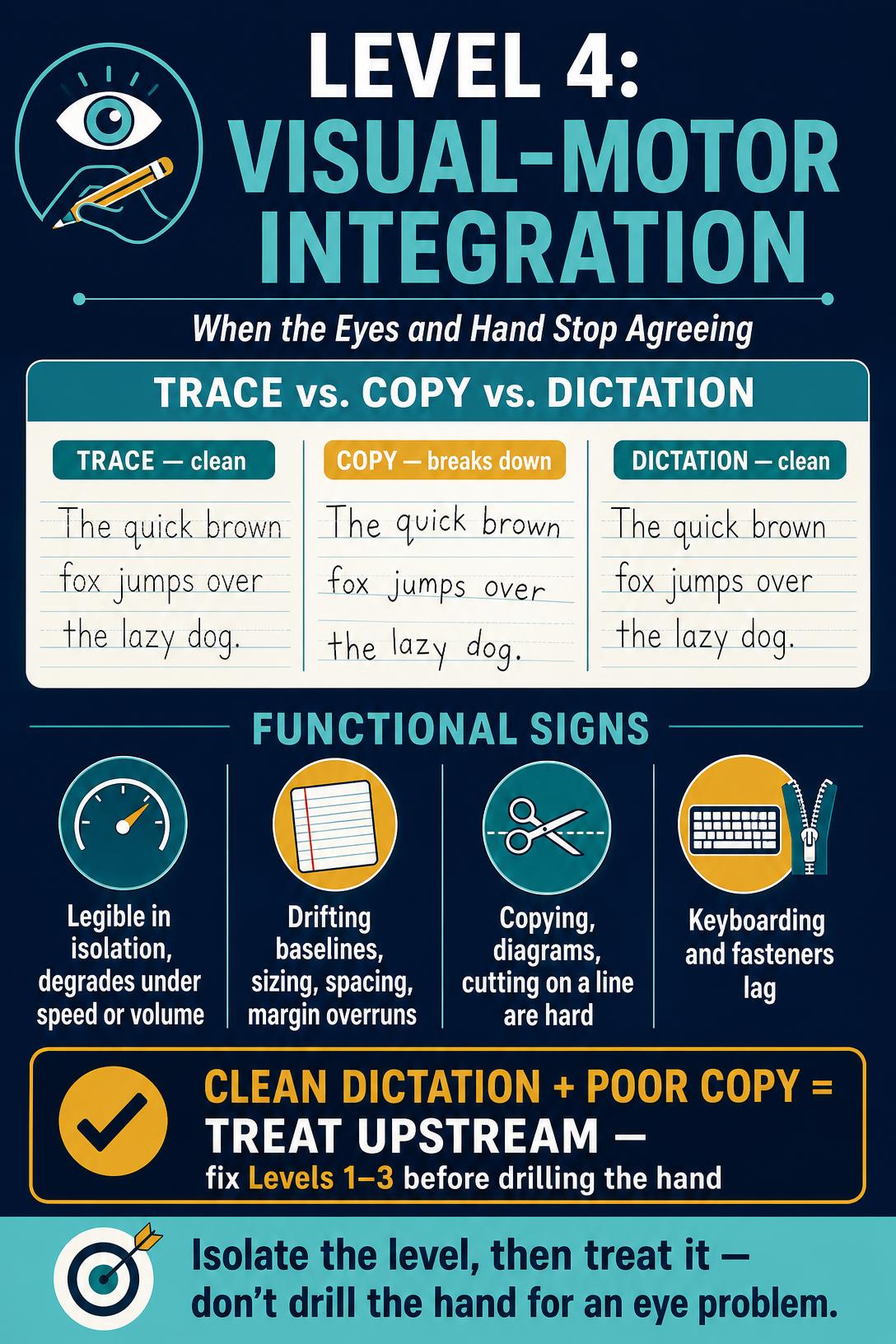
You seeLegible when traced, drifting and uneven when copied from the board.You probeTrace vs. copy vs. dictation on the same sentence.You doShrinking model, part-to-whole, spatial scaffolds; reduce copy volume.

Level 5 · Functional

You seeReads 4 minutes before quitting; writes far below what he can say aloud.You probeThe classroom occupation itself, timed and scored.You doGoal in minutes, accuracy, and output; intervene on the unstable floor beneath it.
One worked example per level — what you see, the probe that confirms it, and the OT move that follows.

What you see, the probe that confirms it, and the OT move that follows — for all five levels.

Vision in OT Practice
9 / 36
  • What you see, the probe that confirms it, and the OT move that follows — for all five levels.
  • Diagram: level-examples-grid

Say this

Talk over the visual: "One example per level."

Say the caption in your own words: What you see, the probe that confirms it, and the OT move that follows — for all five levels.

My notes

2.10 — Five levels, bottom to top

Five-Level Framework

The ladder

Five levels, bottom to top

1

Visual Acuity & Sensory Foundation

Can the visual signal get in clearly enough to use?

2

Visual Efficiency

Fixation, pursuits, saccades, binocular comfort, near endurance.

3

Visual Processing

Discrimination, memory, closure, figure-ground, form constancy, spatial relations.

4

Visual-Motor Integration

Translating what is seen into graded, accurate motor output.

5

Functional Integration

Reading, writing, and task performance under real classroom demand.

Vision in OT Practice
10 / 36
  • Level 1 — Visual Acuity & Sensory Foundation: Can the visual signal get in clearly enough to use?
  • Level 2 — Visual Efficiency: Fixation, pursuits, saccades, binocular comfort, near endurance.
  • Level 3 — Visual Processing: Discrimination, memory, closure, figure-ground, form constancy, spatial relations.
  • Level 4 — Visual-Motor Integration: Translating what is seen into graded, accurate motor output.
  • Level 5 — Functional Integration: Reading, writing, and task performance under real classroom demand.

Say this

Run the five levels bottom-up.

Name each level, then say which one you assess first and why.

My notes

2.11 — What it looks like — and what OT does

Comparison

Level 1 · Visual Access

What it looks like — and what OT does

Functional signs

  • Print held very close or pushed away; head tilt
  • Fails photocopied/low-contrast packets, fine on crisp ones
  • Performance drops in window glare or late in the day
  • Misses curb edges, thresholds, food on the plate

OT direction — adapt and refer

  • Raise contrast; enlarge by task, not globally
  • Kill glare; control clutter and spacing
  • Set working distance where performance is best
  • Write the eye-exam referral in parallel, not after
Vision in OT Practice
11 / 36
  • Functional signs: Print held very close or pushed away; head tilt · Fails photocopied/low-contrast packets, fine on crisp ones · Performance drops in window glare or late in the day · Misses curb edges, thresholds, food on the plate
  • OT direction — adapt and refer: Raise contrast; enlarge by task, not globally · Kill glare; control clutter and spacing · Set working distance where performance is best · Write the eye-exam referral in parallel, not after

Say this

Contrast the two columns: Functional signs versus OT direction — adapt and refer.

Functional signs:

• Print held very close or pushed away; head tilt

• Fails photocopied/low-contrast packets, fine on crisp ones

• Performance drops in window glare or late in the day

• Misses curb edges, thresholds, food on the plate

OT direction — adapt and refer:

• Raise contrast; enlarge by task, not globally

• Kill glare; control clutter and spacing

• Set working distance where performance is best

• Write the eye-exam referral in parallel, not after

Ask: "Which column is your student living in right now?"

My notes

2.12 — Access, before and after

Visual

Level 1 in the real work

Access, before and after

What the student was handed

3rd-generation photocopy, 11 pt, glossy paper near a window. Reads 4 of 12 items in 5 minutes.

Same content, access fixed

Clean black-on-cream original, 16 pt, matte paper, glare controlled. Reads 11 of 12 items in the same 5 minutes.

Nothing about the student changed between these two panels. If a level-1 change produces the gain, the finding is access — not processing, and not motivation.

Level 1 · Access — the same worksheet at faded photocopy contrast and at full contrast with larger print. Trial the condition, record the one that works, and write it into accommodations.

The same worksheet at photocopy contrast and at full contrast with larger print — the gain came from the page, not the student.

Vision in OT Practice
12 / 36
  • The same worksheet at photocopy contrast and at full contrast with larger print — the gain came from the page, not the student.
  • Diagram: level-1-example

Say this

Talk over the visual: "Access, before and after."

Say the caption in your own words: The same worksheet at photocopy contrast and at full contrast with larger print — the gain came from the page, not the student.

My notes

2.13 — What it looks like — and what OT does

Comparison

Level 2 · Visual efficiency

What it looks like — and what OT does

Functional signs

  • Loses place, re-reads, finger-tracks past expected age
  • Accurate early, degrades by minute 8–10
  • Blur, doubling, headache, "words move" after near work
  • Reads as inattention in the last block of the day

OT direction — remediate + support

  • Graded scanning and cancellation on real class text
  • Near–far transitions tied to board-to-desk copying
  • Fade support: finger → card → typoscope → none
  • Keep a compensatory tool while stamina is built
Vision in OT Practice
13 / 36
  • Functional signs: Loses place, re-reads, finger-tracks past expected age · Accurate early, degrades by minute 8–10 · Blur, doubling, headache, "words move" after near work · Reads as inattention in the last block of the day
  • OT direction — remediate + support: Graded scanning and cancellation on real class text · Near–far transitions tied to board-to-desk copying · Fade support: finger → card → typoscope → none · Keep a compensatory tool while stamina is built

Say this

Contrast the two columns: Functional signs versus OT direction — remediate + support.

Functional signs:

• Loses place, re-reads, finger-tracks past expected age

• Accurate early, degrades by minute 8–10

• Blur, doubling, headache, "words move" after near work

• Reads as inattention in the last block of the day

OT direction — remediate + support:

• Graded scanning and cancellation on real class text

• Near–far transitions tied to board-to-desk copying

• Fade support: finger → card → typoscope → none

• Keep a compensatory tool while stamina is built

Ask: "Which column is your student living in right now?"

My notes

2.14 — Line loss and the stamina curve

Visual

Level 2 in the real work

Line loss and the stamina curve

Observed scan path

Red points mark a re-read, a skipped line, and a lost return sweep in a 2-minute passage.

Accuracy over time on task

0 min12 min

Accurate at the start, degrading past minute 8 — a stamina signature, not a skill the student never had.

Level 2 · Visual efficiency — line loss on a timed passage and the accuracy decay curve that separates an efficiency problem from an attention problem.

Place-keeping errors across a 2-minute passage, and accuracy decaying past minute 8 — an efficiency signature, not inattention.

Vision in OT Practice
14 / 36
  • Place-keeping errors across a 2-minute passage, and accuracy decaying past minute 8 — an efficiency signature, not inattention.
  • Diagram: level-2-example

Say this

Talk over the visual: "Line loss and the stamina curve."

Say the caption in your own words: Place-keeping errors across a 2-minute passage, and accuracy decaying past minute 8 — an efficiency signature, not inattention.

My notes

2.15 — Oculomotor control — the movement systems

Visual

Level 2 · Visual efficiency

Oculomotor control — the movement systems

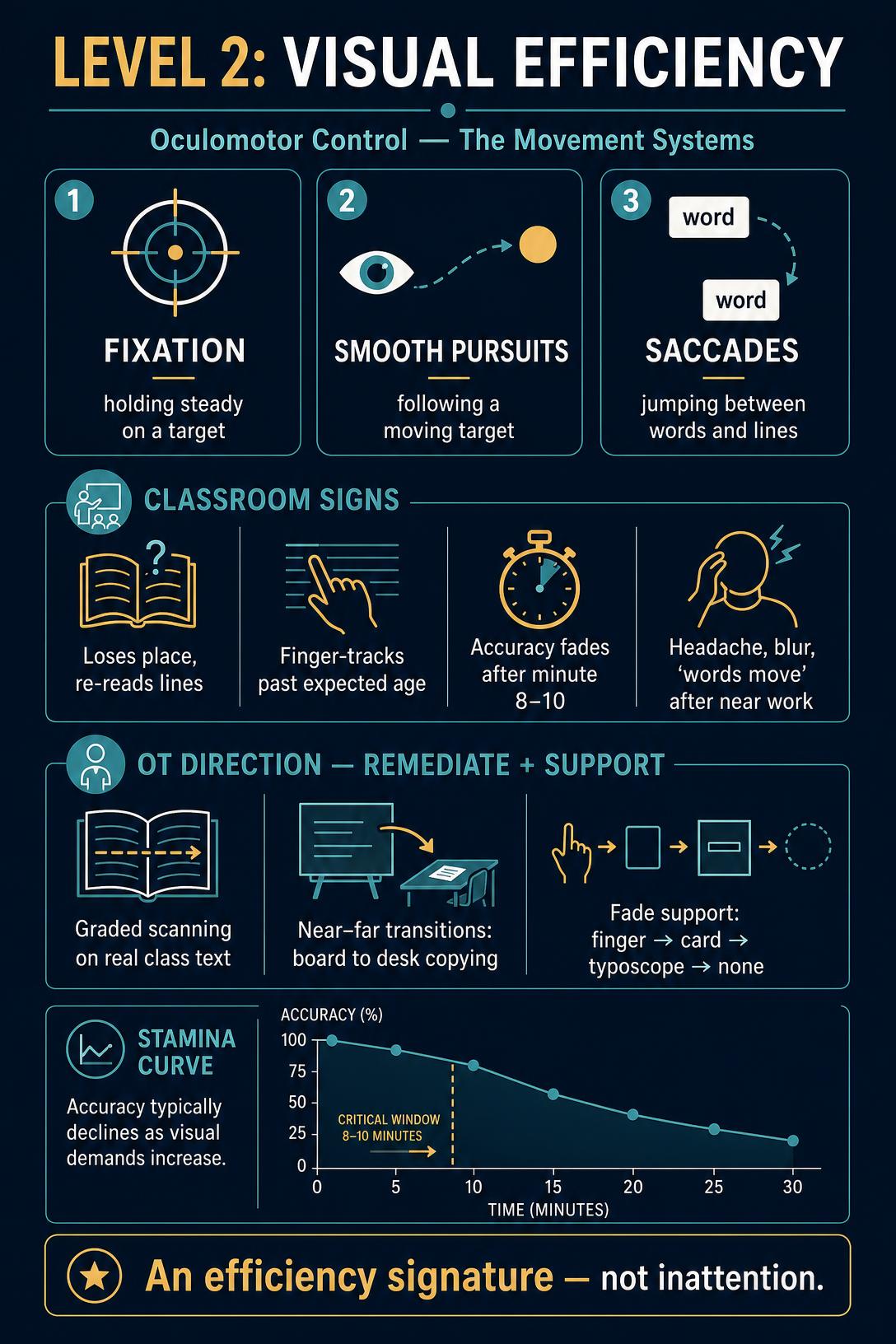
Fixation, smooth pursuits, and saccades carry reading and copying. When they fatigue, accuracy decays on a predictable curve — the classroom signs and the OT directions, side by side.

Fixation, smooth pursuits, and saccades carry reading and copying. When they fatigue, accuracy decays on a predictable curve — the classroom signs and the OT directions, side by side.

Vision in OT Practice
15 / 36
  • Fixation, smooth pursuits, and saccades carry reading and copying. When they fatigue, accuracy decays on a predictable curve — the classroom signs and the OT directions, side by side.

Say this

Talk over the visual: "Oculomotor control — the movement systems."

Say the caption in your own words: Fixation, smooth pursuits, and saccades carry reading and copying. When they fatigue, accuracy decays on a predictable curve — the classroom signs and the OT directions, side by side.

My notes

2.16 — What it looks like — and what OT does

Comparison

Level 3 · Visual processing

What it looks like — and what OT does

Functional signs

  • Cannot find the item on a busy page or crowded hook rack
  • b/d/p/q confusion past the developmental window
  • Many glances per copied word; model does not hold
  • Reverses place value; struggles with maps and diagrams

OT direction — load, then strategy

  • Cut visual load: fewer items, boxed work, stable layout
  • Teach a narratable search pattern and self-cue
  • Chunk the model; preview the page for landmarks
  • Outcome = independent strategy, not worksheet score
Vision in OT Practice
16 / 36
  • Functional signs: Cannot find the item on a busy page or crowded hook rack · b/d/p/q confusion past the developmental window · Many glances per copied word; model does not hold · Reverses place value; struggles with maps and diagrams
  • OT direction — load, then strategy: Cut visual load: fewer items, boxed work, stable layout · Teach a narratable search pattern and self-cue · Chunk the model; preview the page for landmarks · Outcome = independent strategy, not worksheet score

Say this

Contrast the two columns: Functional signs versus OT direction — load, then strategy.

Functional signs:

• Cannot find the item on a busy page or crowded hook rack

• b/d/p/q confusion past the developmental window

• Many glances per copied word; model does not hold

• Reverses place value; struggles with maps and diagrams

OT direction — load, then strategy:

• Cut visual load: fewer items, boxed work, stable layout

• Teach a narratable search pattern and self-cue

• Chunk the model; preview the page for landmarks

• Outcome = independent strategy, not worksheet score

Ask: "Which column is your student living in right now?"

My notes

2.17 — Visual load on the page

Visual

Level 3 in the real work

Visual load on the page

High visual load

Target square is present. Median search time 41 s, two prompts required.

Load reduced, strategy taught

Boxed layout plus a narrated left-to-right sweep: 7 s, no prompts, strategy stated aloud.

Level 3 · Visual processing — the same target item on a crowded page and on a de-loaded page. Level 3 work is about search strategy and visual load, not worksheet score.

Same target item on a crowded page and a de-loaded page with a taught search pattern: 41 seconds with prompts vs. 7 seconds without.

Vision in OT Practice
17 / 36
  • Same target item on a crowded page and a de-loaded page with a taught search pattern: 41 seconds with prompts vs. 7 seconds without.
  • Diagram: level-3-example

Say this

Talk over the visual: "Visual load on the page."

Say the caption in your own words: Same target item on a crowded page and a de-loaded page with a taught search pattern: 41 seconds with prompts vs. 7 seconds without.

My notes

2.18 — Perception — and what it looks like in handwriting

Visual

Level 3 · Visual processing

Perception — and what it looks like in handwriting

Discrimination, visual memory, spatial relations, and figure-ground — and how each one surfaces on the page as placement, orientation, sizing, and spacing errors.

Discrimination, visual memory, spatial relations, and figure-ground — and how each one surfaces on the page as placement, orientation, sizing, and spacing errors.

Vision in OT Practice
18 / 36
  • Discrimination, visual memory, spatial relations, and figure-ground — and how each one surfaces on the page as placement, orientation, sizing, and spacing errors.

Say this

Talk over the visual: "Perception — and what it looks like in handwriting."

Say the caption in your own words: Discrimination, visual memory, spatial relations, and figure-ground — and how each one surfaces on the page as placement, orientation, sizing, and spacing errors.

My notes

2.19 — What it looks like — and what OT does

Comparison

Level 4 · Visual-motor integration

What it looks like — and what OT does

Functional signs

  • Legible in isolation, degrades under speed or volume
  • Drifting baselines, sizing, spacing, margin overruns
  • Copying, diagrams, and cutting on a line are hard
  • Keyboarding accuracy and fastener tasks lag

OT direction — isolate, then treat

  • Compare trace vs. copy vs. dictation before planning
  • Clean dictation + poor copy = treat upstream levels
  • Shrinking model, part-to-whole, spatial scaffolds
  • Pair with access: reduced copy volume, notes, tech
Vision in OT Practice
19 / 36
  • Functional signs: Legible in isolation, degrades under speed or volume · Drifting baselines, sizing, spacing, margin overruns · Copying, diagrams, and cutting on a line are hard · Keyboarding accuracy and fastener tasks lag
  • OT direction — isolate, then treat: Compare trace vs. copy vs. dictation before planning · Clean dictation + poor copy = treat upstream levels · Shrinking model, part-to-whole, spatial scaffolds · Pair with access: reduced copy volume, notes, tech

Say this

Contrast the two columns: Functional signs versus OT direction — isolate, then treat.

Functional signs:

• Legible in isolation, degrades under speed or volume

• Drifting baselines, sizing, spacing, margin overruns

• Copying, diagrams, and cutting on a line are hard

• Keyboarding accuracy and fastener tasks lag

OT direction — isolate, then treat:

• Compare trace vs. copy vs. dictation before planning

• Clean dictation + poor copy = treat upstream levels

• Shrinking model, part-to-whole, spatial scaffolds

• Pair with access: reduced copy volume, notes, tech

Ask: "Which column is your student living in right now?"

My notes

2.20 — Trace vs. copy vs. dictation

Visual

Level 4 in the real work

Trace vs. copy vs. dictation

Traced

Legible, even sizing, on the line.

Copied from a model

Baseline drifts, spacing collapses, letters resize — the copy demand is what broke it.

From dictation

Clean dictation with a poor copy points upstream — treat Levels 1–3 before drilling the hand.

Level 4 · Visual-motor integration — the same sentence traced, copied from a model, and written from dictation. Comparing the three tells you whether the breakdown is motor output or an upstream level.

Three writing samples of the same sentence. Clean dictation with a poor copy points upstream — treat Levels 1–3 before drilling the hand.

Vision in OT Practice
20 / 36
  • Three writing samples of the same sentence. Clean dictation with a poor copy points upstream — treat Levels 1–3 before drilling the hand.
  • Diagram: level-4-example

Say this

Talk over the visual: "Trace vs. copy vs. dictation."

Say the caption in your own words: Three writing samples of the same sentence. Clean dictation with a poor copy points upstream — treat Levels 1–3 before drilling the hand.

My notes

2.21 — When the eyes and hand stop agreeing

Visual

Level 4 · Visual-motor integration

When the eyes and hand stop agreeing

The trace–copy–dictation comparison at a glance, with the functional signs and the clinical rule that keeps you from drilling the hand for an eye problem.

The trace–copy–dictation comparison at a glance, with the functional signs and the clinical rule that keeps you from drilling the hand for an eye problem.

Vision in OT Practice
21 / 36
  • The trace–copy–dictation comparison at a glance, with the functional signs and the clinical rule that keeps you from drilling the hand for an eye problem.

Say this

Talk over the visual: "When the eyes and hand stop agreeing."

Say the caption in your own words: The trace–copy–dictation comparison at a glance, with the functional signs and the clinical rule that keeps you from drilling the hand for an eye problem.

My notes

2.22 — Where the goal lives

Comparison

Level 5 · Functional integration

Where the goal lives

Functional signs

  • Reading rate and endurance below expectation
  • Written output far below spoken capability
  • Incomplete work, avoidance, late-period fatigue
  • Multi-step visual tasks fail in class and community

OT direction — measure the occupation

  • Goal = sustained minutes, accuracy, output, independence
  • Intervention sits on whichever floor is unstable
  • Document the chain: occupation → level → dose → probe
  • Re-probe with the identical baseline task
Condition

During grade-level copy tasks from the board

→ Occupation-based context

Learner

the student will

Behavior

accurately copy 5 sentences with correct spacing and letter placement

→ Level 4 — Visual-Motor Integration

Criterion

in 4 of 5 opportunities across 3 consecutive sessions

→ Measurable, defensible

Support

with slant board and visually-simplified target as needed

→ Adapt & Refer language (Level 1)

Anatomy of an OT-authored IEP goal that survives Medicaid audit and speaks to the Five-Level Framework.
Vision in OT Practice
22 / 36
  • Functional signs: Reading rate and endurance below expectation · Written output far below spoken capability · Incomplete work, avoidance, late-period fatigue · Multi-step visual tasks fail in class and community
  • OT direction — measure the occupation: Goal = sustained minutes, accuracy, output, independence · Intervention sits on whichever floor is unstable · Document the chain: occupation → level → dose → probe · Re-probe with the identical baseline task

Say this

Contrast the two columns: Functional signs versus OT direction — measure the occupation.

Functional signs:

• Reading rate and endurance below expectation

• Written output far below spoken capability

• Incomplete work, avoidance, late-period fatigue

• Multi-step visual tasks fail in class and community

OT direction — measure the occupation:

• Goal = sustained minutes, accuracy, output, independence

• Intervention sits on whichever floor is unstable

• Document the chain: occupation → level → dose → probe

• Re-probe with the identical baseline task

Ask: "Which column is your student living in right now?"

My notes

2.23 — Where the goal line sits

Visual

Level 5 in the real work

Where the goal line sits

Sustained silent reading
baseline 4 min
9 wks 14 min
Sentences copied from board
baseline 2 of 5
9 wks 5 of 5
Written words in 10 min
baseline 21 words
9 wks 58 words
Worksheets finished in class
baseline 30 %
9 wks 85 %

Re-probe with the identical baseline task. Change the task and the gain is no longer measurable.

Level 5 · Functional integration — the goal line always sits in the occupation. Intervention may target Level 2 or 4, but the probe that decides progress is the classroom task itself.

Baseline and 9-week re-probe on the occupations themselves: sustained reading minutes, sentences copied, written output, and work completion.

Vision in OT Practice
23 / 36
  • Baseline and 9-week re-probe on the occupations themselves: sustained reading minutes, sentences copied, written output, and work completion.
  • Diagram: level-5-example

Say this

Talk over the visual: "Where the goal line sits."

Say the caption in your own words: Baseline and 9-week re-probe on the occupations themselves: sustained reading minutes, sentences copied, written output, and work completion.

My notes

2.24 — Two rules for choosing where to start

Teaching slide

Direction of travel

Two rules for choosing where to start

  • Bottom-up to stabilize: adapt or fix the lowest unstable floor first.
  • Top-down for meaning: pick the occupation, then find the floor holding it up.
  • Run both threads at once — remediation on the floor, compensation on the occupation.
  • If you cannot tie the session to the student's day, you picked the wrong level.
5

Efficient & durable

Performs accurately, at pace, and sustains across the school day.

4

Functional

Accurate under typical demand; fatigues only at the end of long tasks.

3

Inconsistent

Accuracy varies with load, time pressure, or visual clutter.

2

Emerging with support

Succeeds only with cueing, magnification, spacing, or reduced load.

1

Not observed

Skill not yet available under any tested condition.

The same ladder is used for every skill, so goals move a named skill up a named level. Write the level in present levels and the target level in the goal.
Vision in OT Practice
24 / 36
  • Bottom-up to stabilize: adapt or fix the lowest unstable floor first.
  • Top-down for meaning: pick the occupation, then find the floor holding it up.
  • Run both threads at once — remediation on the floor, compensation on the occupation.
  • If you cannot tie the session to the student's day, you picked the wrong level.

Say this

Frame the slide: "Two rules for choosing where to start."

Walk each point, one sentence each:

• Bottom-up to stabilize: adapt or fix the lowest unstable floor first.

• Top-down for meaning: pick the occupation, then find the floor holding it up.

• Run both threads at once — remediation on the floor, compensation on the occupation.

• If you cannot tie the session to the student's day, you picked the wrong level.

Point at the figure while you talk — name the parts before the labels.

Close with: "If you only take one of these back, take the first one."

My notes

2.25 — The Active OT Remediation Pathway

Visual

The pathway

The Active OT Remediation Pathway

Medical clearance is the floor; the five levels climb from Visual Access through Functional Integration. Remediate the unstable floor on one side, compensate on the occupation on the other.

Medical clearance is the floor; the five levels climb from Visual Access through Functional Integration. Remediate the unstable floor on one side, compensate on the occupation on the other.

Vision in OT Practice
25 / 36
  • Medical clearance is the floor; the five levels climb from Visual Access through Functional Integration. Remediate the unstable floor on one side, compensate on the occupation on the other.

Say this

Talk over the visual: "The Active OT Remediation Pathway."

Say the caption in your own words: Medical clearance is the floor; the five levels climb from Visual Access through Functional Integration. Remediate the unstable floor on one side, compensate on the occupation on the other.

My notes

2.26 — The same four-part shape, every level

Teaching slide

Session design

The same four-part shape, every level

  • 1 — Baseline probe: re-measure the same task before you treat.
  • 2 — 6–10 min graded work on the unstable floor.
  • 3 — 3–5 min of that skill inside the student's real classroom material.
  • 4 — One-sentence hand-off to the teacher naming the support to keep.
Vision in OT Practice
26 / 36
  • 1 — Baseline probe: re-measure the same task before you treat.
  • 2 — 6–10 min graded work on the unstable floor.
  • 3 — 3–5 min of that skill inside the student's real classroom material.
  • 4 — One-sentence hand-off to the teacher naming the support to keep.

Say this

Frame the slide: "The same four-part shape, every level."

Walk each point, one sentence each:

• 1 — Baseline probe: re-measure the same task before you treat.

• 2 — 6–10 min graded work on the unstable floor.

• 3 — 3–5 min of that skill inside the student's real classroom material.

• 4 — One-sentence hand-off to the teacher naming the support to keep.

Close with: "If you only take one of these back, take the first one."

My notes

2.27 — Levels 1–2 on Monday morning

Comparison

Intervention direction

Levels 1–2 on Monday morning

Level 1 — Access

  • Contrast and print-size trials, not drills
  • Record the best condition; paste it into accommodations
  • Glare control and setup taught as self-advocacy
  • Eye-exam referral sent the same day

Level 2 — Efficiency

  • Fixation hold → saccadic accuracy → pursuit path
  • Near–far transitions tied to board-to-desk copying
  • Timed re-probe of the passage you opened with
  • Fade support in writing: finger → card → typoscope → none
Vision in OT Practice
27 / 36
  • Level 1 — Access: Contrast and print-size trials, not drills · Record the best condition; paste it into accommodations · Glare control and setup taught as self-advocacy · Eye-exam referral sent the same day
  • Level 2 — Efficiency: Fixation hold → saccadic accuracy → pursuit path · Near–far transitions tied to board-to-desk copying · Timed re-probe of the passage you opened with · Fade support in writing: finger → card → typoscope → none

Say this

Contrast the two columns: Level 1 — Access versus Level 2 — Efficiency.

Level 1 — Access:

• Contrast and print-size trials, not drills

• Record the best condition; paste it into accommodations

• Glare control and setup taught as self-advocacy

• Eye-exam referral sent the same day

Level 2 — Efficiency:

• Fixation hold → saccadic accuracy → pursuit path

• Near–far transitions tied to board-to-desk copying

• Timed re-probe of the passage you opened with

• Fade support in writing: finger → card → typoscope → none

Ask: "Which column is your student living in right now?"

My notes

2.28 — Levels 3–5 on Monday morning

Comparison

Intervention direction

Levels 3–5 on Monday morning

Levels 3–4

  • Stress one processing skill inside a real page
  • Outcome = the strategy the student narrates unprompted
  • L4: trace vs. copy vs. dictate before you plan
  • Pair every remedial block with an access change

Level 5

  • End every session inside the occupation itself
  • Sustained reading minutes, full copy task, timed writing
  • This probe is the goal line — nothing else belongs there
  • Document occupation → level → dose → probe
Vision in OT Practice
28 / 36
  • Levels 3–4: Stress one processing skill inside a real page · Outcome = the strategy the student narrates unprompted · L4: trace vs. copy vs. dictate before you plan · Pair every remedial block with an access change
  • Level 5: End every session inside the occupation itself · Sustained reading minutes, full copy task, timed writing · This probe is the goal line — nothing else belongs there · Document occupation → level → dose → probe

Say this

Contrast the two columns: Levels 3–4 versus Level 5.

Levels 3–4:

• Stress one processing skill inside a real page

• Outcome = the strategy the student narrates unprompted

• L4: trace vs. copy vs. dictate before you plan

• Pair every remedial block with an access change

Level 5:

• End every session inside the occupation itself

• Sustained reading minutes, full copy task, timed writing

• This probe is the goal line — nothing else belongs there

• Document occupation → level → dose → probe

Ask: "Which column is your student living in right now?"

My notes

2.29 — What you already have, by level

Comparison

VML resources

What you already have, by level

Levels 1–2

  • L1: Fast Screener acuity/contrast; VPA ladders at 60 cm and 40 cm; printable cards in the Worksheet Print Hub
  • L2: Follow the Ball, Dynamic Pursuit, Tracking Patterns, Arrow Zigzag, Saccade Sweep, Letter Hunt, Jumping Words, Convergence Zoom, Z-Pattern Scan Grid
  • L2: Red/Green anaglyph screening + intervention packets

Levels 3–5

  • L3: Hidden Treasure Hunt, Figure Ground, Form Constancy Contrast Challenge, Memory Grid, Visual Closure — each with a matched worksheet
  • L4: Visual Motor Skills, grid/spatial-planning sheets, curriculum-neutral handwriting-readiness packets
  • L5: grade-banded reading and writing probes, Treatment Templates (9-week LTG/STO), generated clinical report
Activity library · filtered by level
L1Contrast-enhanced single-symbol cardCan the signal get in?
L2Line-isolated tracking strip, 30 s trialsEfficiency under time
L3Figure-ground search on a dense pageProcessing under clutter
L4Copy-from-model grid with spacing cuesPerception → motor output
L5Timed board-to-paper copy in the classroomReal occupational demand
Every activity in the library is tagged to the level it actually loads. Tagging is what keeps intervention entering at the level where performance broke down instead of defaulting to worksheets.
Vision in OT Practice
29 / 36
  • Levels 1–2: L1: Fast Screener acuity/contrast; VPA ladders at 60 cm and 40 cm; printable cards in the Worksheet Print Hub · L2: Follow the Ball, Dynamic Pursuit, Tracking Patterns, Arrow Zigzag, Saccade Sweep, Letter Hunt, Jumping Words, Convergence Zoom, Z-Pattern Scan Grid · L2: Red/Green anaglyph screening + intervention packets
  • Levels 3–5: L3: Hidden Treasure Hunt, Figure Ground, Form Constancy Contrast Challenge, Memory Grid, Visual Closure — each with a matched worksheet · L4: Visual Motor Skills, grid/spatial-planning sheets, curriculum-neutral handwriting-readiness packets · L5: grade-banded reading and writing probes, Treatment Templates (9-week LTG/STO), generated clinical report

Say this

Contrast the two columns: Levels 1–2 versus Levels 3–5.

Levels 1–2:

• L1: Fast Screener acuity/contrast; VPA ladders at 60 cm and 40 cm; printable cards in the Worksheet Print Hub

• L2: Follow the Ball, Dynamic Pursuit, Tracking Patterns, Arrow Zigzag, Saccade Sweep, Letter Hunt, Jumping Words, Convergence Zoom, Z-Pattern Scan Grid

• L2: Red/Green anaglyph screening + intervention packets

Levels 3–5:

• L3: Hidden Treasure Hunt, Figure Ground, Form Constancy Contrast Challenge, Memory Grid, Visual Closure — each with a matched worksheet

• L4: Visual Motor Skills, grid/spatial-planning sheets, curriculum-neutral handwriting-readiness packets

• L5: grade-banded reading and writing probes, Treatment Templates (9-week LTG/STO), generated clinical report

Ask: "Which column is your student living in right now?"

My notes

2.30 — Module 2 video — the five-level visual performance structure

Video

Lecture

Module 2 video — the five-level visual performance structure

VIDEO SLOT

Level-by-level narration with functional examples.

Slides tab → set “url” to your YouTube/Vimeo/Loom embed link

Vision in OT Practice
30 / 36
  • Level-by-level narration with functional examples.

Say this

Set up the clip in one sentence, play it, then debrief with "what did you notice?"

My notes

2.31 — Diagram — the five-level ladder

Visual

Import

Diagram — the five-level ladder

5

Efficient & durable

Performs accurately, at pace, and sustains across the school day.

4

Functional

Accurate under typical demand; fatigues only at the end of long tasks.

3

Inconsistent

Accuracy varies with load, time pressure, or visual clutter.

2

Emerging with support

Succeeds only with cueing, magnification, spacing, or reduced load.

1

Not observed

Skill not yet available under any tested condition.

The same ladder is used for every skill, so goals move a named skill up a named level. Write the level in present levels and the target level in the goal.
Vision in OT Practice
31 / 36
  • Your own framework graphic, if you want it in place of the built-in ladder slide.

Say this

Describe what belongs here: Your own framework graphic, if you want it in place of the built-in ladder slide..

My notes

2.32 — Screenshot — level-tagged activity from the library

Visual

Import

Screenshot — level-tagged activity from the library

Activity library · filtered by level
L1Contrast-enhanced single-symbol cardCan the signal get in?
L2Line-isolated tracking strip, 30 s trialsEfficiency under time
L3Figure-ground search on a dense pageProcessing under clutter
L4Copy-from-model grid with spacing cuesPerception → motor output
L5Timed board-to-paper copy in the classroomReal occupational demand
Every activity in the library is tagged to the level it actually loads. Tagging is what keeps intervention entering at the level where performance broke down instead of defaulting to worksheets.
Vision in OT Practice
32 / 36
  • Interactive activity or worksheet that demonstrates work at one specific level.

Say this

Describe what belongs here: Interactive activity or worksheet that demonstrates work at one specific level..

My notes

2.33 — So what? Levels stop you from treating the wrong thing

So what?

So what?

So what? Levels stop you from treating the wrong thing

Most "visual processing" referrals resolve one or two levels lower — the signal was not getting in, or the eyes were not staying on the work long enough to process anything.

The five levels are ordered by dependency: acuity and sensory input, efficiency, processing, visual-motor integration, functional integration.

What you do with it

  • Before you buy a processing program, confirm Level 1 and Level 2 are accounted for.
  • State the level you are targeting in the goal so the team can see the reasoning.
  • Re-check the lower level when progress stalls instead of adding more of the same activity.

Watch for

Fast gains once the lower level is addressed — that is confirmation you had the level wrong, not luck.

Vision in OT Practice
33 / 36
  • Most "visual processing" referrals resolve one or two levels lower — the signal was not getting in, or the eyes were not staying on the work long enough to process anything.
  • Because: The five levels are ordered by dependency: acuity and sensory input, efficiency, processing, visual-motor integration, functional integration.
  • Move: Before you buy a processing program, confirm Level 1 and Level 2 are accounted for.
  • Move: State the level you are targeting in the goal so the team can see the reasoning.
  • Move: Re-check the lower level when progress stalls instead of adding more of the same activity.
  • Watch for: Fast gains once the lower level is addressed — that is confirmation you had the level wrong, not luck.

Say this

Land the "so what": Most "visual processing" referrals resolve one or two levels lower — the signal was not getting in, or the eyes were not staying on the work long enough to process anything.

Explain the mechanism plainly: The five levels are ordered by dependency: acuity and sensory input, efficiency, processing, visual-motor integration, functional integration.

Then give them the moves — say each one as something they can do Monday:

• Before you buy a processing program, confirm Level 1 and Level 2 are accounted for.

• State the level you are targeting in the goal so the team can see the reasoning.

• Re-check the lower level when progress stalls instead of adding more of the same activity.

Tell them what success looks like: Fast gains once the lower level is addressed — that is confirmation you had the level wrong, not luck.

Ask: "Who has a student this describes right now?" Take one answer, then move.

My notes

2.34 — Two-minute case: which level are you actually looking at?

Mini case

Two-minute case

Two-minute case: which level are you actually looking at?

A Grade 3 student reverses letters, loses his place, and rubs his eyes after five minutes of reading. The teacher asks for "visual perceptual therapy."

Which level do you investigate first, and what does that change on Monday?

Vision in OT Practice
34 / 36
  • A Grade 3 student reverses letters, loses his place, and rubs his eyes after five minutes of reading. The teacher asks for "visual perceptual therapy."
  • Question: Which level do you investigate first, and what does that change on Monday?
  • Model answer: Level 2 (visual efficiency) comes first: place-losing plus eye rubbing after a short latency points to fixation and near endurance, not discrimination. Check habitual correction is worn (Level 1), then trial a spaced page and a line marker before any processing program.
  • Teaching point: Symptoms that appear with time on task are efficiency findings until proven otherwise.

Say this

Two-minute case. Read it aloud:

A Grade 3 student reverses letters, loses his place, and rubs his eyes after five minutes of reading. The teacher asks for "visual perceptual therapy."

Put the question to them: "Which level do you investigate first, and what does that change on Monday?" Give 60 seconds, no talking.

Model answer (reveal after they commit): Level 2 (visual efficiency) comes first: place-losing plus eye rubbing after a short latency points to fixation and near endurance, not discrimination. Check habitual correction is worn (Level 1), then trial a spaced page and a line marker before any processing program.

Close with the rule: Symptoms that appear with time on task are efficiency findings until proven otherwise.

My notes

2.35 — Reflect and share

Reflection

Reflect and share

Reflect and share

Take one student. Which level is the lowest one showing a breakdown, and what observable behavior tells you that?

THINKPROCESSSHARE
  • · Start at the bottom of the ladder, not at the complaint.
Vision in OT Practice
35 / 36
  • Take one student. Which level is the lowest one showing a breakdown, and what observable behavior tells you that?
  • Start at the bottom of the ladder, not at the complaint.
  • Starter: The lowest level showing a breakdown is... The behavior that tells me is...

Say this

Reflection prompt: "Take one student. Which level is the lowest one showing a breakdown, and what observable behavior tells you that?"

Cues:

• Start at the bottom of the ladder, not at the complaint.

Offer the sentence starter: "The lowest level showing a breakdown is... The behavior that tells me is..."

Think for one minute, write, then take two shares.

My notes

2.36 — Knowledge check — the ladder

Self-check

Knowledge check

Knowledge check — the ladder

A student copies inaccurately from the board and loses his place mid-line. Where should intervention planning begin?

Vision in OT Practice
36 / 36
  • A student copies inaccurately from the board and loses his place mid-line. Where should intervention planning begin?
  • – Level 4, because the written output is inaccurate
  • – Level 5, because the classroom task is the problem
  • ✓ The lowest level showing a breakdown, verified before working upward
  • – Whichever level the teacher reports first
  • Rationale: The framework is a hierarchy. Treating an upper level while a lower one is unstable produces gains that do not carry into occupation.

Say this

Knowledge check: "A student copies inaccurately from the board and loses his place mid-line. Where should intervention planning begin?"

Options:

• Level 4, because the written output is inaccurate

• Level 5, because the classroom task is the problem

• The lowest level showing a breakdown, verified before working upward

• Whichever level the teacher reports first

Correct answer: option 3. Rationale: The framework is a hierarchy. Treating an upper level while a lower one is unstable produces gains that do not carry into occupation.

My notes

Module 3

3.1 — Screening vs. Assessment: The OT's Two-Step Workflow

Transition

Module 3

Screening vs. Assessment: The OT's Two-Step Workflow

0:52 – 1:18

Vision in OT Practice
1 / 17
  • 0:52 – 1:18

Say this

Transition: "Screening vs. Assessment: The OT's Two-Step Workflow."

My notes

3.2 — Screening vs. Assessment

Title

Module 3

Screening vs. Assessment

The OT two-step workflow: rule in the need, then measure it.

Vision in OT Practice
2 / 17
  • The OT two-step workflow: rule in the need, then measure it.

Say this

Open here. "Screening vs. Assessment." The OT two-step workflow: rule in the need, then measure it.

Say why this section matters for their caseload, then advance.

My notes

3.3 — Your current practice

Poll

Poll

Your current practice

What happens in your setting after a vision screen flags a concern?

Vision in OT Practice
3 / 17
  • What happens in your setting after a vision screen flags a concern?
  • – We move straight to intervention
  • – We refer out and wait
  • – We refer out and run an occupation-based assessment in parallel
  • – It varies by building or by teacher

Say this

Ask the poll: "What happens in your setting after a vision screen flags a concern?"

Options:

• We move straight to intervention

• We refer out and wait

• We refer out and run an occupation-based assessment in parallel

• It varies by building or by teacher

Take a show of hands or the on-screen tally, then name the pattern you see before advancing.

My notes

3.4 — Two different jobs

Comparison

Two different jobs

Screening

  • Fast, caseload-scale, pass/flag
  • Answers: is a closer look warranted?
  • Fast Screener and Mini VPA™
  • Never the basis for a plan of care

Assessment

  • Level-by-level performance measurement
  • Answers: where does performance break down?
  • Full VPA™ — 15 skills across 5 domains
  • Feeds goals, dosage, and disposition
Standard score report
Visual perception (total)92 · 30th %ile
Visual-motor integration88 · 21st %ile
Motor-reduced perception95 · 37th %ile

“Within normal limits.” No statement about copying from the board, near endurance, or output rate.

VPA™ domain profile
L1Acuity & sensory foundationincl. field & scanning
strong
L2Visual efficiency
limiting
L3Visual processing
emerging
L4Visual-motor integration
limiting
L5Functional integration
breaking down

Shape, not a single number: efficiency and output fall away while foundation holds.

A norm-referenced score answers “how does this student compare?”. A VPA™ profile answers “where in the visual performance chain does the school day break down?” Both are evidence; only one tells you what to change on Monday.
Vision in OT Practice
4 / 17
  • Screening: Fast, caseload-scale, pass/flag · Answers: is a closer look warranted? · Fast Screener and Mini VPA™ · Never the basis for a plan of care
  • Assessment: Level-by-level performance measurement · Answers: where does performance break down? · Full VPA™ — 15 skills across 5 domains · Feeds goals, dosage, and disposition

Say this

Contrast the two columns: Screening versus Assessment.

Screening:

• Fast, caseload-scale, pass/flag

• Answers: is a closer look warranted?

• Fast Screener and Mini VPA™

• Never the basis for a plan of care

Assessment:

• Level-by-level performance measurement

• Answers: where does performance break down?

• Full VPA™ — 15 skills across 5 domains

• Feeds goals, dosage, and disposition

Ask: "Which column is your student living in right now?"

My notes

3.5 — The two-step in practice

Teaching slide

Workflow

The two-step in practice

  • Step 1 — Screen: brief probes at each of the five levels; record flags, not diagnoses.
  • Step 2 — Assess: run the Full VPA™ on flagged domains and adjacent levels.
  • Interpret bottom-up: clear the floor before attributing failure to processing.
  • Disposition every finding: OT plan, refer, monitor, or no action.
Teacher / parentconcern raisedOT Screening (VPA Fast Screener)PASS / FLAG on 5 quick tasksPASSFLAGDocument. No further OT.Provide teacher-facingclassroom accommodationsif requested.OT Assessment (Mini or Full VPA)Score all 5 domainsPlan of careIEP goals · interventionAdapt-and-refer (Level 1)if acuity/health concern
Screening asks "Is there a concern?" Assessment asks "What exactly is the problem, and how do we intervene?" The path a referral takes depends on that answer.
Vision in OT Practice
5 / 17
  • Step 1 — Screen: brief probes at each of the five levels; record flags, not diagnoses.
  • Step 2 — Assess: run the Full VPA™ on flagged domains and adjacent levels.
  • Interpret bottom-up: clear the floor before attributing failure to processing.
  • Disposition every finding: OT plan, refer, monitor, or no action.

Say this

Frame the slide: "The two-step in practice."

Walk each point, one sentence each:

• Step 1 — Screen: brief probes at each of the five levels; record flags, not diagnoses.

• Step 2 — Assess: run the Full VPA™ on flagged domains and adjacent levels.

• Interpret bottom-up: clear the floor before attributing failure to processing.

• Disposition every finding: OT plan, refer, monitor, or no action.

Point at the figure while you talk — name the parts before the labels.

Close with: "If you only take one of these back, take the first one."

My notes

3.6 — Fast Screener mid-administration

Visual

Live artifact

Fast Screener mid-administration

Evaluator script, PASS/FLAG rubric, referral triggers, and the on-screen worksheet in a single view.

Evaluator script, PASS/FLAG rubric, referral triggers, and the on-screen worksheet in a single view.

Vision in OT Practice
6 / 17
  • Evaluator script, PASS/FLAG rubric, referral triggers, and the on-screen worksheet in a single view.

Say this

Talk over the visual: "Fast Screener mid-administration."

Say the caption in your own words: Evaluator script, PASS/FLAG rubric, referral triggers, and the on-screen worksheet in a single view.

My notes

3.7 — What VML gives you at the screening step

Teaching slide

Screening tools

What VML gives you at the screening step

  • Fast Screener — brief acuity, contrast, efficiency, and a functional writing sample.
  • Pre-K Quick Screen (ages 3–4) — refer or simple activities, no scoring burden.
  • Mini VPA™ — one probe at each of Levels 1–5 to flag the domains to measure.
  • Free Vision Concern Quiz for teachers and families to start the referral conversation.
L1 · Access
Near acuity
Intermediate / distance acuity
Contrast tolerance
L2 · Efficiency
Fixation
Pursuits
Saccades / NPC & endurance
L3 · Processing
Discrimination & closure
Figure-ground
Visual memory & spatial
L4 · Visual-motor integration
Form reproduction
Copy accuracy
Timed written output
L5 · Functional integration
Sustained reading
Generative writing
Classroom-task simulation

Task rubric 0–3 → reported as VPL 1–5

0

Unable

1

Emerging, max support

2

Functional but inefficient

3

Accurate & efficient

Five domains, fifteen skills — one domain per framework level. Every task is rubric-scored 0–3; the highest task level scored 2 or better is the skill’s achieved level, reported as VPL 1–5 against the age-band expectation.
Vision in OT Practice
7 / 17
  • Fast Screener — brief acuity, contrast, efficiency, and a functional writing sample.
  • Pre-K Quick Screen (ages 3–4) — refer or simple activities, no scoring burden.
  • Mini VPA™ — one probe at each of Levels 1–5 to flag the domains to measure.
  • Free Vision Concern Quiz for teachers and families to start the referral conversation.

Say this

Frame the slide: "What VML gives you at the screening step."

Walk each point, one sentence each:

• Fast Screener — brief acuity, contrast, efficiency, and a functional writing sample.

• Pre-K Quick Screen (ages 3–4) — refer or simple activities, no scoring burden.

• Mini VPA™ — one probe at each of Levels 1–5 to flag the domains to measure.

• Free Vision Concern Quiz for teachers and families to start the referral conversation.

Point at the figure while you talk — name the parts before the labels.

Close with: "If you only take one of these back, take the first one."

My notes

3.8 — What turns a flag into a Full VPA™

Teaching slide

Flag logic

What turns a flag into a Full VPA™

  • Any probe failed at or below the expected level for the age band.
  • A probe passed only with degraded rate, endurance, or heavy strategy use.
  • Teacher or caregiver report that conflicts with a passed probe.
  • Any red-flag ocular symptom — refer regardless of the screen result.

CVI

Variable function, latency, color/movement preference

Optic nerve hypoplasia

Reduced acuity, field loss, nystagmus

Albinism

Photophobia, nystagmus, reduced acuity

Strabismus

Eye turn, suppression, depth judgment errors

Amblyopia

Monocular acuity gap, crowding effects

Nystagmus

Null point head posture, reading endurance loss

Recognize and refer. The OT contribution is the functional description of each pattern during occupation — the diagnosis belongs to eye care.
Vision in OT Practice
8 / 17
  • Any probe failed at or below the expected level for the age band.
  • A probe passed only with degraded rate, endurance, or heavy strategy use.
  • Teacher or caregiver report that conflicts with a passed probe.
  • Any red-flag ocular symptom — refer regardless of the screen result.

Say this

Frame the slide: "What turns a flag into a Full VPA™."

Walk each point, one sentence each:

• Any probe failed at or below the expected level for the age band.

• A probe passed only with degraded rate, endurance, or heavy strategy use.

• Teacher or caregiver report that conflicts with a passed probe.

• Any red-flag ocular symptom — refer regardless of the screen result.

Point at the figure while you talk — name the parts before the labels.

Close with: "If you only take one of these back, take the first one."

My notes

3.9 — Conditions that make a screen interpretable

Comparison

Setup fidelity

Conditions that make a screen interpretable

Measure it

  • Intermediate tasks at 60 cm, near tasks at 40 cm
  • Even, glare-free lighting on the stimulus plane
  • Feet supported, surface at elbow height
  • Habitual correction worn — note if absent

Record it

  • Time of day and time on task
  • Any deviation from the standard setup
  • Prompts given beyond the single permitted repetition
  • Observed strategy, not just pass/fail
Child holding a near-point card at midline while an occupational therapist observes and records, with a ruler on the desk to verify the working distance

Near probes · 40 cm

Card at midline and at eye level; measure from the spectacle plane, not the forehead.

Table/screen · 60 cm

Use the same distance at screening and re-probe — a distance change invalidates the comparison.

Base of support

Feet supported and hips at 90° before any oculomotor scoring; postural drift reads as an efficiency deficit.

Measure, don’t estimate. Near probes are administered at 40 cm and intermediate/table probes at 60 cm, with the page at midline, feet supported, and light from behind the shoulder rather than facing the student.
Vision in OT Practice
9 / 17
  • Measure it: Intermediate tasks at 60 cm, near tasks at 40 cm · Even, glare-free lighting on the stimulus plane · Feet supported, surface at elbow height · Habitual correction worn — note if absent
  • Record it: Time of day and time on task · Any deviation from the standard setup · Prompts given beyond the single permitted repetition · Observed strategy, not just pass/fail

Say this

Contrast the two columns: Measure it versus Record it.

Measure it:

• Intermediate tasks at 60 cm, near tasks at 40 cm

• Even, glare-free lighting on the stimulus plane

• Feet supported, surface at elbow height

• Habitual correction worn — note if absent

Record it:

• Time of day and time on task

• Any deviation from the standard setup

• Prompts given beyond the single permitted repetition

• Observed strategy, not just pass/fail

Ask: "Which column is your student living in right now?"

My notes

3.10 — Module 3 video — screening vs. assessment

Video

Lecture

Module 3 video — screening vs. assessment

VIDEO SLOT

Live narration of the two-step workflow.

Slides tab → set “url” to your YouTube/Vimeo/Loom embed link

Vision in OT Practice
10 / 17
  • Live narration of the two-step workflow.

Say this

Set up the clip in one sentence, play it, then debrief with "what did you notice?"

My notes

3.11 — Screenshot — Mini VPA™ probe in progress

Visual

Import

Screenshot — Mini VPA™ probe in progress

Probe · Saccades (near, 40 cm)

Say

“Look at the star, then the circle, and keep going back and forth until I say stop. Move only your eyes.”

Do

Hold targets 20 cm apart at 40 cm, eye level. Time 30 s. Watch for head movement, undershoot, loss of place, and reported blur.

Score the level reached

L1Cannot localize both targets
L2Localizes with head movement / frequent loss
L3Accurate but effortful; slows within 30 s
L4Accurate and steady for the full trial
L5Accurate and steady while reading aloud (dual task)
Every probe is scripted: what you say, what you do, and the exact behavior that separates one level from the next. Scripting is what makes a re-probe eight weeks later comparable.
Vision in OT Practice
11 / 17
  • Capture the Say/Do card, level ladder, and scoring panel together.

Say this

Describe what belongs here: Capture the Say/Do card, level ladder, and scoring panel together..

My notes

3.12 — Photo — screening setup at 40 cm

Visual

Import

Photo — screening setup at 40 cm

Child holding a near-point card at midline while an occupational therapist observes and records, with a ruler on the desk to verify the working distance

Near probes · 40 cm

Card at midline and at eye level; measure from the spectacle plane, not the forehead.

Table/screen · 60 cm

Use the same distance at screening and re-probe — a distance change invalidates the comparison.

Base of support

Feet supported and hips at 90° before any oculomotor scoring; postural drift reads as an efficiency deficit.

Measure, don’t estimate. Near probes are administered at 40 cm and intermediate/table probes at 60 cm, with the page at midline, feet supported, and light from behind the shoulder rather than facing the student.
Vision in OT Practice
12 / 17
  • Photo of measured working distance, lighting, and seating during a screen.

Say this

Describe what belongs here: Photo of measured working distance, lighting, and seating during a screen..

My notes

3.13 — So what? Screening is a routing decision, not a result

So what?

So what?

So what? Screening is a routing decision, not a result

A screening tells you where to send the student next. It never produces a score you can put in a present level.

Screening is sensitive by design and cannot separate a capacity limit from a demand mismatch. Assessment does that, under controlled setup.

What you do with it

  • Use the Fast Screen to decide: refer, assess, or monitor.
  • Only move to Mini or Full VPA when you are prepared to change the plan based on the result.
  • Say "screening indicated" in writing, never "the student has."

Watch for

Anyone quoting a screening result as a score — correct it in the meeting, in one sentence.

Vision in OT Practice
13 / 17
  • A screening tells you where to send the student next. It never produces a score you can put in a present level.
  • Because: Screening is sensitive by design and cannot separate a capacity limit from a demand mismatch. Assessment does that, under controlled setup.
  • Move: Use the Fast Screen to decide: refer, assess, or monitor.
  • Move: Only move to Mini or Full VPA when you are prepared to change the plan based on the result.
  • Move: Say "screening indicated" in writing, never "the student has."
  • Watch for: Anyone quoting a screening result as a score — correct it in the meeting, in one sentence.

Say this

Land the "so what": A screening tells you where to send the student next. It never produces a score you can put in a present level.

Explain the mechanism plainly: Screening is sensitive by design and cannot separate a capacity limit from a demand mismatch. Assessment does that, under controlled setup.

Then give them the moves — say each one as something they can do Monday:

• Use the Fast Screen to decide: refer, assess, or monitor.

• Only move to Mini or Full VPA when you are prepared to change the plan based on the result.

• Say "screening indicated" in writing, never "the student has."

Tell them what success looks like: Anyone quoting a screening result as a score — correct it in the meeting, in one sentence.

Ask: "Who has a student this describes right now?" Take one answer, then move.

My notes

3.14 — Postural setup changes what you are measuring

Before / after

Change the setup

Postural setup changes what you are measuring

Before — unsupported

Feet unsupported, trunk collapsed, page about 15 cm from the eyes.

Feet unsupported, trunk collapsed, page about 15 cm from the eyes.

  • • Near demand is far higher than the task requires
  • • Fatigue and avoidance appear within minutes

After — supported

Feet supported, hips back, page raised toward a slant, working distance near Harmon distance.

Feet supported, hips back, page raised toward a slant, working distance near Harmon distance.

  • • Working distance is now a controlled variable, not a confound
  • • Endurance findings become interpretable

Fix posture and distance before you score anything. Otherwise you are documenting the setup, not the student.

Vision in OT Practice
14 / 17
  • Before — unsupported: Feet unsupported, trunk collapsed, page about 15 cm from the eyes. · Near demand is far higher than the task requires · Fatigue and avoidance appear within minutes
  • After — supported: Feet supported, hips back, page raised toward a slant, working distance near Harmon distance. · Working distance is now a controlled variable, not a confound · Endurance findings become interpretable
  • Takeaway: Fix posture and distance before you score anything. Otherwise you are documenting the setup, not the student.

Say this

Set up the contrast: "Postural setup changes what you are measuring."

Point at the before panel first. Feet unsupported, trunk collapsed, page about 15 cm from the eyes.

Then the after panel. Feet supported, hips back, page raised toward a slant, working distance near Harmon distance.

Say the rule out loud: Fix posture and distance before you score anything. Otherwise you are documenting the setup, not the student.

Ask: "What did we change — the child, or the demand?"

My notes

3.15 — Two-minute case: screen, assess, or refer?

Mini case

Two-minute case

Two-minute case: screen, assess, or refer?

A Grade 5 student passed the school nurse vision screening in September. In November he holds his book at 12 cm, closes one eye during reading, and has fallen behind on written output.

What is your next step, and why is the passed screening not the answer?

Vision in OT Practice
15 / 17
  • A Grade 5 student passed the school nurse vision screening in September. In November he holds his book at 12 cm, closes one eye during reading, and has fallen behind on written output.
  • Question: What is your next step, and why is the passed screening not the answer?
  • Model answer: Refer to eye care for the new one-eye closure and near behavior, and run your own performance-based screen the same week. The nurse screening tested distance acuity only — it says nothing about near efficiency, binocular comfort, or endurance. Continue OT for the written-output demand meanwhile.
  • Teaching point: A passed acuity screening rules out one thing at one distance. It does not clear the visual system.

Say this

Two-minute case. Read it aloud:

A Grade 5 student passed the school nurse vision screening in September. In November he holds his book at 12 cm, closes one eye during reading, and has fallen behind on written output.

Put the question to them: "What is your next step, and why is the passed screening not the answer?" Give 60 seconds, no talking.

Model answer (reveal after they commit): Refer to eye care for the new one-eye closure and near behavior, and run your own performance-based screen the same week. The nurse screening tested distance acuity only — it says nothing about near efficiency, binocular comfort, or endurance. Continue OT for the written-output demand meanwhile.

Close with the rule: A passed acuity screening rules out one thing at one distance. It does not clear the visual system.

My notes

3.16 — Reflect and share

Reflection

Reflect and share

Reflect and share

Write the decision rule you will use to move a student from screening to full assessment. Be specific enough that a colleague could apply it.

THINKPROCESSSHARE
Vision in OT Practice
16 / 17
  • Write the decision rule you will use to move a student from screening to full assessment. Be specific enough that a colleague could apply it.
  • Starter: I move to a full assessment when... The threshold is... The evidence I need is...

Say this

Reflection prompt: "Write the decision rule you will use to move a student from screening to full assessment. Be specific enough that a colleague could apply it."

Offer the sentence starter: "I move to a full assessment when... The threshold is... The evidence I need is..."

Think for one minute, write, then take two shares.

My notes

3.17 — Knowledge check — the two-step

Self-check

Knowledge check

Knowledge check — the two-step

What is the job of a screen?

Vision in OT Practice
17 / 17
  • What is the job of a screen?
  • – To measure the size of the deficit
  • ✓ To rule the concern in or out and decide the next step
  • – To establish a baseline for the IEP goal
  • – To document medical necessity for billing
  • Rationale: Screens sort; assessments measure. A screen that produces a goal has been asked to do a job it cannot do.

Say this

Knowledge check: "What is the job of a screen?"

Options:

• To measure the size of the deficit

• To rule the concern in or out and decide the next step

• To establish a baseline for the IEP goal

• To document medical necessity for billing

Correct answer: option 2. Rationale: Screens sort; assessments measure. A screen that produces a goal has been asked to do a job it cannot do.

My notes

Module 4

4.1 — IEPs, Medicaid, and Occupation-Based Documentation

Transition

Module 4

IEPs, Medicaid, and Occupation-Based Documentation

1:18 – 1:44

Vision in OT Practice
1 / 17
  • 1:18 – 1:44

Say this

Transition: "IEPs, Medicaid, and Occupation-Based Documentation."

My notes

4.2 — IEPs, Medicaid, and Functional Documentation

Title

Module 4

IEPs, Medicaid, and Functional Documentation

Turning visual performance findings into defensible educational relevance.

Vision in OT Practice
2 / 17
  • Turning visual performance findings into defensible educational relevance.

Say this

Open here. "IEPs, Medicaid, and Functional Documentation." Turning visual performance findings into defensible educational relevance.

Say why this section matters for their caseload, then advance.

My notes

4.3 — Documentation reality check

Poll

Poll

Documentation reality check

What most often gets your vision-related goals pushed back?

Vision in OT Practice
3 / 17
  • What most often gets your vision-related goals pushed back?
  • – Educational relevance is questioned
  • – The goal is not measurable as written
  • – It reads as a medical or optical recommendation
  • – My goals get approved without pushback

Say this

Ask the poll: "What most often gets your vision-related goals pushed back?"

Options:

• Educational relevance is questioned

• The goal is not measurable as written

• It reads as a medical or optical recommendation

• My goals get approved without pushback

Take a show of hands or the on-screen tally, then name the pattern you see before advancing.

My notes

4.4 — What a reviewer needs to see

Teaching slide

Present levels

What a reviewer needs to see

  • The occupation: what the student is expected to do in the school day.
  • The observed performance gap, quantified (rate, accuracy, endurance, prompts).
  • The conditions under which performance changes (distance, time on task, contrast, print size).
  • The educational impact statement tying the gap to access and participation.
Condition

During grade-level copy tasks from the board

→ Occupation-based context

Learner

the student will

Behavior

accurately copy 5 sentences with correct spacing and letter placement

→ Level 4 — Visual-Motor Integration

Criterion

in 4 of 5 opportunities across 3 consecutive sessions

→ Measurable, defensible

Support

with slant board and visually-simplified target as needed

→ Adapt & Refer language (Level 1)

Anatomy of an OT-authored IEP goal that survives Medicaid audit and speaks to the Five-Level Framework.
Vision in OT Practice
4 / 17
  • The occupation: what the student is expected to do in the school day.
  • The observed performance gap, quantified (rate, accuracy, endurance, prompts).
  • The conditions under which performance changes (distance, time on task, contrast, print size).
  • The educational impact statement tying the gap to access and participation.

Say this

Frame the slide: "What a reviewer needs to see."

Walk each point, one sentence each:

• The occupation: what the student is expected to do in the school day.

• The observed performance gap, quantified (rate, accuracy, endurance, prompts).

• The conditions under which performance changes (distance, time on task, contrast, print size).

• The educational impact statement tying the gap to access and participation.

Point at the figure while you talk — name the parts before the labels.

Close with: "If you only take one of these back, take the first one."

My notes

4.5 — Occupation-based goals, not skill-drill goals

Teaching slide

Goal writing

Occupation-based goals, not skill-drill goals

  • Target the occupation: copying, sustained reading, worksheet completion, note-taking.
  • Condition + behavior + criterion + timeframe, all measurable from your own data.
  • Progress monitoring uses the same probe you used at baseline.
  • Avoid goals that read as vision therapy protocols.

Occupation

During a 10-minute copying task from the board,

Observed performance

the student lost place 7 times and copied 12 of 30 words

Condition

at a 3 m board distance under overhead fluorescent lighting.

Level attribution

Findings are consistent with a Level 2 efficiency limiter.

Disposition

Referral to optometry for binocular vision evaluation is recommended.

Every clause earns its place: occupation, observed performance, condition, level attribution, disposition. No diagnostic language, no untested inference.
Vision in OT Practice
5 / 17
  • Target the occupation: copying, sustained reading, worksheet completion, note-taking.
  • Condition + behavior + criterion + timeframe, all measurable from your own data.
  • Progress monitoring uses the same probe you used at baseline.
  • Avoid goals that read as vision therapy protocols.

Say this

Frame the slide: "Occupation-based goals, not skill-drill goals."

Walk each point, one sentence each:

• Target the occupation: copying, sustained reading, worksheet completion, note-taking.

• Condition + behavior + criterion + timeframe, all measurable from your own data.

• Progress monitoring uses the same probe you used at baseline.

• Avoid goals that read as vision therapy protocols.

Point at the figure while you talk — name the parts before the labels.

Close with: "If you only take one of these back, take the first one."

My notes

4.6 — From finding to goal

Case

Applied

From finding to goal

Grade 3 student: near copying accuracy 92% for the first 3 minutes, dropping to 58% by minute 9, with 7 place-loss events. Acuity screen passed.

  • Q1.Which level does this pattern implicate, and which levels must you clear first?
  • Q2.Write the present-level statement in one sentence, with numbers.
  • Q3.Write one annual goal that a reviewer would call educationally relevant.

Present level

Completes 40% of assigned copy lines in 20 minutes with 6 losses of place; 75% with an enlarged, line-isolated model.

Annual goal

By 05/2027, during 20-minute near copy tasks with standard classroom materials, the student will complete 80% of assigned lines with no more than 2 losses of place, across 3 consecutive data collection sessions.

How it is measured

Same 20-minute copy probe, same distance and lighting, collected every 4 weeks.

The goal has to be traceable to the present level and measurable with the same probe you already administered. If you cannot state the re-probe, the goal is not measurable.
Vision in OT Practice
6 / 17
  • Grade 3 student: near copying accuracy 92% for the first 3 minutes, dropping to 58% by minute 9, with 7 place-loss events. Acuity screen passed.
  • Q1. Which level does this pattern implicate, and which levels must you clear first?
  • Q2. Write the present-level statement in one sentence, with numbers.
  • Q3. Write one annual goal that a reviewer would call educationally relevant.

Say this

Read the scenario aloud, slowly:

Grade 3 student: near copying accuracy 92% for the first 3 minutes, dropping to 58% by minute 9, with 7 place-loss events. Acuity screen passed.

Then put these questions to the room:

• Which level does this pattern implicate, and which levels must you clear first?

• Write the present-level statement in one sentence, with numbers.

• Write one annual goal that a reviewer would call educationally relevant.

Give 60 seconds of think time before you take answers. Model answers are in the panel beside this script.

My notes

4.7 — Educational relevance, two ways to say it

Comparison

Wording

Educational relevance, two ways to say it

Reviewer accepts

  • Copy accuracy falls 34% within one class period
  • Requires 3 adult prompts to re-find place per page
  • Completes 40% of assigned written work in allotted time
  • Access improves 22% with 14-pt print and glare control

Reviewer questions

  • "Poor tracking skills"
  • "Visual perceptual deficits noted"
  • "Needs vision therapy exercises"
  • "Below age level on perceptual testing"

Out of scope

“Student has convergence insufficiency and a visual processing disorder, causing reading failure. Vision therapy is recommended.”

Scope-safe

“During 20-minute near copy tasks, the student completes 40% of assigned lines and loses place an average of 6 times, reporting blur after 6 minutes. Performance improves to 75% with an enlarged, line-isolated model. Referral to eye care has been made.”

Write the present level in performance language. Every clause names an observable task, a condition, and a measured result — none names a visual diagnosis.
Vision in OT Practice
7 / 17
  • Reviewer accepts: Copy accuracy falls 34% within one class period · Requires 3 adult prompts to re-find place per page · Completes 40% of assigned written work in allotted time · Access improves 22% with 14-pt print and glare control
  • Reviewer questions: "Poor tracking skills" · "Visual perceptual deficits noted" · "Needs vision therapy exercises" · "Below age level on perceptual testing"

Say this

Contrast the two columns: Reviewer accepts versus Reviewer questions.

Reviewer accepts:

• Copy accuracy falls 34% within one class period

• Requires 3 adult prompts to re-find place per page

• Completes 40% of assigned written work in allotted time

• Access improves 22% with 14-pt print and glare control

Reviewer questions:

• "Poor tracking skills"

• "Visual perceptual deficits noted"

• "Needs vision therapy exercises"

• "Below age level on perceptual testing"

Ask: "Which column is your student living in right now?"

My notes

4.8 — What has to be in the note

Teaching slide

Medicaid / billing

What has to be in the note

  • Skilled reasoning: why an OT was required for this session.
  • Objective data tied to the goal, recorded the same way each time.
  • Response to intervention and the grading decision you made.
  • Plan for the next session, including dose and re-probe schedule.
Competency areaWhat you should be able to doSource
Scope & framingVision is a client factor within OT scopeModule 1
Framework fluencyName and describe the 5 levelsModule 2
Clinical reasoningRoute referrals through screening → assessmentModule 3
DocumentationWrite an OT-defensible IEP goalModule 4
Case applicationInterpret Mini VPA into a plan of careModule 5
Post-course competency map — the quiz samples across every level of the framework. Aim for 8/10 to pass.
Vision in OT Practice
8 / 17
  • Skilled reasoning: why an OT was required for this session.
  • Objective data tied to the goal, recorded the same way each time.
  • Response to intervention and the grading decision you made.
  • Plan for the next session, including dose and re-probe schedule.

Say this

Frame the slide: "What has to be in the note."

Walk each point, one sentence each:

• Skilled reasoning: why an OT was required for this session.

• Objective data tied to the goal, recorded the same way each time.

• Response to intervention and the grading decision you made.

• Plan for the next session, including dose and re-probe schedule.

Point at the figure while you talk — name the parts before the labels.

Close with: "If you only take one of these back, take the first one."

My notes

4.9 — Write accommodations from measured conditions

Teaching slide

Accommodations

Write accommodations from measured conditions

  • Only list a modification you tested and recorded a change from.
  • Name the condition: distance, print size, contrast, lighting, seating.
  • Give the teacher one sentence, not a protocol.
  • Re-test the accommodation at least annually.
Student reading at a desk with the window to the side, a gooseneck task lamp lighting the page, a matte desk mat, and a slant board

Window beside or behind

Never seat a student facing an unshaded window — silhouetting collapses page contrast.

Task light on the working side

Directed onto the page from over the non-writing shoulder to avoid hand shadow and specular glare.

Matte surface + slant board

A non-glare mat and an angled surface raise effective contrast without changing the material.

Lighting is an intervention. Seat the student so the window is beside or behind them, add a task light on the working side, and use a matte overlay or tilted surface to kill specular glare on the page or screen.
Vision in OT Practice
9 / 17
  • Only list a modification you tested and recorded a change from.
  • Name the condition: distance, print size, contrast, lighting, seating.
  • Give the teacher one sentence, not a protocol.
  • Re-test the accommodation at least annually.

Say this

Frame the slide: "Write accommodations from measured conditions."

Walk each point, one sentence each:

• Only list a modification you tested and recorded a change from.

• Name the condition: distance, print size, contrast, lighting, seating.

• Give the teacher one sentence, not a protocol.

• Re-test the accommodation at least annually.

Point at the figure while you talk — name the parts before the labels.

Close with: "If you only take one of these back, take the first one."

My notes

4.10 — Module 4 video — documentation and goal writing

Video

Lecture

Module 4 video — documentation and goal writing

VIDEO SLOT

Walkthrough of present levels, goals, and educational relevance.

Slides tab → set “url” to your YouTube/Vimeo/Loom embed link

Vision in OT Practice
10 / 17
  • Walkthrough of present levels, goals, and educational relevance.

Say this

Set up the clip in one sentence, play it, then debrief with "what did you notice?"

My notes

4.11 — Screenshot — IEP present level and goal

Visual

Import

Screenshot — IEP present level and goal

Present level

Completes 40% of assigned copy lines in 20 minutes with 6 losses of place; 75% with an enlarged, line-isolated model.

Annual goal

By 05/2027, during 20-minute near copy tasks with standard classroom materials, the student will complete 80% of assigned lines with no more than 2 losses of place, across 3 consecutive data collection sessions.

How it is measured

Same 20-minute copy probe, same distance and lighting, collected every 4 weeks.

The goal has to be traceable to the present level and measurable with the same probe you already administered. If you cannot state the re-probe, the goal is not measurable.
Vision in OT Practice
11 / 17
  • De-identified IEP text showing the present level and matching annual goal.

Say this

Describe what belongs here: De-identified IEP text showing the present level and matching annual goal..

My notes

4.12 — Screenshot — progress-monitoring data table

Visual

Import

Screenshot — progress-monitoring data table

ProbeLines completeLosses of placeStudent report
Baseline40%6Blur reported at 6 min
Week 452%5Blur at 9 min
Week 866%3No blur reported
Week 1281%2Goal criterion met (1 of 3)
Baseline and re-probe under identical conditions. Trend lines are only interpretable when distance, lighting, materials, and duration were held constant.
Vision in OT Practice
12 / 17
  • Baseline vs. re-probe data used to document progress.

Say this

Describe what belongs here: Baseline vs. re-probe data used to document progress..

My notes

4.13 — So what? Documentation is what survives the meeting

So what?

So what?

So what? Documentation is what survives the meeting

If the present level does not name the occupation, the condition, and the measurable demand, the service does not get funded and the goal does not get taught.

IEP teams and Medicaid reviewers cannot act on "poor visual skills." They act on observable performance under stated conditions.

What you do with it

  • Write present levels as condition + behavior + criterion, in performance language.
  • Tie every goal to a classroom occupation the team already recognizes.
  • Keep the referral trail in the record so scope is visible to the reader.

Watch for

A goal you cannot measure on a Tuesday with what you already have in the room — rewrite it.

Vision in OT Practice
13 / 17
  • If the present level does not name the occupation, the condition, and the measurable demand, the service does not get funded and the goal does not get taught.
  • Because: IEP teams and Medicaid reviewers cannot act on "poor visual skills." They act on observable performance under stated conditions.
  • Move: Write present levels as condition + behavior + criterion, in performance language.
  • Move: Tie every goal to a classroom occupation the team already recognizes.
  • Move: Keep the referral trail in the record so scope is visible to the reader.
  • Watch for: A goal you cannot measure on a Tuesday with what you already have in the room — rewrite it.

Say this

Land the "so what": If the present level does not name the occupation, the condition, and the measurable demand, the service does not get funded and the goal does not get taught.

Explain the mechanism plainly: IEP teams and Medicaid reviewers cannot act on "poor visual skills." They act on observable performance under stated conditions.

Then give them the moves — say each one as something they can do Monday:

• Write present levels as condition + behavior + criterion, in performance language.

• Tie every goal to a classroom occupation the team already recognizes.

• Keep the referral trail in the record so scope is visible to the reader.

Tell them what success looks like: A goal you cannot measure on a Tuesday with what you already have in the room — rewrite it.

Ask: "Who has a student this describes right now?" Take one answer, then move.

My notes

4.14 — Before / after: the same student, two present levels

Before / after

Documentation

Before / after: the same student, two present levels

Before — not defensible

Reads as a diagnosis, cannot be measured, names no occupation.

  • • "Student has visual processing deficits and convergence insufficiency."
  • • "Needs vision therapy to improve visual skills."

After — defensible

Observation, condition, and measurable classroom demand.

  • • "Given a grade-level worksheet at 40 cm, the student completed 4 of 12 items in 10 minutes, losing place 7 times."
  • • "Referred to eye care 9/12 for reported doubling; OT is addressing near-work endurance and page navigation."

Same student, same session. Only the second version tells the team what to do and lets you show change.

Vision in OT Practice
14 / 17
  • Before — not defensible: Reads as a diagnosis, cannot be measured, names no occupation. · "Student has visual processing deficits and convergence insufficiency." · "Needs vision therapy to improve visual skills."
  • After — defensible: Observation, condition, and measurable classroom demand. · "Given a grade-level worksheet at 40 cm, the student completed 4 of 12 items in 10 minutes, losing place 7 times." · "Referred to eye care 9/12 for reported doubling; OT is addressing near-work endurance and page navigation."
  • Takeaway: Same student, same session. Only the second version tells the team what to do and lets you show change.

Say this

Set up the contrast: "Before / after: the same student, two present levels."

Point at the before panel first. Reads as a diagnosis, cannot be measured, names no occupation.

Then the after panel. Observation, condition, and measurable classroom demand.

Say the rule out loud: Same student, same session. Only the second version tells the team what to do and lets you show change.

Ask: "What did we change — the child, or the demand?"

My notes

4.15 — Two-minute case: rewrite this line

Mini case

Two-minute case

Two-minute case: rewrite this line

A draft IEP present level reads: "Student demonstrates poor visual tracking and visual perceptual weakness affecting academics."

Rewrite it in one sentence you could defend in a Medicaid audit.

Vision in OT Practice
15 / 17
  • A draft IEP present level reads: "Student demonstrates poor visual tracking and visual perceptual weakness affecting academics."
  • Question: Rewrite it in one sentence you could defend in a Medicaid audit.
  • Model answer: "During 10 minutes of grade-level copying from a near model, the student lost place 9 times and completed 40 percent of the passage, compared with the class expectation of full completion." Add the condition (distance, duration, material) and the observable count; leave interpretation for the reasoning section.
  • Teaching point: Condition, behavior, criterion. If a reader cannot repeat your observation, it is not a present level.

Say this

Two-minute case. Read it aloud:

A draft IEP present level reads: "Student demonstrates poor visual tracking and visual perceptual weakness affecting academics."

Put the question to them: "Rewrite it in one sentence you could defend in a Medicaid audit." Give 60 seconds, no talking.

Model answer (reveal after they commit): "During 10 minutes of grade-level copying from a near model, the student lost place 9 times and completed 40 percent of the passage, compared with the class expectation of full completion." Add the condition (distance, duration, material) and the observable count; leave interpretation for the reasoning section.

Close with the rule: Condition, behavior, criterion. If a reader cannot repeat your observation, it is not a present level.

My notes

4.16 — Reflect and share

Reflection

Reflect and share

Reflect and share

Draft one goal now: name the occupation, the visual performance factor limiting it, the condition, and the criterion.

THINKPROCESSSHARE
  • · All four elements, one sentence.
  • · Use the student you brought with you today.
Vision in OT Practice
16 / 17
  • Draft one goal now: name the occupation, the visual performance factor limiting it, the condition, and the criterion.
  • All four elements, one sentence.
  • Use the student you brought with you today.
  • Starter: In [occupation], [student] will [what] under [condition] to reach [criterion].

Say this

Reflection prompt: "Draft one goal now: name the occupation, the visual performance factor limiting it, the condition, and the criterion."

Cues:

• All four elements, one sentence.

• Use the student you brought with you today.

Offer the sentence starter: "In [occupation], [student] will [what] under [condition] to reach [criterion]."

Think for one minute, write, then take two shares.

My notes

4.17 — Knowledge check — documentation

Self-check

Knowledge check

Knowledge check — documentation

Which element is missing? "Student will improve visual tracking to 80% accuracy."

Vision in OT Practice
17 / 17
  • Which element is missing? "Student will improve visual tracking to 80% accuracy."
  • – The criterion
  • ✓ The occupation and the condition
  • – The measurement period
  • – Nothing — this goal is complete
  • Rationale: There is no occupation and no condition, so the goal is not educationally relevant as written and cannot be observed in context.

Say this

Knowledge check: "Which element is missing? "Student will improve visual tracking to 80% accuracy.""

Options:

• The criterion

• The occupation and the condition

• The measurement period

• Nothing — this goal is complete

Correct answer: option 2. Rationale: There is no occupation and no condition, so the goal is not educationally relevant as written and cannot be observed in context.

My notes

Module 5

5.1 — Case Walkthroughs: Three Common Occupational Performance Patterns

Transition

Module 5

Case Walkthroughs: Three Common Occupational Performance Patterns

1:44 – 2:14

Vision in OT Practice
1 / 17
  • 1:44 – 2:14

Say this

Transition: "Case Walkthroughs: Three Common Occupational Performance Patterns."

My notes

5.2 — Case Walkthroughs

Title

Module 5

Case Walkthroughs

Four real student profiles, worked through together — then one on your own.

Vision in OT Practice
2 / 17
  • Four real student profiles, worked through together — then one on your own.

Say this

Open here. "Case Walkthroughs." Four real student profiles, worked through together — then one on your own.

Say why this section matters for their caseload, then advance.

My notes

5.3 — Pattern recognition

Poll

Poll

Pattern recognition

Which of these three presentations shows up most on your caseload?

Vision in OT Practice
3 / 17
  • Which of these three presentations shows up most on your caseload?
  • – Board copying breaks down, near work is fine
  • – Reading endurance collapses after a few minutes
  • – Handwriting is illegible with intact motor control
  • – All three, on different students

Say this

Ask the poll: "Which of these three presentations shows up most on your caseload?"

Options:

• Board copying breaks down, near work is fine

• Reading endurance collapses after a few minutes

• Handwriting is illegible with intact motor control

• All three, on different students

Take a show of hands or the on-screen tally, then name the pattern you see before advancing.

My notes

5.4 — Maya, 3rd grade — "she starts fine, then falls apart"

Case

Case 1 · guided

Maya, 3rd grade — "she starts fine, then falls apart"

Maya, age 8, has glasses worn consistently and a current eye exam. She copies the first two lines from her worksheet accurately, then loses her place, skips lines, and stops after 5 minutes. Her teacher says the first problems on a math page are always her best work.

  • Q1.What does the drop-off after 5 minutes tell you that a single accuracy score does not?
    Guided answer: Accuracy is intact, so the skill exists — what fails is holding it over time. That points to efficiency and endurance (Levels 2–3), not to a missing skill.
  • Q2.Do you treat, refer, or both?
    Guided answer: Treat. Her eye exam is current and her correction is worn, so there is no undiagnosed finding to route out. Build endurance with timed near tasks and reduce the visual load on the page.
VPA™ · Case profile
L1Acuity & sensory foundationincl. field & scanning
strong
L2Visual efficiency
strong
L3Visual processing
limiting
L4Visual-motor integration
emerging
L5Functional integration
breaking down
The same instrument on a different student. Efficiency is intact and processing is the notch — so the plan targets discrimination and figure-ground within real page layouts, not oculomotor drills.
Vision in OT Practice
4 / 17
  • Maya, age 8, has glasses worn consistently and a current eye exam. She copies the first two lines from her worksheet accurately, then loses her place, skips lines, and stops after 5 minutes. Her teacher says the first problems on a math page are always her best work.
  • Q1. What does the drop-off after 5 minutes tell you that a single accuracy score does not?
  • Q2. Do you treat, refer, or both?
  • Answer 1: Accuracy is intact, so the skill exists — what fails is holding it over time. That points to efficiency and endurance (Levels 2–3), not to a missing skill.
  • Answer 2: Treat. Her eye exam is current and her correction is worn, so there is no undiagnosed finding to route out. Build endurance with timed near tasks and reduce the visual load on the page.

Say this

Read the scenario aloud, slowly:

Maya, age 8, has glasses worn consistently and a current eye exam. She copies the first two lines from her worksheet accurately, then loses her place, skips lines, and stops after 5 minutes. Her teacher says the first problems on a math page are always her best work.

Then put these questions to the room:

• What does the drop-off after 5 minutes tell you that a single accuracy score does not?

• Do you treat, refer, or both?

Answer to Q1: Accuracy is intact, so the skill exists — what fails is holding it over time. That points to efficiency and endurance (Levels 2–3), not to a missing skill.

Answer to Q2: Treat. Her eye exam is current and her correction is worn, so there is no undiagnosed finding to route out. Build endurance with timed near tasks and reduce the visual load on the page.

My notes

5.5 — Elijah, 2nd grade — messy writing, clean eyes

Case

Case 2 · guided

Elijah, 2nd grade — messy writing, clean eyes

Elijah, age 7, tracks smoothly, keeps his place while reading, and has 20/20 corrected acuity. His letters vary in size, drift above and below the line, and spacing collapses when he copies from the board.

  • Q1.Which level do you target first?
    Guided answer: Start at the lowest level that is unstable — here that is visual-motor integration (Level 4). Do not start at handwriting output itself; that is the symptom, not the floor.
  • Q2.How do you tell whether it is the visual part or the motor part?
    Guided answer: Grade the task: have him copy from a paper model at his desk instead of the board. If near copying is clean and far copying is not, the breakdown is in the shifting and spatial demand, not in hand control.
Vision in OT Practice
5 / 17
  • Elijah, age 7, tracks smoothly, keeps his place while reading, and has 20/20 corrected acuity. His letters vary in size, drift above and below the line, and spacing collapses when he copies from the board.
  • Q1. Which level do you target first?
  • Q2. How do you tell whether it is the visual part or the motor part?
  • Answer 1: Start at the lowest level that is unstable — here that is visual-motor integration (Level 4). Do not start at handwriting output itself; that is the symptom, not the floor.
  • Answer 2: Grade the task: have him copy from a paper model at his desk instead of the board. If near copying is clean and far copying is not, the breakdown is in the shifting and spatial demand, not in hand control.

Say this

Read the scenario aloud, slowly:

Elijah, age 7, tracks smoothly, keeps his place while reading, and has 20/20 corrected acuity. His letters vary in size, drift above and below the line, and spacing collapses when he copies from the board.

Then put these questions to the room:

• Which level do you target first?

• How do you tell whether it is the visual part or the motor part?

Answer to Q1: Start at the lowest level that is unstable — here that is visual-motor integration (Level 4). Do not start at handwriting output itself; that is the symptom, not the floor.

Answer to Q2: Grade the task: have him copy from a paper model at his desk instead of the board. If near copying is clean and far copying is not, the breakdown is in the shifting and spatial demand, not in hand control.

My notes

5.6 — Aiden, 5th grade — low everywhere

Case

Case 3 · guided

Aiden, 5th grade — low everywhere

Aiden, age 10, scores low on every task you present. He was up late, has no eye exam on file, and his teacher reports he "gives up on everything," not just visual work.

  • Q1.What do you check before you interpret any of these scores?
    Guided answer: Rule out validity threats first: sleep and state, effort, task setup and lighting, and whether he even has correction. Flat-low profiles are usually a testing condition problem before they are a vision problem.
  • Q2.What is your obligation about the missing eye exam?
    Guided answer: Refer. There is no diagnosed acuity or contrast finding here — it is undiagnosed. Route to eye care first; you do not build vision-specific goals on an unexamined visual system.
VPA™ · Scored profile
L1Acuity & sensory foundationincl. field & scanning
strong
L2Visual efficiency
limiting
L3Visual processing
emerging
L4Visual-motor integration
limiting
L5Functional integration
breaking down
Profile shape: foundation intact / output limitedIntervention enters at Level 2 (efficiency), not at Level 4 handwriting drill.
Rows are the five framework levels in order (L1 → L5) — the L number is the level, never the score. Performance is the bar and the word beside it. Read the shape before any composite: a flat-but-low profile, a single notch, and a “foundation intact / output collapsed” staircase call for three different plans.
Vision in OT Practice
6 / 17
  • Aiden, age 10, scores low on every task you present. He was up late, has no eye exam on file, and his teacher reports he "gives up on everything," not just visual work.
  • Q1. What do you check before you interpret any of these scores?
  • Q2. What is your obligation about the missing eye exam?
  • Answer 1: Rule out validity threats first: sleep and state, effort, task setup and lighting, and whether he even has correction. Flat-low profiles are usually a testing condition problem before they are a vision problem.
  • Answer 2: Refer. There is no diagnosed acuity or contrast finding here — it is undiagnosed. Route to eye care first; you do not build vision-specific goals on an unexamined visual system.

Say this

Read the scenario aloud, slowly:

Aiden, age 10, scores low on every task you present. He was up late, has no eye exam on file, and his teacher reports he "gives up on everything," not just visual work.

Then put these questions to the room:

• What do you check before you interpret any of these scores?

• What is your obligation about the missing eye exam?

Answer to Q1: Rule out validity threats first: sleep and state, effort, task setup and lighting, and whether he even has correction. Flat-low profiles are usually a testing condition problem before they are a vision problem.

Answer to Q2: Refer. There is no diagnosed acuity or contrast finding here — it is undiagnosed. Route to eye care first; you do not build vision-specific goals on an unexamined visual system.

My notes

5.7 — Sofia, 8th grade — one spike, everything else fine

Case

Case 4 · guided

Sofia, 8th grade — one spike, everything else fine

Sofia, age 14, reads at grade rate with clean acuity and efficiency. She cannot find a labeled part on a diagram, loses items in a full locker, and misreads graphs in science.

  • Q1.Before you write a goal on figure-ground, what must you confirm?
    Guided answer: Confirm it shows up in real tasks, not just in your testing — locker, diagram, graph. One low score alone is not a goal.
  • Q2.How do you tie this to something the IEP team cares about?
    Guided answer: Write the goal at the occupation: locating labeled information on a science diagram or textbook page within a set time, with the figure-ground skill as the "why," not the goal itself.
Vision in OT Practice
7 / 17
  • Sofia, age 14, reads at grade rate with clean acuity and efficiency. She cannot find a labeled part on a diagram, loses items in a full locker, and misreads graphs in science.
  • Q1. Before you write a goal on figure-ground, what must you confirm?
  • Q2. How do you tie this to something the IEP team cares about?
  • Answer 1: Confirm it shows up in real tasks, not just in your testing — locker, diagram, graph. One low score alone is not a goal.
  • Answer 2: Write the goal at the occupation: locating labeled information on a science diagram or textbook page within a set time, with the figure-ground skill as the "why," not the goal itself.

Say this

Read the scenario aloud, slowly:

Sofia, age 14, reads at grade rate with clean acuity and efficiency. She cannot find a labeled part on a diagram, loses items in a full locker, and misreads graphs in science.

Then put these questions to the room:

• Before you write a goal on figure-ground, what must you confirm?

• How do you tie this to something the IEP team cares about?

Answer to Q1: Confirm it shows up in real tasks, not just in your testing — locker, diagram, graph. One low score alone is not a goal.

Answer to Q2: Write the goal at the occupation: locating labeled information on a science diagram or textbook page within a set time, with the figure-ground skill as the "why," not the goal itself.

My notes

5.8 — Noah, kindergarten — your turn, no answers given

Case

Case 5 · your turn

Noah, kindergarten — your turn, no answers given

Noah, age 5, holds books about 4 inches from his face, squints at the whiteboard, and has a documented diagnosis of albinism with reduced acuity managed by his ophthalmologist. He engages well and works hard for 15 minutes at a time.

  • Q1.Is this a referral or something you address? Say why in one sentence.
  • Q2.Name the first two supports you would put in place tomorrow.
VPA™ · Case profile
L1Acuity & sensory foundationincl. field & scanning
strong
L2Visual efficiency
strong
L3Visual processing
limiting
L4Visual-motor integration
emerging
L5Functional integration
breaking down
The same instrument on a different student. Efficiency is intact and processing is the notch — so the plan targets discrimination and figure-ground within real page layouts, not oculomotor drills.
Vision in OT Practice
8 / 17
  • Noah, age 5, holds books about 4 inches from his face, squints at the whiteboard, and has a documented diagnosis of albinism with reduced acuity managed by his ophthalmologist. He engages well and works hard for 15 minutes at a time.
  • Q1. Is this a referral or something you address? Say why in one sentence.
  • Q2. Name the first two supports you would put in place tomorrow.

Say this

Read the scenario aloud, slowly:

Noah, age 5, holds books about 4 inches from his face, squints at the whiteboard, and has a documented diagnosis of albinism with reduced acuity managed by his ophthalmologist. He engages well and works hard for 15 minutes at a time.

Then put these questions to the room:

• Is this a referral or something you address? Say why in one sentence.

• Name the first two supports you would put in place tomorrow.

Give 60 seconds of think time before you take answers. Model answers are in the panel beside this script.

My notes

5.9 — How to read any profile in four steps

Teaching slide

Sorting rule

How to read any profile in four steps

  • Rule out validity threats: setup, state, effort, correction.
  • Clear the floor: acuity and contrast at the measured distances.
  • Find the lowest unstable level and stop there.
  • Tie that level to the occupation in the referral question.
1

Referral concern

2nd grader — "reverses letters, skips lines"

2

Screen the floors

Fast Screener: PASS acuity, FLAG saccades + copy accuracy

3

Assess the flagged levels

Mini VPA: Level 2 = 2, Level 4 = 2, Level 5 = 3

4

Interpret

Bottom is unstable → line-losing is an efficiency + integration issue, not a "reversal disorder"

5

Plan

Level 2 & 4 intervention; classroom adapt (line marker, larger spacing); IEP goal at Level 4

6

Re-measure

6-week Mini VPA; retest same skills, document VPL change

Case reasoning flow — the same six moves work whether the concern is copy work, reading fluency, or ADL performance.
Vision in OT Practice
9 / 17
  • Rule out validity threats: setup, state, effort, correction.
  • Clear the floor: acuity and contrast at the measured distances.
  • Find the lowest unstable level and stop there.
  • Tie that level to the occupation in the referral question.

Say this

Frame the slide: "How to read any profile in four steps."

Walk each point, one sentence each:

• Rule out validity threats: setup, state, effort, correction.

• Clear the floor: acuity and contrast at the measured distances.

• Find the lowest unstable level and stop there.

• Tie that level to the occupation in the referral question.

Point at the figure while you talk — name the parts before the labels.

Close with: "If you only take one of these back, take the first one."

My notes

5.10 — Four outcomes, every case

Comparison

Disposition

Four outcomes, every case

OT acts

  • Direct service on the unstable floor
  • Accommodation and environmental change
  • Teacher/caregiver hand-off with one support to keep
  • Scheduled re-probe with the baseline task

OT routes out

  • Eye-care referral for any ocular trigger
  • Adjunct standardized testing for depth in one skill
  • Team referral when language or attention confounds
  • Monitor with a defined re-check date
1

Referral concern

2nd grader — "reverses letters, skips lines"

2

Screen the floors

Fast Screener: PASS acuity, FLAG saccades + copy accuracy

3

Assess the flagged levels

Mini VPA: Level 2 = 2, Level 4 = 2, Level 5 = 3

4

Interpret

Bottom is unstable → line-losing is an efficiency + integration issue, not a "reversal disorder"

5

Plan

Level 2 & 4 intervention; classroom adapt (line marker, larger spacing); IEP goal at Level 4

6

Re-measure

6-week Mini VPA; retest same skills, document VPL change

Case reasoning flow — the same six moves work whether the concern is copy work, reading fluency, or ADL performance.
Vision in OT Practice
10 / 17
  • OT acts: Direct service on the unstable floor · Accommodation and environmental change · Teacher/caregiver hand-off with one support to keep · Scheduled re-probe with the baseline task
  • OT routes out: Eye-care referral for any ocular trigger · Adjunct standardized testing for depth in one skill · Team referral when language or attention confounds · Monitor with a defined re-check date

Say this

Contrast the two columns: OT acts versus OT routes out.

OT acts:

• Direct service on the unstable floor

• Accommodation and environmental change

• Teacher/caregiver hand-off with one support to keep

• Scheduled re-probe with the baseline task

OT routes out:

• Eye-care referral for any ocular trigger

• Adjunct standardized testing for depth in one skill

• Team referral when language or attention confounds

• Monitor with a defined re-check date

Ask: "Which column is your student living in right now?"

My notes

5.11 — Module 5 video — case walkthroughs

Video

Lecture

Module 5 video — case walkthroughs

VIDEO SLOT

Narrated reasoning through the four profile shapes.

Slides tab → set “url” to your YouTube/Vimeo/Loom embed link

Vision in OT Practice
11 / 17
  • Narrated reasoning through the four profile shapes.

Say this

Set up the clip in one sentence, play it, then debrief with "what did you notice?"

My notes

5.12 — Screenshot — domain profile graph

Visual

Import

Screenshot — domain profile graph

VPA™ · Scored profile
L1Acuity & sensory foundationincl. field & scanning
strong
L2Visual efficiency
limiting
L3Visual processing
emerging
L4Visual-motor integration
limiting
L5Functional integration
breaking down
Profile shape: foundation intact / output limitedIntervention enters at Level 2 (efficiency), not at Level 4 handwriting drill.
Rows are the five framework levels in order (L1 → L5) — the L number is the level, never the score. Performance is the bar and the word beside it. Read the shape before any composite: a flat-but-low profile, a single notch, and a “foundation intact / output collapsed” staircase call for three different plans.
Vision in OT Practice
12 / 17
  • Profile chart from a completed VPA™ showing the shape you are discussing.

Say this

Describe what belongs here: Profile chart from a completed VPA™ showing the shape you are discussing..

My notes

5.13 — Work sample — student writing or copy task

Visual

Import

Work sample — student writing or copy task

Line 1 → Line 5: letters grow, spacing widens, baseline drifts upward.
A rendered copy sample showing what performance breakdown looks like on the page: baseline drift, widening spacing, and letter size growth across five lines of sustained near work.
Vision in OT Practice
13 / 17
  • De-identified handwriting or copy sample that illustrates the case.

Say this

Describe what belongs here: De-identified handwriting or copy sample that illustrates the case..

My notes

5.14 — So what? Patterns shorten your reasoning, not your looking

So what?

So what?

So what? Patterns shorten your reasoning, not your looking

Three patterns cover most school referrals — near endurance, page navigation, and visual-motor output. Recognizing the pattern gets you to the right first probe in minutes.

Each pattern has a different latency signature: minutes to fatigue, loss across lines, or breakdown as motor precision rises.

What you do with it

  • Name the pattern out loud before you choose a tool.
  • Match the first probe to the pattern rather than running the whole battery.
  • Re-check the pattern at the 9-week mark; patterns shift as demand changes.

Watch for

A student who fits two patterns — that is usually a Level 1 or Level 2 issue driving both.

Vision in OT Practice
14 / 17
  • Three patterns cover most school referrals — near endurance, page navigation, and visual-motor output. Recognizing the pattern gets you to the right first probe in minutes.
  • Because: Each pattern has a different latency signature: minutes to fatigue, loss across lines, or breakdown as motor precision rises.
  • Move: Name the pattern out loud before you choose a tool.
  • Move: Match the first probe to the pattern rather than running the whole battery.
  • Move: Re-check the pattern at the 9-week mark; patterns shift as demand changes.
  • Watch for: A student who fits two patterns — that is usually a Level 1 or Level 2 issue driving both.

Say this

Land the "so what": Three patterns cover most school referrals — near endurance, page navigation, and visual-motor output. Recognizing the pattern gets you to the right first probe in minutes.

Explain the mechanism plainly: Each pattern has a different latency signature: minutes to fatigue, loss across lines, or breakdown as motor precision rises.

Then give them the moves — say each one as something they can do Monday:

• Name the pattern out loud before you choose a tool.

• Match the first probe to the pattern rather than running the whole battery.

• Re-check the pattern at the 9-week mark; patterns shift as demand changes.

Tell them what success looks like: A student who fits two patterns — that is usually a Level 1 or Level 2 issue driving both.

Ask: "Who has a student this describes right now?" Take one answer, then move.

My notes

5.15 — Two-minute case: name the pattern

Mini case

Two-minute case

Two-minute case: name the pattern

A Grade 4 student starts written work strongly, then within six minutes his letter size grows, spacing collapses, and he asks to take a break.

Which pattern is this, and what is your first probe?

Vision in OT Practice
15 / 17
  • A Grade 4 student starts written work strongly, then within six minutes his letter size grows, spacing collapses, and he asks to take a break.
  • Question: Which pattern is this, and what is your first probe?
  • Model answer: Near endurance, not visual-motor capacity: performance was intact at the start and degraded with time on task. Probe sustained near work with a timed baseline, check working distance and posture, and compare a 3-minute and 10-minute sample before touching handwriting instruction.
  • Teaching point: Degradation over time is endurance. Breakdown from the first line is capacity.

Say this

Two-minute case. Read it aloud:

A Grade 4 student starts written work strongly, then within six minutes his letter size grows, spacing collapses, and he asks to take a break.

Put the question to them: "Which pattern is this, and what is your first probe?" Give 60 seconds, no talking.

Model answer (reveal after they commit): Near endurance, not visual-motor capacity: performance was intact at the start and degraded with time on task. Probe sustained near work with a timed baseline, check working distance and posture, and compare a 3-minute and 10-minute sample before touching handwriting instruction.

Close with the rule: Degradation over time is endurance. Breakdown from the first line is capacity.

My notes

5.16 — Reflect and share

Reflection

Reflect and share

Reflect and share

For the vignette we just worked, what would you have done differently before today, and what will you do now?

THINKPROCESSSHARE
Vision in OT Practice
16 / 17
  • For the vignette we just worked, what would you have done differently before today, and what will you do now?
  • Starter: Before today I would have... Now I will...

Say this

Reflection prompt: "For the vignette we just worked, what would you have done differently before today, and what will you do now?"

Offer the sentence starter: "Before today I would have... Now I will..."

Think for one minute, write, then take two shares.

My notes

5.17 — Knowledge check — reasoning

Self-check

Knowledge check

Knowledge check — reasoning

Reading endurance collapses after four minutes but single-word accuracy is intact. What does that pattern point to first?

Vision in OT Practice
17 / 17
  • Reading endurance collapses after four minutes but single-word accuracy is intact. What does that pattern point to first?
  • – Visual processing (Level 3)
  • ✓ Visual efficiency and near endurance (Level 2)
  • – Visual-motor integration (Level 4)
  • – Acuity (Level 1)
  • Rationale: Accuracy intact, endurance failing, is the signature of an efficiency and sustaining problem — not a processing one. Refer for eye examination in parallel.

Say this

Knowledge check: "Reading endurance collapses after four minutes but single-word accuracy is intact. What does that pattern point to first?"

Options:

• Visual processing (Level 3)

• Visual efficiency and near endurance (Level 2)

• Visual-motor integration (Level 4)

• Acuity (Level 1)

Correct answer: option 2. Rationale: Accuracy intact, endurance failing, is the signature of an efficiency and sustaining problem — not a processing one. Refer for eye examination in parallel.

My notes

Module 6

6.1 — Evidence Base, Levels of Evidence, and Selecting Graded Intervention

Transition

Module 6

Evidence Base, Levels of Evidence, and Selecting Graded Intervention

2:14 – 2:40

Vision in OT Practice
1 / 21
  • 2:14 – 2:40

Say this

Transition: "Evidence Base, Levels of Evidence, and Selecting Graded Intervention."

My notes

6.2 — Who Does What — Supports, Roles, and Collaboration

Title

Module 6

Who Does What — Supports, Roles, and Collaboration

Turning one flagged level into a plan the whole team can carry, and saying honestly what it rests on.

Vision in OT Practice
2 / 21
  • Turning one flagged level into a plan the whole team can carry, and saying honestly what it rests on.

Say this

Open here. "Who Does What — Supports, Roles, and Collaboration." Turning one flagged level into a plan the whole team can carry, and saying honestly what it rests on.

Say why this section matters for their caseload, then advance.

My notes

6.3 — Evidence habits

Poll

Poll

Evidence habits

When you choose a vision-related strategy, what usually decides it?

Vision in OT Practice
3 / 21
  • When you choose a vision-related strategy, what usually decides it?
  • – Published evidence for that strategy
  • – What is in the supply closet
  • – What the student will tolerate
  • – What I was taught in fieldwork

Say this

Ask the poll: "When you choose a vision-related strategy, what usually decides it?"

Options:

• Published evidence for that strategy

• What is in the supply closet

• What the student will tolerate

• What I was taught in fieldwork

Take a show of hands or the on-screen tally, then name the pattern you see before advancing.

My notes

6.4 — Vision is already inside the OT domain

Teaching slide

Where vision lives in our framework

Vision is already inside the OT domain

  • We describe vision as a client factor: acuity, field, eye-movement control, focusing, perception.
  • We measure it as a performance skill: what the eyes actually do during reading, writing, dressing, play.
  • We change it in context: light, glare, print size, contrast, seating, clutter.
  • The eye itself — health, glasses, prism, patching — is not ours. That is a referral, every time.

Occupations

What the person needs and wants to do.

  • • Reading and written work
  • • Dressing, eating, self-care
  • • Play, sport, driving, work

Client factors — body functions

The internal capacities that support doing.

  • • Visual acuity and visual field
  • • Eye-movement and focusing control
  • • Visual perception

Performance skills

Observable actions during the task.

  • • Locates, tracks, and keeps place
  • • Aligns, spaces, and copies accurately
  • • Sustains looking over time

Performance patterns

Habits and routines that carry the day.

  • • Break routines during near work
  • • Where materials live on the desk
  • • Self-checks before turning work in

Contexts and environment

Everything around the person.

  • • Lighting, glare, seating
  • • Print size, contrast, clutter
  • • Team expectations and supports

Highlighted boxes are where a visual problem shows up in our documentation: a client factor we describe, a performance skill we measure in the task, and a context we change. The diagnosis of the eye itself sits outside this picture — that belongs to eye care.

The OT practice framework, drawn as the pieces we actually observe. Vision touches three of them directly — client factors, performance skills, and context — which is why vision work is ordinary OT, not a specialty add-on.
Vision in OT Practice
4 / 21
  • We describe vision as a client factor: acuity, field, eye-movement control, focusing, perception.
  • We measure it as a performance skill: what the eyes actually do during reading, writing, dressing, play.
  • We change it in context: light, glare, print size, contrast, seating, clutter.
  • The eye itself — health, glasses, prism, patching — is not ours. That is a referral, every time.

Say this

Frame the slide: "Vision is already inside the OT domain."

Walk each point, one sentence each:

• We describe vision as a client factor: acuity, field, eye-movement control, focusing, perception.

• We measure it as a performance skill: what the eyes actually do during reading, writing, dressing, play.

• We change it in context: light, glare, print size, contrast, seating, clutter.

• The eye itself — health, glasses, prism, patching — is not ours. That is a referral, every time.

Point at the figure while you talk — name the parts before the labels.

Close with: "If you only take one of these back, take the first one."

My notes

6.5 — Four tiers, four owners

Teaching slide

Roles

Four tiers, four owners

  • Prevention is classroom design — the teacher and team own it; we suggest and model it.
  • Accommodation is written access for one student — the team writes it; we trial it and word it.
  • Intervention is skill-building inside the real task — this is the OT-only tier.
  • Eye health, lenses, prism, and patching belong to optometry or ophthalmology.

Prevention — good design for everyone

Teacher / team owns it

  • • 14–18 pt print, one task per page
  • • Board content also handed out on paper
  • • A visual rest built into long near work

OT role: suggest it, model it once, and leave a one-page reference behind.

Accommodation — access for this student

IEP / 504 team writes it, staff carry it out

  • • Enlarged or digital copy
  • • Reduced copying, extended time
  • • Audio or text-to-speech option

OT role: trial it, document which condition restored performance, write the wording for the plan.

Intervention — building the skill

OT owns it

  • • Graded eye-movement work inside the real reading task
  • • Handwriting and visual-motor practice in classwork
  • • Endurance built minute by minute

OT role: this is the only tier that requires us. Measure it in classwork, then hand off.

Eye health, glasses, prism, patching

Optometry / ophthalmology owns it

  • • Blur, pain, double vision, headaches
  • • Any change in eye appearance or alignment
  • • No exam in the last year

OT role: refer, share what we observed in the task, and keep treating occupation while we wait.

Four tiers, four owners. Most vision supports in a school are not OT-only work — naming the owner is what makes the plan survive after you leave the room.
Vision in OT Practice
5 / 21
  • Prevention is classroom design — the teacher and team own it; we suggest and model it.
  • Accommodation is written access for one student — the team writes it; we trial it and word it.
  • Intervention is skill-building inside the real task — this is the OT-only tier.
  • Eye health, lenses, prism, and patching belong to optometry or ophthalmology.

Say this

Frame the slide: "Four tiers, four owners."

Walk each point, one sentence each:

• Prevention is classroom design — the teacher and team own it; we suggest and model it.

• Accommodation is written access for one student — the team writes it; we trial it and word it.

• Intervention is skill-building inside the real task — this is the OT-only tier.

• Eye health, lenses, prism, and patching belong to optometry or ophthalmology.

Point at the figure while you talk — name the parts before the labels.

Close with: "If you only take one of these back, take the first one."

My notes

6.6 — Design first, accommodate second, treat third

Teaching slide

UDL, in plain terms

Design first, accommodate second, treat third

  • Universal Design for Learning simply means: build the room so fewer students need a fix.
  • Three questions — how is it shown, how do they respond, how do we keep them going?
  • Our five levels name the barrier. UDL names what changes on Monday morning.
  • Adaptation is intervention. It is not waiting for the doctor.
Partner
Ask them
Give them
Teacher
When in the day does the work fall apart, and what does the paper look like then?
Two changes to try tomorrow, in writing, with nothing to buy.
Family
When was the last eye exam, and what do homework and screens look like at home?
Plain-language explanation of what we saw and what an exam would answer.
Eye care provider
Is there anything in the exam that limits what this student can do at near?
What we observed during real reading and writing — timed, described, not diagnosed.
Student
What makes your eyes tired, and what helps?
A way to signal fatigue and one self-check they can run without asking.
Team / admin
What can we build into the room for everyone?
A short in-service and a one-page checklist that outlives the therapy block.
Collaboration is a two-way exchange with each partner: one question you ask, one thing you hand back. Education is the deliverable that makes the supports last.
Vision in OT Practice
6 / 21
  • Universal Design for Learning simply means: build the room so fewer students need a fix.
  • Three questions — how is it shown, how do they respond, how do we keep them going?
  • Our five levels name the barrier. UDL names what changes on Monday morning.
  • Adaptation is intervention. It is not waiting for the doctor.

Say this

Frame the slide: "Design first, accommodate second, treat third."

Walk each point, one sentence each:

• Universal Design for Learning simply means: build the room so fewer students need a fix.

• Three questions — how is it shown, how do they respond, how do we keep them going?

• Our five levels name the barrier. UDL names what changes on Monday morning.

• Adaptation is intervention. It is not waiting for the doctor.

Point at the figure while you talk — name the parts before the labels.

Close with: "If you only take one of these back, take the first one."

My notes

6.7 — One support idea per level

Five-Level Framework

Mapping

One support idea per level

1

Visual Acuity & Sensory Foundation

Make it visible: size, contrast, glare, clutter, or an alternate way to get the content.

2

Visual Efficiency

Protect endurance: less copying, chunked near work, scheduled visual rest.

3

Visual Processing

Label every visual, fewer items per page, let them show it without writing.

4

Visual-Motor Integration

Grade content separately from handwriting; offer keyboarding or dictation.

5

Functional Integration

Exemplars, choice, a self-check, and a written hand-off to the team.

Vision in OT Practice
7 / 21
  • Level 1 — Visual Acuity & Sensory Foundation: Make it visible: size, contrast, glare, clutter, or an alternate way to get the content.
  • Level 2 — Visual Efficiency: Protect endurance: less copying, chunked near work, scheduled visual rest.
  • Level 3 — Visual Processing: Label every visual, fewer items per page, let them show it without writing.
  • Level 4 — Visual-Motor Integration: Grade content separately from handwriting; offer keyboarding or dictation.
  • Level 5 — Functional Integration: Exemplars, choice, a self-check, and a written hand-off to the team.

Say this

Run the five levels bottom-up.

Name each level, then say which one you assess first and why.

My notes

6.8 — One question you ask, one thing you hand back

Teaching slide

Collaboration

One question you ask, one thing you hand back

  • Teacher: when does the work fall apart? Give two changes to try tomorrow, in writing.
  • Family: when was the last eye exam? Give plain-language findings and why an exam matters.
  • Eye care: does the exam limit near work? Give what you saw in real reading — described, not diagnosed.
  • Student: what makes your eyes tired? Give a signal and a self-check they control.
Partner
Ask them
Give them
Teacher
When in the day does the work fall apart, and what does the paper look like then?
Two changes to try tomorrow, in writing, with nothing to buy.
Family
When was the last eye exam, and what do homework and screens look like at home?
Plain-language explanation of what we saw and what an exam would answer.
Eye care provider
Is there anything in the exam that limits what this student can do at near?
What we observed during real reading and writing — timed, described, not diagnosed.
Student
What makes your eyes tired, and what helps?
A way to signal fatigue and one self-check they can run without asking.
Team / admin
What can we build into the room for everyone?
A short in-service and a one-page checklist that outlives the therapy block.
Collaboration is a two-way exchange with each partner: one question you ask, one thing you hand back. Education is the deliverable that makes the supports last.
Vision in OT Practice
8 / 21
  • Teacher: when does the work fall apart? Give two changes to try tomorrow, in writing.
  • Family: when was the last eye exam? Give plain-language findings and why an exam matters.
  • Eye care: does the exam limit near work? Give what you saw in real reading — described, not diagnosed.
  • Student: what makes your eyes tired? Give a signal and a self-check they control.

Say this

Frame the slide: "One question you ask, one thing you hand back."

Walk each point, one sentence each:

• Teacher: when does the work fall apart? Give two changes to try tomorrow, in writing.

• Family: when was the last eye exam? Give plain-language findings and why an exam matters.

• Eye care: does the exam limit near work? Give what you saw in real reading — described, not diagnosed.

• Student: what makes your eyes tired? Give a signal and a self-check they control.

Point at the figure while you talk — name the parts before the labels.

Close with: "If you only take one of these back, take the first one."

My notes

6.9 — Teaching the team is part of the treatment

Teaching slide

Education

Teaching the team is part of the treatment

  • A 10-minute in-service beats a 3-page email nobody opens.
  • Leave one printable page behind — the checklist survives the meeting.
  • Show, then watch them do it once. Handoff is a skill, not a handout.
  • Re-check in two weeks: is the support still happening when you are not there?
Vision in OT Practice
9 / 21
  • A 10-minute in-service beats a 3-page email nobody opens.
  • Leave one printable page behind — the checklist survives the meeting.
  • Show, then watch them do it once. Handoff is a skill, not a handout.
  • Re-check in two weeks: is the support still happening when you are not there?

Say this

Frame the slide: "Teaching the team is part of the treatment."

Walk each point, one sentence each:

• A 10-minute in-service beats a 3-page email nobody opens.

• Leave one printable page behind — the checklist survives the meeting.

• Show, then watch them do it once. Handoff is a skill, not a handout.

• Re-check in two weeks: is the support still happening when you are not there?

Close with: "If you only take one of these back, take the first one."

My notes

6.10 — Maya, Grade 4 — handwriting fades and she loses her place

Case

Guided example

Maya, Grade 4 — handwriting fades and she loses her place

Maya writes legibly for about five minutes, then letter size and spacing fall apart. Copying from the board, she skips lines and asks her neighbor where they are. Eye exam last year was normal. Level 2 (efficiency) and Level 4 (visual-motor) flagged.

  • Q1.What is one change that would help every student in that room?
    Guided answer: Prevention (teacher owns): hand out a paper copy of anything written on the board, and keep worksheets to one task per page at 14–18 pt. No eligibility needed, no cost, and the whole class copies less.
  • Q2.What would you write into her plan just for her?
    Guided answer: Accommodation (team writes it, staff carry it out): reduced copying — fill-in notes instead of full board copy — plus extended time on written work. You supply the wording after trialing it and seeing her output hold.
  • Q3.What is the OT-only piece, and how will you know it worked?
    Guided answer: Intervention (OT only): graded copying and place-keeping practice inside her actual classwork, plus visual-motor work on letter size and spacing. Measure it in classwork: minutes until legibility breaks down, and number of lines skipped per copy task. Baseline first, re-probe every two weeks.
VPA™ · Scored profile
L1Acuity & sensory foundationincl. field & scanning
strong
L2Visual efficiency
limiting
L3Visual processing
emerging
L4Visual-motor integration
limiting
L5Functional integration
breaking down
Profile shape: foundation intact / output limitedIntervention enters at Level 2 (efficiency), not at Level 4 handwriting drill.
Rows are the five framework levels in order (L1 → L5) — the L number is the level, never the score. Performance is the bar and the word beside it. Read the shape before any composite: a flat-but-low profile, a single notch, and a “foundation intact / output collapsed” staircase call for three different plans.
Vision in OT Practice
10 / 21
  • Maya writes legibly for about five minutes, then letter size and spacing fall apart. Copying from the board, she skips lines and asks her neighbor where they are. Eye exam last year was normal. Level 2 (efficiency) and Level 4 (visual-motor) flagged.
  • Q1. What is one change that would help every student in that room?
  • Q2. What would you write into her plan just for her?
  • Q3. What is the OT-only piece, and how will you know it worked?
  • Answer 1: Prevention (teacher owns): hand out a paper copy of anything written on the board, and keep worksheets to one task per page at 14–18 pt. No eligibility needed, no cost, and the whole class copies less.
  • Answer 2: Accommodation (team writes it, staff carry it out): reduced copying — fill-in notes instead of full board copy — plus extended time on written work. You supply the wording after trialing it and seeing her output hold.
  • Answer 3: Intervention (OT only): graded copying and place-keeping practice inside her actual classwork, plus visual-motor work on letter size and spacing. Measure it in classwork: minutes until legibility breaks down, and number of lines skipped per copy task. Baseline first, re-probe every two weeks.

Say this

Read the scenario aloud, slowly:

Maya writes legibly for about five minutes, then letter size and spacing fall apart. Copying from the board, she skips lines and asks her neighbor where they are. Eye exam last year was normal. Level 2 (efficiency) and Level 4 (visual-motor) flagged.

Then put these questions to the room:

• What is one change that would help every student in that room?

• What would you write into her plan just for her?

• What is the OT-only piece, and how will you know it worked?

Answer to Q1: Prevention (teacher owns): hand out a paper copy of anything written on the board, and keep worksheets to one task per page at 14–18 pt. No eligibility needed, no cost, and the whole class copies less.

Answer to Q2: Accommodation (team writes it, staff carry it out): reduced copying — fill-in notes instead of full board copy — plus extended time on written work. You supply the wording after trialing it and seeing her output hold.

Answer to Q3: Intervention (OT only): graded copying and place-keeping practice inside her actual classwork, plus visual-motor work on letter size and spacing. Measure it in classwork: minutes until legibility breaks down, and number of lines skipped per copy task. Baseline first, re-probe every two weeks.

My notes

6.11 — Devon, Grade 7 — no answer given

Case

Your turn

Devon, Grade 7 — no answer given

Devon reads fine for a paragraph, then rubs his eyes and stops. He says the words "go blurry" late in the period. No eye exam on file for three years.

  • Q1.What do you refer, and what do you keep treating while you wait?
  • Q2.Name one prevention change, one accommodation, and one OT target.
Vision in OT Practice
11 / 21
  • Devon reads fine for a paragraph, then rubs his eyes and stops. He says the words "go blurry" late in the period. No eye exam on file for three years.
  • Q1. What do you refer, and what do you keep treating while you wait?
  • Q2. Name one prevention change, one accommodation, and one OT target.

Say this

Read the scenario aloud, slowly:

Devon reads fine for a paragraph, then rubs his eyes and stops. He says the words "go blurry" late in the period. No eye exam on file for three years.

Then put these questions to the room:

• What do you refer, and what do you keep treating while you wait?

• Name one prevention change, one accommodation, and one OT target.

Give 60 seconds of think time before you take answers. Model answers are in the panel beside this script.

My notes

6.12 — Say plainly what your plan rests on

Teaching slide

Honesty

Say plainly what your plan rests on

  • Strongest support: practicing the actual occupation — reading, writing, the real task.
  • Good support: changing print, contrast, lighting, and workload for near-work access.
  • Weak support: isolated perceptual drills expected to raise reading scores on their own.
  • Write the strength of the evidence in the plan. Overstating it is the only real error.
Vision in OT Practice
12 / 21
  • Strongest support: practicing the actual occupation — reading, writing, the real task.
  • Good support: changing print, contrast, lighting, and workload for near-work access.
  • Weak support: isolated perceptual drills expected to raise reading scores on their own.
  • Write the strength of the evidence in the plan. Overstating it is the only real error.

Say this

Frame the slide: "Say plainly what your plan rests on."

Walk each point, one sentence each:

• Strongest support: practicing the actual occupation — reading, writing, the real task.

• Good support: changing print, contrast, lighting, and workload for near-work access.

• Weak support: isolated perceptual drills expected to raise reading scores on their own.

• Write the strength of the evidence in the plan. Overstating it is the only real error.

Close with: "If you only take one of these back, take the first one."

My notes

6.13 — Three quick checks

Teaching slide

Before you pick an activity

Three quick checks

  • Does this activity load the level that is actually unstable?
  • Does it look like the occupation she has to do in class?
  • Can I measure the change with the baseline I already ran?
StageWhat it isWhat it gives you
ObservationWhat you can do after todayDescribe visual performance, refer, modify the task
StructureWhat a level-based framework addsOrder of examination, meaning of a finding, sequencing language
MeasurementWhat standardized assessment addsFixed administration, scoring, basal/ceiling, re-measurable baseline
Plan of careWhat the combination producesDefensible goals, documentation, and progress statements
Each stage constrains the next. Observation without structure is unordered; structure without measurement cannot show change.
Vision in OT Practice
13 / 21
  • Does this activity load the level that is actually unstable?
  • Does it look like the occupation she has to do in class?
  • Can I measure the change with the baseline I already ran?

Say this

Frame the slide: "Three quick checks."

Walk each point, one sentence each:

• Does this activity load the level that is actually unstable?

• Does it look like the occupation she has to do in class?

• Can I measure the change with the baseline I already ran?

Point at the figure while you talk — name the parts before the labels.

Close with: "If you only take one of these back, take the first one."

My notes

6.14 — When acuity or field sets a hard ceiling

Comparison

Low-vision service model

When acuity or field sets a hard ceiling

Increase visibility / Enhance

  • Increase visibility: more light, higher contrast, bigger target, less clutter — an 18 pt high-contrast worksheet at a glare-free desk.
  • Enhance: magnify or move the target closer — a handheld magnifier for a map; a magnified medication label at home.

Augment / Substitute

  • Augment: add another channel alongside vision — text-to-speech with the print; talking labels on containers.
  • Substitute: replace vision when the signal cannot be made usable — full audio text and dictation; tactile marks on stove dials.
Illuminated handheld optical magnifier held above a printed worksheet, enlarging a block of text through the lens
Handheld: portable spot use; the student controls focal distance.
Dome stand magnifier and bar magnifier resting directly on an open book page at a fixed focal distance
Stand / bar: lens sits on the page — fixed focus, steady for sustained reading.
Tablet and smartphone on a desk displaying greatly enlarged high-contrast text using built-in accessibility zoom
Electronic / built-in digital: adjustable power, contrast, and speech.

Handheld magnifier

Short spot tasks: price tags, labels, a single line of text.

Portable and cheap; requires a steady hand and short focal distance.

Stand magnifier

Sustained near work for students with tremor or poor motor control.

Fixed focal distance holds the lens steady; less portable, needs desk space.

Hands-free / spectacle

Writing and bimanual tasks where both hands must stay free.

Prescribed by the eye care team; very short working distance at high power.

Telescope (mono/binocular)

Distance targets: the board, signage, a demonstration across the room.

Spot use only — narrow field, not for travel or continuous viewing.

Electronic / video magnifier (CCTV)

Long reading and writing sessions; textbooks, worksheets, science labs.

Adds adjustable magnification, reverse contrast, and speech; cost and setup.

Built-in digital magnification

Phone/tablet zoom, text enlargement, VoiceOver, screen readers.

Already in the student’s hands and free; teach it before purchasing hardware.

Match the device to the task, not to the diagnosis. Higher power means a shorter working distance and a narrower field — students usually need more than one option across the day.
Vision in OT Practice
14 / 21
  • Increase visibility / Enhance: Increase visibility: more light, higher contrast, bigger target, less clutter — an 18 pt high-contrast worksheet at a glare-free desk. · Enhance: magnify or move the target closer — a handheld magnifier for a map; a magnified medication label at home.
  • Augment / Substitute: Augment: add another channel alongside vision — text-to-speech with the print; talking labels on containers. · Substitute: replace vision when the signal cannot be made usable — full audio text and dictation; tactile marks on stove dials.

Say this

Contrast the two columns: Increase visibility / Enhance versus Augment / Substitute.

Increase visibility / Enhance:

• Increase visibility: more light, higher contrast, bigger target, less clutter — an 18 pt high-contrast worksheet at a glare-free desk.

• Enhance: magnify or move the target closer — a handheld magnifier for a map; a magnified medication label at home.

Augment / Substitute:

• Augment: add another channel alongside vision — text-to-speech with the print; talking labels on containers.

• Substitute: replace vision when the signal cannot be made usable — full audio text and dictation; tactile marks on stove dials.

Ask: "Which column is your student living in right now?"

My notes

6.15 — The classroom modification set

Teaching slide

Environment

The classroom modification set

  • Lighting: even light on the task; never backlight the student.
  • Glare: matte surfaces, blinds, seating angled away from windows.
  • Contrast and print: dark on plain, bold lines, sans-serif, larger size, one task per page.
  • Line guides or typoscopes to cut place-loss.
  • Seating with a consistent, close view of the board.
  • Tech: text-to-speech, screen magnification, tablet copy of shared material.
School-age student seated in neutral posture at a desk, feet flat, elbows at desk height, book on a slant board at about 40 cm

Reference posture

Feet flat, hips and knees near 90°, elbows at desk height, trunk upright and off the table.

≈40 cm at midline

A slant board holds the page at a consistent distance and angle; note any habitual 15–20 cm posture.

What to document

Head tilt, page rotation >30°, one eye closing, or distance shortening as the task lengthens.

Habitual working distance is free data. A head held at 15 cm, a persistent tilt, or a page turned 30°+ off midline all tell you something before a single probe is administered.
Vision in OT Practice
15 / 21
  • Lighting: even light on the task; never backlight the student.
  • Glare: matte surfaces, blinds, seating angled away from windows.
  • Contrast and print: dark on plain, bold lines, sans-serif, larger size, one task per page.
  • Line guides or typoscopes to cut place-loss.
  • Seating with a consistent, close view of the board.
  • Tech: text-to-speech, screen magnification, tablet copy of shared material.

Say this

Frame the slide: "The classroom modification set."

Walk each point, one sentence each:

• Lighting: even light on the task; never backlight the student.

• Glare: matte surfaces, blinds, seating angled away from windows.

• Contrast and print: dark on plain, bold lines, sans-serif, larger size, one task per page.

• Line guides or typoscopes to cut place-loss.

• Seating with a consistent, close view of the board.

• Tech: text-to-speech, screen magnification, tablet copy of shared material.

Point at the figure while you talk — name the parts before the labels.

Close with: "If you only take one of these back, take the first one."

My notes

6.16 — Module 6 video — roles, supports, and collaboration

Video

Lecture

Module 6 video — roles, supports, and collaboration

VIDEO SLOT

Who owns each tier, and how to hand a plan off so it lasts.

Slides tab → set “url” to your YouTube/Vimeo/Loom embed link

Vision in OT Practice
16 / 21
  • Who owns each tier, and how to hand a plan off so it lasts.

Say this

Set up the clip in one sentence, play it, then debrief with "what did you notice?"

My notes

6.17 — Screenshot — Treatment Template with dosage

Visual

Import

Screenshot — Treatment Template with dosage

VML Treatment Template · Level 2 entry
LTG · Complete 80% of assigned copy lines in 20 minutes with ≤2 losses of place.
STO · Sustain accurate line-to-line tracking for 3 × 60 s trials with a line guide.

Frequency

3× / week

Intensity

Line-isolated → full page

Time

15 min embedded

Type

Copy task within academics

Progression

Fade guide at 80% × 3

A treatment template forces dosage to be explicit. FITT-P (frequency, intensity, time, type, progression) turns “work on visual skills” into something a colleague could replicate and a district could fund.
Vision in OT Practice
17 / 21
  • Screenshot from the VML Treatment Templates showing LTG/STO and dosage.

Say this

Describe what belongs here: Screenshot from the VML Treatment Templates showing LTG/STO and dosage..

My notes

6.18 — So what? Evidence decides dosage, not just direction

So what?

So what?

So what? Evidence decides dosage, not just direction

Choosing the right activity and delivering it two minutes a week produces the same result as choosing the wrong one.

The evidence base for visual-performance intervention is dosage-sensitive; FITT-P gives you frequency, intensity, time, type, and progression to write into the plan.

What you do with it

  • Write dosage into the plan: how often, how long, how graded.
  • Grade by one variable — distance, size, speed, or complexity — never several at once.
  • Reassess on a 9-week increment so the data lines up with IEP reporting.

Watch for

A plateau at the same grading step for three weeks — change one variable, not the whole program.

Vision in OT Practice
18 / 21
  • Choosing the right activity and delivering it two minutes a week produces the same result as choosing the wrong one.
  • Because: The evidence base for visual-performance intervention is dosage-sensitive; FITT-P gives you frequency, intensity, time, type, and progression to write into the plan.
  • Move: Write dosage into the plan: how often, how long, how graded.
  • Move: Grade by one variable — distance, size, speed, or complexity — never several at once.
  • Move: Reassess on a 9-week increment so the data lines up with IEP reporting.
  • Watch for: A plateau at the same grading step for three weeks — change one variable, not the whole program.

Say this

Land the "so what": Choosing the right activity and delivering it two minutes a week produces the same result as choosing the wrong one.

Explain the mechanism plainly: The evidence base for visual-performance intervention is dosage-sensitive; FITT-P gives you frequency, intensity, time, type, and progression to write into the plan.

Then give them the moves — say each one as something they can do Monday:

• Write dosage into the plan: how often, how long, how graded.

• Grade by one variable — distance, size, speed, or complexity — never several at once.

• Reassess on a 9-week increment so the data lines up with IEP reporting.

Tell them what success looks like: A plateau at the same grading step for three weeks — change one variable, not the whole program.

Ask: "Who has a student this describes right now?" Take one answer, then move.

My notes

6.19 — Two-minute case: the dosage question

Mini case

Two-minute case

Two-minute case: the dosage question

A team asks you to add a visual-efficiency activity to a student's plan. You see the student once every two weeks for 30 minutes.

How do you make this dosage-honest?

Vision in OT Practice
19 / 21
  • A team asks you to add a visual-efficiency activity to a student's plan. You see the student once every two weeks for 30 minutes.
  • Question: How do you make this dosage-honest?
  • Model answer: Do not deliver the intervention only in your session. Set a short daily classroom or home repetition with a named grading step, use your biweekly slot for grading and fidelity checks, and document the actual frequency delivered. If the classroom cannot run it daily, change the intervention rather than the expectation.
  • Teaching point: Write the dosage you can actually deliver, then measure against that.

Say this

Two-minute case. Read it aloud:

A team asks you to add a visual-efficiency activity to a student's plan. You see the student once every two weeks for 30 minutes.

Put the question to them: "How do you make this dosage-honest?" Give 60 seconds, no talking.

Model answer (reveal after they commit): Do not deliver the intervention only in your session. Set a short daily classroom or home repetition with a named grading step, use your biweekly slot for grading and fidelity checks, and document the actual frequency delivered. If the classroom cannot run it daily, change the intervention rather than the expectation.

Close with the rule: Write the dosage you can actually deliver, then measure against that.

My notes

6.20 — Reflect and share

Reflection

Reflect and share

Reflect and share

Name one strategy you use weekly. What level of evidence supports it, and how would you justify it in a meeting?

THINKPROCESSSHARE
Vision in OT Practice
20 / 21
  • Name one strategy you use weekly. What level of evidence supports it, and how would you justify it in a meeting?
  • Starter: I use [strategy] for [level]. The evidence is... In a meeting I would say...

Say this

Reflection prompt: "Name one strategy you use weekly. What level of evidence supports it, and how would you justify it in a meeting?"

Offer the sentence starter: "I use [strategy] for [level]. The evidence is... In a meeting I would say..."

Think for one minute, write, then take two shares.

My notes

6.21 — Knowledge check — evidence

Self-check

Knowledge check

Knowledge check — evidence

What makes an environmental adaptation defensible in documentation?

Vision in OT Practice
21 / 21
  • What makes an environmental adaptation defensible in documentation?
  • – It is inexpensive and easy to implement
  • ✓ It is matched to an identified performance level and justified by the evidence supporting it
  • – The teacher requested it
  • – It was effective for a previous student
  • Rationale: Matching to the identified level plus a stated evidence rationale is what makes the selection reviewable by anyone reading the plan.

Say this

Knowledge check: "What makes an environmental adaptation defensible in documentation?"

Options:

• It is inexpensive and easy to implement

• It is matched to an identified performance level and justified by the evidence supporting it

• The teacher requested it

• It was effective for a previous student

Correct answer: option 2. Rationale: Matching to the identified level plus a stated evidence rationale is what makes the selection reviewable by anyone reading the plan.

My notes

Module 7

7.1 — Competency Wrap-Up and Post-Course Examination

Transition

Module 7

Competency Wrap-Up and Post-Course Examination

2:40 – 3:00

Vision in OT Practice
1 / 13
  • 2:40 – 3:00

Say this

Transition: "Competency Wrap-Up and Post-Course Examination."

My notes

7.2 — Competency Wrap-Up

Title

Module 7

Competency Wrap-Up

What you should be able to do before the post-course examination.

Vision in OT Practice
2 / 13
  • What you should be able to do before the post-course examination.

Say this

Open here. "Competency Wrap-Up." What you should be able to do before the post-course examination.

Say why this section matters for their caseload, then advance.

My notes

7.3 — Self-check before the exam

Teaching slide

Outcomes

Self-check before the exam

  • State the OT scope line for vision in one sentence, without hedging.
  • Name all five levels in order and what each one contributes to occupation.
  • Describe the screening → assessment workflow and when each is indicated.
  • Write one present-level statement and one occupation-based goal from data.
  • Name the strength of evidence behind your selected intervention.
Vision in OT Practice
3 / 13
  • State the OT scope line for vision in one sentence, without hedging.
  • Name all five levels in order and what each one contributes to occupation.
  • Describe the screening → assessment workflow and when each is indicated.
  • Write one present-level statement and one occupation-based goal from data.
  • Name the strength of evidence behind your selected intervention.

Say this

Frame the slide: "Self-check before the exam."

Walk each point, one sentence each:

• State the OT scope line for vision in one sentence, without hedging.

• Name all five levels in order and what each one contributes to occupation.

• Describe the screening → assessment workflow and when each is indicated.

• Write one present-level statement and one occupation-based goal from data.

• Name the strength of evidence behind your selected intervention.

Close with: "If you only take one of these back, take the first one."

My notes

7.4 — Carrying the framework back to your caseload

Comparison

Integration

Carrying the framework back to your caseload

On Monday

  • Pick one flagged student and name the unstable floor
  • Re-run the same baseline probe you will use for progress
  • Change one parameter — dose, support, or clutter
  • Send the eye-care referral if any trigger is present

Within the quarter

  • Convert two present-level statements to performance language
  • Attach a level to every vision-related goal you write
  • Re-probe at fixed intervals, not by impression
  • Report strength of evidence in the plan of care
Competency areaWhat you should be able to doSource
Scope & framingVision is a client factor within OT scopeModule 1
Framework fluencyName and describe the 5 levelsModule 2
Clinical reasoningRoute referrals through screening → assessmentModule 3
DocumentationWrite an OT-defensible IEP goalModule 4
Case applicationInterpret Mini VPA into a plan of careModule 5
Post-course competency map — the quiz samples across every level of the framework. Aim for 8/10 to pass.
Vision in OT Practice
4 / 13
  • On Monday: Pick one flagged student and name the unstable floor · Re-run the same baseline probe you will use for progress · Change one parameter — dose, support, or clutter · Send the eye-care referral if any trigger is present
  • Within the quarter: Convert two present-level statements to performance language · Attach a level to every vision-related goal you write · Re-probe at fixed intervals, not by impression · Report strength of evidence in the plan of care

Say this

Contrast the two columns: On Monday versus Within the quarter.

On Monday:

• Pick one flagged student and name the unstable floor

• Re-run the same baseline probe you will use for progress

• Change one parameter — dose, support, or clutter

• Send the eye-care referral if any trigger is present

Within the quarter:

• Convert two present-level statements to performance language

• Attach a level to every vision-related goal you write

• Re-probe at fixed intervals, not by impression

• Report strength of evidence in the plan of care

Ask: "Which column is your student living in right now?"

My notes

7.5 — Four mistakes to stop making

Teaching slide

Common errors

Four mistakes to stop making

  • Naming a binocular vision diagnosis in an OT report.
  • Treating a processing level while the access floor is unstable.
  • Changing the activity between baseline and re-probe.
  • Writing goals that read as a vision therapy protocol rather than an occupation.
Vision in OT Practice
5 / 13
  • Naming a binocular vision diagnosis in an OT report.
  • Treating a processing level while the access floor is unstable.
  • Changing the activity between baseline and re-probe.
  • Writing goals that read as a vision therapy protocol rather than an occupation.

Say this

Frame the slide: "Four mistakes to stop making."

Walk each point, one sentence each:

• Naming a binocular vision diagnosis in an OT report.

• Treating a processing level while the access floor is unstable.

• Changing the activity between baseline and re-probe.

• Writing goals that read as a vision therapy protocol rather than an occupation.

Close with: "If you only take one of these back, take the first one."

My notes

7.6 — Put the whole chain together

Case

Final application

Put the whole chain together

Grade 5 student: passes acuity, copies accurately for 4 minutes then drops to 60% with 8 place-loss events, and writes half the expected volume in a timed paragraph.

  • Q1.Which level is unstable, and which levels do you clear first?
  • Q2.What is your session shape and dose for the next four weeks?
  • Q3.What is the re-probe, and when do you run it?
1

Referral concern

2nd grader — "reverses letters, skips lines"

2

Screen the floors

Fast Screener: PASS acuity, FLAG saccades + copy accuracy

3

Assess the flagged levels

Mini VPA: Level 2 = 2, Level 4 = 2, Level 5 = 3

4

Interpret

Bottom is unstable → line-losing is an efficiency + integration issue, not a "reversal disorder"

5

Plan

Level 2 & 4 intervention; classroom adapt (line marker, larger spacing); IEP goal at Level 4

6

Re-measure

6-week Mini VPA; retest same skills, document VPL change

Case reasoning flow — the same six moves work whether the concern is copy work, reading fluency, or ADL performance.
Vision in OT Practice
6 / 13
  • Grade 5 student: passes acuity, copies accurately for 4 minutes then drops to 60% with 8 place-loss events, and writes half the expected volume in a timed paragraph.
  • Q1. Which level is unstable, and which levels do you clear first?
  • Q2. What is your session shape and dose for the next four weeks?
  • Q3. What is the re-probe, and when do you run it?

Say this

Read the scenario aloud, slowly:

Grade 5 student: passes acuity, copies accurately for 4 minutes then drops to 60% with 8 place-loss events, and writes half the expected volume in a timed paragraph.

Then put these questions to the room:

• Which level is unstable, and which levels do you clear first?

• What is your session shape and dose for the next four weeks?

• What is the re-probe, and when do you run it?

Give 60 seconds of think time before you take answers. Model answers are in the panel beside this script.

My notes

7.7 — So what? Monday is the test of this course

So what?

So what?

So what? Monday is the test of this course

The value of this material shows up in one place: whether next week's documentation, referrals, and task setups look different.

Scope, levels, screening logic, and dosage only matter when they change a decision on a real caseload.

What you do with it

  • Pick one student and rewrite one present level this week.
  • Send one referral you have been sitting on.
  • Change one task setup — distance, layout, or clutter — and record what happened.

Watch for

A change in the student's output within two weeks of a setup change: that is your demand-versus-capacity answer.

Vision in OT Practice
7 / 13
  • The value of this material shows up in one place: whether next week's documentation, referrals, and task setups look different.
  • Because: Scope, levels, screening logic, and dosage only matter when they change a decision on a real caseload.
  • Move: Pick one student and rewrite one present level this week.
  • Move: Send one referral you have been sitting on.
  • Move: Change one task setup — distance, layout, or clutter — and record what happened.
  • Watch for: A change in the student's output within two weeks of a setup change: that is your demand-versus-capacity answer.

Say this

Land the "so what": The value of this material shows up in one place: whether next week's documentation, referrals, and task setups look different.

Explain the mechanism plainly: Scope, levels, screening logic, and dosage only matter when they change a decision on a real caseload.

Then give them the moves — say each one as something they can do Monday:

• Pick one student and rewrite one present level this week.

• Send one referral you have been sitting on.

• Change one task setup — distance, layout, or clutter — and record what happened.

Tell them what success looks like: A change in the student's output within two weeks of a setup change: that is your demand-versus-capacity answer.

Ask: "Who has a student this describes right now?" Take one answer, then move.

My notes

7.8 — Before you test — plan your Monday

Reflection

Reflect and share

Before you test — plan your Monday

Write the three things you will change in the next two weeks: one sentence, one student, one measurement.

THINKPROCESSSHARE
Vision in OT Practice
8 / 13
  • Write the three things you will change in the next two weeks: one sentence, one student, one measurement.
  • Starter: The sentence I will use is... The student is... The measurement is...

Say this

Reflection prompt: "Write the three things you will change in the next two weeks: one sentence, one student, one measurement."

Offer the sentence starter: "The sentence I will use is... The student is... The measurement is..."

Think for one minute, write, then take two shares.

My notes

7.9 — Where you go from here

Close

Next steps

Where you go from here

Take one student, one level, and one sentence back to work this week.

Do this next

  • 1.Pass the post-course examination (80%, unlimited retakes).
  • 2.Submit the course evaluation to release your certificate.
  • 3.Rewrite one present-level statement in performance language.
  • 4.Run one Fast Screener on the student you had in mind today.

Resources

  • Participation & Reflection Guide (your saved entries)
  • Course handout — every slide, print-ready
  • Vision Library: level-tagged worksheets and activities
  • Reference list and evidence table for this course

Questions: jeff@visualmindslearning.com · Certificates verify at visualmindslearning.com/ceu/verify

Vision in OT Practice
9 / 13
  • Take one student, one level, and one sentence back to work this week.
  • Pass the post-course examination (80%, unlimited retakes).
  • Submit the course evaluation to release your certificate.
  • Rewrite one present-level statement in performance language.
  • Run one Fast Screener on the student you had in mind today.
  • Participation & Reflection Guide (your saved entries)
  • Course handout — every slide, print-ready
  • Vision Library: level-tagged worksheets and activities
  • Reference list and evidence table for this course
  • Questions: jeff@visualmindslearning.com · Certificates verify at visualmindslearning.com/ceu/verify

Say this

Talk through this close step in Module 7.

My notes

7.10 — Where to go next

References

Where to go next

  • Course 2 — The VPA™: Assessment & Clinical Reasoning (level-by-level measurement).
  • VML Treatment Templates — 9-week LTG/STO sets with FITT-P dosage.
  • PD Activity Documentation — full graded reference list with levels of evidence.
Vision in OT Practice
10 / 13
  • Course 2 — The VPA™: Assessment & Clinical Reasoning (level-by-level measurement).
  • VML Treatment Templates — 9-week LTG/STO sets with FITT-P dosage.
  • PD Activity Documentation — full graded reference list with levels of evidence.

Say this

Point out that the full reference list travels with the handout; do not read it aloud.

My notes

7.11 — Module 7 video — competency wrap-up

Video

Lecture

Module 7 video — competency wrap-up

VIDEO SLOT

Closing summary and exam orientation.

Slides tab → set “url” to your YouTube/Vimeo/Loom embed link

Vision in OT Practice
11 / 13
  • Closing summary and exam orientation.

Say this

Set up the clip in one sentence, play it, then debrief with "what did you notice?"

My notes

7.12 — Screenshot — completed clinical report

Visual

Import

Screenshot — completed clinical report

VPA™ clinical report (de-identified)
Reason for referralDifficulty copying from the board; incomplete written work.
Occupational demandSustained near copy work, 20–30 min blocks, 4× daily.
FindingsEfficiency L2, visual-motor integration L2, foundation L5.
InterpretationPerformance breaks down at efficiency under sustained near demand, not at acuity.
PlanLevel-2 entry, 3× weekly × 15 min, embedded in copy tasks; re-probe at 8 weeks.
DispositionRefer to eye care for binocular evaluation; OT services continue.
The generated report keeps one chain visible end to end: occupation → level of breakdown → dose → probe. Anything that does not serve that chain is trimmed.
Vision in OT Practice
12 / 13
  • De-identified generated report showing the occupation → level → dose → probe chain.

Say this

Describe what belongs here: De-identified generated report showing the occupation → level → dose → probe chain..

My notes

7.13 — Image — course completion / certificate sample

Visual

Import

Image — course completion / certificate sample

Certificate of Completion

Visual Minds Learning

This certifies that

Learner name

has completed

Why Visual Performance Matters: Foundations for Occupational Therapy Practice

Contact hours: 3.0AOTA Approved Provider #0000001618Date of completion
On completion, learners receive a certificate carrying the AOTA Approved Provider number, contact hours, and completion date — the record a licensing board will ask for.
Vision in OT Practice
13 / 13
  • Certificate or AOTA provider badge image for the closing slide.

Say this

Describe what belongs here: Certificate or AOTA provider badge image for the closing slide..

My notes