3.1 — Screening vs. Assessment: The OT's Two-Step Workflow
Transition- 0:52 – 1:18
Say this
Transition: "Screening vs. Assessment: The OT's Two-Step Workflow."
My notes
Presenter study handout
3 contact hours · 0.3 AOTA CEUs · Module 3 · 17 slides
Presenter-side material. Each block shows the slide as the audience sees it, the talk track, and space for your own notes. Model answers appear here — do not hand this version to learners.
Say this
Transition: "Screening vs. Assessment: The OT's Two-Step Workflow."
My notes
Say this
Open here. "Screening vs. Assessment." The OT two-step workflow: rule in the need, then measure it.
Say why this section matters for their caseload, then advance.
My notes
Say this
Ask the poll: "What happens in your setting after a vision screen flags a concern?"
Options:
• We move straight to intervention
• We refer out and wait
• We refer out and run an occupation-based assessment in parallel
• It varies by building or by teacher
Take a show of hands or the on-screen tally, then name the pattern you see before advancing.
My notes
Say this
Contrast the two columns: Screening versus Assessment.
Screening:
• Fast, caseload-scale, pass/flag
• Answers: is a closer look warranted?
• Fast Screener and Mini VPA™
• Never the basis for a plan of care
Assessment:
• Level-by-level performance measurement
• Answers: where does performance break down?
• Full VPA™ — 15 skills across 5 domains
• Feeds goals, dosage, and disposition
Ask: "Which column is your student living in right now?"
My notes
Say this
Frame the slide: "The two-step in practice."
Walk each point, one sentence each:
• Step 1 — Screen: brief probes at each of the five levels; record flags, not diagnoses.
• Step 2 — Assess: run the Full VPA™ on flagged domains and adjacent levels.
• Interpret bottom-up: clear the floor before attributing failure to processing.
• Disposition every finding: OT plan, refer, monitor, or no action.
Point at the figure while you talk — name the parts before the labels.
Close with: "If you only take one of these back, take the first one."
My notes
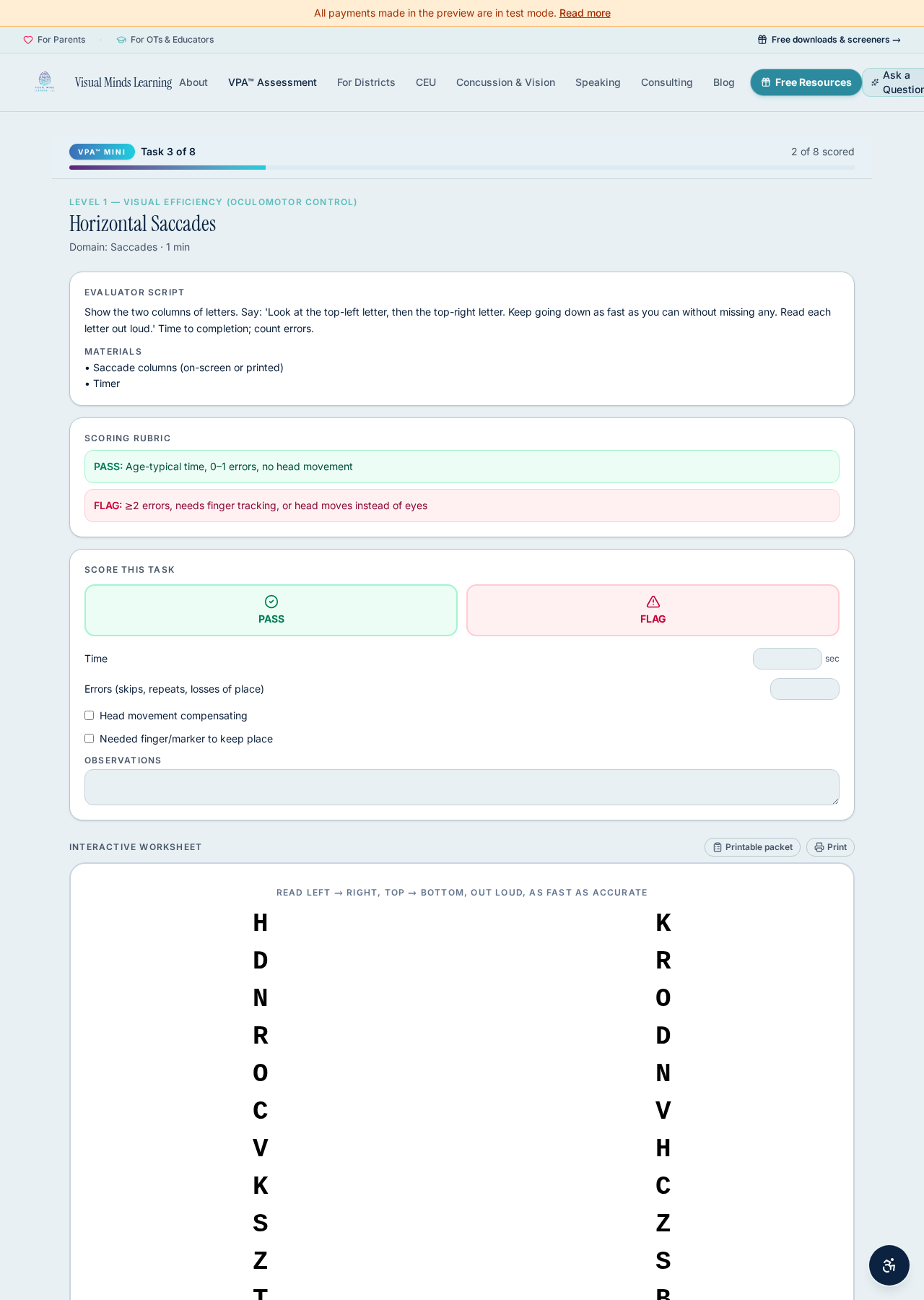
Say this
Talk over the visual: "Fast Screener mid-administration."
Say the caption in your own words: Evaluator script, PASS/FLAG rubric, referral triggers, and the on-screen worksheet in a single view.
My notes
Say this
Frame the slide: "What VML gives you at the screening step."
Walk each point, one sentence each:
• Fast Screener — brief acuity, contrast, efficiency, and a functional writing sample.
• Pre-K Quick Screen (ages 3–4) — refer or simple activities, no scoring burden.
• Mini VPA™ — one probe at each of Levels 1–5 to flag the domains to measure.
• Free Vision Concern Quiz for teachers and families to start the referral conversation.
Point at the figure while you talk — name the parts before the labels.
Close with: "If you only take one of these back, take the first one."
My notes
Say this
Frame the slide: "What turns a flag into a Full VPA™."
Walk each point, one sentence each:
• Any probe failed at or below the expected level for the age band.
• A probe passed only with degraded rate, endurance, or heavy strategy use.
• Teacher or caregiver report that conflicts with a passed probe.
• Any red-flag ocular symptom — refer regardless of the screen result.
Point at the figure while you talk — name the parts before the labels.
Close with: "If you only take one of these back, take the first one."
My notes
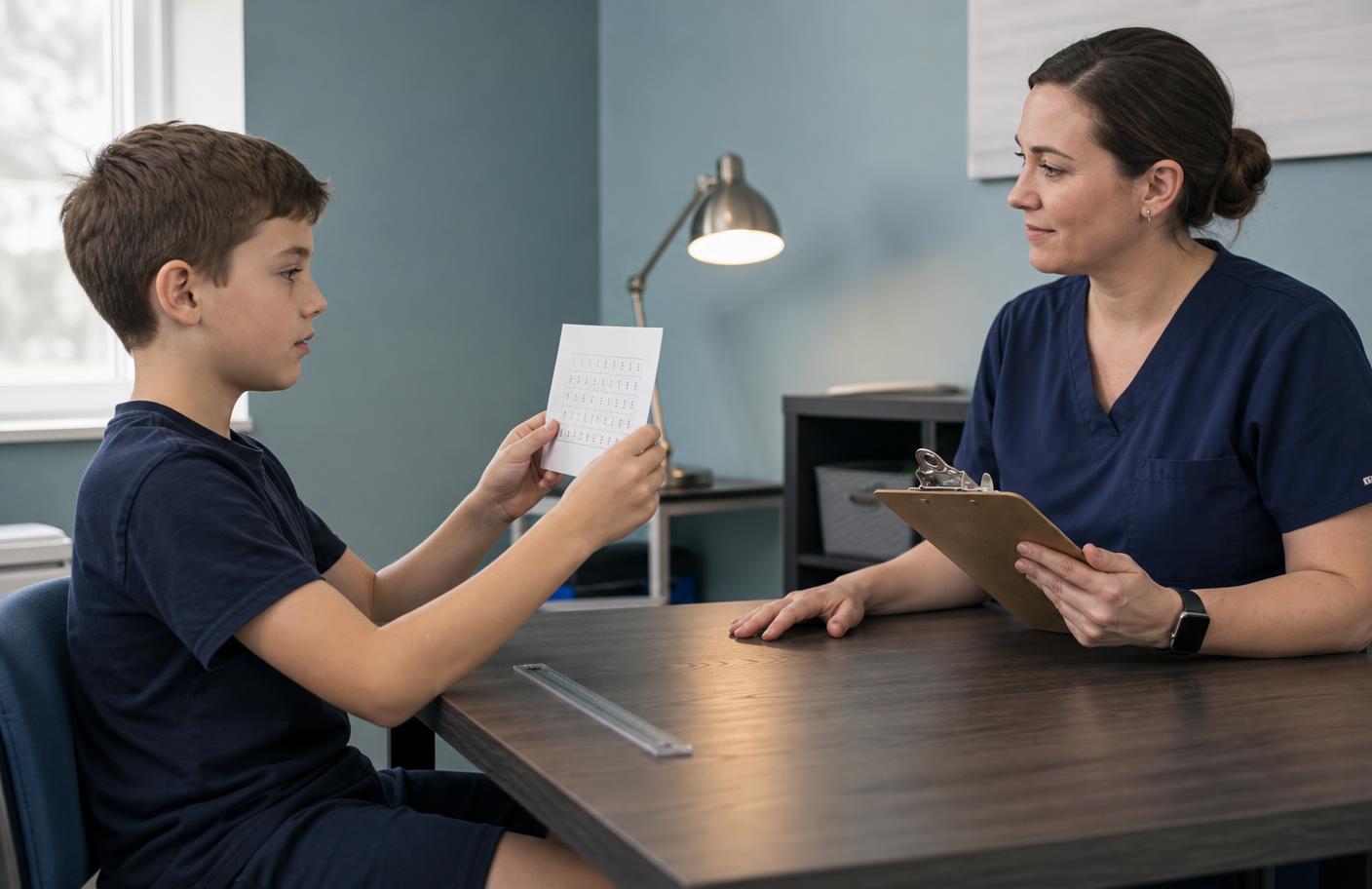
Near probes · 40 cm
Card at midline and at eye level; measure from the spectacle plane, not the forehead.
Table/screen · 60 cm
Use the same distance at screening and re-probe — a distance change invalidates the comparison.
Base of support
Feet supported and hips at 90° before any oculomotor scoring; postural drift reads as an efficiency deficit.
Say this
Contrast the two columns: Measure it versus Record it.
Measure it:
• Intermediate tasks at 60 cm, near tasks at 40 cm
• Even, glare-free lighting on the stimulus plane
• Feet supported, surface at elbow height
• Habitual correction worn — note if absent
Record it:
• Time of day and time on task
• Any deviation from the standard setup
• Prompts given beyond the single permitted repetition
• Observed strategy, not just pass/fail
Ask: "Which column is your student living in right now?"
My notes
Say this
Set up the clip in one sentence, play it, then debrief with "what did you notice?"
My notes
Say this
Describe what belongs here: Capture the Say/Do card, level ladder, and scoring panel together..
My notes
Near probes · 40 cm
Card at midline and at eye level; measure from the spectacle plane, not the forehead.
Table/screen · 60 cm
Use the same distance at screening and re-probe — a distance change invalidates the comparison.
Base of support
Feet supported and hips at 90° before any oculomotor scoring; postural drift reads as an efficiency deficit.
Say this
Describe what belongs here: Photo of measured working distance, lighting, and seating during a screen..
My notes
Say this
Land the "so what": A screening tells you where to send the student next. It never produces a score you can put in a present level.
Explain the mechanism plainly: Screening is sensitive by design and cannot separate a capacity limit from a demand mismatch. Assessment does that, under controlled setup.
Then give them the moves — say each one as something they can do Monday:
• Use the Fast Screen to decide: refer, assess, or monitor.
• Only move to Mini or Full VPA when you are prepared to change the plan based on the result.
• Say "screening indicated" in writing, never "the student has."
Tell them what success looks like: Anyone quoting a screening result as a score — correct it in the meeting, in one sentence.
Ask: "Who has a student this describes right now?" Take one answer, then move.
My notes
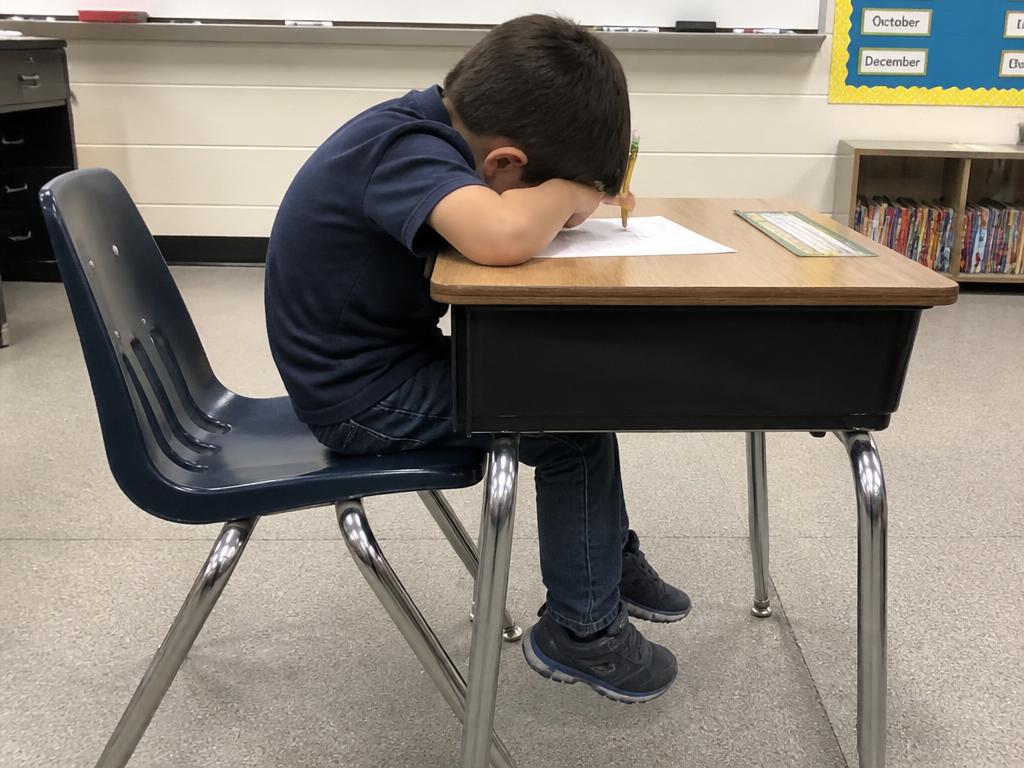
Feet unsupported, trunk collapsed, page about 15 cm from the eyes.

Feet supported, hips back, page raised toward a slant, working distance near Harmon distance.
Fix posture and distance before you score anything. Otherwise you are documenting the setup, not the student.
Say this
Set up the contrast: "Postural setup changes what you are measuring."
Point at the before panel first. Feet unsupported, trunk collapsed, page about 15 cm from the eyes.
Then the after panel. Feet supported, hips back, page raised toward a slant, working distance near Harmon distance.
Say the rule out loud: Fix posture and distance before you score anything. Otherwise you are documenting the setup, not the student.
Ask: "What did we change — the child, or the demand?"
My notes
Say this
Two-minute case. Read it aloud:
A Grade 5 student passed the school nurse vision screening in September. In November he holds his book at 12 cm, closes one eye during reading, and has fallen behind on written output.
Put the question to them: "What is your next step, and why is the passed screening not the answer?" Give 60 seconds, no talking.
Model answer (reveal after they commit): Refer to eye care for the new one-eye closure and near behavior, and run your own performance-based screen the same week. The nurse screening tested distance acuity only — it says nothing about near efficiency, binocular comfort, or endurance. Continue OT for the written-output demand meanwhile.
Close with the rule: A passed acuity screening rules out one thing at one distance. It does not clear the visual system.
My notes
Say this
Reflection prompt: "Write the decision rule you will use to move a student from screening to full assessment. Be specific enough that a colleague could apply it."
Offer the sentence starter: "I move to a full assessment when... The threshold is... The evidence I need is..."
Think for one minute, write, then take two shares.
My notes
Say this
Knowledge check: "What is the job of a screen?"
Options:
• To measure the size of the deficit
• To rule the concern in or out and decide the next step
• To establish a baseline for the IEP goal
• To document medical necessity for billing
Correct answer: option 2. Rationale: Screens sort; assessments measure. A screen that produces a goal has been asked to do a job it cannot do.
My notes