Back to CEU courses

Presenter study handout

The VPA™: Assessment & Clinical Reasoning

4 contact hours · 0.4 AOTA CEUs · Module 2 · 16 slides

Presenter-side material. Each block shows the slide as the audience sees it, the talk track, and space for your own notes. Model answers appear here — do not hand this version to learners.

Module 2

2.1 — VPA™ architecture: 15 skills across 5 domains, Fast Screener vs. Mini vs. Full

Transition

Module 2

VPA™ architecture: 15 skills across 5 domains, Fast Screener vs. Mini vs. Full

0:20 – 0:50

The VPA™: Assessment & Clinical Reasoning
1 / 16

Say this

Transition: "VPA™ architecture: 15 skills across 5 domains, Fast Screener vs. Mini vs. Full."

My notes

2.2 — VPA™ Architecture

Title

Module 2

VPA™ Architecture

15 skills across 5 domains — Fast Screener, Mini VPA™, and Full VPA™.

The VPA™: Assessment & Clinical Reasoning
2 / 16

Say this

Open here. "VPA™ Architecture." 15 skills across 5 domains — Fast Screener, Mini VPA™, and Full VPA™.

Say why this section matters for their caseload, then advance.

My notes

2.3 — Choosing a depth

Poll

Poll

Choosing a depth

Given 20 minutes with a new referral, what would you run today?

The VPA™: Assessment & Clinical Reasoning
3 / 16

Say this

Ask the poll: "Given 20 minutes with a new referral, what would you run today?"

Options:

• Fast Screener

My notes

2.4 — The five domains map to the five levels

Five-Level Framework

Domains

The five domains map to the five levels

1

Visual Acuity & Sensory Foundation

Can the visual signal get in clearly enough to use?

2

Visual Efficiency

Fixation, pursuits, saccades, binocular comfort, near endurance.

3

Visual Processing

Discrimination, memory, closure, figure-ground, form constancy, spatial relations.

4

Visual-Motor Integration

Translating what is seen into graded, accurate motor output.

5

Functional Integration

Reading, writing, and task performance under real classroom demand.

The VPA™: Assessment & Clinical Reasoning
4 / 16

Say this

Run the five levels bottom-up.

Name each level, then say which one you assess first and why.

My notes

2.5 — Which instrument, when

Comparison

Which instrument, when

Mini VPA™ (screen)

  • One probe at each of Levels 1–5
  • Flags the domains needing measurement
  • Caseload-scale, brief
  • Never a stand-alone plan of care

Full VPA™ (assess)

  • 15 skills, L1–L5 progression each
  • Basal and ceiling rules per skill
  • Domain profile and composite
  • Drives goals, dosage, referral
Teacher / parentconcern raisedOT Screening (VPA Fast Screener)PASS / FLAG on 5 quick tasksPASSFLAGDocument. No further OT.Provide teacher-facingclassroom accommodationsif requested.OT Assessment (Mini or Full VPA)Score all 5 domainsPlan of careIEP goals · interventionAdapt-and-refer (Level 1)if acuity/health concern
Screening asks "Is there a concern?" Assessment asks "What exactly is the problem, and how do we intervene?" The path a referral takes depends on that answer.
The VPA™: Assessment & Clinical Reasoning
5 / 16

Say this

Contrast the two columns: Mini VPA™ (screen) versus Full VPA™ (assess).

Mini VPA™ (screen):

• One probe at each of Levels 1–5

My notes
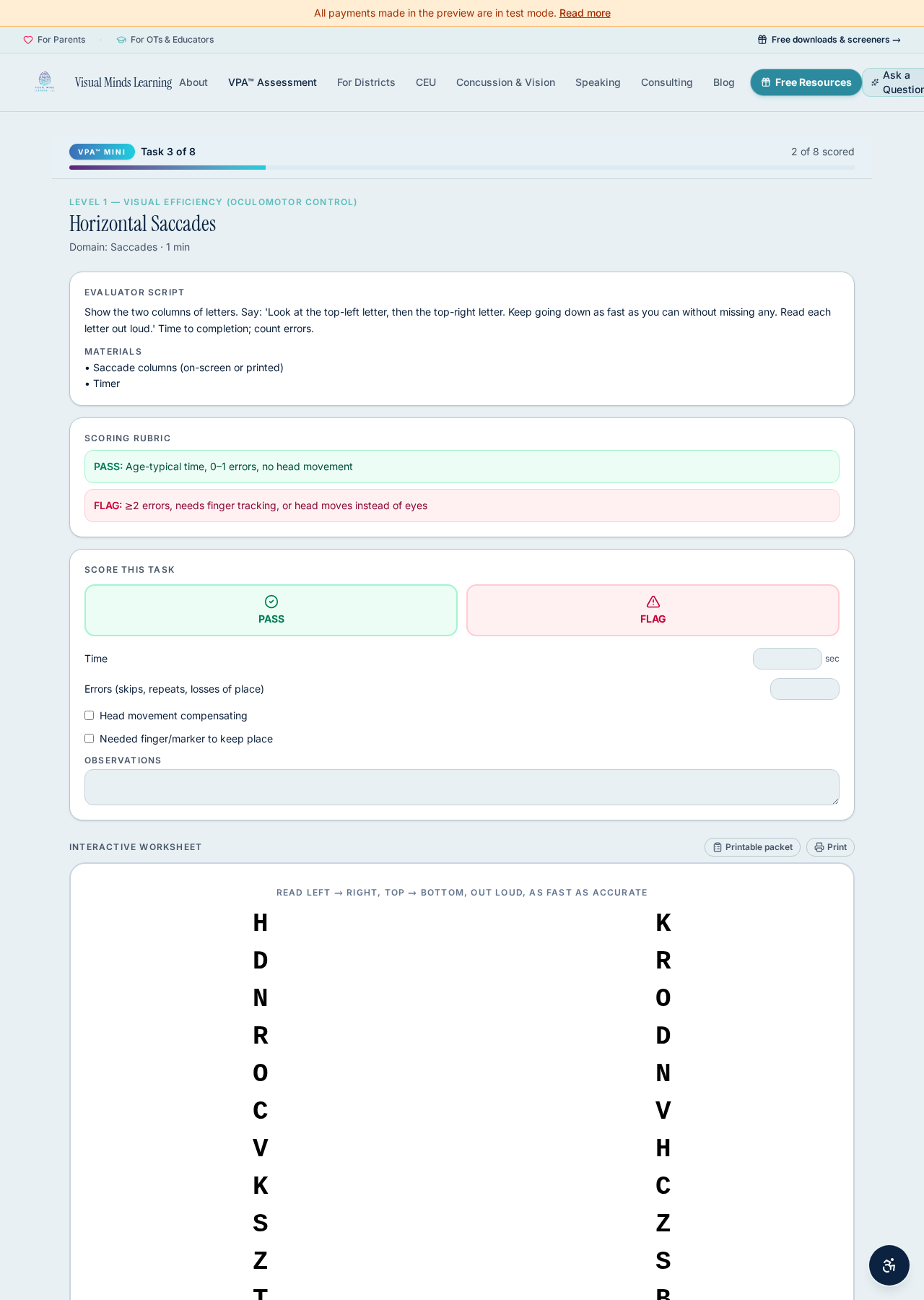
2.6 — Mini VPA™ administration view

Visual

Artifact

Mini VPA™ administration view

Say/Do script, level ladder, and the scoring worksheet in one clinician view.

Say/Do script, level ladder, and the scoring worksheet in one clinician view.

The VPA™: Assessment & Clinical Reasoning
6 / 16

Say this

Talk over the visual: "Mini VPA™ administration view."

Say the caption in your own words: Say/Do script, level ladder, and the scoring worksheet in one clinician view.

My notes

2.7 — Why 15 skills across 5 domains

Teaching slide

Design logic

Why 15 skills across 5 domains

  • Each domain samples one level of the framework: Access, Efficiency, Processing, Visual-Motor Integration, Functional Integration.
  • Three skills per domain give enough spread to see a shape, not a point.
  • Every skill runs its own L1–L5 task ladder, so breakdown is located, not inferred.
  • Functional Integration includes both reading and writing — the two referral drivers.
L1 · Access
Near acuity
Intermediate / distance acuity
Contrast tolerance
L2 · Efficiency
Fixation
Pursuits
Saccades / NPC & endurance
L3 · Processing
Discrimination & closure
Figure-ground
Visual memory & spatial
L4 · Visual-motor integration
Form reproduction
Copy accuracy
Timed written output
L5 · Functional integration
Sustained reading
Generative writing
Classroom-task simulation

Task rubric 0–3 → reported as VPL 1–5

0

Unable

1

Emerging, max support

2

Functional but inefficient

3

Accurate & efficient

Five domains, fifteen skills — one domain per framework level. Every task is rubric-scored 0–3; the highest task level scored 2 or better is the skill’s achieved level, reported as VPL 1–5 against the age-band expectation.
The VPA™: Assessment & Clinical Reasoning
7 / 16

Say this

Frame the slide: "Why 15 skills across 5 domains."

Walk each point, one sentence each:

• Each domain samples one level of the framework: Access, Efficiency, Processing, Visual-Motor Integration, Functional Integration.

My notes

2.8 — Three numbers — and they are not the same number

Comparison

Scoring

Three numbers — and they are not the same number

What you record at the table

  • Item rubric 0–3 for every task you administer: 0 unable, 1 emerging with maximum support, 2 functional with inefficiency, 3 accurate and efficient.
  • A rubric of 2 or 3 counts as passing that task; 0 or 1 does not.
  • Observation is recorded alongside every rubric score — head movement, refixations, latency, discomfort.

What the software derives

  • Achieved level L1–L5: the highest task level scored 2 or better on that skill.
  • VPL 1–5 (Visual Performance Level): achieved level adjusted for rubric quality — VPL 1 (emerging), VPL 2 (developing), VPL 3 (functional), VPL 4 (efficient), VPL 5 (advanced). Always write the number; “functional” is a descriptor of VPL 3, not the name of Domain 5.
  • Gap: VPL compared to the expected VPL range for the student’s age band.
VPA™ · Scored profile
L1Acuity & sensory foundationincl. field & scanning
strong
L2Visual efficiency
limiting
L3Visual processing
emerging
L4Visual-motor integration
limiting
L5Functional integration
breaking down
Profile shape: foundation intact / output limitedIntervention enters at Level 2 (efficiency), not at Level 4 handwriting drill.
Rows are the five framework levels in order (L1 → L5) — the L number is the level, never the score. Performance is the bar and the word beside it. Read the shape before any composite: a flat-but-low profile, a single notch, and a “foundation intact / output collapsed” staircase call for three different plans.
The VPA™: Assessment & Clinical Reasoning
8 / 16

Say this

Contrast the two columns: What you record at the table versus What the software derives.

What you record at the table:

• Item rubric 0–3 for every task you administer: 0 unable, 1 emerging with maximum support, 2 functional with inefficiency, 3 accurate and efficient.

My notes

2.9 — When to reach for a standardized tool

Teaching slide

Adjuncts

When to reach for a standardized tool

  • A single skill is flagged and you need depth for eligibility.
  • A payer or district requires a norm-referenced score.
  • Team disagreement about whether the finding is real.
  • Use adjuncts to deepen a flagged area — not to replace the level profile.
L0

Visual acuity & ocular health

Distance/near acuity check, contrast, red-flag screen

L1

Visual fields & attention to space

Confrontation fields, cancellation, scan-grid coverage

L2

Oculomotor & near-point efficiency

Fixation, pursuits, saccade columns, NPC, endurance

L3

Visual-perceptual processing

Discrimination, figure-ground, closure, memory, spatial

L4

Visual-motor integration

Copy tasks, form reproduction, timed written output

Each level is sampled by its own task family. A composite score collapses these into one number; the profile keeps them separate so the plan can target the unstable floor.
The VPA™: Assessment & Clinical Reasoning
9 / 16

Say this

Frame the slide: "When to reach for a standardized tool."

Walk each point, one sentence each:

• A single skill is flagged and you need depth for eligibility.

My notes

2.10 — Module 2 video — VPA™ architecture

Video

Lecture

Module 2 video — VPA™ architecture

VIDEO SLOT

Tour of the instrument family and how the pieces relate.

Slides tab → set “url” to your YouTube/Vimeo/Loom embed link

The VPA™: Assessment & Clinical Reasoning
10 / 16

Say this

Set up the clip in one sentence, play it, then debrief with "what did you notice?"

My notes

2.11 — Diagram — 15 skills mapped to 5 domains

Visual

Import

Diagram — 15 skills mapped to 5 domains

L1 · Access
Near acuity
Intermediate / distance acuity
Contrast tolerance
L2 · Efficiency
Fixation
Pursuits
Saccades / NPC & endurance
L3 · Processing
Discrimination & closure
Figure-ground
Visual memory & spatial
L4 · Visual-motor integration
Form reproduction
Copy accuracy
Timed written output
L5 · Functional integration
Sustained reading
Generative writing
Classroom-task simulation

Task rubric 0–3 → reported as VPL 1–5

0

Unable

1

Emerging, max support

2

Functional but inefficient

3

Accurate & efficient

Five domains, fifteen skills — one domain per framework level. Every task is rubric-scored 0–3; the highest task level scored 2 or better is the skill’s achieved level, reported as VPL 1–5 against the age-band expectation.
The VPA™: Assessment & Clinical Reasoning
11 / 16

Say this

Describe what belongs here: Architecture graphic showing domains, skills, and the L1–L5 ladder..

My notes

2.12 — Screenshot — Full VPA™ skill menu

Visual

Import

Screenshot — Full VPA™ skill menu

Visual Performance Assessment™ · Select skills

Ocular foundation

  • Near acuity
  • Distance acuity
  • Contrast & glare tolerance

Field & attention to space

  • Field awareness
  • Organized scanning
  • Left/right coverage

Oculomotor efficiency

  • Fixation stability
  • Pursuits
  • Saccades & NPC

Perceptual processing

  • Discrimination & closure
  • Figure-ground
  • Visual memory & spatial

Visual-motor integration

  • Copy accuracy
  • Form reproduction
  • Timed written output
The Full VPA™ skill menu. Clinicians select the skills the referral question actually requires; the ladder and scoring rules stay identical across every skill selected.
The VPA™: Assessment & Clinical Reasoning
12 / 16

Say this

Describe what belongs here: Skill menu view showing the 15 skills grouped by domain..

My notes

2.13 — So what? Pick the tier by the decision you owe

So what?

So what?

So what? Pick the tier by the decision you owe

Fast Screener, Mini, and Full are three different commitments of time. Choosing the wrong tier costs you a session you will not get back.

Screening routes, Mini characterizes a suspected domain, Full establishes level and profile across all fifteen skills.

What you do with it

  • Fast Screener when the question is "does this need looking at?"
  • Mini when you suspect a domain and need to confirm before writing a goal.
  • Full when you need an achieved level, a domain profile, and a progress baseline.

Watch for

Repeating a Mini three times — that is a Full you have already paid for in pieces.

The VPA™: Assessment & Clinical Reasoning
13 / 16

Say this

Land the "so what": Fast Screener, Mini, and Full are three different commitments of time. Choosing the wrong tier costs you a session you will not get back.

Explain the mechanism plainly: Screening routes, Mini characterizes a suspected domain, Full establishes level and profile across all fifteen skills.

Then give them the moves — say each one as something they can do Monday:

My notes

2.14 — Two-minute case: which tier?

Mini case

Two-minute case

Two-minute case: which tier?

You have 25 minutes with a newly referred Grade 2 student, an IEP meeting in three weeks, and a teacher report of place-losing and slow copying.

Which tier do you run today, and what do you schedule?

The VPA™: Assessment & Clinical Reasoning
14 / 16

Say this

Two-minute case. Read it aloud:

You have 25 minutes with a newly referred Grade 2 student, an IEP meeting in three weeks, and a teacher report of place-losing and slow copying.

Put the question to them: "Which tier do you run today, and what do you schedule?" Give 60 seconds, no talking.

My notes

2.15 — Reflect and share

Reflection

Reflect and share

Reflect and share

Which of the 15 skills do you currently never assess — and what has that cost you?

THINKPROCESSSHARE
The VPA™: Assessment & Clinical Reasoning
15 / 16

Say this

Reflection prompt: "Which of the 15 skills do you currently never assess — and what has that cost you?"

Offer the sentence starter: "I currently do not assess [skill]. This has cost me because..."

Think for one minute, write, then take two shares.

My notes

2.16 — Knowledge check — architecture

Self-check

Knowledge check

Knowledge check — architecture

When is the Fast Screener the right instrument?

The VPA™: Assessment & Clinical Reasoning
16 / 16

Say this

Knowledge check: "When is the Fast Screener the right instrument?"

Options:

• When you need a score for the IEP

My notes