2.1 — VPA™ architecture: 15 skills across 5 domains, Fast Screener vs. Mini vs. Full
Transition- 0:20 – 0:50
Say this
Transition: "VPA™ architecture: 15 skills across 5 domains, Fast Screener vs. Mini vs. Full."
My notes
Presenter study handout
4 contact hours · 0.4 AOTA CEUs · Module 2 · 16 slides
Presenter-side material. Each block shows the slide as the audience sees it, the talk track, and space for your own notes. Model answers appear here — do not hand this version to learners.
Say this
Transition: "VPA™ architecture: 15 skills across 5 domains, Fast Screener vs. Mini vs. Full."
My notes
Say this
Open here. "VPA™ Architecture." 15 skills across 5 domains — Fast Screener, Mini VPA™, and Full VPA™.
Say why this section matters for their caseload, then advance.
My notes
Say this
Ask the poll: "Given 20 minutes with a new referral, what would you run today?"
Options:
• Fast Screener
• Mini VPA™
• Full VPA™
• I would not know which to pick
Take a show of hands or the on-screen tally, then name the pattern you see before advancing.
My notes
Say this
Run the five levels bottom-up.
Name each level, then say which one you assess first and why.
My notes
Say this
Contrast the two columns: Mini VPA™ (screen) versus Full VPA™ (assess).
Mini VPA™ (screen):
• One probe at each of Levels 1–5
• Flags the domains needing measurement
• Caseload-scale, brief
• Never a stand-alone plan of care
Full VPA™ (assess):
• 15 skills, L1–L5 progression each
• Basal and ceiling rules per skill
• Domain profile and composite
• Drives goals, dosage, referral
Ask: "Which column is your student living in right now?"
My notes
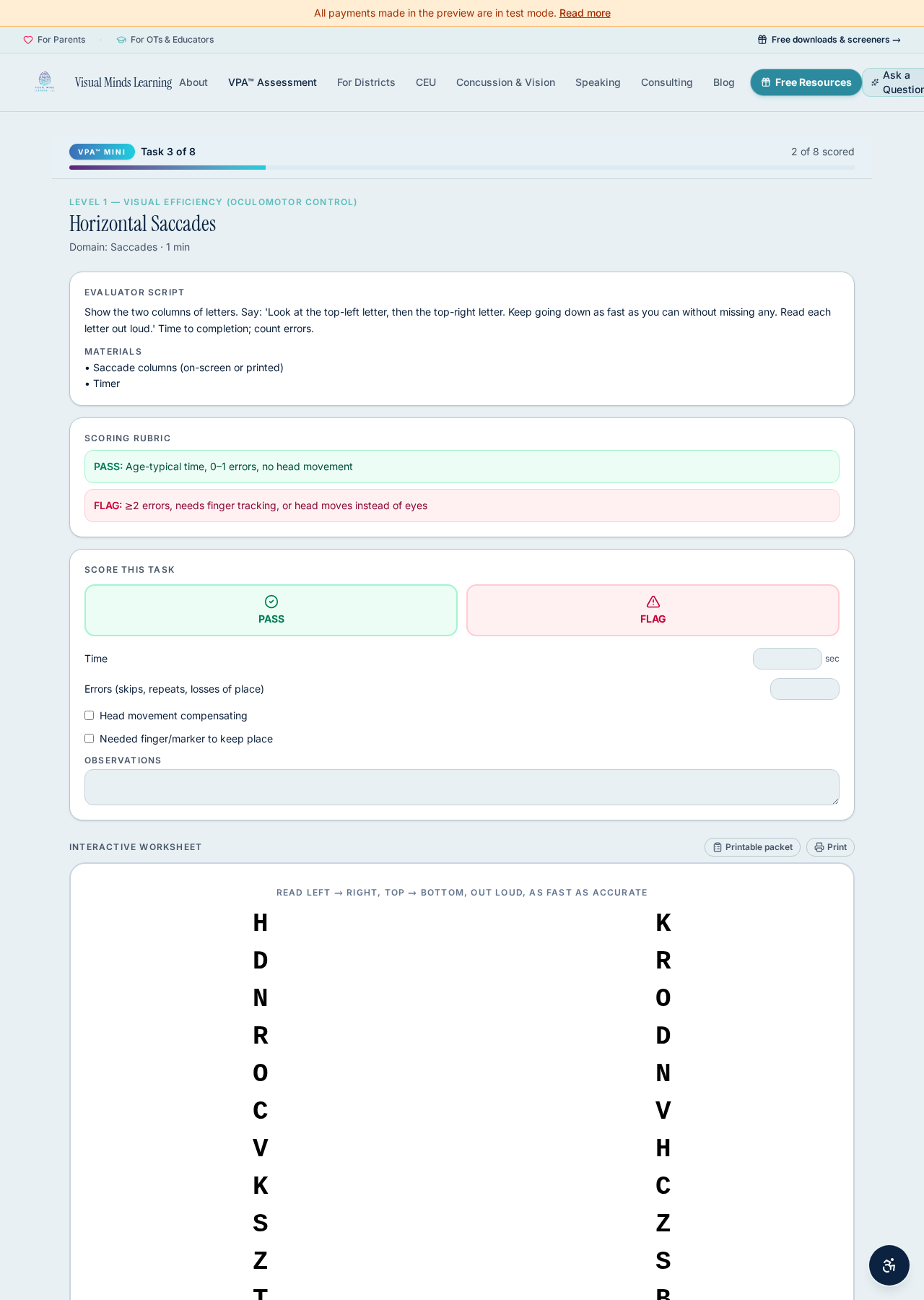
Say this
Talk over the visual: "Mini VPA™ administration view."
Say the caption in your own words: Say/Do script, level ladder, and the scoring worksheet in one clinician view.
My notes
Say this
Frame the slide: "Why 15 skills across 5 domains."
Walk each point, one sentence each:
• Each domain samples one level of the framework: Access, Efficiency, Processing, Visual-Motor Integration, Functional Integration.
• Three skills per domain give enough spread to see a shape, not a point.
• Every skill runs its own L1–L5 task ladder, so breakdown is located, not inferred.
• Functional Integration includes both reading and writing — the two referral drivers.
Point at the figure while you talk — name the parts before the labels.
Close with: "If you only take one of these back, take the first one."
My notes
Say this
Contrast the two columns: What you record at the table versus What the software derives.
What you record at the table:
• Item rubric 0–3 for every task you administer: 0 unable, 1 emerging with maximum support, 2 functional with inefficiency, 3 accurate and efficient.
• A rubric of 2 or 3 counts as passing that task; 0 or 1 does not.
• Observation is recorded alongside every rubric score — head movement, refixations, latency, discomfort.
What the software derives:
• Achieved level L1–L5: the highest task level scored 2 or better on that skill.
• VPL 1–5 (Visual Performance Level): achieved level adjusted for rubric quality — VPL 1 (emerging), VPL 2 (developing), VPL 3 (functional), VPL 4 (efficient), VPL 5 (advanced). Always write the number; “functional” is a descriptor of VPL 3, not the name of Domain 5.
• Gap: VPL compared to the expected VPL range for the student’s age band.
Ask: "Which column is your student living in right now?"
My notes
Say this
Frame the slide: "When to reach for a standardized tool."
Walk each point, one sentence each:
• A single skill is flagged and you need depth for eligibility.
• A payer or district requires a norm-referenced score.
• Team disagreement about whether the finding is real.
• Use adjuncts to deepen a flagged area — not to replace the level profile.
Point at the figure while you talk — name the parts before the labels.
Close with: "If you only take one of these back, take the first one."
My notes
Say this
Set up the clip in one sentence, play it, then debrief with "what did you notice?"
My notes
Say this
Describe what belongs here: Architecture graphic showing domains, skills, and the L1–L5 ladder..
My notes
Say this
Describe what belongs here: Skill menu view showing the 15 skills grouped by domain..
My notes
Say this
Land the "so what": Fast Screener, Mini, and Full are three different commitments of time. Choosing the wrong tier costs you a session you will not get back.
Explain the mechanism plainly: Screening routes, Mini characterizes a suspected domain, Full establishes level and profile across all fifteen skills.
Then give them the moves — say each one as something they can do Monday:
• Fast Screener when the question is "does this need looking at?"
• Mini when you suspect a domain and need to confirm before writing a goal.
• Full when you need an achieved level, a domain profile, and a progress baseline.
Tell them what success looks like: Repeating a Mini three times — that is a Full you have already paid for in pieces.
Ask: "Who has a student this describes right now?" Take one answer, then move.
My notes
Say this
Two-minute case. Read it aloud:
You have 25 minutes with a newly referred Grade 2 student, an IEP meeting in three weeks, and a teacher report of place-losing and slow copying.
Put the question to them: "Which tier do you run today, and what do you schedule?" Give 60 seconds, no talking.
Model answer (reveal after they commit): Run the Mini today, targeted at the suspected efficiency domain, so you have defensible information for the meeting. Schedule the Full before goal-writing if the Mini confirms the domain, and use the Fast Screener for the two other students on the same referral list.
Close with the rule: Match the tier to the decision and the calendar, not to how thorough you feel.
My notes
Say this
Reflection prompt: "Which of the 15 skills do you currently never assess — and what has that cost you?"
Offer the sentence starter: "I currently do not assess [skill]. This has cost me because..."
Think for one minute, write, then take two shares.
My notes
Say this
Knowledge check: "When is the Fast Screener the right instrument?"
Options:
• When you need a score for the IEP
• When you need to rule a concern in or out and decide the next step
• When the family requests a full evaluation
• When the student is under 8 years old
Correct answer: option 2. Rationale: The Screener sorts. The Mini and Full measure.
My notes