Back to CEU courses

Presenter study handout

Why Visual Performance Matters: Foundations for Occupational Therapy Practice

3 contact hours · 0.3 AOTA CEUs · All 6 modules · 115 slides

Presenter-side material. Each block shows the slide as the audience sees it, the talk track, and space for your own notes. Model answers appear here — do not hand this version to learners.

Module 1

1.1 — Welcome — while you get set up

Welcome

Welcome

Welcome — while you get set up

Why Visual Performance Matters: Foundations for Occupational Therapy Practice · Free · 3.0 contact hours · 0.3 AOTA CEUs

Have ready

  • Participation & Reflection Guide (printed or on screen)
  • One client or student to think with for the whole session
  • Pen and paper, or the reflection boxes in this player
  • One referral or eye care report you have received

Before we begin

  • Modules are self-paced; your place is saved as you go.
  • Polls, reflections, and self-checks are participation supports — they do not affect your quiz score.
  • Take a stretch break between modules; sustained near work is the topic, not the goal.
  • The post-course exam and evaluation unlock after the last module.
Why Visual Performance Matters: Foundations for Occupational Therapy Practice
1 / 22
  • Materials: Participation & Reflection Guide (printed or on screen)
  • Materials: One client or student to think with for the whole session
  • Materials: Pen and paper, or the reflection boxes in this player
  • Materials: One referral or eye care report you have received
  • Modules are self-paced; your place is saved as you go.
  • Polls, reflections, and self-checks are participation supports — they do not affect your quiz score.
  • Take a stretch break between modules; sustained near work is the topic, not the goal.
  • The post-course exam and evaluation unlock after the last module.

Say this

Housekeeping while people arrive.

Materials to have ready:

• Participation & Reflection Guide (printed or on screen)

• One client or student to think with for the whole session

• Pen and paper, or the reflection boxes in this player

• One referral or eye care report you have received

Housekeeping:

• Modules are self-paced; your place is saved as you go.

• Polls, reflections, and self-checks are participation supports — they do not affect your quiz score.

• Take a stretch break between modules; sustained near work is the topic, not the goal.

• The post-course exam and evaluation unlock after the last module.

My notes
1.2 — What you will be able to do

Learning outcomes

Learning outcomes

What you will be able to do

So you can recognize visual performance patterns, describe them in occupational terms, decide when to refer, and change the task on Monday.

  • 1Explain the developmental and anatomical basis of the visual system and articulate the occupational therapy practitioner's role in supporting visual function within the OT scope of practice.
  • 2Differentiate ventral ("what") and dorsal ("where") visual pathway functions and identify classroom-based behavioral signatures associated with dysfunction in each pathway.
  • 3Recognize clinical signs of visual conditions warranting referral to optometry, ophthalmology, or developmental vision specialists and distinguish them from findings addressable through OT intervention.
  • 4Analyze comorbidity patterns between visual function deficits and autism, ADHD, dyslexia, and dysgraphia to inform integrated, occupation-based intervention planning.
  • 5Apply a low-vision service delivery model, including environmental modification strategies, to support occupational performance for clients with reduced visual function.
  • 6Construct an immediate next-step plan for a client with suspected visual performance limitations, sequencing clinical observation, occupation-based documentation, referral, and structured follow-up assessment within the OT scope of practice.
Why Visual Performance Matters: Foundations for Occupational Therapy Practice
2 / 22
  • So you can recognize visual performance patterns, describe them in occupational terms, decide when to refer, and change the task on Monday.
  • Explain the developmental and anatomical basis of the visual system and articulate the occupational therapy practitioner's role in supporting visual function within the OT scope of practice.
  • Differentiate ventral ("what") and dorsal ("where") visual pathway functions and identify classroom-based behavioral signatures associated with dysfunction in each pathway.
  • Recognize clinical signs of visual conditions warranting referral to optometry, ophthalmology, or developmental vision specialists and distinguish them from findings addressable through OT intervention.
  • Analyze comorbidity patterns between visual function deficits and autism, ADHD, dyslexia, and dysgraphia to inform integrated, occupation-based intervention planning.
  • Apply a low-vision service delivery model, including environmental modification strategies, to support occupational performance for clients with reduced visual function.
  • Construct an immediate next-step plan for a client with suspected visual performance limitations, sequencing clinical observation, occupation-based documentation, referral, and structured follow-up assessment within the OT scope of practice.

Say this

Read the filed learning objectives verbatim — this is the AOTA-approved wording.

Objectives:

• Explain the developmental and anatomical basis of the visual system and articulate the occupational therapy practitioner's role in supporting visual function within the OT scope of practice.

• Differentiate ventral ("what") and dorsal ("where") visual pathway functions and identify classroom-based behavioral signatures associated with dysfunction in each pathway.

• Recognize clinical signs of visual conditions warranting referral to optometry, ophthalmology, or developmental vision specialists and distinguish them from findings addressable through OT intervention.

• Analyze comorbidity patterns between visual function deficits and autism, ADHD, dyslexia, and dysgraphia to inform integrated, occupation-based intervention planning.

• Apply a low-vision service delivery model, including environmental modification strategies, to support occupational performance for clients with reduced visual function.

• Construct an immediate next-step plan for a client with suspected visual performance limitations, sequencing clinical observation, occupation-based documentation, referral, and structured follow-up assessment within the OT scope of practice.

My notes

1.3 — How this session runs

How the session runs

Your learning experience

How this session runs

Session schedule

  • Six modules, 3.0 contact hours total
  • Each module: teach → show → reflect → self-check
  • Post-course exam (80% to pass, unlimited retakes)
  • Course evaluation, then certificate

Participation & Reflection Guide

  • Write your reflections as you go
  • Entries save to your guide and print with the handout
  • Use it as your Monday-morning action plan

Discussion & engagement

  • Opening poll in every module
  • Think / Process / Share reflection prompts
  • Case vignettes with referral and modification prompts
  • One knowledge check per module
Why Visual Performance Matters: Foundations for Occupational Therapy Practice
3 / 22
  • Six modules, 3.0 contact hours total
  • Each module: teach → show → reflect → self-check
  • Post-course exam (80% to pass, unlimited retakes)
  • Course evaluation, then certificate
  • Write your reflections as you go
  • Entries save to your guide and print with the handout
  • Use it as your Monday-morning action plan
  • Opening poll in every module
  • Think / Process / Share reflection prompts
  • Case vignettes with referral and modification prompts
  • One knowledge check per module

Say this

Explain how the session runs.

Schedule:

• Six modules, 3.0 contact hours total

• Each module: teach → show → reflect → self-check

• Post-course exam (80% to pass, unlimited retakes)

• Course evaluation, then certificate

How they participate:

• Opening poll in every module

• Think / Process / Share reflection prompts

• Case vignettes with referral and modification prompts

• One knowledge check per module

My notes

1.4 — Module 1

Transition

Module 1

Module 1

Why Visual Performance Matters: Foundations for Occupational Therapy Practice
4 / 22

Say this

Transition: "Module 1."

My notes

1.5 — Why Visual Performance Matters

Title

Module 1

Why Visual Performance Matters

Vision is already on your caseload. The only question is whether it is named, measured, and treated.

Why Visual Performance Matters: Foundations for Occupational Therapy Practice
5 / 22
  • Vision is already on your caseload. The only question is whether it is named, measured, and treated.
  • Visual Minds Learning · AOTA Approved Provider

Say this

Open here. "Why Visual Performance Matters." Vision is already on your caseload. The only question is whether it is named, measured, and treated.

Say why this section matters for their caseload, then advance.

My notes

1.6 — Your current confidence

Poll

Poll

Your current confidence

When you see a visual concern in a student, how do you usually respond first?

Why Visual Performance Matters: Foundations for Occupational Therapy Practice
6 / 22
  • When you see a visual concern in a student, how do you usually respond first?
  • – I refer to the eye doctor and wait for results
  • – I observe in class and document what I see
  • – I start adaptation or intervention while also referring
  • – I assume the issue is already covered by the school vision screen

Say this

Ask the poll: "When you see a visual concern in a student, how do you usually respond first?"

Options:

• I refer to the eye doctor and wait for results

• I observe in class and document what I see

• I start adaptation or intervention while also referring

• I assume the issue is already covered by the school vision screen

Take a show of hands or the on-screen tally, then name the pattern you see before advancing.

My notes

1.7 — You are already treating vision

Teaching slide

The hook

You are already treating vision

  • Handwriting, reading endurance, board copying, dressing, feeding, mobility, play, driving, work simulation — every one routes through vision.
  • When a practitioner says "vision is not my area," the visual contribution does not disappear. It gets renamed as attention, behavior, motivation, or motor planning.
  • The plan of care is then built on the wrong variable — the most common reason a well-written visual-motor goal never moves.
  • This is not a specialty. It is a competency inside occupational therapy.

Occupations

What the person needs and wants to do.

  • • Reading and written work
  • • Dressing, eating, self-care
  • • Play, sport, driving, work

Client factors — body functions

The internal capacities that support doing.

  • • Visual acuity and visual field
  • • Eye-movement and focusing control
  • • Visual perception

Performance skills

Observable actions during the task.

  • • Locates, tracks, and keeps place
  • • Aligns, spaces, and copies accurately
  • • Sustains looking over time

Performance patterns

Habits and routines that carry the day.

  • • Break routines during near work
  • • Where materials live on the desk
  • • Self-checks before turning work in

Contexts and environment

Everything around the person.

  • • Lighting, glare, seating
  • • Print size, contrast, clutter
  • • Team expectations and supports

Highlighted boxes are where a visual problem shows up in our documentation: a client factor we describe, a performance skill we measure in the task, and a context we change. The diagnosis of the eye itself sits outside this picture — that belongs to eye care.

The OT practice framework, drawn as the pieces we actually observe. Vision touches three of them directly — client factors, performance skills, and context — which is why vision work is ordinary OT, not a specialty add-on.
Why Visual Performance Matters: Foundations for Occupational Therapy Practice
7 / 22
  • Handwriting, reading endurance, board copying, dressing, feeding, mobility, play, driving, work simulation — every one routes through vision.
  • When a practitioner says "vision is not my area," the visual contribution does not disappear. It gets renamed as attention, behavior, motivation, or motor planning.
  • The plan of care is then built on the wrong variable — the most common reason a well-written visual-motor goal never moves.
  • This is not a specialty. It is a competency inside occupational therapy.

Say this

Frame the slide: "You are already treating vision."

Walk each point, one sentence each:

• Handwriting, reading endurance, board copying, dressing, feeding, mobility, play, driving, work simulation — every one routes through vision.

• When a practitioner says "vision is not my area," the visual contribution does not disappear. It gets renamed as attention, behavior, motivation, or motor planning.

• The plan of care is then built on the wrong variable — the most common reason a well-written visual-motor goal never moves.

• This is not a specialty. It is a competency inside occupational therapy.

Point at the figure while you talk — name the parts before the labels.

Close with: "If you only take one of these back, take the first one."

My notes

1.8 — Understand → assess → intervene

Teaching slide

Three claims

Understand → assess → intervene

  • Understanding is not optional: vision is a client factor and a performance skill inside every occupational performance evaluation you already do.
  • Understanding without assessment is a guess: "visual issues" in a report gives the team nothing to act on and nothing to re-measure.
  • Assessment without intervention is abandonment: a profile that does not change Monday is documentation, not care.
  • The Five-Level Framework and the VPA™ exist to close that loop — structured findings that point directly at an entry point for treatment.

Module 1 — Vision as a gateway system

12345

Frames the whole system; every level is introduced.

Module 2 — Visual pathways (ventral / dorsal)

12345

Magnocellular/dorsal work shows at Level 2 efficiency; parvocellular/ventral identification is Level 3 processing.

Module 3 — Underlying Conditions vs. Functional Limitations

12345

Ocular and neurological conditions act on the sensory foundation and on binocular efficiency; OT treats the functional limitation, not the diagnosis.

Module 4 — Comorbidity patterns

12345

Autism, ADHD, dyslexia, dysgraphia signatures appear as processing and visual-motor integration performance.

Module 5 — Low-vision service model

12345

Low vision is a Level 1 sensory-foundation problem. Contrast, lighting, and magnification restore access at the floor; the Level 5 change is the downstream result, not the target.

Module 6 — Where this goes next

12345

Functional integration is where all findings resolve into a plan of care.

L1 · Acuity & sensory foundationL2 · Visual efficiencyL3 · Visual processingL4 · Visual-motor integrationL5 · Functional integration
Which level of the framework each module is actually operating on. Use this to keep the module content, the slide framework references, and your documentation language aligned.
Why Visual Performance Matters: Foundations for Occupational Therapy Practice
8 / 22
  • Understanding is not optional: vision is a client factor and a performance skill inside every occupational performance evaluation you already do.
  • Understanding without assessment is a guess: "visual issues" in a report gives the team nothing to act on and nothing to re-measure.
  • Assessment without intervention is abandonment: a profile that does not change Monday is documentation, not care.
  • The Five-Level Framework and the VPA™ exist to close that loop — structured findings that point directly at an entry point for treatment.

Say this

Frame the slide: "Understand → assess → intervene."

Walk each point, one sentence each:

• Understanding is not optional: vision is a client factor and a performance skill inside every occupational performance evaluation you already do.

• Understanding without assessment is a guess: "visual issues" in a report gives the team nothing to act on and nothing to re-measure.

• Assessment without intervention is abandonment: a profile that does not change Monday is documentation, not care.

• The Five-Level Framework and the VPA™ exist to close that loop — structured findings that point directly at an entry point for treatment.

Point at the figure while you talk — name the parts before the labels.

Close with: "If you only take one of these back, take the first one."

My notes

1.9 — Same competency, three settings

Comparison

Who this is for

Same competency, three settings

Schools and clinics

  • Schools: visual performance sits under reading, writing, accommodations, and state testing.
  • Clinics: visual demands drive ADL independence, concussion recovery, and return to work or sport.
  • Both need language a team can fund, act on, and re-test.

Universities and programs

  • Entry-level curricula still teach vision as anatomy and acuity.
  • Graduates arrive able to name structures but not to describe visual performance in occupational terms.
  • A shared framework gives faculty, fieldwork educators, and new grads one vocabulary.
Why Visual Performance Matters: Foundations for Occupational Therapy Practice
9 / 22
  • Schools and clinics: Schools: visual performance sits under reading, writing, accommodations, and state testing. · Clinics: visual demands drive ADL independence, concussion recovery, and return to work or sport. · Both need language a team can fund, act on, and re-test.
  • Universities and programs: Entry-level curricula still teach vision as anatomy and acuity. · Graduates arrive able to name structures but not to describe visual performance in occupational terms. · A shared framework gives faculty, fieldwork educators, and new grads one vocabulary.

Say this

Contrast the two columns: Schools and clinics versus Universities and programs.

Schools and clinics:

• Schools: visual performance sits under reading, writing, accommodations, and state testing.

• Clinics: visual demands drive ADL independence, concussion recovery, and return to work or sport.

• Both need language a team can fund, act on, and re-test.

Universities and programs:

• Entry-level curricula still teach vision as anatomy and acuity.

• Graduates arrive able to name structures but not to describe visual performance in occupational terms.

• A shared framework gives faculty, fieldwork educators, and new grads one vocabulary.

Ask: "Which column is your student living in right now?"

My notes

1.10 — Vision is the dominant channel for learning

Teaching slide

Why it matters

Vision is the dominant channel for learning

  • Classroom occupations are visually loaded: reading, copying, board work, worksheets, and navigation all route through vision (framing statement, Visual Minds Learning — not a prevalence figure).
  • Visual demand dominates the school day, which is why an unstable visual system shows up as an academic problem first.
  • Vision is not one skill — it is a gateway system that every other occupation is routed through.
  • When the gateway is unstable, the deficit shows up everywhere: reading, writing, mobility, social participation.
BirthLight response,brief fixation2–3 moSmooth pursuit,social fixation4–6 moBinocularity,reach-to-graspunder vision1–2 yrVisually guidedmobility, formmatching3–5 yrForm constancy,copying, sustainednear work6–9 yrReading endurance,fluent saccades
Visual function matures in an ordered sequence. Knowing the expected sequence is what lets you call a finding delayed rather than merely low.
Why Visual Performance Matters: Foundations for Occupational Therapy Practice
10 / 22
  • Classroom occupations are visually loaded: reading, copying, board work, worksheets, and navigation all route through vision (framing statement, Visual Minds Learning — not a prevalence figure).
  • Visual demand dominates the school day, which is why an unstable visual system shows up as an academic problem first.
  • Vision is not one skill — it is a gateway system that every other occupation is routed through.
  • When the gateway is unstable, the deficit shows up everywhere: reading, writing, mobility, social participation.

Say this

Frame the slide: "Vision is the dominant channel for learning."

Walk each point, one sentence each:

• Classroom occupations are visually loaded: reading, copying, board work, worksheets, and navigation all route through vision (framing statement, Visual Minds Learning — not a prevalence figure).

• Visual demand dominates the school day, which is why an unstable visual system shows up as an academic problem first.

• Vision is not one skill — it is a gateway system that every other occupation is routed through.

• When the gateway is unstable, the deficit shows up everywhere: reading, writing, mobility, social participation.

Point at the figure while you talk — name the parts before the labels.

Close with: "If you only take one of these back, take the first one."

My notes

1.11 — Why schools are required to respond

Teaching slide

Legal context

Why schools are required to respond

  • IDEA covers school-age children whose qualifying condition adversely affects educational performance.
  • Section 504 covers a broader group of "qualified handicapped" students, without requiring special education eligibility.
  • OTs contribute functional, performance-based evidence that supports both pathways.
  • Our documentation describes impact on occupation — it does not establish medical or ocular diagnosis.
1

Ocular structures

Cornea, lens, retina, extraocular muscles — image quality and eye alignment.

Looks like: Blur, fatigue, suppression, head tilt.

2

Pathways & processing

Optic nerve → chiasm → LGN → V1, then ventral "what" and dorsal "where" streams.

Looks like: Recognition errors, spatial disorganization, place-losing.

3

Visual performance

Efficiency under real demand: sustaining near work, scanning, copying, moving through space.

Looks like: Slow output, avoidance, careless-looking errors.

4

Occupation

Reading, writing, math layout, PE, cafeteria, hallway navigation, self-care.

Looks like: The referral you actually receive.

OT does not diagnose the first two columns; we measure the third and change the fourth. Eye care partners own structure and pathway health — our contribution is performance under occupational demand.
Why Visual Performance Matters: Foundations for Occupational Therapy Practice
11 / 22
  • IDEA covers school-age children whose qualifying condition adversely affects educational performance.
  • Section 504 covers a broader group of "qualified handicapped" students, without requiring special education eligibility.
  • OTs contribute functional, performance-based evidence that supports both pathways.
  • Our documentation describes impact on occupation — it does not establish medical or ocular diagnosis.

Say this

Frame the slide: "Why schools are required to respond."

Walk each point, one sentence each:

• IDEA covers school-age children whose qualifying condition adversely affects educational performance.

• Section 504 covers a broader group of "qualified handicapped" students, without requiring special education eligibility.

• OTs contribute functional, performance-based evidence that supports both pathways.

• Our documentation describes impact on occupation — it does not establish medical or ocular diagnosis.

Point at the figure while you talk — name the parts before the labels.

Close with: "If you only take one of these back, take the first one."

My notes

1.12 — Typical visual development, birth to 4 years

Comparison

Milestones

Typical visual development, birth to 4 years

Oculomotor and acuity

  • Fixation and basic eye movements emerge by 2–3 months
  • Good oculomotor control by ~2 years; complex control to age 9
  • Acuity ~20/200–20/400 at 1–4 months, ~20/50 by 12–24 months, ~20/20 by 24–36 months
  • Fine motor coordination and refined eye movement by 36–48 months

Related development

  • Color vision develops through 5–8 months, maturing gradually
  • Depth perception and eye-hand coordination build 12–24 months
  • Eye dominance emerges by age 4, more consistent by 7, mature by 12
  • Dominance directs fixation and is as resistant to change as hand dominance
Why Visual Performance Matters: Foundations for Occupational Therapy Practice
12 / 22
  • Oculomotor and acuity: Fixation and basic eye movements emerge by 2–3 months · Good oculomotor control by ~2 years; complex control to age 9 · Acuity ~20/200–20/400 at 1–4 months, ~20/50 by 12–24 months, ~20/20 by 24–36 months · Fine motor coordination and refined eye movement by 36–48 months
  • Related development: Color vision develops through 5–8 months, maturing gradually · Depth perception and eye-hand coordination build 12–24 months · Eye dominance emerges by age 4, more consistent by 7, mature by 12 · Dominance directs fixation and is as resistant to change as hand dominance

Say this

Contrast the two columns: Oculomotor and acuity versus Related development.

Oculomotor and acuity:

• Fixation and basic eye movements emerge by 2–3 months

• Good oculomotor control by ~2 years; complex control to age 9

• Acuity ~20/200–20/400 at 1–4 months, ~20/50 by 12–24 months, ~20/20 by 24–36 months

• Fine motor coordination and refined eye movement by 36–48 months

Related development:

• Color vision develops through 5–8 months, maturing gradually

• Depth perception and eye-hand coordination build 12–24 months

• Eye dominance emerges by age 4, more consistent by 7, mature by 12

• Dominance directs fixation and is as resistant to change as hand dominance

Ask: "Which column is your student living in right now?"

My notes

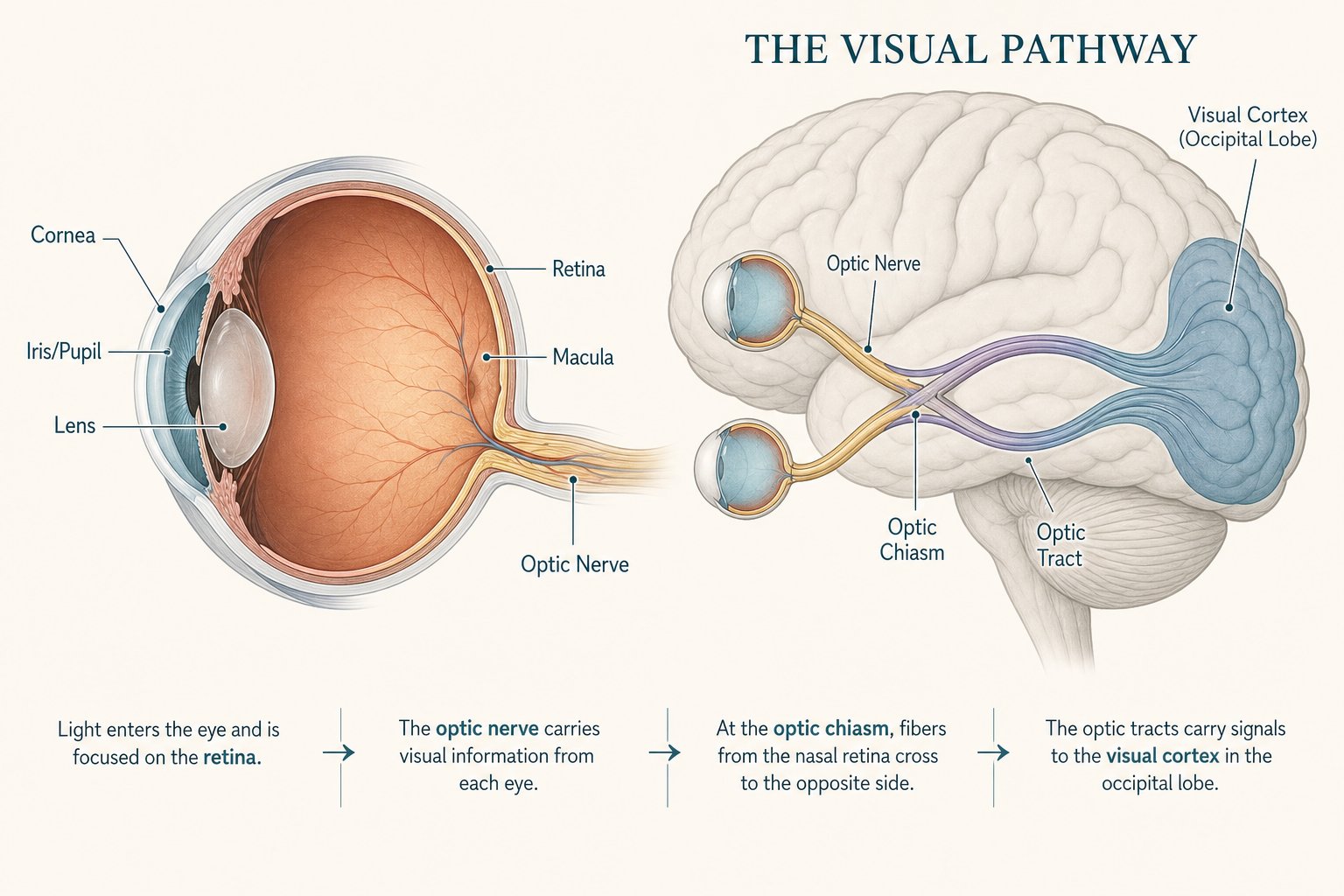
1.13 — Visual anatomy — the structures behind the function

Visual

Anatomy

Visual anatomy — the structures behind the function

Cornea, lens, retina, optic nerve, chiasm, tracts, and visual cortex — the hardware that visual performance depends on.

Cornea, lens, retina, optic nerve, chiasm, tracts, and visual cortex — the hardware that visual performance depends on.

Why Visual Performance Matters: Foundations for Occupational Therapy Practice
13 / 22
  • Cornea, lens, retina, optic nerve, chiasm, tracts, and visual cortex — the hardware that visual performance depends on.

Say this

Talk over the visual: "Visual anatomy — the structures behind the function."

Say the caption in your own words: Cornea, lens, retina, optic nerve, chiasm, tracts, and visual cortex — the hardware that visual performance depends on.

My notes

1.14 — Where OT sits relative to the eye care team

Teaching slide

OT scope

Where OT sits relative to the eye care team

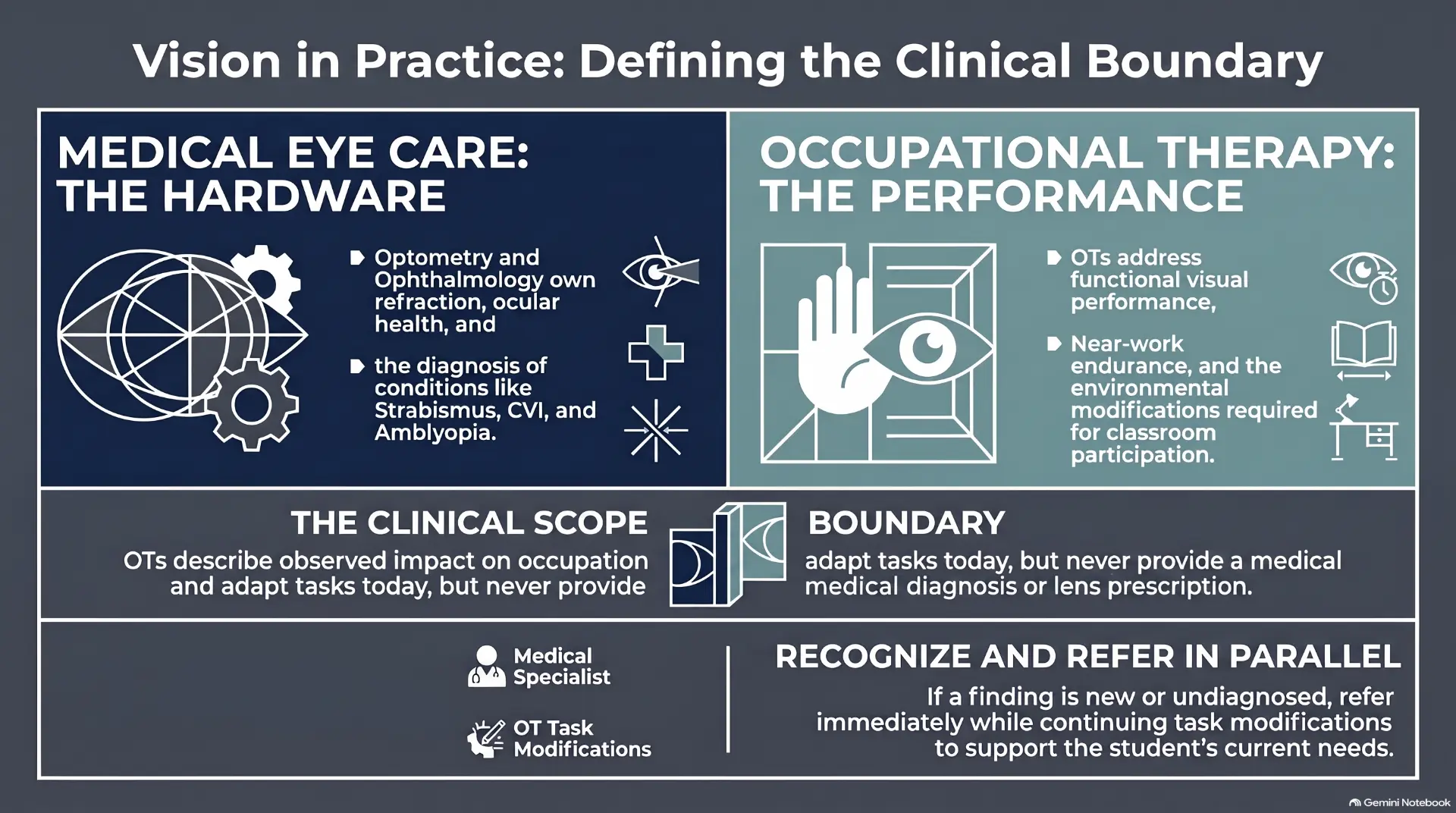
  • Optometry and ophthalmology own refraction, ocular health, and diagnosis.
  • OT owns the functional question: how does this student's visual system perform inside real occupations?
  • We describe observed performance, conditions, and occupational impact — never a diagnosis or a lens prescription.
  • Every visual finding in this course is framed as "recognize and refer," not "diagnose and treat."
1Systematic reviews & meta-analysesSets the default direction of practice.
2Randomized controlled trials (e.g., CITT)Supports specific dosed interventions.
3Cohort & case-control studiesDescribes patterns and associations, not cause.
4Practice guidelines & consensus (AOTA, AOA)Defines scope and role boundaries.
5Expert opinion & single-case designsFills gaps; documented as such in the plan.
Claims in this course are labeled by tier. Where the evidence is consensus or emerging, the course says so rather than overstating it.
Why Visual Performance Matters: Foundations for Occupational Therapy Practice
14 / 22
  • Optometry and ophthalmology own refraction, ocular health, and diagnosis.
  • OT owns the functional question: how does this student's visual system perform inside real occupations?
  • We describe observed performance, conditions, and occupational impact — never a diagnosis or a lens prescription.
  • Every visual finding in this course is framed as "recognize and refer," not "diagnose and treat."

Say this

Frame the slide: "Where OT sits relative to the eye care team."

Walk each point, one sentence each:

• Optometry and ophthalmology own refraction, ocular health, and diagnosis.

• OT owns the functional question: how does this student's visual system perform inside real occupations?

• We describe observed performance, conditions, and occupational impact — never a diagnosis or a lens prescription.

• Every visual finding in this course is framed as "recognize and refer," not "diagnose and treat."

Point at the figure while you talk — name the parts before the labels.

Close with: "If you only take one of these back, take the first one."

My notes

1.15 — Two lanes, one student

Visual

Scope

Two lanes, one student

Medical eye care owns diagnosis and the optical correction; OT owns performance inside real occupations. The referral and the task modification run in parallel, on the same day.

Medical eye care owns diagnosis and the optical correction; OT owns performance inside real occupations. The referral and the task modification run in parallel, on the same day.

Why Visual Performance Matters: Foundations for Occupational Therapy Practice
15 / 22
  • Medical eye care owns diagnosis and the optical correction; OT owns performance inside real occupations. The referral and the task modification run in parallel, on the same day.

Say this

Talk over the visual: "Two lanes, one student."

Say the caption in your own words: Medical eye care owns diagnosis and the optical correction; OT owns performance inside real occupations. The referral and the task modification run in parallel, on the same day.

My notes

1.16 — The brain's two visual highways

Video

Lecture

The brain's two visual highways

Why Visual Performance Matters: Foundations for Occupational Therapy Practice
16 / 22
  • Ventral "what" and dorsal "where" streams, and how each one shows up in the school day.

Say this

Set up the clip in one sentence, play it, then debrief with "what did you notice?"

My notes

1.17 — A gateway problem hiding in plain sight

Case

Application

A gateway problem hiding in plain sight

A kindergarten teacher reports that a student "just isn't paying attention" during calendar time and often bumps into classmates during transitions. The student passed a school vision screening six months ago.

  • Q1.What visual-performance questions would you want answered before assuming this is an attention or behavior issue?
  • Q2.What is the one sentence you would write in a consult note, and what referral would run in parallel?
RetinaChiasmLGNV1striate cortex
Retina → optic nerve → chiasm → LGN → primary visual cortex (V1), then divergence: the dorsal stream travels superiorly to parietal cortex, the ventral stream inferiorly to temporal cortex.
Why Visual Performance Matters: Foundations for Occupational Therapy Practice
17 / 22
  • A kindergarten teacher reports that a student "just isn't paying attention" during calendar time and often bumps into classmates during transitions. The student passed a school vision screening six months ago.
  • Q1. What visual-performance questions would you want answered before assuming this is an attention or behavior issue?
  • Q2. What is the one sentence you would write in a consult note, and what referral would run in parallel?

Say this

Read the scenario aloud, slowly:

A kindergarten teacher reports that a student "just isn't paying attention" during calendar time and often bumps into classmates during transitions. The student passed a school vision screening six months ago.

Then put these questions to the room:

• What visual-performance questions would you want answered before assuming this is an attention or behavior issue?

• What is the one sentence you would write in a consult note, and what referral would run in parallel?

Give 60 seconds of think time before you take answers. Model answers are in the panel beside this script.

My notes

1.18 — Where the referral sits in the student’s day

Visual

Import

Where the referral sits in the student’s day

Copy from the boardRepeated far↔near shifts, place-holding, sustained saccades
Worksheet completionNear endurance, figure-ground on a dense page, line tracking
Silent reading blockFixation stability, convergence comfort over 20+ minutes
Chromebook workContrast/glare tolerance, scrolling scan, screen-to-paper shifts
Hallway & lunch transitionsPeripheral awareness, depth on stairs, moving-crowd scanning
Referrals arrive as behavior (“loses place”, “refuses writing”). Name the occupational demand first — the demand is what you assess and what you later document as educational relevance.
Why Visual Performance Matters: Foundations for Occupational Therapy Practice
18 / 22
  • The referral question, the occupation it interrupts, and who else is already involved.

Say this

Describe what belongs here: The referral question, the occupation it interrupts, and who else is already involved..

My notes

1.19 — So what? "Passed the screening" is not a clearance

So what?

So what?

So what? "Passed the screening" is not a clearance

A distance acuity screening answers one question at one distance. Nearly every school task the student is failing happens at 40 cm, under time pressure, with both eyes working together.

Screenings are built to catch reduced acuity, not efficiency, endurance, or integration.

What you do with it

  • Ask what the screening actually measured before accepting it as a clearance.
  • Observe the student in the failing occupation, at the real distance and duration.
  • Refer when a sign is undiagnosed, even if the screening was passed.

Watch for

Performance that falls apart only under sustained near demand — a screening will never show you that.

Why Visual Performance Matters: Foundations for Occupational Therapy Practice
19 / 22
  • A distance acuity screening answers one question at one distance. Nearly every school task the student is failing happens at 40 cm, under time pressure, with both eyes working together.
  • Because: Screenings are built to catch reduced acuity, not efficiency, endurance, or integration.
  • Move: Ask what the screening actually measured before accepting it as a clearance.
  • Move: Observe the student in the failing occupation, at the real distance and duration.
  • Move: Refer when a sign is undiagnosed, even if the screening was passed.
  • Watch for: Performance that falls apart only under sustained near demand — a screening will never show you that.

Say this

Land the "so what": A distance acuity screening answers one question at one distance. Nearly every school task the student is failing happens at 40 cm, under time pressure, with both eyes working together.

Explain the mechanism plainly: Screenings are built to catch reduced acuity, not efficiency, endurance, or integration.

Then give them the moves — say each one as something they can do Monday:

• Ask what the screening actually measured before accepting it as a clearance.

• Observe the student in the failing occupation, at the real distance and duration.

• Refer when a sign is undiagnosed, even if the screening was passed.

Tell them what success looks like: Performance that falls apart only under sustained near demand — a screening will never show you that.

Ask: "Who has a student this describes right now?" Take one answer, then move.

My notes

1.20 — Two-minute case: what did the screening tell you?

Mini case

Two-minute case

Two-minute case: what did the screening tell you?

A teacher forwards a screening result of 20/20 in each eye and says "so it is not her vision."

What is your one-sentence reply, and what do you do next?

Why Visual Performance Matters: Foundations for Occupational Therapy Practice
20 / 22
  • A teacher forwards a screening result of 20/20 in each eye and says "so it is not her vision."
  • Question: What is your one-sentence reply, and what do you do next?
  • Model answer: "That tells us she can resolve detail at distance; it does not tell us how her eyes hold up at 40 cm for twenty minutes." Then observe a real near task at real duration and document what changes with time on task.
  • Teaching point: Distance acuity is a floor, not a clearance.

Say this

Two-minute case. Read it aloud:

A teacher forwards a screening result of 20/20 in each eye and says "so it is not her vision."

Put the question to them: "What is your one-sentence reply, and what do you do next?" Give 60 seconds, no talking.

Model answer (reveal after they commit): "That tells us she can resolve detail at distance; it does not tell us how her eyes hold up at 40 cm for twenty minutes." Then observe a real near task at real duration and document what changes with time on task.

Close with the rule: Distance acuity is a floor, not a clearance.

My notes

1.21 — Reflect and share

Reflection

Reflect and share

Reflect and share

Think about a referral you received that mentioned a visual concern. What did you own as OT, and what did you defer to eye care?

THINKPROCESSSHARE
  • · Name one observation you could write in occupational terms.
  • · Name one thing you would not write because it is outside OT scope.
Why Visual Performance Matters: Foundations for Occupational Therapy Practice
21 / 22
  • Think about a referral you received that mentioned a visual concern. What did you own as OT, and what did you defer to eye care?
  • Name one observation you could write in occupational terms.
  • Name one thing you would not write because it is outside OT scope.
  • Starter: I own the occupational observation that... I defer to eye care the question of whether...

Say this

Reflection prompt: "Think about a referral you received that mentioned a visual concern. What did you own as OT, and what did you defer to eye care?"

Cues:

• Name one observation you could write in occupational terms.

• Name one thing you would not write because it is outside OT scope.

Offer the sentence starter: "I own the occupational observation that... I defer to eye care the question of whether..."

Think for one minute, write, then take two shares.

My notes

1.22 — Knowledge check — scope and development

Self-check

Knowledge check

Knowledge check — scope and development

A first-grade student holds books at 10 cm and squints. The school vision screen was passed. Which statement is most appropriate for your OT note?

Why Visual Performance Matters: Foundations for Occupational Therapy Practice
22 / 22
  • A first-grade student holds books at 10 cm and squints. The school vision screen was passed. Which statement is most appropriate for your OT note?
  • – Student has convergence insufficiency and needs vision therapy.
  • – Student passes vision screen; no visual concerns noted.
  • ✓ Student reads at 10 cm working distance with squinting; refer for comprehensive eye exam and adapt materials in the meantime.
  • – Student requires reading glasses before starting OT intervention.
  • Rationale: The OT describes observable performance and working distance, recommends referral, and continues adaptation. Diagnosis, therapy prescriptions, and optical recommendations belong to eye care.

Say this

Knowledge check: "A first-grade student holds books at 10 cm and squints. The school vision screen was passed. Which statement is most appropriate for your OT note?"

Options:

• Student has convergence insufficiency and needs vision therapy.

• Student passes vision screen; no visual concerns noted.

• Student reads at 10 cm working distance with squinting; refer for comprehensive eye exam and adapt materials in the meantime.

• Student requires reading glasses before starting OT intervention.

Correct answer: option 3. Rationale: The OT describes observable performance and working distance, recommends referral, and continues adaptation. Diagnosis, therapy prescriptions, and optical recommendations belong to eye care.

My notes

Module 2

2.1 — Module 2

Transition

Module 2

Module 2

Why Visual Performance Matters: Foundations for Occupational Therapy Practice
1 / 21

Say this

Transition: "Module 2."

My notes

2.2 — The Visual Pathways

Title

Module 2

The Visual Pathways

Ventral "what" vs. dorsal "where," and their classroom signatures.

Why Visual Performance Matters: Foundations for Occupational Therapy Practice
2 / 21
  • Ventral "what" vs. dorsal "where," and their classroom signatures.

Say this

Open here. "The Visual Pathways." Ventral "what" vs. dorsal "where," and their classroom signatures.

Say why this section matters for their caseload, then advance.

My notes

2.3 — Where do your students struggle?

Poll

Poll

Where do your students struggle?

Which visual performance patterns show up most in your current caseload?

Why Visual Performance Matters: Foundations for Occupational Therapy Practice
3 / 21
  • Which visual performance patterns show up most in your current caseload?
  • – Slow recognition of letters, words, or symbols
  • – Losing place, bumping into things, misjudging space
  • – Both identification and spatial problems
  • – I am not sure how to tell the difference

Say this

Ask the poll: "Which visual performance patterns show up most in your current caseload?"

Options:

• Slow recognition of letters, words, or symbols

• Losing place, bumping into things, misjudging space

• Both identification and spatial problems

• I am not sure how to tell the difference

Take a show of hands or the on-screen tally, then name the pattern you see before advancing.

My notes

2.4 — Two streams, one retina

Visual

Neuroanatomy

Two streams, one retina

RetinaChiasmLGNV1striate cortex
Retina → optic nerve → chiasm → LGN → primary visual cortex (V1), then divergence: the dorsal stream travels superiorly to parietal cortex, the ventral stream inferiorly to temporal cortex.

Retina → optic nerve → chiasm → LGN → V1, then divergence: dorsal superiorly to parietal cortex, ventral inferiorly to temporal cortex (Visual Minds Learning clinical education).

Why Visual Performance Matters: Foundations for Occupational Therapy Practice
4 / 21
  • Retina → optic nerve → chiasm → LGN → V1, then divergence: dorsal superiorly to parietal cortex, ventral inferiorly to temporal cortex (Visual Minds Learning clinical education).
  • Diagram: pathway-routing

Say this

Talk over the visual: "Two streams, one retina."

Say the caption in your own words: Retina → optic nerve → chiasm → LGN → V1, then divergence: dorsal superiorly to parietal cortex, ventral inferiorly to temporal cortex (Visual Minds Learning clinical education).

My notes

2.5 — Parvocellular and magnocellular tracts

Visual

Tracts

Parvocellular and magnocellular tracts

ParvocellularMagnocellular
Cell body sizeSmall (parvo = “small”)Large (magno = “large”)
LGN layersLayers 3–6Layers 1–2
Best atFine spatial detail, color (red/green)Motion, low contrast, coarse form
Temporal responseSustained, slower conductionTransient, fast conduction
Contrast sensitivityNeeds higher contrastResponds to very low contrast
Feeds primarilyVentral “what” streamDorsal “where/how” stream
Functional signatureSlow letter/word ID, detail errors, color-cue reliancePlace loss, spatial/postural errors, motion-guided reach errors
Parvocellular and magnocellular tracts carry different information from retina to cortex — they explain transmission, not treatment. OT addresses the functional components in the bottom row; we never treat or train a tract.

Parvocellular cells carry fine detail and color into the ventral stream; magnocellular cells carry motion and low-contrast information into the dorsal stream.

Why Visual Performance Matters: Foundations for Occupational Therapy Practice
5 / 21
  • Parvocellular cells carry fine detail and color into the ventral stream; magnocellular cells carry motion and low-contrast information into the dorsal stream.
  • Diagram: parvo-magno-tracts

Say this

Talk over the visual: "Parvocellular and magnocellular tracts."

Say the caption in your own words: Parvocellular cells carry fine detail and color into the ventral stream; magnocellular cells carry motion and low-contrast information into the dorsal stream.

My notes

2.6 — Vision's Two Highways

Visual

Neuroanatomy

Vision's Two Highways

RetinaMagnocellularHighwayParvocellularHighwayLGNtraffic controlcenterV1striate cortexVPA link: Field & attention + Oculomotor efficiencyMagno/dorsal dominance supports scanning, tracking, and spatial action.VPA link: Visual-perceptual processingParvo/ventral dominance supports discrimination, closure, memory, and form.
The retina sends two parallel “highways” to the LGN: the magnocellular tract handles motion, contrast, and spatial-action cues; the parvocellular tract handles detail, color, and object recognition. Both pass through the LGN, then split into the dorsal (where/how) and ventral (what) streams.

The magnocellular highway (motion, contrast, spatial awareness, action) and the parvocellular highway (detail, color, form, recognition) merge at the LGN before diverging into the dorsal and ventral streams.

Why Visual Performance Matters: Foundations for Occupational Therapy Practice
6 / 21
  • The magnocellular highway (motion, contrast, spatial awareness, action) and the parvocellular highway (detail, color, form, recognition) merge at the LGN before diverging into the dorsal and ventral streams.
  • Diagram: two-highways

Say this

Talk over the visual: "Vision's Two Highways."

Say the caption in your own words: The magnocellular highway (motion, contrast, spatial awareness, action) and the parvocellular highway (detail, color, form, recognition) merge at the LGN before diverging into the dorsal and ventral streams.

My notes

2.7 — Vision's two highways in the school day

Visual

Classroom translation

Vision's two highways in the school day

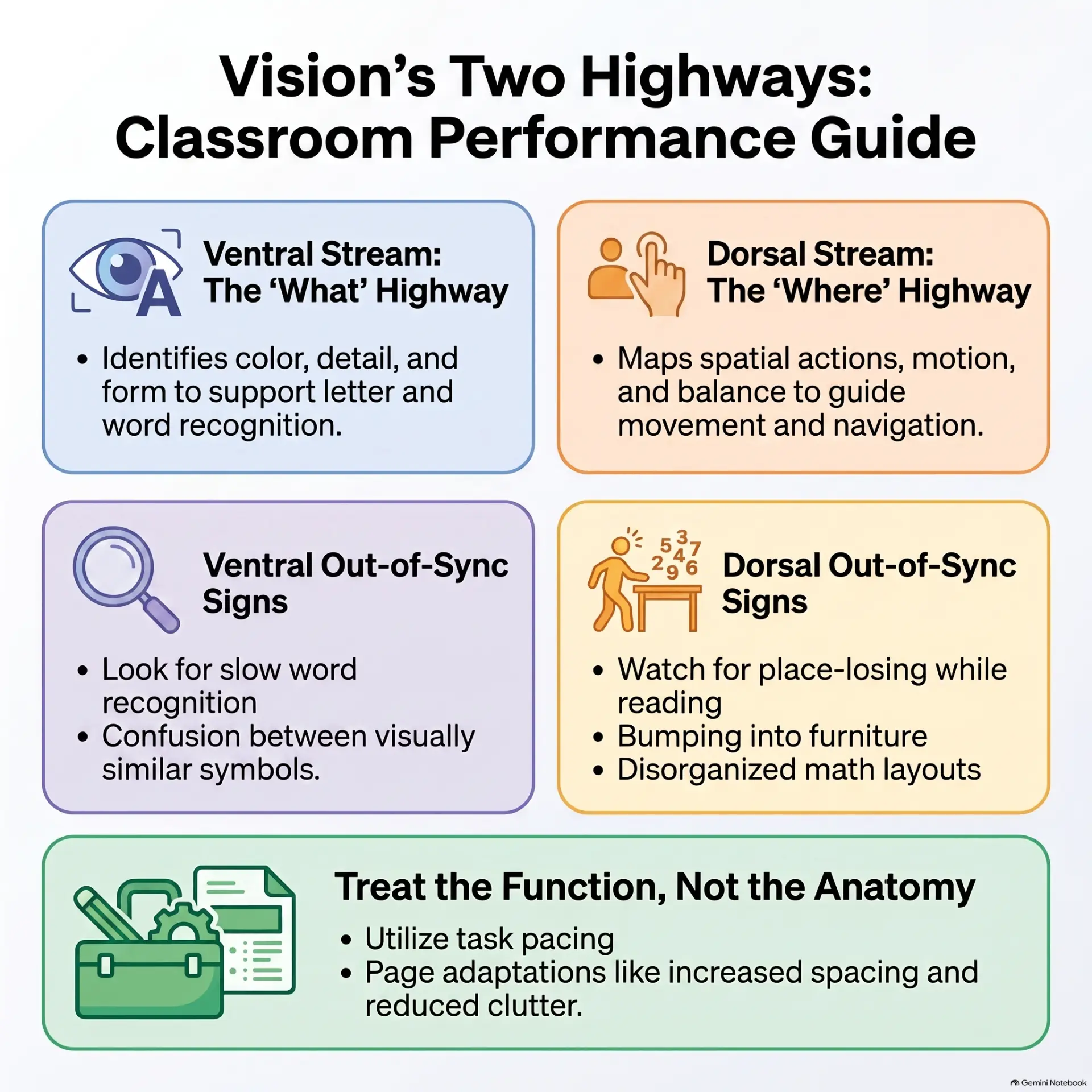
Ventral "what" signs versus dorsal "where" signs, side by side with the classroom behaviors each one produces.

Ventral "what" signs versus dorsal "where" signs, side by side with the classroom behaviors each one produces.

Why Visual Performance Matters: Foundations for Occupational Therapy Practice
7 / 21
  • Ventral "what" signs versus dorsal "where" signs, side by side with the classroom behaviors each one produces.

Say this

Talk over the visual: "Vision's two highways in the school day."

Say the caption in your own words: Ventral "what" signs versus dorsal "where" signs, side by side with the classroom behaviors each one produces.

My notes

2.8 — Ventral vs. dorsal at a glance

Comparison

The two streams

Ventral vs. dorsal at a glance

Ventral stream — "What?"

  • Parvocellular tract
  • Object identity, color, size, fine detail
  • Supports letter/word recognition and object identification
  • Deficits show up as slow or inaccurate visual identification

Dorsal stream — "Where?"

  • Magnocellular tract
  • Spatial orientation, mapping, posture, balance
  • Supports locating items in space and guiding movement toward them
  • Deficits show up as spatial, postural, and navigation errors
RetinaMagnocellularHighwayParvocellularHighwayLGNtraffic controlcenterV1striate cortexVPA link: Field & attention + Oculomotor efficiencyMagno/dorsal dominance supports scanning, tracking, and spatial action.VPA link: Visual-perceptual processingParvo/ventral dominance supports discrimination, closure, memory, and form.
The retina sends two parallel “highways” to the LGN: the magnocellular tract handles motion, contrast, and spatial-action cues; the parvocellular tract handles detail, color, and object recognition. Both pass through the LGN, then split into the dorsal (where/how) and ventral (what) streams.
Why Visual Performance Matters: Foundations for Occupational Therapy Practice
8 / 21
  • Ventral stream — "What?": Parvocellular tract · Object identity, color, size, fine detail · Supports letter/word recognition and object identification · Deficits show up as slow or inaccurate visual identification
  • Dorsal stream — "Where?": Magnocellular tract · Spatial orientation, mapping, posture, balance · Supports locating items in space and guiding movement toward them · Deficits show up as spatial, postural, and navigation errors

Say this

Contrast the two columns: Ventral stream — "What?" versus Dorsal stream — "Where?".

Ventral stream — "What?":

• Parvocellular tract

• Object identity, color, size, fine detail

• Supports letter/word recognition and object identification

• Deficits show up as slow or inaccurate visual identification

Dorsal stream — "Where?":

• Magnocellular tract

• Spatial orientation, mapping, posture, balance

• Supports locating items in space and guiding movement toward them

• Deficits show up as spatial, postural, and navigation errors

Ask: "Which column is your student living in right now?"

My notes

2.9 — What a ventral-stream (parvocellular) signature looks like in class

Teaching slide

Classroom signatures

What a ventral-stream (parvocellular) signature looks like in class

  • Slow, effortful recognition of letters, sight words, or numerals
  • Confusing visually similar letters or symbols beyond the expected age
  • Difficulty matching an object to its picture or naming what was just seen
  • Strong performance on movement-based tasks but weak on detail/identification tasks

Dorsal — "where / how"

Occipital → parietal

  • • Bumps furniture, misjudges stairs and doorways
  • • Loses place, uneven spacing, drifting margins
  • • Struggles in visually busy rooms
  • • Reach and grasp inaccurate under time pressure

Ventral — "what"

Occipital → temporal

  • • Letter and symbol confusion beyond age expectation
  • • Difficulty recognizing familiar faces or objects
  • • Relies on color or context cues to identify items
  • • Slow to find a known item in an array
Two cortical streams, two classroom signatures. "What" failures look like recognition errors; "where" failures look like navigation, spacing, and copying errors.
Why Visual Performance Matters: Foundations for Occupational Therapy Practice
9 / 21
  • Slow, effortful recognition of letters, sight words, or numerals
  • Confusing visually similar letters or symbols beyond the expected age
  • Difficulty matching an object to its picture or naming what was just seen
  • Strong performance on movement-based tasks but weak on detail/identification tasks

Say this

Frame the slide: "What a ventral-stream (parvocellular) signature looks like in class."

Walk each point, one sentence each:

• Slow, effortful recognition of letters, sight words, or numerals

• Confusing visually similar letters or symbols beyond the expected age

• Difficulty matching an object to its picture or naming what was just seen

• Strong performance on movement-based tasks but weak on detail/identification tasks

Point at the figure while you talk — name the parts before the labels.

Close with: "If you only take one of these back, take the first one."

My notes

2.10 — What a dorsal-stream (magnocellular) signature looks like in class

Teaching slide

Classroom signatures

What a dorsal-stream (magnocellular) signature looks like in class

  • Bumping into furniture, misjudging distances, poor spatial awareness in the room
  • Difficulty locating an item visually even when it is in plain sight
  • Trouble copying spatial layouts — maps, graphs, math columns, diagrams
  • Balance, posture, or motor-planning concerns alongside the visual complaint
What you observeMore consistent withNext OT move
Slow, effortful letter or sight-word recognitionVentralDescribe identification accuracy and rate; reduce visual detail load
Confuses visually similar letters past expected ageVentralSample discrimination directly; refer if acuity untested this year
Loses place returning from board to pageDorsalLine marker, copy-reduction; screen saccades and fixation stability
Bumps furniture, misjudges distance in transitionsDorsalEnvironmental path clearing; refer for binocular/depth evaluation
Cannot copy a graph, map, or math column layoutDorsalPre-structured paper, spatial cueing; document spatial organization
Strong on movement tasks, weak on detail tasksVentralContrast this split explicitly in the present-level statement
Sorting a “what” problem from a “where” problem in the classroom. Stream language is for your reasoning; the documentation stays in occupational terms.
Why Visual Performance Matters: Foundations for Occupational Therapy Practice
10 / 21
  • Bumping into furniture, misjudging distances, poor spatial awareness in the room
  • Difficulty locating an item visually even when it is in plain sight
  • Trouble copying spatial layouts — maps, graphs, math columns, diagrams
  • Balance, posture, or motor-planning concerns alongside the visual complaint

Say this

Frame the slide: "What a dorsal-stream (magnocellular) signature looks like in class."

Walk each point, one sentence each:

• Bumping into furniture, misjudging distances, poor spatial awareness in the room

• Difficulty locating an item visually even when it is in plain sight

• Trouble copying spatial layouts — maps, graphs, math columns, diagrams

• Balance, posture, or motor-planning concerns alongside the visual complaint

Point at the figure while you talk — name the parts before the labels.

Close with: "If you only take one of these back, take the first one."

My notes

2.11 — We do not treat tracts — we treat the functional components

Teaching slide

Scope

We do not treat tracts — we treat the functional components

  • The magnocellular and parvocellular tracts describe transmission: how visual information travels from retina to cortex. That is anatomy and physiology, and it is outside what OT assesses or changes.
  • OT works one layer up, on the functional components the tract supports — fixation stability, saccadic accuracy, place-keeping, contrast and motion tolerance, discrimination, visual memory.
  • The intervention target is always a functional component plus the task and environment: contrast and print adaptation, graded near-work load, pacing, reduced visual clutter, compensatory access.
  • Never write, say, or imply that OT intervention improves, trains, strengthens, or repairs a pathway, or that a VPA™ result identifies a magnocellular deficit.
  • The measured outcome stays in the occupation — reading the passage, copying the assignment, crossing the parking lot — not in the pathway.

Occupations

What the person needs and wants to do.

  • • Reading and written work
  • • Dressing, eating, self-care
  • • Play, sport, driving, work

Client factors — body functions

The internal capacities that support doing.

  • • Visual acuity and visual field
  • • Eye-movement and focusing control
  • • Visual perception

Performance skills

Observable actions during the task.

  • • Locates, tracks, and keeps place
  • • Aligns, spaces, and copies accurately
  • • Sustains looking over time

Performance patterns

Habits and routines that carry the day.

  • • Break routines during near work
  • • Where materials live on the desk
  • • Self-checks before turning work in

Contexts and environment

Everything around the person.

  • • Lighting, glare, seating
  • • Print size, contrast, clutter
  • • Team expectations and supports

Highlighted boxes are where a visual problem shows up in our documentation: a client factor we describe, a performance skill we measure in the task, and a context we change. The diagnosis of the eye itself sits outside this picture — that belongs to eye care.

The OT practice framework, drawn as the pieces we actually observe. Vision touches three of them directly — client factors, performance skills, and context — which is why vision work is ordinary OT, not a specialty add-on.
Why Visual Performance Matters: Foundations for Occupational Therapy Practice
11 / 21
  • The magnocellular and parvocellular tracts describe transmission: how visual information travels from retina to cortex. That is anatomy and physiology, and it is outside what OT assesses or changes.
  • OT works one layer up, on the functional components the tract supports — fixation stability, saccadic accuracy, place-keeping, contrast and motion tolerance, discrimination, visual memory.
  • The intervention target is always a functional component plus the task and environment: contrast and print adaptation, graded near-work load, pacing, reduced visual clutter, compensatory access.
  • Never write, say, or imply that OT intervention improves, trains, strengthens, or repairs a pathway, or that a VPA™ result identifies a magnocellular deficit.
  • The measured outcome stays in the occupation — reading the passage, copying the assignment, crossing the parking lot — not in the pathway.

Say this

Frame the slide: "We do not treat tracts — we treat the functional components."

Walk each point, one sentence each:

• The magnocellular and parvocellular tracts describe transmission: how visual information travels from retina to cortex. That is anatomy and physiology, and it is outside what OT assesses or changes.

• OT works one layer up, on the functional components the tract supports — fixation stability, saccadic accuracy, place-keeping, contrast and motion tolerance, discrimination, visual memory.

• The intervention target is always a functional component plus the task and environment: contrast and print adaptation, graded near-work load, pacing, reduced visual clutter, compensatory access.

• Never write, say, or imply that OT intervention improves, trains, strengthens, or repairs a pathway, or that a VPA™ result identifies a magnocellular deficit.

• The measured outcome stays in the occupation — reading the passage, copying the assignment, crossing the parking lot — not in the pathway.

Point at the figure while you talk — name the parts before the labels.

Close with: "If you only take one of these back, take the first one."

My notes

2.12 — Where the two streams sit in a level-based visual performance framework

Five-Level Framework

Framework link

Where the two streams sit in a level-based visual performance framework

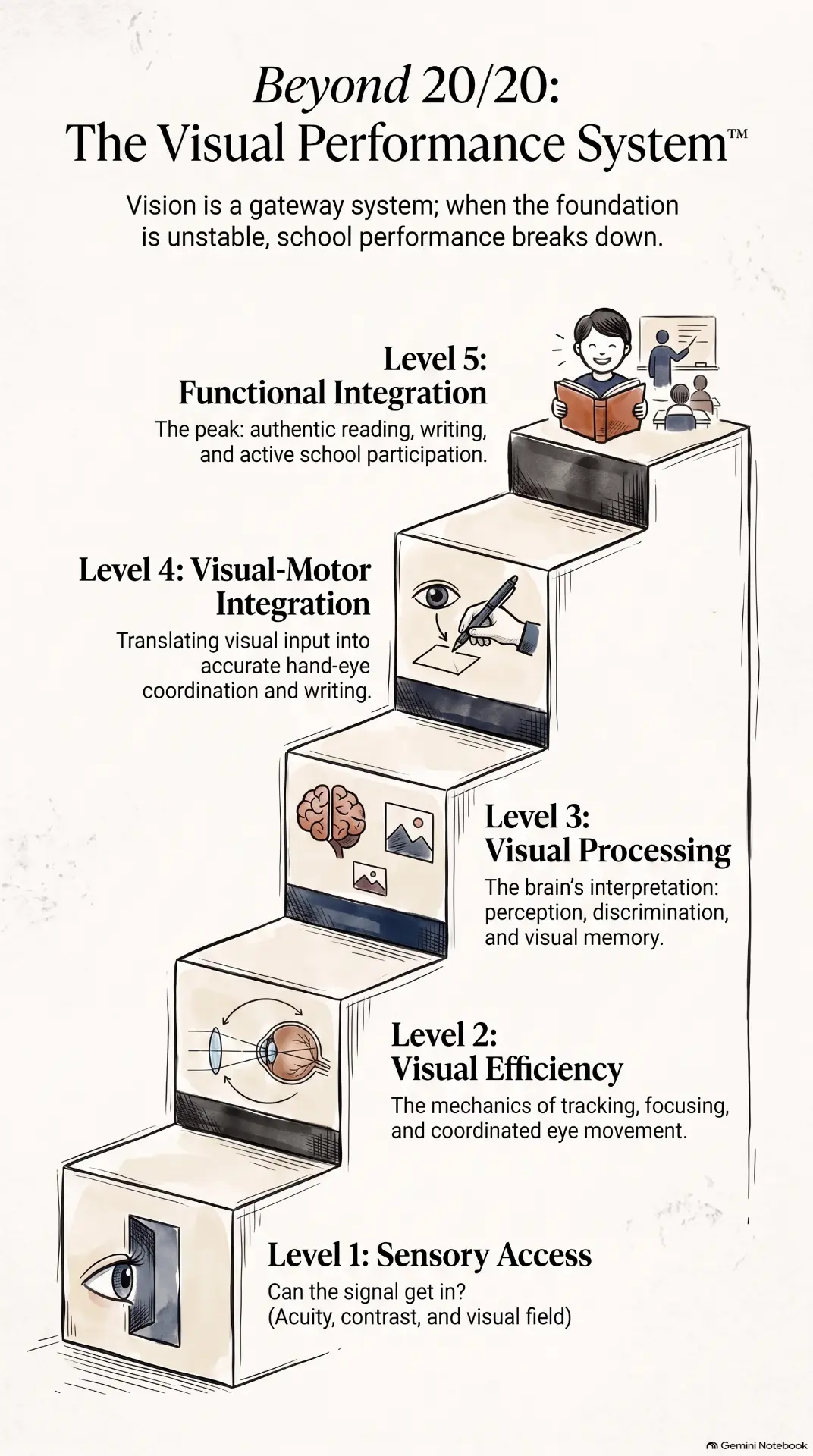
1

Visual Acuity & Sensory Foundation

Can the visual signal get in clearly enough to use?

2

Visual Efficiency

Magnocellular/dorsal load shows here first — fixation stability, saccadic return, place-keeping.

3

Visual Processing

Parvocellular/ventral identification lives here — discrimination, form constancy, figure-ground.

4

Visual-Motor Integration

Translating what is seen into graded, accurate motor output.

5

Functional Integration

Reading, writing, and task performance under real classroom demand.

Why Visual Performance Matters: Foundations for Occupational Therapy Practice
12 / 21
  • Level 1 — Visual Acuity & Sensory Foundation: Can the visual signal get in clearly enough to use?
  • Level 2 — Visual Efficiency: Magnocellular/dorsal load shows here first — fixation stability, saccadic return, place-keeping.
  • Level 3 — Visual Processing (focus): Parvocellular/ventral identification lives here — discrimination, form constancy, figure-ground.
  • Level 4 — Visual-Motor Integration: Translating what is seen into graded, accurate motor output.
  • Level 5 — Functional Integration: Reading, writing, and task performance under real classroom demand.

Say this

Run the five levels bottom-up.

Spend your time on Level 3 — that is the point of this slide.

My notes

2.13 — Module 2 video — how the brain splits visual processing

Video

Lecture

Module 2 video — how the brain splits visual processing

Why Visual Performance Matters: Foundations for Occupational Therapy Practice
13 / 21
  • Narrated walkthrough connecting stream anatomy to functional classroom signs.

Say this

Set up the clip in one sentence, play it, then debrief with "what did you notice?"

My notes

2.14 — Beyond 20/20 — the Visual Performance System™

Visual

Framework

Beyond 20/20 — the Visual Performance System™

Level 1 Visual Access → Level 2 Visual Efficiency → Level 3 Visual Processing → Level 4 Visual-Motor Integration → Level 5 Functional Integration.

Level 1 Visual Access → Level 2 Visual Efficiency → Level 3 Visual Processing → Level 4 Visual-Motor Integration → Level 5 Functional Integration.

Why Visual Performance Matters: Foundations for Occupational Therapy Practice
14 / 21
  • Level 1 Visual Access → Level 2 Visual Efficiency → Level 3 Visual Processing → Level 4 Visual-Motor Integration → Level 5 Functional Integration.

Say this

Talk over the visual: "Beyond 20/20 — the Visual Performance System™."

Say the caption in your own words: Level 1 Visual Access → Level 2 Visual Efficiency → Level 3 Visual Processing → Level 4 Visual-Motor Integration → Level 5 Functional Integration.

My notes

2.15 — Sorting a "what" problem from a "where" problem

Case

Application

Sorting a "what" problem from a "where" problem

A 3rd-grade student reads individual words accurately in isolation but cannot find her place after looking up from the page, and she frequently loses items placed directly in front of her on a busy desk.

  • Q1.Which stream does this description sound more consistent with, and what would you probe next to confirm it?
  • Q2.How would you phrase this finding for a teacher without naming a "dorsal stream deficit"?
What you observeMore consistent withNext OT move
Slow, effortful letter or sight-word recognitionVentralDescribe identification accuracy and rate; reduce visual detail load
Confuses visually similar letters past expected ageVentralSample discrimination directly; refer if acuity untested this year
Loses place returning from board to pageDorsalLine marker, copy-reduction; screen saccades and fixation stability
Bumps furniture, misjudges distance in transitionsDorsalEnvironmental path clearing; refer for binocular/depth evaluation
Cannot copy a graph, map, or math column layoutDorsalPre-structured paper, spatial cueing; document spatial organization
Strong on movement tasks, weak on detail tasksVentralContrast this split explicitly in the present-level statement
Sorting a “what” problem from a “where” problem in the classroom. Stream language is for your reasoning; the documentation stays in occupational terms.
Why Visual Performance Matters: Foundations for Occupational Therapy Practice
15 / 21
  • A 3rd-grade student reads individual words accurately in isolation but cannot find her place after looking up from the page, and she frequently loses items placed directly in front of her on a busy desk.
  • Q1. Which stream does this description sound more consistent with, and what would you probe next to confirm it?
  • Q2. How would you phrase this finding for a teacher without naming a "dorsal stream deficit"?

Say this

Read the scenario aloud, slowly:

A 3rd-grade student reads individual words accurately in isolation but cannot find her place after looking up from the page, and she frequently loses items placed directly in front of her on a busy desk.

Then put these questions to the room:

• Which stream does this description sound more consistent with, and what would you probe next to confirm it?

• How would you phrase this finding for a teacher without naming a "dorsal stream deficit"?

Give 60 seconds of think time before you take answers. Model answers are in the panel beside this script.

My notes

2.16 — What a spatial ("where") breakdown looks like on the page

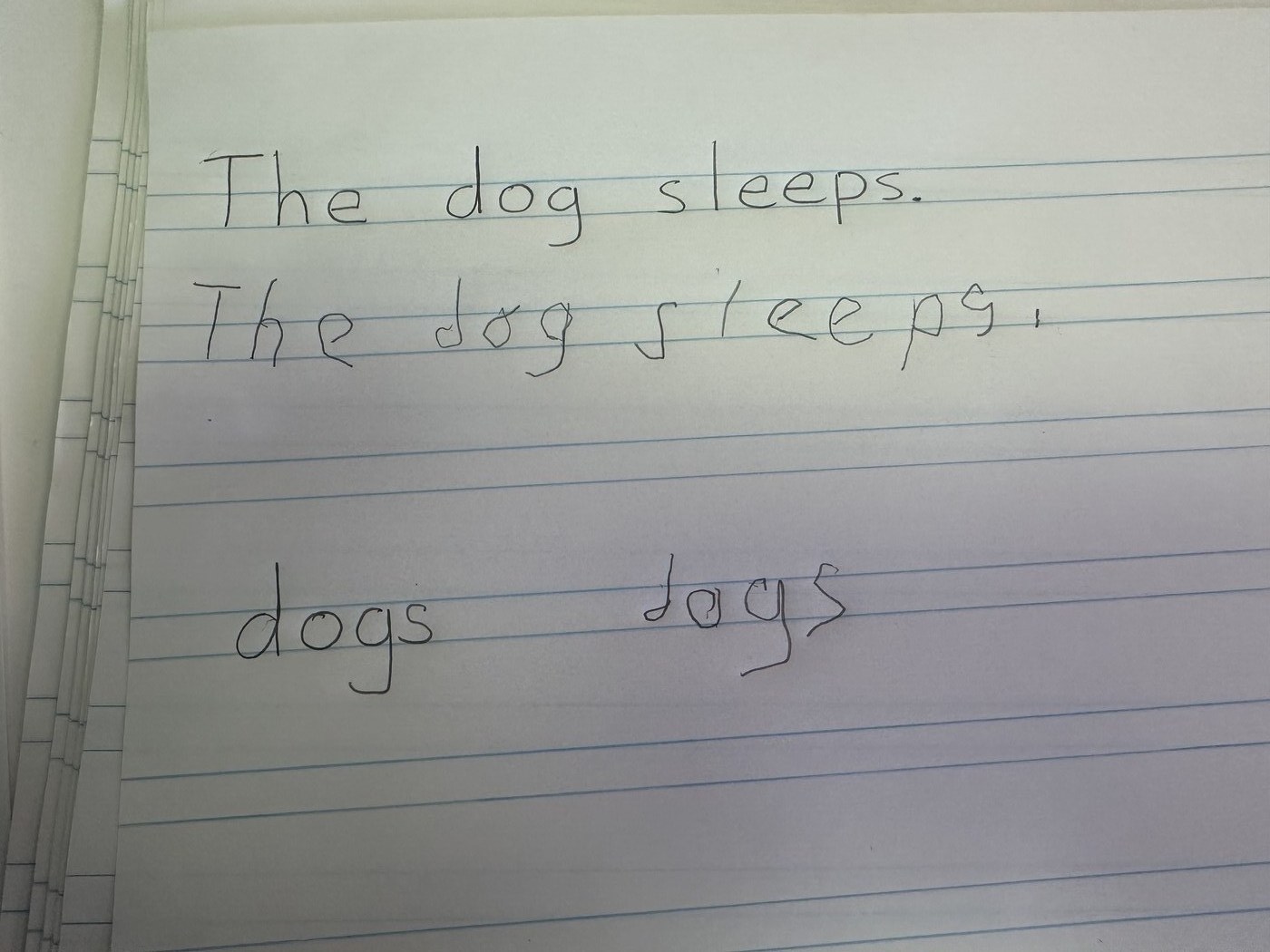
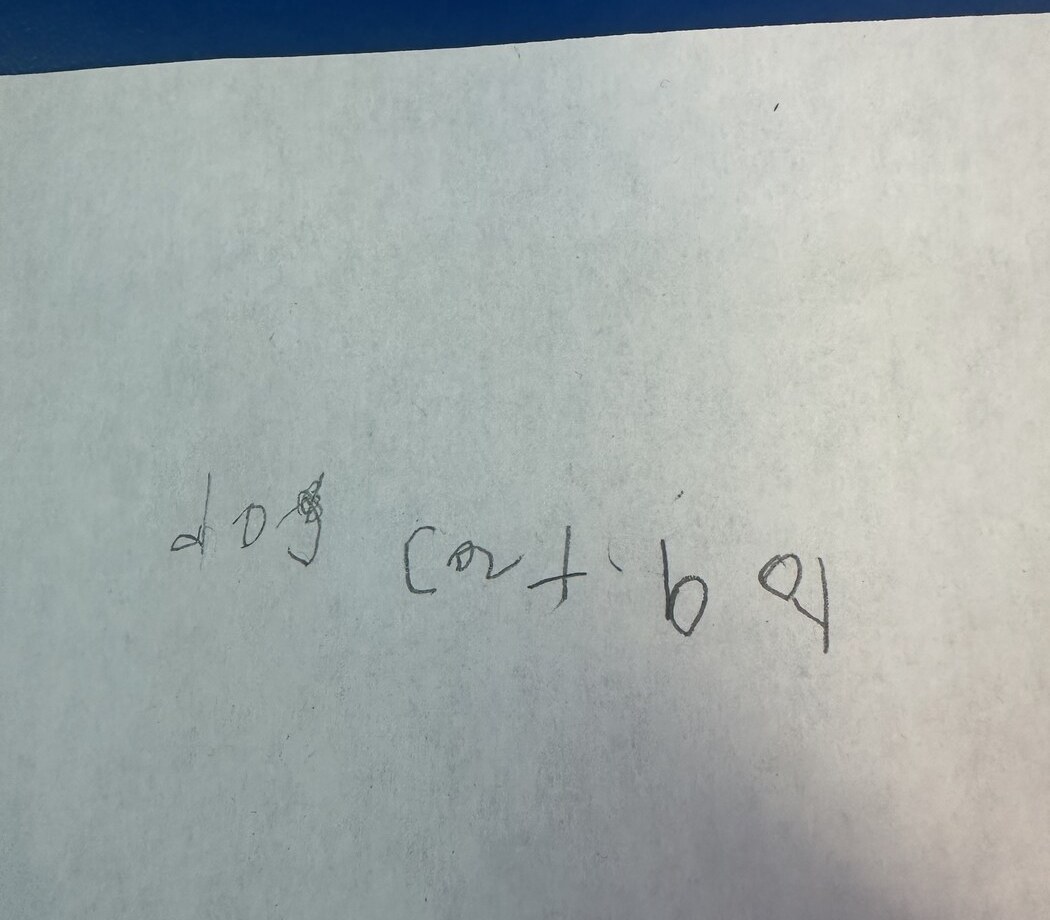
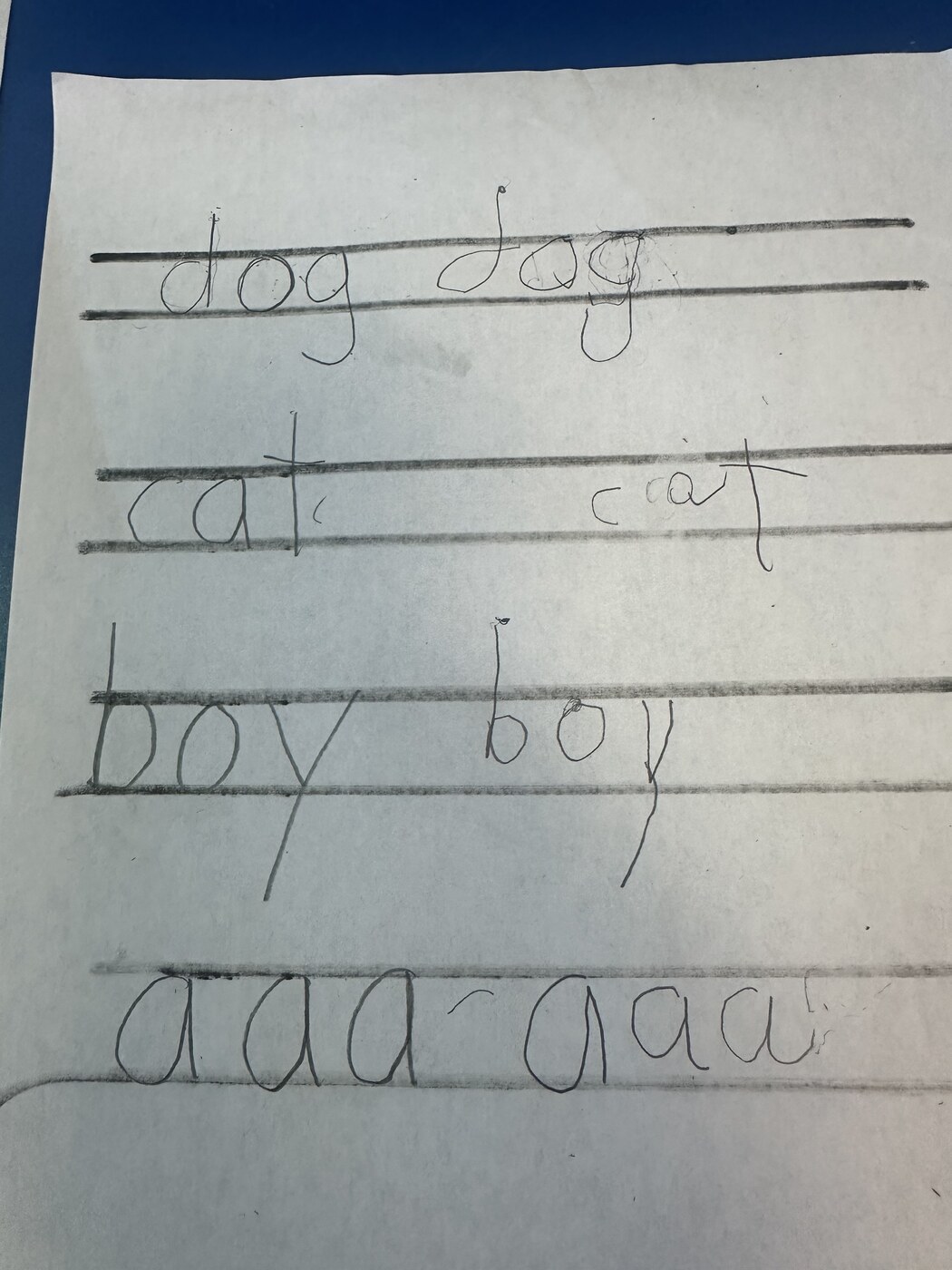
Before / after

Work sample

What a spatial ("where") breakdown looks like on the page

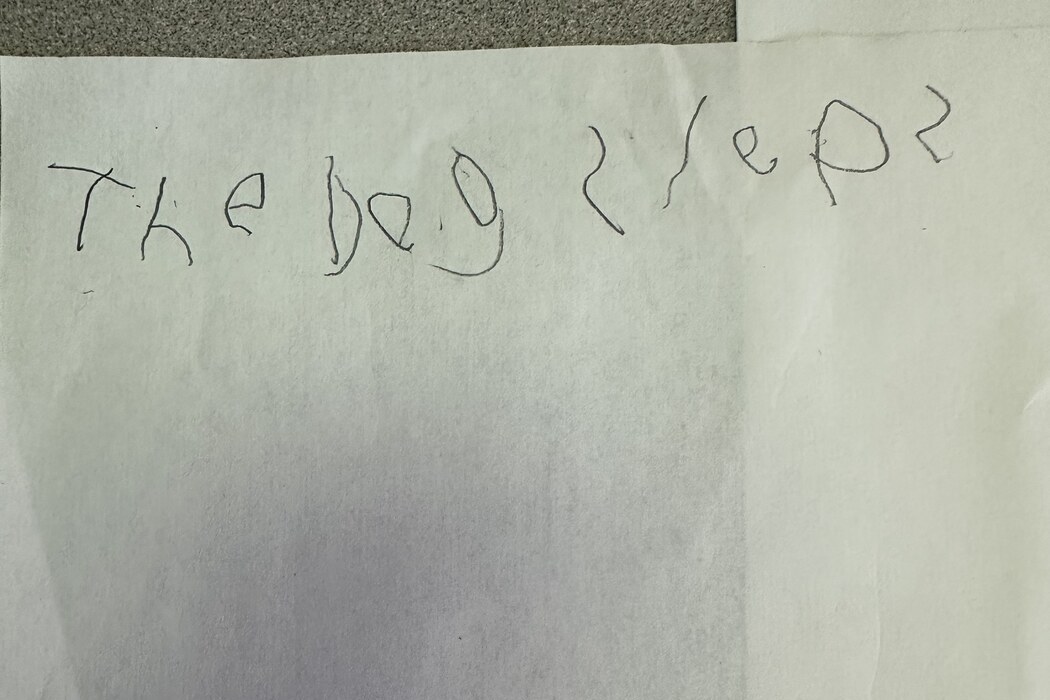
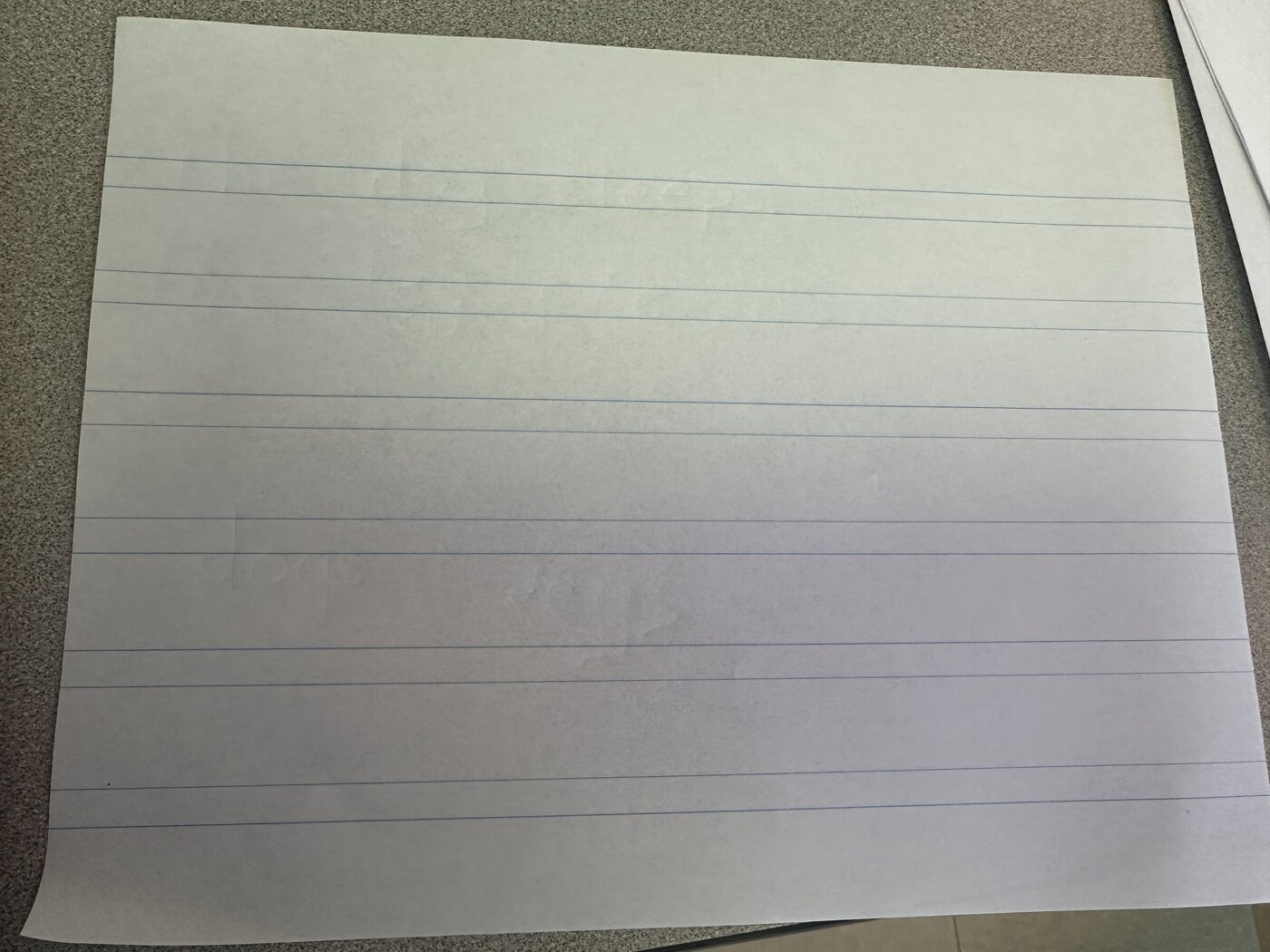
Blank paper — no spatial reference

The student has to generate placement, size, and direction with no external structure.

The student has to generate placement, size, and direction with no external structure.

  • • The line drifts upward across the page.
  • • Letter size and orientation shift mid-sentence; several letters reverse.
  • • Spacing is unpredictable — the "where" system is doing unsupported work.

Lined paper — visual stability points supplied

Same sentence, same student, with baseline and line-to-line reference restored.

Same sentence, same student, with baseline and line-to-line reference restored.

  • • The line holds horizontal; drift disappears.
  • • Letter size normalizes against the ruling.
  • • Word spacing becomes consistent and readable.

When performance changes because the environment supplied the spatial reference, you are looking at a spatial ("where") demand, not a word-knowledge ("what") problem.

Why Visual Performance Matters: Foundations for Occupational Therapy Practice
16 / 21
  • Blank paper — no spatial reference: The student has to generate placement, size, and direction with no external structure. · The line drifts upward across the page. · Letter size and orientation shift mid-sentence; several letters reverse. · Spacing is unpredictable — the "where" system is doing unsupported work.
  • Lined paper — visual stability points supplied: Same sentence, same student, with baseline and line-to-line reference restored. · The line holds horizontal; drift disappears. · Letter size normalizes against the ruling. · Word spacing becomes consistent and readable.
  • Takeaway: When performance changes because the environment supplied the spatial reference, you are looking at a spatial ("where") demand, not a word-knowledge ("what") problem.

Say this

Set up the contrast: "What a spatial ("where") breakdown looks like on the page."

Point at the before panel first. The student has to generate placement, size, and direction with no external structure.

Then the after panel. Same sentence, same student, with baseline and line-to-line reference restored.

Say the rule out loud: When performance changes because the environment supplied the spatial reference, you are looking at a spatial ("where") demand, not a word-knowledge ("what") problem.

Ask: "What did we change — the child, or the demand?"

My notes

2.17 — So what? Vision shows up as behavior first

So what?

So what?

So what? Vision shows up as behavior first

You will almost never be handed a vision complaint. You will be handed avoidance, sloppiness, slowness, or "not trying."

Children rarely report a visual world they have always had. They report what it costs them, in behavior.

What you do with it

  • Translate the referral complaint into an observable visual demand.
  • Compare performance across distance, duration, and layout before judging effort.
  • Give the team the behavioral signature in writing so it stops being a character description.

Watch for

Consistent avoidance of one occupation while a similar-difficulty task with lower visual load is fine.

Why Visual Performance Matters: Foundations for Occupational Therapy Practice
17 / 21
  • You will almost never be handed a vision complaint. You will be handed avoidance, sloppiness, slowness, or "not trying."
  • Because: Children rarely report a visual world they have always had. They report what it costs them, in behavior.
  • Move: Translate the referral complaint into an observable visual demand.
  • Move: Compare performance across distance, duration, and layout before judging effort.
  • Move: Give the team the behavioral signature in writing so it stops being a character description.
  • Watch for: Consistent avoidance of one occupation while a similar-difficulty task with lower visual load is fine.

Say this

Land the "so what": You will almost never be handed a vision complaint. You will be handed avoidance, sloppiness, slowness, or "not trying."

Explain the mechanism plainly: Children rarely report a visual world they have always had. They report what it costs them, in behavior.

Then give them the moves — say each one as something they can do Monday:

• Translate the referral complaint into an observable visual demand.

• Compare performance across distance, duration, and layout before judging effort.

• Give the team the behavioral signature in writing so it stops being a character description.

Tell them what success looks like: Consistent avoidance of one occupation while a similar-difficulty task with lower visual load is fine.

Ask: "Who has a student this describes right now?" Take one answer, then move.

My notes

2.18 — Postural setup changes what you are measuring

Before / after

Change the setup

Postural setup changes what you are measuring

Before — unsupported

Feet unsupported, trunk collapsed, page about 15 cm from the eyes.

Feet unsupported, trunk collapsed, page about 15 cm from the eyes.

  • • Near demand is far higher than the task requires
  • • Fatigue and avoidance appear within minutes

After — supported

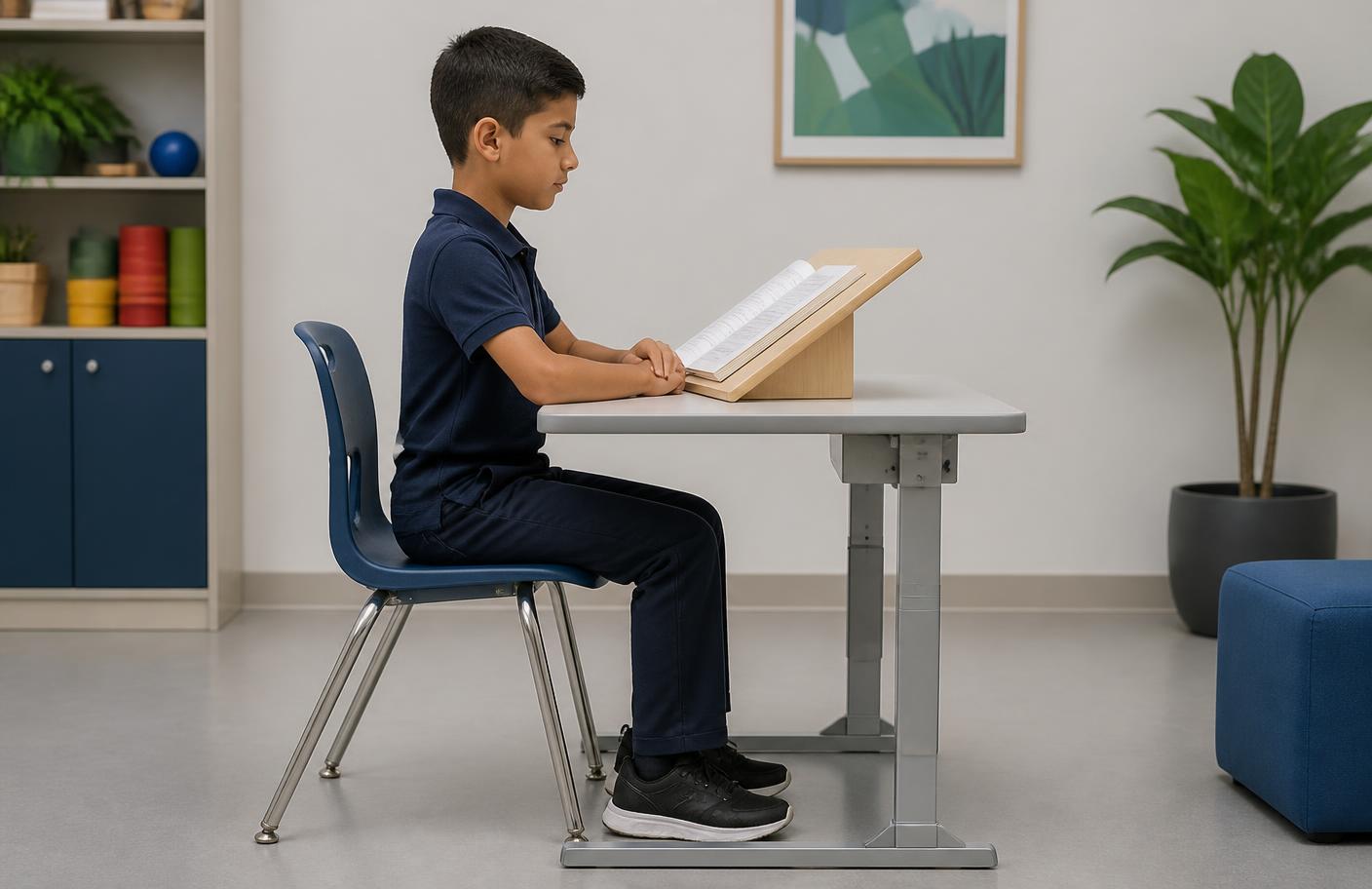
Feet supported, hips back, page raised toward a slant, working distance near Harmon distance.

Feet supported, hips back, page raised toward a slant, working distance near Harmon distance.

  • • Working distance is now a controlled variable, not a confound
  • • Endurance findings become interpretable

Fix posture and distance before you score anything. Otherwise you are documenting the setup, not the student.

Why Visual Performance Matters: Foundations for Occupational Therapy Practice
18 / 21
  • Before — unsupported: Feet unsupported, trunk collapsed, page about 15 cm from the eyes. · Near demand is far higher than the task requires · Fatigue and avoidance appear within minutes
  • After — supported: Feet supported, hips back, page raised toward a slant, working distance near Harmon distance. · Working distance is now a controlled variable, not a confound · Endurance findings become interpretable
  • Takeaway: Fix posture and distance before you score anything. Otherwise you are documenting the setup, not the student.

Say this

Set up the contrast: "Postural setup changes what you are measuring."

Point at the before panel first. Feet unsupported, trunk collapsed, page about 15 cm from the eyes.

Then the after panel. Feet supported, hips back, page raised toward a slant, working distance near Harmon distance.

Say the rule out loud: Fix posture and distance before you score anything. Otherwise you are documenting the setup, not the student.

Ask: "What did we change — the child, or the demand?"

My notes

2.19 — Two-minute case: effort or demand?

Mini case

Two-minute case

Two-minute case: effort or demand?

A Grade 3 student completes math facts on a whiteboard quickly, but produces almost nothing on the same problems given as a dense worksheet.

What does that difference tell you, and what do you trial first?

Why Visual Performance Matters: Foundations for Occupational Therapy Practice
19 / 21
  • A Grade 3 student completes math facts on a whiteboard quickly, but produces almost nothing on the same problems given as a dense worksheet.
  • Question: What does that difference tell you, and what do you trial first?
  • Model answer: The math skill is intact; the visual demand of the page is the variable. Trial the same items with enlarged print, fewer items per page, and a line guide. If output normalizes, document a demand mismatch and modify the page while you investigate efficiency.
  • Teaching point: When the same content succeeds in one visual format and fails in another, look at the format first.

Say this

Two-minute case. Read it aloud:

A Grade 3 student completes math facts on a whiteboard quickly, but produces almost nothing on the same problems given as a dense worksheet.

Put the question to them: "What does that difference tell you, and what do you trial first?" Give 60 seconds, no talking.

Model answer (reveal after they commit): The math skill is intact; the visual demand of the page is the variable. Trial the same items with enlarged print, fewer items per page, and a line guide. If output normalizes, document a demand mismatch and modify the page while you investigate efficiency.

Close with the rule: When the same content succeeds in one visual format and fails in another, look at the format first.

My notes

2.20 — Reflect and share

Reflection

Reflect and share

Reflect and share

Choose one student. Describe one behavior that looks like a "what" problem and one that looks like a "where" problem.

THINKPROCESSSHARE
  • · Use only the language of classroom performance, not stream labels.
Why Visual Performance Matters: Foundations for Occupational Therapy Practice
20 / 21
  • Choose one student. Describe one behavior that looks like a "what" problem and one that looks like a "where" problem.
  • Use only the language of classroom performance, not stream labels.
  • Starter: A "what" problem looks like... A "where" problem looks like...

Say this

Reflection prompt: "Choose one student. Describe one behavior that looks like a "what" problem and one that looks like a "where" problem."

Cues:

• Use only the language of classroom performance, not stream labels.

Offer the sentence starter: "A "what" problem looks like... A "where" problem looks like..."

Think for one minute, write, then take two shares.

My notes

2.21 — Knowledge check — streams

Self-check

Knowledge check

Knowledge check — streams

A student reads words accurately but cannot copy from a spatial diagram. Which description fits best?

Why Visual Performance Matters: Foundations for Occupational Therapy Practice
21 / 21
  • A student reads words accurately but cannot copy from a spatial diagram. Which description fits best?
  • – Ventral stream problem — difficulty identifying details
  • ✓ Dorsal stream problem — difficulty with spatial layout and mapping
  • – Both streams are equally affected
  • – The student is not trying hard enough
  • Rationale: Difficulty copying spatial layouts, maps, and diagrams is consistent with a dorsal / spatial-mapping pattern. Accurate word reading suggests the ventral identification stream is relatively intact.

Say this

Knowledge check: "A student reads words accurately but cannot copy from a spatial diagram. Which description fits best?"

Options:

• Ventral stream problem — difficulty identifying details

• Dorsal stream problem — difficulty with spatial layout and mapping

• Both streams are equally affected

• The student is not trying hard enough

Correct answer: option 2. Rationale: Difficulty copying spatial layouts, maps, and diagrams is consistent with a dorsal / spatial-mapping pattern. Accurate word reading suggests the ventral identification stream is relatively intact.

My notes

Module 3

3.1 — Module 3

Transition

Module 3

Module 3

Why Visual Performance Matters: Foundations for Occupational Therapy Practice
1 / 19

Say this

Transition: "Module 3."

My notes

3.2 — Underlying Conditions vs. Functional Limitations

Title

Module 3

Underlying Conditions vs. Functional Limitations

The eye and brain conditions that may sit under what you observe — and the functional problems OT actually treats.

Why Visual Performance Matters: Foundations for Occupational Therapy Practice
2 / 19
  • The eye and brain conditions that may sit under what you observe — and the functional problems OT actually treats.

Say this

Open here. "Underlying Conditions vs. Functional Limitations." The eye and brain conditions that may sit under what you observe — and the functional problems OT actually treats.

Say why this section matters for their caseload, then advance.

My notes

3.3 — Condition recognition

Poll

Poll

Condition recognition

Which condition are you least confident recognizing functionally?

Why Visual Performance Matters: Foundations for Occupational Therapy Practice
3 / 19
  • Which condition are you least confident recognizing functionally?
  • – Cortical Visual Impairment (CVI)
  • – Amblyopia / strabismus
  • – Convergence problems
  • – Albinism / ONH / coloboma

Say this

Ask the poll: "Which condition are you least confident recognizing functionally?"

Options:

• Cortical Visual Impairment (CVI)

• Amblyopia / strabismus

• Convergence problems

• Albinism / ONH / coloboma

Take a show of hands or the on-screen tally, then name the pattern you see before advancing.

My notes

3.4 — How to use this module

Teaching slide

Scope reminder

How to use this module

  • These are possible underlying diagnoses, not OT findings — diagnosis belongs to ophthalmology, optometry, and neurology.
  • OT does not diagnose or treat the condition; OT describes and treats the functional limitation it produces.
  • The point is vocabulary and mechanism: knowing the condition tells you what ceiling you are working under and which supports are worth trying.
  • A short red-flag list still warrants prompt medical eye care, and OT intervention continues in parallel either way.

CVI

Variable function, latency, color/movement preference

Optic nerve hypoplasia

Reduced acuity, field loss, nystagmus

Albinism

Photophobia, nystagmus, reduced acuity

Strabismus

Eye turn, suppression, depth judgment errors

Amblyopia

Monocular acuity gap, crowding effects

Nystagmus

Null point head posture, reading endurance loss

Recognize and refer. The OT contribution is the functional description of each pattern during occupation — the diagnosis belongs to eye care.
Why Visual Performance Matters: Foundations for Occupational Therapy Practice
4 / 19
  • These are possible underlying diagnoses, not OT findings — diagnosis belongs to ophthalmology, optometry, and neurology.
  • OT does not diagnose or treat the condition; OT describes and treats the functional limitation it produces.
  • The point is vocabulary and mechanism: knowing the condition tells you what ceiling you are working under and which supports are worth trying.
  • A short red-flag list still warrants prompt medical eye care, and OT intervention continues in parallel either way.

Say this

Frame the slide: "How to use this module."

Walk each point, one sentence each:

• These are possible underlying diagnoses, not OT findings — diagnosis belongs to ophthalmology, optometry, and neurology.

• OT does not diagnose or treat the condition; OT describes and treats the functional limitation it produces.

• The point is vocabulary and mechanism: knowing the condition tells you what ceiling you are working under and which supports are worth trying.

• A short red-flag list still warrants prompt medical eye care, and OT intervention continues in parallel either way.

Point at the figure while you talk — name the parts before the labels.

Close with: "If you only take one of these back, take the first one."

My notes

3.5 — Cortical Visual Impairment (CVI)

Comparison

CVI

Cortical Visual Impairment (CVI)

What it is

  • Brain-based, not ocular — the eye exam is often normal
  • A visual-processing problem, not low vision
  • Often described as a "kaleidoscope" visual experience

Functional limitations OT treats

  • Strong color preference
  • Vision improves with movement or positioning
  • Visual latency — delayed response
  • Breaks down in visual clutter
RetinaChiasmLGNV1striate cortex
Retina → optic nerve → chiasm → LGN → primary visual cortex (V1), then divergence: the dorsal stream travels superiorly to parietal cortex, the ventral stream inferiorly to temporal cortex.
Why Visual Performance Matters: Foundations for Occupational Therapy Practice
5 / 19
  • What it is: Brain-based, not ocular — the eye exam is often normal · A visual-processing problem, not low vision · Often described as a "kaleidoscope" visual experience
  • Functional limitations OT treats: Strong color preference · Vision improves with movement or positioning · Visual latency — delayed response · Breaks down in visual clutter

Say this

Contrast the two columns: What it is versus Functional limitations OT treats.

What it is:

• Brain-based, not ocular — the eye exam is often normal

• A visual-processing problem, not low vision

• Often described as a "kaleidoscope" visual experience

Functional limitations OT treats:

• Strong color preference

• Vision improves with movement or positioning

• Visual latency — delayed response

• Breaks down in visual clutter

Ask: "Which column is your student living in right now?"

My notes

3.6 — Optic Nerve Hypoplasia (ONH)

Comparison

ONH

Optic Nerve Hypoplasia (ONH)

What it is

  • Congenital under-development of the optic nerve
  • Prenatal drug or alcohol exposure is commonly cited
  • Ranges from mild nerve dysfunction to complete loss
  • Frequently presents with autistic-like behaviors — light gazing, stereotypies, social-gaze differences

Functional limitations OT treats

  • Acuity and field loss — print size, contrast, materials placement
  • Performance varies by lighting and setting; one acuity number does not predict the day
  • Near-work endurance and visual attention
  • Autistic-like behaviors are described functionally, never diagnosed by OT
Why Visual Performance Matters: Foundations for Occupational Therapy Practice
6 / 19
  • What it is: Congenital under-development of the optic nerve · Prenatal drug or alcohol exposure is commonly cited · Ranges from mild nerve dysfunction to complete loss · Frequently presents with autistic-like behaviors — light gazing, stereotypies, social-gaze differences
  • Functional limitations OT treats: Acuity and field loss — print size, contrast, materials placement · Performance varies by lighting and setting; one acuity number does not predict the day · Near-work endurance and visual attention · Autistic-like behaviors are described functionally, never diagnosed by OT

Say this

Contrast the two columns: What it is versus Functional limitations OT treats.

What it is:

• Congenital under-development of the optic nerve

• Prenatal drug or alcohol exposure is commonly cited

• Ranges from mild nerve dysfunction to complete loss

• Frequently presents with autistic-like behaviors — light gazing, stereotypies, social-gaze differences

Functional limitations OT treats:

• Acuity and field loss — print size, contrast, materials placement

• Performance varies by lighting and setting; one acuity number does not predict the day

• Near-work endurance and visual attention

• Autistic-like behaviors are described functionally, never diagnosed by OT

Ask: "Which column is your student living in right now?"

My notes

3.7 — Misalignment and its downstream cost

Comparison

Strabismus & amblyopia

Misalignment and its downstream cost

Strabismus

  • Eyes are not aligned with one another; can be congenital or acquired
  • Creates a double image the CNS may suppress from one eye ("sensory suppression")
  • Can present as a phoria (fusion holds it in check, but effortful) or a tropia (constant, observable deviation)
  • Phoria drives visual stress, reduced concentration, slowed reading, and headaches even without a visible turn

Amblyopia

  • Functional "blindness" in central vision from ongoing sensory suppression
  • Significantly reduced acuity in the suppressed eye
  • Impairs binocular vision — eyes do not work together effectively for daily tasks
  • Timing matters medically: the treatment window narrows with age, so an unexamined eye turn is worth naming in your report
Why Visual Performance Matters: Foundations for Occupational Therapy Practice
7 / 19
  • Strabismus: Eyes are not aligned with one another; can be congenital or acquired · Creates a double image the CNS may suppress from one eye ("sensory suppression") · Can present as a phoria (fusion holds it in check, but effortful) or a tropia (constant, observable deviation) · Phoria drives visual stress, reduced concentration, slowed reading, and headaches even without a visible turn
  • Amblyopia: Functional "blindness" in central vision from ongoing sensory suppression · Significantly reduced acuity in the suppressed eye · Impairs binocular vision — eyes do not work together effectively for daily tasks · Timing matters medically: the treatment window narrows with age, so an unexamined eye turn is worth naming in your report

Say this

Contrast the two columns: Strabismus versus Amblyopia.

Strabismus:

• Eyes are not aligned with one another; can be congenital or acquired

• Creates a double image the CNS may suppress from one eye ("sensory suppression")

• Can present as a phoria (fusion holds it in check, but effortful) or a tropia (constant, observable deviation)

• Phoria drives visual stress, reduced concentration, slowed reading, and headaches even without a visible turn

Amblyopia:

• Functional "blindness" in central vision from ongoing sensory suppression

• Significantly reduced acuity in the suppressed eye

• Impairs binocular vision — eyes do not work together effectively for daily tasks

• Timing matters medically: the treatment window narrows with age, so an unexamined eye turn is worth naming in your report

Ask: "Which column is your student living in right now?"

My notes

3.8 — Naming the direction — vocabulary, not diagnosis

Teaching slide

Types of tropia

Naming the direction — vocabulary, not diagnosis

  • Esotropia — eye turns inward.
  • Exotropia — eye turns outward.
  • Hypertropia — eye turns upward.
  • Hypotropia — eye turns downward.
  • OTs may describe an observed eye position; the eye care team confirms and classifies the diagnosis.

Esotropia

turns inward

Eye turns toward the nose. Watch for closing one eye at near.

Exotropia

turns outward

Eye drifts out, often with fatigue or distance viewing.

Hypertropia

turns upward

Eye sits higher. Head tilt is a common compensation.

Hypotropia

turns downward

Eye sits lower; chin-up posture may appear.

Deviation is named for the direction the non-fixating eye turns, with the left eye deviating in each illustration. OT documents the functional signature — head posture, eye closing, place-losing — and refers for the diagnosis.
Why Visual Performance Matters: Foundations for Occupational Therapy Practice
8 / 19
  • Esotropia — eye turns inward.
  • Exotropia — eye turns outward.
  • Hypertropia — eye turns upward.
  • Hypotropia — eye turns downward.
  • OTs may describe an observed eye position; the eye care team confirms and classifies the diagnosis.

Say this

Frame the slide: "Naming the direction — vocabulary, not diagnosis."

Walk each point, one sentence each:

• Esotropia — eye turns inward.

• Exotropia — eye turns outward.

• Hypertropia — eye turns upward.

• Hypotropia — eye turns downward.

• OTs may describe an observed eye position; the eye care team confirms and classifies the diagnosis.

Point at the figure while you talk — name the parts before the labels.

Close with: "If you only take one of these back, take the first one."

My notes

3.9 — Two conditions that often travel together

Comparison

Albinism & nystagmus

Two conditions that often travel together

Ocular albinism

  • Hereditary condition; excess light enters through an unpigmented iris
  • Reduced visual acuity and severe photophobia
  • Frequently co-occurs with nystagmus and severe astigmatism

Nystagmus

  • Involuntary, rhythmic eye movement — horizontal, vertical, or torsional
  • Reduces acuity through poor gaze stability; often experienced as blur
  • Rarely isolated — seen with albinism, cataract, optic atrophy, vestibular/cerebellar or brain-injury involvement
  • Some individuals find a "null point" head position that improves stability and acuity
Why Visual Performance Matters: Foundations for Occupational Therapy Practice
9 / 19
  • Ocular albinism: Hereditary condition; excess light enters through an unpigmented iris · Reduced visual acuity and severe photophobia · Frequently co-occurs with nystagmus and severe astigmatism
  • Nystagmus: Involuntary, rhythmic eye movement — horizontal, vertical, or torsional · Reduces acuity through poor gaze stability; often experienced as blur · Rarely isolated — seen with albinism, cataract, optic atrophy, vestibular/cerebellar or brain-injury involvement · Some individuals find a "null point" head position that improves stability and acuity

Say this

Contrast the two columns: Ocular albinism versus Nystagmus.

Ocular albinism:

• Hereditary condition; excess light enters through an unpigmented iris

• Reduced visual acuity and severe photophobia

• Frequently co-occurs with nystagmus and severe astigmatism

Nystagmus:

• Involuntary, rhythmic eye movement — horizontal, vertical, or torsional

• Reduces acuity through poor gaze stability; often experienced as blur

• Rarely isolated — seen with albinism, cataract, optic atrophy, vestibular/cerebellar or brain-injury involvement

• Some individuals find a "null point" head position that improves stability and acuity

Ask: "Which column is your student living in right now?"

My notes

3.10 — Three more conditions that change the sensory floor

Comparison

ROP, RP, cataracts

Three more conditions that change the sensory floor

Retinopathy of Prematurity & Retinitis Pigmentosa

  • ROP: abnormal blood vessel growth unique to preterm infants; incidence approaches 100% in the smallest, lowest-birth-weight infants
  • RP: inherited, progressive rod-cell loss beginning mid-periphery ("donut" pattern), progressing centrally and peripherally over years
  • Both carry a progressive or high-risk course — flag for ongoing ophthalmologic monitoring

Congenital cataracts

  • Present at birth; causes include genetic factors and in-utero exposures (e.g., rubella)
  • Most are non-progressive and many do not cause significant impairment
  • Bilateral, significant cataracts are typically removed within the first two months of life
  • Intra-ocular lens replacement is not used in infancy; corrective lenses or contacts follow surgery
Why Visual Performance Matters: Foundations for Occupational Therapy Practice
10 / 19
  • Retinopathy of Prematurity & Retinitis Pigmentosa: ROP: abnormal blood vessel growth unique to preterm infants; incidence approaches 100% in the smallest, lowest-birth-weight infants · RP: inherited, progressive rod-cell loss beginning mid-periphery ("donut" pattern), progressing centrally and peripherally over years · Both carry a progressive or high-risk course — flag for ongoing ophthalmologic monitoring
  • Congenital cataracts: Present at birth; causes include genetic factors and in-utero exposures (e.g., rubella) · Most are non-progressive and many do not cause significant impairment · Bilateral, significant cataracts are typically removed within the first two months of life · Intra-ocular lens replacement is not used in infancy; corrective lenses or contacts follow surgery

Say this

Contrast the two columns: Retinopathy of Prematurity & Retinitis Pigmentosa versus Congenital cataracts.

Retinopathy of Prematurity & Retinitis Pigmentosa:

• ROP: abnormal blood vessel growth unique to preterm infants; incidence approaches 100% in the smallest, lowest-birth-weight infants

• RP: inherited, progressive rod-cell loss beginning mid-periphery ("donut" pattern), progressing centrally and peripherally over years

• Both carry a progressive or high-risk course — flag for ongoing ophthalmologic monitoring

Congenital cataracts:

• Present at birth; causes include genetic factors and in-utero exposures (e.g., rubella)

• Most are non-progressive and many do not cause significant impairment

• Bilateral, significant cataracts are typically removed within the first two months of life

• Intra-ocular lens replacement is not used in infancy; corrective lenses or contacts follow surgery

Ask: "Which column is your student living in right now?"

My notes

3.11 — Diagnosis names the mechanism — you treat the limitation

Comparison

The translation

Diagnosis names the mechanism — you treat the limitation

What the diagnosis tells you

  • Reduced acuity — detail is limited
  • Field loss — part of the world is unavailable
  • Photophobia — light load is intolerable
  • Unstable fixation or misalignment
  • Complexity intolerance (CVI)

What you write and treat

  • Print size, contrast, working distance
  • Scanning and placement in the usable field
  • Lighting, glare control, seating
  • Near-work endurance, tracking, place-keeping
  • Array density and response latency
Finding
Diagnosed & managed → OT addresses
New / undiagnosed / changing → refer
Reduced acuity
Magnify (optical, electronic, or digital), enlarge print, increase working-distance control, reduce visual clutter, seat for viewing angle.
No comprehensive eye exam on file, correction not worn or outgrown, or a new drop in near/distance performance.
Reduced contrast sensitivity
High-contrast materials, bold line paper, dark-on-light or reverse-polarity screens, glare and lighting control, edge marking on stairs and thresholds.
Contrast difficulty never evaluated, or a functional loss that is new, worsening, or does not match the documented diagnosis.
Field loss
Teach systematic scanning, anchoring, and line-tracking; position materials and seating into the intact field; organize the workspace; travel-safety routines with the O&M specialist.
Field loss suspected but never documented, or new field complaints, bumping, or missed content on one side.
Ocular alignment, oculomotor, accommodation
Grade the visual demand of the occupation, build near-point stamina, chunk and space text, schedule visual breaks.
New eye turn, new double vision, headaches or pain with near work, or no eye care follow-up in place.

OT addresses diagnosed, medically managed limitations. A new or undiagnosed finding is a referral — the diagnosis has to come first before we treat that finding as a known visual limitation.

The standing rule: OT addresses the functional limitation only when the ocular condition is already diagnosed and medically managed. If the finding is new, undiagnosed, unclear, or changing, the appropriate OT action is referral.
Why Visual Performance Matters: Foundations for Occupational Therapy Practice
11 / 19
  • What the diagnosis tells you: Reduced acuity — detail is limited · Field loss — part of the world is unavailable · Photophobia — light load is intolerable · Unstable fixation or misalignment · Complexity intolerance (CVI)
  • What you write and treat: Print size, contrast, working distance · Scanning and placement in the usable field · Lighting, glare control, seating · Near-work endurance, tracking, place-keeping · Array density and response latency

Say this

Contrast the two columns: What the diagnosis tells you versus What you write and treat.

What the diagnosis tells you:

• Reduced acuity — detail is limited

• Field loss — part of the world is unavailable

• Photophobia — light load is intolerable

• Unstable fixation or misalignment

• Complexity intolerance (CVI)

What you write and treat:

• Print size, contrast, working distance

• Scanning and placement in the usable field

• Lighting, glare control, seating

• Near-work endurance, tracking, place-keeping

• Array density and response latency

Ask: "Which column is your student living in right now?"

My notes

3.12 — When a screening result is not the whole story

Case

Application

When a screening result is not the whole story

A 2nd-grade student passed a school acuity screening this year. In therapy, he tilts his head to one side while reading, occasionally reports "things look blurry and double," and squints in bright hallway light.

  • Q1.Which underlying conditions could plausibly produce this picture, and which of them would a passed acuity screen fail to detect?
  • Q2.Write the one sentence of documentation that names the functional limitation you will treat, without naming a diagnosis.

Same-day / urgent

Ophthalmology or ED via family and school nurse

  • • Sudden vision loss or new double vision
  • • New eye turn, new head tilt, or new nystagmus
  • • Eye pain, trauma, or acute photophobia

Routine eye care referral

Optometry / developmental optometry

  • • Blur, squinting, or headaches with near work
  • • Suspected phoria: fatigue, place loss, avoidance
  • • No comprehensive exam within the past year

Educational vision team

TVI · O&M specialist

  • • Documented low vision or field loss
  • • Navigation or travel safety concerns
  • • Braille, large print, or AT decisions

OT continues in parallel

You

  • • Environmental and task modification today
  • • Functional description for the IEP team
  • • Re-check performance after the modification
Referral routing. A referral never pauses OT — modification, documentation, and re-measurement continue while the eye care team works.
Why Visual Performance Matters: Foundations for Occupational Therapy Practice
12 / 19
  • A 2nd-grade student passed a school acuity screening this year. In therapy, he tilts his head to one side while reading, occasionally reports "things look blurry and double," and squints in bright hallway light.
  • Q1. Which underlying conditions could plausibly produce this picture, and which of them would a passed acuity screen fail to detect?
  • Q2. Write the one sentence of documentation that names the functional limitation you will treat, without naming a diagnosis.

Say this

Read the scenario aloud, slowly:

A 2nd-grade student passed a school acuity screening this year. In therapy, he tilts his head to one side while reading, occasionally reports "things look blurry and double," and squints in bright hallway light.

Then put these questions to the room:

• Which underlying conditions could plausibly produce this picture, and which of them would a passed acuity screen fail to detect?

• Write the one sentence of documentation that names the functional limitation you will treat, without naming a diagnosis.

Give 60 seconds of think time before you take answers. Model answers are in the panel beside this script.

My notes

3.13 — Module 3 video — underlying conditions and the functional problems they produce

Video

Lecture

Module 3 video — underlying conditions and the functional problems they produce

Why Visual Performance Matters: Foundations for Occupational Therapy Practice
13 / 19
  • Condition by condition: the mechanism, the functional limitation, and the OT-scope language for each.

Say this

Set up the clip in one sentence, play it, then debrief with "what did you notice?"

My notes

3.14 — Address it, refer it — or both

Comparison

The standing rule

Address it, refer it — or both

Diagnosed and managed → OT addresses it

  • Low acuity: magnification, enlarged print, working distance, seating.
  • Contrast loss: bold-line paper, reverse polarity, glare control.
  • Field loss: systematic scanning, anchoring, materials in the intact field.
  • The OT target is the limitation, never the eye condition.

Undiagnosed, unclear, or changing → refer

  • No comprehensive exam on file, or correction unworn or outgrown.
  • A functional loss no one has evaluated, or one that does not match the diagnosis.
  • Anything new: eye turn, double vision, field complaint, pain.
  • Refer and keep working — the modification goes in today.
Finding
Diagnosed & managed → OT addresses
New / undiagnosed / changing → refer
Reduced acuity
Magnify (optical, electronic, or digital), enlarge print, increase working-distance control, reduce visual clutter, seat for viewing angle.
No comprehensive eye exam on file, correction not worn or outgrown, or a new drop in near/distance performance.
Reduced contrast sensitivity
High-contrast materials, bold line paper, dark-on-light or reverse-polarity screens, glare and lighting control, edge marking on stairs and thresholds.
Contrast difficulty never evaluated, or a functional loss that is new, worsening, or does not match the documented diagnosis.
Field loss
Teach systematic scanning, anchoring, and line-tracking; position materials and seating into the intact field; organize the workspace; travel-safety routines with the O&M specialist.
Field loss suspected but never documented, or new field complaints, bumping, or missed content on one side.
Ocular alignment, oculomotor, accommodation
Grade the visual demand of the occupation, build near-point stamina, chunk and space text, schedule visual breaks.
New eye turn, new double vision, headaches or pain with near work, or no eye care follow-up in place.

OT addresses diagnosed, medically managed limitations. A new or undiagnosed finding is a referral — the diagnosis has to come first before we treat that finding as a known visual limitation.

The standing rule: OT addresses the functional limitation only when the ocular condition is already diagnosed and medically managed. If the finding is new, undiagnosed, unclear, or changing, the appropriate OT action is referral.
Why Visual Performance Matters: Foundations for Occupational Therapy Practice
14 / 19
  • Diagnosed and managed → OT addresses it: Low acuity: magnification, enlarged print, working distance, seating. · Contrast loss: bold-line paper, reverse polarity, glare control. · Field loss: systematic scanning, anchoring, materials in the intact field. · The OT target is the limitation, never the eye condition.
  • Undiagnosed, unclear, or changing → refer: No comprehensive exam on file, or correction unworn or outgrown. · A functional loss no one has evaluated, or one that does not match the diagnosis. · Anything new: eye turn, double vision, field complaint, pain. · Refer and keep working — the modification goes in today.

Say this

Contrast the two columns: Diagnosed and managed → OT addresses it versus Undiagnosed, unclear, or changing → refer.

Diagnosed and managed → OT addresses it:

• Low acuity: magnification, enlarged print, working distance, seating.

• Contrast loss: bold-line paper, reverse polarity, glare control.

• Field loss: systematic scanning, anchoring, materials in the intact field.

• The OT target is the limitation, never the eye condition.

Undiagnosed, unclear, or changing → refer:

• No comprehensive exam on file, or correction unworn or outgrown.

• A functional loss no one has evaluated, or one that does not match the diagnosis.

• Anything new: eye turn, double vision, field complaint, pain.

• Refer and keep working — the modification goes in today.

Ask: "Which column is your student living in right now?"

My notes

3.15 — When medical eye care gets involved — and what OT keeps doing

Comparison

Take with you

When medical eye care gets involved — and what OT keeps doing

Refer promptly

  • New or intermittent eye turn, head tilt, or double vision
  • Sudden acuity change, eye pain, or light sensitivity that is new
  • No comprehensive eye exam on file, or glasses outgrown or unworn
  • Function that does not match the documented diagnosis

OT continues in parallel

  • Print size, contrast, and lighting adjusted today
  • Scanning, place-keeping, and copying strategies taught
  • Near-work endurance graded and monitored
  • Functional observations documented for the eye care report

Same-day / urgent

Ophthalmology or ED via family and school nurse

  • • Sudden vision loss or new double vision
  • • New eye turn, new head tilt, or new nystagmus
  • • Eye pain, trauma, or acute photophobia

Routine eye care referral

Optometry / developmental optometry

  • • Blur, squinting, or headaches with near work
  • • Suspected phoria: fatigue, place loss, avoidance
  • • No comprehensive exam within the past year

Educational vision team

TVI · O&M specialist

  • • Documented low vision or field loss
  • • Navigation or travel safety concerns
  • • Braille, large print, or AT decisions

OT continues in parallel

You

  • • Environmental and task modification today
  • • Functional description for the IEP team
  • • Re-check performance after the modification
Referral routing. A referral never pauses OT — modification, documentation, and re-measurement continue while the eye care team works.
Why Visual Performance Matters: Foundations for Occupational Therapy Practice
15 / 19
  • Refer promptly: New or intermittent eye turn, head tilt, or double vision · Sudden acuity change, eye pain, or light sensitivity that is new · No comprehensive eye exam on file, or glasses outgrown or unworn · Function that does not match the documented diagnosis
  • OT continues in parallel: Print size, contrast, and lighting adjusted today · Scanning, place-keeping, and copying strategies taught · Near-work endurance graded and monitored · Functional observations documented for the eye care report

Say this

Contrast the two columns: Refer promptly versus OT continues in parallel.

Refer promptly:

• New or intermittent eye turn, head tilt, or double vision

• Sudden acuity change, eye pain, or light sensitivity that is new

• No comprehensive eye exam on file, or glasses outgrown or unworn

• Function that does not match the documented diagnosis

OT continues in parallel:

• Print size, contrast, and lighting adjusted today

• Scanning, place-keeping, and copying strategies taught

• Near-work endurance graded and monitored

• Functional observations documented for the eye care report

Ask: "Which column is your student living in right now?"

My notes

3.16 — So what? Urgency decides your week, not your caseload order

So what?

So what?

So what? Urgency decides your week, not your caseload order

Some findings move to the front of the line the day you see them; most do not. Knowing which is which protects the student and your scope.

Pain, sudden change, new diplopia, new head tilt, or an unexplained acuity drop are same-day referrals regardless of caseload.

What you do with it

  • Keep the same-day list somewhere you can see it during observations.
  • Refer and document on the same day for those findings.
  • Continue OT services alongside the referral, never instead of it.

Watch for

A new sign in a student you already know — change is more informative than a static finding.

Why Visual Performance Matters: Foundations for Occupational Therapy Practice
16 / 19
  • Some findings move to the front of the line the day you see them; most do not. Knowing which is which protects the student and your scope.
  • Because: Pain, sudden change, new diplopia, new head tilt, or an unexplained acuity drop are same-day referrals regardless of caseload.
  • Move: Keep the same-day list somewhere you can see it during observations.
  • Move: Refer and document on the same day for those findings.
  • Move: Continue OT services alongside the referral, never instead of it.
  • Watch for: A new sign in a student you already know — change is more informative than a static finding.

Say this

Land the "so what": Some findings move to the front of the line the day you see them; most do not. Knowing which is which protects the student and your scope.

Explain the mechanism plainly: Pain, sudden change, new diplopia, new head tilt, or an unexplained acuity drop are same-day referrals regardless of caseload.

Then give them the moves — say each one as something they can do Monday:

• Keep the same-day list somewhere you can see it during observations.

• Refer and document on the same day for those findings.

• Continue OT services alongside the referral, never instead of it.

Tell them what success looks like: A new sign in a student you already know — change is more informative than a static finding.

Ask: "Who has a student this describes right now?" Take one answer, then move.

My notes

3.17 — Two-minute case: how fast do you move?

Mini case

Two-minute case

Two-minute case: how fast do you move?

During a Thursday session, a student you have treated for months suddenly holds his head tilted to the right and reports "two of things" when he looks at the board.

What is your action today?

Why Visual Performance Matters: Foundations for Occupational Therapy Practice
17 / 19
  • During a Thursday session, a student you have treated for months suddenly holds his head tilted to the right and reports "two of things" when he looks at the board.
  • Question: What is your action today?
  • Model answer: Same-day referral: new head tilt plus new diplopia. Notify the family and the school nurse today, document the observation in performance language, do not attempt to characterize the deviation, and keep your session plan for the tasks he can currently do safely.
  • Teaching point: New, sudden, or changing signs are urgent regardless of what you have already ruled out.

Say this

Two-minute case. Read it aloud:

During a Thursday session, a student you have treated for months suddenly holds his head tilted to the right and reports "two of things" when he looks at the board.

Put the question to them: "What is your action today?" Give 60 seconds, no talking.

Model answer (reveal after they commit): Same-day referral: new head tilt plus new diplopia. Notify the family and the school nurse today, document the observation in performance language, do not attempt to characterize the deviation, and keep your session plan for the tasks he can currently do safely.

Close with the rule: New, sudden, or changing signs are urgent regardless of what you have already ruled out.

My notes

3.18 — Reflect and share

Reflection

Reflect and share

Reflect and share

Write a one-sentence referral note for a student you suspect may have a visual condition that needs eye care. Include only what you observed and why it matters.

THINKPROCESSSHARE
Why Visual Performance Matters: Foundations for Occupational Therapy Practice
18 / 19
  • Write a one-sentence referral note for a student you suspect may have a visual condition that needs eye care. Include only what you observed and why it matters.
  • Starter: During [activity], [student] was observed... This matters because it affects...

Say this

Reflection prompt: "Write a one-sentence referral note for a student you suspect may have a visual condition that needs eye care. Include only what you observed and why it matters."

Offer the sentence starter: "During [activity], [student] was observed... This matters because it affects..."

Think for one minute, write, then take two shares.

My notes

3.19 — Knowledge check — red flags

Self-check

Knowledge check

Knowledge check — red flags

Which finding requires the most urgent referral?

Why Visual Performance Matters: Foundations for Occupational Therapy Practice
19 / 19
  • Which finding requires the most urgent referral?
  • – A student who reads slowly with large print
  • ✓ A student who reports sudden double vision after a playground fall
  • – A student who prefers a specific color highlight
  • – A student who squints when looking at the board
  • Rationale: Sudden double vision after head trauma is an ocular/neurological red flag requiring urgent evaluation. The other findings warrant attention but are not same-day emergencies.

Say this

Knowledge check: "Which finding requires the most urgent referral?"

Options:

• A student who reads slowly with large print

• A student who reports sudden double vision after a playground fall

• A student who prefers a specific color highlight

• A student who squints when looking at the board

Correct answer: option 2. Rationale: Sudden double vision after head trauma is an ocular/neurological red flag requiring urgent evaluation. The other findings warrant attention but are not same-day emergencies.

My notes

Module 4

4.1 — Module 4

Transition

Module 4

Module 4

Why Visual Performance Matters: Foundations for Occupational Therapy Practice
1 / 17

Say this

Transition: "Module 4."

My notes

4.2 — Comorbidity Patterns

Title

Module 4

Comorbidity Patterns

Autism, ADHD, dyslexia, and dysgraphia — visual performance signs, not causation.

Why Visual Performance Matters: Foundations for Occupational Therapy Practice
2 / 17
  • Autism, ADHD, dyslexia, and dysgraphia — visual performance signs, not causation.

Say this

Open here. "Comorbidity Patterns." Autism, ADHD, dyslexia, and dysgraphia — visual performance signs, not causation.

Say why this section matters for their caseload, then advance.

My notes

4.3 — Comorbidity reality

Poll

Poll

Comorbidity reality

In your practice, when a student has a diagnosis like ADHD or dyslexia, how often is a visual contribution also checked?

Why Visual Performance Matters: Foundations for Occupational Therapy Practice
3 / 17
  • In your practice, when a student has a diagnosis like ADHD or dyslexia, how often is a visual contribution also checked?
  • – Always
  • – Usually
  • – Rarely
  • – Never

Say this

Ask the poll: "In your practice, when a student has a diagnosis like ADHD or dyslexia, how often is a visual contribution also checked?"

Options:

• Always

• Usually

• Rarely

• Never

Take a show of hands or the on-screen tally, then name the pattern you see before advancing.

My notes

4.4 — Association is not causation

Teaching slide

Framing

Association is not causation

  • These four conditions frequently co-occur with visual performance differences — the visual finding does not cause the diagnosis.
  • OT describes the visual sign and its occupational impact; OT does not attribute a diagnosis to a visual cause.
  • About 1 in 4 school-age children may have an undiagnosed vision problem affecting academics (Kleinstein et al., 2003, CLEERE).
  • These patterns raise suspicion for a referral — they do not replace one.
Visual performanceAttention / ADHDReading / dysgraphia
Overlapping presentations. Shared surface behaviors do not mean shared mechanism — describe what you observed and how conditions changed it.
Why Visual Performance Matters: Foundations for Occupational Therapy Practice
4 / 17
  • These four conditions frequently co-occur with visual performance differences — the visual finding does not cause the diagnosis.
  • OT describes the visual sign and its occupational impact; OT does not attribute a diagnosis to a visual cause.
  • About 1 in 4 school-age children may have an undiagnosed vision problem affecting academics (Kleinstein et al., 2003, CLEERE).
  • These patterns raise suspicion for a referral — they do not replace one.

Say this

Frame the slide: "Association is not causation."

Walk each point, one sentence each:

• These four conditions frequently co-occur with visual performance differences — the visual finding does not cause the diagnosis.

• OT describes the visual sign and its occupational impact; OT does not attribute a diagnosis to a visual cause.

• About 1 in 4 school-age children may have an undiagnosed vision problem affecting academics (Kleinstein et al., 2003, CLEERE).

• These patterns raise suspicion for a referral — they do not replace one.

Point at the figure while you talk — name the parts before the labels.

Close with: "If you only take one of these back, take the first one."

My notes

4.5 — Visual performance signs associated with autism

Comparison

Autism

Visual performance signs associated with autism

What is reported

  • Reduced eye contact or difficulty sustaining visual focus
  • Difficulty tracking moving objects
  • Visual hypersensitivity; avoids visually busy settings
  • Figure-ground difficulty in cluttered environments

Occupational impact

  • Face recognition and disorganization with visual materials
  • Reduced reading of expressions and nonverbal cues
  • Strabismus reported at 1.8–8.3% in autism (Holhoș et al., 2022) — association only
  • Magnocellular associations reported; mechanism unsettled

Dyslexia — deficit in ≥1 visual-processing domain

73%

JAMA, cited in VML clinical education

Dyslexia — unstable eye dominance

63%

VML clinical education

Students with an undiagnosed visual problem affecting academics

25%

Kleinstein

ADHD — reported unspecified vision problem

16%

Bellato et al.

Autism — reported strabismus prevalence (range)

8%

1.8–8.3%, Holhos et al.

Children under 18 with a diagnosed visual condition

6.8%

CDC

Reported co-occurrence rates. These raise the index of suspicion for a referral — they are associations, not causal explanations, and none of them is an OT diagnosis.
Why Visual Performance Matters: Foundations for Occupational Therapy Practice
5 / 17
  • What is reported: Reduced eye contact or difficulty sustaining visual focus · Difficulty tracking moving objects · Visual hypersensitivity; avoids visually busy settings · Figure-ground difficulty in cluttered environments
  • Occupational impact: Face recognition and disorganization with visual materials · Reduced reading of expressions and nonverbal cues · Strabismus reported at 1.8–8.3% in autism (Holhoș et al., 2022) — association only · Magnocellular associations reported; mechanism unsettled

Say this

Contrast the two columns: What is reported versus Occupational impact.

What is reported:

• Reduced eye contact or difficulty sustaining visual focus

• Difficulty tracking moving objects

• Visual hypersensitivity; avoids visually busy settings

• Figure-ground difficulty in cluttered environments

Occupational impact:

• Face recognition and disorganization with visual materials

• Reduced reading of expressions and nonverbal cues

• Strabismus reported at 1.8–8.3% in autism (Holhoș et al., 2022) — association only

• Magnocellular associations reported; mechanism unsettled

Ask: "Which column is your student living in right now?"

My notes

4.6 — Visual performance signs associated with ADHD

Comparison

ADHD

Visual performance signs associated with ADHD

What is reported

  • Difficulty sustaining focus on visual tasks; easily distracted
  • Struggles tracking words across a page; frequent place loss
  • Trouble filtering important visual details from background clutter

Occupational impact

  • Difficulty recalling visual details; needs repetition to interpret visual information
  • Impulsive, rushed visual task completion with disorganized output
  • ~16% report an unspecified vision problem (Bellato et al., 2023, systematic review); higher reported likelihood of convergence issues (Koscinski, 2022, narrative review) — co-occurrence only, not causation
Why Visual Performance Matters: Foundations for Occupational Therapy Practice
6 / 17
  • What is reported: Difficulty sustaining focus on visual tasks; easily distracted · Struggles tracking words across a page; frequent place loss · Trouble filtering important visual details from background clutter
  • Occupational impact: Difficulty recalling visual details; needs repetition to interpret visual information · Impulsive, rushed visual task completion with disorganized output · ~16% report an unspecified vision problem (Bellato et al., 2023, systematic review); higher reported likelihood of convergence issues (Koscinski, 2022, narrative review) — co-occurrence only, not causation

Say this

Contrast the two columns: What is reported versus Occupational impact.

What is reported:

• Difficulty sustaining focus on visual tasks; easily distracted

• Struggles tracking words across a page; frequent place loss

• Trouble filtering important visual details from background clutter

Occupational impact:

• Difficulty recalling visual details; needs repetition to interpret visual information

• Impulsive, rushed visual task completion with disorganized output

• ~16% report an unspecified vision problem (Bellato et al., 2023, systematic review); higher reported likelihood of convergence issues (Koscinski, 2022, narrative review) — co-occurrence only, not causation

Ask: "Which column is your student living in right now?"

My notes

4.7 — Visual performance signs associated with dyslexia

Comparison

Dyslexia

Visual performance signs associated with dyslexia

What is reported

  • Letter or number reversals; misaligned text or math columns
  • Difficulty focusing on relevant text amid a page (figure-ground)
  • Difficulty following lines of text; challenges with saccadic movement
  • Struggles recalling letter order or spelling from visual memory

Reported associations

  • 73% show deficits in at least one visual-processing domain (reported in the dyslexia visual-processing literature; observational samples, not a population prevalence)
  • 63% show unstable eye dominance (same observational literature)
  • Significant magnocellular correlation reported (Greatrex et al., observational)
  • AAP / AAO / AAPOS joint statement: dyslexia is a language-based disorder; visual findings are correlates, not causes, and vision treatment is not a treatment for dyslexia
Why Visual Performance Matters: Foundations for Occupational Therapy Practice
7 / 17
  • What is reported: Letter or number reversals; misaligned text or math columns · Difficulty focusing on relevant text amid a page (figure-ground) · Difficulty following lines of text; challenges with saccadic movement · Struggles recalling letter order or spelling from visual memory
  • Reported associations: 73% show deficits in at least one visual-processing domain (reported in the dyslexia visual-processing literature; observational samples, not a population prevalence) · 63% show unstable eye dominance (same observational literature) · Significant magnocellular correlation reported (Greatrex et al., observational) · AAP / AAO / AAPOS joint statement: dyslexia is a language-based disorder; visual findings are correlates, not causes, and vision treatment is not a treatment for dyslexia

Say this

Contrast the two columns: What is reported versus Reported associations.

What is reported:

• Letter or number reversals; misaligned text or math columns

• Difficulty focusing on relevant text amid a page (figure-ground)

• Difficulty following lines of text; challenges with saccadic movement

• Struggles recalling letter order or spelling from visual memory

Reported associations:

• 73% show deficits in at least one visual-processing domain (reported in the dyslexia visual-processing literature; observational samples, not a population prevalence)

• 63% show unstable eye dominance (same observational literature)

• Significant magnocellular correlation reported (Greatrex et al., observational)

• AAP / AAO / AAPOS joint statement: dyslexia is a language-based disorder; visual findings are correlates, not causes, and vision treatment is not a treatment for dyslexia

Ask: "Which column is your student living in right now?"

My notes

4.8 — Visual performance signs associated with dysgraphia

Teaching slide

Dysgraphia

Visual performance signs associated with dysgraphia

  • Illegible handwriting; struggles with letter formation, alignment, and spacing.
  • Difficulty sustaining visual attention on writing tasks, producing incomplete or messy work.
  • Frustration on precision visual-motor tasks such as drawing shapes or copying diagrams.
  • This is a Level 4 visual-motor integration signature in a structured visual performance framework, treatable directly in OT — the framework that defines these levels is taught in Course 1.
Letter formationInconsistent starting points; reversals persist past age expectation
SpacingWord gaps vary within the same line
AlignmentBaseline drift increases with line count
SizingLetter height grows across the page
RateOutput slows sharply after ~5 minutes
RecognitionCopies accurately when given an enlarged, isolated model
A Level 4 visual-motor integration signature associated with dysgraphia. Note the last row: accurate copying with an isolated model separates an output problem from a perception problem.
Why Visual Performance Matters: Foundations for Occupational Therapy Practice
8 / 17
  • Illegible handwriting; struggles with letter formation, alignment, and spacing.
  • Difficulty sustaining visual attention on writing tasks, producing incomplete or messy work.
  • Frustration on precision visual-motor tasks such as drawing shapes or copying diagrams.
  • This is a Level 4 visual-motor integration signature in a structured visual performance framework, treatable directly in OT — the framework that defines these levels is taught in Course 1.

Say this

Frame the slide: "Visual performance signs associated with dysgraphia."

Walk each point, one sentence each:

• Illegible handwriting; struggles with letter formation, alignment, and spacing.

• Difficulty sustaining visual attention on writing tasks, producing incomplete or messy work.

• Frustration on precision visual-motor tasks such as drawing shapes or copying diagrams.

• This is a Level 4 visual-motor integration signature in a structured visual performance framework, treatable directly in OT — the framework that defines these levels is taught in Course 1.

Point at the figure while you talk — name the parts before the labels.

Close with: "If you only take one of these back, take the first one."

My notes

4.9 — The numbers behind the urgency

Teaching slide

Why this matters

The numbers behind the urgency

  • 1 in 4 school-age children are estimated to have an undiagnosed vision problem affecting academics (Kleinstein et al., 2003, population-based cohort).
  • 6.8% of children under 18 have a diagnosed visual condition; 3% are blind or visually impaired (CDC surveillance data). These are co-occurrence figures, not causal claims.
  • A visual performance sign inside any of these four diagnoses is a prompt for OT documentation and referral — not for OT diagnosis of the visual disorder.

Dyslexia — deficit in ≥1 visual-processing domain

73%

JAMA, cited in VML clinical education

Dyslexia — unstable eye dominance

63%

VML clinical education

Students with an undiagnosed visual problem affecting academics

25%

Kleinstein

ADHD — reported unspecified vision problem

16%

Bellato et al.

Autism — reported strabismus prevalence (range)

8%

1.8–8.3%, Holhos et al.

Children under 18 with a diagnosed visual condition

6.8%

CDC

Reported co-occurrence rates. These raise the index of suspicion for a referral — they are associations, not causal explanations, and none of them is an OT diagnosis.
Why Visual Performance Matters: Foundations for Occupational Therapy Practice
9 / 17
  • 1 in 4 school-age children are estimated to have an undiagnosed vision problem affecting academics (Kleinstein et al., 2003, population-based cohort).
  • 6.8% of children under 18 have a diagnosed visual condition; 3% are blind or visually impaired (CDC surveillance data). These are co-occurrence figures, not causal claims.
  • A visual performance sign inside any of these four diagnoses is a prompt for OT documentation and referral — not for OT diagnosis of the visual disorder.

Say this

Frame the slide: "The numbers behind the urgency."

Walk each point, one sentence each:

• 1 in 4 school-age children are estimated to have an undiagnosed vision problem affecting academics (Kleinstein et al., 2003, population-based cohort).

• 6.8% of children under 18 have a diagnosed visual condition; 3% are blind or visually impaired (CDC surveillance data). These are co-occurrence figures, not causal claims.

• A visual performance sign inside any of these four diagnoses is a prompt for OT documentation and referral — not for OT diagnosis of the visual disorder.

Point at the figure while you talk — name the parts before the labels.

Close with: "If you only take one of these back, take the first one."

My notes

4.10 — A comorbidity pattern in a real referral

Case

Application

A comorbidity pattern in a real referral

A 5th-grade student with an ADHD diagnosis is referred for "poor handwriting and inattention." During your session he loses his place three times in one paragraph and cannot locate his pencil among other items on the desk.

  • Q1.Which findings are visual-performance signs worth documenting separately from the ADHD diagnosis?
  • Q2.What would your present-level sentence say, and what referral (if any) would accompany it?
What you observeMore consistent withNext OT move
Slow, effortful letter or sight-word recognitionVentralDescribe identification accuracy and rate; reduce visual detail load
Confuses visually similar letters past expected ageVentralSample discrimination directly; refer if acuity untested this year
Loses place returning from board to pageDorsalLine marker, copy-reduction; screen saccades and fixation stability
Bumps furniture, misjudges distance in transitionsDorsalEnvironmental path clearing; refer for binocular/depth evaluation
Cannot copy a graph, map, or math column layoutDorsalPre-structured paper, spatial cueing; document spatial organization
Strong on movement tasks, weak on detail tasksVentralContrast this split explicitly in the present-level statement
Sorting a “what” problem from a “where” problem in the classroom. Stream language is for your reasoning; the documentation stays in occupational terms.
Why Visual Performance Matters: Foundations for Occupational Therapy Practice
10 / 17
  • A 5th-grade student with an ADHD diagnosis is referred for "poor handwriting and inattention." During your session he loses his place three times in one paragraph and cannot locate his pencil among other items on the desk.
  • Q1. Which findings are visual-performance signs worth documenting separately from the ADHD diagnosis?
  • Q2. What would your present-level sentence say, and what referral (if any) would accompany it?

Say this

Read the scenario aloud, slowly:

A 5th-grade student with an ADHD diagnosis is referred for "poor handwriting and inattention." During your session he loses his place three times in one paragraph and cannot locate his pencil among other items on the desk.

Then put these questions to the room:

• Which findings are visual-performance signs worth documenting separately from the ADHD diagnosis?

• What would your present-level sentence say, and what referral (if any) would accompany it?

Give 60 seconds of think time before you take answers. Model answers are in the panel beside this script.

My notes

4.11 — Module 4 video — comorbidity patterns and OT documentation

Video

Lecture

Module 4 video — comorbidity patterns and OT documentation

Why Visual Performance Matters: Foundations for Occupational Therapy Practice
11 / 17
  • Walkthrough of the four comorbidity profiles and scope-safe phrasing.

Say this

Set up the clip in one sentence, play it, then debrief with "what did you notice?"

My notes

4.12 — A visual-motor signature on the page — and what changed it

Before / after

Work sample

A visual-motor signature on the page — and what changed it

Unlined paper

Same student, same words, no external spatial structure.

Same student, same words, no external spatial structure.

  • • Letter size drifts word to word; no consistent body height.
  • • Spacing between words is inconsistent and the line drifts downward.
  • • Letter formation breaks down as the line goes on (endurance, not knowledge).

Two-line paper with a defined body space

The visual boundary is supplied by the page instead of held in the head.

The visual boundary is supplied by the page instead of held in the head.

  • • Size becomes consistent because the target is visible.
  • • Baseline and descenders land where they belong.
  • • Output improves without any change to the writing prompt itself.

This is a spacing, alignment, and formation problem — a visual-motor integration signature — not a motivation or handwriting-instruction problem. Document what you observed, modify the page today, and refer if no eye exam is on file.

Why Visual Performance Matters: Foundations for Occupational Therapy Practice
12 / 17
  • Unlined paper: Same student, same words, no external spatial structure. · Letter size drifts word to word; no consistent body height. · Spacing between words is inconsistent and the line drifts downward. · Letter formation breaks down as the line goes on (endurance, not knowledge).
  • Two-line paper with a defined body space: The visual boundary is supplied by the page instead of held in the head. · Size becomes consistent because the target is visible. · Baseline and descenders land where they belong. · Output improves without any change to the writing prompt itself.
  • Takeaway: This is a spacing, alignment, and formation problem — a visual-motor integration signature — not a motivation or handwriting-instruction problem. Document what you observed, modify the page today, and refer if no eye exam is on file.

Say this

Set up the contrast: "A visual-motor signature on the page — and what changed it."

Point at the before panel first. Same student, same words, no external spatial structure.

Then the after panel. The visual boundary is supplied by the page instead of held in the head.

Say the rule out loud: This is a spacing, alignment, and formation problem — a visual-motor integration signature — not a motivation or handwriting-instruction problem. Document what you observed, modify the page today, and refer if no eye exam is on file.

Ask: "What did we change — the child, or the demand?"

My notes

4.13 — So what? Co-occurrence is the norm, not the exception

So what?

So what?

So what? Co-occurrence is the norm, not the exception

Autism, ADHD, dyslexia, and dysgraphia all produce behavior that overlaps with visual-performance findings. Treating one and ignoring the other stalls the student.

Overlapping presentations share observable behavior but differ in the conditions that change performance.

What you do with it

  • Manipulate one visual condition and see whether performance moves.
  • Keep both hypotheses alive in your documentation instead of choosing early.
  • Coordinate with the SLP, teacher, and psychologist on what each of you is testing.

Watch for

Performance that changes with a visual manipulation but not with an attention support, or the reverse.

Why Visual Performance Matters: Foundations for Occupational Therapy Practice
13 / 17
  • Autism, ADHD, dyslexia, and dysgraphia all produce behavior that overlaps with visual-performance findings. Treating one and ignoring the other stalls the student.
  • Because: Overlapping presentations share observable behavior but differ in the conditions that change performance.
  • Move: Manipulate one visual condition and see whether performance moves.
  • Move: Keep both hypotheses alive in your documentation instead of choosing early.
  • Move: Coordinate with the SLP, teacher, and psychologist on what each of you is testing.
  • Watch for: Performance that changes with a visual manipulation but not with an attention support, or the reverse.

Say this

Land the "so what": Autism, ADHD, dyslexia, and dysgraphia all produce behavior that overlaps with visual-performance findings. Treating one and ignoring the other stalls the student.

Explain the mechanism plainly: Overlapping presentations share observable behavior but differ in the conditions that change performance.

Then give them the moves — say each one as something they can do Monday:

• Manipulate one visual condition and see whether performance moves.

• Keep both hypotheses alive in your documentation instead of choosing early.

• Coordinate with the SLP, teacher, and psychologist on what each of you is testing.

Tell them what success looks like: Performance that changes with a visual manipulation but not with an attention support, or the reverse.

Ask: "Who has a student this describes right now?" Take one answer, then move.

My notes

4.14 — Task layout: dense page versus spaced page

Before / after

Change the demand

Task layout: dense page versus spaced page

Before — dense layout

Small print, tight leading, items packed edge to edge.

Small print, tight leading, items packed edge to edge.

  • • Return sweeps land on the wrong line
  • • Skipped and repeated items look like carelessness

After — spaced layout

Larger print, wide line spacing, fewer items per page, clear margin cue.

Larger print, wide line spacing, fewer items per page, clear margin cue.

  • • Line-finding demand drops without lowering the academic demand
  • • Accuracy rises before speed does — expect that order

Spacing is not an accommodation for content; the reading or math demand is unchanged. Only the visual-efficiency load moved.

Why Visual Performance Matters: Foundations for Occupational Therapy Practice
14 / 17
  • Before — dense layout: Small print, tight leading, items packed edge to edge. · Return sweeps land on the wrong line · Skipped and repeated items look like carelessness
  • After — spaced layout: Larger print, wide line spacing, fewer items per page, clear margin cue. · Line-finding demand drops without lowering the academic demand · Accuracy rises before speed does — expect that order
  • Takeaway: Spacing is not an accommodation for content; the reading or math demand is unchanged. Only the visual-efficiency load moved.

Say this

Set up the contrast: "Task layout: dense page versus spaced page."

Point at the before panel first. Small print, tight leading, items packed edge to edge.

Then the after panel. Larger print, wide line spacing, fewer items per page, clear margin cue.

Say the rule out loud: Spacing is not an accommodation for content; the reading or math demand is unchanged. Only the visual-efficiency load moved.

Ask: "What did we change — the child, or the demand?"

My notes

4.15 — Two-minute case: vision, attention, or both?

Mini case

Two-minute case

Two-minute case: vision, attention, or both?

A Grade 4 student with an ADHD diagnosis loses his place while reading, skips lines, and finishes about half the passage. Medication is stable and he sustains attention well in a listening task.

How do you decide whether the reading breakdown is visual?

Why Visual Performance Matters: Foundations for Occupational Therapy Practice
15 / 17
  • A Grade 4 student with an ADHD diagnosis loses his place while reading, skips lines, and finishes about half the passage. Medication is stable and he sustains attention well in a listening task.
  • Question: How do you decide whether the reading breakdown is visual?
  • Model answer: Manipulate the visual variable, not the attention variable: same passage with a line guide, larger print, and fewer lines per page. If place-losing and completion improve without any attention support changing, you have a visual-efficiency contribution to document alongside the ADHD.
  • Teaching point: Co-occurring diagnoses do not cancel each other. Change one condition at a time and let performance answer.

Say this

Two-minute case. Read it aloud:

A Grade 4 student with an ADHD diagnosis loses his place while reading, skips lines, and finishes about half the passage. Medication is stable and he sustains attention well in a listening task.

Put the question to them: "How do you decide whether the reading breakdown is visual?" Give 60 seconds, no talking.

Model answer (reveal after they commit): Manipulate the visual variable, not the attention variable: same passage with a line guide, larger print, and fewer lines per page. If place-losing and completion improve without any attention support changing, you have a visual-efficiency contribution to document alongside the ADHD.

Close with the rule: Co-occurring diagnoses do not cancel each other. Change one condition at a time and let performance answer.

My notes

4.16 — Reflect and share

Reflection

Reflect and share

Reflect and share

Think about a student with a comorbid diagnosis. What one visual performance question would you add to the evaluation or IEP meeting?

THINKPROCESSSHARE
Why Visual Performance Matters: Foundations for Occupational Therapy Practice
16 / 17
  • Think about a student with a comorbid diagnosis. What one visual performance question would you add to the evaluation or IEP meeting?
  • Starter: I will ask: "When [student] does [occupation], what visual demand is hardest to meet?"

Say this

Reflection prompt: "Think about a student with a comorbid diagnosis. What one visual performance question would you add to the evaluation or IEP meeting?"

Offer the sentence starter: "I will ask: "When [student] does [occupation], what visual demand is hardest to meet?""

Think for one minute, write, then take two shares.

My notes

4.17 — Knowledge check — comorbidity

Self-check

Knowledge check

Knowledge check — comorbidity

Which statement about dyslexia and vision is supported by evidence?

Why Visual Performance Matters: Foundations for Occupational Therapy Practice
17 / 17
  • Which statement about dyslexia and vision is supported by evidence?
  • – Dyslexia is caused by visual tracking problems and can be cured with eye exercises.
  • ✓ Dyslexia is language-based; some students may also have co-occurring visual efficiency problems that need separate care.
  • – Colored overlays are the first-line treatment for dyslexia.
  • – OTs should not address visual-motor issues in students with dyslexia.
  • Rationale: Major pediatric and ophthalmology organizations agree that dyslexia is language-based. Some students may also have visual efficiency concerns, and those should be addressed by the appropriate provider while reading intervention targets the language deficit.

Say this

Knowledge check: "Which statement about dyslexia and vision is supported by evidence?"

Options:

• Dyslexia is caused by visual tracking problems and can be cured with eye exercises.

• Dyslexia is language-based; some students may also have co-occurring visual efficiency problems that need separate care.

• Colored overlays are the first-line treatment for dyslexia.

• OTs should not address visual-motor issues in students with dyslexia.

Correct answer: option 2. Rationale: Major pediatric and ophthalmology organizations agree that dyslexia is language-based. Some students may also have visual efficiency concerns, and those should be addressed by the appropriate provider while reading intervention targets the language deficit.

My notes

Module 5

5.1 — Module 5

Transition

Module 5

Module 5

Why Visual Performance Matters: Foundations for Occupational Therapy Practice
1 / 21

Say this

Transition: "Module 5."

My notes

5.2 — The Low-Vision Service Model

Title

Module 5

The Low-Vision Service Model

Usable vs. non-usable vision, and the environmental modifications that change performance today.

Why Visual Performance Matters: Foundations for Occupational Therapy Practice
2 / 21
  • Usable vs. non-usable vision, and the environmental modifications that change performance today.

Say this

Open here. "The Low-Vision Service Model." Usable vs. non-usable vision, and the environmental modifications that change performance today.

Say why this section matters for their caseload, then advance.

My notes

5.3 — Your low-vision toolkit

Poll

Poll

Your low-vision toolkit

Which low-vision strategies have you already used?

Why Visual Performance Matters: Foundations for Occupational Therapy Practice
3 / 21
  • Which low-vision strategies have you already used?
  • – Increased lighting or contrast
  • – Magnification or larger print
  • – Text-to-speech or audio support
  • – Tactile or non-visual substitution
  • – None of these yet

Say this

Ask the poll: "Which low-vision strategies have you already used?"

Options:

• Increased lighting or contrast

• Magnification or larger print

• Text-to-speech or audio support

• Tactile or non-visual substitution

• None of these yet

Take a show of hands or the on-screen tally, then name the pattern you see before advancing.

My notes

5.4 — Two categories of clients drive two different plans

Teaching slide

Service model

Two categories of clients drive two different plans

  • Usable vision — the client can still use residual vision functionally with the right supports.
  • Non-usable vision — vision cannot be relied on as the primary channel; other senses and strategies carry the task.
  • For vision users: increase visibility, enhance visual components, and augment with other sensory input.
  • The same environment can be modified for both groups at once — lighting and contrast changes rarely conflict.

Environment

Lighting, glare control, contrast, seating, clutter reduction

Task

Print size, spacing, slant board, reduced copy load

Non-optical tools

Reading guides, bold-line paper, typoscope, task lamp

Optical / AT

Magnification, screen enlargement, speech output — with the eye care team

Instruction

Compensatory strategy training and self-advocacy

Work up the ladder, not down it. Environment and task changes are the cheapest, fastest, and most durable supports in a school day.
Why Visual Performance Matters: Foundations for Occupational Therapy Practice
4 / 21
  • Usable vision — the client can still use residual vision functionally with the right supports.
  • Non-usable vision — vision cannot be relied on as the primary channel; other senses and strategies carry the task.
  • For vision users: increase visibility, enhance visual components, and augment with other sensory input.
  • The same environment can be modified for both groups at once — lighting and contrast changes rarely conflict.

Say this

Frame the slide: "Two categories of clients drive two different plans."

Walk each point, one sentence each:

• Usable vision — the client can still use residual vision functionally with the right supports.

• Non-usable vision — vision cannot be relied on as the primary channel; other senses and strategies carry the task.

• For vision users: increase visibility, enhance visual components, and augment with other sensory input.

• The same environment can be modified for both groups at once — lighting and contrast changes rarely conflict.

Point at the figure while you talk — name the parts before the labels.

Close with: "If you only take one of these back, take the first one."

My notes

5.5 — Environment first, then the page

Comparison

Increasing visibility

Environment first, then the page

Environment

  • Preferential seating closer to the front / instructional materials
  • Appropriate lighting; avoid glare; face away from windows
  • Minimize patterned backgrounds and visual clutter
  • Encourage large, bold, black-marker writing on whiteboards

The page

  • Enlarge text; use large print where possible
  • Maximize print contrast — black on white or white on black
  • Use a familiar, bold typeface; avoid decorative or superfluous fonts
  • Provide high-contrast stickers or labels for materials
Student reading at a desk with the window to the side, a gooseneck task lamp lighting the page, a matte desk mat, and a slant board

Window beside or behind

Never seat a student facing an unshaded window — silhouetting collapses page contrast.

Task light on the working side

Directed onto the page from over the non-writing shoulder to avoid hand shadow and specular glare.

Matte surface + slant board

A non-glare mat and an angled surface raise effective contrast without changing the material.

Lighting is an intervention. Seat the student so the window is beside or behind them, add a task light on the working side, and use a matte overlay or tilted surface to kill specular glare on the page or screen.
Why Visual Performance Matters: Foundations for Occupational Therapy Practice
5 / 21
  • Environment: Preferential seating closer to the front / instructional materials · Appropriate lighting; avoid glare; face away from windows · Minimize patterned backgrounds and visual clutter · Encourage large, bold, black-marker writing on whiteboards
  • The page: Enlarge text; use large print where possible · Maximize print contrast — black on white or white on black · Use a familiar, bold typeface; avoid decorative or superfluous fonts · Provide high-contrast stickers or labels for materials

Say this

Contrast the two columns: Environment versus The page.

Environment:

• Preferential seating closer to the front / instructional materials

• Appropriate lighting; avoid glare; face away from windows

• Minimize patterned backgrounds and visual clutter

• Encourage large, bold, black-marker writing on whiteboards

The page:

• Enlarge text; use large print where possible

• Maximize print contrast — black on white or white on black

• Use a familiar, bold typeface; avoid decorative or superfluous fonts

• Provide high-contrast stickers or labels for materials

Ask: "Which column is your student living in right now?"

My notes

5.6 — Lighting is a modifiable variable, not a fixed constraint

Teaching slide

Lighting and glare

Lighting is a modifiable variable, not a fixed constraint

  • Light from behind, over the shoulder, close to the reading surface — avoid shadowing.
  • Use full-spectrum lighting where possible; avoid glossy paper that creates glare.
  • Use typoscopes (line-isolation windows) and colored overlays/filters when they measurably improve performance.
  • Improper lighting causes glare, shadows, and strain that compound both low vision and visual-processing deficits.
Student reading at a desk with the window to the side, a gooseneck task lamp lighting the page, a matte desk mat, and a slant board

Window beside or behind

Never seat a student facing an unshaded window — silhouetting collapses page contrast.

Task light on the working side

Directed onto the page from over the non-writing shoulder to avoid hand shadow and specular glare.

Matte surface + slant board

A non-glare mat and an angled surface raise effective contrast without changing the material.

Lighting is an intervention. Seat the student so the window is beside or behind them, add a task light on the working side, and use a matte overlay or tilted surface to kill specular glare on the page or screen.
Why Visual Performance Matters: Foundations for Occupational Therapy Practice
6 / 21
  • Light from behind, over the shoulder, close to the reading surface — avoid shadowing.
  • Use full-spectrum lighting where possible; avoid glossy paper that creates glare.
  • Use typoscopes (line-isolation windows) and colored overlays/filters when they measurably improve performance.
  • Improper lighting causes glare, shadows, and strain that compound both low vision and visual-processing deficits.

Say this

Frame the slide: "Lighting is a modifiable variable, not a fixed constraint."

Walk each point, one sentence each:

• Light from behind, over the shoulder, close to the reading surface — avoid shadowing.

• Use full-spectrum lighting where possible; avoid glossy paper that creates glare.

• Use typoscopes (line-isolation windows) and colored overlays/filters when they measurably improve performance.

• Improper lighting causes glare, shadows, and strain that compound both low vision and visual-processing deficits.

Point at the figure while you talk — name the parts before the labels.

Close with: "If you only take one of these back, take the first one."

My notes

5.7 — Contrast is not intuitive — measure it

Comparison

Contrast reference

Contrast is not intuitive — measure it

Real-world contrast values

  • Exit sign: ~80% contrast
  • Newspaper print: ~71–75% contrast
  • Currency: ~55–60% contrast
  • Gray car in shade: ~32% contrast
  • Maroon chair on maroon carpet: ~5% contrast

What this means for classrooms

  • Everyday materials sit far below the contrast a low-vision student needs
  • High-contrast worksheets change access, not just comfort
  • Contrast-sensitivity tools (e.g., Lea Low Contrast Chart) quantify it
  • Pair contrast fixes with figure-ground support
80%
The quick brown fox — 5 6 8 3
Exit sign
73%
The quick brown fox — 5 6 8 3
Newspaper print
58%
The quick brown fox — 5 6 8 3
Currency
32%
The quick brown fox — 5 6 8 3
Gray car in shade
5%
The quick brown fox — 5 6 8 3
Maroon chair on maroon carpet

Quantify it for the report with a contrast-sensitivity tool (e.g., Lea Low Contrast) rather than estimating by eye.

Contrast is not intuitive — each band shows sample text at the approximate contrast of a real-world target. Everyday classroom materials often sit well below what a student with low vision needs.
Why Visual Performance Matters: Foundations for Occupational Therapy Practice
7 / 21
  • Real-world contrast values: Exit sign: ~80% contrast · Newspaper print: ~71–75% contrast · Currency: ~55–60% contrast · Gray car in shade: ~32% contrast · Maroon chair on maroon carpet: ~5% contrast
  • What this means for classrooms: Everyday materials sit far below the contrast a low-vision student needs · High-contrast worksheets change access, not just comfort · Contrast-sensitivity tools (e.g., Lea Low Contrast Chart) quantify it · Pair contrast fixes with figure-ground support

Say this

Contrast the two columns: Real-world contrast values versus What this means for classrooms.

Real-world contrast values:

• Exit sign: ~80% contrast

• Newspaper print: ~71–75% contrast

• Currency: ~55–60% contrast

• Gray car in shade: ~32% contrast

• Maroon chair on maroon carpet: ~5% contrast

What this means for classrooms:

• Everyday materials sit far below the contrast a low-vision student needs

• High-contrast worksheets change access, not just comfort

• Contrast-sensitivity tools (e.g., Lea Low Contrast Chart) quantify it

• Pair contrast fixes with figure-ground support

Ask: "Which column is your student living in right now?"

My notes

5.8 — What those contrast values actually look like

Visual

Contrast reference

What those contrast values actually look like

Circle the word that names the picture.

~90% contrast — Black on white — target for worksheets and labels.

Circle the word that names the picture.

~70% contrast — Typical newspaper / textbook print.

Circle the word that names the picture.

~40% contrast — Faded photocopy — many classroom handouts land here.

Circle the word that names the picture.

~10% contrast — Low-contrast worksheet; effectively inaccessible.

Circle the word that names the picture.

Reverse contrast — white on dark; often preferred with glare or photophobia.

Circle the word that names the picture.

Tinted background — trial it; keep it only if performance measurably improves.

The same sentence at descending contrast. Access fails long before the text disappears for a typically sighted adult — check the handout, not just the eye. Reverse contrast (light on dark) helps many students with glare sensitivity or media opacities.

The same worksheet line at ~90%, ~70%, ~40%, and ~10% contrast, plus reverse and tinted variants — hold a student handout next to these before assuming the print is usable.

Why Visual Performance Matters: Foundations for Occupational Therapy Practice
8 / 21
  • The same worksheet line at ~90%, ~70%, ~40%, and ~10% contrast, plus reverse and tinted variants — hold a student handout next to these before assuming the print is usable.
  • Diagram: contrast-examples

Say this

Talk over the visual: "What those contrast values actually look like."

Say the caption in your own words: The same worksheet line at ~90%, ~70%, ~40%, and ~10% contrast, plus reverse and tinted variants — hold a student handout next to these before assuming the print is usable.

My notes

5.9 — Magnification options, side by side

Visual

Assistive technology

Magnification options, side by side

Illuminated handheld optical magnifier held above a printed worksheet, enlarging a block of text through the lens
Handheld: portable spot use; the student controls focal distance.
Dome stand magnifier and bar magnifier resting directly on an open book page at a fixed focal distance
Stand / bar: lens sits on the page — fixed focus, steady for sustained reading.
Tablet and smartphone on a desk displaying greatly enlarged high-contrast text using built-in accessibility zoom
Electronic / built-in digital: adjustable power, contrast, and speech.

Handheld magnifier

Short spot tasks: price tags, labels, a single line of text.

Portable and cheap; requires a steady hand and short focal distance.

Stand magnifier

Sustained near work for students with tremor or poor motor control.

Fixed focal distance holds the lens steady; less portable, needs desk space.

Hands-free / spectacle

Writing and bimanual tasks where both hands must stay free.

Prescribed by the eye care team; very short working distance at high power.

Telescope (mono/binocular)

Distance targets: the board, signage, a demonstration across the room.

Spot use only — narrow field, not for travel or continuous viewing.

Electronic / video magnifier (CCTV)

Long reading and writing sessions; textbooks, worksheets, science labs.

Adds adjustable magnification, reverse contrast, and speech; cost and setup.

Built-in digital magnification

Phone/tablet zoom, text enlargement, VoiceOver, screen readers.

Already in the student’s hands and free; teach it before purchasing hardware.

Match the device to the task, not to the diagnosis. Higher power means a shorter working distance and a narrower field — students usually need more than one option across the day.

Handheld, stand, spectacle/telescope, electronic (CCTV), and built-in digital magnification — each with its own working distance and field trade-off.

Why Visual Performance Matters: Foundations for Occupational Therapy Practice
9 / 21
  • Handheld, stand, spectacle/telescope, electronic (CCTV), and built-in digital magnification — each with its own working distance and field trade-off.
  • Diagram: magnification-types

Say this

Talk over the visual: "Magnification options, side by side."

Say the caption in your own words: Handheld, stand, spectacle/telescope, electronic (CCTV), and built-in digital magnification — each with its own working distance and field trade-off.

My notes

5.10 — Low vision: what OT addresses, and when OT refers

Teaching slide

Scope check

Low vision: what OT addresses, and when OT refers

  • Diagnosed acuity loss: magnify, enlarge, control working distance, seat for the task.
  • Documented contrast loss: high-contrast materials, bold-line paper, glare control.
  • Documented field loss: scanning patterns, anchoring, materials in the intact field, O&M collaboration.
  • Refer when the loss is undiagnosed, correction is unverified, or anything is new or worsening.
Finding
Diagnosed & managed → OT addresses
New / undiagnosed / changing → refer
Reduced acuity
Magnify (optical, electronic, or digital), enlarge print, increase working-distance control, reduce visual clutter, seat for viewing angle.
No comprehensive eye exam on file, correction not worn or outgrown, or a new drop in near/distance performance.
Reduced contrast sensitivity
High-contrast materials, bold line paper, dark-on-light or reverse-polarity screens, glare and lighting control, edge marking on stairs and thresholds.
Contrast difficulty never evaluated, or a functional loss that is new, worsening, or does not match the documented diagnosis.
Field loss
Teach systematic scanning, anchoring, and line-tracking; position materials and seating into the intact field; organize the workspace; travel-safety routines with the O&M specialist.
Field loss suspected but never documented, or new field complaints, bumping, or missed content on one side.
Ocular alignment, oculomotor, accommodation
Grade the visual demand of the occupation, build near-point stamina, chunk and space text, schedule visual breaks.
New eye turn, new double vision, headaches or pain with near work, or no eye care follow-up in place.

OT addresses diagnosed, medically managed limitations. A new or undiagnosed finding is a referral — the diagnosis has to come first before we treat that finding as a known visual limitation.

The standing rule: OT addresses the functional limitation only when the ocular condition is already diagnosed and medically managed. If the finding is new, undiagnosed, unclear, or changing, the appropriate OT action is referral.
Why Visual Performance Matters: Foundations for Occupational Therapy Practice
10 / 21
  • Diagnosed acuity loss: magnify, enlarge, control working distance, seat for the task.
  • Documented contrast loss: high-contrast materials, bold-line paper, glare control.
  • Documented field loss: scanning patterns, anchoring, materials in the intact field, O&M collaboration.
  • Refer when the loss is undiagnosed, correction is unverified, or anything is new or worsening.

Say this

Frame the slide: "Low vision: what OT addresses, and when OT refers."

Walk each point, one sentence each:

• Diagnosed acuity loss: magnify, enlarge, control working distance, seat for the task.

• Documented contrast loss: high-contrast materials, bold-line paper, glare control.

• Documented field loss: scanning patterns, anchoring, materials in the intact field, O&M collaboration.

• Refer when the loss is undiagnosed, correction is unverified, or anything is new or worsening.

Point at the figure while you talk — name the parts before the labels.

Close with: "If you only take one of these back, take the first one."

My notes

5.11 — Magnification and AT, matched to the task

Comparison

Assistive technology

Magnification and AT, matched to the task

Optical and electronic magnification

  • Handheld, stand, and hands-free magnifiers for near tasks
  • Telescopes (binocular or monocular) for distance viewing
  • Electronic magnification (desktop or portable) adds adjustable contrast and screen-reader options
  • Stronger magnifiers require shorter focal distances — fit to task, not preference alone

Everyday and digital AT

  • Built-in phone/tablet accessibility features: text enlargement, voice-over, magnifier
  • Screen magnifiers/readers (e.g., ZoomText, JAWS); text-to-speech and speech-to-text apps
  • Slant boards to reduce glare and improve writing visibility
  • Contrast tape on steps/furniture edges; tactile graphics for spatial tasks
Illuminated handheld optical magnifier held above a printed worksheet, enlarging a block of text through the lens
Handheld: portable spot use; the student controls focal distance.
Dome stand magnifier and bar magnifier resting directly on an open book page at a fixed focal distance
Stand / bar: lens sits on the page — fixed focus, steady for sustained reading.
Tablet and smartphone on a desk displaying greatly enlarged high-contrast text using built-in accessibility zoom
Electronic / built-in digital: adjustable power, contrast, and speech.

Handheld magnifier

Short spot tasks: price tags, labels, a single line of text.

Portable and cheap; requires a steady hand and short focal distance.

Stand magnifier

Sustained near work for students with tremor or poor motor control.

Fixed focal distance holds the lens steady; less portable, needs desk space.

Hands-free / spectacle

Writing and bimanual tasks where both hands must stay free.

Prescribed by the eye care team; very short working distance at high power.

Telescope (mono/binocular)

Distance targets: the board, signage, a demonstration across the room.

Spot use only — narrow field, not for travel or continuous viewing.

Electronic / video magnifier (CCTV)

Long reading and writing sessions; textbooks, worksheets, science labs.

Adds adjustable magnification, reverse contrast, and speech; cost and setup.

Built-in digital magnification

Phone/tablet zoom, text enlargement, VoiceOver, screen readers.

Already in the student’s hands and free; teach it before purchasing hardware.

Match the device to the task, not to the diagnosis. Higher power means a shorter working distance and a narrower field — students usually need more than one option across the day.
Why Visual Performance Matters: Foundations for Occupational Therapy Practice
11 / 21
  • Optical and electronic magnification: Handheld, stand, and hands-free magnifiers for near tasks · Telescopes (binocular or monocular) for distance viewing · Electronic magnification (desktop or portable) adds adjustable contrast and screen-reader options · Stronger magnifiers require shorter focal distances — fit to task, not preference alone
  • Everyday and digital AT: Built-in phone/tablet accessibility features: text enlargement, voice-over, magnifier · Screen magnifiers/readers (e.g., ZoomText, JAWS); text-to-speech and speech-to-text apps · Slant boards to reduce glare and improve writing visibility · Contrast tape on steps/furniture edges; tactile graphics for spatial tasks

Say this

Contrast the two columns: Optical and electronic magnification versus Everyday and digital AT.

Optical and electronic magnification:

• Handheld, stand, and hands-free magnifiers for near tasks

• Telescopes (binocular or monocular) for distance viewing

• Electronic magnification (desktop or portable) adds adjustable contrast and screen-reader options

• Stronger magnifiers require shorter focal distances — fit to task, not preference alone

Everyday and digital AT:

• Built-in phone/tablet accessibility features: text enlargement, voice-over, magnifier

• Screen magnifiers/readers (e.g., ZoomText, JAWS); text-to-speech and speech-to-text apps

• Slant boards to reduce glare and improve writing visibility

• Contrast tape on steps/furniture edges; tactile graphics for spatial tasks

Ask: "Which column is your student living in right now?"

My notes

5.12 — Organization, mobility, and multisensory support

Teaching slide

Beyond vision alone

Organization, mobility, and multisensory support

  • Teach organization strategies (one master notebook, home/school large-print duplicates, time management).
  • Refer to Orientation & Mobility (O&M) specialists when mobility or navigation is affected; allow extra transition time.
  • Augment with tactile cues (markings on notebooks, tactile technology cues) and auditory input (screen readers, voice-to-text).
  • Multisensory pairing — visual instruction plus verbal or tactile cues — supports both low-vision and visual-processing needs simultaneously.
School-age student seated in neutral posture at a desk, feet flat, elbows at desk height, book on a slant board at about 40 cm

Reference posture

Feet flat, hips and knees near 90°, elbows at desk height, trunk upright and off the table.

≈40 cm at midline

A slant board holds the page at a consistent distance and angle; note any habitual 15–20 cm posture.

What to document

Head tilt, page rotation >30°, one eye closing, or distance shortening as the task lengthens.

Habitual working distance is free data. A head held at 15 cm, a persistent tilt, or a page turned 30°+ off midline all tell you something before a single probe is administered.
Why Visual Performance Matters: Foundations for Occupational Therapy Practice
12 / 21
  • Teach organization strategies (one master notebook, home/school large-print duplicates, time management).
  • Refer to Orientation & Mobility (O&M) specialists when mobility or navigation is affected; allow extra transition time.
  • Augment with tactile cues (markings on notebooks, tactile technology cues) and auditory input (screen readers, voice-to-text).
  • Multisensory pairing — visual instruction plus verbal or tactile cues — supports both low-vision and visual-processing needs simultaneously.

Say this

Frame the slide: "Organization, mobility, and multisensory support."

Walk each point, one sentence each:

• Teach organization strategies (one master notebook, home/school large-print duplicates, time management).

• Refer to Orientation & Mobility (O&M) specialists when mobility or navigation is affected; allow extra transition time.

• Augment with tactile cues (markings on notebooks, tactile technology cues) and auditory input (screen readers, voice-to-text).

• Multisensory pairing — visual instruction plus verbal or tactile cues — supports both low-vision and visual-processing needs simultaneously.

Point at the figure while you talk — name the parts before the labels.

Close with: "If you only take one of these back, take the first one."

My notes

5.13 — Building one modification plan for two needs

Case

Application

Building one modification plan for two needs

A student has documented low vision (usable, functional vision with correction) and a separate visual-processing profile with figure-ground weakness. The IEP team asks for one classroom modification plan.

  • Q1.Which three modifications from this module serve both profiles at once?
  • Q2.What would you measure before and after the modifications to show they worked?

Circle the word that names the picture.

~90% contrast — Black on white — target for worksheets and labels.

Circle the word that names the picture.

~70% contrast — Typical newspaper / textbook print.

Circle the word that names the picture.

~40% contrast — Faded photocopy — many classroom handouts land here.

Circle the word that names the picture.

~10% contrast — Low-contrast worksheet; effectively inaccessible.

Circle the word that names the picture.

Reverse contrast — white on dark; often preferred with glare or photophobia.

Circle the word that names the picture.

Tinted background — trial it; keep it only if performance measurably improves.

The same sentence at descending contrast. Access fails long before the text disappears for a typically sighted adult — check the handout, not just the eye. Reverse contrast (light on dark) helps many students with glare sensitivity or media opacities.
Why Visual Performance Matters: Foundations for Occupational Therapy Practice
13 / 21
  • A student has documented low vision (usable, functional vision with correction) and a separate visual-processing profile with figure-ground weakness. The IEP team asks for one classroom modification plan.
  • Q1. Which three modifications from this module serve both profiles at once?
  • Q2. What would you measure before and after the modifications to show they worked?

Say this

Read the scenario aloud, slowly:

A student has documented low vision (usable, functional vision with correction) and a separate visual-processing profile with figure-ground weakness. The IEP team asks for one classroom modification plan.

Then put these questions to the room:

• Which three modifications from this module serve both profiles at once?

• What would you measure before and after the modifications to show they worked?

Give 60 seconds of think time before you take answers. Model answers are in the panel beside this script.

My notes

5.14 — Paper choice is a visual support

Before / after

Modification in hand

Paper choice is a visual support

Two-line paper — a visual support

Two lines define one body space, so the writing target is on the page instead of in the head.

Two lines define one body space, so the writing target is on the page instead of in the head.

  • • Two-line paper supplies a clear body space to aim for.
  • • Plain paper and three-line paper give more lines to sort out than the student can use.

Highlighted two-line paper — added contrast

A high-contrast band fills the body space; the baseline becomes a boundary, not a guess.

A high-contrast band fills the body space; the baseline becomes a boundary, not a guess.

  • • Contrast does the spatial work the visual system is struggling with.
  • • Same task demand, lower visual search cost.

Two-line paper is already a visual support; highlighting the body space adds contrast for students with documented access needs. Plain or three-line paper is the confusing option. Both of these are Level 1 access modifications you can put on the desk today.

Why Visual Performance Matters: Foundations for Occupational Therapy Practice
14 / 21
  • Two-line paper — a visual support: Two lines define one body space, so the writing target is on the page instead of in the head. · Two-line paper supplies a clear body space to aim for. · Plain paper and three-line paper give more lines to sort out than the student can use.
  • Highlighted two-line paper — added contrast: A high-contrast band fills the body space; the baseline becomes a boundary, not a guess. · Contrast does the spatial work the visual system is struggling with. · Same task demand, lower visual search cost.
  • Takeaway: Two-line paper is already a visual support; highlighting the body space adds contrast for students with documented access needs. Plain or three-line paper is the confusing option. Both of these are Level 1 access modifications you can put on the desk today.

Say this

Set up the contrast: "Paper choice is a visual support."

Point at the before panel first. Two lines define one body space, so the writing target is on the page instead of in the head.

Then the after panel. A high-contrast band fills the body space; the baseline becomes a boundary, not a guess.

Say the rule out loud: Two-line paper is already a visual support; highlighting the body space adds contrast for students with documented access needs. Plain or three-line paper is the confusing option. Both of these are Level 1 access modifications you can put on the desk today.

Ask: "What did we change — the child, or the demand?"

My notes

5.15 — Module 5 video — the low-vision service model in practice

Video

Lecture

Module 5 video — the low-vision service model in practice

Why Visual Performance Matters: Foundations for Occupational Therapy Practice
15 / 21
  • Walkthrough of usable/non-usable vision, lighting, contrast, and AT selection.

Say this

Set up the clip in one sentence, play it, then debrief with "what did you notice?"

My notes

5.16 — Where low vision sits in the framework

Visual

Framework placement

Where low vision sits in the framework

Module 1 — Vision as a gateway system

12345

Frames the whole system; every level is introduced.

Module 2 — Visual pathways (ventral / dorsal)

12345

Magnocellular/dorsal work shows at Level 2 efficiency; parvocellular/ventral identification is Level 3 processing.

Module 3 — Underlying Conditions vs. Functional Limitations

12345

Ocular and neurological conditions act on the sensory foundation and on binocular efficiency; OT treats the functional limitation, not the diagnosis.

Module 4 — Comorbidity patterns

12345

Autism, ADHD, dyslexia, dysgraphia signatures appear as processing and visual-motor integration performance.

Module 5 — Low-vision service model

12345

Low vision is a Level 1 sensory-foundation problem. Contrast, lighting, and magnification restore access at the floor; the Level 5 change is the downstream result, not the target.

Module 6 — Where this goes next

12345

Functional integration is where all findings resolve into a plan of care.

L1 · Acuity & sensory foundationL2 · Visual efficiencyL3 · Visual processingL4 · Visual-motor integrationL5 · Functional integration
Which level of the framework each module is actually operating on. Use this to keep the module content, the slide framework references, and your documentation language aligned.

Low vision is a Level 1 access problem. Contrast, lighting, and magnification restore the floor so the higher levels can be measured at all.

Why Visual Performance Matters: Foundations for Occupational Therapy Practice
16 / 21
  • Low vision is a Level 1 access problem. Contrast, lighting, and magnification restore the floor so the higher levels can be measured at all.
  • Diagram: module-level-map

Say this

Talk over the visual: "Where low vision sits in the framework."

Say the caption in your own words: Low vision is a Level 1 access problem. Contrast, lighting, and magnification restore the floor so the higher levels can be measured at all.

My notes

5.17 — So what? Modifications are diagnostic, not just supportive

So what?

So what?

So what? Modifications are diagnostic, not just supportive

When you change the environment and output improves the same day, you have learned something about the student, not just helped them.

A demand mismatch responds immediately to a change in demand; a capacity limit does not.

What you do with it

  • Change one variable — clutter, layout, distance, or lighting — and record the result.
  • Give the teacher one modification, not five, so the result is interpretable.
  • Write the response to modification into your reasoning as evidence.

Watch for

No change after a clean modification trial — escalate to structured assessment.

Why Visual Performance Matters: Foundations for Occupational Therapy Practice
17 / 21
  • When you change the environment and output improves the same day, you have learned something about the student, not just helped them.
  • Because: A demand mismatch responds immediately to a change in demand; a capacity limit does not.
  • Move: Change one variable — clutter, layout, distance, or lighting — and record the result.
  • Move: Give the teacher one modification, not five, so the result is interpretable.
  • Move: Write the response to modification into your reasoning as evidence.
  • Watch for: No change after a clean modification trial — escalate to structured assessment.

Say this

Land the "so what": When you change the environment and output improves the same day, you have learned something about the student, not just helped them.

Explain the mechanism plainly: A demand mismatch responds immediately to a change in demand; a capacity limit does not.

Then give them the moves — say each one as something they can do Monday:

• Change one variable — clutter, layout, distance, or lighting — and record the result.

• Give the teacher one modification, not five, so the result is interpretable.

• Write the response to modification into your reasoning as evidence.

Tell them what success looks like: No change after a clean modification trial — escalate to structured assessment.

Ask: "Who has a student this describes right now?" Take one answer, then move.

My notes

5.18 — Visual clutter: the same student, two desks

Before / after

Change the demand

Visual clutter: the same student, two desks

Before — competing detail

Overlapping papers, patterned surface, busy wall directly behind the work.

Overlapping papers, patterned surface, busy wall directly behind the work.

  • • Figure-ground load is highest exactly where the task is
  • • Locating the next item costs a search, not a saccade

After — one task in view

One page, one tool, plain background, work placed in midline.

One page, one tool, plain background, work placed in midline.

  • • Search cost drops, so effort goes to the task
  • • Attention loss now means something else — keep looking

Change one variable at a time. If output improves with clutter removed, you have found a demand problem, not a capacity problem.

Why Visual Performance Matters: Foundations for Occupational Therapy Practice
18 / 21
  • Before — competing detail: Overlapping papers, patterned surface, busy wall directly behind the work. · Figure-ground load is highest exactly where the task is · Locating the next item costs a search, not a saccade
  • After — one task in view: One page, one tool, plain background, work placed in midline. · Search cost drops, so effort goes to the task · Attention loss now means something else — keep looking
  • Takeaway: Change one variable at a time. If output improves with clutter removed, you have found a demand problem, not a capacity problem.

Say this

Set up the contrast: "Visual clutter: the same student, two desks."

Point at the before panel first. Overlapping papers, patterned surface, busy wall directly behind the work.

Then the after panel. One page, one tool, plain background, work placed in midline.

Say the rule out loud: Change one variable at a time. If output improves with clutter removed, you have found a demand problem, not a capacity problem.

Ask: "What did we change — the child, or the demand?"

My notes

5.19 — Two-minute case: one variable at a time

Mini case

Two-minute case

Two-minute case: one variable at a time

You want to help a student who cannot copy from the board. The teacher offers to move his seat, enlarge the print, give him a printed copy, and add a slant board all at once.

What do you ask her to do instead, and why?

Why Visual Performance Matters: Foundations for Occupational Therapy Practice
19 / 21
  • You want to help a student who cannot copy from the board. The teacher offers to move his seat, enlarge the print, give him a printed copy, and add a slant board all at once.
  • Question: What do you ask her to do instead, and why?
  • Model answer: Start with the printed near copy alone for a week and record completion, because it removes the far-to-near transition entirely. If output normalizes, the far-near shift is the demand; if it does not, add the next single change. Bundling four modifications gives you a happier student and no information.
  • Teaching point: Stack modifications for support, but trial them one at a time when you need an answer.

Say this

Two-minute case. Read it aloud:

You want to help a student who cannot copy from the board. The teacher offers to move his seat, enlarge the print, give him a printed copy, and add a slant board all at once.

Put the question to them: "What do you ask her to do instead, and why?" Give 60 seconds, no talking.

Model answer (reveal after they commit): Start with the printed near copy alone for a week and record completion, because it removes the far-to-near transition entirely. If output normalizes, the far-near shift is the demand; if it does not, add the next single change. Bundling four modifications gives you a happier student and no information.

Close with the rule: Stack modifications for support, but trial them one at a time when you need an answer.

My notes

5.20 — Reflect and share

Reflection

Reflect and share

Reflect and share

Choose one occupation from your caseload or life. Describe one modification at each of the four low-vision levels for that occupation.

THINKPROCESSSHARE
Why Visual Performance Matters: Foundations for Occupational Therapy Practice
20 / 21
  • Choose one occupation from your caseload or life. Describe one modification at each of the four low-vision levels for that occupation.
  • Starter: For [occupation]: increasing visibility means... enhancing the signal means... substitution means...

Say this

Reflection prompt: "Choose one occupation from your caseload or life. Describe one modification at each of the four low-vision levels for that occupation."

Offer the sentence starter: "For [occupation]: increasing visibility means... enhancing the signal means... substitution means..."

Think for one minute, write, then take two shares.

My notes

5.21 — Knowledge check — low-vision model

Self-check

Knowledge check

Knowledge check — low-vision model

Which strategy is an example of "enhancing" the visual signal?

Why Visual Performance Matters: Foundations for Occupational Therapy Practice
21 / 21
  • Which strategy is an example of "enhancing" the visual signal?
  • – Adding a desk lamp
  • ✓ Using a handheld magnifier
  • – Listening to an audiobook instead of reading
  • – Adding high-contrast tape to stairs
  • Rationale: Enhancing the signal means magnifying the target or bringing it closer. Adding light is increasing visibility; audiobooks are substitution; high-contrast tape is increasing visibility.

Say this

Knowledge check: "Which strategy is an example of "enhancing" the visual signal?"

Options:

• Adding a desk lamp

• Using a handheld magnifier

• Listening to an audiobook instead of reading

• Adding high-contrast tape to stairs

Correct answer: option 2. Rationale: Enhancing the signal means magnifying the target or bringing it closer. Adding light is increasing visibility; audiobooks are substitution; high-contrast tape is increasing visibility.

My notes

Module 6

6.1 — Module 6

Transition

Module 6

Module 6

Why Visual Performance Matters: Foundations for Occupational Therapy Practice
1 / 15

Say this

Transition: "Module 6."

My notes

6.2 — Where This Goes Next

Title

Block 6

Where This Goes Next

From observation to structure, and from structure to measurement.

Why Visual Performance Matters: Foundations for Occupational Therapy Practice
2 / 15
  • From observation to structure, and from structure to measurement.

Say this

Open here. "Where This Goes Next." From observation to structure, and from structure to measurement.

Say why this section matters for their caseload, then advance.

My notes

6.3 — Where you are now

Poll

Poll

Where you are now

After today, what is your honest next step with visual performance?

Why Visual Performance Matters: Foundations for Occupational Therapy Practice
3 / 15
  • After today, what is your honest next step with visual performance?
  • – Start describing it in my notes this week
  • – Make one modification and watch what happens
  • – Write a referral I have been putting off
  • – Learn a structured framework before I change anything

Say this

Ask the poll: "After today, what is your honest next step with visual performance?"

Options:

• Start describing it in my notes this week

• Make one modification and watch what happens

• Write a referral I have been putting off

• Learn a structured framework before I change anything

Take a show of hands or the on-screen tally, then name the pattern you see before advancing.

My notes

6.4 — Five blocks in, here is the skill set

Teaching slide

What you have now

Five blocks in, here is the skill set

  • You can describe visual performance in occupational language instead of diagnostic language.
  • You can sort a red flag from an OT-addressable finding and refer without hesitating.
  • You can recognize when autism, ADHD, dyslexia, or dysgraphia is shaping the visual picture.
  • You can change the environment and the task so the student or client can work today.
StageWhat it isWhat it gives you
ObservationWhat you can do after todayDescribe visual performance, refer, modify the task
StructureWhat a level-based framework addsOrder of examination, meaning of a finding, sequencing language
MeasurementWhat standardized assessment addsFixed administration, scoring, basal/ceiling, re-measurable baseline
Plan of careWhat the combination producesDefensible goals, documentation, and progress statements
Each stage constrains the next. Observation without structure is unordered; structure without measurement cannot show change.
Why Visual Performance Matters: Foundations for Occupational Therapy Practice
4 / 15
  • You can describe visual performance in occupational language instead of diagnostic language.
  • You can sort a red flag from an OT-addressable finding and refer without hesitating.
  • You can recognize when autism, ADHD, dyslexia, or dysgraphia is shaping the visual picture.
  • You can change the environment and the task so the student or client can work today.

Say this

Frame the slide: "Five blocks in, here is the skill set."

Walk each point, one sentence each:

• You can describe visual performance in occupational language instead of diagnostic language.

• You can sort a red flag from an OT-addressable finding and refer without hesitating.

• You can recognize when autism, ADHD, dyslexia, or dysgraphia is shaping the visual picture.

• You can change the environment and the task so the student or client can work today.

Point at the figure while you talk — name the parts before the labels.

Close with: "If you only take one of these back, take the first one."

My notes

6.5 — Which level each block of this course was operating on

Visual

Framework alignment

Which level each block of this course was operating on

Module 1 — Vision as a gateway system

12345

Frames the whole system; every level is introduced.

Module 2 — Visual pathways (ventral / dorsal)

12345

Magnocellular/dorsal work shows at Level 2 efficiency; parvocellular/ventral identification is Level 3 processing.

Module 3 — Underlying Conditions vs. Functional Limitations

12345

Ocular and neurological conditions act on the sensory foundation and on binocular efficiency; OT treats the functional limitation, not the diagnosis.

Module 4 — Comorbidity patterns

12345

Autism, ADHD, dyslexia, dysgraphia signatures appear as processing and visual-motor integration performance.

Module 5 — Low-vision service model

12345

Low vision is a Level 1 sensory-foundation problem. Contrast, lighting, and magnification restore access at the floor; the Level 5 change is the downstream result, not the target.

Module 6 — Where this goes next

12345

Functional integration is where all findings resolve into a plan of care.

L1 · Acuity & sensory foundationL2 · Visual efficiencyL3 · Visual processingL4 · Visual-motor integrationL5 · Functional integration
Which level of the framework each module is actually operating on. Use this to keep the module content, the slide framework references, and your documentation language aligned.

Blocks 1–6 mapped to the five-level framework, so your documentation language matches the level the finding actually came from.

Why Visual Performance Matters: Foundations for Occupational Therapy Practice
5 / 15
  • Blocks 1–6 mapped to the five-level framework, so your documentation language matches the level the finding actually came from.
  • Diagram: module-level-map

Say this

Talk over the visual: "Which level each block of this course was operating on."

Say the caption in your own words: Blocks 1–6 mapped to the five-level framework, so your documentation language matches the level the finding actually came from.

My notes

6.6 — Observation alone is unordered

Teaching slide

The limitation

Observation alone is unordered

  • Two therapists watching the same client notice different things and prioritize differently.
  • "Why did you target this first?" has no defensible answer without a sequence.
  • Progress statements built on impressions do not hold up in an IEP meeting or a payer review.
  • What is missing is structure — a defined relationship between findings.
Competency areaWhat you should be able to doSource
Scope & framingVision is a client factor within OT scopeModule 1
Framework fluencyName and describe the 5 levelsModule 2
Clinical reasoningRoute referrals through screening → assessmentModule 3
DocumentationWrite an OT-defensible IEP goalModule 4
Case applicationInterpret Mini VPA into a plan of careModule 5
Post-course competency map — the quiz samples across every level of the framework. Aim for 8/10 to pass.
Why Visual Performance Matters: Foundations for Occupational Therapy Practice
6 / 15
  • Two therapists watching the same client notice different things and prioritize differently.
  • "Why did you target this first?" has no defensible answer without a sequence.
  • Progress statements built on impressions do not hold up in an IEP meeting or a payer review.
  • What is missing is structure — a defined relationship between findings.

Say this

Frame the slide: "Observation alone is unordered."

Walk each point, one sentence each:

• Two therapists watching the same client notice different things and prioritize differently.

• "Why did you target this first?" has no defensible answer without a sequence.

• Progress statements built on impressions do not hold up in an IEP meeting or a payer review.

• What is missing is structure — a defined relationship between findings.

Point at the figure while you talk — name the parts before the labels.

Close with: "If you only take one of these back, take the first one."

My notes

6.7 — What a level-based structure adds

Comparison

Stage two

What a level-based structure adds

What it does

  • Tells you where to look first, because foundational levels constrain higher ones
  • Tells you what a finding means based on where it sits
  • Gives you sequencing language for documentation

What it is not

  • Not a diagnosis and not a substitute for the eye exam
  • Not a replacement for observation — it organizes observation
  • Not taught in this course; it is the next stage of the sequence
1

Level 1 — Access

Near acuityContrast sensitivityOcular health screen
2

Level 2 — Visual Efficiency

PursuitsSaccadesConvergenceAccommodation
3

Level 3 — Visual Processing

DiscriminationMemorySpatialClosureFigure-ground
4

Level 4 — Visual-Motor Integration

Copy tasksHandwritingForm construction
5

Level 5 — Functional Integration

ReadingWritingClassroom participationADL/IADL
The Five-Level Visual Performance Framework — each level is a floor. If a lower floor is unstable, everything above it wobbles.
Why Visual Performance Matters: Foundations for Occupational Therapy Practice
7 / 15
  • What it does: Tells you where to look first, because foundational levels constrain higher ones · Tells you what a finding means based on where it sits · Gives you sequencing language for documentation
  • What it is not: Not a diagnosis and not a substitute for the eye exam · Not a replacement for observation — it organizes observation · Not taught in this course; it is the next stage of the sequence

Say this

Contrast the two columns: What it does versus What it is not.

What it does:

• Tells you where to look first, because foundational levels constrain higher ones

• Tells you what a finding means based on where it sits

• Gives you sequencing language for documentation

What it is not:

• Not a diagnosis and not a substitute for the eye exam

• Not a replacement for observation — it organizes observation

• Not taught in this course; it is the next stage of the sequence

Ask: "Which column is your student living in right now?"

My notes

6.8 — What the VPA™ adds on top of structure

Teaching slide

Stage three

What the VPA™ adds on top of structure

  • A standardized administration and scoring procedure, taught in Course 2.
  • Criterion-referenced, not norm-referenced.
  • The same student produces a comparable profile regardless of who administers it.
  • For most school questions the VPA™ is the assessment; attach outside standardized scores only when a payer or team requires them.
5

Efficient & durable

Performs accurately, at pace, and sustains across the school day.

4

Functional

Accurate under typical demand; fatigues only at the end of long tasks.

3

Inconsistent

Accuracy varies with load, time pressure, or visual clutter.

2

Emerging with support

Succeeds only with cueing, magnification, spacing, or reduced load.

1

Not observed

Skill not yet available under any tested condition.

The same ladder is used for every skill, so goals move a named skill up a named level. Write the level in present levels and the target level in the goal.
Why Visual Performance Matters: Foundations for Occupational Therapy Practice
8 / 15
  • A standardized administration and scoring procedure, taught in Course 2.
  • Criterion-referenced, not norm-referenced.
  • The same student produces a comparable profile regardless of who administers it.
  • For most school questions the VPA™ is the assessment; attach outside standardized scores only when a payer or team requires them.

Say this

Frame the slide: "What the VPA™ adds on top of structure."

Walk each point, one sentence each:

• A standardized administration and scoring procedure, taught in Course 2.

• Criterion-referenced, not norm-referenced.

• The same student produces a comparable profile regardless of who administers it.

• For most school questions the VPA™ is the assessment; attach outside standardized scores only when a payer or team requires them.

Point at the figure while you talk — name the parts before the labels.

Close with: "If you only take one of these back, take the first one."

My notes

6.9 — Your one client, three sentences

Case

Application

Your one client, three sentences

Take the client you have had in mind through this session. You are going to leave with a written plan, not a general intention.

  • Q1.Write the functional description in one sentence, in occupational terms.
  • Q2.Write the referral decision and rationale in one sentence.
  • Q3.Write the modification you will make Monday and the single observable indicator you will watch.
VPA™ · Scored profile
L1Acuity & sensory foundationincl. field & scanning
strong
L2Visual efficiency
limiting
L3Visual processing
emerging
L4Visual-motor integration
limiting
L5Functional integration
breaking down
Profile shape: foundation intact / output limitedIntervention enters at Level 2 (efficiency), not at Level 4 handwriting drill.
Rows are the five framework levels in order (L1 → L5) — the L number is the level, never the score. Performance is the bar and the word beside it. Read the shape before any composite: a flat-but-low profile, a single notch, and a “foundation intact / output collapsed” staircase call for three different plans.
Why Visual Performance Matters: Foundations for Occupational Therapy Practice
9 / 15
  • Take the client you have had in mind through this session. You are going to leave with a written plan, not a general intention.
  • Q1. Write the functional description in one sentence, in occupational terms.
  • Q2. Write the referral decision and rationale in one sentence.
  • Q3. Write the modification you will make Monday and the single observable indicator you will watch.

Say this

Read the scenario aloud, slowly:

Take the client you have had in mind through this session. You are going to leave with a written plan, not a general intention.

Then put these questions to the room:

• Write the functional description in one sentence, in occupational terms.

• Write the referral decision and rationale in one sentence.

• Write the modification you will make Monday and the single observable indicator you will watch.

Give 60 seconds of think time before you take answers. Model answers are in the panel beside this script.

My notes

6.10 — Where to go from here — by name

Comparison

Your next two steps

Where to go from here — by name

Course 1 — The Five-Level Visual Performance Framework

  • 3.0 contact hours · 0.3 AOTA CEUs · $49
  • The framework level by level
  • Screening vs. assessment: the OT two-step workflow
  • Occupation-based goals and IEP-ready language

Course 2 — The VPA™: Assessment & Clinical Reasoning

  • 4.0 contact hours · 0.4 AOTA CEUs · $79
  • Administer the Mini and Full VPA™ to a fidelity standard
  • Basal and ceiling rules; the five validity threats
  • Findings into goals, justification, and progress monitoring
Competency areaWhat you should be able to doSource
Scope & framingVision is a client factor within OT scopeModule 1
Framework fluencyName and describe the 5 levelsModule 2
Clinical reasoningRoute referrals through screening → assessmentModule 3
DocumentationWrite an OT-defensible IEP goalModule 4
Case applicationInterpret Mini VPA into a plan of careModule 5
Post-course competency map — the quiz samples across every level of the framework. Aim for 8/10 to pass.
Why Visual Performance Matters: Foundations for Occupational Therapy Practice
10 / 15
  • Course 1 — The Five-Level Visual Performance Framework: 3.0 contact hours · 0.3 AOTA CEUs · $49 · The framework level by level · Screening vs. assessment: the OT two-step workflow · Occupation-based goals and IEP-ready language
  • Course 2 — The VPA™: Assessment & Clinical Reasoning: 4.0 contact hours · 0.4 AOTA CEUs · $79 · Administer the Mini and Full VPA™ to a fidelity standard · Basal and ceiling rules; the five validity threats · Findings into goals, justification, and progress monitoring

Say this

Contrast the two columns: Course 1 — The Five-Level Visual Performance Framework versus Course 2 — The VPA™: Assessment & Clinical Reasoning.

Course 1 — The Five-Level Visual Performance Framework:

• 3.0 contact hours · 0.3 AOTA CEUs · $49

• The framework level by level

• Screening vs. assessment: the OT two-step workflow

• Occupation-based goals and IEP-ready language

Course 2 — The VPA™: Assessment & Clinical Reasoning:

• 4.0 contact hours · 0.4 AOTA CEUs · $79

• Administer the Mini and Full VPA™ to a fidelity standard

• Basal and ceiling rules; the five validity threats

• Findings into goals, justification, and progress monitoring

Ask: "Which column is your student living in right now?"

My notes

6.11 — Block 6 video — from observation to the VPA™

Video

Lecture

Block 6 video — from observation to the VPA™

Why Visual Performance Matters: Foundations for Occupational Therapy Practice
11 / 15
  • Why sequencing matters, what the five-level framework adds, and what the VPA™ adds on top of it.

Say this

Set up the clip in one sentence, play it, then debrief with "what did you notice?"

My notes

6.12 — So what? Observation gets you to the door, structure gets you through it

So what?

So what?

So what? Observation gets you to the door, structure gets you through it

Everything in this course improves your hypotheses. It does not yet give you a score you can report, monitor, or defend.

Structured, performance-based assessment is what converts a good observation into a measurable present level and a progress line.

What you do with it

  • Use observation to decide who needs structured assessment.
  • Set the setup conditions before you measure anything.
  • Plan reassessment on the 9-week cycle so change is visible to the team.

Watch for

A confident hypothesis with no measurement behind it — that is where documentation fails.

Why Visual Performance Matters: Foundations for Occupational Therapy Practice
12 / 15
  • Everything in this course improves your hypotheses. It does not yet give you a score you can report, monitor, or defend.
  • Because: Structured, performance-based assessment is what converts a good observation into a measurable present level and a progress line.
  • Move: Use observation to decide who needs structured assessment.
  • Move: Set the setup conditions before you measure anything.
  • Move: Plan reassessment on the 9-week cycle so change is visible to the team.
  • Watch for: A confident hypothesis with no measurement behind it — that is where documentation fails.

Say this

Land the "so what": Everything in this course improves your hypotheses. It does not yet give you a score you can report, monitor, or defend.

Explain the mechanism plainly: Structured, performance-based assessment is what converts a good observation into a measurable present level and a progress line.

Then give them the moves — say each one as something they can do Monday:

• Use observation to decide who needs structured assessment.

• Set the setup conditions before you measure anything.

• Plan reassessment on the 9-week cycle so change is visible to the team.

Tell them what success looks like: A confident hypothesis with no measurement behind it — that is where documentation fails.

Ask: "Who has a student this describes right now?" Take one answer, then move.

My notes

6.13 — Your one client, three sentences

Reflection

Reflect and share

Your one client, three sentences

Write the functional description, the referral decision with rationale, and the Monday modification with the observable indicator you will watch.

THINKPROCESSSHARE
Why Visual Performance Matters: Foundations for Occupational Therapy Practice
13 / 15
  • Write the functional description, the referral decision with rationale, and the Monday modification with the observable indicator you will watch.
  • Starter: Functional description:... Referral decision:... because... Monday modification:... I will watch for...

Say this

Reflection prompt: "Write the functional description, the referral decision with rationale, and the Monday modification with the observable indicator you will watch."

Offer the sentence starter: "Functional description:... Referral decision:... because... Monday modification:... I will watch for..."

Think for one minute, write, then take two shares.

My notes

6.14 — Knowledge check — next steps

Self-check

Knowledge check

Knowledge check — next steps

What does a level-based structure add that a list of observations does not?

Why Visual Performance Matters: Foundations for Occupational Therapy Practice
14 / 15
  • What does a level-based structure add that a list of observations does not?
  • – A medical diagnosis for the visual finding
  • – Permission to treat vision without a referral
  • ✓ A defined order for what to look at first and defensible sequencing language
  • – A guarantee of reimbursement
  • Rationale: Structure orders findings so lower levels are examined before higher ones and so sequencing decisions can be justified in documentation. It does not diagnose, authorize, or guarantee anything.

Say this

Knowledge check: "What does a level-based structure add that a list of observations does not?"

Options:

• A medical diagnosis for the visual finding

• Permission to treat vision without a referral

• A defined order for what to look at first and defensible sequencing language

• A guarantee of reimbursement

Correct answer: option 3. Rationale: Structure orders findings so lower levels are examined before higher ones and so sequencing decisions can be justified in documentation. It does not diagnose, authorize, or guarantee anything.

My notes

6.15 — Where you go from here

Close

Next steps

Where you go from here

Take one observation, one referral rule, and one modification back to work this week.

Do this next

  • 1.Pass the post-course examination (80%, unlimited retakes).
  • 2.Submit the course evaluation to release your certificate.
  • 3.Write one referral rule based on a red flag from Module 3.
  • 4.Add one environmental modification to your caseload next week.

Resources

  • Participation & Reflection Guide (your saved entries)
  • Course handout — every slide, print-ready
  • Vision Library: level-tagged worksheets and activities
  • Reference list and evidence table for this course

Questions: jeff@visualmindslearning.com · Certificates verify at visualmindslearning.com/ceu/verify

Why Visual Performance Matters: Foundations for Occupational Therapy Practice
15 / 15
  • Take one observation, one referral rule, and one modification back to work this week.
  • Pass the post-course examination (80%, unlimited retakes).
  • Submit the course evaluation to release your certificate.
  • Write one referral rule based on a red flag from Module 3.
  • Add one environmental modification to your caseload next week.
  • Participation & Reflection Guide (your saved entries)
  • Course handout — every slide, print-ready
  • Vision Library: level-tagged worksheets and activities
  • Reference list and evidence table for this course
  • Questions: jeff@visualmindslearning.com · Certificates verify at visualmindslearning.com/ceu/verify

Say this

Talk through this close step in Module 6.

My notes